Raoul Pal: Bitcoin's 87% Correlation with Global Liquidity Outweighs Financial Results and News

cryptonews.ruPublished on 2026-07-28Last updated on 2026-07-28

Abstract

Raoul Pal, founder of Real Vision and former Goldman Sachs hedge fund manager, asserts that Bitcoin and major indices like the Nasdaq trade primarily based on global liquidity conditions, not fundamentals like earnings or news. He claims an 87% correlation between Bitcoin and global liquidity, with Nasdaq showing a 97% correlation. Global liquidity is measured by central bank balance sheets, the M2 money supply, and bank lending growth. Analysts at crypto market maker Keyrock developed a model supporting Pal's correlation claim, noting an eight-month lag between Treasury bill issuance and Bitcoin's price response. Pal's theory, which he detailed earlier this year, posits that central banks are forced to inject liquidity in a recurring cycle to manage global debt refinancing every four years. This forms the basis for his $450,000 Bitcoin price target, contingent on continued liquidity expansion. The high correlation suggests Bitcoin and tech stocks are trading as similar liquidity indicators rather than distinct asset classes. This view challenges narratives centered on Bitcoin's own supply dynamics, halving cycles, or adoption news. Michael Saylor of MicroStrategy has expressed a similar sentiment, downplaying the halving cycle's dominance in favor of capital flows from ETFs, corporate treasuries, and sovereign reserves. It's noted that Pal's post does not include the original datasets or methodology. Furthermore, the correlation's strength has fluctuated in 2026, and Keyr...

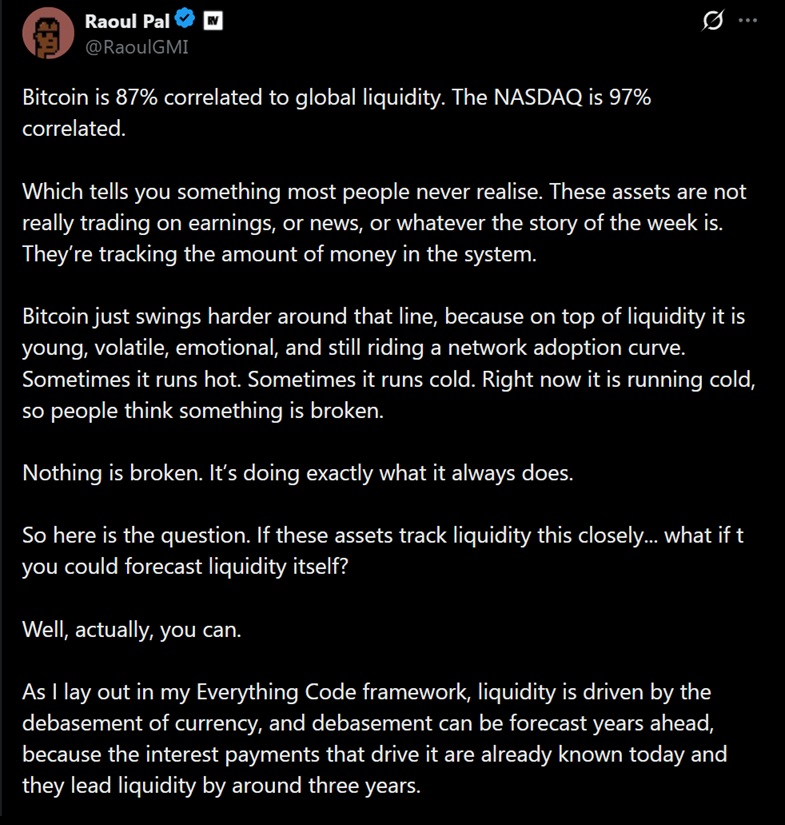
Pal, the founder of the financial media platform Real Vision and a former Goldman Sachs hedge fund manager, is one of the most authoritative macroeconomics experts in the cryptocurrency sphere, closely followed by many. For the past seven months, he has primarily argued that digital asset prices are determined by liquidity conditions, not fundamentals. In his post on X, Pal explained:

"Bitcoin is 87% correlated with global liquidity. The Nasdaq index is 97%. This reveals something most people never realize. These assets aren't actually trading based on earnings, news, or some event of the week. They are tracking the amount of money in the system."
Global liquidity refers to the total volume of funds available for injection into financial markets, typically measured by central bank balance sheets, the global M2 indicator (broad money supply), and growth in bank lending.

Analysts at crypto market maker Keyrock developed an eight-month lag model tracking how Treasury bill issuance affects Bitcoin's yield—this model supports Pal's claim of a correlation. The firm's net liquidity indicator, defined as the Federal Reserve's balance sheet minus Treasury cash balances and reverse repo operation balances, aims to isolate the amount of spending power actually entering markets at a given time.

A Familiar Theory, Updated Data

The figures cited by Pal build upon a position he elaborated on in May, when he told Real Vision viewers that Bitcoin maintains approximately a 90% correlation with the global money supply, arguing that governments' reliance on issuing short-term debt forces central banks to inject liquidity in a recurring cycle.

"Every four years there is a rollover of global debt, and central banks are forced to inject liquidity to avoid systemic collapse," Pal stated then. This thesis underpins his $450,000 Bitcoin price target, which he says is contingent on whether central banks can significantly expand liquidity by year-end.

An Even Tighter Correlation with the Nasdaq

An even more striking figure in Pal's post may be the 97% correlation he assigned to the Nasdaq—the U.S. stock index dominated by technology companies. Such a tight correlation suggests Bitcoin and mega-cap tech stocks are now trading as near-identical indicators of the same liquidity conditions, rather than distinct asset classes reacting to different catalysts. This stance contradicts the notion that Bitcoin trades primarily driven by its own supply dynamics, halving cycles, or adoption news.

Pal is not alone in making this argument: MicroStrategy (Nasdaq: MSTR) Executive Chairman Michael Saylor stated earlier this month that the traditional four-year Bitcoin cycle defined by halving "is no longer the dominant model," pointing instead to ETF inflows, corporate treasury Bitcoin accumulation, sovereign reserves, and global liquidity conditions as more significant drivers. He added:

Over the next decade, Bitcoin's trajectory will be less determined by miner issuance and more by capital flows.

That said, neither Pal nor the correlation data cited in his post are accompanied by an original dataset or published methodology, and the strength of the relationship between Bitcoin and liquidity has fluctuated throughout 2026 as liquidity impulses have waxed and waned. Keyrock's own tracking shows Bitcoin's reaction to Treasury issuance lags by about eight months, meaning any current correlation metrics likely reflect liquidity conditions from several months ago, not in real-time.

The next major factor that could challenge the Real Vision founder's thesis will be whether central banks continue the balance sheet expansion he says is necessary to sustain his $450,000 target.


Trending Cryptos

Related Questions

QAccording to Raoul Pal, what does an 87% correlation between Bitcoin and global liquidity indicate about its price drivers?

AIt indicates that Bitcoin's price is predominantly driven by the amount of money available in the financial system (global liquidity) rather than by fundamentals, earnings, or news.

QWhat is meant by 'global liquidity' in the context of this article?

AGlobal liquidity refers to the total amount of cash available to flow into financial markets, typically measured by central bank balance sheets, the global M2 money supply, and growth in bank lending.

QHow does Michael Saylor's view on Bitcoin's price drivers relate to or differ from Raoul Pal's thesis?

AMichael Saylor's view aligns with Pal's thesis, as he also downplays the traditional four-year halving cycle. Saylor points to capital flows from ETFs, corporate treasury accumulation, sovereign reserves, and global liquidity conditions as more significant drivers, shifting focus from miner issuance.

QWhat is the significance of the 97% correlation figure Pal attributes to the Nasdaq index?

AIt suggests that Bitcoin and mega-cap tech stocks (represented by Nasdaq) are currently trading as almost identical indicators of the same liquidity conditions, not as separate asset classes reacting to different catalysts.

QWhat potential development does the article mention could undermine Raoul Pal's $450,000 Bitcoin price target?

AHis target depends on central banks significantly expanding liquidity. Therefore, if central banks do not continue expanding their balance sheets as he expects, it could undermine his price thesis.

Related Reads

Core Scientific Writes Off $41.9 Million to Accelerate Exit from Bitcoin Mining

Core Scientific reported a $41.9 million payment to terminate a contract with Block and its subsidiary Proto for the supply of Bitcoin mining chips. This move finalizes its exit from plans to grow its hash rate, shifting its business model entirely towards AI colocation. The agreement, announced in July 2024, was for 3nm chips providing roughly 15 EH/s of hash rate. Following the cancellation, Core Scientific stated it will no longer invest in new mining hardware to maintain or expand its cryptocurrency mining capacity. Instead, it will generate cash flow from its existing mining fleet while repurposing its data centers, potentially selling or decommissioning ASIC miners. In Q2 2026, revenue from AI colocation surged to $136.7 million from $10.6 million a year earlier, representing 83% of total revenue. In contrast, its own Bitcoin mining revenue fell 66% to $21.5 million. Quarterly Bitcoin production dropped 53% year-over-year. AI colocation capacity reached 437 MW by mid-July 2026, with CoreWeave accounting for all current hosting revenue and approximately 77% of Core Scientific's total revenue in H1 2026. The company also announced a partnership with AMD for up to 2.5 GW of potential data center capacity, with initial 15-year agreements for about 530 MW estimated to bring in over $14 billion in contract revenue. Total Q2 revenue grew to $164.2 million, while capital expenditures jumped to $797.5 million. As of June 30, 2026, the company reported long-term debt of $4.3 billion and free liquidity of $1.82 billion. The shift aligns with a broader industry trend of major Bitcoin miners accelerating a pivot to AI amid pressure on Bitcoin mining profitability.

cryptonews.ru27m ago

Core Scientific Writes Off $41.9 Million to Accelerate Exit from Bitcoin Mining

cryptonews.ru27m ago

Trading

Spot

Hot Articles

What is $BITCOIN

DIGITAL GOLD ($BITCOIN): A Comprehensive Analysis Introduction to DIGITAL GOLD ($BITCOIN) DIGITAL GOLD ($BITCOIN) is a blockchain-based project operating on the Solana network, which aims to combine the characteristics of traditional precious metals with the innovation of decentralized technologies. While it shares a name with Bitcoin, often referred to as “digital gold” due to its perception as a store of value, DIGITAL GOLD is a separate token designed to create a unique ecosystem within the Web3 landscape. Its goal is to position itself as a viable alternative digital asset, although specifics regarding its applications and functionalities are still developing. What is DIGITAL GOLD ($BITCOIN)? DIGITAL GOLD ($BITCOIN) is a cryptocurrency token explicitly designed for use on the Solana blockchain. In contrast to Bitcoin, which provides a widely recognized value storage role, this token appears to focus on broader applications and characteristics. Notable aspects include: Blockchain Infrastructure: The token is built on the Solana blockchain, known for its capacity to handle high-speed and low-cost transactions. Supply Dynamics: DIGITAL GOLD has a maximum supply capped at 100 quadrillion tokens (100P $BITCOIN), although details regarding its circulating supply are currently undisclosed. Utility: While precise functionalities are not explicitly outlined, there are indications that the token could be utilized for various applications, potentially involving decentralized applications (dApps) or asset tokenization strategies. Who is the Creator of DIGITAL GOLD ($BITCOIN)? At present, the identity of the creators and development team behind DIGITAL GOLD ($BITCOIN) remains unknown. This situation is typical among many innovative projects within the blockchain space, particularly those aligning with decentralized finance and meme coin phenomena. While such anonymity may foster a community-driven culture, it intensifies concerns about governance and accountability. Who are the Investors of DIGITAL GOLD ($BITCOIN)? The available information indicates that DIGITAL GOLD ($BITCOIN) does not have any known institutional backers or prominent venture capital investments. The project seems to operate on a peer-to-peer model focused on community support and adoption rather than traditional funding routes. Its activity and liquidity are primarily situated on decentralized exchanges (DEXs), such as PumpSwap, rather than established centralized trading platforms, further highlighting its grassroots approach. How DIGITAL GOLD ($BITCOIN) Works The operational mechanics of DIGITAL GOLD ($BITCOIN) can be elaborated on based on its blockchain design and network attributes: Consensus Mechanism: By leveraging Solana’s unique proof-of-history (PoH) combined with a proof-of-stake (PoS) model, the project ensures efficient transaction validation contributing to the network's high performance. Tokenomics: While specific deflationary mechanisms have not been extensively detailed, the vast maximum token supply implies that it may cater to microtransactions or niche use cases that are still to be defined. Interoperability: There exists the potential for integration with Solana’s broader ecosystem, including various decentralized finance (DeFi) platforms. However, the details regarding specific integrations remain unspecified. Timeline of Key Events Here is a timeline that highlights significant milestones concerning DIGITAL GOLD ($BITCOIN): 2023: The initial deployment of the token occurs on the Solana blockchain, marked by its contract address. 2024: DIGITAL GOLD gains visibility as it becomes available for trading on decentralized exchanges like PumpSwap, allowing users to trade it against SOL. 2025: The project witnesses sporadic trading activity and potential interest in community-led engagements, although no noteworthy partnerships or technical advancements have been documented as of yet. Critical Analysis Strengths Scalability: The underlying Solana infrastructure supports high transaction volumes, which could enhance the utility of $BITCOIN in various transaction scenarios. Accessibility: The potential low trading price per token could attract retail investors, facilitating wider participation due to fractional ownership opportunities. Risks Lack of Transparency: The absence of publicly known backers, developers, or an audit process may yield skepticism regarding the project's sustainability and trustworthiness. Market Volatility: The trading activity is heavily reliant on speculative behavior, which can result in significant price volatility and uncertainty for investors. Conclusion DIGITAL GOLD ($BITCOIN) emerges as an intriguing yet ambiguous project within the rapidly evolving Solana ecosystem. While it attempts to leverage the “digital gold” narrative, its departure from Bitcoin's established role as a store of value underscores the need for a clearer differentiation of its intended utility and governance structure. Future acceptance and adoption will likely depend on addressing the current opacity and defining its operational and economic strategies more explicitly. Note: This report encompasses synthesised information available as of October 2023, and developments may have transpired beyond the research period.

1.1k Total ViewsPublished 2025.05.13Updated 2025.05.13

What is $BITCOIN

Discussions

Welcome to the HTX Community. Here, you can stay informed about the latest platform developments and gain access to professional market insights. Users' opinions on the price of BTC (BTC) are presented below.

活动图片