El flujo de caja libre de Google se vuelve negativo por primera vez en Q2, aumenta el gasto de capital anual a un máximo de 205.000 millones de dólares y el negocio en la nube crece un 82%

链捕手Published on 2026-07-24Last updated on 2026-07-24

Abstract

Google (Alphabet) ha publicado sus resultados del segundo trimestre. La noticia principal es ambivalente: mientras que su negocio en la nube, Google Cloud, registró un crecimiento explosivo del 82% en ingresos, superando expectativas, la compañía reportó por primera vez en décadas un flujo de caja libre trimestral negativo (aproximadamente -59 mil millones de dólares). Este débito se debe a un fuerte aumento en gastos de capital (449 mil millones de dólares), destinados principalmente a infraestructura para IA. Como consecuencia, Alphabet elevó por segunda vez este año su guía de gastos de capital anuales, situándola ahora entre 1950 y 2050 mil millones de dólares. Esta intensificación de la inversión, que incluye emisiones de deuda y acciones por cerca de 1000 mil millones de dólares, generó preocupación en el mercado sobre la rentabilidad futura de estas apuestas, haciendo que las acciones cayeran. Por el lado positivo, Google Cloud alcanzó ingresos de 247,68 mil millones de dólares y su cartera de pedidos pendientes superó por primera vez los 5000 mil millones. El CEO Sundar Pichai destacó que la inversión en IA está remodelando toda la empresa, con un enfoque en el próximo modelo Gemini 4. Aunque los negocios publicitarios tradicionales siguen creciendo de forma estable, el equilibrio entre la carrera por el liderazgo en IA y la salud financiera será el foco clave de los inversores en los próximos trimestres.

Autores:Yang Chen, Long Yue
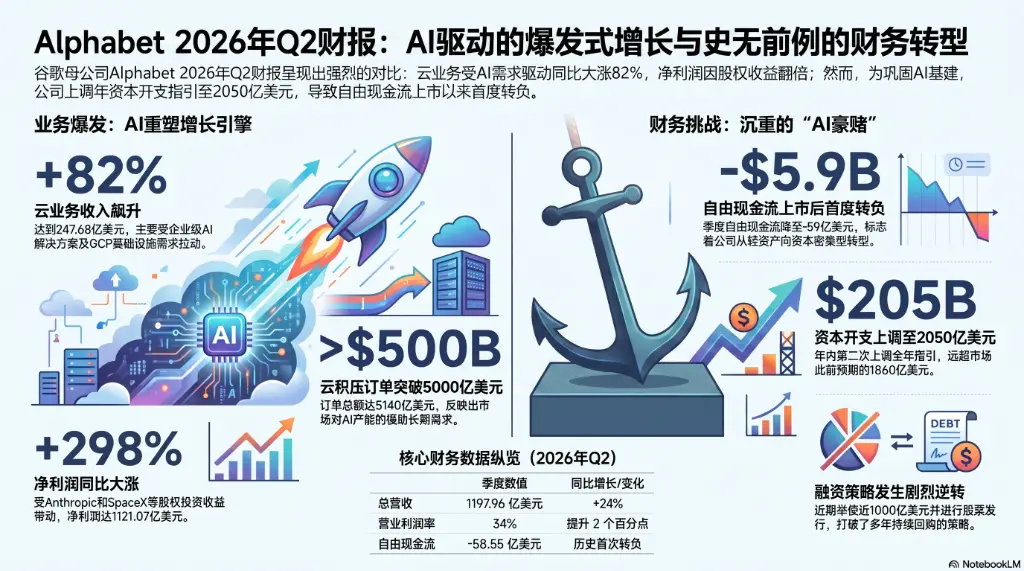
Alphabet, la matriz de Google, anunció sus resultados del segundo trimestre, en los que los ingresos del negocio en la nube superaron considerablemente las expectativas de Wall Street, y el cartera de pedidos pendientes de la nube superó por primera vez la barrera de los 500.000 millones de dólares.Sin embargo, el foco del mercado rápidamente se centró en otro aspecto: este es el primer trimestre en décadas desde que Google cotiza en bolsa en el que su flujo de caja libre se vuelve negativo, al mismo tiempo que la empresa aumentó por segunda vez este año su guía de gastos de capital anuales, lo que avivó de repente la preocupación de los inversores sobre si la gran apuesta por la IA traerá los retornos correspondientes.

En el segundo trimestre hasta el 30 de junio, Alphabet obtuvo unos ingresos de 119.796 millones de dólares, un aumento del 24% interanual; un crecimiento del 23% calculado a tipos de cambio constantes, logrando su decimosegundo trimestre consecutivo de crecimiento de ingresos de dos dígitos. El beneficio operativo aumentó un 30% interanual hasta los 40.770 millones de dólares, y el margen operativo mejoró 2 puntos porcentuales hasta el 34%.

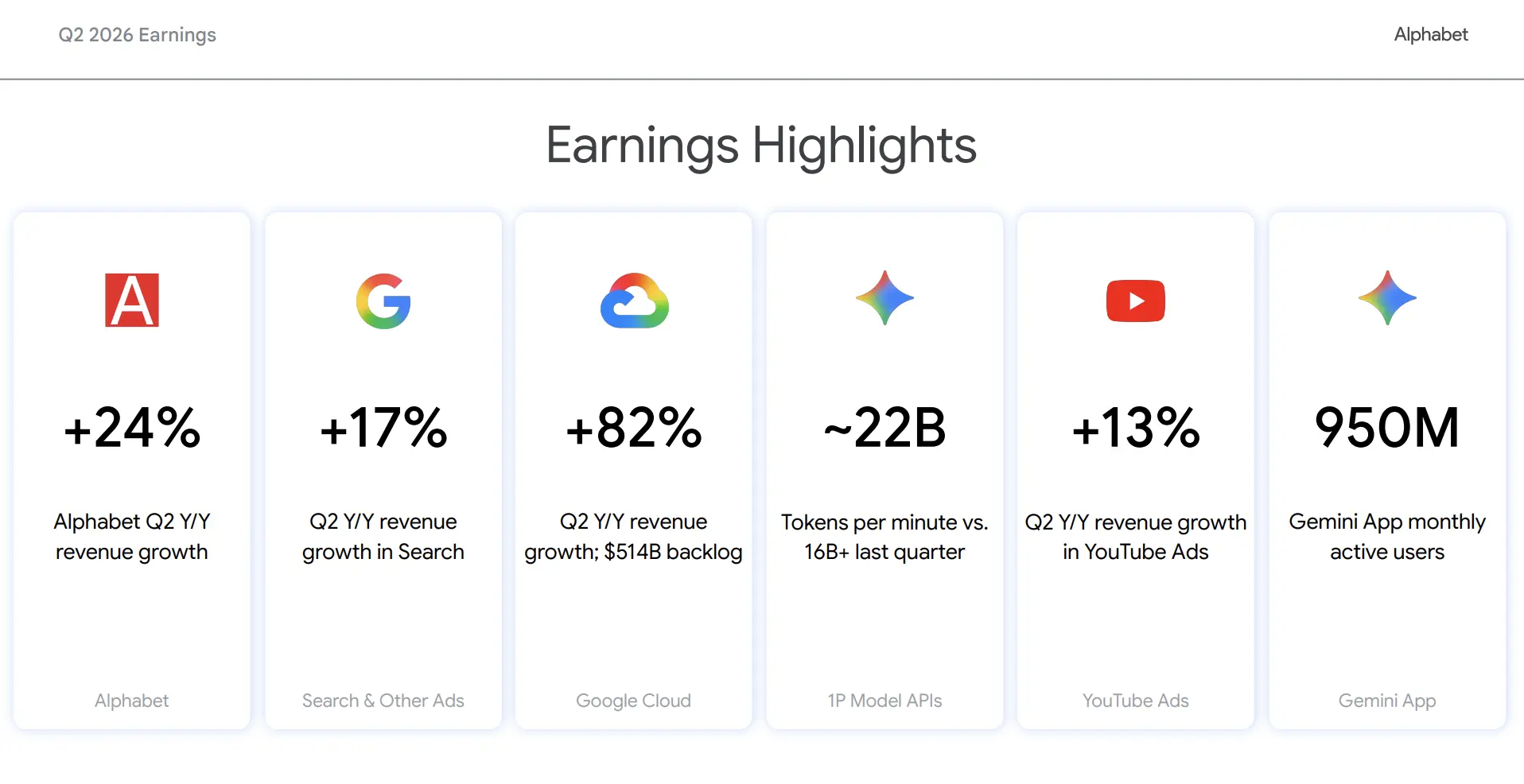
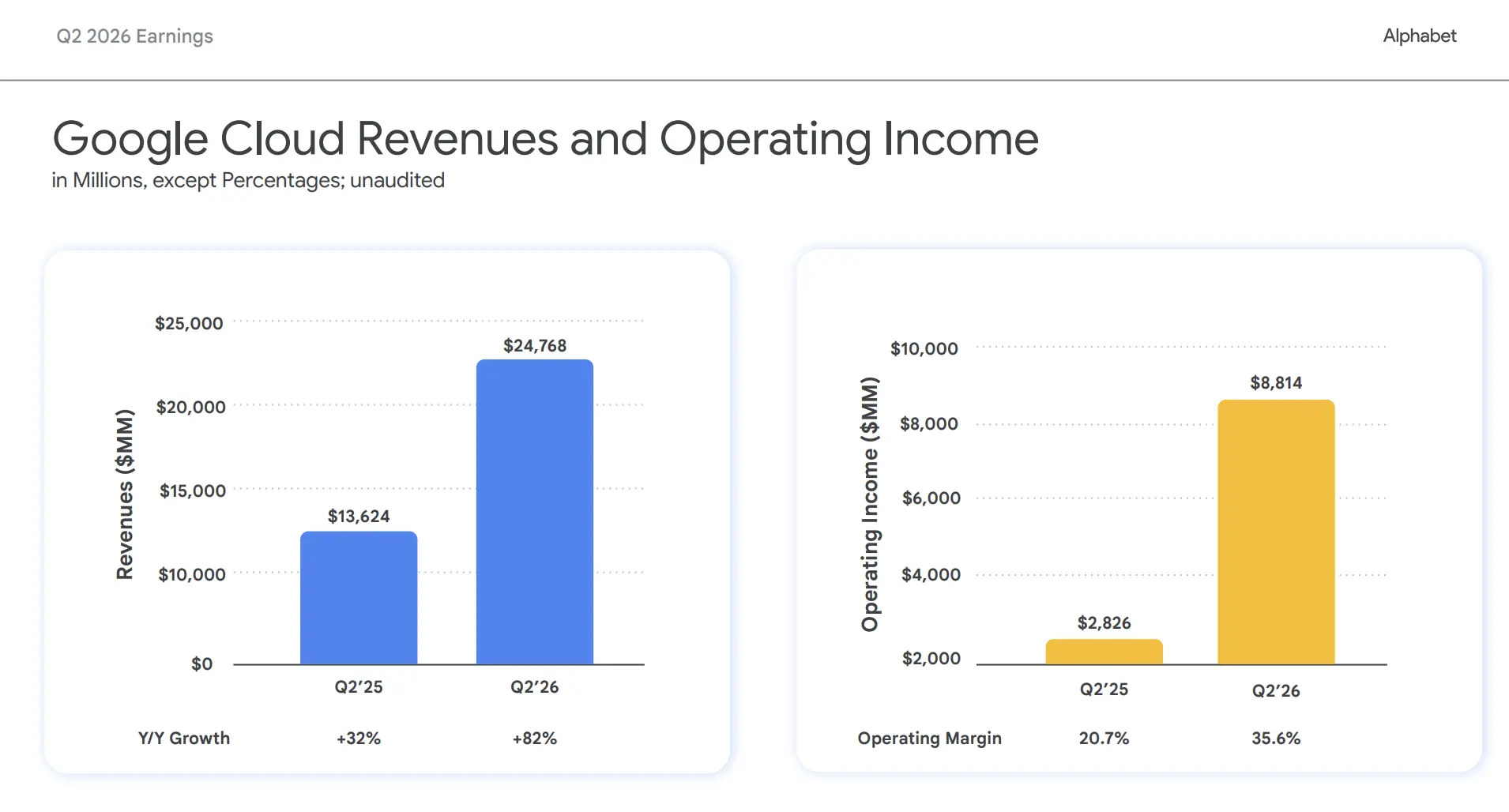
Entre ellos, los ingresos de Google Cloud alcanzaron los 24.768 millones de dólares, superando las expectativas del mercado de 22.460 millones, con un aumento espectacular del 82% interanual, marcando el ritmo de crecimiento más rápido en los últimos años, lo que muestra que la inversión en IA se está traduciendo continuamente en retornos comerciales. Los ingresos por publicidad en búsquedas fueron de 63.270 millones de dólares, ligeramente por debajo de las expectativas del mercado de 63.280 millones.

Alphabet posee participaciones en varias empresas, incluidas Anthropic y SpaceX, y debido a un aumento significativo en las ganancias no realizadas de valores de capital, los ingresos por inversiones del trimestre fueron de casi 100.000 millones de dólares, impulsando el beneficio neto atribuible a los accionistas ordinarios hasta los 112.107 millones de dólares, un aumento del 298% interanual.
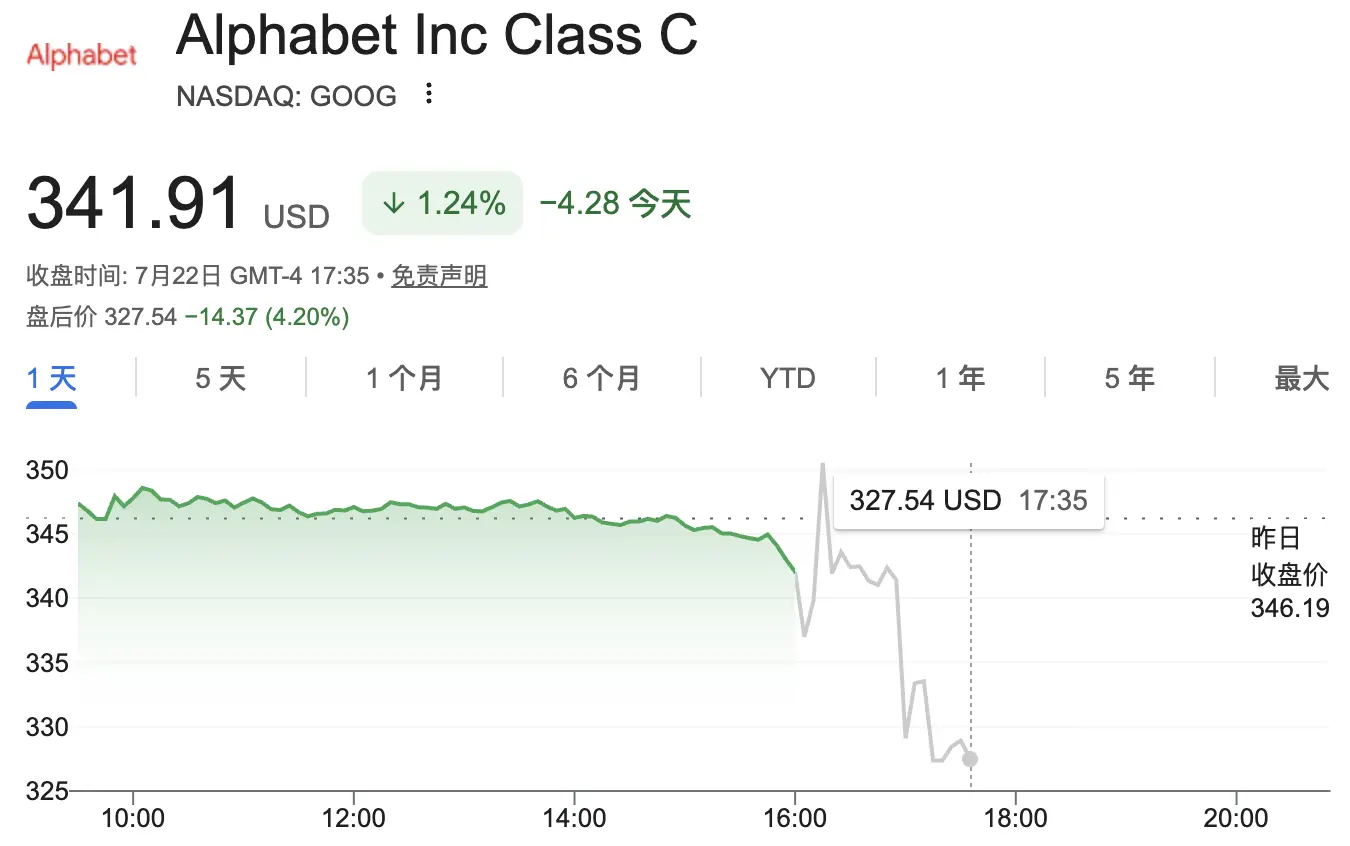
Tras la publicación de los resultados, las acciones de Google mostraron una ligera volatilidad. En la conferencia telefónica de resultados, Google aumentó su guía de gastos de capital anuales a un rango entre 195.000 y 205.000 millones de dólares, frente a una previsión anterior de 180.000-190.000 millones. Tras la publicación de la noticia, la preocupación del mercado sobre si los enormes gastos de capital traerán los retornos correspondientes hizo que las acciones de Google cayeran un 4,2%.
El flujo de caja libre se vuelve negativo por primera vez, y los gastos de capital se aumentan de nuevo

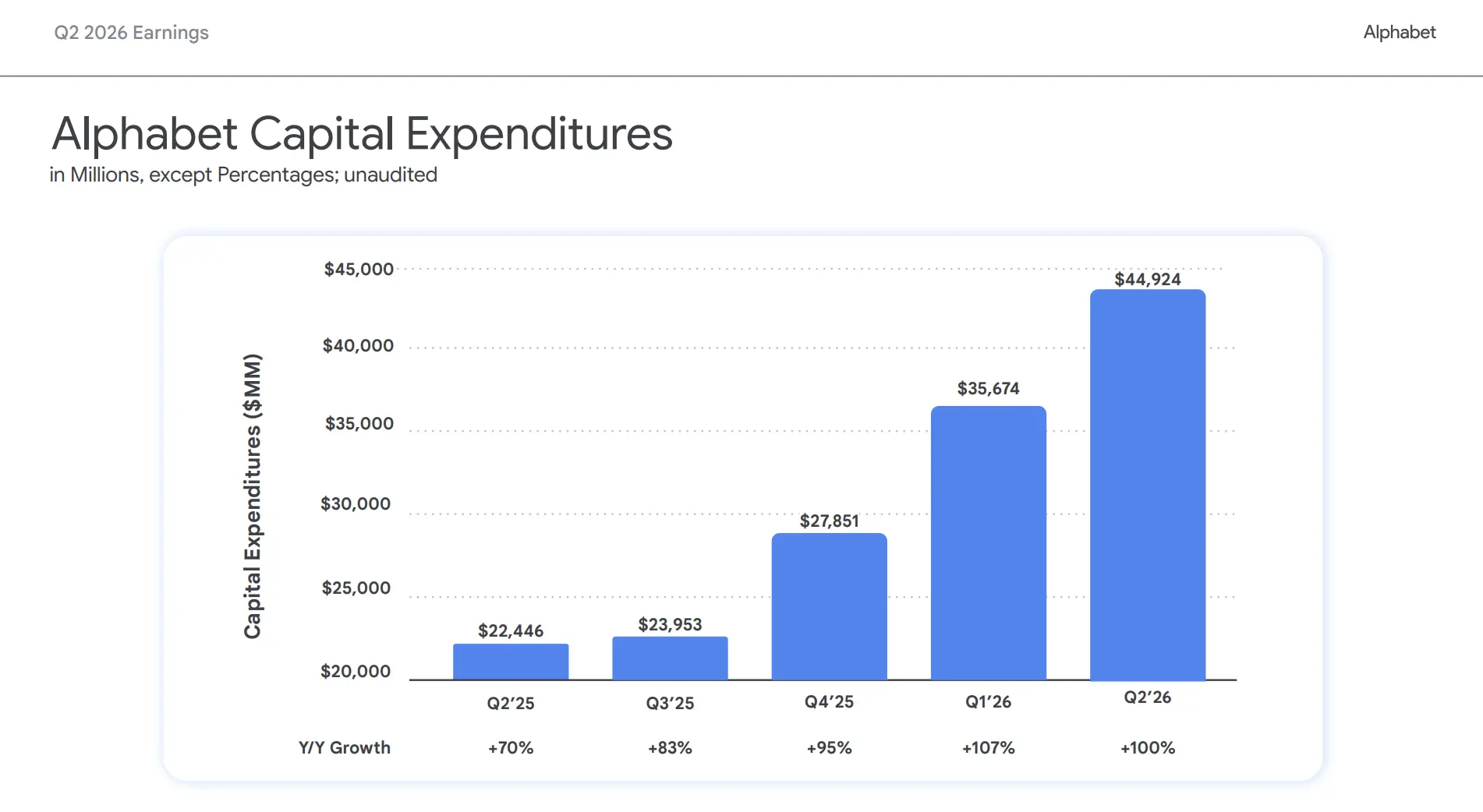
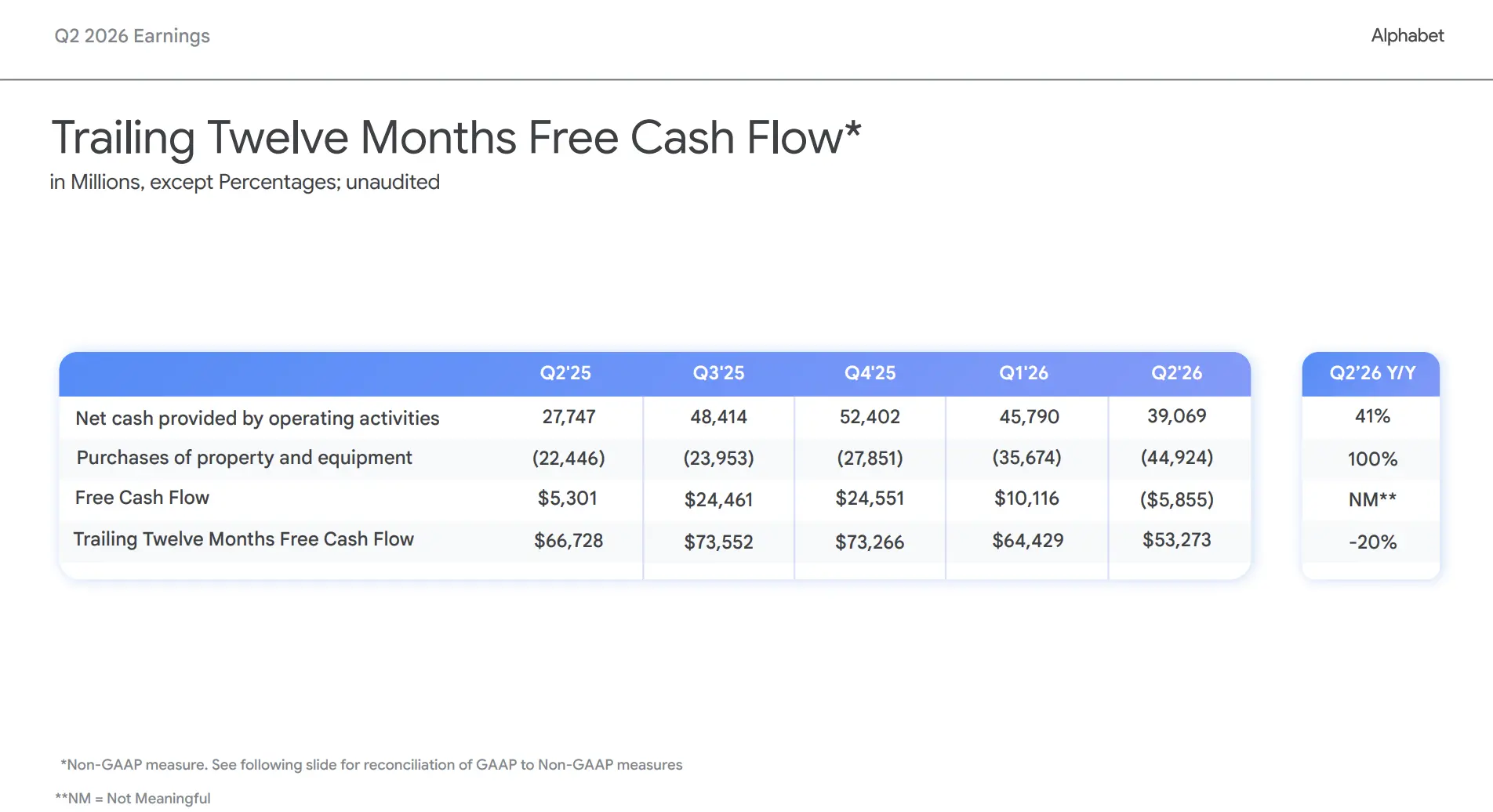
Los gastos de capital de Alphabet en el segundo trimestre alcanzaron los 44.924 millones de dólares, muy por encima de los 22.446 millones del mismo período del año pasado, lo que provocó directamente que el flujo de caja libre del trimestre se volviera negativo en -5.855 millones de dólares (aproximadamente -5.900 millones) —esta es la primera vez en décadas desde que Google cotiza en bolsa que su flujo de caja libre trimestral es negativo.

El flujo de caja libre es un indicador clave que mide el efectivo disponible para pagar deudas o recompensar a los accionistas después de cubrir los costes operativos y los gastos de capital, y siempre ha sido una métrica central de Wall Street para evaluar la salud financiera de las empresas tecnológicas.

En la conferencia telefónica de resultados, la directora financiera, Anat Ashkenazi, anunció que la guía de gastos de capital para todo 2026 se ha aumentado a un rango de 195.000 a 205.000 millones de dólares, por encima de la expectativa anterior de 180.000-190.000 millones, y también por encima de la previsión de los analistas de unos 186.000 millones. Esta es la segunda vez este año que Google aumenta su guía de gastos de capital —en abril de este año ya había aumentado la expectativa desde el nivel anterior hasta un máximo de 190.000 millones de dólares.

Ashkenazi declaró: "Esperamos que el flujo de caja libre continúe bajo presión, impulsado por nuestras inversiones en infraestructura tecnológica, que nos permiten aprovechar las oportunidades de la IA y generar continuamente retornos considerables."

Sin embargo, tras la publicación de la noticia, las acciones cayeron. La preocupación de los inversores radica en que Google se está transformando rápidamente de una empresa con activos ligeros a una empresa intensiva en capital. Para respaldar las enormes inversiones en infraestructura de IA, Alphabet ha recurrido recientemente a la deuda por cerca de 100.000 millones de dólares, y en junio completó su primera emisión de acciones en más de veinte años desde que cotiza en bolsa, recaudando netamente unos 85.000 millones de dólares —lo que contrasta marcadamente con la estrategia de recompras de acciones sostenidas durante años anteriores.

Thomas Monteiro, analista senior de Investing.com, afirmó directamente: "El nuevo aumento de los gastos de capital no es favorable para Alphabet. Sumado al entorno de tipos de interés al alza y a la continua tensión entre la oferta y la demanda de infraestructura de IA, la lógica de 'autogeneración de efectivo mediante el flujo de caja operativo' está empezando a tambalearse."

Sin embargo, Dec Mullarkey, director gerente de la empresa de gestión de activos SLC Management, mantiene una actitud relativamente optimista: "El mercado quiere ver a los gigantes de la nube luchando por el liderazgo en IA, pero no a costa de erosionar la rentabilidad. Por ahora, Alphabet todavía está manteniendo ese equilibrio."

Ashkenazi añadió que la empresa utilizará una combinación de flujo de caja operativo, financiación mediante deuda y capital para respaldar los gastos, y dejó claro que no realizará nuevas emisiones de acciones más allá de lo ya anunciado, al tiempo que enfatizó que mantendrá un balance sólido.

Google Cloud se convierte en el mayor motor de crecimiento

Desglosando por negocios, Google Cloud continuó siendo el negocio de más rápido crecimiento de Alphabet.

En el segundo trimestre, los ingresos de Google Cloud alcanzaron los 24.768 millones de dólares, un aumento del 82% interanual, acelerándose aún más respecto al trimestre anterior. La empresa indicó que el crecimiento provino principalmente de las soluciones de IA empresarial de Google Cloud Platform (GCP), la infraestructura de IA empresarial y la continua demanda de servicios básicos en la nube. Al mismo tiempo, el beneficio operativo de Google Cloud alcanzó los 8.814 millones de dólares, mejorando significativamente respecto a los 2.826 millones del mismo período del año pasado, mostrando una rentabilidad claramente fortalecida.

La cartera de pedidos pendientes del negocio en la nube (backlog, es decir, el valor contractual firmado pero aún no reconocido como ingreso) aumentó a 5,14 billones de dólares, expandiéndose aún más respecto a los aproximadamente 4,6 billones del trimestre anterior, superando por primera vez los 5 billones de dólares. La empresa indicó que más de la mitad de esto se espera que se reconozca como ingreso en los próximos 24 meses, y que la cartera de clientes abarca "una amplia mezcla de perfiles".

Monteiro afirmó que el desempeño superior a lo esperado del negocio en la nube al menos muestra claramente que la inversión en IA de la empresa se está "transformando en ingresos rentables de alto crecimiento, con contratos relevantes materializándose inmediatamente una vez que se construye la capacidad".

Aunque Google Cloud todavía está por detrás de Amazon AWS y Microsoft Azure, gracias a la fuerte demanda de infraestructura de IA por parte de empresas emergentes de IA y clientes corporativos, se ha convertido en uno de los negocios de más rápido crecimiento de Alphabet.
En comparación, el negocio publicitario tradicional mantuvo un crecimiento sólido:

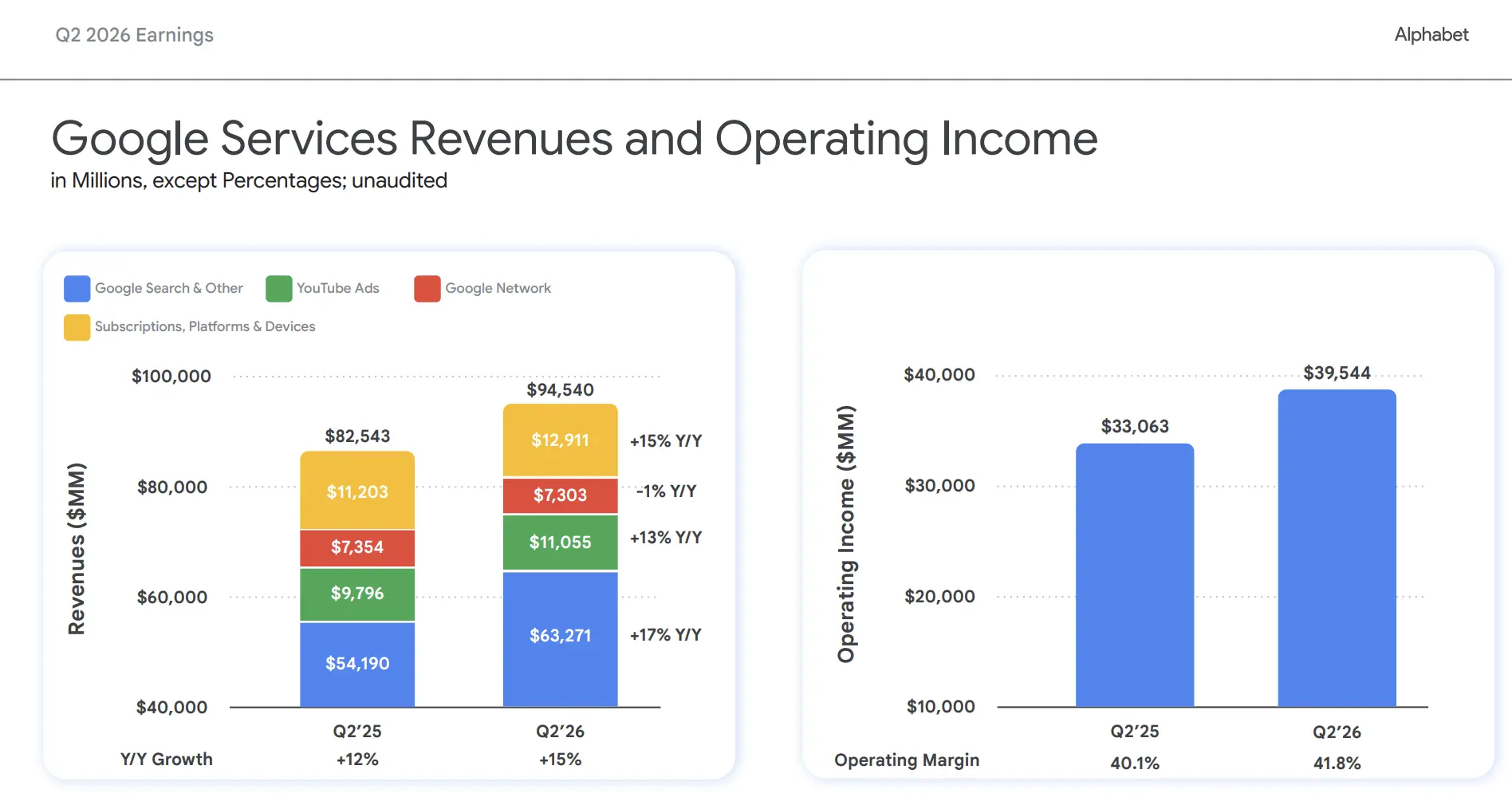
  • Los ingresos de Google Search y otros negocios fueron de 63.271 millones de dólares, un aumento del 17% interanual;
  • Los ingresos por publicidad en YouTube fueron de 11.055 millones de dólares, un aumento del 13% interanual; en cuanto a usuarios únicos mensuales de YouTube, durante la Copa Mundial 2026, más de 1.700 millones de usuarios únicos vieron videos relacionados a través de esta plataforma, impulsando aún más el crecimiento del tráfico;
  • Los ingresos del negocio de suscripciones, plataformas y dispositivos de Google fueron de 12.911 millones de dólares, un aumento del 15% interanual.

Los ingresos totales del negocio Google Services alcanzaron los 94.540 millones de dólares, un aumento del 15% interanual.
CEO: La inversión en IA está remodelando todo Google, centrándose en Gemini 4

El CEO de Alphabet, Sundar Pichai, declaró que la inversión en IA de la empresa está redefiniendo todo el negocio. Dijo a los inversores: "Sentimos que estamos en una etapa muy temprana de transformaciones estructurales a largo plazo en múltiples áreas... En el último año, nos hemos vuelto cada vez más optimistas sobre las oportunidades futuras."

Reveló que actualmente casi el 90% de las empresas del Fortune 100 utilizan Gemini Enterprise; el modelo Gemini procesa 22.000 millones de tokens de API por minuto, y la aplicación Gemini tiene 950 millones de usuarios activos mensuales. Nate Elliott, analista jefe de eMarketer, señaló: "Gemini está a solo un paso de convertirse en el tercer producto de IA de consumo de Google con mil millones de usuarios (junto con AI Overviews y AI Mode)."

En cuanto al roadmap de modelos, Pichai centró la atención en el próximo modelo insignia Gemini 4, al que describió como "el próximo modelo de frontera a mayor escala", y dijo que actualmente se están concentrando recursos computacionales para priorizar su entrenamiento, añadiendo que el ritmo de lanzamiento de modelos de Google se acelerará. El lanzamiento retrasado de Gemini 3.5 Pro anteriormente había generado dudas externas sobre la competitividad de Google en áreas como la programación de IA, donde Anthropic y OpenAI ya han obtenido ventajas evidentes entre la comunidad de desarrolladores.

Al mismo tiempo, las funciones de IA continúan impulsando el crecimiento en el volumen de consultas de búsqueda de Google, y la demanda de los productos de ciberseguridad de la empresa también se mantiene sólida, con el recién lanzado Gemini 3.5 Flash Cyber mostrando un rendimiento destacado en eficiencia de costes. Además, durante la Copa Mundial 2026, más de 1.700 millones de usuarios únicos vieron videos relacionados a través de YouTube, impulsando aún más el crecimiento del tráfico de la plataforma.

Pichai afirmó que la "estrategia de IA integral diferenciada" de la empresa continúa creando valor comercial cuantificable para consumidores, clientes empresariales y socios.

Aumentando continuamente la infraestructura de IA

Para satisfacer la creciente demanda de capacidad de computación para IA, Alphabet intensificó su financiación en el segundo trimestre.

En junio, la empresa completó la emisión de acciones de Clase A, Clase C y acciones preferentes convertibles forzosas, recaudando netamente 49.600 millones de dólares; al mismo tiempo, emitió bonos senior no garantizados por 20.300 millones de dólares; además, estableció un programa de emisión de acciones ATM (mercado de colocación continua) de hasta 40.000 millones de dólares, que al cierre del segundo trimestre aún no se había activado. Estas medidas han llevado a que Alphabet haya acumulado recientemente deuda por cerca de 1 billón de dólares.
Debido al aumento significativo de los gastos de capital, el flujo de caja libre del trimestre se volvió negativo en -5.855 millones de dólares, pero el flujo de caja libre de los últimos 12 meses aún alcanzó los 53.273 millones de dólares. Al mismo tiempo, se estima que los gastos de capital combinados de los cuatro gigantes de la nube (Google, Meta, Microsoft, Amazon) para 2026 superarán los 725.000 millones de dólares, y el flujo de caja libre de toda la industria tecnológica ha caído a su nivel más bajo en una década.
En general, estos resultados presentan una marcada "dualidad": el crecimiento explosivo del negocio en la nube y una cartera de pedidos pendientes que supera los 5 billones de dólares confirman que la inversión en IA está comenzando a generar retornos comerciales; pero el flujo de caja libre volviéndose negativo por primera vez y el segundo aumento de gastos de capital en el año mantienen al mercado en alto estado de alerta sobre la sostenibilidad de esta carrera armamentística de IA. La capacidad de Google para mantener continuamente el equilibrio entre competir por el liderazgo en IA y preservar la salud financiera será la cuestión central que más preocupará a los inversores en los próximos trimestres.


Trending Cryptos

Related Questions

Q¿Cuál es un hito histórico negativo que Alphabet, la matriz de Google, reportó en su flujo de caja libre para el segundo trimestre?

AAlphabet reportó un flujo de caja libre negativo de -58.55 mil millones de dólares (aproximadamente -59 mil millones) para el segundo trimestre. Este es el primer trimestre en varias décadas desde que Google cotiza en bolsa en que su flujo de caja libre es negativo.

Q¿Cuál fue la nueva guía de gastos de capital anual que Alphabet anunció, y qué tan significativo es este cambio?

AAlphabet elevó su guía de gastos de capital para todo el año 2026 a un rango de 195,000 a 205,000 millones de dólares. Esto supone un aumento con respecto a la previsión anterior de 180,000-190,000 millones de dólares y marca la segunda vez este año que la compañía incrementa esta guía.

Q¿Qué tan rápido crecieron los ingresos de Google Cloud en el segundo trimestre y cuál es el valor de su cartera de pedidos pendientes (backlog)?

ALos ingresos de Google Cloud crecieron un 82% interanual en el segundo trimestre, alcanzando los 24,768 millones de dólares. Además, su cartera de pedidos pendientes (backlog) superó por primera vez la marca de los 500,000 millones de dólares, situándose en 514,000 millones.

Q¿Qué medidas de financiación recientes ha tomado Alphabet para respaldar sus masivas inversiones en infraestructura de IA?

APara financiar sus inversiones en IA, Alphabet realizó recientemente una emisión de acciones que recaudó aproximadamente 49,600 millones de dólares netos, emitió bonos por 20,300 millones de dólares y tiene un plan de emisión de acciones (ATM) autorizado por hasta 40,000 millones de dólares. En total, estas medidas han elevado su endeudamiento reciente a cerca de 100,000 millones de dólares.

Q¿Cómo describió el CEO Sundar Pichai el impacto de las inversiones en IA y en qué modelo se centra ahora el desarrollo futuro?

AEl CEO Sundar Pichai declaró que las inversiones en IA están redefiniendo todo el negocio de Google y que se encuentran en 'etapas muy tempranas de múltiples cambios estructurales a largo plazo'. Para el futuro, el enfoque se ha desplazado al desarrollo del próximo modelo insignia, Gemini 4, al que se refirió como el 'próximo modelo frontera a mayor escala'.

Related Reads

Trading

Spot

Hot Articles

What is SONIC

Sonic: Pioneering the Future of Gaming in Web3 Introduction to Sonic In the ever-evolving landscape of Web3, the gaming industry stands out as one of the most dynamic and promising sectors. At the forefront of this revolution is Sonic, a project designed to amplify the gaming ecosystem on the Solana blockchain. Leveraging cutting-edge technology, Sonic aims to deliver an unparalleled gaming experience by efficiently processing millions of requests per second, ensuring that players enjoy seamless gameplay while maintaining low transaction costs. This article delves into the intricate details of Sonic, exploring its creators, funding sources, operational mechanics, and the timeline of significant events that have shaped its journey. What is Sonic? Sonic is an innovative layer-2 network that operates atop the Solana blockchain, specifically tailored to enhance the existing Solana gaming ecosystem. It accomplishes this through a customised, VM-agnostic game engine paired with a HyperGrid interpreter, facilitating sovereign game economies that roll up back to the Solana platform. The primary goals of Sonic include: Enhanced Gaming Experiences: Sonic is committed to offering lightning-fast on-chain gameplay, allowing players and developers to engage with games at previously unattainable speeds. Atomic Interoperability: This feature enables transactions to be executed within Sonic without the need to redeploy Solana programmes and accounts. This makes the process more efficient and directly benefits from Solana Layer1 services and liquidity. Seamless Deployment: Sonic allows developers to write for Ethereum Virtual Machine (EVM) based systems and execute them on Solana’s SVM infrastructure. This interoperability is crucial for attracting a broader range of dApps and decentralised applications to the platform. Support for Developers: By offering native composable gaming primitives and extensible data types - dining within the Entity-Component-System (ECS) framework - game creators can craft intricate business logic with ease. Overall, Sonic's unique approach not only caters to players but also provides an accessible and low-cost environment for developers to innovate and thrive. Creator of Sonic The information regarding the creator of Sonic is somewhat ambiguous. However, it is known that Sonic's SVM is owned by the company Mirror World. The absence of detailed information about the individuals behind Sonic reflects a common trend in several Web3 projects, where collective efforts and partnerships often overshadow individual contributions. Investors of Sonic Sonic has garnered considerable attention and support from various investors within the crypto and gaming sectors. Notably, the project raised an impressive $12 million during its Series A funding round. The round was led by BITKRAFT Ventures, with other notable investors including Galaxy, Okx Ventures, Interactive, Big Brain Holdings, and Mirana. This financial backing signifies the confidence that investment foundations have in Sonic’s potential to revolutionise the Web3 gaming landscape, further validating its innovative approaches and technologies. How Does Sonic Work? Sonic utilises the HyperGrid framework, a sophisticated parallel processing mechanism that enhances its scalability and customisability. Here are the core features that set Sonic apart: Lightning Speed at Low Costs: Sonic offers one of the fastest on-chain gaming experiences compared to other Layer-1 solutions, powered by the scalability of Solana’s virtual machine (SVM). Atomic Interoperability: Sonic enables transaction execution without redeployment of Solana programmes and accounts, effectively streamlining the interaction between users and the blockchain. EVM Compatibility: Developers can effortlessly migrate decentralised applications from EVM chains to the Solana environment using Sonic’s HyperGrid interpreter, increasing the accessibility and integration of various dApps. Ecosystem Support for Developers: By exposing native composable gaming primitives, Sonic facilitates a sandbox-like environment where developers can experiment and implement business logic, greatly enhancing the overall development experience. Monetisation Infrastructure: Sonic natively supports growth and monetisation efforts, providing frameworks for traffic generation, payments, and settlements, thereby ensuring that gaming projects are not only viable but also sustainable financially. Timeline of Sonic The evolution of Sonic has been marked by several key milestones. Below is a brief timeline highlighting critical events in the project's history: 2022: The Sonic cryptocurrency was officially launched, marking the beginning of its journey in the Web3 gaming arena. 2024: June: Sonic SVM successfully raised $12 million in a Series A funding round. This investment allowed Sonic to further develop its platform and expand its offerings. August: The launch of the Sonic Odyssey testnet provided users with the first opportunity to engage with the platform, offering interactive activities such as collecting rings—a nod to gaming nostalgia. October: SonicX, an innovative crypto game integrated with Solana, made its debut on TikTok, capturing the attention of over 120,000 users within a short span. This integration illustrated Sonic’s commitment to reaching a broader, global audience and showcased the potential of blockchain gaming. Key Points Sonic SVM is a revolutionary layer-2 network on Solana explicitly designed to enhance the GameFi landscape, demonstrating great potential for future development. HyperGrid Framework empowers Sonic by introducing horizontal scaling capabilities, ensuring that the network can handle the demands of Web3 gaming. Integration with Social Platforms: The successful launch of SonicX on TikTok displays Sonic’s strategy to leverage social media platforms to engage users, exponentially increasing the exposure and reach of its projects. Investment Confidence: The substantial funding from BITKRAFT Ventures, among others, emphasizes the robust backing Sonic has, paving the way for its ambitious future. In conclusion, Sonic encapsulates the essence of Web3 gaming innovation, striking a balance between cutting-edge technology, developer-centric tools, and community engagement. As the project continues to evolve, it is poised to redefine the gaming landscape, making it a notable entity for gamers and developers alike. As Sonic moves forward, it will undoubtedly attract greater interest and participation, solidifying its place within the broader narrative of blockchain gaming.

2.1k Total ViewsPublished 2024.04.04Updated 2024.12.03

What is SONIC

What is $S$

Understanding SPERO: A Comprehensive Overview Introduction to SPERO As the landscape of innovation continues to evolve, the emergence of web3 technologies and cryptocurrency projects plays a pivotal role in shaping the digital future. One project that has garnered attention in this dynamic field is SPERO, denoted as SPERO,$$s$. This article aims to gather and present detailed information about SPERO, to help enthusiasts and investors understand its foundations, objectives, and innovations within the web3 and crypto domains. What is SPERO,$$s$? SPERO,$$s$ is a unique project within the crypto space that seeks to leverage the principles of decentralisation and blockchain technology to create an ecosystem that promotes engagement, utility, and financial inclusion. The project is tailored to facilitate peer-to-peer interactions in new ways, providing users with innovative financial solutions and services. At its core, SPERO,$$s$ aims to empower individuals by providing tools and platforms that enhance user experience in the cryptocurrency space. This includes enabling more flexible transaction methods, fostering community-driven initiatives, and creating pathways for financial opportunities through decentralised applications (dApps). The underlying vision of SPERO,$$s$ revolves around inclusiveness, aiming to bridge gaps within traditional finance while harnessing the benefits of blockchain technology. Who is the Creator of SPERO,$$s$? The identity of the creator of SPERO,$$s$ remains somewhat obscure, as there are limited publicly available resources providing detailed background information on its founder(s). This lack of transparency can stem from the project's commitment to decentralisation—an ethos that many web3 projects share, prioritising collective contributions over individual recognition. By centring discussions around the community and its collective goals, SPERO,$$s$ embodies the essence of empowerment without singling out specific individuals. As such, understanding the ethos and mission of SPERO remains more important than identifying a singular creator. Who are the Investors of SPERO,$$s$? SPERO,$$s$ is supported by a diverse array of investors ranging from venture capitalists to angel investors dedicated to fostering innovation in the crypto sector. The focus of these investors generally aligns with SPERO's mission—prioritising projects that promise societal technological advancement, financial inclusivity, and decentralised governance. These investor foundations are typically interested in projects that not only offer innovative products but also contribute positively to the blockchain community and its ecosystems. The backing from these investors reinforces SPERO,$$s$ as a noteworthy contender in the rapidly evolving domain of crypto projects. How Does SPERO,$$s$ Work? SPERO,$$s$ employs a multi-faceted framework that distinguishes it from conventional cryptocurrency projects. Here are some of the key features that underline its uniqueness and innovation: Decentralised Governance: SPERO,$$s$ integrates decentralised governance models, empowering users to participate actively in decision-making processes regarding the project’s future. This approach fosters a sense of ownership and accountability among community members. Token Utility: SPERO,$$s$ utilises its own cryptocurrency token, designed to serve various functions within the ecosystem. These tokens enable transactions, rewards, and the facilitation of services offered on the platform, enhancing overall engagement and utility. Layered Architecture: The technical architecture of SPERO,$$s$ supports modularity and scalability, allowing for seamless integration of additional features and applications as the project evolves. This adaptability is paramount for sustaining relevance in the ever-changing crypto landscape. Community Engagement: The project emphasises community-driven initiatives, employing mechanisms that incentivise collaboration and feedback. By nurturing a strong community, SPERO,$$s$ can better address user needs and adapt to market trends. Focus on Inclusion: By offering low transaction fees and user-friendly interfaces, SPERO,$$s$ aims to attract a diverse user base, including individuals who may not previously have engaged in the crypto space. This commitment to inclusion aligns with its overarching mission of empowerment through accessibility. Timeline of SPERO,$$s$ Understanding a project's history provides crucial insights into its development trajectory and milestones. Below is a suggested timeline mapping significant events in the evolution of SPERO,$$s$: Conceptualisation and Ideation Phase: The initial ideas forming the basis of SPERO,$$s$ were conceived, aligning closely with the principles of decentralisation and community focus within the blockchain industry. Launch of Project Whitepaper: Following the conceptual phase, a comprehensive whitepaper detailing the vision, goals, and technological infrastructure of SPERO,$$s$ was released to garner community interest and feedback. Community Building and Early Engagements: Active outreach efforts were made to build a community of early adopters and potential investors, facilitating discussions around the project’s goals and garnering support. Token Generation Event: SPERO,$$s$ conducted a token generation event (TGE) to distribute its native tokens to early supporters and establish initial liquidity within the ecosystem. Launch of Initial dApp: The first decentralised application (dApp) associated with SPERO,$$s$ went live, allowing users to engage with the platform's core functionalities. Ongoing Development and Partnerships: Continuous updates and enhancements to the project's offerings, including strategic partnerships with other players in the blockchain space, have shaped SPERO,$$s$ into a competitive and evolving player in the crypto market. Conclusion SPERO,$$s$ stands as a testament to the potential of web3 and cryptocurrency to revolutionise financial systems and empower individuals. With a commitment to decentralised governance, community engagement, and innovatively designed functionalities, it paves the way toward a more inclusive financial landscape. As with any investment in the rapidly evolving crypto space, potential investors and users are encouraged to research thoroughly and engage thoughtfully with the ongoing developments within SPERO,$$s$. The project showcases the innovative spirit of the crypto industry, inviting further exploration into its myriad possibilities. While the journey of SPERO,$$s$ is still unfolding, its foundational principles may indeed influence the future of how we interact with technology, finance, and each other in interconnected digital ecosystems.

229 Total ViewsPublished 2024.12.17Updated 2024.12.17

What is $S$

What is AGENT S

Agent S: The Future of Autonomous Interaction in Web3 Introduction In the ever-evolving landscape of Web3 and cryptocurrency, innovations are constantly redefining how individuals interact with digital platforms. One such pioneering project, Agent S, promises to revolutionise human-computer interaction through its open agentic framework. By paving the way for autonomous interactions, Agent S aims to simplify complex tasks, offering transformative applications in artificial intelligence (AI). This detailed exploration will delve into the project's intricacies, its unique features, and the implications for the cryptocurrency domain. What is Agent S? Agent S stands as a groundbreaking open agentic framework, specifically designed to tackle three fundamental challenges in the automation of computer tasks: Acquiring Domain-Specific Knowledge: The framework intelligently learns from various external knowledge sources and internal experiences. This dual approach empowers it to build a rich repository of domain-specific knowledge, enhancing its performance in task execution. Planning Over Long Task Horizons: Agent S employs experience-augmented hierarchical planning, a strategic approach that facilitates efficient breakdown and execution of intricate tasks. This feature significantly enhances its ability to manage multiple subtasks efficiently and effectively. Handling Dynamic, Non-Uniform Interfaces: The project introduces the Agent-Computer Interface (ACI), an innovative solution that enhances the interaction between agents and users. Utilizing Multimodal Large Language Models (MLLMs), Agent S can navigate and manipulate diverse graphical user interfaces seamlessly. Through these pioneering features, Agent S provides a robust framework that addresses the complexities involved in automating human interaction with machines, setting the stage for myriad applications in AI and beyond. Who is the Creator of Agent S? While the concept of Agent S is fundamentally innovative, specific information about its creator remains elusive. The creator is currently unknown, which highlights either the nascent stage of the project or the strategic choice to keep founding members under wraps. Regardless of anonymity, the focus remains on the framework's capabilities and potential. Who are the Investors of Agent S? As Agent S is relatively new in the cryptographic ecosystem, detailed information regarding its investors and financial backers is not explicitly documented. The lack of publicly available insights into the investment foundations or organisations supporting the project raises questions about its funding structure and development roadmap. Understanding the backing is crucial for gauging the project's sustainability and potential market impact. How Does Agent S Work? At the core of Agent S lies cutting-edge technology that enables it to function effectively in diverse settings. Its operational model is built around several key features: Human-like Computer Interaction: The framework offers advanced AI planning, striving to make interactions with computers more intuitive. By mimicking human behaviour in tasks execution, it promises to elevate user experiences. Narrative Memory: Employed to leverage high-level experiences, Agent S utilises narrative memory to keep track of task histories, thereby enhancing its decision-making processes. Episodic Memory: This feature provides users with step-by-step guidance, allowing the framework to offer contextual support as tasks unfold. Support for OpenACI: With the ability to run locally, Agent S allows users to maintain control over their interactions and workflows, aligning with the decentralised ethos of Web3. Easy Integration with External APIs: Its versatility and compatibility with various AI platforms ensure that Agent S can fit seamlessly into existing technological ecosystems, making it an appealing choice for developers and organisations. These functionalities collectively contribute to Agent S's unique position within the crypto space, as it automates complex, multi-step tasks with minimal human intervention. As the project evolves, its potential applications in Web3 could redefine how digital interactions unfold. Timeline of Agent S The development and milestones of Agent S can be encapsulated in a timeline that highlights its significant events: September 27, 2024: The concept of Agent S was launched in a comprehensive research paper titled “An Open Agentic Framework that Uses Computers Like a Human,” showcasing the groundwork for the project. October 10, 2024: The research paper was made publicly available on arXiv, offering an in-depth exploration of the framework and its performance evaluation based on the OSWorld benchmark. October 12, 2024: A video presentation was released, providing a visual insight into the capabilities and features of Agent S, further engaging potential users and investors. These markers in the timeline not only illustrate the progress of Agent S but also indicate its commitment to transparency and community engagement. Key Points About Agent S As the Agent S framework continues to evolve, several key attributes stand out, underscoring its innovative nature and potential: Innovative Framework: Designed to provide an intuitive use of computers akin to human interaction, Agent S brings a novel approach to task automation. Autonomous Interaction: The ability to interact autonomously with computers through GUI signifies a leap towards more intelligent and efficient computing solutions. Complex Task Automation: With its robust methodology, it can automate complex, multi-step tasks, making processes faster and less error-prone. Continuous Improvement: The learning mechanisms enable Agent S to improve from past experiences, continually enhancing its performance and efficacy. Versatility: Its adaptability across different operating environments like OSWorld and WindowsAgentArena ensures that it can serve a broad range of applications. As Agent S positions itself in the Web3 and crypto landscape, its potential to enhance interaction capabilities and automate processes signifies a significant advancement in AI technologies. Through its innovative framework, Agent S exemplifies the future of digital interactions, promising a more seamless and efficient experience for users across various industries. Conclusion Agent S represents a bold leap forward in the marriage of AI and Web3, with the capacity to redefine how we interact with technology. While still in its early stages, the possibilities for its application are vast and compelling. Through its comprehensive framework addressing critical challenges, Agent S aims to bring autonomous interactions to the forefront of the digital experience. As we move deeper into the realms of cryptocurrency and decentralisation, projects like Agent S will undoubtedly play a crucial role in shaping the future of technology and human-computer collaboration.

894 Total ViewsPublished 2025.01.14Updated 2025.01.14

What is AGENT S

Discussions

Welcome to the HTX Community. Here, you can stay informed about the latest platform developments and gain access to professional market insights. Users' opinions on the price of S (S) are presented below.

活动图片