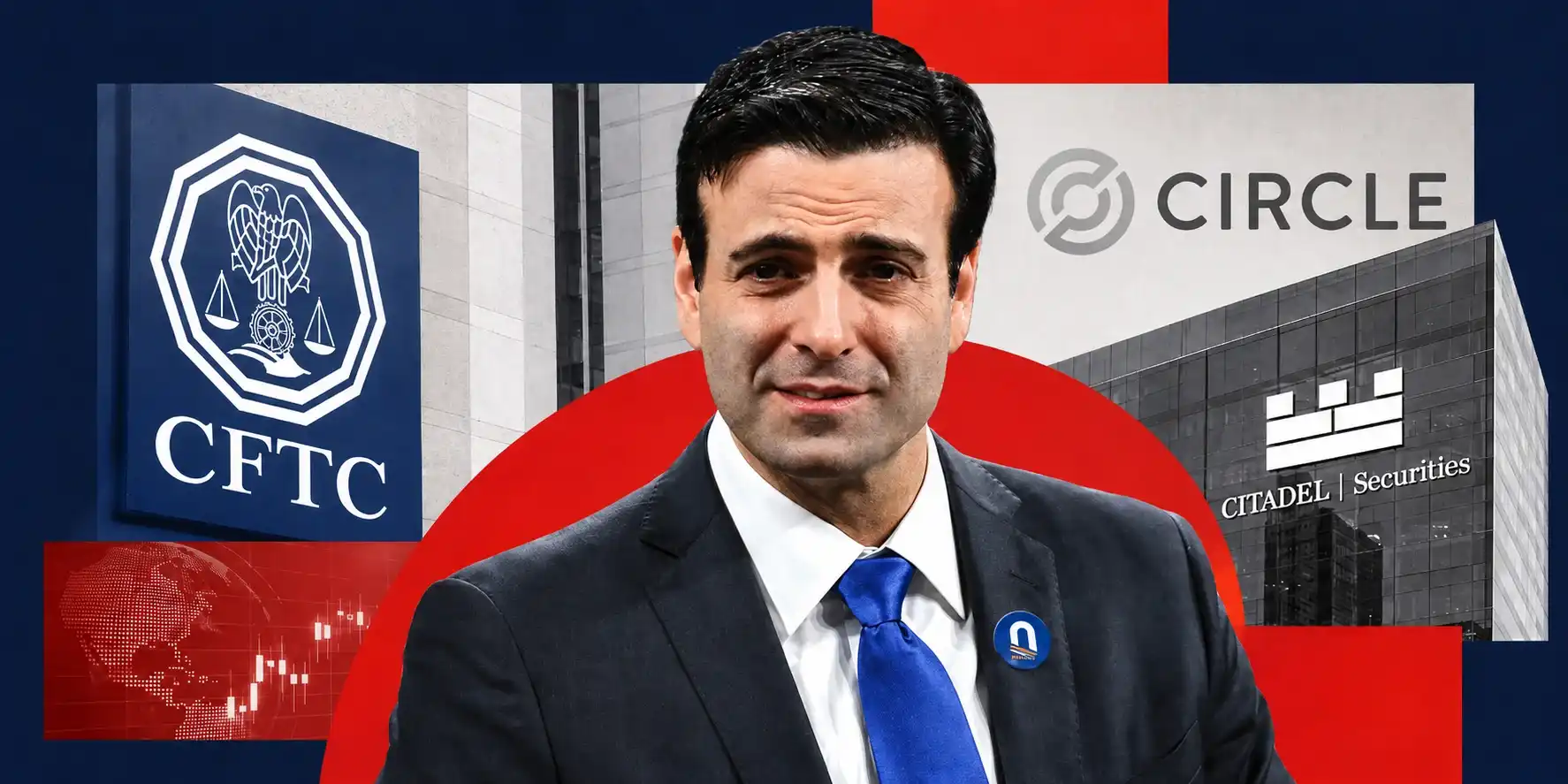
Ancien président de la CFTC et président de Circle, Tarbert : Vous prêche le long terme tout en réalisant lui-même 30 millions de dollars

marsbitPublished on 2026-07-22Last updated on 2026-07-22

Abstract

L'ancien président de la CFTC et actuel président de Circle, Heath Tarbert, a conseillé aux investisseurs de privilégier une vision à long terme alors que l'action de l'entreprise a chuté de 70 % par rapport à son sommet. Cependant, il a été révélé que depuis l'introduction en bourse de Circle, Tarbert a vendu des actions pour une valeur d'environ 30 millions de dollars via des plans de vente préétablis (10b5-1), sans jamais en acheter sur le marché public. Cette divergence entre son discours public et ses actions personnelles suscite des critiques. La carrière de Tarbert illustre le "pantalon tournant" entre la régulation et le secteur privé. Après avoir quitté la CFTC en mars 2021, il a rejoint Citadel Securities comme responsable juridique en seulement 27 jours, en pleine controverse GameStop. Plus tard, chez Circle, son rôle a été crucial pour naviguer dans le paysage réglementaire et faciliter l'IPO. Son parcours démontre une habileté à convertir son expertise réglementaire et son réseau en opportunités professionnelles lucratives dans le secteur financier, laissant aux investisseurs ordinaires le risque à long terme qu'il promeut verbalement.

Auteur : Zen, PANews

« Circle se concentre sur le développement à long terme et croit que le cours de l'action finira par donner la réponse. »

Face à la triste réalité d'une action ayant perdu 70 % par rapport à son sommet et d'une capitalisation boursière évaporée. Le 14 juillet, Heath Tarbert, ancien président de la CFTC et président de Circle, interrogé par FOX Business, a déclaré avec calme le point de vue ci-dessus lorsqu'on lui a demandé ce qu'il dirait aux investisseurs ayant acheté des actions Circle à son plus haut historique.

Mais la réalité est défavorable à Circle. Des analystes de Mizuho Securities USA LLC ont récemment abaissé la note de Circle de « Neutre » à « Sous-performant », fixant l'objectif de cours le plus bas de Wall Street à 50 dollars.

Face à la chute continue du cours, appeler les actionnaires ordinaires à opter pour le long terme et à faire preuve de patience fait effectivement partie du travail de Tarbert en tant que président. Cependant, lorsqu'il a été révélé qu'il avait continuellement vendu des actions CRCL depuis l'introduction en bourse de Circle, réalisant environ 30 millions de dollars au total sans jamais en avoir racheté, cette divergence extrême entre ses paroles et ses actes apparaît particulièrement ironique.

Monétisation frénétique, laissant le long terme aux marchés

Les portes tournantes entre politique et affaires sont un scénario classique pour les anciens responsables américains. En tant qu'ancien président de la CFTC favorable aux cryptomonnaies, Heath Tarbert a rejoint Circle en juillet 2023 en tant que directeur juridique et responsable des affaires institutionnelles. Son rôle était clairement d'utiliser son parcours couvrant le Trésor américain, la CFTC, la Maison Blanche et Wall Street pour aider Circle à dialoguer avec les régulateurs, accélérer la croissance et l'introduction en bourse, et favoriser l'intégration de l'USDC dans le système financier traditionnel.

Tarbert a lui-même déclaré qu'il appréciait l'approche « régulation d'abord » de Circle, souhaitant promouvoir des règles claires et cohérentes pour les actifs numériques. Début 2025, il a été promu premier président de Circle, supervisant les affaires juridiques, la conformité, les risques, les politiques publiques, la communication et l'expansion internationale.

D'après ses déclarations publiques, Tarbert a presque toujours été l'un des plus fervents promoteurs du récit du « long terme » de Circle. Il a répété que les stablecoins ne devraient pas être compris uniquement comme des outils de trading cryptographique, mais comme la prochaine génération d'infrastructures de paiement, de règlement et de finance internet. Les investissements actuels de Circle ne peuvent être mesurés simplement par les bénéfices à court terme ou les fluctuations du cours de l'action.

Mais sur la question de sa participation personnelle, il a mis en place, bien avant l'introduction en bourse de Circle, des arrangements radicalement différents de ses positions publiques. Le 4 juin 2025, la veille de la fixation du prix d'introduction et de l'entrée officielle en bourse de Circle, Tarbert a établi un plan de transactions 10b5-1, prévoyant de vendre jusqu'à 353 290 actions Circle dans l'année.

Ainsi, au cours des 13 mois suivant l'introduction en bourse, il a vendu des actions pendant 7 mois, cédant au total plus de 360 000 actions pour une valeur de plus de 30 millions de dollars. Parmi ces transactions, le 2 mars 2026, Tarbert a vendu en une seule fois 122 007 actions pour une valeur d'environ 11,5 millions de dollars, la plus grosse transaction de toutes.

Le plan 10b5-1 permet aux dirigeants de pré-établir le timing, la quantité ou les conditions de prix de futures ventes d'actions lorsqu'ils ne détiennent pas d'informations privilégiées importantes, évitant ainsi les transactions opportunistes basées sur des informations internes. La plupart des ventes de Tarbert ont été exécutées automatiquement par des courtiers via ce type de plan, générant un profit d'environ 24,4 millions de dollars.

Peut-être Tarbert a-t-il estimé que l'intensité de ses ventes n'était pas encore suffisante. Avant même la fin complète du premier plan de transactions, il en a établi un nouveau le 10 mars 2026, prévoyant de vendre jusqu'à 160 000 actions supplémentaires d'ici la fin de l'année, incluant des actions obtenues via l'exercice d'options. Depuis l'introduction en bourse de Circle, Tarbert n'a jamais procédé à un achat actif d'actions de la société sur le marché public.

En réalité, il est assez courant que les dirigeants vendent une partie de leurs actions pour diversifier leur patrimoine personnel. Mais ce qui mécontente la communauté, c'est que même après avoir réalisé d'importantes liquidités à un cours relativement élevé, et alors que le cours a chuté d'environ trois quarts, il continue de prêcher le long terme aux marchés, mais n'a lui-même aucune intention de racheter sur le marché public. Cela conduit inévitablement à penser que Tarbert ne cherche en réalité qu'à empocher de l'argent avant de partir, sans jamais avoir véritablement cru au développement à long terme de Circle.

Maître des portes tournantes, ayant rejoint Citadel Securities 27 jours après avoir quitté la CFTC

En réalité, avant d'entrer dans le management central de Circle, Tarbert excellait déjà à monétiser ses ressources politiques et commerciales américaines.

Formé au droit et à la finance, il a travaillé à la Maison Blanche, au Comité bancaire du Sénat et au Trésor américain, et a également été responsable de la régulation bancaire au sein du cabinet d'avocats international Allen & Overy. Sous l'administration Trump, Tarbert a occupé le poste de sous-secrétaire adjoint du Trésor américain chargé des marchés internationaux, participant au G7, au G20, au Comité de stabilité financière et à la coordination réglementaire financière entre les États-Unis et l'Europe, et assumant par intérim les fonctions de sous-secrétaire aux affaires internationales du Trésor.

En 2019, Trump a nommé Tarbert à la présidence de la CFTC. Ayant à la fois une expérience dans l'administration républicaine et un background en régulation bancaire, en finance internationale et en droit, sa nomination n'a pas rencontré d'opposition notable. Le Sénat a finalement confirmé sa nomination à la présidence par 84 voix pour et 9 contre, son mandat étant initialement prévu jusqu'en avril 2024.

Après l'élection présidentielle de 2020, les démocrates étant revenus à la Maison Blanche, Tarbert a démissionné le jour de l'investiture de Biden. Sa raison publique était de faire place à un nouveau président pour choisir un président permanent, ce qui relève de la passation normale des pouvoirs dans les agences de régulation américaines après une alternance politique.

Cependant, Tarbert aurait pu continuer à siéger en tant que commissaire ordinaire jusqu'en 2024, mais il a démissionné de toutes ses fonctions le 5 mars 2021, de manière anticipée. Vingt-sept jours plus tard, Tarbert a rapidement rejoint Citadel Securities, un important teneur de marché directement affecté par les politiques de régulation financière, en tant que directeur juridique.

Cette expérience a ensuite façonné la perception que le public a de lui – très habile à intégrer le système réglementaire, à accumuler des ressources institutionnelles, puis à transformer ces ressources en capacités de conformité, de lobbying et d'influence politique pour de grandes entreprises financières.

De Citadel Securities à Circle, la controverse commence avec les « portes tournantes »

Outre le fait d'avoir rejoint Citadel Securities en moins d'un mois après avoir quitté un poste réglementaire clé, le moment précis de son arrivée « urgente » dans cette entreprise a également suscité des interrogations externes.

Début 2021, de nombreux investisseurs particuliers ont massivement acheté des actions comme GameStop, lourdement vendues à découvert par les institutions, provoquant une hausse brutale des cours et d'importantes pertes pour certains fonds vendeurs à découvert. Au plus fort de cette turbulence, Robinhood a soudainement restreint l'achat d'actions comme GameStop et AMC par ses utilisateurs, tout en permettant encore les ventes, entraînant une chute significative des cours. Certains investisseurs ont ensuite accusé Robinhood et Citadel Securities de s'être concertés pour faire baisser le cours, estimant que la plateforme avait affaibli la demande des particuliers en fermant le « bouton d'achat », pour venir en aide aux vendeurs à découvert de Wall Street.

Lors de cette affaire, Citadel Securities est devenu un point de mire des soupçons. D'une part, c'était l'un des principaux exécuteurs d'ordres et sources de paiement pour flux d'ordres de Robinhood ; d'autre part, le fonds spéculatif Citadel, appartenant à son fondateur Ken Griffin, venait d'injecter des capitaux dans Melvin Capital, lourdement touché par le short squeeze de GameStop. À ce moment-là, cet important teneur de marché était sous le feu des projecteurs du Congrès, des régulateurs et de l'opinion publique.

C'est précisément à cette phase sensible que Tarbert, venant tout juste de quitter la CFTC, est devenu directeur juridique de Citadel Securities, chargé des affaires juridiques, de la conformité et des relations avec les régulateurs. Tarbert maîtrisait le fonctionnement des agences de régulation, le processus d'élaboration des politiques et disposait de relations à Washington – exactement ce dont Citadel Securities avait le plus besoin à l'époque pour faire face aux enquêtes du Congrès et aux éventuelles réformes de la structure des marchés.

Après son arrivée chez Citadel Securities, Tarbert ne s'est pas cantonné aux affaires juridiques traditionnelles. En 2023, alors qu'il était directeur juridique, Citadel Securities s'est fermement opposé à la réforme de la concurrence pour les ordres de détail proposée par la SEC. La SEC souhaitait que certains ordres de particuliers soient soumis à une concurrence publique avant exécution, pour accroître la concurrence entre teneurs de marché. Citadel Securities a soumis un long mémoire argumentant que l'analyse économique de la SEC contenait de graves erreurs, qualifiant la réforme d'« expérience radicale » non éprouvée susceptible de nuire à la qualité d'exécution pour les particuliers.

Des croisements d'intérêts similaires sont apparus sur le marché cryptographique. En septembre 2022, Tarbert, en sa qualité de directeur juridique de Citadel Securities, a témoigné devant une commission sénatoriale américaine pour soutenir le « Digital Commodity Consumer Protection Act », plaidant pour l'extension des pouvoirs de la CFTC sur le marché au comptant des cryptomonnaies. Dans le même temps, Citadel Securities avait déjà reçu un investissement de 1,15 milliard de dollars de Sequoia Capital et du fonds d'investissement cryptographique Paradigm, et avait publiquement déclaré son intention d'étendre ses activités aux actifs cryptographiques.

Chronologiquement, le fait qu'un ancien président de la CFTC, après avoir rejoint un teneur de marché souhaitant pénétrer le marché cryptographique, plaide publiquement pour l'extension des pouvoirs de la CFTC sur ce marché, suscite inévitablement des interrogations : agit-il en tant que régulateur concevant des règles publiques, ou aide-t-il son nouvel employeur potentiel à façonner à l'avance un environnement de marché plus favorable ?

En 2023, Tarbert a quitté Citadel Securities pour rejoindre Circle. Fin 2022, confrontée à un environnement réglementaire difficile, l'ambitieux projet d'introduction en bourse de Circle via un SPAC avait échoué. Par la suite, Circle avait un besoin urgent d'un dirigeant politiquement avisé pour lui ouvrir la voie vers l'introduction en bourse, visant une IPO directe. Deux ans plus tard, Circle a réussi son introduction en bourse, et Tarbert est à nouveau devenu l'un des principaux représentants externes d'une entreprise financière hautement dépendante des politiques réglementaires.

Du point de vue de l'entreprise, Tarbert est sans aucun doute un dirigeant d'une grande valeur. Il connaît le fonctionnement du système réglementaire, excelle à mobiliser les ressources politiques, relationnelles et de marché, et parvient toujours, au moment le plus crucial, à aider l'entreprise à franchir les étapes clés que sont la conformité, le financement et l'accès au marché.

dir="ltr">En examinant la carrière de Tarbert, ce qui la traverse constamment est une évaluation précise des cycles politiques et des fenêtres d'opportunité du marché. Son véritable talent réside dans la transformation, à différentes étapes, de la crédibilité accumulée par son parcours réglementaire, des ressources politiques et des opportunités de marché, en atouts professionnels les plus valorisants pour lui-même.

Seulement, lorsqu'il passe et repasse d'une agence de régulation à une entreprise financière, et encaisse ses gains au moment opportun, ce ne sont pas lui, mais les investisseurs qui croient à son discours public, qui assument les risques à long terme.


Trending Cryptos

Related Questions

QQuel est le comportement contradictoire de Heath Tarbert, président de Circle, selon l'article ?

ASelon l'article, Heath Tarbert prône publiquement le 'long-termisme' et demande aux investisseurs d'être patients face à la baisse du cours de l'action de Circle, alors qu'en parallèle, il a vendu pour environ 30 millions de dollars d'actions CRCL depuis l'introduction en bourse de l'entreprise, sans jamais en acheter.

QQuel instrument Tarbert a-t-il utilisé pour vendre ses actions de Circle, et quel est son avantage ?

ATarbert a utilisé des plans de trading 10b5-1 pour vendre la majorité de ses actions. Cet instrument permet aux dirigeants de planifier à l'avance la vente d'actions à des moments, quantités ou prix prédéterminés, évitant ainsi les accusations de trading sur information privilégiée.

QPourquoi la transition de Tarbert de la CFTC à Citadel Securities a-t-elle suscité des controverses ?

ASa transition a suscité des controverses car il a démissionné de son poste de président de la CFTC en mars 2021 et a rejoint Citadel Securities, un important teneur de marché, seulement 27 jours plus tard, à un moment où l'entreprise était sous le feu des projecteurs du Congrès et des régulateurs suite à l'affaire GameStop.

QQuel était l'objectif principal de Circle en recrutant Heath Tarbert, d'après l'article ?

AD'après l'article, Circle avait un besoin urgent d'un cadre supérieur bien connecté politiquement pour l'aider à surmonter les obstacles réglementaires et à faciliter son introduction en bourse par IPO directe, après l'échec d'un projet de fusion SPAC en 2022.

QComment l'article caractérise-t-il la carrière de Heath Tarbert dans son ensemble ?

AL'article caractérise sa carrière comme étant marquée par une capacité à jongler habilement avec la 'porte tournante' entre la régulation et la finance privée. Il convertit systématiquement son expérience réglementaire, ses ressources politiques et ses relations en opportunités de carrière lucratives dans le secteur financier, au moment le plus opportun pour lui.

Related Reads

Analyst Forecasts Bitcoin's Movement in August

Analyst Forecasts Bitcoin Movement in August Bitcoin ends July under market caution due to a lack of new macroeconomic catalysts and regulatory uncertainty, according to Bitbanker analyst Andrey Poroshin. He forecasts that in August, BTC may first test the $60,000–$62,000 range before recovering to around $70,000. The analyst notes that the U.S. Federal Reserve's neutral stance provided no strong market signals, with inflation remaining above target. Currently, Bitcoin trades below the U.S. mining cost range of $73,000–$75,000, a key global profitability benchmark, though costs are lower in some countries like Russia. Significant July events include the bankruptcy of derivatives exchange BitMEX, which Poroshin views as a capitulation of weaker market participants, often preceding potential reversal zones. Retail investor activity has declined, with many placing stop orders in the $60,000–$62,000 range, where significant liquidity is concentrated and could be tested. While geopolitical factors like U.S.-Iran tensions are losing market impact, regulatory uncertainty persists as the U.S. CLARITY Act vote was postponed to September. Typically, August sees lower trading activity due to holidays, leading to more technical, less volatile price movements. Poroshin's base scenario for August is a test of $60,000–$62,000 followed by a recovery to $70,000, with more significant moves likely in September post-Fed signals and potential CLARITY Act developments. Separately, a Russian deputy finance minister stated that non-qualified investors in Russia will soon be allowed to legally purchase Bitcoin, Ethereum, and major stablecoins, with an annual limit of 300,000 rubles per intermediary.

cryptonews.ru9m ago

Analyst Forecasts Bitcoin's Movement in August

cryptonews.ru9m ago

The Blockchain Industry Enters a Phase of Mass Adoption and Efficiency

In Q2 2026, the blockchain industry demonstrated a divergence between market sentiment and fundamental network growth. While on-chain activity surged, network fee revenues declined due to protocol designs making block space cheaper and more abundant. Ethereum saw institutional staking reach an all-time high of 40.2 million ETH. Despite processing nearly double the transactions per second, its network revenue fell 51% YoY to $64 million, with staker yields driven primarily by consensus rewards. Solana processed nearly 10 billion transactions, but its economic value also dropped to $51 million due to reduced congestion. Notably, its real-world asset (RWA) sector boomed, with tokenized stock trading volume growing 2,479x YoY to $3.32 billion in June 2026. Hyperliquid emerged as an outlier, generating $175 million in revenue with 32% of its $652 billion trading volume from non-crypto markets like commodities. Avalanche saw transaction growth but a sharp drop in fee revenue, while focusing on sovereign L1s for enterprise use. The NEAR Protocol ecosystem shifted from gas-intensive apps to Intents-based trading and introduced a novel feature allowing users to pay for AI services via staked tokens. The Tempo network, backed by Stripe and Paradigm, processed $386 million in stablecoin transfers, including $30 million for contractor payouts by Deel. The report concludes that the industry is transitioning from high-fee speculation to a phase of mass adoption and infrastructure efficiency, where cheap block space fuels transaction growth and institutional entry.

cryptonews.ru10m ago

The Blockchain Industry Enters a Phase of Mass Adoption and Efficiency

cryptonews.ru10m ago

Trading

Spot

Hot Articles

What is SONIC

Sonic: Pioneering the Future of Gaming in Web3 Introduction to Sonic In the ever-evolving landscape of Web3, the gaming industry stands out as one of the most dynamic and promising sectors. At the forefront of this revolution is Sonic, a project designed to amplify the gaming ecosystem on the Solana blockchain. Leveraging cutting-edge technology, Sonic aims to deliver an unparalleled gaming experience by efficiently processing millions of requests per second, ensuring that players enjoy seamless gameplay while maintaining low transaction costs. This article delves into the intricate details of Sonic, exploring its creators, funding sources, operational mechanics, and the timeline of significant events that have shaped its journey. What is Sonic? Sonic is an innovative layer-2 network that operates atop the Solana blockchain, specifically tailored to enhance the existing Solana gaming ecosystem. It accomplishes this through a customised, VM-agnostic game engine paired with a HyperGrid interpreter, facilitating sovereign game economies that roll up back to the Solana platform. The primary goals of Sonic include: Enhanced Gaming Experiences: Sonic is committed to offering lightning-fast on-chain gameplay, allowing players and developers to engage with games at previously unattainable speeds. Atomic Interoperability: This feature enables transactions to be executed within Sonic without the need to redeploy Solana programmes and accounts. This makes the process more efficient and directly benefits from Solana Layer1 services and liquidity. Seamless Deployment: Sonic allows developers to write for Ethereum Virtual Machine (EVM) based systems and execute them on Solana’s SVM infrastructure. This interoperability is crucial for attracting a broader range of dApps and decentralised applications to the platform. Support for Developers: By offering native composable gaming primitives and extensible data types - dining within the Entity-Component-System (ECS) framework - game creators can craft intricate business logic with ease. Overall, Sonic's unique approach not only caters to players but also provides an accessible and low-cost environment for developers to innovate and thrive. Creator of Sonic The information regarding the creator of Sonic is somewhat ambiguous. However, it is known that Sonic's SVM is owned by the company Mirror World. The absence of detailed information about the individuals behind Sonic reflects a common trend in several Web3 projects, where collective efforts and partnerships often overshadow individual contributions. Investors of Sonic Sonic has garnered considerable attention and support from various investors within the crypto and gaming sectors. Notably, the project raised an impressive $12 million during its Series A funding round. The round was led by BITKRAFT Ventures, with other notable investors including Galaxy, Okx Ventures, Interactive, Big Brain Holdings, and Mirana. This financial backing signifies the confidence that investment foundations have in Sonic’s potential to revolutionise the Web3 gaming landscape, further validating its innovative approaches and technologies. How Does Sonic Work? Sonic utilises the HyperGrid framework, a sophisticated parallel processing mechanism that enhances its scalability and customisability. Here are the core features that set Sonic apart: Lightning Speed at Low Costs: Sonic offers one of the fastest on-chain gaming experiences compared to other Layer-1 solutions, powered by the scalability of Solana’s virtual machine (SVM). Atomic Interoperability: Sonic enables transaction execution without redeployment of Solana programmes and accounts, effectively streamlining the interaction between users and the blockchain. EVM Compatibility: Developers can effortlessly migrate decentralised applications from EVM chains to the Solana environment using Sonic’s HyperGrid interpreter, increasing the accessibility and integration of various dApps. Ecosystem Support for Developers: By exposing native composable gaming primitives, Sonic facilitates a sandbox-like environment where developers can experiment and implement business logic, greatly enhancing the overall development experience. Monetisation Infrastructure: Sonic natively supports growth and monetisation efforts, providing frameworks for traffic generation, payments, and settlements, thereby ensuring that gaming projects are not only viable but also sustainable financially. Timeline of Sonic The evolution of Sonic has been marked by several key milestones. Below is a brief timeline highlighting critical events in the project's history: 2022: The Sonic cryptocurrency was officially launched, marking the beginning of its journey in the Web3 gaming arena. 2024: June: Sonic SVM successfully raised $12 million in a Series A funding round. This investment allowed Sonic to further develop its platform and expand its offerings. August: The launch of the Sonic Odyssey testnet provided users with the first opportunity to engage with the platform, offering interactive activities such as collecting rings—a nod to gaming nostalgia. October: SonicX, an innovative crypto game integrated with Solana, made its debut on TikTok, capturing the attention of over 120,000 users within a short span. This integration illustrated Sonic’s commitment to reaching a broader, global audience and showcased the potential of blockchain gaming. Key Points Sonic SVM is a revolutionary layer-2 network on Solana explicitly designed to enhance the GameFi landscape, demonstrating great potential for future development. HyperGrid Framework empowers Sonic by introducing horizontal scaling capabilities, ensuring that the network can handle the demands of Web3 gaming. Integration with Social Platforms: The successful launch of SonicX on TikTok displays Sonic’s strategy to leverage social media platforms to engage users, exponentially increasing the exposure and reach of its projects. Investment Confidence: The substantial funding from BITKRAFT Ventures, among others, emphasizes the robust backing Sonic has, paving the way for its ambitious future. In conclusion, Sonic encapsulates the essence of Web3 gaming innovation, striking a balance between cutting-edge technology, developer-centric tools, and community engagement. As the project continues to evolve, it is poised to redefine the gaming landscape, making it a notable entity for gamers and developers alike. As Sonic moves forward, it will undoubtedly attract greater interest and participation, solidifying its place within the broader narrative of blockchain gaming.

2.1k Total ViewsPublished 2024.04.04Updated 2024.12.03

What is SONIC

What is $S$

Understanding SPERO: A Comprehensive Overview Introduction to SPERO As the landscape of innovation continues to evolve, the emergence of web3 technologies and cryptocurrency projects plays a pivotal role in shaping the digital future. One project that has garnered attention in this dynamic field is SPERO, denoted as SPERO,$$s$. This article aims to gather and present detailed information about SPERO, to help enthusiasts and investors understand its foundations, objectives, and innovations within the web3 and crypto domains. What is SPERO,$$s$? SPERO,$$s$ is a unique project within the crypto space that seeks to leverage the principles of decentralisation and blockchain technology to create an ecosystem that promotes engagement, utility, and financial inclusion. The project is tailored to facilitate peer-to-peer interactions in new ways, providing users with innovative financial solutions and services. At its core, SPERO,$$s$ aims to empower individuals by providing tools and platforms that enhance user experience in the cryptocurrency space. This includes enabling more flexible transaction methods, fostering community-driven initiatives, and creating pathways for financial opportunities through decentralised applications (dApps). The underlying vision of SPERO,$$s$ revolves around inclusiveness, aiming to bridge gaps within traditional finance while harnessing the benefits of blockchain technology. Who is the Creator of SPERO,$$s$? The identity of the creator of SPERO,$$s$ remains somewhat obscure, as there are limited publicly available resources providing detailed background information on its founder(s). This lack of transparency can stem from the project's commitment to decentralisation—an ethos that many web3 projects share, prioritising collective contributions over individual recognition. By centring discussions around the community and its collective goals, SPERO,$$s$ embodies the essence of empowerment without singling out specific individuals. As such, understanding the ethos and mission of SPERO remains more important than identifying a singular creator. Who are the Investors of SPERO,$$s$? SPERO,$$s$ is supported by a diverse array of investors ranging from venture capitalists to angel investors dedicated to fostering innovation in the crypto sector. The focus of these investors generally aligns with SPERO's mission—prioritising projects that promise societal technological advancement, financial inclusivity, and decentralised governance. These investor foundations are typically interested in projects that not only offer innovative products but also contribute positively to the blockchain community and its ecosystems. The backing from these investors reinforces SPERO,$$s$ as a noteworthy contender in the rapidly evolving domain of crypto projects. How Does SPERO,$$s$ Work? SPERO,$$s$ employs a multi-faceted framework that distinguishes it from conventional cryptocurrency projects. Here are some of the key features that underline its uniqueness and innovation: Decentralised Governance: SPERO,$$s$ integrates decentralised governance models, empowering users to participate actively in decision-making processes regarding the project’s future. This approach fosters a sense of ownership and accountability among community members. Token Utility: SPERO,$$s$ utilises its own cryptocurrency token, designed to serve various functions within the ecosystem. These tokens enable transactions, rewards, and the facilitation of services offered on the platform, enhancing overall engagement and utility. Layered Architecture: The technical architecture of SPERO,$$s$ supports modularity and scalability, allowing for seamless integration of additional features and applications as the project evolves. This adaptability is paramount for sustaining relevance in the ever-changing crypto landscape. Community Engagement: The project emphasises community-driven initiatives, employing mechanisms that incentivise collaboration and feedback. By nurturing a strong community, SPERO,$$s$ can better address user needs and adapt to market trends. Focus on Inclusion: By offering low transaction fees and user-friendly interfaces, SPERO,$$s$ aims to attract a diverse user base, including individuals who may not previously have engaged in the crypto space. This commitment to inclusion aligns with its overarching mission of empowerment through accessibility. Timeline of SPERO,$$s$ Understanding a project's history provides crucial insights into its development trajectory and milestones. Below is a suggested timeline mapping significant events in the evolution of SPERO,$$s$: Conceptualisation and Ideation Phase: The initial ideas forming the basis of SPERO,$$s$ were conceived, aligning closely with the principles of decentralisation and community focus within the blockchain industry. Launch of Project Whitepaper: Following the conceptual phase, a comprehensive whitepaper detailing the vision, goals, and technological infrastructure of SPERO,$$s$ was released to garner community interest and feedback. Community Building and Early Engagements: Active outreach efforts were made to build a community of early adopters and potential investors, facilitating discussions around the project’s goals and garnering support. Token Generation Event: SPERO,$$s$ conducted a token generation event (TGE) to distribute its native tokens to early supporters and establish initial liquidity within the ecosystem. Launch of Initial dApp: The first decentralised application (dApp) associated with SPERO,$$s$ went live, allowing users to engage with the platform's core functionalities. Ongoing Development and Partnerships: Continuous updates and enhancements to the project's offerings, including strategic partnerships with other players in the blockchain space, have shaped SPERO,$$s$ into a competitive and evolving player in the crypto market. Conclusion SPERO,$$s$ stands as a testament to the potential of web3 and cryptocurrency to revolutionise financial systems and empower individuals. With a commitment to decentralised governance, community engagement, and innovatively designed functionalities, it paves the way toward a more inclusive financial landscape. As with any investment in the rapidly evolving crypto space, potential investors and users are encouraged to research thoroughly and engage thoughtfully with the ongoing developments within SPERO,$$s$. The project showcases the innovative spirit of the crypto industry, inviting further exploration into its myriad possibilities. While the journey of SPERO,$$s$ is still unfolding, its foundational principles may indeed influence the future of how we interact with technology, finance, and each other in interconnected digital ecosystems.

218 Total ViewsPublished 2024.12.17Updated 2024.12.17

What is $S$

What is AGENT S

Agent S: The Future of Autonomous Interaction in Web3 Introduction In the ever-evolving landscape of Web3 and cryptocurrency, innovations are constantly redefining how individuals interact with digital platforms. One such pioneering project, Agent S, promises to revolutionise human-computer interaction through its open agentic framework. By paving the way for autonomous interactions, Agent S aims to simplify complex tasks, offering transformative applications in artificial intelligence (AI). This detailed exploration will delve into the project's intricacies, its unique features, and the implications for the cryptocurrency domain. What is Agent S? Agent S stands as a groundbreaking open agentic framework, specifically designed to tackle three fundamental challenges in the automation of computer tasks: Acquiring Domain-Specific Knowledge: The framework intelligently learns from various external knowledge sources and internal experiences. This dual approach empowers it to build a rich repository of domain-specific knowledge, enhancing its performance in task execution. Planning Over Long Task Horizons: Agent S employs experience-augmented hierarchical planning, a strategic approach that facilitates efficient breakdown and execution of intricate tasks. This feature significantly enhances its ability to manage multiple subtasks efficiently and effectively. Handling Dynamic, Non-Uniform Interfaces: The project introduces the Agent-Computer Interface (ACI), an innovative solution that enhances the interaction between agents and users. Utilizing Multimodal Large Language Models (MLLMs), Agent S can navigate and manipulate diverse graphical user interfaces seamlessly. Through these pioneering features, Agent S provides a robust framework that addresses the complexities involved in automating human interaction with machines, setting the stage for myriad applications in AI and beyond. Who is the Creator of Agent S? While the concept of Agent S is fundamentally innovative, specific information about its creator remains elusive. The creator is currently unknown, which highlights either the nascent stage of the project or the strategic choice to keep founding members under wraps. Regardless of anonymity, the focus remains on the framework's capabilities and potential. Who are the Investors of Agent S? As Agent S is relatively new in the cryptographic ecosystem, detailed information regarding its investors and financial backers is not explicitly documented. The lack of publicly available insights into the investment foundations or organisations supporting the project raises questions about its funding structure and development roadmap. Understanding the backing is crucial for gauging the project's sustainability and potential market impact. How Does Agent S Work? At the core of Agent S lies cutting-edge technology that enables it to function effectively in diverse settings. Its operational model is built around several key features: Human-like Computer Interaction: The framework offers advanced AI planning, striving to make interactions with computers more intuitive. By mimicking human behaviour in tasks execution, it promises to elevate user experiences. Narrative Memory: Employed to leverage high-level experiences, Agent S utilises narrative memory to keep track of task histories, thereby enhancing its decision-making processes. Episodic Memory: This feature provides users with step-by-step guidance, allowing the framework to offer contextual support as tasks unfold. Support for OpenACI: With the ability to run locally, Agent S allows users to maintain control over their interactions and workflows, aligning with the decentralised ethos of Web3. Easy Integration with External APIs: Its versatility and compatibility with various AI platforms ensure that Agent S can fit seamlessly into existing technological ecosystems, making it an appealing choice for developers and organisations. These functionalities collectively contribute to Agent S's unique position within the crypto space, as it automates complex, multi-step tasks with minimal human intervention. As the project evolves, its potential applications in Web3 could redefine how digital interactions unfold. Timeline of Agent S The development and milestones of Agent S can be encapsulated in a timeline that highlights its significant events: September 27, 2024: The concept of Agent S was launched in a comprehensive research paper titled “An Open Agentic Framework that Uses Computers Like a Human,” showcasing the groundwork for the project. October 10, 2024: The research paper was made publicly available on arXiv, offering an in-depth exploration of the framework and its performance evaluation based on the OSWorld benchmark. October 12, 2024: A video presentation was released, providing a visual insight into the capabilities and features of Agent S, further engaging potential users and investors. These markers in the timeline not only illustrate the progress of Agent S but also indicate its commitment to transparency and community engagement. Key Points About Agent S As the Agent S framework continues to evolve, several key attributes stand out, underscoring its innovative nature and potential: Innovative Framework: Designed to provide an intuitive use of computers akin to human interaction, Agent S brings a novel approach to task automation. Autonomous Interaction: The ability to interact autonomously with computers through GUI signifies a leap towards more intelligent and efficient computing solutions. Complex Task Automation: With its robust methodology, it can automate complex, multi-step tasks, making processes faster and less error-prone. Continuous Improvement: The learning mechanisms enable Agent S to improve from past experiences, continually enhancing its performance and efficacy. Versatility: Its adaptability across different operating environments like OSWorld and WindowsAgentArena ensures that it can serve a broad range of applications. As Agent S positions itself in the Web3 and crypto landscape, its potential to enhance interaction capabilities and automate processes signifies a significant advancement in AI technologies. Through its innovative framework, Agent S exemplifies the future of digital interactions, promising a more seamless and efficient experience for users across various industries. Conclusion Agent S represents a bold leap forward in the marriage of AI and Web3, with the capacity to redefine how we interact with technology. While still in its early stages, the possibilities for its application are vast and compelling. Through its comprehensive framework addressing critical challenges, Agent S aims to bring autonomous interactions to the forefront of the digital experience. As we move deeper into the realms of cryptocurrency and decentralisation, projects like Agent S will undoubtedly play a crucial role in shaping the future of technology and human-computer collaboration.

887 Total ViewsPublished 2025.01.14Updated 2025.01.14

What is AGENT S

Discussions

Welcome to the HTX Community. Here, you can stay informed about the latest platform developments and gain access to professional market insights. Users' opinions on the price of S (S) are presented below.

活动图片