Claude Hadirkan Fitur Baru: Rekaman Layar+Suara, Satu Klik "Mendistilasi" Skill untuk Bekerja Menggantikan Anda

marsbitPublished on 2026-07-22Last updated on 2026-07-22

Abstract

Anthropic telah meluncurkan fitur "Record a Skill" pada aplikasi desktop Claude. Fitur ini memungkinkan pengguna Pro, Max, dan Team untuk membuat Skill yang dapat digunakan kembali hanya dengan merekam layar dan memberikan penjelasan suara tentang alur kerja mereka. Claude kemudian secara otomatis menganalisis rekaman dan menghasilkan Skill yang siap pakai, yang dapat dipanggil dengan perintah garis miring (/) dalam percakapan. Fitur ini secara signifikan menurunkan hambatan untuk mengotomatisasi tugas. Alih-alih harus menulis instruksi manual dalam Markdown, pengguna hanya perlu mendemonstrasikan dan menceritakan prosesnya. Hal ini tidak hanya menangkap langkah-langkah yang terlihat, tetapi juga logika dan pertimbangan tersembunyi yang disampaikan dalam narasi suara. Inovasi ini berpotensi mengubah manajemen pengetahuan dan operasi di tempat kerja, memudahkan pendokumentasian dan transfer keahlian. Namun, artikel ini juga menyoroti sisi lain: kemudahan dalam mengemas keahlian menjadi alur kerja otomatis dapat mengikis "parit pertahanan" pekerjaan tradisional. Kemampuan untuk melakukan suatu tugas menjadi kurang berharga dibandingkan kemampuan untuk melakukan hal-hal yang tidak dapat dengan mudah diajarkan atau diotomatisasi.

Sekarang, Anda bisa mendistilasi diri Anda sepenuhnya menjadi sebuah Skill melalui cara merekam layar + penjelasan suara.

Pada 21 Juli, Anthropic menambahkan item "Record a Skill" di menu + pada versi desktop Cowork Claude: rekam layar, lakukan operasi sambil menjelaskan dengan suara, setelah selesai merekam, Claude secara otomatis mengubah demonstrasi tersebut menjadi Skill yang dapat digunakan kembali.
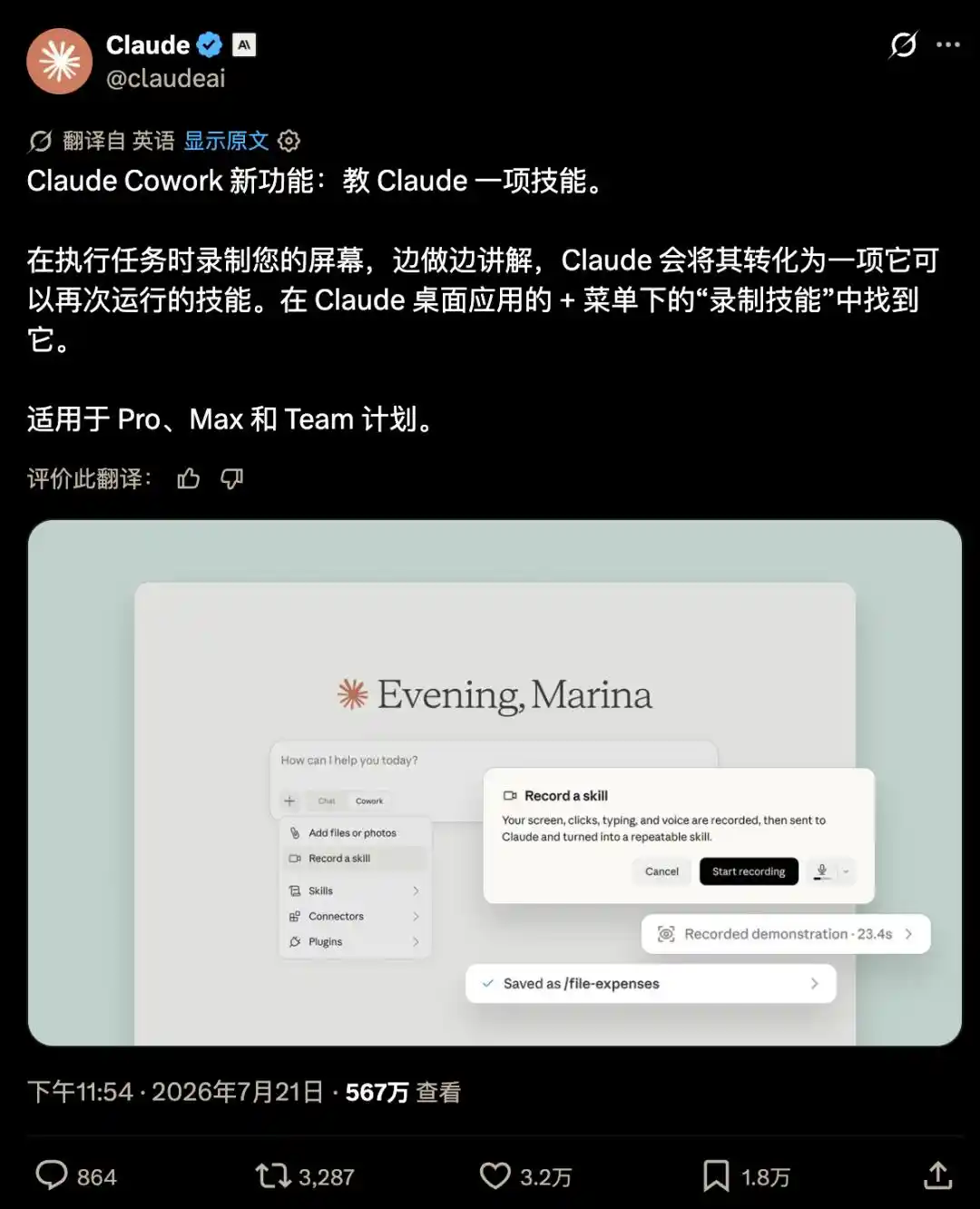
https://x.com/claudeai/status/2079595988998554047

Fitur ini saat ini tersedia untuk pengguna Pro, Max, dan Team.

Uji Coba Langsung: Benar-Bisa Digunakan

Kami segera melakukan uji coba sederhana terhadap fitur ini.

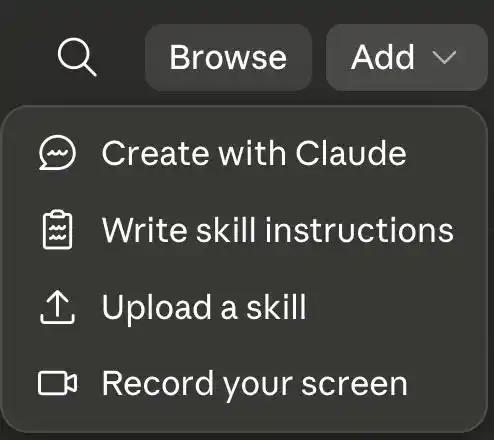
Buka klien Claude, klik tombol [+] di kiri bawah kotak chat -> Skills -> Manage skills -> Add -> Record your screen, maka Anda dapat mulai menggunakan fitur baru ini.
Perlu diperhatikan, hindari memasukkan informasi sensitif pribadi seperti kata sandi teks biasa, kunci rahasia, API Key, informasi kartu kredit, dll. selama proses perekaman layar.
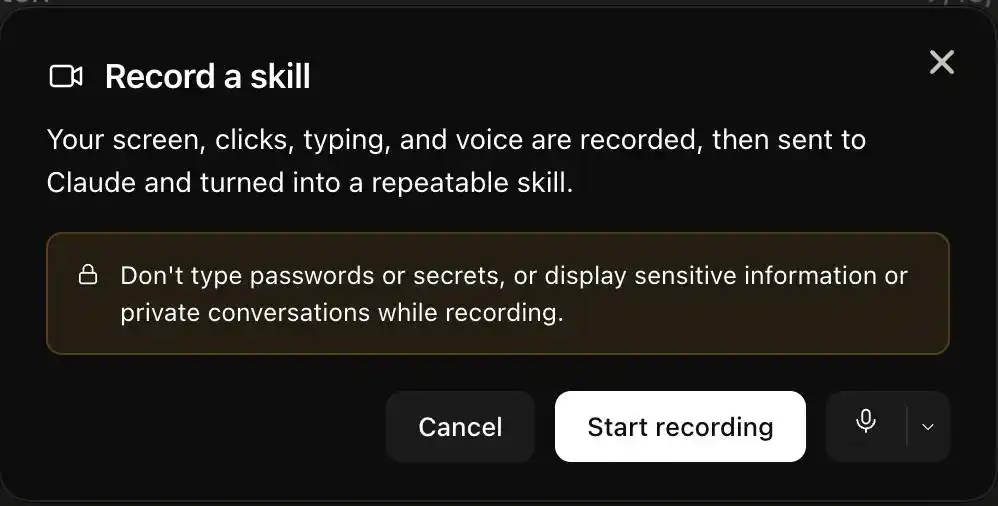
Pertama kali mungkin perlu memberikan izin rekam layar dan suara, setelah diizinkan, klik [Start Recording], maka Anda dapat memulai perekaman.

Anda hanya perlu mengulangi alur kerja lengkap Anda di komputer, menambahkan penjelasan lisan untuk logika operasi implisit yang diperlukan, sambil menghindari operasi yang tidak relevan (misalnya, menonton video pendek atau bermalas-malasan sambil menunggu hasil), klik untuk mengakhiri perekaman maka akan secara otomatis kembali ke antarmuka Claude Cowork untuk dianalisis dan dilakukan penyulingan Skill.
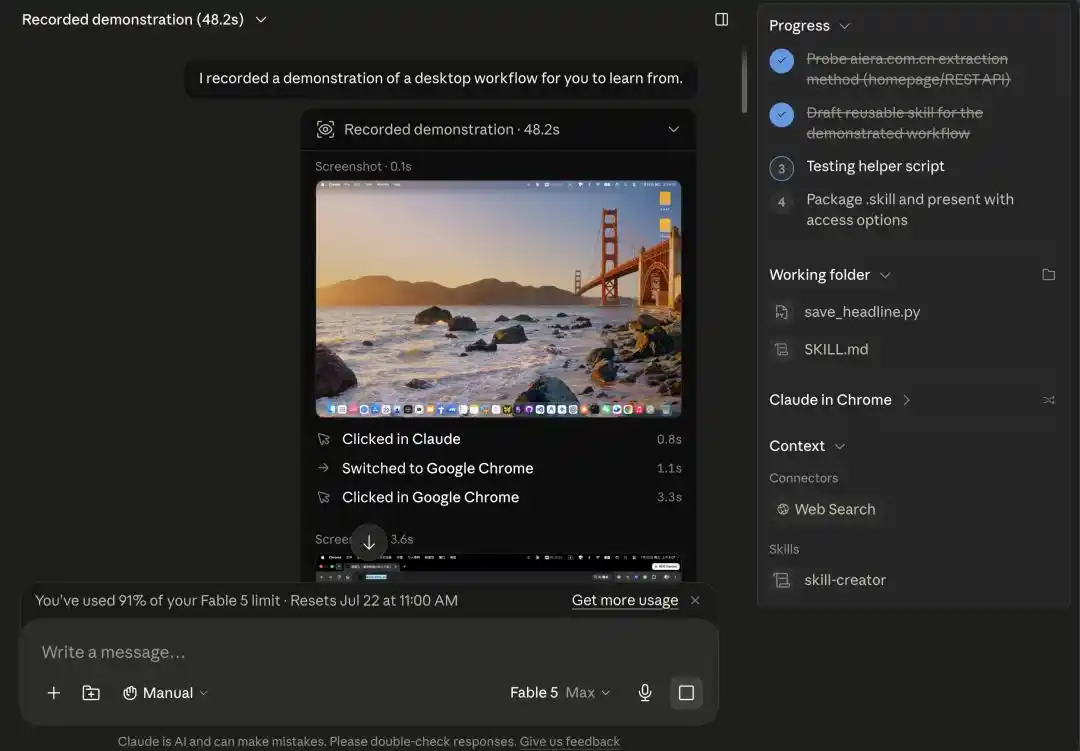
Setelah menunggu sejenak, Skill eksklusif Anda sudah jadi, klik [Save Skill] maka dapat langsung diterapkan ke Claude.
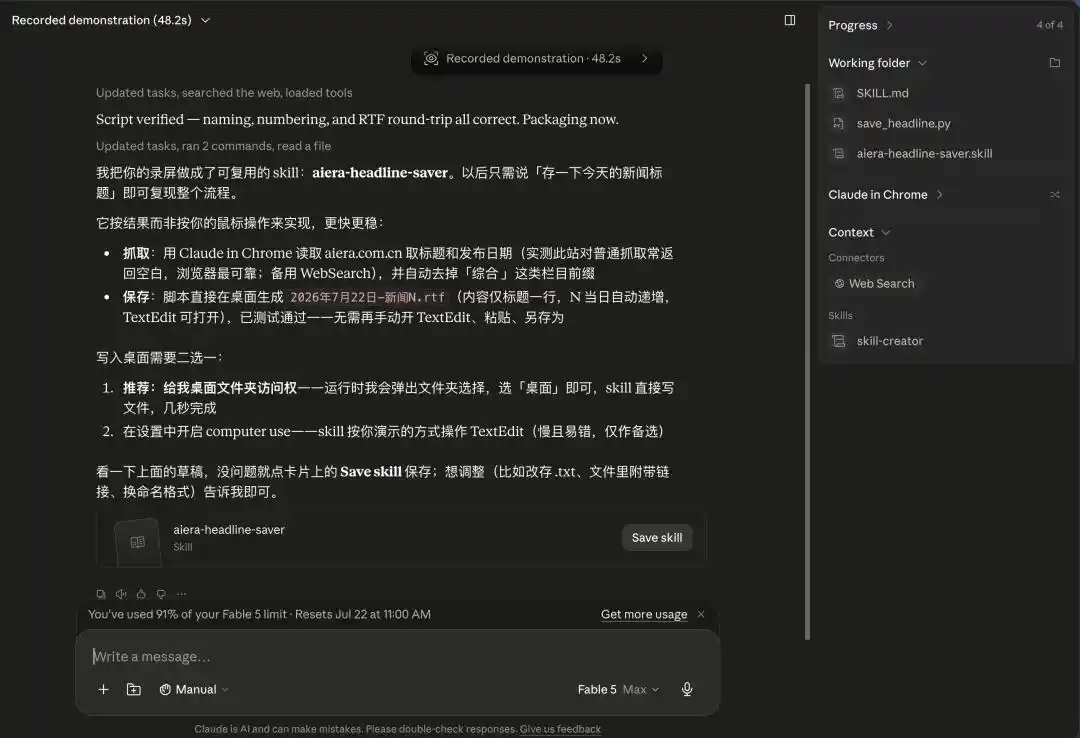
Saat mengobrol, gunakan perintah garis miring (/) untuk memanggil Skill tersebut agar dapat bekerja.
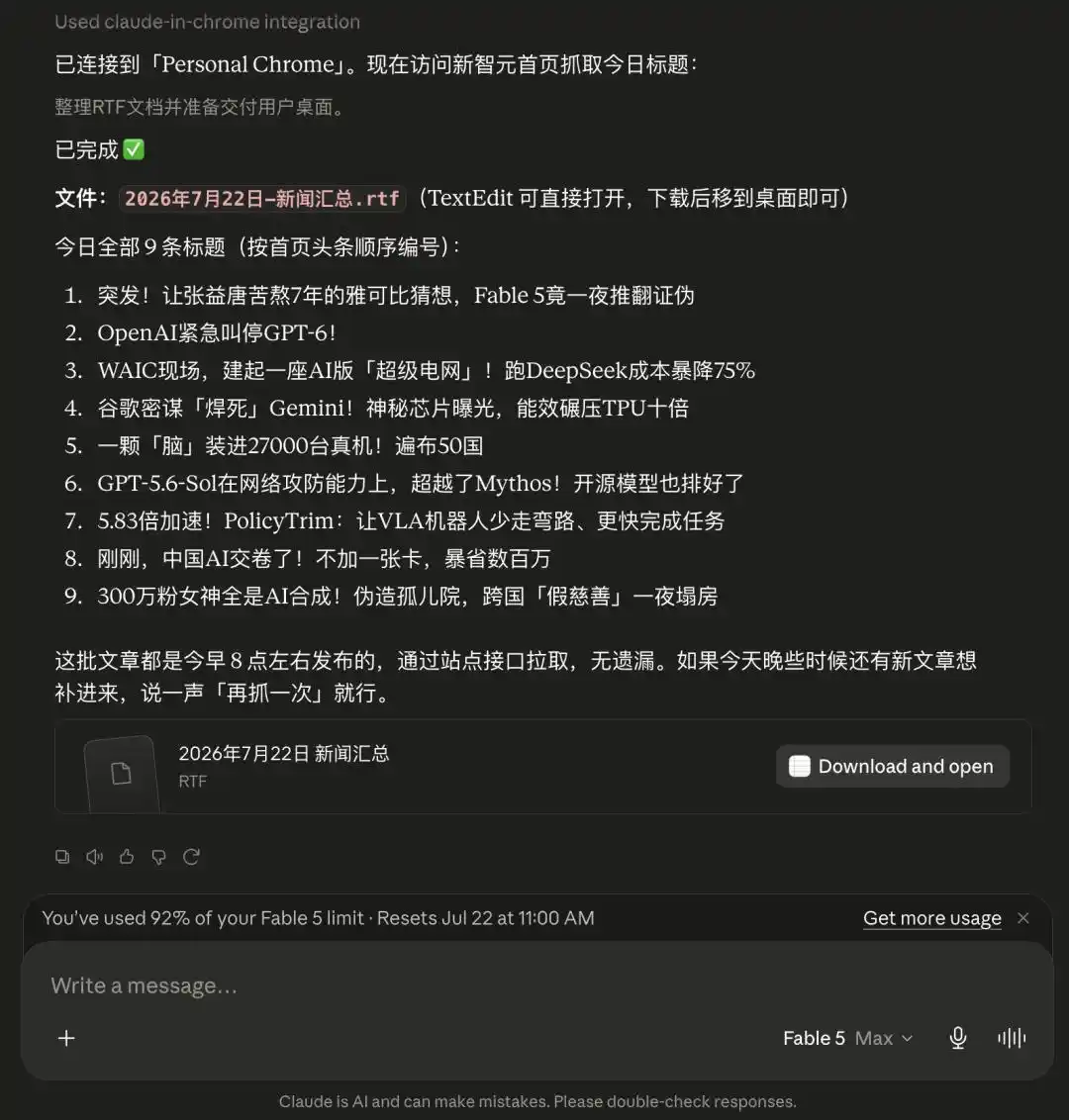
Tidak perlu penyesuaian berulang kali, Skill eksklusif yang baru jadi dapat langsung digunakan.

Bukan Hanya Alat Peningkatan Efisiensi

Kebanyakan pemberitaan mengategorikan "Record a Skill" (rekam layar untuk membuat Skill) sebagai "cara yang lebih mudah untuk membuat alur otomatisasi", tetapi pemahaman ini hanya berhenti di permukaan.

Sebelumnya, membuat Skill memerlukan penulisan manual file SKILL.md, menggunakan Markdown untuk menjelaskan langkah-langkah, kondisi pemicu, dan metadata dengan jelas.

Orang non-teknis harus berpikir seperti seorang perancang proses untuk menyelesaikan hal ini.

Tantangannya terletak pada menerjemahkan pengalaman implisit menjadi instruksi eksplisit.

Sedangkan sekarang, "Record a Skill" melewati tahap penerjemahan.

Fitur ini secara bersamaan menangkap operasi layar dan penjelasan suara, yang terakhir ini adalah kuncinya: Penjelasan dari pengguna akan secara alami mengungkap logika penilaian, situasi mana yang harus dilewati, format mana yang merupakan persyaratan keras dari klien, angka mana yang tidak biasa dan perlu diperiksa ulang secara manual.

Hal-hal seperti ini sulit ditulis menjadi manual operasi, tetapi dapat dipertahankan secara lengkap oleh sebuah rekaman layar.

"Record a Skill" melewati langkah "menulis".

Manajemen pengetahuan perusahaan telah menghabiskan dana selama puluhan tahun untuk membangun basis pengetahuan, menulis SOP, dan mengumpulkan pustaka praktik terbaik, inti permasalahannya selalu sama: Pakar tidak mau menulis dokumentasi, dan dokumentasi yang sudah ditulis pun tidak ada yang memelihara.

Ambang batas penjelasan dengan rekaman layar jauh lebih rendah dibandingkan menulis dokumentasi, Skill yang dihasilkan dapat dibaca manusia, dan AI juga dapat langsung menjalankannya.

Sisi Lain dari Rekaman Layar

Media teknologi MakeUseOf pada Maret tahun ini melaporkan sebuah kasus:

Seorang penulis lepas menggunakan Claude Cowork untuk menyusun alur kerja pembuatan konten selama proses serah terima kerja, memasukkan dokumen merek, panduan gaya, dan artikel-artikel lama yang sudah dikemas, lalu mengeluarkan kalender konten bulanan sesuai dengan proses Skill.

Saat serah terima, klien berkata:

Karena Anda akan pergi, bisakah Anda mengonfigurasikan ini agar kami bisa menjalankannya sendiri?

Lima tahun hubungan kerjasama digantikan oleh sebuah folder Skill.
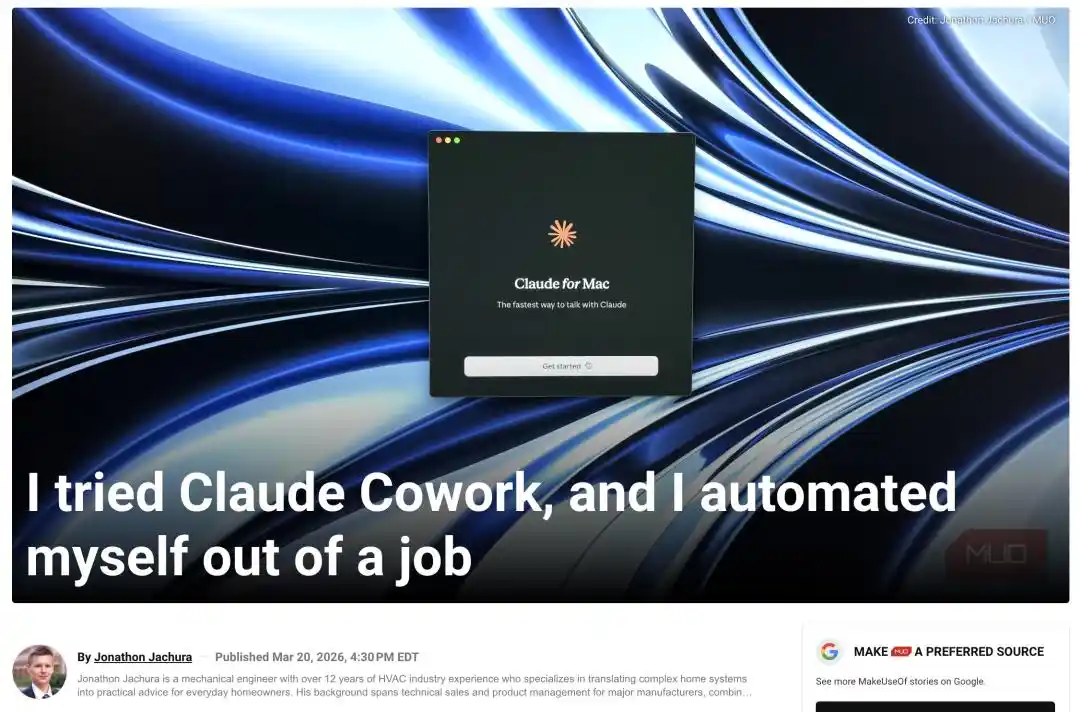
https://www.makeuseof.com/claude-cowork-automated-away-job/

Kisah ini terjadi sebelum "Record a Skill" diluncurkan, masih menggunakan cara menulis Skill secara manual.

Pengajaran dengan rekaman layar membuat biaya operasi untuk hal yang sama semakin rendah: Tidak perlu memahami Markdown, tidak perlu mengabstraksikan proses, cukup lakukan sekali dan jelaskan sekali.

Data penelitian Harvard Business School pada Maret 2026 dapat menjadi catatan kaki untuk sisi lainnya: Perekrutan untuk posisi dengan paparan AI tertinggi turun 17%, sementara perekrutan untuk posisi yang memerlukan kolaborasi manusia-AI meningkat 22%.
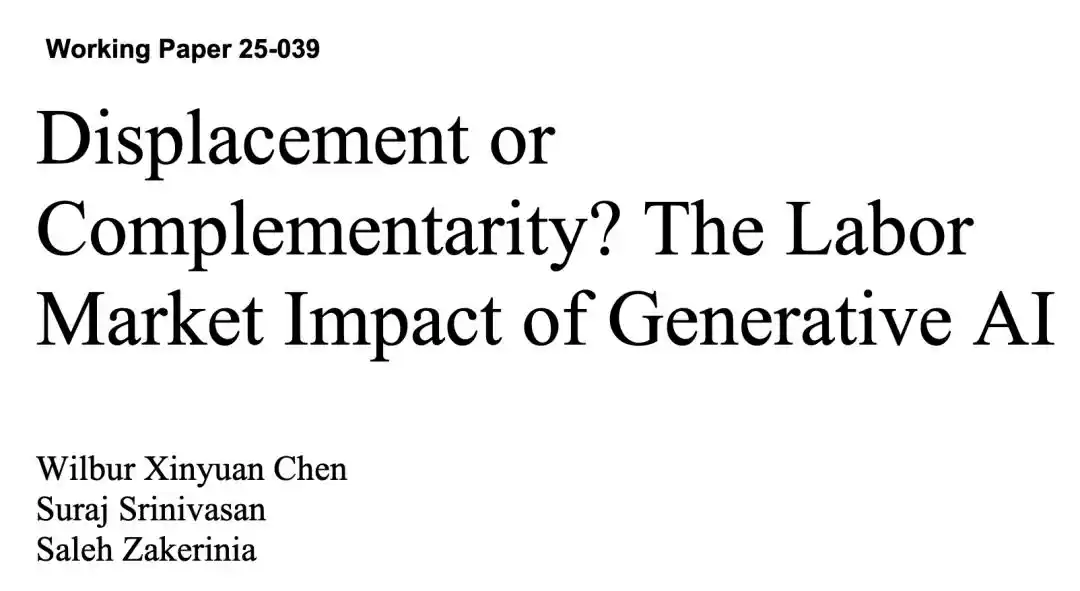
https://www.hbs.edu/ris/Publication%20Files/25-039_05fbec84-1f23-459b-8410-e3cd7ab6c88a.pdf

Tapi arah yang didorong oleh "Record a Skill" sangat jelas: Parit pertahanan pekerjaan, bermigrasi dari "bisa mengerjakan" menjadi "bisa mengerjakan hal yang tidak bisa dilakukan orang lain".

Referensi: https://x.com/claudeai/status/2079595988998554047

Artikel ini berasal dari akun WeChat publik "Xin Zhi Yuan", penulis: ASI Apocalypse; Editor: Mark


Trending Cryptos

Related Questions

QApa yang dimaksud dengan fungsi "Record a Skill" baru di Claude?

AFungsi "Record a Skill" adalah fitur baru di aplikasi desktop Claude (Cowork) yang memungkinkan pengguna membuat Skill (keahlian/keterampilan yang dapat digunakan kembali untuk mengotomatisasi tugas) hanya dengan merekam layar dan memberikan penjelasan suara saat melakukan suatu alur kerja. Claude kemudian secara otomatis menganalisis rekaman dan membuat Skill yang dapat dipanggil kapan saja.

QBagaimana cara menggunakan fitur "Record a Skill"?

AUntuk menggunakan fitur ini, pengguna Pro, Max, atau Team membuka klien Claude, klik tombol [+], pilih "Skills", lalu "Manage skills", "Add", dan "Record your screen". Setelah memberikan izin perekaman layar dan suara, klik "Start Recording", lakukan alur kerja sambil menjelaskan secara verbal, lalu akhiri perekaman. Claude akan menganalisis dan membuat Skill siap pakai.

QMengapa fitur "Record a Skill" dianggap lebih dari sekadar alat peningkatan efisiensi?

AKarena fitur ini melewati hambatan terbesar dalam manajemen pengetahuan dan pembuatan prosedur operasi standar (SOP), yaitu mengubah pengalaman implisit menjadi instruksi eksplisit dengan menulis. Dengan merekam tindakan dan penjelasan verbal, logika keputusan, pengecualian, dan konteks yang sulit didokumentasikan tertangkap secara alami, sehingga pengetahuan praktis ahli lebih mudah diabadikan dan digunakan oleh AI.

QSiapa saja yang dapat mengakses fitur "Record a Skill" saat ini?

ASaat ini, fitur "Record a Skill" tersedia untuk pengguna Claude dengan paket berlangganan Pro, Max, dan Team.

QMenurut artikel, apa dampak potensial dari teknologi seperti "Record a Skill" terhadap pekerjaan?

ATeknologi ini mendorong pergeseran di mana nilai atau 'parit pertahanan' pekerjaan berpindah dari sekadar 'bisa melakukan' suatu tugas rutin menjadi 'bisa melakukan hal yang tidak dapat dilakukan orang lain'. Ini dapat mengotomatisasi dan mendistilasi keahlian tertentu, seperti yang dicontohkan kasus penulis lepas, namun juga meningkatkan permintaan untuk peran yang membutuhkan kolaborasi manusia-AI.

Related Reads

Sales Director Consulted with DeepSeek, Lost Job and 5 Million Rubles

Babuskinsky District Court of Moscow upheld the lawful dismissal of Ekaterina Remizova, sales director at GK Energoprof, for disclosing trade secrets. The employee was found to have forwarded company documents, including tender participation details and colleagues' salary data, to her personal email. Furthermore, she uploaded confidential reports with sales statistics, financial metrics, and cash flow data from the company's internal PowerBI resources into the external AI service DeepSeek. The court ruled that uploading such protected information into the DeepSeek AI system itself constitutes disclosure. An additional ground for dismissal was her disclosure of strategic company plans to a supplier, after which the counterparty ceased communication. The employer also cited systematic failure to meet sales targets. Following her dismissal, Remizova sued, demanding the termination be declared illegal, changed to "by mutual agreement," and seeking a contractual "golden parachute" of 5 million rubles. The court rejected the 5 million ruble claim, as such payment was only stipulated for mutual agreement or redundancy. While one disciplinary penalty was deemed unjustified, ordering the company to pay 10,000 rubles in moral compensation, the court largely sided with the employer, refusing to recognize the dismissal as unlawful. The case highlights risks associated with using external AI services. A security expert noted that DeepSeek's "Share" function creates links that can be indexed by search engines like Google, potentially turning temporary shares into permanent, publicly accessible digital traces containing corporate data.

cryptonews.ru1m ago

Sales Director Consulted with DeepSeek, Lost Job and 5 Million Rubles

cryptonews.ru1m ago

A Serious Threat is Looming for Bitcoin (BTC) and Cryptocurrencies: They Could Be the First Target!

The rapid advancement of quantum computing poses a serious threat not only to cryptocurrencies but to the entire encryption system, including banking. However, experts warn that the cryptocurrency market might be the first sector to suffer from this transformation. As predictions of a 'Q-Day' approach, the slow governance processes of cryptocurrencies, rather than their cryptography, could become the biggest obstacle to defending against quantum attacks. Quantum Xchange CEO Eddy Zervigon has compared cryptocurrencies to "canaries in the coal mine," stating that the first successful quantum-powered cyberattack is likely to target decentralized blockchain networks. While a cryptographically relevant quantum computer capable of breaking the elliptic curve cryptography underlying Bitcoin's signatures and banking security does not yet exist, work by giants like Microsoft, IBM, and Google suggests the threat is nearer than previously thought. The industry consensus estimates such a computer could emerge around 2029. Supporting this view, recent Google research indicates the number of physical qubits needed to break the cryptographic systems protecting Bitcoin and Ethereum has decreased by about 20 times compared to prior estimates, highlighting the accelerated danger. Zervigon concludes that Bitcoin's greatest risk lies not in its current cryptographic system, but in the slow pace of implementing major network upgrades.

cryptonews.ru47m ago

A Serious Threat is Looming for Bitcoin (BTC) and Cryptocurrencies: They Could Be the First Target!

cryptonews.ru47m ago

Crypto Outperforming Stocks: How Digital Assets Are Withstanding Macroeconomic Pressure

Crypto Outperforms Stocks Amid Macro Pressure Trading firm QCP Capital's report analyzes the divergent performance of crypto and stock markets ahead of the July 29 FOMC meeting. While major US stock indexes showed mixed results, with tech weakness pressuring the Nasdaq, crypto assets like Bitcoin (up ~11.6% in July) and Ethereum (up ~24.6%) have outperformed despite a challenging macro backdrop, including rising Treasury yields and risk-off sentiment. Key focus points include the upcoming Fed decision and commentary from Chair Kevin Warsh, which could signal the regulator's stance on inflation and growth. Spot Bitcoin and Ethereum ETFs saw a net outflow of ~$311 million on July 24, ending a seven-day inflow streak, highlighting shifting institutional sentiment. Option market data reveals increased demand for downside protection, indicating caution, though constructive long-term positioning remains. Implied volatility for Ethereum trades at a premium to Bitcoin, and perpetual funding rates stay positive. The week's key events are the FOMC decision, Treasury yield movements, ETF flow trends, and US regulatory developments like the CLARITY Act. The market balances crypto's resilience against growing option market caution, with the Fed's decision poised to tip the scales. Analysis compares the current Fed pause to historical rate-cutting cycles, questioning whether crypto's strength can persist if monetary policy tightening persists.

cryptonews.ru57m ago

Crypto Outperforming Stocks: How Digital Assets Are Withstanding Macroeconomic Pressure

cryptonews.ru57m ago

Trading

Spot

Hot Articles

What is SONIC

Sonic: Pioneering the Future of Gaming in Web3 Introduction to Sonic In the ever-evolving landscape of Web3, the gaming industry stands out as one of the most dynamic and promising sectors. At the forefront of this revolution is Sonic, a project designed to amplify the gaming ecosystem on the Solana blockchain. Leveraging cutting-edge technology, Sonic aims to deliver an unparalleled gaming experience by efficiently processing millions of requests per second, ensuring that players enjoy seamless gameplay while maintaining low transaction costs. This article delves into the intricate details of Sonic, exploring its creators, funding sources, operational mechanics, and the timeline of significant events that have shaped its journey. What is Sonic? Sonic is an innovative layer-2 network that operates atop the Solana blockchain, specifically tailored to enhance the existing Solana gaming ecosystem. It accomplishes this through a customised, VM-agnostic game engine paired with a HyperGrid interpreter, facilitating sovereign game economies that roll up back to the Solana platform. The primary goals of Sonic include: Enhanced Gaming Experiences: Sonic is committed to offering lightning-fast on-chain gameplay, allowing players and developers to engage with games at previously unattainable speeds. Atomic Interoperability: This feature enables transactions to be executed within Sonic without the need to redeploy Solana programmes and accounts. This makes the process more efficient and directly benefits from Solana Layer1 services and liquidity. Seamless Deployment: Sonic allows developers to write for Ethereum Virtual Machine (EVM) based systems and execute them on Solana’s SVM infrastructure. This interoperability is crucial for attracting a broader range of dApps and decentralised applications to the platform. Support for Developers: By offering native composable gaming primitives and extensible data types - dining within the Entity-Component-System (ECS) framework - game creators can craft intricate business logic with ease. Overall, Sonic's unique approach not only caters to players but also provides an accessible and low-cost environment for developers to innovate and thrive. Creator of Sonic The information regarding the creator of Sonic is somewhat ambiguous. However, it is known that Sonic's SVM is owned by the company Mirror World. The absence of detailed information about the individuals behind Sonic reflects a common trend in several Web3 projects, where collective efforts and partnerships often overshadow individual contributions. Investors of Sonic Sonic has garnered considerable attention and support from various investors within the crypto and gaming sectors. Notably, the project raised an impressive $12 million during its Series A funding round. The round was led by BITKRAFT Ventures, with other notable investors including Galaxy, Okx Ventures, Interactive, Big Brain Holdings, and Mirana. This financial backing signifies the confidence that investment foundations have in Sonic’s potential to revolutionise the Web3 gaming landscape, further validating its innovative approaches and technologies. How Does Sonic Work? Sonic utilises the HyperGrid framework, a sophisticated parallel processing mechanism that enhances its scalability and customisability. Here are the core features that set Sonic apart: Lightning Speed at Low Costs: Sonic offers one of the fastest on-chain gaming experiences compared to other Layer-1 solutions, powered by the scalability of Solana’s virtual machine (SVM). Atomic Interoperability: Sonic enables transaction execution without redeployment of Solana programmes and accounts, effectively streamlining the interaction between users and the blockchain. EVM Compatibility: Developers can effortlessly migrate decentralised applications from EVM chains to the Solana environment using Sonic’s HyperGrid interpreter, increasing the accessibility and integration of various dApps. Ecosystem Support for Developers: By exposing native composable gaming primitives, Sonic facilitates a sandbox-like environment where developers can experiment and implement business logic, greatly enhancing the overall development experience. Monetisation Infrastructure: Sonic natively supports growth and monetisation efforts, providing frameworks for traffic generation, payments, and settlements, thereby ensuring that gaming projects are not only viable but also sustainable financially. Timeline of Sonic The evolution of Sonic has been marked by several key milestones. Below is a brief timeline highlighting critical events in the project's history: 2022: The Sonic cryptocurrency was officially launched, marking the beginning of its journey in the Web3 gaming arena. 2024: June: Sonic SVM successfully raised $12 million in a Series A funding round. This investment allowed Sonic to further develop its platform and expand its offerings. August: The launch of the Sonic Odyssey testnet provided users with the first opportunity to engage with the platform, offering interactive activities such as collecting rings—a nod to gaming nostalgia. October: SonicX, an innovative crypto game integrated with Solana, made its debut on TikTok, capturing the attention of over 120,000 users within a short span. This integration illustrated Sonic’s commitment to reaching a broader, global audience and showcased the potential of blockchain gaming. Key Points Sonic SVM is a revolutionary layer-2 network on Solana explicitly designed to enhance the GameFi landscape, demonstrating great potential for future development. HyperGrid Framework empowers Sonic by introducing horizontal scaling capabilities, ensuring that the network can handle the demands of Web3 gaming. Integration with Social Platforms: The successful launch of SonicX on TikTok displays Sonic’s strategy to leverage social media platforms to engage users, exponentially increasing the exposure and reach of its projects. Investment Confidence: The substantial funding from BITKRAFT Ventures, among others, emphasizes the robust backing Sonic has, paving the way for its ambitious future. In conclusion, Sonic encapsulates the essence of Web3 gaming innovation, striking a balance between cutting-edge technology, developer-centric tools, and community engagement. As the project continues to evolve, it is poised to redefine the gaming landscape, making it a notable entity for gamers and developers alike. As Sonic moves forward, it will undoubtedly attract greater interest and participation, solidifying its place within the broader narrative of blockchain gaming.

1.9k Total ViewsPublished 2024.04.04Updated 2024.12.03

What is SONIC

What is $S$

Understanding SPERO: A Comprehensive Overview Introduction to SPERO As the landscape of innovation continues to evolve, the emergence of web3 technologies and cryptocurrency projects plays a pivotal role in shaping the digital future. One project that has garnered attention in this dynamic field is SPERO, denoted as SPERO,$$s$. This article aims to gather and present detailed information about SPERO, to help enthusiasts and investors understand its foundations, objectives, and innovations within the web3 and crypto domains. What is SPERO,$$s$? SPERO,$$s$ is a unique project within the crypto space that seeks to leverage the principles of decentralisation and blockchain technology to create an ecosystem that promotes engagement, utility, and financial inclusion. The project is tailored to facilitate peer-to-peer interactions in new ways, providing users with innovative financial solutions and services. At its core, SPERO,$$s$ aims to empower individuals by providing tools and platforms that enhance user experience in the cryptocurrency space. This includes enabling more flexible transaction methods, fostering community-driven initiatives, and creating pathways for financial opportunities through decentralised applications (dApps). The underlying vision of SPERO,$$s$ revolves around inclusiveness, aiming to bridge gaps within traditional finance while harnessing the benefits of blockchain technology. Who is the Creator of SPERO,$$s$? The identity of the creator of SPERO,$$s$ remains somewhat obscure, as there are limited publicly available resources providing detailed background information on its founder(s). This lack of transparency can stem from the project's commitment to decentralisation—an ethos that many web3 projects share, prioritising collective contributions over individual recognition. By centring discussions around the community and its collective goals, SPERO,$$s$ embodies the essence of empowerment without singling out specific individuals. As such, understanding the ethos and mission of SPERO remains more important than identifying a singular creator. Who are the Investors of SPERO,$$s$? SPERO,$$s$ is supported by a diverse array of investors ranging from venture capitalists to angel investors dedicated to fostering innovation in the crypto sector. The focus of these investors generally aligns with SPERO's mission—prioritising projects that promise societal technological advancement, financial inclusivity, and decentralised governance. These investor foundations are typically interested in projects that not only offer innovative products but also contribute positively to the blockchain community and its ecosystems. The backing from these investors reinforces SPERO,$$s$ as a noteworthy contender in the rapidly evolving domain of crypto projects. How Does SPERO,$$s$ Work? SPERO,$$s$ employs a multi-faceted framework that distinguishes it from conventional cryptocurrency projects. Here are some of the key features that underline its uniqueness and innovation: Decentralised Governance: SPERO,$$s$ integrates decentralised governance models, empowering users to participate actively in decision-making processes regarding the project’s future. This approach fosters a sense of ownership and accountability among community members. Token Utility: SPERO,$$s$ utilises its own cryptocurrency token, designed to serve various functions within the ecosystem. These tokens enable transactions, rewards, and the facilitation of services offered on the platform, enhancing overall engagement and utility. Layered Architecture: The technical architecture of SPERO,$$s$ supports modularity and scalability, allowing for seamless integration of additional features and applications as the project evolves. This adaptability is paramount for sustaining relevance in the ever-changing crypto landscape. Community Engagement: The project emphasises community-driven initiatives, employing mechanisms that incentivise collaboration and feedback. By nurturing a strong community, SPERO,$$s$ can better address user needs and adapt to market trends. Focus on Inclusion: By offering low transaction fees and user-friendly interfaces, SPERO,$$s$ aims to attract a diverse user base, including individuals who may not previously have engaged in the crypto space. This commitment to inclusion aligns with its overarching mission of empowerment through accessibility. Timeline of SPERO,$$s$ Understanding a project's history provides crucial insights into its development trajectory and milestones. Below is a suggested timeline mapping significant events in the evolution of SPERO,$$s$: Conceptualisation and Ideation Phase: The initial ideas forming the basis of SPERO,$$s$ were conceived, aligning closely with the principles of decentralisation and community focus within the blockchain industry. Launch of Project Whitepaper: Following the conceptual phase, a comprehensive whitepaper detailing the vision, goals, and technological infrastructure of SPERO,$$s$ was released to garner community interest and feedback. Community Building and Early Engagements: Active outreach efforts were made to build a community of early adopters and potential investors, facilitating discussions around the project’s goals and garnering support. Token Generation Event: SPERO,$$s$ conducted a token generation event (TGE) to distribute its native tokens to early supporters and establish initial liquidity within the ecosystem. Launch of Initial dApp: The first decentralised application (dApp) associated with SPERO,$$s$ went live, allowing users to engage with the platform's core functionalities. Ongoing Development and Partnerships: Continuous updates and enhancements to the project's offerings, including strategic partnerships with other players in the blockchain space, have shaped SPERO,$$s$ into a competitive and evolving player in the crypto market. Conclusion SPERO,$$s$ stands as a testament to the potential of web3 and cryptocurrency to revolutionise financial systems and empower individuals. With a commitment to decentralised governance, community engagement, and innovatively designed functionalities, it paves the way toward a more inclusive financial landscape. As with any investment in the rapidly evolving crypto space, potential investors and users are encouraged to research thoroughly and engage thoughtfully with the ongoing developments within SPERO,$$s$. The project showcases the innovative spirit of the crypto industry, inviting further exploration into its myriad possibilities. While the journey of SPERO,$$s$ is still unfolding, its foundational principles may indeed influence the future of how we interact with technology, finance, and each other in interconnected digital ecosystems.

164 Total ViewsPublished 2024.12.17Updated 2024.12.17

What is $S$

What is AGENT S

Agent S: The Future of Autonomous Interaction in Web3 Introduction In the ever-evolving landscape of Web3 and cryptocurrency, innovations are constantly redefining how individuals interact with digital platforms. One such pioneering project, Agent S, promises to revolutionise human-computer interaction through its open agentic framework. By paving the way for autonomous interactions, Agent S aims to simplify complex tasks, offering transformative applications in artificial intelligence (AI). This detailed exploration will delve into the project's intricacies, its unique features, and the implications for the cryptocurrency domain. What is Agent S? Agent S stands as a groundbreaking open agentic framework, specifically designed to tackle three fundamental challenges in the automation of computer tasks: Acquiring Domain-Specific Knowledge: The framework intelligently learns from various external knowledge sources and internal experiences. This dual approach empowers it to build a rich repository of domain-specific knowledge, enhancing its performance in task execution. Planning Over Long Task Horizons: Agent S employs experience-augmented hierarchical planning, a strategic approach that facilitates efficient breakdown and execution of intricate tasks. This feature significantly enhances its ability to manage multiple subtasks efficiently and effectively. Handling Dynamic, Non-Uniform Interfaces: The project introduces the Agent-Computer Interface (ACI), an innovative solution that enhances the interaction between agents and users. Utilizing Multimodal Large Language Models (MLLMs), Agent S can navigate and manipulate diverse graphical user interfaces seamlessly. Through these pioneering features, Agent S provides a robust framework that addresses the complexities involved in automating human interaction with machines, setting the stage for myriad applications in AI and beyond. Who is the Creator of Agent S? While the concept of Agent S is fundamentally innovative, specific information about its creator remains elusive. The creator is currently unknown, which highlights either the nascent stage of the project or the strategic choice to keep founding members under wraps. Regardless of anonymity, the focus remains on the framework's capabilities and potential. Who are the Investors of Agent S? As Agent S is relatively new in the cryptographic ecosystem, detailed information regarding its investors and financial backers is not explicitly documented. The lack of publicly available insights into the investment foundations or organisations supporting the project raises questions about its funding structure and development roadmap. Understanding the backing is crucial for gauging the project's sustainability and potential market impact. How Does Agent S Work? At the core of Agent S lies cutting-edge technology that enables it to function effectively in diverse settings. Its operational model is built around several key features: Human-like Computer Interaction: The framework offers advanced AI planning, striving to make interactions with computers more intuitive. By mimicking human behaviour in tasks execution, it promises to elevate user experiences. Narrative Memory: Employed to leverage high-level experiences, Agent S utilises narrative memory to keep track of task histories, thereby enhancing its decision-making processes. Episodic Memory: This feature provides users with step-by-step guidance, allowing the framework to offer contextual support as tasks unfold. Support for OpenACI: With the ability to run locally, Agent S allows users to maintain control over their interactions and workflows, aligning with the decentralised ethos of Web3. Easy Integration with External APIs: Its versatility and compatibility with various AI platforms ensure that Agent S can fit seamlessly into existing technological ecosystems, making it an appealing choice for developers and organisations. These functionalities collectively contribute to Agent S's unique position within the crypto space, as it automates complex, multi-step tasks with minimal human intervention. As the project evolves, its potential applications in Web3 could redefine how digital interactions unfold. Timeline of Agent S The development and milestones of Agent S can be encapsulated in a timeline that highlights its significant events: September 27, 2024: The concept of Agent S was launched in a comprehensive research paper titled “An Open Agentic Framework that Uses Computers Like a Human,” showcasing the groundwork for the project. October 10, 2024: The research paper was made publicly available on arXiv, offering an in-depth exploration of the framework and its performance evaluation based on the OSWorld benchmark. October 12, 2024: A video presentation was released, providing a visual insight into the capabilities and features of Agent S, further engaging potential users and investors. These markers in the timeline not only illustrate the progress of Agent S but also indicate its commitment to transparency and community engagement. Key Points About Agent S As the Agent S framework continues to evolve, several key attributes stand out, underscoring its innovative nature and potential: Innovative Framework: Designed to provide an intuitive use of computers akin to human interaction, Agent S brings a novel approach to task automation. Autonomous Interaction: The ability to interact autonomously with computers through GUI signifies a leap towards more intelligent and efficient computing solutions. Complex Task Automation: With its robust methodology, it can automate complex, multi-step tasks, making processes faster and less error-prone. Continuous Improvement: The learning mechanisms enable Agent S to improve from past experiences, continually enhancing its performance and efficacy. Versatility: Its adaptability across different operating environments like OSWorld and WindowsAgentArena ensures that it can serve a broad range of applications. As Agent S positions itself in the Web3 and crypto landscape, its potential to enhance interaction capabilities and automate processes signifies a significant advancement in AI technologies. Through its innovative framework, Agent S exemplifies the future of digital interactions, promising a more seamless and efficient experience for users across various industries. Conclusion Agent S represents a bold leap forward in the marriage of AI and Web3, with the capacity to redefine how we interact with technology. While still in its early stages, the possibilities for its application are vast and compelling. Through its comprehensive framework addressing critical challenges, Agent S aims to bring autonomous interactions to the forefront of the digital experience. As we move deeper into the realms of cryptocurrency and decentralisation, projects like Agent S will undoubtedly play a crucial role in shaping the future of technology and human-computer collaboration.

836 Total ViewsPublished 2025.01.14Updated 2025.01.14

What is AGENT S

Discussions

Welcome to the HTX Community. Here, you can stay informed about the latest platform developments and gain access to professional market insights. Users' opinions on the price of S (S) are presented below.

活动图片