CASHCAT cae un 32% tras que una ballena retira $2,85M – ¿Soportará los $0,10?

ambcryptoPublished on 2026-07-15Last updated on 2026-07-15

Abstract

CASHCAT, uno de los memecoins más comentados, cayó un 32% hasta alrededor de $0.12 tras alcanzar un máximo histórico de $0.23. La presión bajista se intensificó cuando un 'whale' convirtió una inversión inicial de $3.000 en $2,85 millones, vendiendo 16,3 millones de tokens y marcando un posible cambio de sentimiento. El mercado enfrenta liquidaciones masivas, con $2,14 millones en posiciones largas eliminadas. El volumen de ventas supera al de compras, y el flujo neto negativo sugiere un pánico generalizado. Si la presión vendedora continúa, CASHCAT podría romper el soporte de $0,10 y caer hacia $0,08. Para recuperarse, necesita superar la resistencia de $0,20.

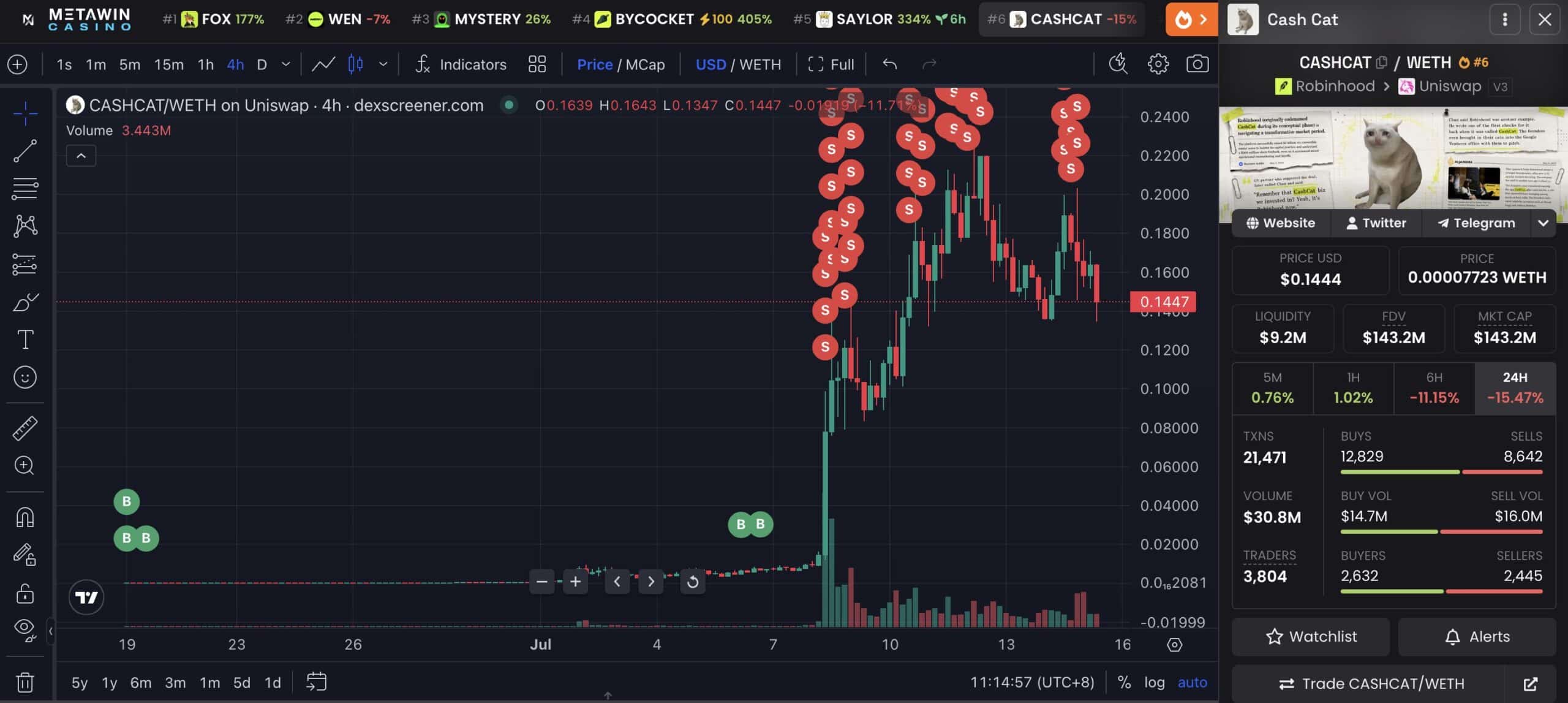
Cash Cat [CASHCAT] se ha convertido en uno de los activos cripto más comentados durante la última semana. En medio de un enorme revuelo en el mercado, el memecoin se disparó hasta un máximo histórico de $0,23 el 14 de julio.

Desde entonces, el memecoin ha experimentado una presión bajista extrema a medida que los precios han caído. En el momento de redactar este artículo, CASHCAT cotizaba alrededor de $0,12, tras caer un 32% en los gráficos diarios. Con la continua caída del precio, los inversores de alto patrimonio neto que se apresuraron a acumular el token en las primeras fases se han vuelto bajistas y han comenzado a tomar beneficios.

Un trader de CASHCAT liquida $2,8M en tokens

Cuando la fiebre de CASHCAT llegó al mercado, los traders, especialmente las ballenas, desplegaron un capital significativo para acumular el token. Sin embargo, el impulso se está desvaneciendo lentamente en medio de la caída del precio, y estos traders han comenzado a retirar sus ganancias.
Fuente: Lookonchain

Según Lookonchain, un trader retiró $2,85 millones de CASHCAT, asegurando un retorno de 952×. El trader había gastado solo $3.000 para comprar 16,3 millones de CASHCAT, vendiendo posteriormente toda la pila por 1.527 ETH valorados en $2,85 millones.

Al asegurar estos beneficios, la ballena señaló un desvanecimiento de la especulación en el mercado, ya que las grandes retiradas de capital a menudo marcan un deterioro del sentimiento. Como resultado, incluso los especuladores se han vuelto escépticos y ahora esperan que el mercado continúe su declive.

La presión del mercado se intensifica

Además de las salidas de ballenas, los participantes en el mercado de CASHCAT han enfrentado una presión extrema. Anteriormente, los traders eran excesivamente alcistas y abrieron posiciones apalancadas, apuntando a una tendencia alcista continua.

Sin embargo, a medida que el mercado de memecoins continuó cayendo, este descenso de precio desencadenó una ola de liquidaciones de posiciones largas. Según datos de CoinGlass, se borraron $2,14 millones en posiciones largas, señalando la fuerza de la tendencia bajista.
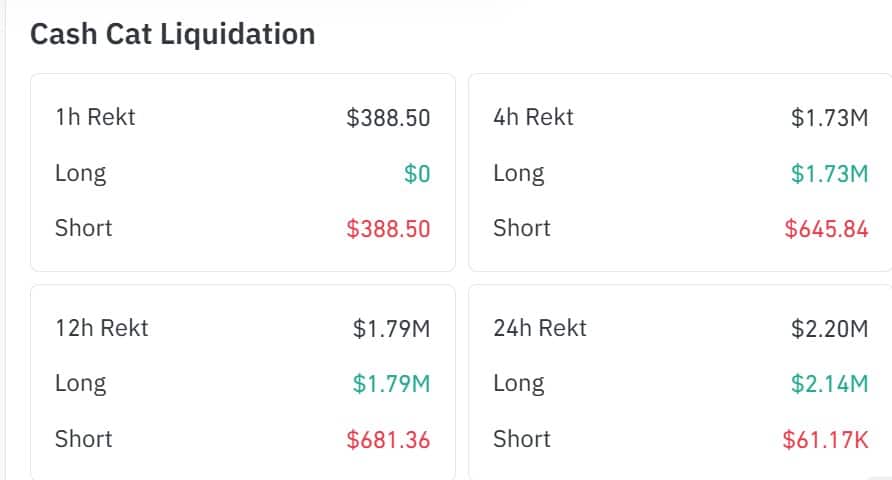
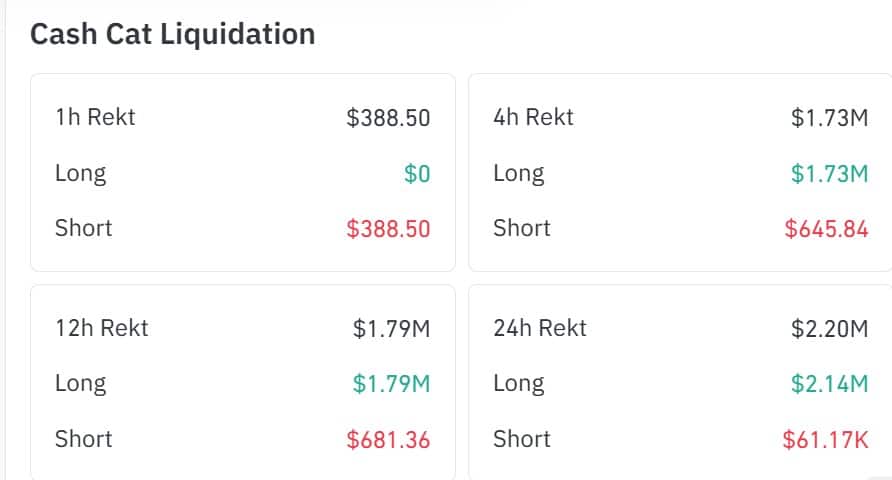
Fuente: CoinGlass

Como era de esperar, este aumento del riesgo de liquidación desencadenó pánico entre los traders, incitándoles a cerrar sus posiciones. Por ejemplo, el memecoin registró un volumen de venta en Perpetuos de 65,57 millones frente a un volumen de compra de 45 millones.
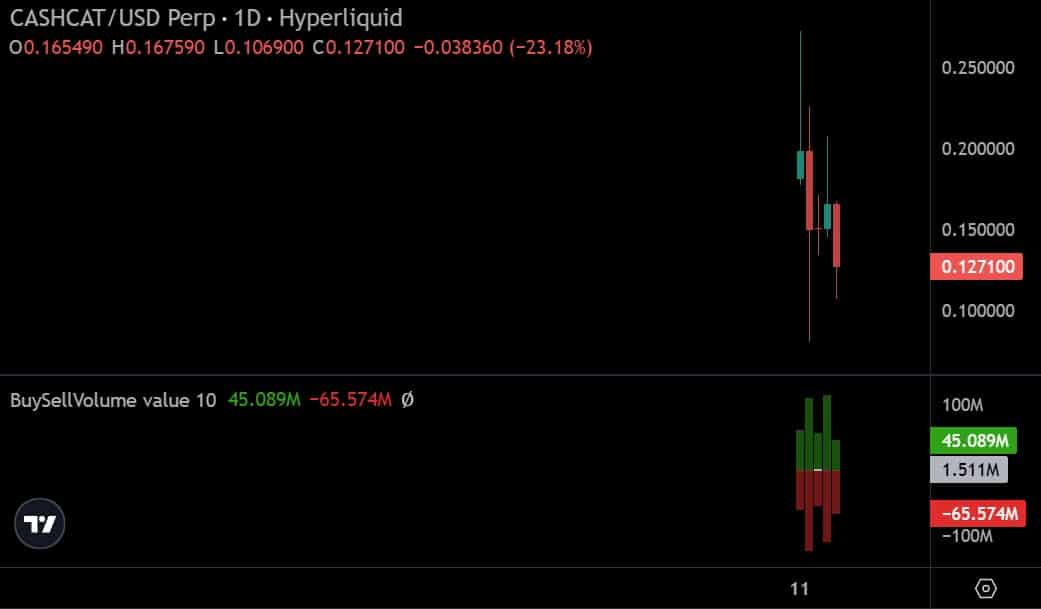
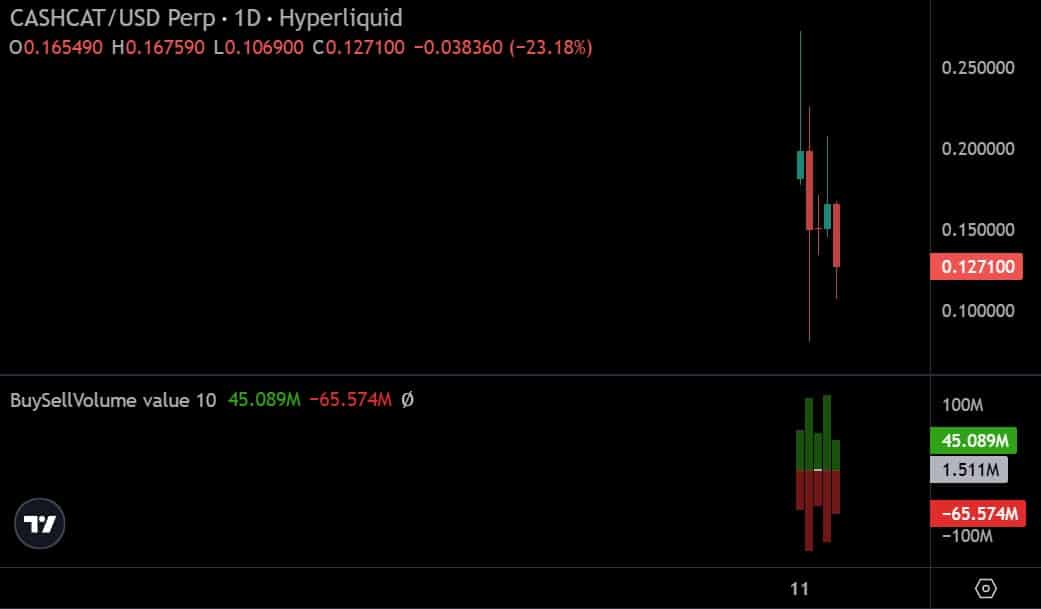
Fuente: Coinalyze

Al mismo tiempo, la compra neta del altcoin se mantuvo negativa alrededor de -100 millones, con un delta de -20,49 millones. Una compra neta negativa en Perpetuos sugiere que más traders cerraron sus operaciones, temiendo mayores pérdidas.

¿Qué le depara al memecoin?

Además, CASHCAT se encuentra actualmente bajo una presión extrema, con la mayoría de los participantes del mercado vendiendo agresivamente. Bajo estas condiciones de mercado, el memecoin corre el riesgo de seguir cayendo.

Por lo tanto, si los traders continúan cerrando sus posiciones, CASHOUT probablemente romperá el soporte de $0,1 y caerá hacia $0,08. Para evitar un mayor deslizamiento, el memecoin necesita recuperar los $0,2, lo que eliminaría eficazmente a todos los bajistas del mercado.


Resumen final

  • Un trader vendió 16,3 millones de CASHCAT valorados en $2,85 millones tras invertir $3.000.
  • Cashcat cayó un 32% hasta un mínimo de $0,11 en medio de una intensa presión bajista.

Trending Cryptos

Related Questions

Q¿Qué sucedió con el precio de CASHCAT después de alcanzar su máximo histórico?

ADespués de alcanzar un máximo histórico de $0.23 el 14 de julio, el precio de CASHCAT cayó un 32% en los gráficos diarios, cotizando alrededor de $0.12 en el momento de escribir el artículo.

Q¿Cuánto ganó un trader al vender sus tokens CASHCAT y cuál fue su retorno de inversión?

AUn trader vendió 16.3 millones de tokens CASHCAT por un valor de $2.85 millones, obteniendo un retorno de 952 veces su inversión inicial de $3,000.

Q¿Qué impacto tuvieron las liquidaciones de posiciones largas en el mercado de CASHCAT?

ALas liquidaciones de posiciones largas alcanzaron $2.14 millones, lo que indica la fuerza de la tendencia bajista y generó pánico entre los traders, que cerraron sus posiciones para evitar más pérdidas.

Q¿Qué indican el volumen de ventas y las compras netas negativas de CASHCAT?

AEl volumen de ventas en Perps fue de 65.57 millones frente a 45 millones en compras, y las compras netas se mantuvieron negativas en torno a -100 millones. Esto sugiere que más traders están cerrando sus operaciones por temor a mayores pérdidas.

Q¿Cuáles son los posibles niveles de soporte y resistencia para CASHCAT según el artículo?

ASi la presión de venta continúa, CASHCAT podría romper el soporte de $0.10 y caer hacia $0.08. Para evitar más caídas, necesita recuperar el nivel de $0.20, lo que eliminaría la presión bajista en el mercado.

Related Reads

Interview with Robinhood Executive: Meme + Tokenized US Stocks as "Barbell" Customer Acquisition Strategy, All Business Lines Achieve Hundreds of Millions in Revenue

Interview with Robinhood executive Johann Kerbrat reveals the company's "barbell" customer acquisition strategy for its new Robinhood Chain, combining meme tokens with tokenized stocks. Three weeks after mainnet launch, the chain has seen over $3B in weekly DEX volume and 105M transactions. Kerbrat explains the logic behind the permissionless chain: meme tokens attract DeFi users, while tokenized real-world assets (RWA), currently over 90 US stocks and ETFs accessible in 120+ countries, serve global users. The goal is to bring Robinhood's 27 million funded accounts on-chain by simplifying DeFi with a user-friendly interface, exemplified by features like Robinhood Earn which offers yield without requiring wallet management. Built on Arbitrum's technology stack for its speed, low cost, and Ethereum's security, the chain focuses on financial products like Earn, spot trading, and perpetuals. Kerbrat downplays direct competition with platforms like Base, emphasizing the goal of expanding the overall market for on-chain assets. He details selective partnerships (e.g., Morpho, Lighter) based on compliance, unique UX, and differentiation. While regulatory clarity is pending for US perpetuals, the expansion continues via Bitstamp in Europe. Finally, Kerbrat positions Robinhood as a "super app" integrating stocks, options, crypto, banking, and AI trading, with all major business lines generating hundreds of millions in revenue. For the chain, current priority is driving adoption over maximizing gas fee revenue.

marsbit40m ago

Interview with Robinhood Executive: Meme + Tokenized US Stocks as "Barbell" Customer Acquisition Strategy, All Business Lines Achieve Hundreds of Millions in Revenue

marsbit40m ago

Fidelity Q3 Report: BTC, ETH, and SOL Continue to Build Bottoms; How Much Further Will This Crypto Bear Market Go?

Fidelity's Q3 Crypto Signal Report analyzes the current bear market, noting Bitcoin (BTC), Ethereum (ETH), and Solana (SOL) are in a prolonged bottoming phase. Key indicators like the weighted Net Unrealized Profit/Loss (NUPL) have turned negative (-0.01), signaling the market is slightly below its aggregate cost basis, with BTC acting as the primary stabilizing asset. BTC's dominance has risen to 68%, indicating a lack of capital rotation to other digital assets. Performance has been weak across the board, with BTC, ETH, and SOL down significantly year-to-date. Market sentiment is depressed, exacerbated by substantial outflows from spot ETPs and a challenging macro environment. The report compares the current ~203-day downtrend to historical ~300-day bottoming cycles, suggesting the process may be two-thirds complete, with late 2026 as a potential timeframe to monitor. For Bitcoin, NUPL at 0.09 indicates cautious sentiment, while momentum signals remain negative. The Yardstick metric points to potential undervaluation relative to network security (hashrate). Ethereum's NUPL is deep in the "capitulation" zone at -0.43, a historically positive signal for future returns, though its momentum and network fee revenue are negative. Solana shows the deepest NUPL at -0.72 but demonstrates relative resilience in on-chain activity and stablecoin transfer volume. The report concludes that while several metrics are near historical capitulation levels, a definitive market bottom has not yet been established. The path forward likely involves continued consolidation, with BTC's relative strength and fundamental on-chain usage for ETH and SOL providing key areas for investor observation.

marsbit54m ago

Fidelity Q3 Report: BTC, ETH, and SOL Continue to Build Bottoms; How Much Further Will This Crypto Bear Market Go?

marsbit54m ago

Trading

Spot

Hot Articles

What is TRUMP CAT

Trump Cat Family, $Trump Cat: An Unraveled Mystery Introduction In the constantly evolving landscape of crypto projects and web3 innovations, a curious phenomenon has emerged—one that appears to straddle the line between cryptocurrency and internet meme culture. This is the enigmatic “Trump Cat Family”, also referred to as “$Trump Cat”. Though it might arouse curiosity among crypto enthusiasts, the reality appears far removed from the standard definition of a crypto project. This article aims to explore the concept of Trump Cat Family, bringing to light the context surrounding it and clarifying its status in the crypto realm. What is Trump Cat Family, $Trump Cat? At first glance, one might think that “Trump Cat Family” refers to a legitimate cryptocurrency or web3 project. However, upon deeper investigation, it becomes evident that the term lacks the trappings of a traditional crypto venture. Instead, “Trump Cat” seems to be predominantly associated with the viral meme culture that surged following controversial statements made by former U.S. President Donald Trump regarding Haitian immigrants. The media coverage sparked a myriad of memes, humorous interpretations, and a wave of social commentary. These memes depict various forms of satire centred on Trump's dialogue, often utilising cats in comedic and sometimes absurd scenarios. Rather than a structured project aimed at addressing technological advancements or financial transactions, the “Trump Cat Family” concept exists predominantly in the realm of internet humour. Who is the Creator of Trump Cat Family, $Trump Cat? In the investigation of who stands behind the “Trump Cat Family,” it becomes apparent that there exists no identifiable creator or founding figure. The phenomenon seems to have originated from collective internet expression, rather than from a singular visionary with a defined project goal. This anonymity further emphasises its status as a meme rather than a structured initiative akin to most known crypto projects. Who are the Investors of Trump Cat Family, $Trump Cat? Given that “Trump Cat Family” does not conform to the characteristics of a reputable crypto project, the question of investment becomes moot. There have been no established foundations or organisations expressing support for a project by this name. Instead, what exists are individual contributors to meme culture—hobbyists, artists, and social media users who collectively populate the internet with their interpretations and humour surrounding the term “Trump Cat.” This organic growth within digital human communication reflects more of a social commentary than a financial investment landscape. How Does Trump Cat Family, $Trump Cat Work? If one seeks to establish how “Trump Cat Family” operates, the answer is vastly different from what might be expected of standard crypto projects. There are no operational mechanisms, technological innovations, or unique features inherent to this phenomenon. Instead, it exists through viral spread online, relying upon social media platforms for proliferation. The “how” lies in the realm of culture and communication—its essence derived from the dynamics of social interaction rather than from established crypto protocols or blockchain functionalities. What makes “Trump Cat” unique, if anything, is the way it dramatizes a political dialogue through humour. People utilise engaging visuals, inside jokes, and inventive storytelling to convey sentiments regarding political figures and societal issues. The power of memes transcends traditional communication, encapsulating complex thoughts in a form that resonates widely, yet remains elusive in terms of quantifiable success or structured goals. Timeline of Trump Cat Family, $Trump Cat September 2024: The discourse surrounding Donald Trump's comments about Haitian immigrants allegedly consuming pets gains traction online, leading to a blossoming of memes and parodic interpretations across various platforms. Continuing Impact: Following this period, the “Trump Cat” phenomenon sees continued life as social media users leverage humour to address, critique, or simply celebrate the absurdity of political conversations and events. It is essential to note that as “Trump Cat Family” lacks the formal structure of a traditional project, the timeline consists primarily of anecdotal observation rather than remarkable milestones commonly found in recognised crypto ventures. Key Points Meme Culture: Rather than a structured crypto initiative, “Trump Cat” aligns more with the evolving landscape of internet memes. Origin of the Term: The genesis of “Trump Cat” relates directly to commentary on President Trump's remarks about Haitian immigrants, sparking widespread humorous representation. Absence of a Project Framework: The term fails to align with any defined project objectives, creators, or investors, marking it as a novel cultural experience rather than a crypto project. Conclusion In summary, the investigation into “Trump Cat Family, $Trump Cat” reveals a phenomenon entrenched in internet meme culture rather than a recognised project within the cryptocurrency or web3 sectors. The virality surrounding the term is birthed from collective user engagement, reflective of modern digital discourse rather than a formalised initiative with structure or strategic foresight. For all the curiosity it may invoke among those seeking the next big crypto project, “Trump Cat Family” serves as a testament to humanity's creativity, humour, and often absurd relationship with politics in the digital age.

306 Total ViewsPublished 2025.01.22Updated 2025.01.22

What is TRUMP CAT

Discussions

Welcome to the HTX Community. Here, you can stay informed about the latest platform developments and gain access to professional market insights. Users' opinions on the price of CAT (CAT) are presented below.

活动图片