Un article d'ingénierie des prompts accepté à l'ICML 2026, la polémique fait rage en ligne

marsbitPublished on 2026-07-15Last updated on 2026-07-15

Abstract

Le papier intitulé "Verbalized Sampling" (VS), accepté à ICML 2026, suscite un vif débat. Sa proposition centrale est simple : en modifiant simplement l'invite (prompt) pour demander à un LLM de générer des réponses tout en verbalisant leurs probabilités estimées, on peut significativement augmenter la diversité des sorties et atténuer l'effondrement des modes (mode collapse), un problème récurrent où les modèles produisent des réponses trop conventionnelles. Les auteurs attribuent la racine du problème non pas aux algorithmes d'alignement, mais à un "biais de typicalité" dans les données de préférence humaines utilisées pour l'entraînement, qui favorisent les réponses familières. Leur méthode, testée sur plusieurs modèles et ensembles de données, multiplierait la diversité par 1,6 à 2,1 dans des tâches créatives sans nuire à l'exactitude ou à la sécurité. Sur Reddit, les réactions sont partagées. Les critiques soulignent que l'idée semble triviale, manque de robustesse théorique par rapport à une nouvelle méthode algorithmique, et pourrait relever de la suroptimisation expérimentale. Les défenseurs rétorquent que la recherche valable ne se juge pas à sa complexité, mais à sa rigueur, sa reproductibilité et l'importance de son insight – ici, identifier la cause profonde du problème. Ils comparent cela à l'émergence du "Chain-of-Thought" (CoT), une simple invite devenue un champ de recherche fondamental. Le débat reflète une évolution potentielle de la discipline, où l'ingén...

De nos jours, on peut publier un article sur l'ingénierie des prompts à l'ICML ???

Récemment, un internaute a partagé sur Reddit un article venant d'être accepté pour l'ICML 2026. Le post est immédiatement devenu viral, et le nombre de commentaires a explosé.

Mais tout le monde était perplexe : C'est possible ?
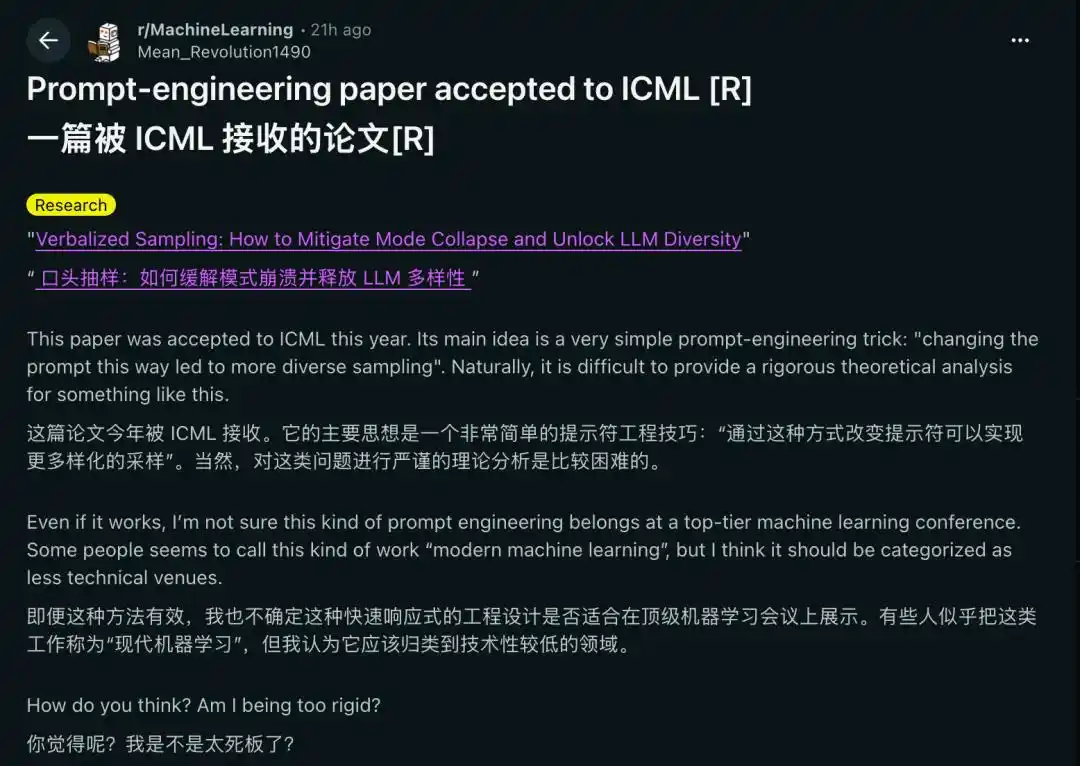
Sans proposer de nouvel algorithme d'optimisation, ni avoir entraîné un nouveau grand modèle, les auteurs n'ont fait qu'une chose —

Modifier le Prompt.

L'article propose une méthode appelée Verbalized Sampling (VS) qui, simplement en ajustant l'instruction, permet d'améliorer significativement la diversité des sorties des grands modèles de langage, atténuant ainsi le problème de Mode Collapse (effondrement des modes) qui perturbe depuis longtemps les LLM.

Cela semble présenter une valeur pratique considérable, mais est-il juste qu'une simple astuce de Prompt puisse être acceptée dans une conférence prestigieuse ?

Examinons d'abord l'article avant de juger.

Un article ICML très controversé
Avez-vous déjà eu cette impression que l'IA devient de plus en plus homogène ?

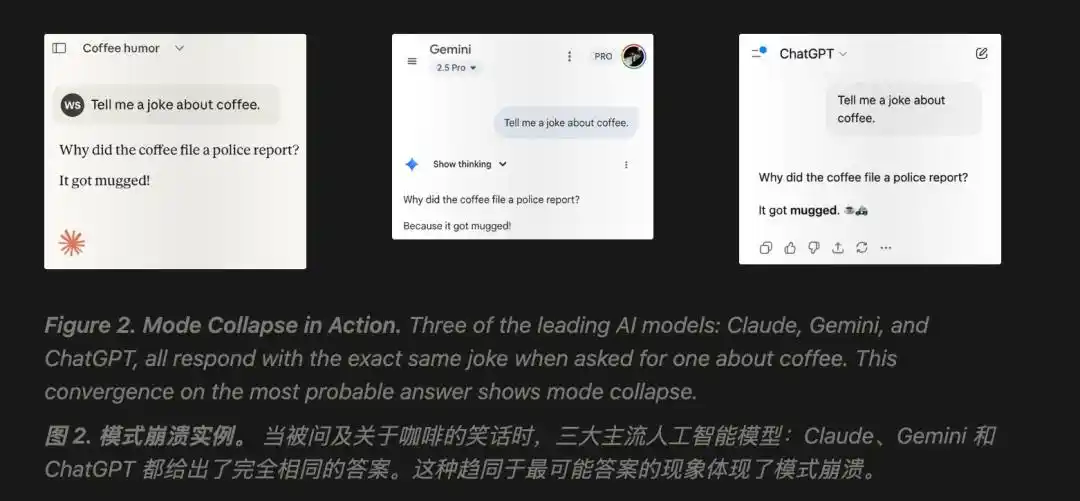
Demandez-lui dix fois de « raconter une blague », les réponses sont souvent très similaires. Et ce n'est pas seulement le cas pour les tâches créatives, mais aussi pour répondre aux questions, générer du code...

Ce phénomène est connu dans le milieu universitaire sous le nom d'effondrement des modes.

En bref, le modèle a tendance à privilégier les réponses classiques, les plus probables et les plus sûres, et à rejeter les idées créatives alternatives.
Par le passé, pour résoudre ce problème, la plupart des chercheurs pensaient d'abord à ajuster les paramètres d'échantillonnage, modifier les algorithmes de décodage, ré-entraîner, etc. Mais cet article prend une voie différente : il demande directement au modèle de sortir également son propre processus d'échantillonnage.

Par exemple, reprenons la blague précédente. Les auteurs modifient l'instruction pour demander au modèle :

Génère 5 blagues, et attribue une valeur de probabilité possible à chaque blague.

Le modèle peut alors produire des réponses plus riches et moins répétitives.

Cela semble très simple, et c'est en fait la contribution principale de cet article — la méthode d'échantillonnage verbalisé des probabilités. Pas besoin de fine-tuning, il suffit de changer la façon de poser la question pour augmenter considérablement la diversité du contenu.
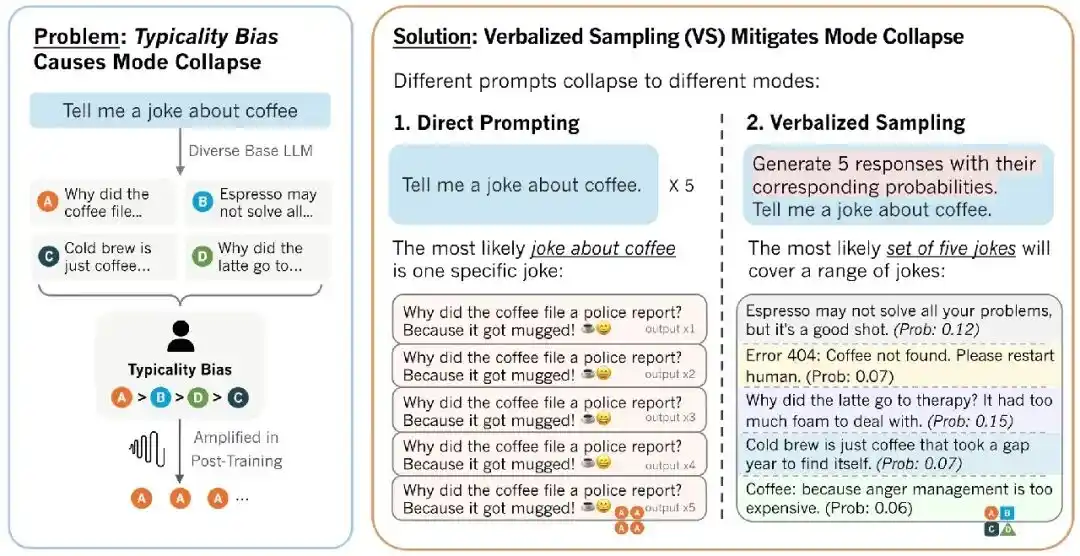
Cependant, dans l'article, les auteurs appuient cette idée par un processus de démonstration rigoureux.

Ils répondent d'abord à la cause fondamentale de l'uniformité des modèles.

Par le passé, le milieu académique attribuait ce problème à des facteurs algorithmiques, comme un modèle de récompense imparfait ou une pénalité KL mal calibrée. Cet article approfondit l'investigation et estime que la véritable racine du problème réside dans les données de préférence elles-mêmes.

Ils proposent le concept de biais de typicalité. Du point de vue de la psychologie cognitive, les annotateurs humains ont une préférence naturelle pour les textes familiers, fluides et conventionnels. Lorsqu'ils attribuent des scores, ils donnent naturellement des notes plus élevées aux réponses stéréotypées et grand public.
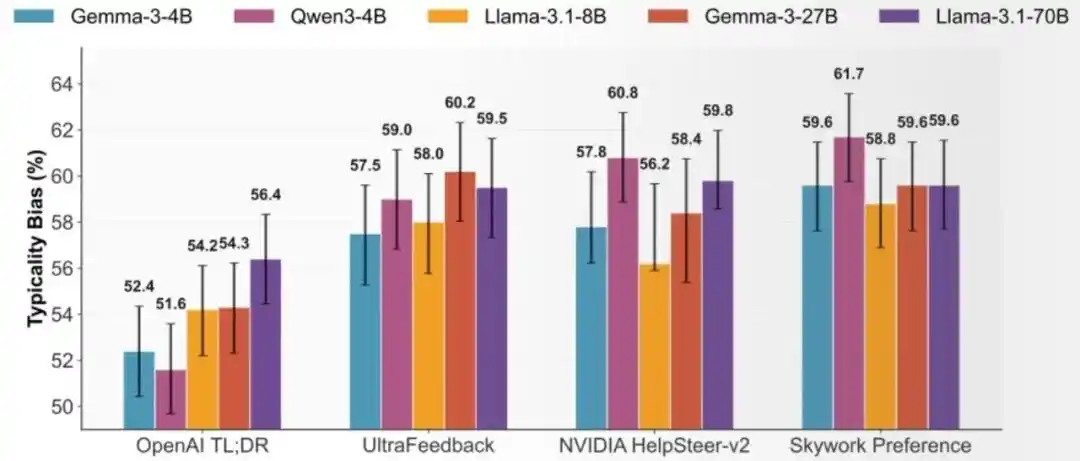
Ainsi, même avec un modèle de récompense et un algorithme d'optimisation parfaits, si les données de préférence humaine utilisées pour l'entraînement contiennent un biais de typicalité, le modèle aligné souffrira toujours d'un effondrement des modes.

Pour vérifier cela, les auteurs ont effectué des tests répétés sur cinq ensembles de données de préférence et différents modèles de base, et la conclusion est restée cohérente.

Après avoir compris ce point, les auteurs estiment que puisque le problème est enraciné dans les données d'entraînement, il suffit de concevoir une solution au niveau de l'inférence pour le corriger. Ainsi, en demandant dans le Prompt au modèle de produire une distribution de probabilité complète, on peut réveiller la distribution de sortie plurielle que le modèle possédait originellement pendant la phase de pré-entraînement, et retrouver la diversité.

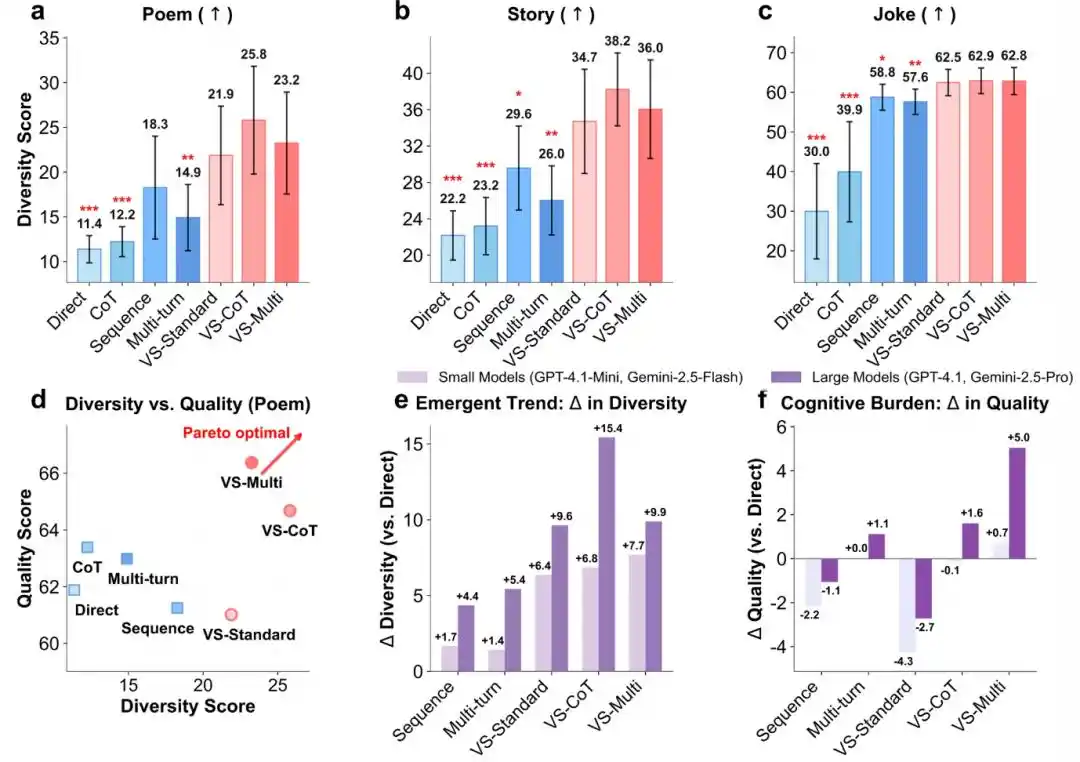
Il ne restait plus qu'à tester cette méthode dans divers scénarios. Les résultats montrent que dans les tâches d'écriture créative, la diversité est 1,6 à 2,1 fois supérieure à celle d'un prompt standard, sans pour autant réduire la précision factuelle du contenu ou le niveau de sécurité du modèle.

De plus, plus le modèle est puissant et plus son nombre de paramètres est élevé, plus l'amélioration de la diversité apportée par la VS est importante.
Ainsi, même si la méthode proposée dans cet article est finalement simple, l'ICML l'a tout de même acceptée.

La polémique fait rage sur Reddit

Mais sous le post original, les avis sur cet article sont partagés.

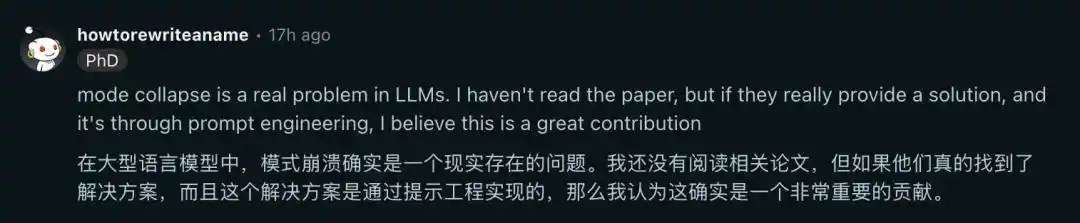
De nombreux internautes estiment qu'auparavant, l'ICML était réservée à des innovations techniques comme de nouveaux modèles, algorithmes ou théories. Se concentrer uniquement sur le Prompt et l'optimisation du processus d'inférence ne correspond pas à une recherche sérieuse en apprentissage automatique.

En comparaison, l'innovation de ce travail semble un peu légère et présente plusieurs problèmes :

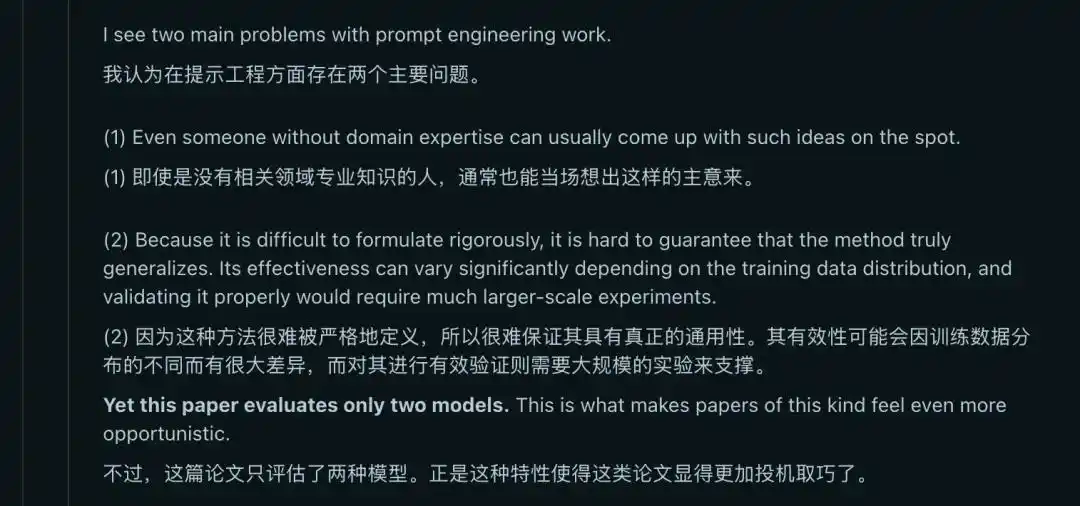
Premièrement, des méthodes similaires d'écriture d'instructions ne sont pas uniques, certains affirmant même qu'ils écrivaient déjà leurs prompts de cette façon hier. Deuxièmement, la théorie n'est pas facile à vérifier, car un prompt peut devenir inefficace avec un autre modèle, contrairement à un algorithme plus stable. Troisièmement, l'échelle expérimentale est limitée, ce qui ne suffit pas à prouver qu'il s'agit d'une règle universelle.
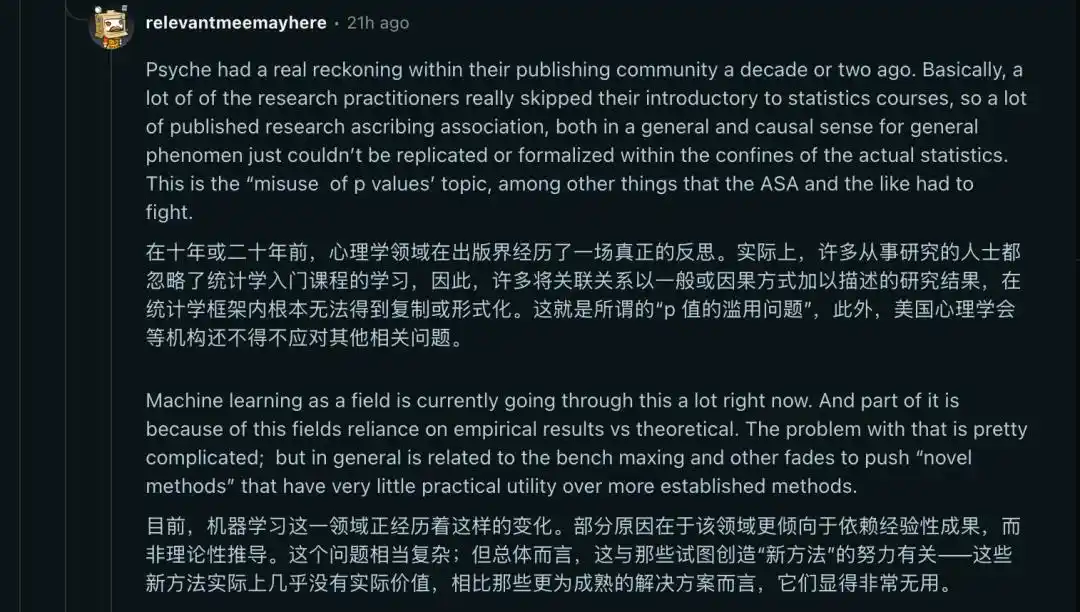
Certains internautes comparent même la situation actuelle dans le domaine de l'apprentissage automatique à la crise académique qu'a traversée le milieu de la psychologie il y a une dizaine d'années.

À l'époque, de nombreux chercheurs avaient une faible base en statistiques et abusaient des outils statistiques, conduisant à des conclusions non reproductibles dans de nombreux articles et à une grave crise de confiance dans le secteur. Aujourd'hui, l'industrie de l'apprentissage automatique est aussi fortement dépendante des expériences empiriques et néglige souvent un soutien théorique rigoureux.

La concurrence interne pousse à la course aux nouvelles méthodes, mais il existe une tendance généralisée au surajustement des paramètres et à l'amélioration artificielle des scores sur des benchmarks. Beaucoup de prétendues innovations algorithmiques n'ont pratiquement aucune valeur pratique par rapport aux modèles de référence matures, et sont présentées comme des résultats innovants sur la base d'améliorations minimes d'indicateurs.

En substance, ces problèmes de publication d'articles sont dus au manque de clarté des normes professionnelles suite à l'expansion rapide de la discipline.
Mais les partisans estiment que la recherche scientifique ne consiste pas à comparer la complexité des méthodes. Tant que l'hypothèse est claire, les expériences sont suffisantes et les résultats sont stables et reproductibles, cela peut très bien constituer une recherche de qualité.

Par exemple, cet article explique clairement ce qu'est l'effondrement des modes et avance que le véritable problème réside dans le biais de typicalité des préférences. Ce point de vue est plus important que le Prompt lui-même.
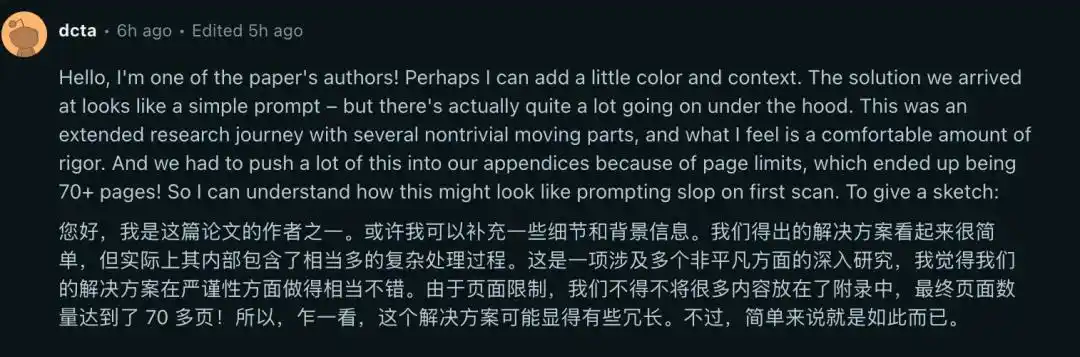
L'un des auteurs a lui-même répondu dans les commentaires, indiquant que cet article, bien qu'apparemment simple, impliquait en réalité un processus de traitement très complexe.

L'ensemble du travail comprend une analyse complète de la source du problème, une nouvelle attribution théorique, une dérivation mathématique, des expériences quantitatives multidimensionnelles, ce n'est pas un travail superficiel de réglage de prompt.
Beaucoup ont également mentionné le CoT (Chain-of-Thought). Lorsque le CoT est apparu pour la première fois, il s'agissait essentiellement d'une simple instruction :

Réfléchissons étape par étape.

Mais aujourd'hui, presque toutes les méthodes de raisonnement peuvent être rattachées au CoT. Cela montre précisément que l'ingénierie des prompts n'est plus simplement l'écriture d'instructions ; elle devient une nouvelle méthode pour étudier le comportement des modèles.

Au cours des dix dernières années, la recherche en apprentissage automatique s'est principalement concentrée sur l'entraînement. Mais aujourd'hui, certaines techniques d'utilisation au stade de l'inférence commencent également à occuper une place centrale dans la recherche en apprentissage automatique.

Peut-être que dans les prochaines années, nous verrons de plus en plus d'articles de ce type. Ils n'ajoutent pas une seule ligne de code d'entraînement ni un seul paramètre de modèle, mais peuvent néanmoins repousser les limites des capacités des grands modèles.

Présentation de l'équipe de recherche

Enfin, jetons un coup d'œil à l'équipe de recherche.

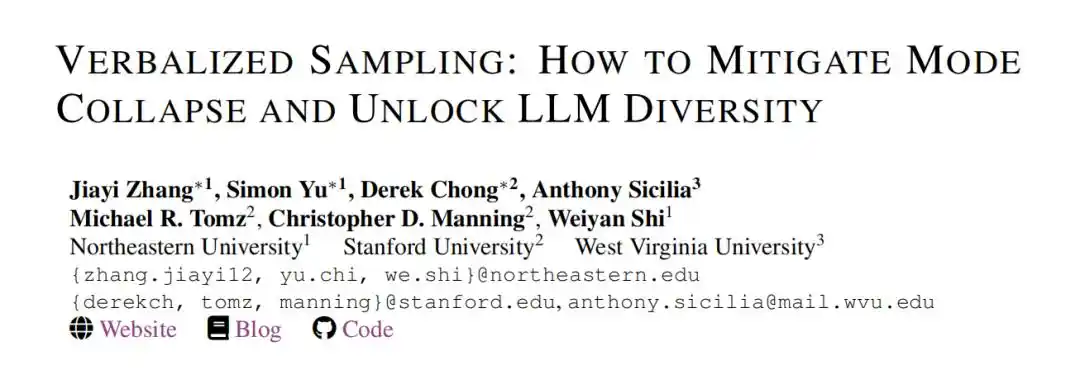
Ce travail est le fruit d'une collaboration entre l'équipe de Weiyan Shi de la Northeastern University, le Manning Lab de Stanford et l'Université de Virginie-Occidentale. Jiayi Zhang, Simon Yu et Derek Chong sont les premiers auteurs conjoints.

Jiayi Zhang a obtenu son bachelor à l'Université du Michigan avec un triple diplôme en informatique, mathématiques et linguistique, puis a poursuivi un master en informatique à la Northeastern University.

Un autre de ses articles, accepté à la conférence NLP de premier plan NAACL 2024, intitulé « Analyzing the Role of Semantic Representations in the Era of Large Language Models », s'intéresse également aux représentations sémantiques et aux grands modèles de langage.

Simon Yu prépare actuellement un doctorat à la Northeastern University. Ses recherches portent principalement sur les mécanismes d'alignement et d'apprentissage par renforcement dans les grands modèles. Il a obtenu son master et son bachelor à l'Université d'Édimbourg et a publié plusieurs articles dans des conférences de premier plan.

En plus de cet article, un autre de ses articles, « Unsafer in Many Turns: Benchmarking and Defending Multi-Turn Safety Risks in Tool-Using Agents », a également été accepté pour l'ICML 2026.

Derek Chong est diplômé d'un master de l'Université de Stanford et est actuellement chercheur au Stanford Artificial Intelligence Laboratory. Ses recherches se concentrent principalement sur les grands modèles de langage et le NLP.

Il a trois ans d'expérience en tant que fondateur de startup et a travaillé en tant que scientifique appliqué chez Ello, participant au développement et à la mise en œuvre de l'IA dans l'industrie. Il possède donc à la fois des bases théoriques solides et une riche expérience pratique sur le terrain.

Références :[1]https://www.reddit.com/r/MachineLearning/comments/1uv1xb3/promptengineering_paper_accepted_to_icml_r/

[2]https://www.linkedin.com/in/jiayizx/[3]https://simonucl.github.io/[4]https://www.linkedin.com/in/derekch/

Cet article provient du compte WeChat « 量子位 » (Qubit), auteur : 关注前沿科技 (Suivre les technologies de pointe)


Trending Cryptos

Related Questions

QQuel est le nom de la méthode présentée dans l'article pour améliorer la diversité des sorties des grands modèles de langage ?

ALa méthode présentée s'appelle "Verbalized Sampling" (VS), qui consiste à ajuster les prompts pour que le modèle génère une distribution de probabilités complète, augmentant ainsi la diversité des réponses.

QPourquoi les réponses des modèles de langage deviennent-elles souvent similaires et répétitives selon l'article ?

ASelon l'article, cette tendance, appelée "effondrement modal" (Mode Collapse), est principalement due au biais de typicalité dans les données de préférence humaines utilisées pour l'entraînement, où les annotateurs favorisent inconsciemment des réponses familières et conventionnelles.

QQuel argument est avancé dans l'article pour justifier qu'une simple technique de prompt puisse mériter une publication dans une conférence prestigieuse comme l'ICML ?

AL'article souligne que le travail inclut une analyse théorique approfondie, une attribution causale (biais de typicalité), des dérivations mathématiques et des expériences quantitatives rigoureuses, dépassant le simple ajustement de prompt et offrant une contribution scientifique significative.

QQuelle analogie est faite par certains commentateurs en ligne concernant l'état actuel de la recherche en apprentissage automatique ?

ACertains commentateurs comparent la situation actuelle en apprentissage automatique à la crise de réplication qu'a connue la psychologie il y a une dizaine d'années, critiquant une dépendance excessive aux expériences empiriques et un manque de fondements théoriques rigoureux.

QQuel exemple historique de technique de prompt est cité dans l'article pour illustrer l'importance croissante de l'ingénierie des prompts ?

AL'article cite la méthode "Chain-of-Thought" (CoT), qui a débuté avec un simple prompt "Let's think step by step", comme exemple fondateur montrant que l'ingénierie des prompts est devenue une méthode de recherche cruciale pour comprendre et améliorer le comportement des modèles.

Related Reads

Low Investment Isn't Apple's Immunity Pass

While Meta and Google face investor scrutiny over ballooning AI capital expenditures, Apple's minimal AI investment has paradoxically become a strength. Its market cap recently reclaimed the global top spot, surpassing $5 trillion. The irony is deep: Apple's own AI efforts have lagged, with "Apple Intelligence" delayed and core talent lost, forcing reliance on partners like Google Gemini and Alibaba's Qianwen. Its Q3 FY2026 (Q2 CY) earnings initially seemed stellar. Revenue hit $109.4B (up 16% YoY), with iPhone and Mac sales, growing 22% and 29% respectively, driving most of the growth. However, the stock fell over 8% post-earnings. The primary concern was a weaker Q4 revenue growth forecast of 9-11%, below expectations, due to looming supply chain constraints. Apple is feeling the indirect cost of the AI boom. Soaring memory and chip prices, fueled by massive data center investments from Microsoft, Amazon, and others, are forcing Apple to raise Mac and iPad prices significantly. The upcoming iPhone launch is also expected to see substantial price hikes. Despite avoiding heavy AI infrastructure spending—its capital expenditures are actually down 28%—Apple cannot escape the industry-wide supply and cost pressures. While Apple's operating cash flow remains robust, its substantial R&D spending (up 32% YoY) has yet to yield major AI breakthroughs. As Tim Cook prepares to step down as CEO, Apple faces a challenging transition: balancing its premium hardware success against the strategic and cost pressures of the AI era it has so far cautiously navigated.

marsbit41m ago

Low Investment Isn't Apple's Immunity Pass

marsbit41m ago

PA Graphics Explanation | One Chart to Understand the Major Web3 Events in August 2026

**PANews Crypto Calendar: Key Web3 Events in August 2026** PANews introduces its revamped crypto calendar, featuring comprehensive coverage, flexible filtering, and easy export options. The market in August will be shaped by multiple key events across macroeconomics, regulation, tokenomics, and project developments: * **Macro & Policy:** Key US economic data releases (July Non-Farm Payrolls, CPI), the Federal Reserve meeting minutes, and the Jackson Hole Economic Symposium will be in focus. On the regulatory front, the US Senate plans to release a new draft of the *CLARITY Act*, while the EU's expanded crypto ban against Belarus comes into effect. * **Token Unlocks:** Significant token unlocks are scheduled for assets including ENA, AVAX, CONX, ZRO, and KAITO, which may influence market volatility. * **Project Updates & Shutdowns:** Several services, including Exchange Art, Ctrl Wallet, Zapper, NFTfi, and Summer.fi, are set to cease operations or undergo major adjustments. Users are advised to manage their assets accordingly. * **Corporate Activity:** Q2 earnings reports from companies like SpaceX, Circle, and Nvidia are due. Unitree Robotics will initiate its IPO subscription on the STAR Market, and Moonshot AI plans to begin a Pre-IPO financing round. * **Industry Events:** Major conferences such as Bitcoin Asia 2026 and the 2026 Digital Expo will take place. The overarching market narrative for August will revolve around macroeconomic expectations, regulatory developments, token unlock schedules, and ongoing industry consolidation.

marsbit52m ago

PA Graphics Explanation | One Chart to Understand the Major Web3 Events in August 2026

marsbit52m ago

Wall Street's Most Famous 'Cassandra' Now Has His Sights Set on Nvidia

Michael Burry, the famed "Big Short" investor, has once again captured Wall Street's attention with a series of short positions against major tech and semiconductor stocks, most notably Nvidia. In late June and July, through his "Cassandra Unchained" newsletter, Burry disclosed short bets against Nvidia, Tesla, Applied Materials, Caterpillar, the SOXX semiconductor ETF, and later, Micron Technology. His core thesis revolves around potential distortions in the AI infrastructure boom, specifically questioning whether extended depreciation schedules (e.g., 6 years vs. a realistic 2-3 years for AI chips) by cloud giants like Microsoft and Google artificially inflate profits. He also raises concerns about possible "off-balance-sheet circular financing," where chip demand might be propped up by vendor-backed funding to clients. Nvidia's stock experienced volatility following these disclosures, briefly dipping but largely holding near Burry's reported entry points, leaving his positions roughly flat or slightly underwater as of late July. This move is part of a pattern for Burry, whose track record since his legendary 2008 bet is mixed. He has faced notable losses, such as on Tesla in 2021, while scoring on broader market turns like the 2020 pandemic crash. His methodology focuses intensely on free cash flow and scrutinizing original financial documents to spot overvaluation and structural risks, but it often struggles with timing the market. The article contrasts Burry's stance with other prominent investors. Steve Eisman, another "Big Short" figure, is not shorting Nvidia, citing strong fundamentals but expressing nervousness about sustainability. Jim Chanos agrees with the broad "accounting mismatch" concern—comparing it to the dot-com bubble—but targets financial leverage in private equity firms rather than the chip stocks themselves. While Nvidia's short interest remains relatively low at 1.3-1.4% of float, the massive stock size means absolute short losses have been significant, exceeding $5 billion earlier this year. The piece concludes that for ordinary investors, the key takeaway is not replicating specific short bets but learning from the critical frameworks these investors use: questioning rosy accounting, identifying structural vulnerabilities, and maintaining skepticism during market euphoria, even if pinpointing the exact catalyst for a downturn remains elusive.

marsbit1h ago

Wall Street's Most Famous 'Cassandra' Now Has His Sights Set on Nvidia

marsbit1h ago

Weekly Selection丨Epic Stock Market Volatility, Changxin Tech's IPO Reshapes Storage Landscape, Saylor Aims to Re-Anchor STRC Around September 8th

PANews Weekly Digest: Market Turmoil, Tech Breakthroughs, and Crypto Developments. The week saw significant volatility across global markets. South Korea's KOSPI index experienced extreme turbulence, including multiple trading halts, largely driven by sharp declines in AI hardware stocks like SK Hynix. In contrast, China's Changxin Xinqiao (CXC) achieved a landmark IPO with a market cap surpassing 4 trillion yuan, marking a major success for the domestic DRAM industry after a decade of losses. In the crypto and Web3 space, several key narratives emerged. AI is driving demand for new infrastructure, with projects like AI agent wallets and programmable payments gaining traction, attracting interest from firms like Coinbase. The Bitcoin mining sector is pivoting, with companies like MARA focusing on energy management as electricity becomes a core AI-era asset. Meanwhile, the RWA (Real World Assets) sector faces a "utilization puzzle," with hundreds of billions in on-chain assets remaining dormant. Notable market movements included a historic single-day surge of over 17% for the KOSPI index and a significant migration of $16.5 billion in staked ETH within the Lido ecosystem. Michael Saylor announced a target to re-peg the STRC stablecoin around September 8th. Other highlights include discussions on Ethereum's ambitious 2030 roadmap for scaling and privacy, analysis showing high protocol revenues not always translating to token price gains, and warnings from Citi about potential extreme commodity price shocks by late 2026.

marsbit1h ago

Weekly Selection丨Epic Stock Market Volatility, Changxin Tech's IPO Reshapes Storage Landscape, Saylor Aims to Re-Anchor STRC Around September 8th

marsbit1h ago

When the Market Begins to Question AI Capex: A Full Analysis of Q2 Earnings Reports from Five Tech Giants

In late July 2026, five major US tech giants—Alphabet, Intel, Microsoft, Meta, and Apple—released their Q2 earnings reports. While all companies exceeded revenue and profit expectations, driven by strong AI-related business growth, investor reactions diverged sharply due to concerns over escalating AI capital expenditures (capex) and their impact on free cash flow. Alphabet reported strong revenue growth and a surging cloud business, but its stock fell after announcing a doubled year-on-year capex and negative quarterly free cash flow for the first time. Intel posted its strongest revenue growth in over 15 years, but its stock experienced volatile trading after significantly raising its full-year capex guidance. Microsoft saw its stock surge after beating estimates and, crucially, lowering its capex forecast while projecting positive free cash flow. Meta faced the most severe sell-off as its profits declined despite revenue beats, with free cash flow plunging over 90% and its capex guidance raised. Apple reported record June-quarter results, but its stock plummeted after providing Q4 revenue guidance that fell short of expectations, citing supply chain constraints and forex headwinds. The overall takeaway is that the market's focus has shifted from validating AI demand to scrutinizing the timeline for returns on massive AI investments. Companies demonstrating a clearer path to managing capex and preserving free cash flow, like Microsoft, were rewarded, while those signaling continued aggressive spending faced investor skepticism.

Odaily星球日报1h ago

When the Market Begins to Question AI Capex: A Full Analysis of Q2 Earnings Reports from Five Tech Giants

Odaily星球日报1h ago

Trading

Spot

Hot Articles

What is G$

Understanding GoodDollar ($G$): A Blueprint for Decentralised Universal Basic Income Introduction In the ever-evolving landscape of cryptocurrency and blockchain technology, initiatives that seek to address pressing social issues have garnered increased attention. One such project is GoodDollar ($G$), a Web3-based universal basic income (UBI) solution. GoodDollar endeavours to tackle inequality and bridge the wealth gap by creating and distributing accessible economic resources to those most in need. Through its innovative use of decentralised finance (DeFi), GoodDollar presents a unique model that could potentially reshape the way financial assistance is perceived and delivered globally. What is GoodDollar ($G$)? GoodDollar is a cryptocurrency protocol that facilitates the issuance and distribution of digital tokens, referred to as $G$, to its registered users on a daily basis. These tokens function as a form of universal basic income, promoting financial empowerment for individuals from various backgrounds, especially those traditionally excluded from the financial system. Operating on the blockchain, GoodDollar utilises multiple chains, including Ethereum, Celo, and Fuse, ensuring broad access and usability. The fundamental goal of GoodDollar is to make cryptocurrency accessible and beneficial to everyone, irrespective of their economic starting point. The Creator of GoodDollar ($G$) Details concerning the creator of GoodDollar remain somewhat obscure. However, it is notably highlighted that the project has strong backing from eToro, a widely recognised investment platform that provided the initial funding and foundational support for GoodDollar's development. The vision behind the project is not solely profit-driven but leans heavily towards social entrepreneurship, aiming for a systemic change in economic accessibility. Investors of GoodDollar ($G$) GoodDollar enjoys the financial backing and operational support of eToro. This partnership has played a significant role in launching the protocol and its subsequent developments. While eToro was instrumental in establishing the foundation of the project, GoodDollar envisions transitioning towards a model funded by its community in the long run. This shift to community funding is in line with GoodDollar's commitment to decentralisation, allowing its users to have a direct stake in the project's future. How Does GoodDollar ($G$) Work? GoodDollar's operational framework relies heavily on DeFi principles to generate interest from staked cryptocurrencies. This mechanism allows the project to mint and distribute $G$ tokens as a digital basic income for users worldwide. Several key features contribute to GoodDollar's uniqueness and innovation: Universal Basic Income (UBI): Every day, registered users receive free tokens, establishing an automatic income stream intended to alleviate financial pressures. Sustainable Economic Model: The project’s tokenomics aim to balance supply and demand for $G$ tokens, ensuring that the value remains stable over time. Reserve-Backed Tokens: Each $G$ token is backed by a reserve of cryptocurrencies, providing it with inherent value and reliability, a crucial aspect for maintaining user trust. Decentralised Governance: GoodDollar incorporates a democratic approach to decision-making through token-powered decentralised governance. This allows community members to actively participate in the shaping of the project's trajectory, making it truly community-driven. Global Accessibility: GoodDollar has established a considerable community footprint, boasting over 640,000 members spanning 181 countries. Such widespread reach is instrumental in facilitating UBI on a global scale. Timeline of GoodDollar ($G$) The evolution of GoodDollar is marked by several significant milestones throughout its history: 2019: The launch of the GoodDollar wallet marked the first step in operationalising its vision of delivering UBI through cryptocurrency. 2020: Following the successful wallet rollout, the GoodDollar protocol officially debuted. This marked a crucial phase in its mission to provide daily distributed income. 2021: The project advanced further with the introduction of its Decentralised Autonomous Organization (DAO), fostering a greater level of community involvement and governance. 2022: GoodDollar unveiled its DeFi-friendly version 2 (V2), striving for enhanced user engagement and operational efficiency. The same year also saw the transition to a decentralised governance structure via GoodDAO. 2022: A new roadmap was conceptualised, focusing on initiatives like a grant program designed to promote $G$-related entrepreneurial ventures and an upgraded GoodDollar Marketplace. Key Features of GoodDollar ($G$) The GoodDollar project introduces numerous critical features aimed at redefining the landscape of basic income: Universal Basic Income: Delivering daily free tokens to its users fundamentally underscores its mission to eliminate economic precarity. Multi-Chain Operation: Leveraging multiple blockchain networks enhances accessibility and scalability, ensuring broader participation. Engagement with Decentralised Finance: The use of DeFi allows for sustainable funding of the UBI model, reinforcing its viability as an economic solution. Community Engagement and Governance: GoodDollar envisions a model where the community influences operations through democratic participation, fostering transparency and accountability. Global Community: Boasting a diverse global community enables the project to implement UBI solutions tailored to various cultural and economic contexts. Conclusion GoodDollar represents a transformative leap towards incorporating the principles of universal basic income through the innovative lens of blockchain technology. By harnessing decentralised finance, the project not only provides a solution to financial inequality but also actively engages users in its governance and operations. With a growing community and evolving roadmap, GoodDollar stands as a significant player in the intersection of cryptocurrency and social good, paving the way for a more equitable financial future. As it continues to evolve, GoodDollar’s journey may ultimately inspire other initiatives to consider similar models, furthering the cause of economic empowerment for all.

270 Total ViewsPublished 2024.04.05Updated 2024.12.03

What is G$

What is @G

Graphite Network, $@G: Bridging TradFi and Web3 Introduction to Graphite Network, $@G In the vibrant world of cryptocurrencies and web3 projects, Graphite Network emerges as a beacon of innovation. With its native token, $@G, this Layer-1, Proof-of-Authority (PoA) blockchain is tailored to bridge the gap between traditional finance (TradFi) and the rapidly evolving Web3 ecosystem. As digital currencies gain traction, Graphite Network strives to offer a blockchain platform that prioritises security, compliance, and speed, presenting itself as a facilitator of trust and accountability. What is Graphite Network, $@G? Graphite Network is not merely another blockchain project; it aims to redefine how decentralisation, security, and user accountability are perceived in the digital finance realm. The project boasts a series of distinctive features: Reputation-Based Blockchain: At its core, Graphite Network implements a one-user, one-account policy, fortified with integrated Know Your Customer (KYC) verification and scoring mechanisms. This design ensures a balance between user privacy and transparency—a critical aspect of financial operations in today’s digital world. Entry-Point Node Income: The network incentivises users to set up entry-point nodes, allowing operators to earn rewards from network transactions. This income generation model not only boosts user engagement but also reinforces network health and decentralisation. EVM Compatibility: With an Ethereum-compatible virtual machine (VM), Graphite Network enables seamless integration of existing Solidity decentralised applications (dApps) and smart contracts, thereby inviting developers to leverage its capabilities without extensive modifications. KYC Integration: In an era where compliance is paramount, the integrated KYC framework with multiple verification tiers enhances control over financial operations without mandatory participation, setting a precedent for user autonomy. Who is the Creator of Graphite Network, $@G? The Graphite Network is borne out of the endeavours of the Graphite Foundation, a non-profit organisation dedicated to the development, maintenance, and evolution of the Graphite Network. The foundation’s commitment underscores the project’s vision to create a secure and sustainable blockchain environment focused on genuine user engagement and compliance. Who are the Investors of Graphite Network, $@G? Currently, there is limited information available on the specific investors backing the Graphite Network initiative. The founding organisation, the Graphite Foundation, functions independently in fostering the project’s growth while seeking partnerships that resonate with its vision of a compliant and accessible blockchain platform. How Does Graphite Network, $@G Work? Graphite Network’s operation is grounded in its unique Proof-of-Authority consensus mechanism, which strikes an impressive balance between high throughput and decentralisation. Let's delve into the various components that define its operation: Transport Nodes: Serving as the entry-point nodes, these are critical to the ecosystem. Operators can earn revenue from transactions that traverse the network, which not only empowers individual users but also bolsters network decentralisation. Authorised Nodes: At the heart of the Graphite Network are core validators who undergo rigorous compliance tests, encompassing robust KYC verification along with technical assessments. This layer of trust is essential for ensuring that transactions within the network maintain a high level of integrity. Ticker System: Graphite Network employs a distinctive ticker system for its wrapped tokens, denoted as @G. This feature enhances clarity in asset integration, making user transactions comprehensible and straightforward. Graphite Network’s innovative approach reflects a significant step in addressing the crucial issues of digital finance, positioning itself favourably for the future as more users transition from traditional forms of finance into the world of decentralised applications. Timeline of Graphite Network, $@G To understand the progression and milestones of Graphite Network, it is beneficial to overview key events in its timeline: 2021: The inception of Graphite Network by the Graphite Foundation marks the commencement of a new chapter in blockchain development, focusing on compliance and user empowerment. Key Developments: Following its launch, the introduction of entry-point node income, the establishment of a reputation-based model, integrated KYC verification, and the provision of EVM compatibility represent significant advancements in the project. Recent Activities: The continuous development and nurturing efforts of the Graphite Foundation have focused on augmenting network features while fostering the ecosystem's growth, demonstrating a long-term commitment to sustainability and innovation. Additional Key Points Beyond its foundational components, Graphite Network encompasses several tools and features that bolster its usability: Graphite Wallet: A user-friendly Chrome extension that facilitates access to various network features and applications across Ethereum-compatible chains, enhancing user convenience. Graphite Bridge: This utility allows seamless transfers of Graphite assets across different networks, fostering an integrated and interoperable ecosystem. Graphite Explorer: Serving as an essential tool within the ecosystem, this feature enables users to view and verify smart contract source code, track transactions, and explore other vital information in real-time. Graphite Testnet: The project provides a robust testing environment for developers, allowing them to ensure stability and scalability prior to mainnet deployment. This initiative not only empowers developers but also enhances the reliability of the entire network. Conclusion Graphite Network, with its native token $@G, represents a significant stride toward bridging traditional finance and cutting-edge blockchain technology. By focusing on security, compliance, and decentralisation, this innovative platform is set to lead the transition into the Web3 era. As user engagement grows and more projects leverage its capabilities, Graphite Network is poised to make lasting contributions to the rapidly evolving digital landscape. In conclusion, Graphite Network stands as a testament to what can be achieved when innovative thinking meets the growing demands of modern finance and technology. As the world explores the potential of decentralised finance, Graphite Network will undoubtedly remain a noteworthy player in this arena.

49 Total ViewsPublished 2025.01.06Updated 2025.01.06

What is @G

Discussions

Welcome to the HTX Community. Here, you can stay informed about the latest platform developments and gain access to professional market insights. Users' opinions on the price of G (G) are presented below.

活动图片