Les actions de semi-conducteurs propulsent la reprise du Nasdaq, le Dow franchit pour la première fois 53 000 points, le pétrole et l'or sous pression, le Bitcoin s'envole après la déclaration de Trump

华尔街日报Published on 2026-07-13Last updated on 2026-07-13

Abstract

Les marchés américains ont affiché une reprise générale lundi, portée par les actions technologiques et les semi-conducteurs, interrompant une série de pertes hebdomadaires. Le Dow Jones a franchi pour la première fois le seuil des 53 000 points. Cette dynamique a été soutenue par des annonces positives concernant les feuilles de route des serveurs de Nvidia et l'extension jusqu'en 2031 du partenariat entre Broadcom et Apple. Le bitcoin a connu un rebond significatif après que l'ancien président Donald Trump se soit déclaré "fervent partisan des cryptomonnaies", atteignant 63 571 dollars. À l'inverse, l'or a légèrement reculé sous la pression de sorties d'ETF et de commentaires plus fermes de la Fed. Sur le marché pétrolier, les prix restent sous pression après que l'Arabie saoudite a annoncé la plus forte réduction de ses prix officiels depuis au moins 26 ans pour ses livraisons d'août, ravivant les craintes d'un excès d'offre. L'OPEC+ a par ailleurs convenu d'augmenter progressivement ses objectifs de production. Certains analystes émettent des réserves sur la durabilité du rallye des semi-conducteurs, comparant sa trajectoire à celle de l'argent avant un récent repli. La question centrale pour l'IA reste de savoir si les niveaux de profit exceptionnels actuels pourront être maintenus. Les investisseurs surveillent également les plans de dépenses en capital des géants du cloud pour évaluer la pérennité de la demande en infrastructures d'IA.

Les marchés actions américains ont progressé lundi, les valeurs technologiques en tête, interrompant la série de baisses de la semaine précédente. Parallèlement, une forte réduction du prix du pétrole par l'Arabie saoudite a ravivé les inquiétudes liées à un surplus d'offre, faisant pression sur les prix internationaux du brut.

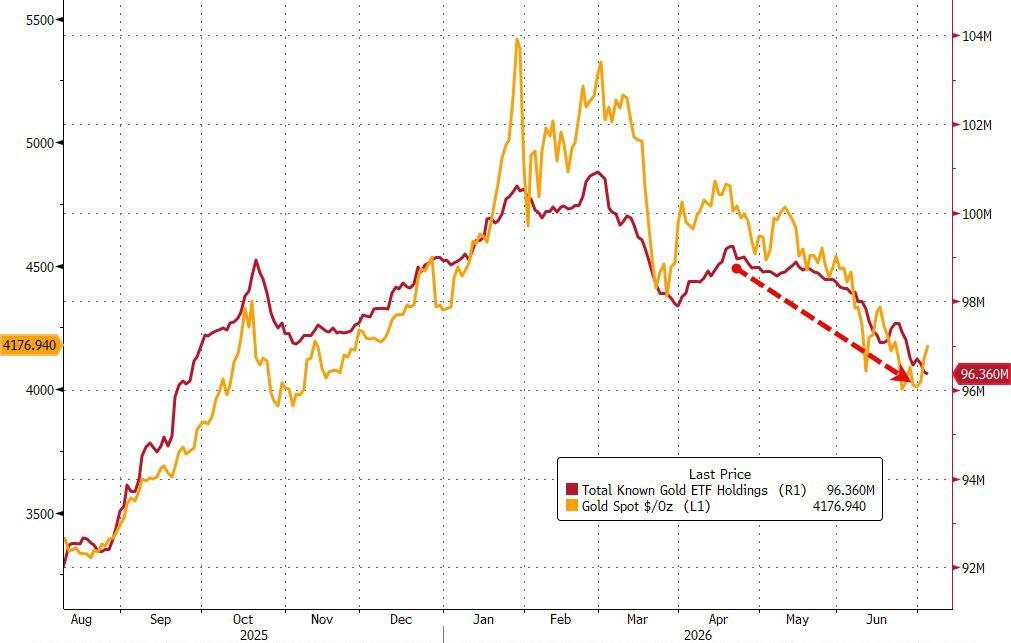
L'or a légèrement reculé en raison des sorties continues des ETF ; le Bitcoin, en revanche, a rebondi vigoureusement après que Donald Trump a publiquement exprimé son soutien aux cryptomonnaies.
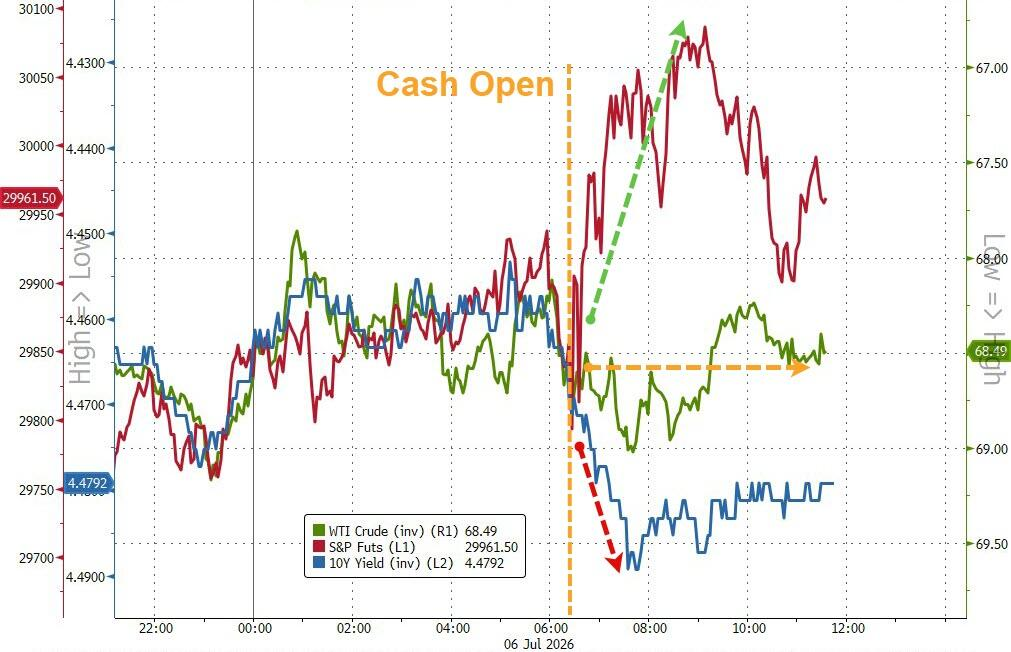
L'indice Nasdaq 100 a gagné 1,3 % lundi, le S&P 500 a progressé de 0,7 % et le Dow Jones Industrial Average a augmenté de 0,3 %, franchissant en cours de séance le seuil symbolique des 53 000 points. La confirmation par Nvidia que sa feuille de route serveur n'est pas affectée, et l'annonce par Broadcom d'une prolongation de sa collaboration sur les puces avec Apple jusqu'en 2031, ont renforcé la confiance du marché dans la pérennité des investissements dans les infrastructures d'IA.

Donald Trump, depuis le Bureau ovale de la Maison Blanche, a déclaré publiquement : "Je suis devenu un fervent partisan des cryptomonnaies", ce qui a directement propulsé le Bitcoin vers ses plus hauts de la journée, élargissant sa hausse intrajournalière à environ 1,4 %, à 63 571 dollars. L'or a quant à lui baissé de 0,4 % à 4 162 dollars l'once, les commentaires plutôt hawkish de responsables de la Fed continuant de peser sur les métaux précieux.
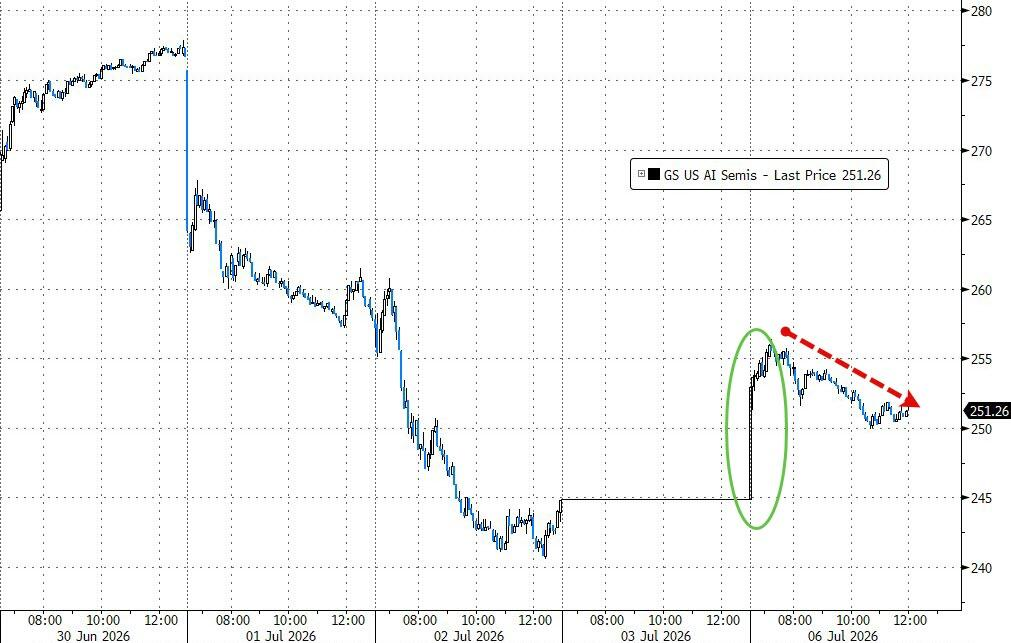
Hon Hai Precision, partenaire de Nvidia, a publié un chiffre d'affaires trimestriel en progression d'environ 40 % en glissement annuel, dépassant les attentes du marché, et a indiqué que la demande en IA continuait de s'élargir.

Le géant sud-coréen des puces mémoire SK Hynix a également entamé lundi sa tournée de promotion officielle pour son introduction en Bourse aux États-Unis, visant une levée de fonds de 43 000 milliards de wons (environ 280 milliards de dollars), et ayant déjà obtenu des engagements indicatifs allant jusqu'à 70 milliards de dollars de la part d'investisseurs clés.

Cependant, une comparaison établie par Mike Wilson, stratège en chef de Morgan Stanley, a retenu l'attention. Il souligne que la trajectoire actuelle du secteur des semi-conducteurs ressemble fortement à celle de l'argent avant son effondrement, suggérant un risque de bulle non négligeable.

L'équipe du BlackRock Investment Institute, dirigée par Jean Boivin, estime que la question centrale pour déterminer si l'IA constitue une bulle n'est pas le niveau de valorisation actuel, mais la capacité future des bénéfices à se maintenir à un niveau exceptionnel. L'équipe écrit :

Le marché valorise de plus en plus ce scénario, anticipant que l'IA sera suffisante pour stimuler la productivité et la croissance, soutenant ainsi les bénéfices exceptionnels actuels.

L'équipe de Jean Boivin indique que les marges encore élevées actuellement constituent l'un des arguments en faveur de la résilience des bénéfices.

Mark Haefele, directeur des investissements chez UBS, déclare que cette semaine, les investisseurs chercheront des signes de stabilisation de la récente volatilité des actions technologiques, tout en évaluant si la pression sur les cours des grands opérateurs de cloud hyperscale affecte les anticipations du marché concernant la trajectoire des dépenses en capital liées à l'IA.

Il note que si les plans de dépenses en capital restent inchangés, cela contribuera à dissiper les doutes du marché sur la pérennité de la demande en infrastructures d'IA.

Le marché pétrolier a poursuivi sa faiblesse lundi, le brut WTI évoluant quasiment à l'équilibre dans la fourchette de 68 à 69 dollars, tandis que le Brent est tombé à 71,75 dollars, son plus bas niveau depuis fin février de cette année.
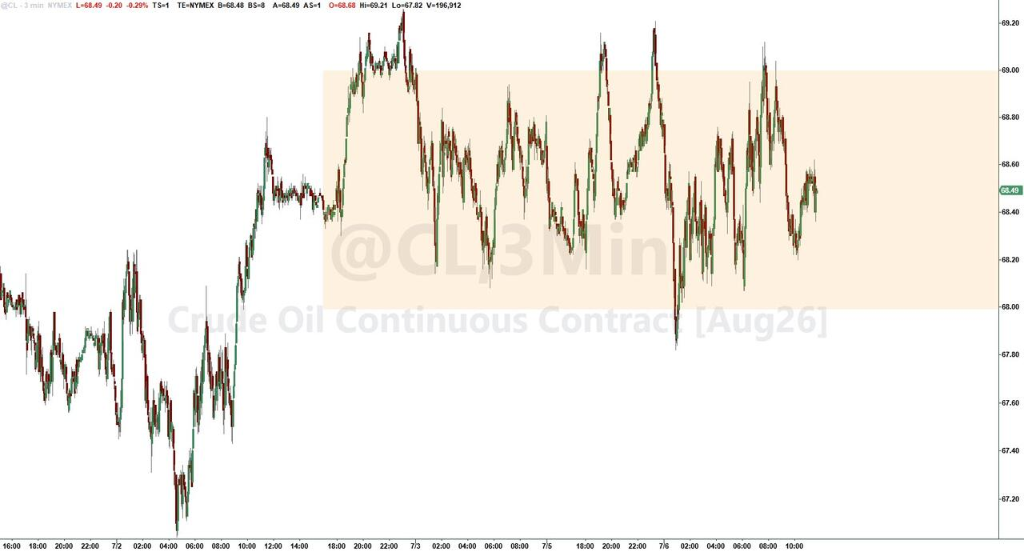
Le déclencheur clé de cette pression sur les prix du pétrole réside dans la forte réduction par l'Arabie saoudite des prix officiels de ses cargaisons de brut pour août.
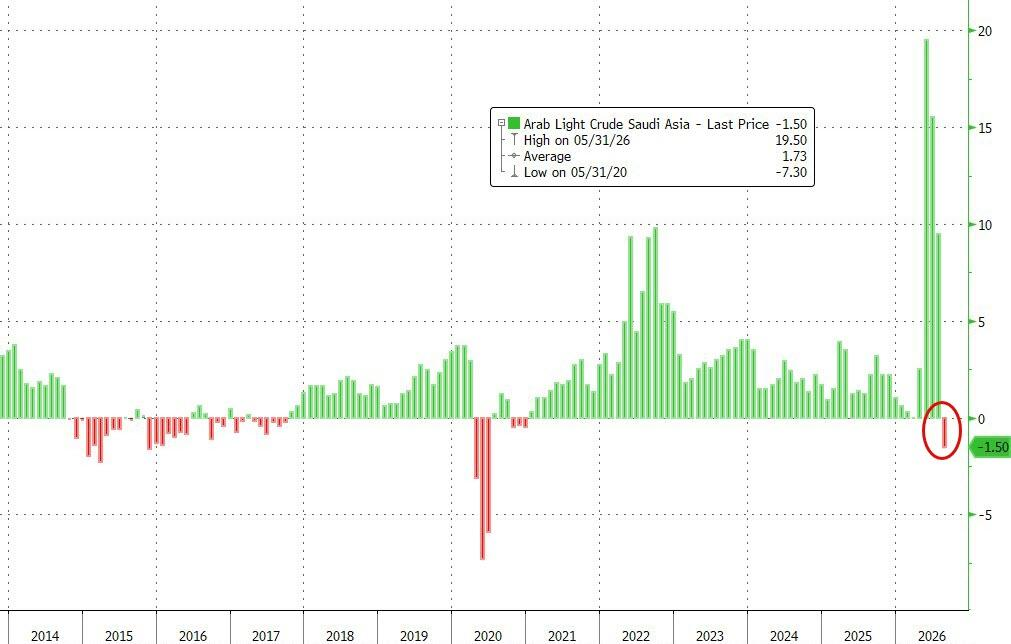
Il s'agit de la plus forte réduction des prix officiels en au moins 26 ans par l'Arabie saoudite, et également de la première fois depuis la guerre des prix de 2020 qu'elle vend du pétrole à prix réduit.

Cela suscite des craintes quant à la possibilité que d'autres pays producteurs de pétrole du Moyen-Orient soient contraints de suivre avec des réductions de prix, leurs prix officiels devant être publiés dans les prochains jours. L'OPEP+ a parallèlement convenu de relever ses objectifs de production de 188 000 barils par jour à partir d'août.

Ahmed Mehdi, analyste des marchés pétroliers chez Renaissance Energy Advisors, explique que la réduction de prix de l'Arabie saoudite reflète un engorgement des stocks de cargaisons spot, et non une nouvelle guerre des prix, étant davantage le résultat de la "normalisation du désordre dans le détroit d'Ormuz". Il ajoute :

Les prix doivent être suffisamment compétitifs pour réactiver l'intérêt d'achat des pays asiatiques.

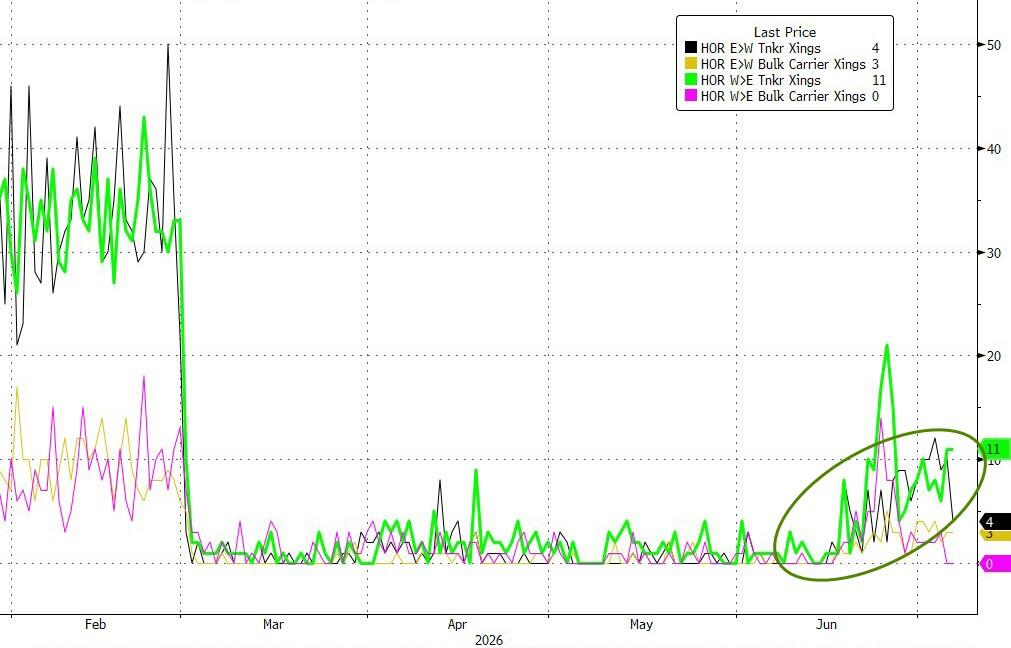
Le nombre de navires transitant par le détroit d'Ormuz continue de remonter, avec 160 navires ayant traversé le détroit du lundi au samedi dernier selon les rapports, bien que le niveau global reste bien inférieur à la normale d'avant la guerre.
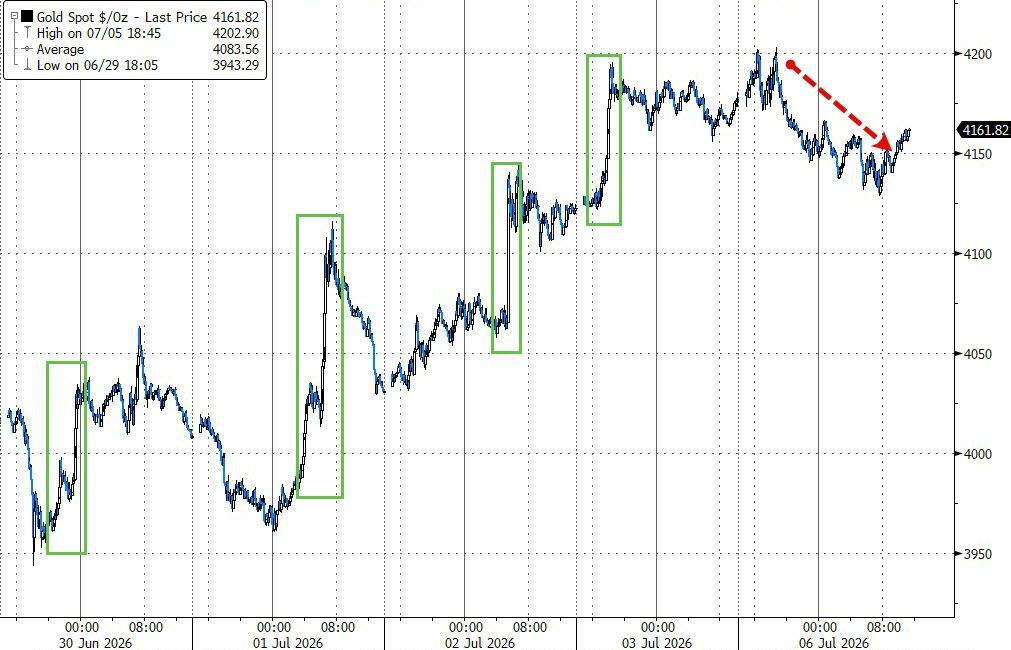
L'or a reculé lundi, le lingot physique perdant environ 0,4 % pour s'établir à 4 162 dollars l'once, bien qu'il ait brièvement testé le seuil des 4 200 dollars dans la nuit.
Selon un reportage de Bloomberg, la logique fondamentale de la pression sur l'or est la suivante : malgré la baisse du prix du pétrole, le dollar et les taux d'intérêt, les deux principaux moteurs financiers de l'or, influencés par des signaux hawkish de la Fed, évoluent tous deux dans une direction défavorable pour le métal jaune.
Le gouverneur de la Fed, Christopher Waller, a réaffirmé lors d'une conférence à Rome que les indications prospectives conservaient de la valeur lorsqu'elles étaient utilisées avec prudence, tout en soulignant que la balance des risques de la Fed penchait désormais clairement du côté de l'inflation.

Les données de l'ISM sur les services, publiées lundi, montrent que l'activité du secteur des services aux États-Unis a ralenti légèrement en juin, mais que l'emploi s'est redressé et les pressions sur les coûts se sont quelque peu atténuées. Le rapport de l'ISM note également que, en raison des conflits géopolitiques et des pressions sur les coûts sectoriels, plusieurs industries prévoient d'augmenter leurs prix, renforçant les anticipations d'inertie inflationniste.

Lawrence Gillum, stratège en chef des titres à revenu fixe chez LPL Financial, déclare :

Le marché des taux s'est nettement apaisé, ce n'est plus l'histoire du prix du pétrole, et il n'y a pas non plus de facteurs stimulants majeurs.

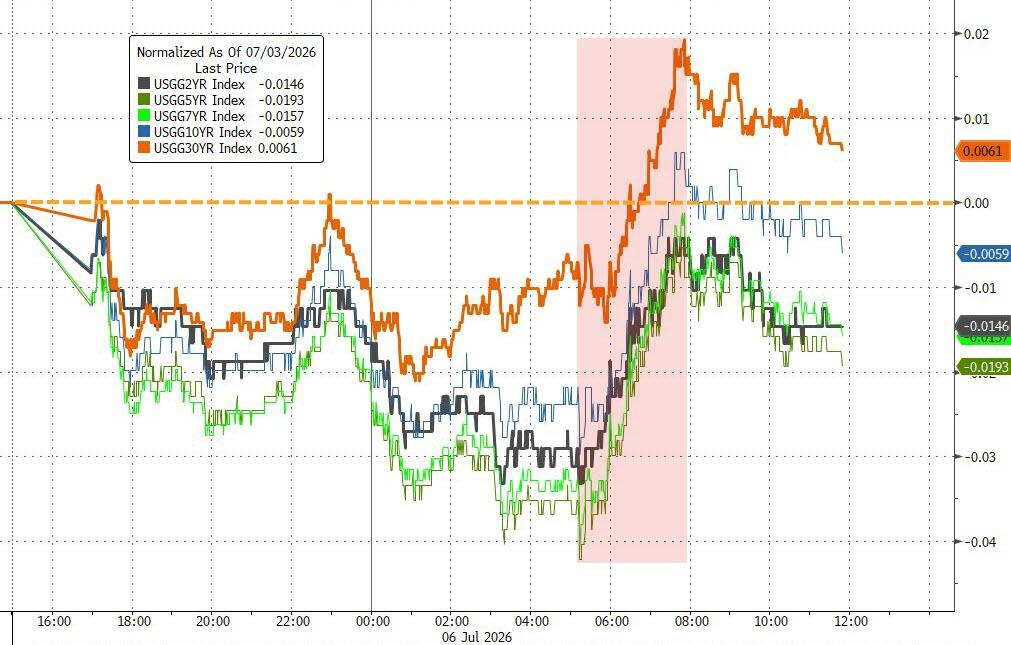
Le rendement des obligations du Trésor américain à 10 ans a légèrement reculé de 2 points de base lundi, à 4,47 %, tandis que celui à 30 ans a augmenté d'un point de base, la courbe dans son ensemble évoluant de manière modérée.
Les anticipations de hausse des taux pour 2026 se maintiennent à environ 30 points de base, restant significativement plus élevées que la valorisation du marché avant la prise de fonction du nouveau président de la Fed, Kevin Warsh.
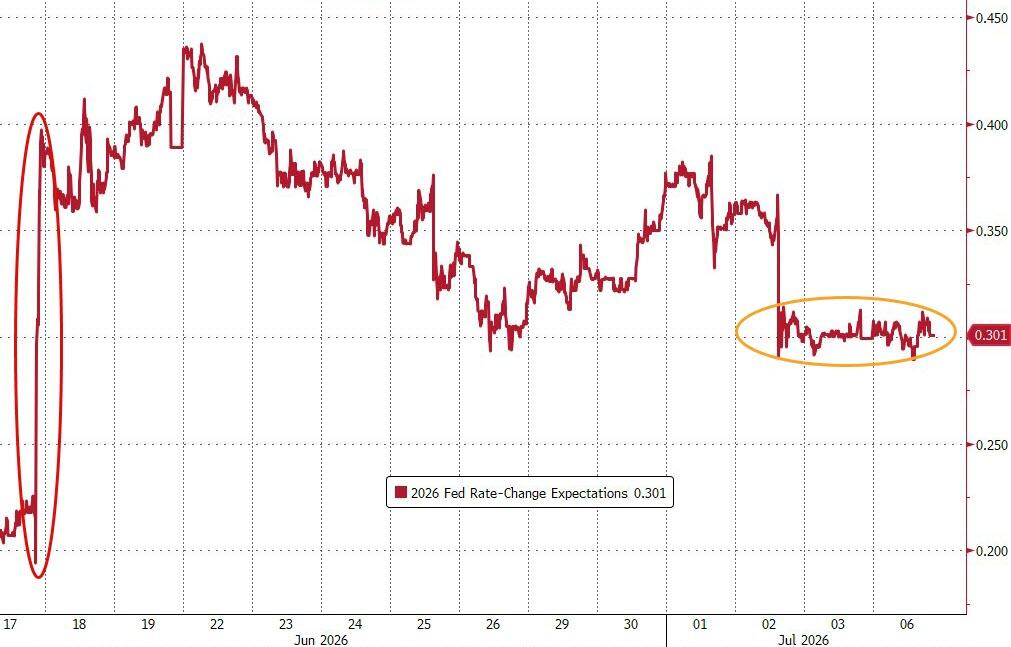
Le marché s'attend généralement à ce que Kevin Warsh conduise à un affaiblissement des éléments d'orientation politique dans les comptes rendus des réunions du FOMC. Steve Englander de Standard Chartered écrit dans un rapport :

Nous nous attendons à ce que Kevin Warsh rende les comptes rendus du FOMC, moins informatifs quant à la représentation des points de vue des participants.

Le marché des cryptomonnaies a connu des fluctuations marquées lundi.

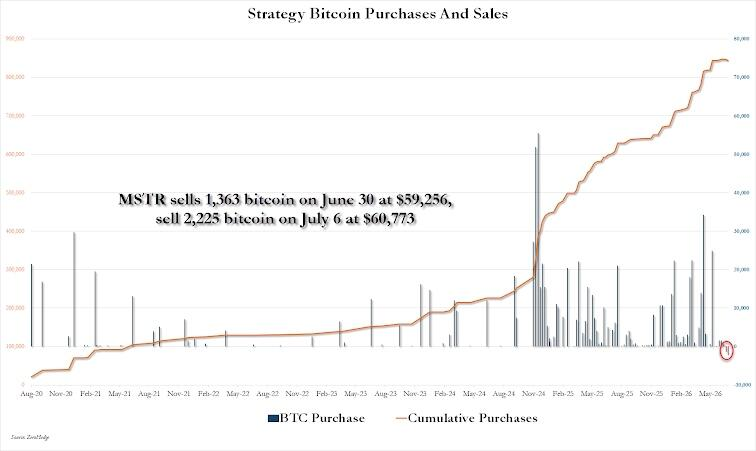
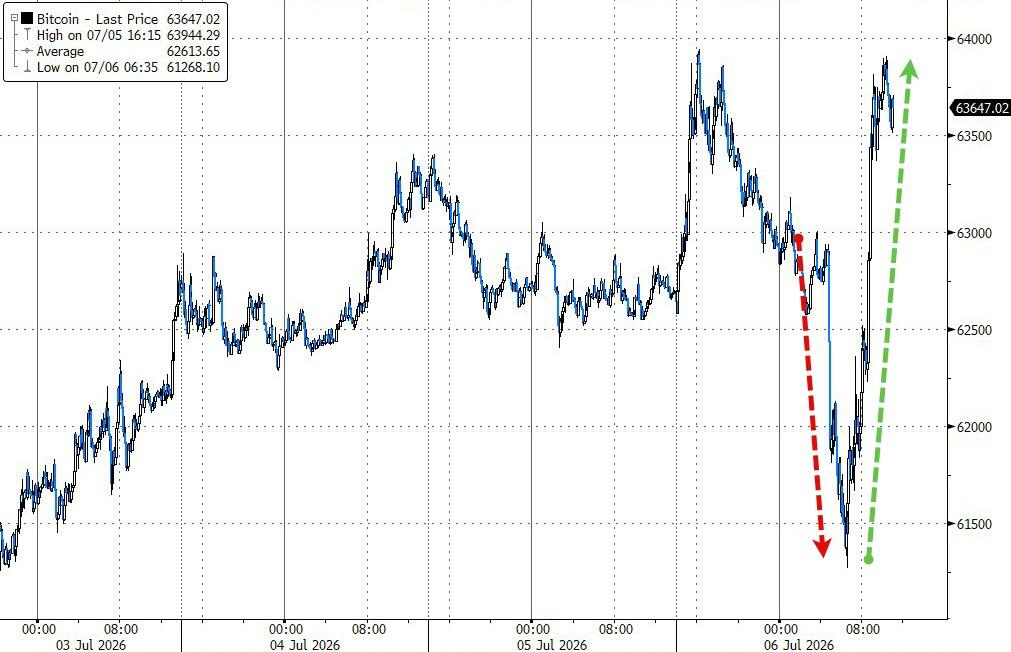
Le Bitcoin a brièvement chuté vers 61 000 dollars en cours de séance, le déclencheur étant la vente par la société Strategy d'environ 216 millions de dollars de positions en Bitcoin, soit sa deuxième vente importante de l'année, dans le cadre d'un récent plan de restructuration de son financement.
Cependant, la déclaration publique ultérieure de Donald Trump depuis le Bureau ovale a rapidement inversé le sentiment du marché. Répondant à une question d'un journaliste, il a déclaré : "Je suis devenu un fervent partisan des cryptomonnaies", ce qui a immédiatement propulsé le Bitcoin vers ses plus hauts de la journée, clôturant finalement en hausse d'environ 1,4 % à 63 571 dollars. L'Ethereum a progressé de 0,7 % le même jour, à 1 787 dollars.
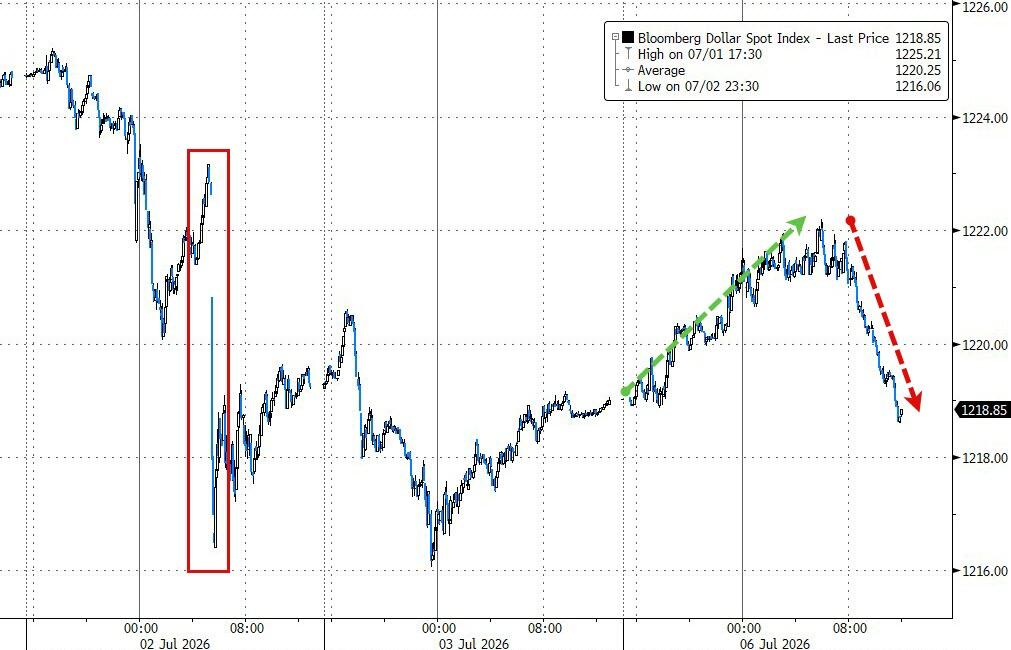
L'indice dollar s'est pratiquement terminé à l'équilibre lundi, après avoir progressé en cours de séance, testant l'écart baissier survenu après la publication des chiffres de l'emploi la semaine précédente, avant de finalement perdre ses gains.
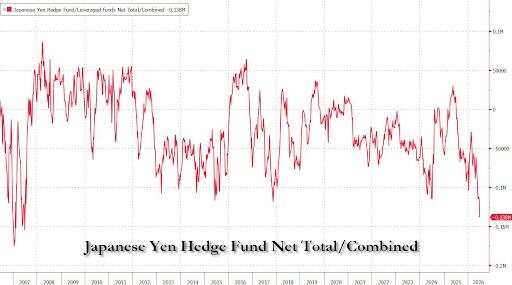
Concernant le yen, le dollar/yen a augmenté de 0,4 % à 162,03, se rapprochant de son plus haut niveau en 40 ans à 162,84, indiquant que le marché teste toujours la volonté d'intervention des autorités japonaises. Parallèlement, les positions vendeuses sur le yen des hedge funds sont proches de niveaux historiquement élevés.
Les marchés actions américains ont globalement rebondi et progressé lundi, les actions technologiques (Nasdaq) en tête, le Dow franchissant pour la première fois les 53 000 points. Les achats ont repris après le long week-end, suivant les ventes après les données sur l'emploi de la semaine précédente.

Indices actions américains de référence :

  • De retour après le long week-end, l'indice S&P 500 a clôturé en hausse de 54,19 points, soit +0,72 %, à 7 537,43 points.

  • Le Dow Jones Industrial Average a clôturé en hausse de 155,84 points, soit +0,29 %, à 53 055,91 points, dépassant le record historique de clôture établi le jour des données sur l'emploi (2 juillet).

  • Le Nasdaq a clôturé en hausse de 288,488 points, soit +1,12 %, à 26 121,16 points. L'indice Nasdaq 100 a clôturé en hausse de 368,66 points, soit +1,26 %, à 29 697,873 points.

  • L'indice Russell 2000 a clôturé en hausse de 0,45 %, à 3 009,541 points.

  • L'indice de volatilité VIX a clôturé en baisse de 1,58 %, à 15,56, s'étant stabilisé autour de 10,30 depuis 15h00 (heure de Pékin) avant de reculer continuellement à l'ouverture des marchés américains.

ETF sectoriels américains :

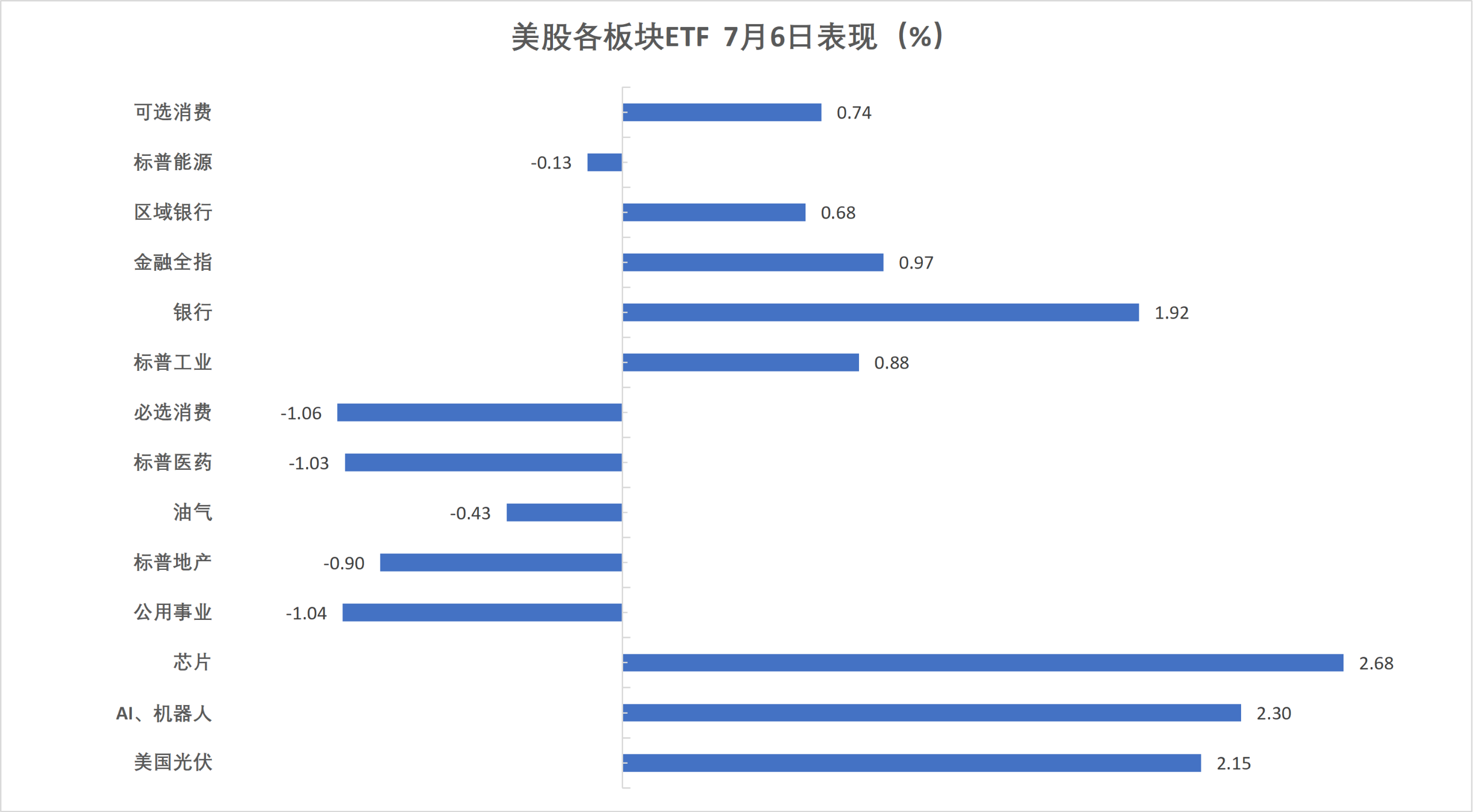
  • La majorité des ETF sectoriels américains ont clôturé en hausse, l'ETF Global Tech (indice mondial des actions technologiques) gagnant 2,18 %, l'ETF Semiconducteurs progressant de 2,03 %, les ETF du secteur technologique et des valeurs Internet augmentant jusqu'à 1,67 %, tandis que les ETF du secteur de l'énergie et de la biotechnologie ont clôturé en baisse jusqu'à 0,20 %.

(6 juillet – ETF sectoriels des marchés américains)

Les sept géants de la tech :

  • L'indice Wind US Tech Magnificent 7 a progressé de 1,42 %.

  • Tesla a clôturé en hausse de 6,69 %, Meta de 2,98 %, Alphabet (Classe A) de 1,82 %, Apple de 1,31 %, Amazon de 0,61 %, Nvidia de 0,37 %, tandis que Microsoft a reculé de 0,96 %.

Actions de semi-conducteurs :

  • L'indice Philadelphia Semiconductor a clôturé en hausse de 2,17 %, à 12 900,142 points.

  • L'ADR de TSMC a progressé de 4,07 %, AMD de 6,61 %.

Actions chinoises :

  • L'indice Nasdaq Golden Dragon China a clôturé en hausse de 1,71 %, à 6 013,62 points.

  • Parmi les actions chinoises populaires, BYD, Tencent, ASE Technology, et Canadian Solar ont clôturé en hausse de plus de 4,5 %, Nio et Meituan ont gagné 4,1 %, XPeng a progressé de 3,6 %, New Oriental et NetEase ont augmenté de 3 %, et Alibaba a pris 1,9 %.

Autres actions individuelles :

  • Circle a progressé de 6,24 %.

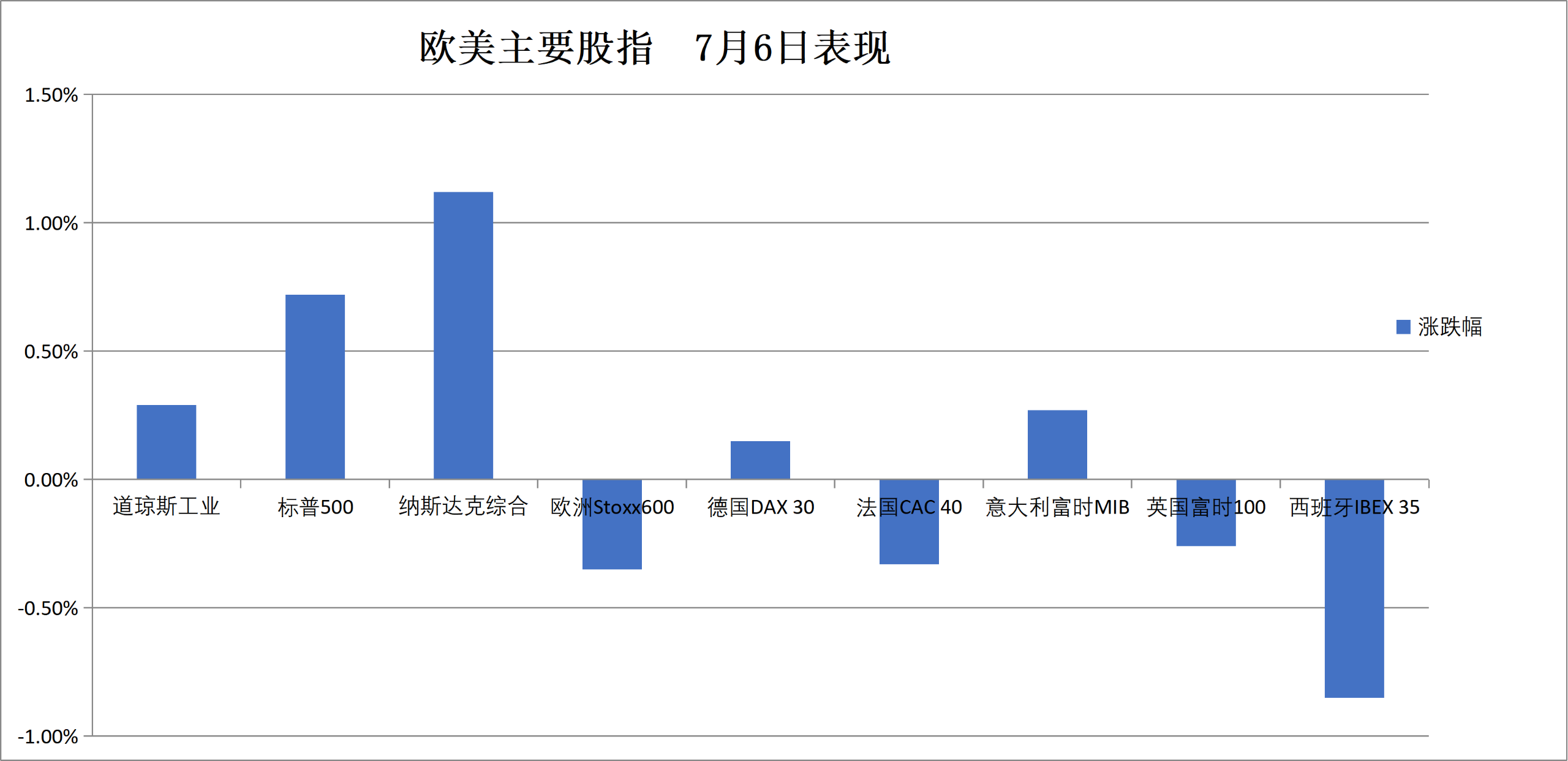
L'indice paneuropéen STOXX 600 s'est éloigné du record historique de clôture de 652,77 points établi vendredi dernier (3 juillet, lendemain de la publication du rapport américain sur l'emploi), mais avait atteint en début de séance lundi un record historique intraséance à 654,44 points.

Indices paneuropéens :

  • L'indice STOXX Europe 600 a clôturé en baisse de 0,35 %, à 650,50 points.

  • L'indice STOXX Euro 50 a clôturé en baisse de 0,23 %, à 6 398,01 points.

Indices nationaux :

  • L'indice allemand DAX 30 a clôturé en hausse de 0,15 %, à 25 817,89 points, établissant un troisième record historique de clôture consécutif, pour une cinquième journée de hausse consécutive (gagnant 4,84 % sur la période).

  • L'indice français CAC 40 a clôturé en baisse de 0,33 %, à 8 479,87 points.

  • L'indice britannique FTSE 100 a clôturé en baisse de 0,26 %, à 10 651,77 points.

    (6 juillet – Performance des principaux indices européens et américains)

Secteurs et actions individuelles :

  • Parmi les valeurs blue-chips de la zone euro, Anheuser-Busch InBev a clôturé en baisse de 4,11 %, Bayer a perdu 4,09 %, Iberdrola a reculé de 3,81 % (troisième plus forte baisse), L'Oréal a cédé 1,16 % et Hermès a perdu 0,88 %, parmi les moins performantes.

  • Parmi toutes les composantes de l'indice STOXX Europe 600, BE Semiconductor Industries a clôturé en baisse de 5,49 %, les actions de classe B d'A.P. Møller – Mærsk ont reculé de 5,45 %, et Kongsberg Maritime a perdu 4,79 % (troisième plus forte baisse).
Trending Cryptos

Related Questions

QQuels sont les principaux facteurs qui ont contribué à la hausse du Nasdaq et du Dow Jones le lundi ?

ALe Nasdaq et le Dow Jones ont progressé lundi principalement grâce à une forte performance des actions technologiques, en particulier des sociétés liées aux puces et à l'IA. Des annonces positives comme la confirmation par Nvidia de sa feuille de route serveur et la prolongation de la coopération entre Broadcom et Apple jusqu'en 2031 ont renforcé la confiance dans les investissements en infrastructures IA. De plus, la demande d'IA soutenue par les résultats d'entreprises comme Foxconn a également contribué au rebond.

QPourquoi le prix du pétrole a-t-il été sous pression le lundi ?

ALe prix du pétrole a été sous pression lundi principalement parce que l'Arabie saoudite a annoncé une importante réduction de ses prix officiels pour le pétrole livré en août. Il s'agit de la plus forte baisse depuis au moins 26 ans, alimentant les inquiétudes concernant un excès de l'offre. De plus, l'OPEP+ a convenu d'augmenter ses objectifs de production à partir d'août, ce qui a accentué les préoccupations liées à l'offre.

QQuelle a été l'influence de la déclaration de Donald Trump sur le prix du Bitcoin ?

ALa déclaration publique de Donald Trump, dans laquelle il s'est présenté comme un "fervent partisan des cryptomonnaies", a directement provoqué un rebond marqué du Bitcoin. Après une vente initiale, le cours du Bitcoin a grimpé pour atteindre son plus haut niveau de la journée, avec une hausse d'environ 1,4 % pour clôturer à 63 571 dollars.

QQuels sont les facteurs mentionnés qui ont exercé une pression à la baisse sur le prix de l'or ?

ALe prix de l'or a baissé en raison de plusieurs facteurs : des sorties continues des ETF sur l'or, des commentaires plutôt favorables à une politique monétaire restrictive de la part de responsables de la Fed, ainsi que la force du dollar et des taux d'intérêt. Ces facteurs financiers ont créé un environnement défavorable pour les métaux précieux comme l'or.

QSelon l'article, quel est le débat clé parmi les analystes concernant l'IA et son potentiel de bulle ?

ALe débat clé parmi les analystes ne porte pas tant sur les niveaux de valorisation actuels, mais sur la question de savoir si les bénéfices futurs de l'IA peuvent se maintenir à des niveaux exceptionnels sur une longue période. Des équipes comme celle de BlackRock et des stratégistes comme Mike Wilson de Morgan Stanley discutent de la durabilité de la demande d'infrastructures IA et comparent la trajectoire du secteur des semi-conducteurs à celle d'autres actifs ayant connu des bulles par le passé.

Related Reads

Trading

Spot

Hot Articles

What is LINON

Linde plc Tokenized Stock (Ondo): Revolutionizing Traditional Equity Access Through Blockchain Innovation The emergence of Linde plc Tokenized Stock (Ondo), represented by the ticker $LINON, signifies a monumental shift in the fusion of traditional financial structures and decentralized finance (DeFi). This innovative financial instrument showcases the tremendous potential of blockchain technology to democratize access to traditional equity markets while ensuring the security and regulatory compliance necessary for institutional-grade financial products. Through Ondo Finance's pioneering tokenization platform, $LINON provides a seamless pathway for global investors to engage with one of the world's leading industrial gas companies, Linde plc, creating a blockchain-native representation of the underlying equity. Introduction to Linde plc Tokenized Stock The landscape of financial markets is witnessing a groundbreaking transformation through the tokenization of real-world assets. Linde plc Tokenized Stock (Ondo) epitomizes this revolutionary approach by bridging the gap between conventional stock ownership and blockchain-enabled financial infrastructure. The $LINON token allows investors to gain exposure to one of the prominent industrial companies worldwide through decentralized technology. Operating within Ondo Finance's comprehensive ecosystem, $LINON symbolizes a practical application of tokenization technology that enhances accessibility, efficiency, and global connectivity in traditional financial markets. By leveraging blockchain infrastructure, this tokenized stock enables international investors to participate in U.S. equity markets, overcoming traditional barriers associated with cross-border investing. The significance of $LINON goes beyond technological innovation; it represents a fundamental shift in asset structuring, distribution, and trading in the digital age. This tokenized stock maintains all the economic benefits associated with traditional Linde plc shares while offering improved liquidity, programmable compliance features, and seamless integration with decentralized finance protocols. The development of $LINON indicates a growing acceptance of blockchain technology as a viable means for traditional finance, exemplifying how even well-established assets like Linde plc can integrate into blockchain systems. This approach preserves the core attributes that appeal to investors while introducing advanced capabilities that enhance the overall investment proposition. Project Overview and Objectives Linde plc Tokenized Stock (Ondo) encapsulates a strategic effort to democratize access to traditional equity markets through advanced blockchain technologies. The primary objective of $LINON is to provide approved global investors seamless access to the economic exposure associated with Linde plc shares, furthering an effort to create a more inclusive financial ecosystem. Beyond the digital representation of traditional assets, $LINON endeavors to eliminate barriers of geography and time zones that limit investor participation. Its design ensures that blockchain technology can elevate traditional investment vehicles without undermining the security or compliance requirements expected by investors. Key goals of the project include enhanced liquidity provision, programmable compliance mechanisms, and interoperability with other blockchain networks. Each $LINON token is fortified by actual Linde plc securities housed at U.S.-registered broker-dealers, allowing holders to reap economic advantages akin to traditional stockholders, such as dividend reinvestment. Furthermore, $LINON aims to establish new industry standards for institutional-grade tokenized securities, paving the way for traditional assets to embrace blockchain technology while remaining compliant with regulatory frameworks. By associating itself with a company as reputable as Linde plc, the project opens avenues for exploring tokenized equities catering to both conservative institutional players and daring retail investors. Project Creator and Development Team The vision for Linde plc Tokenized Stock (Ondo) comes from Nathan Allman, founder and CEO of Ondo Finance. His background in traditional finance coupled with expertise in blockchain technology positions him uniquely to navigate the complexities of asset tokenization. Allman's academic journey began at Brown University, focusing on Economics and Biology, equipping him with valuable analytical skills. His time at Goldman Sachs in the Digital Assets division strengthened his understanding of the interplay between financial institutions and emerging technologies, laying the groundwork for his later endeavors in alternative investment strategies. Under Allman's guidance, Ondo Finance has emerged as a leader in asset tokenization, launching $LINON as a flagship example of the company's larger mission towards revolutionizing traditional financial systems using blockchain technology. His commitment to leveraging blockchain for creating institutional-grade financial products has shaped the landscape of real-world asset tokenization. Investment and Funding Structure The growth of Ondo Finance, the platform powering Linde plc Tokenized Stock (Ondo), is bolstered by robust financial backing from prestigious venture capital firms and strategic investors. This strong investment foundation underpins the development of the key infrastructure essential for compliant tokenized securities like $LINON. In August 2021, Ondo Finance secured $4 million in seed funding led by a major venture capital firm, which enabled the company to commence platform development and establish the necessary regulatory processes for tokenizing real-world assets. This early investment cemented Ondo Finance's credibility within the industry. The Series A funding round followed, garnering $20 million with participation from renowned firms committed to transformative technology companies. This backing demonstrated substantial institutional confidence in Ondo Finance's vision, allowing it to hone its approach to asset tokenization through mechanisms that ensure compliance and accessibility. Noteworthy contributors, including institutional investors and experienced partners, have added significant value to Ondo Finance’s development efforts. Their involvement underscores the confidence across sectors in Ondo Finance's approach to bridging traditional finance with blockchain innovations. Technical Infrastructure and Innovation The technical architecture that underpins Linde plc Tokenized Stock (Ondo) represents a sophisticated melding of traditional finance systems and cutting-edge blockchain technology. The architecture's foundation is built on the Ethereum network, renowned for its security and programmability—both critical for intricate financial instruments. The $LINON tokenization process comprises creating a blockchain-native representation of Linde plc shares that preserves economic benefits while augmenting investor capabilities. Each token corresponds to actual shares held at U.S.-registered broker-dealers, creating a compliant custody structure that legitimizes the asset's existence and value. Automated compliance systems are integrated into the tokenization process, managing critical components such as know-your-customer (KYC) verification and anti-money laundering (AML) protocols. This incorporation of programmable compliance empowers $LINON to uphold regulatory standards essential for institutional proliferation. Cross-chain interoperability characterizes the advanced technical features of $LINON. While initially deployed on Ethereum, the framework is designed for expansion to other networks such as Solana and BNB Chain. This adaptability enhances liquidity and accessibility, allowing investors to select their preferred blockchain ecosystems. Historical Timeline and Development Crafting the history of Linde plc Tokenized Stock (Ondo) unfolds in parallel with the evolution of Ondo Finance's tokenization platform. The timeline's inception dates back to March 2021 when Nathan Allman laid the foundations for creating institutional-grade financial products on blockchain infrastructure. The initial funding round in August 2021 provided crucial resources for developing the platform and establishing partnerships necessary for effective tokenization. By January 2023, Ondo Finance launched its tokenized treasury products, establishing mechanisms that would facilitate future tokenized equities such as $LINON. A pivotal milestone arose in February 2025 when Ondo Chain—a Layer 1 blockchain designed specifically for asset tokenization—was introduced. This infrastructure enhances capabilities vital for institutional markets, demonstrating Ondo Finance's long-term commitment to tokenization. Subsequently, the launch of Ondo Global Markets in September 2025 marked the official debut of $LINON. This milestone showcased the successful transition from development to active trading, enabling investors around the world to access American financial markets seamlessly. Ongoing development plans include a targeted expansion of available tokenized assets to over 1,000 by the end of 2025, pointing to a bright future for Ondo Finance's ecosystem and its mission to broaden tokenized equity accessibility. Regulatory Compliance and Legal Framework The legal architecture governing Linde plc Tokenized Stock (Ondo) emphasizes a sophisticated approach to regulatory compliance, allowing tokenized securities to be implemented within a blockchain-based framework. The legal structure governing $LINON spans multiple jurisdictions while maintaining a robust legal footing. Compliance systems ensure that only eligible investors can access the token, enforced through automated verification that aligns with international regulations. This innovative regulatory technology promises real-time enforcement of complex requirements, considerably enhancing efficiency in operating within the regulatory landscape. The custody framework undergirding $LINON ensures that the underlying shares are securely held at U.S.-registered broker-dealers, complying with necessary regulations while delivering blockchain-driven access to investors. The token maintains its economic equivalency and security through this carefully structured custody arrangement. KYC and AML compliance systems are embedded within the smart contract architecture, ensuring integrity and adherence to regulatory practices while fostering transparency for investors. The jurisdictional restrictions mark a commitment to navigating the evolving landscape of international securities laws. Market Impact and Industry Significance The advent of Linde plc Tokenized Stock (Ondo) holds profound implications for the broader financial landscape, symbolizing a clear shift towards blockchain-enabled markets. $LINON serves as a proof-of-concept for integrating traditional companies into blockchain ecosystems, showcasing the potential benefits such as broader accessibility and improved efficiency. The market's response to $LINON indicates a growing acceptance of tokenization among institutional investors, contributing to the emergence of an expanding sector wherein traditional assets can be interconnected with blockchain innovations. The success of $LINON further solidifies market confidence, indicating an overarching shift towards recognizing asset tokenization as a transformative force in finance. Future Development and Expansion Plans The future trajectory for Linde plc Tokenized Stock (Ondo) centers around the expansion of the tokenization ecosystem and enhanced infrastructure supporting blockchain-enabled financial services. Plans for cross-chain integration usher in new opportunities for liquidity and flexibility within the investment framework, with existing capabilities poised for continuous enhancement. With the introduction of Ondo Chain, Ondo Finance aims to transition $LINON to an optimized blockchain environment specifically designed for asset tokenization. This new infrastructure heralds exciting prospects for the development of institutional-grade financial products, ensuring ongoing compatibility with contemporary investment strategies. Further integration with decentralized finance protocols signifies a commitment to empowering $LINON holders through advanced financial strategies. The anticipated expansion of available tokenized assets promises to broaden investor access, enhancing the utility and appeal of the platform. In alignment with ambitions for regulatory expansion, ongoing efforts to secure approvals for new jurisdictions will enhance investor access, further positioning $LINON at the forefront of the burgeoning tokenization market. Conclusion Linde plc Tokenized Stock (Ondo), as represented by the $LINON token, stands at the intersection of traditional finance and blockchain innovation. It embodies a transformative milestone in how financial assets are structured, distributed, and engaged within modern investment ecosystems. The technical sophistication behind $LINON, combined with its regulatory compliance framework, illustrates that asset tokenization can improve financial infrastructure rather than simply digitizing existing products. This pioneering effort not only enhances investor access to U.S. equity markets but also signifies an evolution of how traditional financial services can integrate blockchain technology. As the asset tokenization market grows exponentially, with prospects suggesting significant valuation increases, $LINON paves the way for a future where tokenized securities become standard fixtures in the financial landscape. The trajectory of $LINON will undoubtedly influence how traditional finance adapts to a transformed, blockchain-powered world.

3.5k Total ViewsPublished 2025.12.05Updated 2025.12.05

What is LINON

What is CRMON

Salesforce Tokenized Stock (Ondo): Revolutionising Traditional Equity Access Through Blockchain Innovation The emergence of Salesforce Tokenized Stock (CRMON) marks a pivotal advancement in integrating traditional financial markets with blockchain technology. This innovative approach offers investors unprecedented access to equity exposure through tokenisation. Developed by Ondo Finance, CRMON provides tokenholders with economic exposure equivalent to holding Salesforce stock (CRM) while automatically reinvesting dividends. This effectively bridges the gap between conventional equity markets and decentralised finance (DeFi). Introduction and Comprehensive Overview of Salesforce Tokenized Stock In recent years, the financial landscape has dramatically transformed due to blockchain technology, fundamentally altering how investors access and interact with traditional assets. The development of Salesforce Tokenized Stock (CRMON) is a prime example of this evolution, representing a sophisticated fusion of conventional equity markets with cutting-edge distributed ledger technology. CRMON is a tokenised version of Salesforce stock, emerging from the innovative work of Ondo Finance, a leading platform in the real-world asset tokenisation sector that positions itself as a bridge between traditional finance and decentralised systems. Designed to provide tokenholders with economic exposure that mirrors the performance of the underlying Salesforce stock, CRMON incorporates automatic dividend reinvestment mechanisms. This eliminates many traditional barriers associated with international equity investment, such as complex brokerage relationships, currency conversion challenges, and restricted trading hours. The tokenisation process reimagines stock ownership as a blockchain-native asset while maintaining its economic equivalence with the underlying security, offering enhanced portability and integration capabilities within decentralised finance ecosystems. CRMON transcends its individual utility as an investment instrument to represent a fundamental shift in how financial markets can operate in an increasingly digital world. By maintaining full backing through U.S.-registered broker-dealers and implementing robust compliance frameworks, CRMON demonstrates that tokenised securities can achieve the regulatory standards necessary for institutional adoption while delivering the technological advantages of blockchain infrastructure. Understanding Tokenized Real-World Assets and CRMON's Strategic Position Tokenised real-world assets signify one of the most significant innovations in modern finance, fundamentally reimagining how traditional securities are represented, traded, and utilised within digital ecosystems. CRMON operates as a tokenised equity instrument correlating directly with Salesforce stock while optimising accessibility and efficiency. This aligns with Ondo Finance's broader mission to democratise access to institutional-grade financial products through innovative tokenisation strategies. The tokenisation process guarantees complete economic equivalence with the underlying Salesforce equity. Each CRMON token represents a proportional claim on Salesforce stock held by qualified custodians, with dividend payments automatically reinvested to maintain continuous exposure to total return performance. This structure simplifies dividend management and ensures that tokenholders receive the full economic benefit of their equity exposure, encompassing both capital appreciation and income generation. Ondo Finance's strategy in tokenising Salesforce stock demonstrates its expertise in creating compliant, institutional-grade products that meet traditional financial markets' stringent requirements. The platform’s focus on merging regulatory compliance with blockchain benefits positions it at the forefront of decentralised finance, captivating both institutional and retail investors seeking blockchain-native solutions. The Technology and Innovation Framework Behind CRMON The technological infrastructure supporting CRMON integrates blockchain technology with traditional financial mechanisms, delivering institutional-grade security and compliance while maintaining the operational advantages of decentralised systems. Built on the Ethereum blockchain, CRMON utilises robust smart contract capabilities to ensure transparent, secure operations. The smart contract architecture incorporates layered security and compliance mechanisms, enabling automated compliance checks and real-time asset backing verification. Integration with oracle services maintains accurate pricing and dividend information, ensuring CRMON reflects the underlying Salesforce stock's accurate performance. This architecture delivers automated dividend reinvestments and other corporate actions, eliminating manual processing requirements and directly enhancing tokenholder benefits. Ondo Finance ensures CRMON's security structure includes daily third-party verification of holdings, independent collateral agents, and a multiple-layer custody system through partnerships with established financial institutions. This framework safeguards tokenholder interests against operational risks while providing robust asset backing. The user interface enhances integration capabilities, allowing seamless interaction between CRMON and various decentralised finance protocols, as well as cryptocurrency exchanges. This interoperability enables users to leverage their tokenised equity across multiple platforms, creating sophisticated investment strategies that marry traditional equity characteristics with blockchain-native innovation. Leadership and Corporate Structure of Ondo Finance The leadership team behind CRMON and Ondo Finance blends expertise from traditional finance and blockchain technology, presenting a robust combination of skills essential for successfully bridging conventional markets with decentralised finance. Nathan Allman, the founder and CEO, emerged from a distinguished financial background before establishing Ondo Finance in 2021. Allman's experience includes notable roles at major financial institutions, including significant contributions to developing cryptocurrency market services. His insights into regulatory compliance were paramount in developing products like CRMON that successfully unify traditional securities with blockchain technology. With a team of professionals boasting substantial experience in both conventional finance and blockchain sectors, Ondo Finance's leadership comprises diverse expertise that covers every aspect of tokenised asset development. Justin Schmidt serves as President and COO, contributing unique operational expertise, while Chris Tyrell brings essential compliance knowledge. Investment Landscape and Funding History The investment landscape surrounding Ondo Finance reflects significant institutional confidence in its mission to tokenise real-world assets. The company has raised substantial funds through various investment rounds, attracting leading venture capital firms and strategic investors that recognise the transformative potential of tokenised securities like CRMON. Notably, Ondo Finance completed a successful Series A funding round in 2022, led by well-known venture capital firms. This funding success validates Ondo Finance's innovative approach to creating compliant, institutional-grade tokenised products. In total, Ondo Finance has successfully secured substantial funding, raising significant capital for product development and market expansion, including a noteworthy token sale that reinforced its governance structure through the establishment of the ONDO token. The diverse composition of investors reflects broad market confidence in Ondo Finance's business model, demonstrating support from both traditional and blockchain-native organisations. Operational Mechanics and Technical Implementation The operational framework supporting CRMON exemplifies sophisticated integration of traditional financial mechanisms with blockchain technology. The technical implementation introduces multiple layers of security, compliance, and operational efficiency to meet institutional standards while enhancing accessibility. The tokenisation process begins by acquiring actual Salesforce stock through U.S.-registered broker-dealers, ensuring each CRMON token maintains direct correlation with the underlying equity performance. Smart contracts automate operational processes, including dividend reinvestment and corporate action processing, facilitating a streamlined user experience. The Minting and redemption processes allow authorised participants to manage CRMON tokens effectively. During U.S. trading hours, institutions can mint new tokens by depositing stablecoins that are used to purchase corresponding Salesforce equity. This structure maintains a tight correlation with underlying assets, enhancing liquidity and price discovery. Additionally, the infrastructure supports twenty-four-hour token transfer capabilities, providing CRMON holders with operations outside traditional market hours. This represents a significant advantage over conventional securities ownership, thus promoting integration with decentralised finance applications. Plans for cross-chain compatibility through partnerships signal further ambitions for CRMON's market reach. By expanding to other blockchain networks, Ondo Finance aims to enhance accessibility and user engagement with tokenised equity products. Timeline and Historical Development of Tokenized Equity Innovation The timeline of CRMON's development and Ondo Finance's broader tokenised capabilities demonstrates a systematic innovation process beginning with the company's founding in 2021. 2021: Ondo Finance is founded by Nathan Allman and co-founders, launching initial products focused on structured vault offerings on the Ethereum blockchain. 2022: The company completes substantial funding rounds—both equity and token sales—totaling significant capital and launching initial tokenised U.S. Treasury products. 2023-2024: Ondo Finance experiences substantial growth, establishing partnerships with major financial institutions while expanding its product offerings beyond fixed-income securities. February 2025: Ondo Global Markets is announced, marking the transition into equity tokenisation with plans for accessing over one hundred U.S. stocks and ETFs. September 2025: The official launch of Ondo Global Markets includes CRMON alongside other tokenised equity offerings, marking a significant evolution in Ondo Finance's product ecosystem. This timeline highlights the organisation's rapid growth and its capability to adapt its technological and compliance frameworks to accommodate different asset classes effectively while maintaining security and regulatory integrity. Regulatory Framework and Compliance Approach Ondo Finance's regulatory framework showcases a sophisticated compliance strategy, essential for achieving institutional adoption in the tokenised securities market. The company's strong partnerships with U.S.-registered broker-dealers promote adherence to Securities and Exchange Commission regulations and apply robust investor protections. Acquisitions, such as Oasis Pro—a registered broker-dealer—significantly enhance Ondo Finance's compliance capabilities, ensuring thorough alignment with existing regulatory structures. The company employs independent verification procedures that foster transparency, aiming for a solid performance standards reputation. Furthermore, Ondo Finance's commitment extends to international regulatory compliance, ensuring token access remains restricted to eligible investors while adhering to pertinent cross-border securities regulations. Comprehensive attention to tax implications and reporting requirements fortifies the security and compliance landscape of CRMON, ensuring that investor obligations remain manageable. Future Prospects and Market Positioning The forward-looking landscape for CRMON and Ondo Finance illustrates substantial growth opportunities driven by institutional adoption of blockchain technology and escalating demand for efficient alternatives to conventional securities ownership. Market projections indicate the tokenised asset sector could value multiple trillion dollars by 2030. With plans to scale CRMON offerings significantly and integrate it with a dedicated blockchain infrastructure—Ondo Chain—Ondo Finance aims to elevate its institutional-grade tokenised asset operations. Additionally, the development of strategic partnerships enhances distribution capabilities while establishing the company's credibility in the financial market. Furthermore, the integration of tokenised equity with decentralised finance protocols offers new potential for innovative financial products and strategies previously impossible with traditional securities. These factors underscore CRMON's positioning to effectively capture increased market share and deliver innovative solutions for international investment exposure. Conclusion Salesforce Tokenized Stock (CRMON) symbolises a transformative development within financial markets, successfully bridging traditional equity ownership with blockchain technology to create unprecedented accessibility for global investors. Through Ondo Finance's sophisticated tokenisation framework, CRMON provides complete economic exposure to Salesforce equity performance while enhancing operational advantages that exceed traditional ownership. The launch of CRMON reflects the broader evolution of financial markets towards blockchain infrastructures that maintain regulatory compliance while delivering increased efficiency. Ondo Finance's extensive approach to regulatory adherence, institutional-grade security, and technological innovation solidifies CRMON as a model for future tokenised securities, delivering access previously unattainable in conventional brokerage structures. As the tokenised asset sector continues to develop, CRMON is well-positioned to address historical inefficiencies in capital markets while providing investors with innovative solutions for accessing traditional securities. The outlook for CRMON looks exceptionally promising, supported by ambitious expansion plans, technological innovations, and strategic partnerships, thereby representing a pioneering model of modern financial infrastructure evolving through blockchain integration.

3.6k Total ViewsPublished 2025.12.05Updated 2025.12.05

What is CRMON

What is SHOPON

Shopify Tokenized Stock (Ondo): A Comprehensive Analysis of Real-World Asset Tokenization in Web3 This article delves into the Shopify Tokenized Stock (Ondo), recognised by its ticker symbol $SHOPON, exploring its implications at the intersection of traditional finance and blockchain technology. As a part of Ondo Finance's tokenized securities platform, Shopify’s tokenized stock exemplifies advancements in democratizing access to global capital markets through innovative digital assets. Introduction and Overview of Shopify Tokenized Stock (Ondo) Shopify Tokenized Stock (Ondo), or $SHOPON, portrays a pivotal innovation in the realm of tokenized securities, allowing investors to gain economic exposure akin to directly owning shares of Shopify Inc. This token, developed under the umbrella of Ondo Finance, not only provides investors with the ability to hold digital representations of the company’s stock but also integrates features such as automatic reinvestment of dividends. This advancement represents a substantial shift in the landscape of decentralized finance (DeFi), linking conventional equity markets with blockchain solutions designed to enhance accessibility, transparency, and liquidity. By eliminating geographical barriers and enabling 24/7 trading capabilities, $SHOPON is positioned as a bridge connecting traditional financial instruments and the emerging Web3 ecosystem. What is Shopify Tokenized Stock (Ondo), $SHOPON? The $SHOPON token serves as a digital manifestation of Shopify Inc.'s shares, engineered to provide a direct correlation to the underlying asset's performance. Through the utilization of blockchain technology, the token gives holders a mechanism to participate in the economic benefits associated with equity ownership, including capital appreciation and dividend distribution. The unique aspect of $SHOPON lies in its automatic dividend reinvestment mechanism, which allows returns to compound without necessitating active management by the investor. This feature inherently enhances its attractiveness as an investment vehicle, particularly for individuals seeking passive income growth alongside exposure to high-performing equities. The tokenization process is facilitated by the custody of actual Shopify shares through regulated intermediaries, ensuring that every $SHOPON token is verifiably backed by real equity. This structure empowers investors with the dual advantages of both traditional financial characteristics and the innovative benefits tied to blockchain technology. Who is the Creator of Shopify Tokenized Stock (Ondo)? The creator of Shopify Tokenized Stock (Ondo), Nathan Allman, is an experienced figure in the finance sector, formerly associated with Goldman Sachs. His rich background includes significant expertise in digital asset development, bridging the gap between traditional finance and cryptocurrencies. Allman’s educational journey, marked by studies at Brown University, provided him with a deep understanding of economics and biology, equipping him with analytical skills that inform his strategic vision. In 2021, he founded Ondo Finance, committing to developing tokenized securities that meet institutional-grade standards while leveraging blockchain's transformative capabilities. Under Allman's leadership, Ondo Finance has focused on creating compliant and innovative financial products that empower a diverse investor base. Who are the Investors of Shopify Tokenized Stock (Ondo)? The investment landscape surrounding Shopify Tokenized Stock (Ondo) is notably robust, underpinned by significant institutional support. Primarily, Pantera Capital stands out as a strategic partner through the Ondo Catalyst initiative, a $250 million commitment aimed at accelerating the development of on-chain capital markets. This partnership not only signifies institutional confidence in the potential of tokenized assets but also reinforces Ondo Finance's operational capabilities and market positioning. The funding pathways have included earlier rounds that amassed millions in seed funding and further structural investments, solidifying relationships with both venture capital firms and private investors. Moreover, the financial framework is complemented by strategic partnerships with established financial institutions and technology companies, enhancing Ondo’s infrastructure and operational expertise. How Does Shopify Tokenized Stock (Ondo), $SHOPON Work? At the core of $SHOPON's operational framework is a sophisticated system integrating traditional finance mechanisms with blockchain technology. The custody of actual Shopify shares ensures that token holders retain authentic economic exposure, safeguarding their investments in line with recognized legal structures. The smart contracts employed in managing $SHOPON handle various functions, including automatic dividend reinvestment and ownership transfer, offering instant settlement and increased liquidity, marking a significant departure from conventional trading systems plagued by multi-day settlement delays. By providing interoperability with other decentralized finance applications, $SHOPON empowers holders with potentially lucrative opportunities for advanced investment strategies, including lending and automated market making. This complex integration presents a unique value proposition, catering to both traditional and crypto-native investors. The innovative structure of $SHOPON also allows for real-time settlements and transactions documented on the blockchain, delivering unparalleled transparency and security—a major advancement over standard equity trading practices. Timeline of Shopify Tokenized Stock (Ondo) March 2021: Nathan Allman establishes Ondo Finance, initially focusing on decentralized finance yield optimization. August 2021: Completion of a $4 million seed funding round led by Pantera Capital. January 2023: Launch of initial tokenized treasury security products, laying the groundwork for future equity tokenization. July 2025: Announcement of the Ondo Catalyst initiative, a strategic investment program valued at $250 million, aimed at propelling the development of tokenization in capital markets. September 3, 2025: Launch of Ondo Global Markets featuring over 100 tokenized U.S. stocks and ETFs, including $SHOPON. Technical Implementation and Blockchain Infrastructure Shopify Tokenized Stock (Ondo) operates on a technical architectural framework that marries blockchain protocols with traditional financial custody arrangements. The ecosystem leverages Ethereum's smart contract capabilities, providing seamless transaction management while ensuring compliance with regulatory standards through established financial custodians. Central to this architecture are security measures and transparent transaction records that affirm the legitimacy of each tokenholder's economic stake. With automated features managed by intricate smart contracts, $SHOPON not only streamlines ownership transfers but also allows for the tactical reinvestment of dividends—a hallmark of modern investment strategies. Moreover, the incorporation of LayerZero technology facilitates cross-chain interoperability, making $SHOPON accessible across multiple blockchain environments while preserving its functional robustness. This forward-thinking technical design positions $SHOPON as an adaptable asset within the larger DeFi milieu. Regulatory Framework and Compliance Architecture $SHOPON's regulatory framework is built upon the meticulous navigation of existing financial regulations that govern securities. The custody arrangements for the underlying Shopify shares are managed by U.S.-regulated broker-dealers, ensuring compliance and protection for investors. By maintaining a separation between the blockchain tokenization process and traditional custody, $SHOPON adheres to legal requirements while offering innovative functionalities that challenge conventional constraints. This dual-layered compliance approach enhances investor confidence and underscores Ondo Finance's commitment to regulatory integrity. Notably, the availability of $SHOPON is tailored to international investors from regions such as Asia-Pacific, Europe, and Africa, as regulatory parameters in the U.S. and U.K. present challenges in accessing tokenized securities. Market Access and Global Distribution Strategy The distribution strategy of $SHOPON is keenly designed to optimize global access while conforming to regulatory standards. The platform aims to establish comprehensive coverage for eligible investors across multiple regions, effectively dismantling traditional barriers through the implementation of blockchain technology. Integration with various cryptocurrency wallets and exchanges also promotes user-friendliness and accessibility, establishing a streamlined experience for investors to manage their holdings. Moreover, the 24/7 trading capabilities afforded by the tokenized model allow participants to react promptly to market shifts, fundamentally transforming how global equities are accessed and traded. Technology Integration and Cross-Chain Functionality The remarkable technological underpinnings of $SHOPON propagate its multi-chain functionality, set to expand its reach beyond Ethereum to networks such as Solana and BNB Chain. Such cross-chain capabilities allow users flexibility when navigating between blockchains, concurrently leveraging distinct network attributes to optimize their trading experience. LayerZero serves as the backbone for ensuring decentralized transfers between networks while providing the requisite security and speed, quintessential for maintaining investor trust. This comprehensive interoperability illustrates $SHOPON's commitment to being a versatile, user-centric asset in the evolving investment landscape. Ecosystem Integration and DeFi Compatibility Incorporating $SHOPON into broader DeFi protocols signifies its potential beyond traditional stock ownership. Token holders can leverage their holdings for various sophisticated strategies and applications, enhancing investment returns and liquidity management. By establishing a presence in lending protocols and automated trading systems, $SHOPON effectively democratizes access to advanced financial strategies previously limited to institutional investors. Such integration contributes to a more competitive and dynamic financial landscape, where individual investors can capitalize on tools typically reserved for larger entities. Risk Management and Security Framework Security remains paramount in the operational infrastructure of $SHOPON. The tokenization framework employs multiple layers of protection—beginning with regulated custody of the underlying Shopify shares. The operational protocols establish rigorous auditing, key management, and transaction monitoring standards, thus safeguarding against potential vulnerabilities. Moreover, meticulous adherence to evolving regulatory requirements provides an extra layer of security, fortifying investor protections and institutional compliance. Market Impact and Industry Implications The introduction of Shopify Tokenized Stock (Ondo) heralds a transformative shift in how financial markets operate, emphasizing the potential of tokenized securities to reshape traditional investment paradigms. The successful integration of $SHOPON encapsulates the efficiencies inherent in blockchain technology and opens avenues for new user demographics previously barred from extensive market participation. The impact extends beyond the immediate benefits to token holders, indicating broader trends that may challenge the status quo of investment services, particularly in addressing geographic restrictions and operational costs typically associated with traditional brokerage platforms. Undeniably, $SHOPON encapsulates the potential for traditional institutions to innovate further, leveraging the increasing demand for seamless blockchain access to complement existing financial infrastructure. Future Development Roadmap and Strategic Vision As Ondo Finance looks forward, the trajectory of $SHOPON rests on ambitious goals aimed at broadening the spectrum of available tokenized assets significantly. Over the next few years, plans are in place to expand to more than 1,000 tokenized securities, further enhancing market participation and investment options for individuals worldwide. Continued integration with traditional financial actors, development of specialized institutional products, and enhancements in automated trading capabilities will ensure that $SHOPON maintains its position at the forefront of financial innovation. Regulatory collaboration will also remain a focal point, establishing a framework that not only supports the compliance requirements but also promotes a healthy environment for tokenized asset proliferation. Conclusion and Market Significance In summary, Shopify Tokenized Stock (Ondo), represented by the ticker $SHOPON, is more than merely a tokenized equity offering; it embodies the innovation possible when traditional finance collides with modern blockchain applications. With a robust technical architecture, a commitment to compliance, and a clear strategic vision, $SHOPON exemplifies the potential for tokenized assets to enhance liquidity, accessibility, and functionality in capital markets. As the global investment landscape evolves, the transformative implications of $SHOPON extend beyond individual investors to revolutionize how financial instruments are perceived, traded, and utilized within both traditional and decentralized frameworks.

3.6k Total ViewsPublished 2025.12.05Updated 2025.12.05

What is SHOPON

Discussions

Welcome to the HTX Community. Here, you can stay informed about the latest platform developments and gain access to professional market insights. Users' opinions on the price of CHIP (CHIP) are presented below.

活动图片