La personne la plus malchanceuse : zéro appel d'API, et facturée secrètement 100 millions de yuans par Anthropic

marsbitPublished on 2026-07-13Last updated on 2026-07-13

Abstract

Le 8 juillet, un développeur coréen a partagé sur Threads des factures d'Anthropic s'élevant à 1,66 million et 16,62 millions de dollars en l'espace de 24 heures, malgré un plan gratuit et aucune utilisation d'API. Sa banque a bloqué les paiements. Ce cas extrême révèle un problème systémique. Une société d'audit de factures IA, Vaudit, a identifié environ 1,7 million de dollars de surfacturations chez 60 entreprises, souvent liées à Claude Code. Les erreurs incluent la facturation selon un modèle plus récent et cher, ou la tarification de requêtes en échec ou de tentatives répétées. La méfiance grandit dans la communauté des développeurs. Un bug de facturation "HERMES.md" en avril a entraîné des surfacturations pour les abonnés Max. En juin, une action collective a été intentée pour manque de transparence sur les quotas d'utilisation des forfaits. Les changements de tarification rapides du modèle Fable 5 ont également semé la confusion. Le discours d'Anthropic sur la "sécurité de l'IA" contraste avec l'opacité de sa facturation, un défi pour toute l'industrie où la complexité des modèles de tarification (token, appels API, replis) crée une opacité. Des concurrents comme Microsoft, OpenAI ou DeepSeek pourraient en tirer avantage en offrant plus de transparence. La clarté des factures devient un élément crucial de l'expérience utilisateur et de la confiance.

Le 8 juillet, le développeur coréen bien connu remy_notes a posté sur Threads deux captures d'écran de factures d'Anthropic : la première de 1 669 000 dollars (environ 11,3 millions de yuans), la seconde de 16,62 millions de dollars (environ 110 millions de yuans). Moins de 24 heures séparent les deux factures, le montant ayant été multiplié par près de 10.
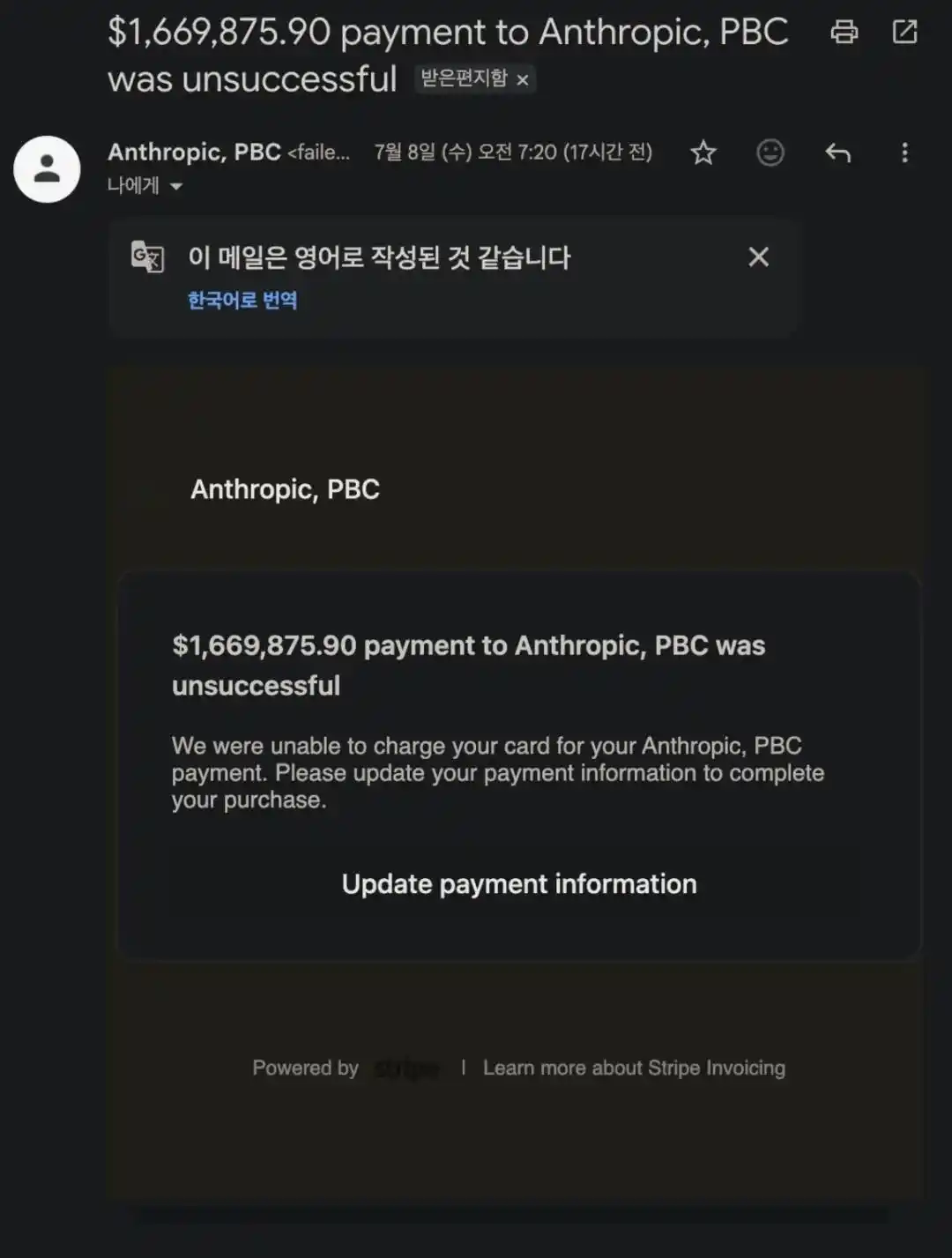
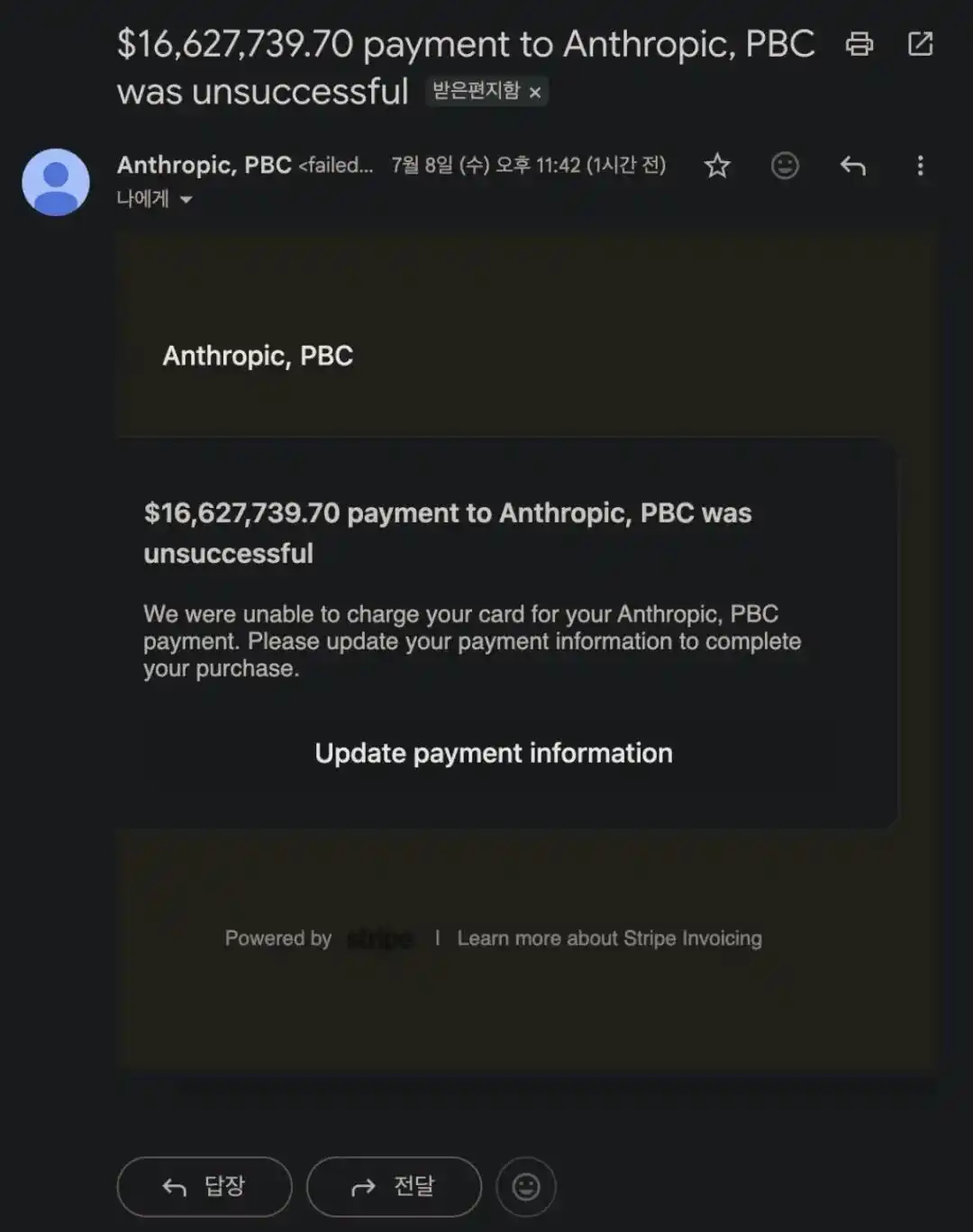
Il a d'abord pensé à un email de phishing, mais l'adresse de l'expéditeur et le lien de paiement pointaient tous deux vers le domaine Stripe officiel d'Anthropic.
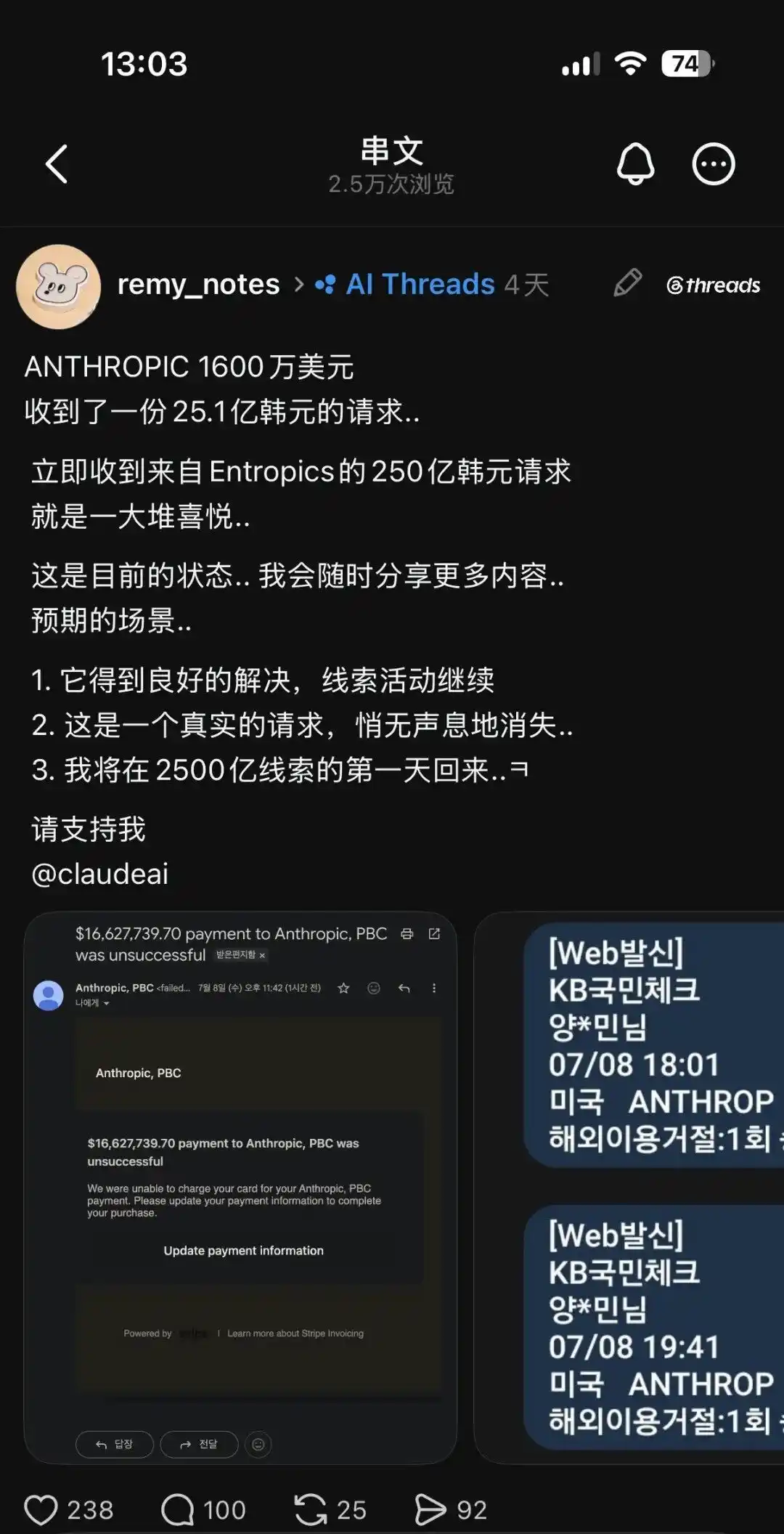
Sa carte de débit de la KB Kookmin Bank a bloqué, le même jour, deux demandes de débit provenant du commerçant américain « ANTHROP » – refusées en raison de limites de transaction insuffisantes.
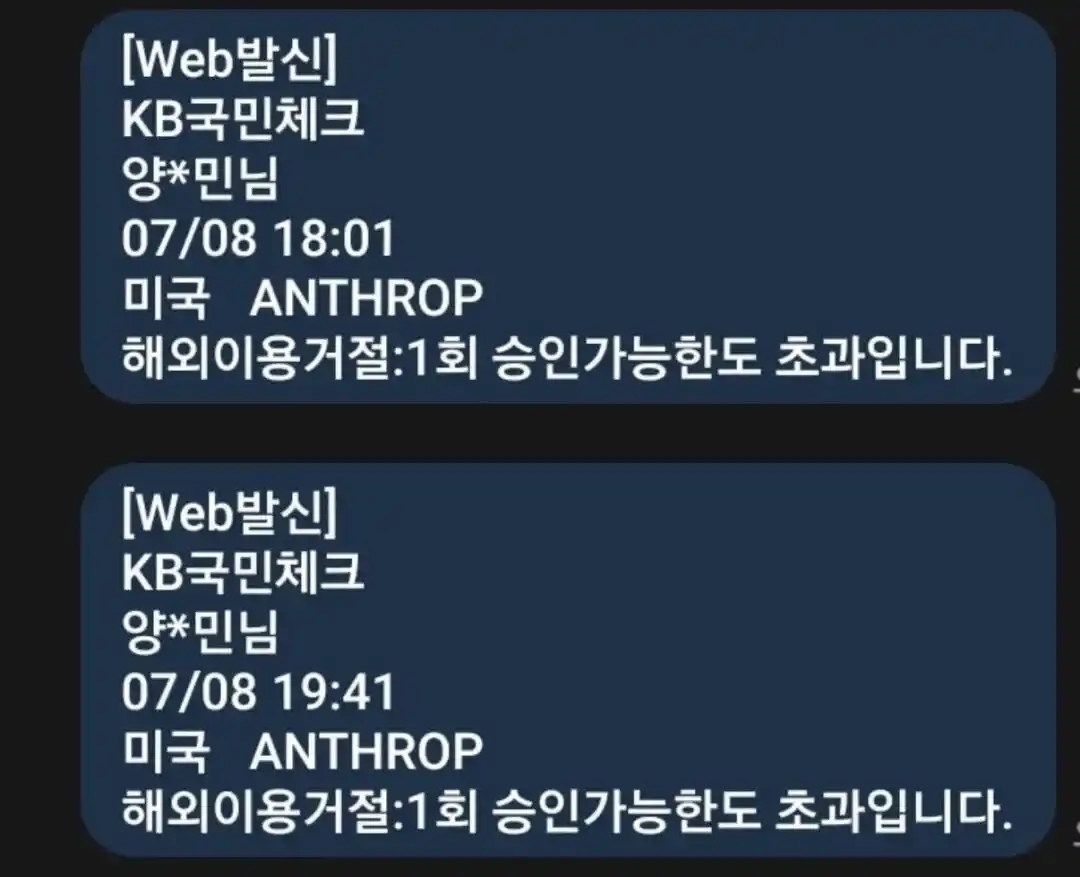
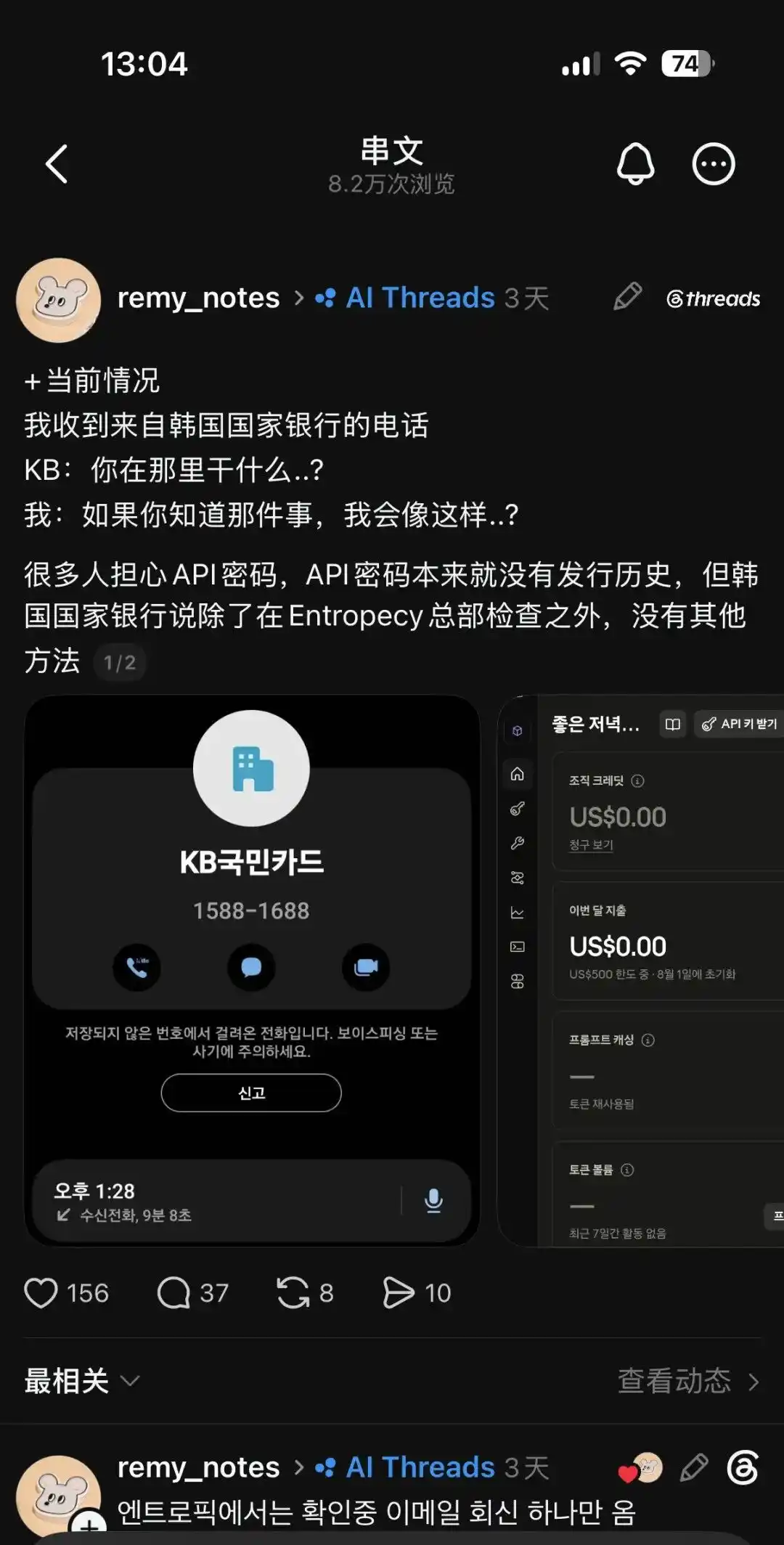
Son compte était sous un plan gratuit, sans carte de crédit liée, et le tableau de bord affichait une consommation d'API nulle.
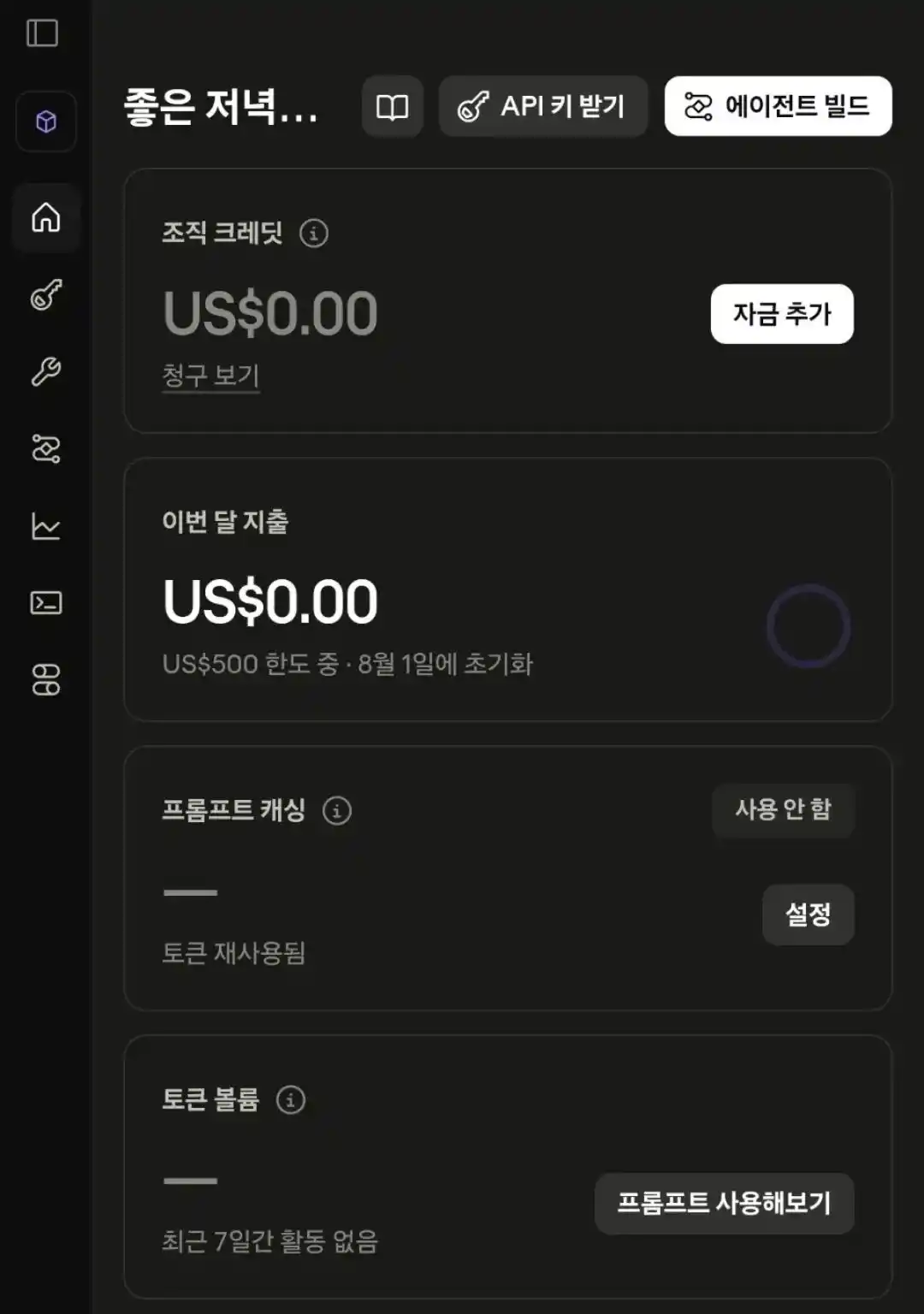
Au moment de la publication, Anthropic n'avait pas publiquement expliqué l'origine de cette « facture fantôme ».
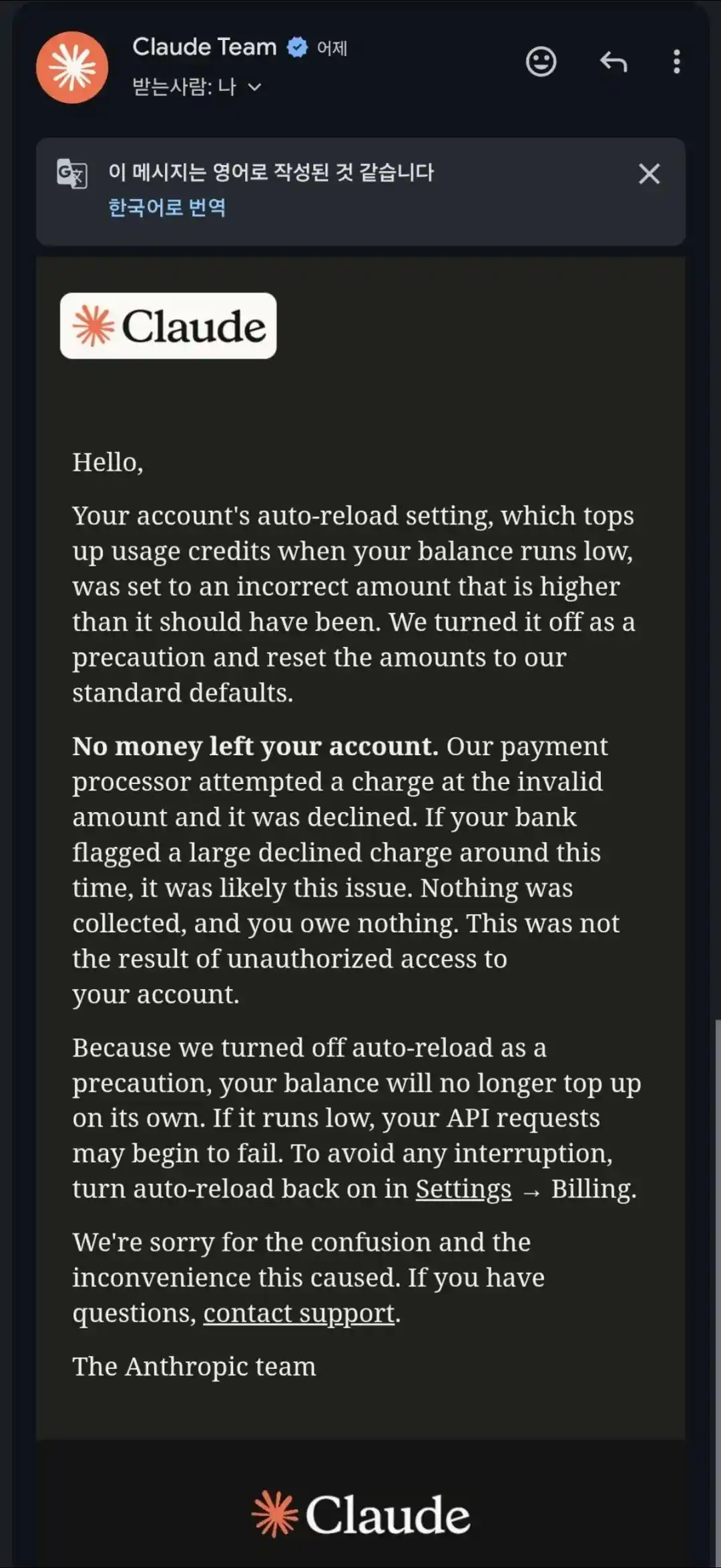
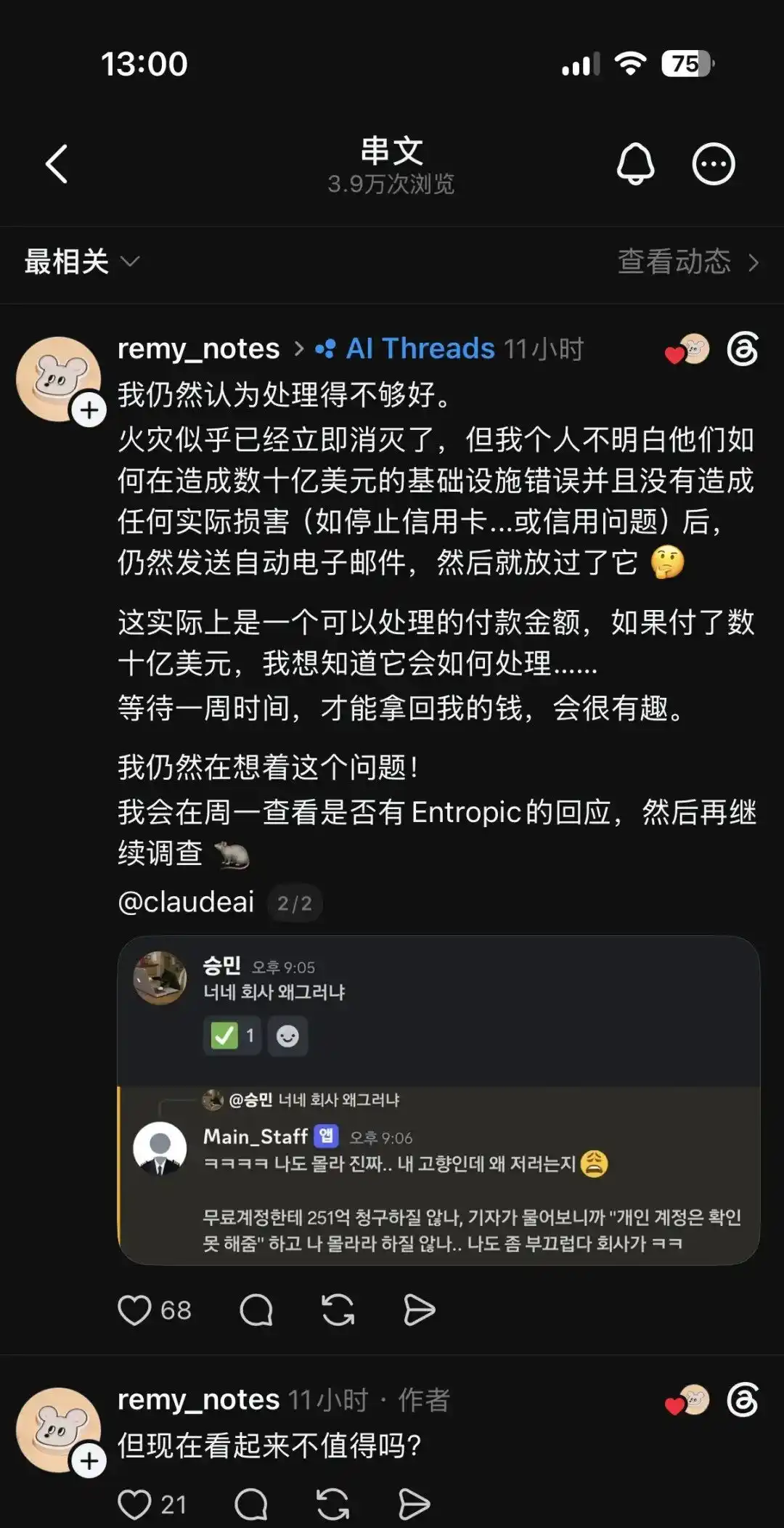
Plus d'une « facture fantôme »

Le montant de 16,6 millions de dollars est suffisamment frappant, mais ce qui mérite vraiment l'attention est le problème systémique qu'il révèle.

Vaudit, une entreprise d'audit de factures IA, a examiné entre mars et juin les factures IA de 60 entreprises, totalisant 34 millions de dollars, et a découvert des surfacturations erronées d'environ 1,7 million de dollars, dont la plupart étaient liées à Claude Code d'Anthropic.

Les clients de Vaudit incluent Panasonic, HP et Honda.

Michael Hahn, PDG de Vaudit

Michael Hahn, PDG de Vaudit, a décrit au journal The Information plusieurs modèles courants de surfacturation :

Les clients utilisent d'anciens modèles, moins chers, mais sont facturés comme s'ils utilisaient des modèles nouveaux et plus coûteux ;

Les agents IA ou chatbots n'achevant pas les requêtes, voire renvoyant des messages d'erreur, génèrent quand même des frais ;

L'agent réessaie de manière répétée après un échec de tâche (tempête de nouvelles tentatives), chaque réessai étant facturé.

Un porte-parole d'Anthropic a répondu que l'entreprise ne facture pas les requêtes non terminées ou les messages d'erreur, ne redirige pas les requêtes des utilisateurs vers d'anciens modèles, et que « la surfacturation ne semble pas être un problème répandu ».

Mais suite aux réclamations de Vaudit et de ses clients, Amazon, Google, Microsoft, Anthropic et OpenAI ont remboursé environ 80 % des montants contestés.

Hahn a déclaré que ces entreprises avaient été « très coopératives » dans le traitement des litiges de facturation.

Un détail notable : une partie des clients audités par Vaudit n'achetaient pas directement les services auprès d'Anthropic, mais passaient par des plateformes cloud comme AWS, Google Cloud ou Microsoft Azure.

Après avoir transité par une couche supplémentaire, l'attribution des responsabilités devient plus floue.

Pourquoi les factures IA deviennent de plus en plus opaques

La méfiance de la communauté des développeurs envers la facturation d'Anthropic ne s'est pas accumulée en une nuit.

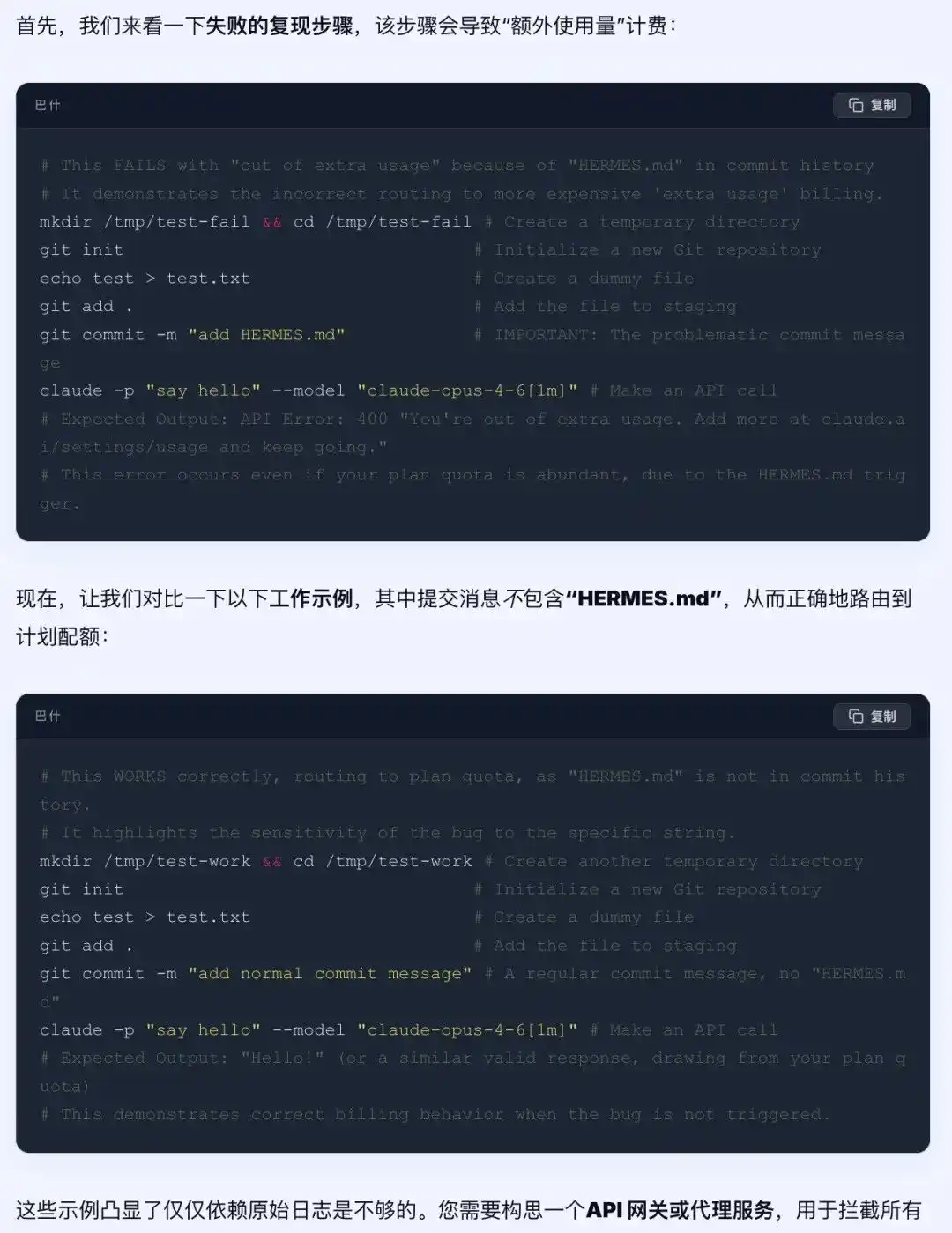
En avril, les développeurs ont découvert un bug de facturation appelé « HERMES.md » : lorsque l'historique des commits de code contenait une chaîne de caractères spécifique, le backend d'Anthropic redirigeait silencieusement les requêtes, qui auraient dû être déduites du quota du plan Max, vers le canal de facturation plus cher « consommation supplémentaire ».

Les utilisateurs payaient un abonnement de 200 dollars/mois, mais étaient en réalité facturés séparément aux tarifs de l'API.

Anthropic l'a qualifié de « problème de routage de l'authentification », mais a d'abord refusé les remboursements, déclenchant un nombre important de contestations de paiement par carte bancaire de la part des développeurs.
Le 14 juin, un utilisateur de Washington D.C., Karl Kahn, a intenté une action collective devant le tribunal de district fédéral du nord de la Californie, accusant Anthropic d'induire en erreur sur les promesses d'utilisation des plans d'abonnement Max 5x (100$/mois) et Max 20x (200$/mois).

Kahn a affirmé qu'en utilisant le plan Max 20x, une seule session de programmation de 5 heures avait consommé 15 % de son quota hebdomadaire.

Le procès estime que la méthode de calcul de la consommation d'Anthropic n'est pas transparente, et que les utilisateurs ne peuvent pratiquement pas vérifier s'ils reçoivent le service promis.

L'évolution tarifaire de Fable 5 a encore amplifié cette méfiance.

Ce modèle, le plus puissant jamais rendu public par Anthropic, a été intégré aux plans d'abonnement lors de sa sortie le 9 juin, mais seulement 13 jours plus tard, il en a été retiré pour passer à une facturation basée sur l'utilisation des crédits aux tarifs de l'API (10$ par million de tokens en entrée, 50$ en sortie) – deux fois le prix d'Opus 4.8.

Lecture complémentaire : Urgence ! Anthropic désactive Claude 5 dans le monde entier

Le modèle a également été hors ligne dans le monde pendant 19 jours en raison des contrôles à l'exportation du gouvernement américain.

Après sa restauration le 1er juillet, Anthropic n'a offert qu'une fenêtre gratuite de 6 jours, prolongée ensuite jusqu'au 12 juillet.

Quand la « sécurité » ne protège pas le portefeuille

Anthropic fonde son récit de marque sur la « sécurité de l'IA ».

Mais pour les utilisateurs payants, la définition de la sécurité s'élargit : elle ne signifie pas seulement que le modèle ne produira pas de contenu nuisible, mais aussi que vous ne serez pas débité d'un montant inexplicable à votre insu.

Ce n'est pas seulement un problème d'Anthropic.

La structure de facturation des services IA est naturellement complexe – niveaux de modèles, consommation de tokens, nombre d'appels d'API, nouvelles tentatives, marges des plateformes cloud, différents chemins d'achat direct et de revente – qui, superposés, forment une boîte noire qu'un utilisateur ordinaire ne peut pratiquement pas vérifier par lui-même.

L'émergence d'entreprises d'audit comme Vaudit est en soi un signal : les factures IA sont devenues si complexes qu'il faut un tiers professionnel pour les comprendre.

La concurrence flaire l'opportunité.

Microsoft a présenté MAI-Thinking-1 lors de la conférence Build de juin, et le responsable IA Mustafa Suleyman a déclaré à Bloomberg : « Beaucoup de gens recherchent activement des alternatives aux modèles coûteux d'Anthropic. »

OpenAI envisagerait, selon des rapports, de réduire considérablement le prix des tokens.

Le prix des tokens de sortie de DeepSeek V4 est d'environ 1/90e de celui de Sonnet 4.6, et commence à être pris en compte par les développeurs dans les comparaisons de coûts.

L'année dernière, les entreprises d'IA ont gagné des utilisateurs grâce à la capacité de leurs modèles.

Dans la phase de compétition suivante, la transparence de la facturation fera partie de l'expérience produit.

Quand les utilisateurs commencent à vérifier vos factures avec des outils d'audit, et à remettre en cause vos promesses tarifaires par des actions collectives, « notre modèle est plus intelligent » ne suffit plus.

Le problème auquel Anthropic est confronté aujourd'hui, toute l'industrie le rencontrera – celui qui rendra sa facturation compréhensible en premier, obtiendra le ticket d'entrée pour le prochain cycle de confiance.

Références :

https://www.internationalcyberdigest.com/anthropic-tried-to-phantom-charge-16-6m/

https://www.theinformation.com/newsletters/applied-ai/anthropic-customers-find-errant-charges-auditing-startup-says

Cet article provient du compte WeChat officiel « New Zhiyuan », auteur : ASI Apocalypse

Trending Cryptos

Related Questions

QQuel est le montant total des factures « fantômes » qu'Anthropic a tenté de prélever sur le développeur sud-coréen ?

ALes deux factures s'élevaient à 166,9 mille dollars (environ 11,3 millions de RMB) et 16,62 millions de dollars (environ 110 millions de RMB), pour un total d'environ 1,21 milliard de RMB.

QQuelle entreprise a audité des factures d'IA et a découvert des surfacturations principalement liées à Anthropic ?

AL'entreprise d'audit de factures d'IA Vaudit. Elle a examiné des factures de 60 entreprises et découvert environ 1,7 million de dollars de surfacturations erronées, principalement liées au Claude Code d'Anthropic.

QQuels étaient les principaux modèles de surfacturation identifiés par Vaudit dans les factures d'IA ?

ALes principaux modèles étaient : la facturation selon un nouveau modèle plus cher alors qu'un ancien modèle moins cher était utilisé ; la facturation de requêtes non terminées ou renvoyant des erreurs ; et la facturation de multiples nouvelles tentatives ('tempête de nouvelles tentatives') après un échec.

QQuel bug de facturation, surnommé 'HERMES.md bug', a affecté les utilisateurs du plan Max d'Anthropic ?

AC'était un bug où, si l'historique des commits de code contenait une chaîne de caractères spécifique, Anthropic acheminait silencieusement les requêtes censées être couvertes par le forfait mensuel Max vers un canal de facturation plus cher basé sur l'utilisation supplémentaire de l'API, conduisant à des frais supplémentaires.

QSelon l'article, quel aspect deviendra une partie cruciale de l'expérience produit dans la prochaine phase de concurrence entre les entreprises d'IA ?

ALa transparence de la facturation. L'article souligne qu'alors que les entreprises d'IA ont gagné des utilisateurs grâce aux capacités de leurs modèles, la clarté et la vérifiabilité des factures deviendront un élément clé de la confiance et de l'expérience utilisateur.

Related Reads

Bitcoin Mining Farms Are Becoming AI Factories

Bitcoin mines are transforming into AI factories. This shift is driven by the convergence of three key assets from the previous crypto cycle: infrastructure, talent, and capital. Crypto mining companies like Crusoe, CoreWeave, and Bitdeer are repurposing their core competency—securing power, land, and grid connections in remote locations—to build data centers for AI clients. These firms are signing multi-billion dollar, long-term contracts with companies like Anthropic, AWS, and Microsoft, as AI's demand for reliable, high-capacity compute surpasses the profitability of Bitcoin mining. Simultaneously, crypto entrepreneurs and engineers are applying their skills to new AI ventures. Examples include OpenSea's co-founder launching OpenRouter (an AI model aggregator), and former Coinbase engineers building Fal.ai (a generative media infrastructure platform). Their experience in building scalable, global software networks translates effectively to the AI space. Furthermore, capital accumulated during the crypto boom is now fueling AI. Figures like Jed McCaleb (co-founder of Ripple) funded Voltage Park, a large-scale GPU cloud provider. Notably, some crypto investments, like FTX's early bets on Anthropic and Cursor, have generated astronomical paper returns, demonstrating how high-risk crypto capital flowed into AI before it became mainstream. The transition is not just about repurposing hardware, but about redirecting critical resources—power infrastructure, distributed systems expertise, and venture funding—to the next technological frontier: artificial intelligence.

链捕手1h ago

Bitcoin Mining Farms Are Becoming AI Factories

链捕手1h ago

Morpho Launches Fixed-Rate Product Midnight: Lenders and Borrowers Set Their Own Rates, Ending the Era of Interest Rate Models

Morpho Launches Fixed-Rate Product Midnight: Lenders and Borrowers Set Their Own Rates, Ending the Era of Algorithmic Interest Models On-chain lending has grown to $60 billion but remains minuscule compared to traditional finance's $200 trillion annual credit volume. Morpho identifies the lack of fixed rates and maturity dates as key bottlenecks. Institutions need predictability, not the passive floating rates set by algorithmic models. Midnight allows lenders and borrowers to directly quote rates, set terms, and become price makers, not takers. Fixed-rate lending is now viable due to cheaper, faster blockchains and the entry of institutions demanding control and certainty over returns, costs, and duration. Morpho Blue previously gave users control over risk; Midnight adds control over interest rates. Past attempts at on-chain fixed-rate lending failed primarily because they were built on top of floating-rate pools (creating unpredictability) or lacked sufficient active participants. Midnight avoids these pitfalls as a standalone primitive with fixed rates at its core, built upon Morpho Blue's existing large and active user base. Midnight offers distinct value: institutions gain predictable term structures and full control; fintech companies can offer tailored fixed-rate products; lenders/borrowers achieve predictability and efficiency; and curators can now differentiate by configuring both risk and interest rates. Morpho Midnight is not a replacement for Morpho Blue. The Morpho network will now feature two complementary market structures: floating-rate/open-term (Blue) for flexibility and fixed-rate/fixed-term (Midnight) for predictability. Liquidity can flow between them. The launch will be gradual, prioritizing security. Initially, it will support direct lending on Base network with one trading pair (cbBTC/USDC) and limited maturity dates. Advanced features like auto-rollovers will be introduced later.

marsbit1h ago

Morpho Launches Fixed-Rate Product Midnight: Lenders and Borrowers Set Their Own Rates, Ending the Era of Interest Rate Models

marsbit1h ago

Trading

Spot

Hot Articles

How to Buy WELL

Welcome to HTX.com! We've made purchasing Moonwell Artemis (WELL) simple and convenient. Follow our step-by-step guide to embark on your crypto journey.Step 1: Create Your HTX AccountUse your email or phone number to sign up for a free account on HTX. Experience a hassle-free registration journey and unlock all features.Get My AccountStep 2: Go to Buy Crypto and Choose Your Payment MethodCredit/Debit Card: Use your Visa or Mastercard to buy Moonwell Artemis (WELL) instantly.Balance: Use funds from your HTX account balance to trade seamlessly.Third Parties: We've added popular payment methods such as Google Pay and Apple Pay to enhance convenience.P2P: Trade directly with other users on HTX.Over-the-Counter (OTC): We offer tailor-made services and competitive exchange rates for traders.Step 3: Store Your Moonwell Artemis (WELL)After purchasing your Moonwell Artemis (WELL), store it in your HTX account. Alternatively, you can send it elsewhere via blockchain transfer or use it to trade other cryptocurrencies.Step 4: Trade Moonwell Artemis (WELL)Easily trade Moonwell Artemis (WELL) on HTX's spot market. Simply access your account, select your trading pair, execute your trades, and monitor in real-time. We offer a user-friendly experience for both beginners and seasoned traders.

2.7k Total ViewsPublished 2024.03.29Updated 2026.06.02

How to Buy WELL

What is $WELL

WELL3, $$WELL: Revolutionizing Health and Wellness with DePIN and AI Introduction In the rapidly evolving landscape of digital technology, the health and wellness sector stands at the forefront of innovation, striving to enhance patient care and promote healthier lifestyles. A groundbreaking player in this domain is WELL3, a pioneering Web3 project that seeks to revolutionize how individuals engage with their health. By leveraging technologies such as Decentralized Physical Infrastructure Network (DePIN), Decentralized Identity (DID), and Artificial Intelligence (AI), WELL3 aims to foster secure, data-empowered health journeys. This comprehensive article delves deep into the core aspects of WELL3, $$WELL, exploring its functionalities, creators, investors, and unique features. What is WELL3, $$WELL? WELL3 serves as an innovative platform set to redefine the approach towards health and wellness. Focused on integrating DePIN and DID alongside AI systems, the project is designed to create personalized user experiences while ensuring the safety and privacy of individuals' health data. With an impressive figure of over one million pre-registered users, the primary mission of WELL3 revolves around enhancing well-being through secure, data-driven health journeys. At its core, WELL3 employs advanced blockchain technologies to ensure that users have complete control over their personal information. This project not only addresses the challenges of data security and accessibility but also aspires to create a vibrant community connected by a shared commitment to better health. Key Features of WELL3: DePIN and DID: These technologies enable secure ownership and authentication of data, giving users full control over their information. AI Integration: Utilizing AI analytics, WELL3 offers personalized insights and solutions tailored to individual health needs. Community Engagement: Facilitates a supportive environment where users can connect, share experiences, and motivate each other toward healthier living. Creator of WELL3, $$WELL The identity of the creator of WELL3 remains unspecified in the available information. As the project progresses, further details may emerge, shedding light on the visionary minds behind this transformative initiative. Investors of WELL3, $$WELL WELL3 has garnered support from a myriad of influential investment entities, highlighting its credibility and potential in the health and wellness space. Notable investors include: Animoca Brands AWS Samsung The Spartan Group Blocore Fenbushi Capital Newman Group Soul Capital XY Finance Lumoz The backing from these established organizations demonstrates a strong belief in WELL3's mission, providing it with the necessary resources to innovate and expand its offerings. How Does WELL3, $$WELL Work? WELL3 operates by melding cutting-edge technologies in a multichain framework, ensuring a seamless and innovative user experience. Below are some factors that uniquely position WELL3 in the wellness market: 1. Secure Data Ownership With the integration of DePIN and DID, users can maintain complete control over their personal health information. This layer of security is paramount in today's digital age, where data breaches and unauthorized access are rampant. Through WELL3, data ownership is decentralised, enabling users to manage their information proactively. 2. Personalization through AI WELL3 implements AI-driven analytics to provide users with tailored health insights. By harnessing the power of AI, the platform can offer individualised recommendations and solutions, encouraging users to achieve their health goals more effectively. 3. Multichain Framework The WELL3 project is designed to work across multiple blockchain platforms, including Bitcoin, Ethereum, Polygon, Solana, Blast, and TON. This multichain capability ensures that users can interact with the platform seamlessly across different networks, enhancing accessibility and usability. 4. WELL Token Central to the WELL3 ecosystem is the WELL Token, which serves multiple functions including utility, governance, and rewards. The token allows for ecosystem participation, supports health data sharing, and incentivizes users based on their engagement with the platform. Timeline of WELL3, $$WELL The trajectory of WELL3 showcases significant milestones in its development, each contributing to the project's overall success. Here is a brief timeline of critical events in the history of WELL3: February 10, 2024: WELL3 launched its NFT project, quickly rising to prominence as the largest NFT collection on the opBNB chain with over 324,000 owners and reaching 8 million NFTs created by April 27, 2024. Public Sale: The project achieved a remarkable total value locked (TVL) of approximately 15,237.2 ETH within just seven days, indicating robust market interest and backing. WELL ID Launch: The platform saw over 900,000 users sign up for the WELL ID and its corresponding NFT Ring whitelist, marking a significant adoption phase within the ecosystem. Partnership Development: WELL3 established partnerships with leading entities including Animoca Brands, AWS, Samsung, and others to enhance its ecosystem and expand its reach. Transaction Volume: WELL3 has facilitated over $17 million in transactions, reflecting its growing utility and engagement within the health and wellness community. Key Points About WELL3, $$WELL As a progressive initiative shifting towards the wellness market, WELL3 has identified several vital elements that will contribute to its ongoing success. Here are some key takeaways to note: Tokenomics The $$WELL token has a maximum supply of 42 billion, with a significant 71% earmarked for community initiatives. This distribution strategy emphasises the project's commitment to its user base and long-term sustainability. Lock-Up Period To ensure stability within the ecosystem, tokens are released in batches over a 24-month lock-up period, promoting trust and confidence among users. Ecosystem Development WELL3's vision extends toward creating a comprehensive and sustainable ecosystem to encourage thriving community engagement, health-enhancing behaviors, and digital solutions that address the pressing needs of the wellness domain. Market Fit The wellness industry, valued at $5.6 trillion, presents a lucrative opportunity that WELL3 aims to tap into. With an anticipated annual growth rate of 5-10%, the project is ideally positioned amid a rising trend towards health-conscious living. Wearables Introducing the WELL3 Ring, a crypto-incentivized wearable, aligns with the growing demand for personalized health data. This device not only enhances user experience but also redefines what it means to be engaged with one’s health in the context of Web3. Conclusion WELL3 represents a significant advancement in the integration of blockchain technology within the health and wellness sector. By addressing crucial issues around data ownership, personalization, and community engagement, this innovative platform offers a forward-thinking solution to enhance individual well-being. With robust backing from notable investors and a commitment to pioneering technologies, WELL3 stands poised to make a lasting impact in the wellness landscape. For those seeking to navigate the complexities of health in the digital age, WELL3 is certainly one to watch as it continues to evolve and grow.

815 Total ViewsPublished 2024.07.14Updated 2024.12.03

What is $WELL

Discussions

Welcome to the HTX Community. Here, you can stay informed about the latest platform developments and gain access to professional market insights. Users' opinions on the price of WELL (WELL) are presented below.

活动图片