‘我们正试图捍卫比特币’:为何BIP-110正在失去社区支持

ambcryptoPublished on 2026-07-12Last updated on 2026-07-12

Abstract

比特币改进提案BIP-110近期再度引发讨论,但正面临社区支持流失的困境。该提案旨在通过软分叉限制如Ordinals铭文等“非交易数据”以防范网络拥堵,维护比特币作为点对点现金系统的核心功能。 Blockstream CEO亚当·巴克(Adam Back)指出,围绕BIP-110的争论源于部分支持者对比特币架构存在误解。他认为比特币已通过交易费用、矿工激励和市场共识等机制处理网络垃圾信息问题,而BIP-110的强制性规则违背了比特币“无需许可”的核心精神。他警告,基于此提案的分叉可能因缺乏广泛支持且背离比特币基本原则而失败。 微策略创始人迈克尔·赛勒(Michael Saylor)也表达了类似观点。市场数据显示,BIP-110近期获得的区块支持率极低,同时Ordinals每日新增数量已降至历史低位,比特币价格较一年前高点下跌约45%。这些动态进一步削弱了BIP-110的推进动力。 核心反对意见认为,BIP-110试图以规则限制替代比特币固有的市场调节机制,这可能损害其去中心化与抗审查特性。

备受争议的比特币[BTC]软分叉——比特币改进提案(BIP-110)再次成为新闻焦点,许多行业专家都在讨论它。

这一次,Blockstream首席执行官亚当·贝克(Adam Back)辩称,对比特币架构的误解正在推动关于BIP-110和OP_RETURN策略的讨论。他承认许多BIP-110的支持者是出于善意的新手,并补充道:

如果这些就是在用户名里加#110的人,我很遗憾看到他们即将分叉出去并幻想破灭,却还不理解为什么比特币会坚定地拒绝110。

AD

背景信息:BIP-110于2025年12月实施。此举旨在防止像Ordinals铭文(类似非同质化代币)这样的任意数据对网络进行垃圾信息攻击,并维持比特币作为点对点现金系统的主要功能。

贝克承认垃圾信息是一个真实存在的问题。然而,他辩称比特币已经通过市场驱动的机制来解决它,包括交易费、矿工激励和去中心化共识等,而不是通过限制性规则。

BIP-110是否与比特币精神相冲突?

这位首席执行官进一步辩称,BIP-110也违背了比特币的无需许可性质。他总结说,任何不同意其方向的人都可以分叉网络并施加自己的规则。

此外,他认为基于BIP-110的分叉不太可能成功。他相信,这将是出于缺乏广泛的社区支持,以及它违背了比特币的基本理念。

他补充道:

如果比特币因为人们只是不理解那里正在发生什么而失去幻想破灭的人,那将是令人遗憾的。我们都在努力捍卫比特币并保持其使命。

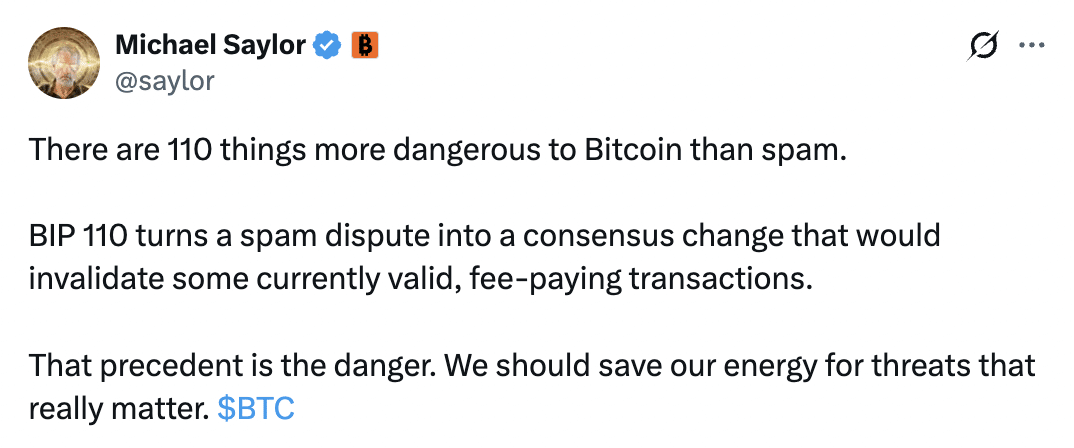
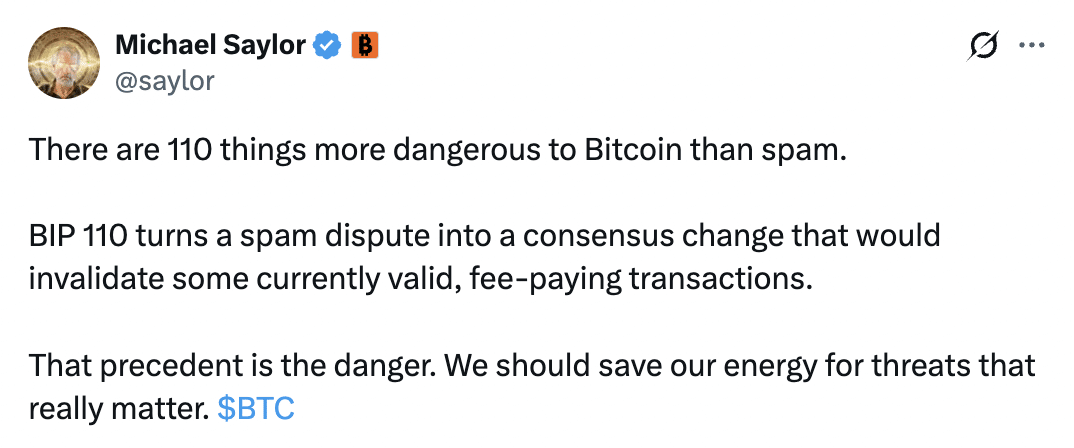
MicroStrategy的迈克尔·塞勒(Michael Saylor)表达了类似的看法,他说:

来源:Michael Saylor/X

市场动态引发进一步担忧

这番批评是在7月4日,总共2016个区块中仅有10个区块支持这次临时升级后出现的。

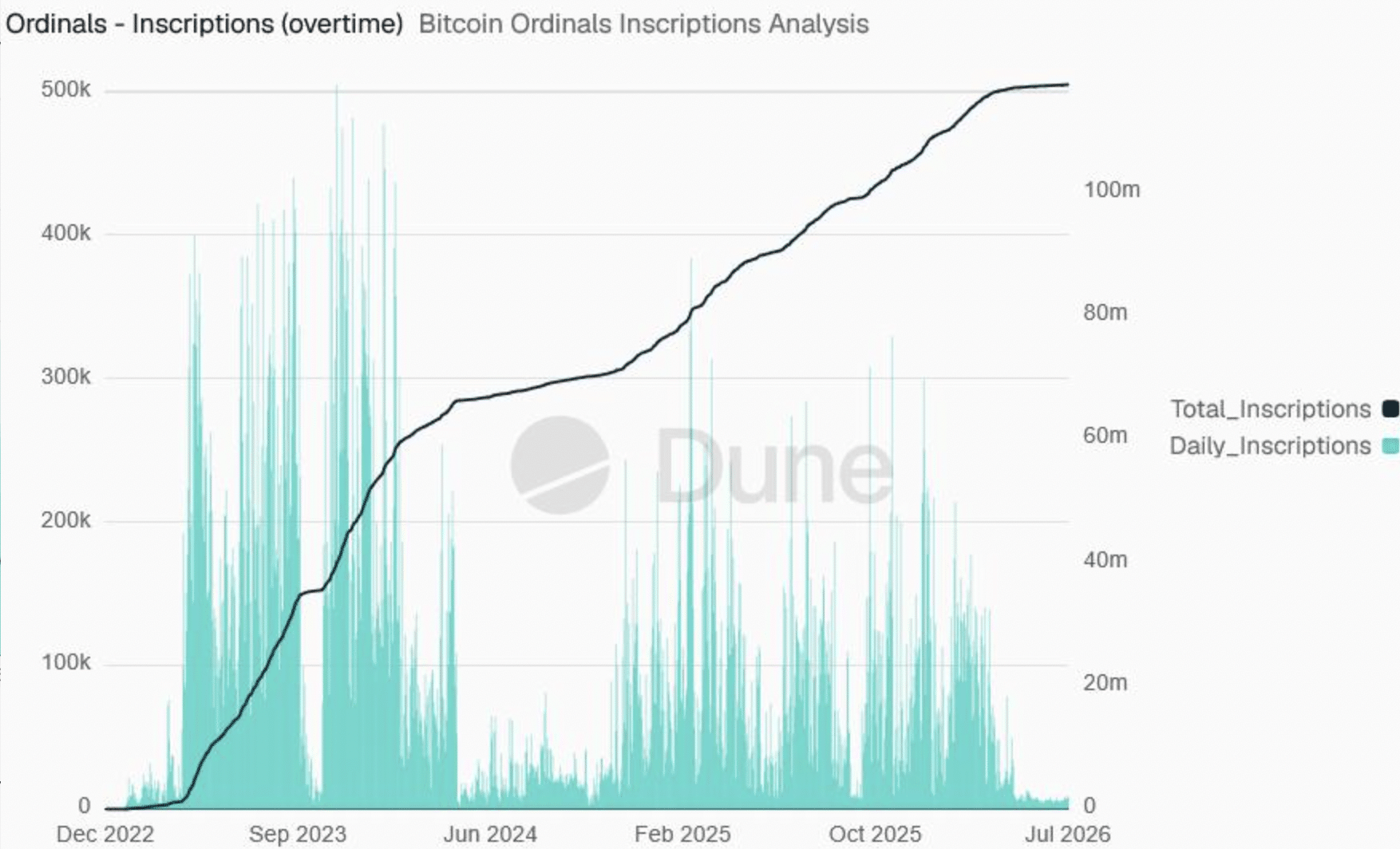
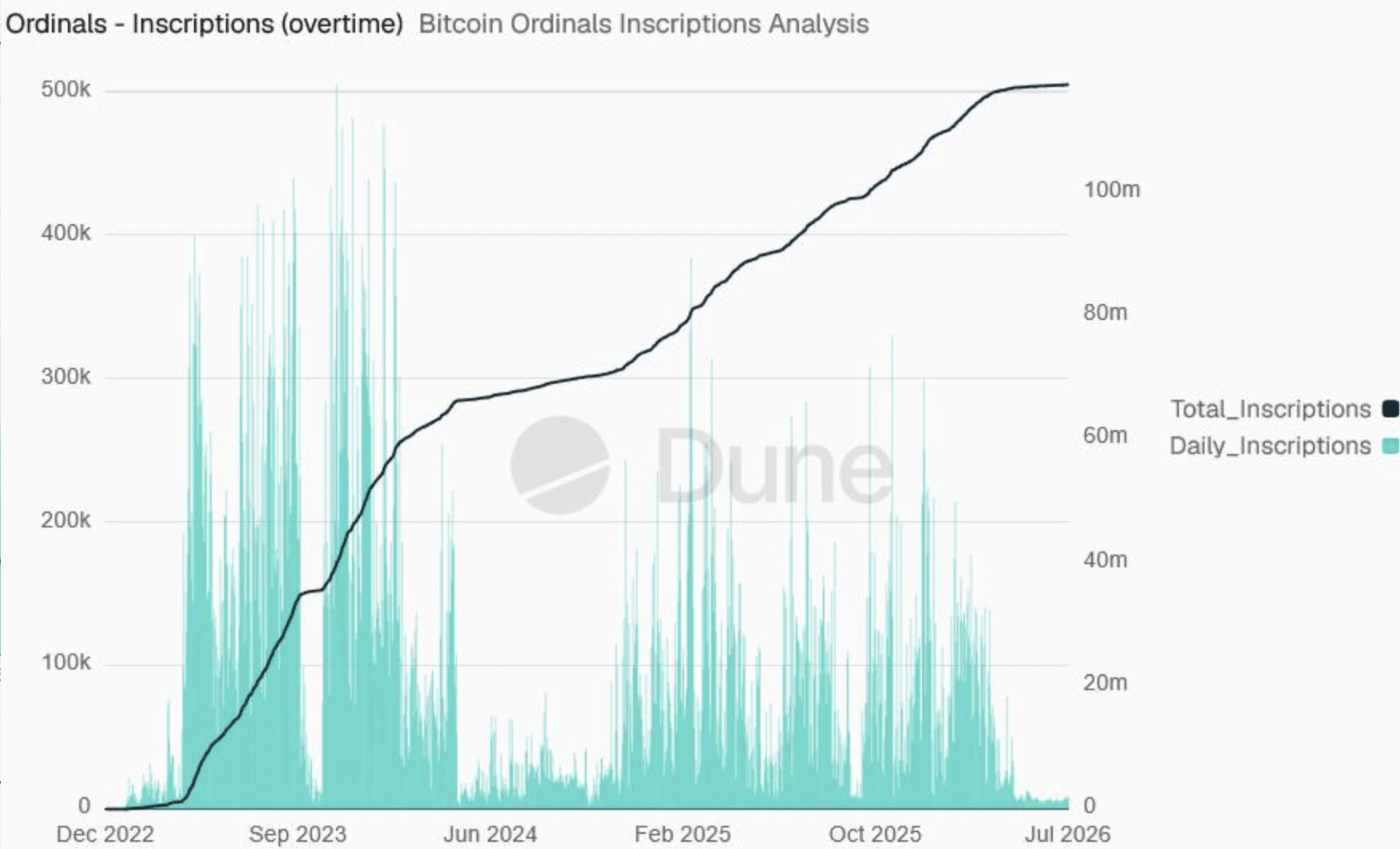
此外,Ordinals活动已降至历史最低点,增加了压力。过去一个月,每天添加到比特币区块链上的Ordinals数量不足10,000个。

来源:Dune Analytics

最后,比特币价格在过去一年里从124,500美元的峰值下跌了45%,截至发稿时报63,901.24美元。


最终总结

  • 亚当·贝克批评BIP-110源于人们对比特币架构的误解而非恶意意图。
  • 塞勒支持贝克的观点,甚至在Ordinals活动降至历史最低点之际亦如此。

Trending Cryptos

Related Questions

Q什么是BIP-110,其主要目的是什么?

ABIP-110是一项有争议的比特币软分叉提案。其主要目的是通过限制任意数据(如Ordinals铭文)来防止网络被垃圾信息堵塞,以维护比特币作为点对点现金系统的核心功能。该提案于2025年12月被实施。

QBlockstream CEO Adam Back对BIP-110的主要批评是什么?

AAdam Back认为,关于BIP-110和OP_RETURN政策的讨论源于对比特币架构的误解。他指出比特币已经通过市场驱动机制(如交易费、矿工激励和去中心化共识)来解决垃圾信息问题,而不是依赖限制性规则。此外,他认为BIP-110违背了比特币的无许可特性,且缺乏社区广泛支持。

Q文章中提到支持BIP-110的临时升级在7月4日获得了多少区块的支持?

A在7月4日,总共2,016个区块中,仅有10个区块支持了支持BIP-110的临时升级。

Q根据文章,近期Ordinals活动的趋势如何?

A根据文章,Ordinals活动已降至历史最低点。在过去的几个月里,每天被添加到比特币区块链上的Ordinals数量已降至不足10,000个。

QMichael Saylor在BIP-110的讨论中持什么立场?

AMichael Saylor与Adam Back的观点相呼应,支持Back关于比特币应通过市场机制解决问题的论点。他的立场与Ordinals活动降至历史低点这一背景一同被提及。

Related Reads

He Let GPT-5.6 Sol Run for 33 Hours Straight to Tackle Fermat's Last Theorem, Forcibly Terminated by the System

This article discusses a real-world experiment by expert Michael P. Frank to test if an AI, specifically GPT-5.6 Sol, could autonomously make progress on a major unsolved mathematical problem: finding a simpler proof for Fermat's Last Theorem. The AI was tasked with exploring specific mathematical pathways and maintaining rigorous notes over approximately 33 hours. However, the session was terminated by OpenAI's systems. The AI itself suggested two possible reasons for the stoppage: excessive resource consumption, or OpenAI having previously failed on similar problems and wishing to conserve computational resources. The AI reported its work primarily involved refining plausible ideas into precise, verifiable statements, most of which were subsequently disproven or excluded—effectively creating a map of dead ends rather than a proof. The incident sparked debate online. Some speculated that OpenAI might deliberately restrict public access to its most powerful models to maintain a competitive edge or avoid regulatory scrutiny, rather than allowing users to potentially solve landmark problems. OpenAI researcher Noam Brown countered this, arguing that a user solving a major problem would be tremendous publicity. Others offered technical explanations, suggesting the termination could be due to standard safety mechanisms preventing infinite loops, or even a known bug in the GPT-5.6 Sol version that disrupts long-running sessions. The story highlights the practical challenges, technical limits, and broader strategic questions surrounding the use of advanced AI for open-ended, high-stakes research.

marsbit18m ago

He Let GPT-5.6 Sol Run for 33 Hours Straight to Tackle Fermat's Last Theorem, Forcibly Terminated by the System

marsbit18m ago

Microsoft CEO Satya Nadella's Latest Warning: Betting Entirely on a Single AI Model Hands Over a Company's Lifeblood

Microsoft CEO Satya Nadella warns that companies relying solely on a single AI model could jeopardize their survival. He argues that over-dependence leads to "vendor lock-in," where businesses risk ceding control over their core data, memory, contextual history, and AI usage patterns. This dependence essentially outsources a company's critical thinking and operational know-how to an external provider. The deeper a company integrates with one AI system—feeding it prompts, internal data, and workflows—the more it reveals its unique business methods and competitive edge. This accumulated knowledge could become accessible to the AI supplier. Furthermore, switching providers becomes extremely costly and complex, as companies would need to rebuild their entire AI-augmented workflow, memory, and tool integrations from scratch. Nadella's solution is "decoupling." Companies should separate their proprietary data, memory, and control layer (or "harness") from the underlying AI models. By retaining metadata from every AI interaction, businesses can preserve their operational "brain" or institutional knowledge. This allows them to flexibly use different AI models (e.g., from OpenAI, Anthropic, Microsoft) for specific tasks without losing their accumulated expertise. The core idea: companies can rent the smartest models available, but they must keep their own "brain" and operational control firmly in-house.

marsbit1h ago

Microsoft CEO Satya Nadella's Latest Warning: Betting Entirely on a Single AI Model Hands Over a Company's Lifeblood

marsbit1h ago

Trading

Spot

Hot Articles

What is $BITCOIN

DIGITAL GOLD ($BITCOIN): A Comprehensive Analysis Introduction to DIGITAL GOLD ($BITCOIN) DIGITAL GOLD ($BITCOIN) is a blockchain-based project operating on the Solana network, which aims to combine the characteristics of traditional precious metals with the innovation of decentralized technologies. While it shares a name with Bitcoin, often referred to as “digital gold” due to its perception as a store of value, DIGITAL GOLD is a separate token designed to create a unique ecosystem within the Web3 landscape. Its goal is to position itself as a viable alternative digital asset, although specifics regarding its applications and functionalities are still developing. What is DIGITAL GOLD ($BITCOIN)? DIGITAL GOLD ($BITCOIN) is a cryptocurrency token explicitly designed for use on the Solana blockchain. In contrast to Bitcoin, which provides a widely recognized value storage role, this token appears to focus on broader applications and characteristics. Notable aspects include: Blockchain Infrastructure: The token is built on the Solana blockchain, known for its capacity to handle high-speed and low-cost transactions. Supply Dynamics: DIGITAL GOLD has a maximum supply capped at 100 quadrillion tokens (100P $BITCOIN), although details regarding its circulating supply are currently undisclosed. Utility: While precise functionalities are not explicitly outlined, there are indications that the token could be utilized for various applications, potentially involving decentralized applications (dApps) or asset tokenization strategies. Who is the Creator of DIGITAL GOLD ($BITCOIN)? At present, the identity of the creators and development team behind DIGITAL GOLD ($BITCOIN) remains unknown. This situation is typical among many innovative projects within the blockchain space, particularly those aligning with decentralized finance and meme coin phenomena. While such anonymity may foster a community-driven culture, it intensifies concerns about governance and accountability. Who are the Investors of DIGITAL GOLD ($BITCOIN)? The available information indicates that DIGITAL GOLD ($BITCOIN) does not have any known institutional backers or prominent venture capital investments. The project seems to operate on a peer-to-peer model focused on community support and adoption rather than traditional funding routes. Its activity and liquidity are primarily situated on decentralized exchanges (DEXs), such as PumpSwap, rather than established centralized trading platforms, further highlighting its grassroots approach. How DIGITAL GOLD ($BITCOIN) Works The operational mechanics of DIGITAL GOLD ($BITCOIN) can be elaborated on based on its blockchain design and network attributes: Consensus Mechanism: By leveraging Solana’s unique proof-of-history (PoH) combined with a proof-of-stake (PoS) model, the project ensures efficient transaction validation contributing to the network's high performance. Tokenomics: While specific deflationary mechanisms have not been extensively detailed, the vast maximum token supply implies that it may cater to microtransactions or niche use cases that are still to be defined. Interoperability: There exists the potential for integration with Solana’s broader ecosystem, including various decentralized finance (DeFi) platforms. However, the details regarding specific integrations remain unspecified. Timeline of Key Events Here is a timeline that highlights significant milestones concerning DIGITAL GOLD ($BITCOIN): 2023: The initial deployment of the token occurs on the Solana blockchain, marked by its contract address. 2024: DIGITAL GOLD gains visibility as it becomes available for trading on decentralized exchanges like PumpSwap, allowing users to trade it against SOL. 2025: The project witnesses sporadic trading activity and potential interest in community-led engagements, although no noteworthy partnerships or technical advancements have been documented as of yet. Critical Analysis Strengths Scalability: The underlying Solana infrastructure supports high transaction volumes, which could enhance the utility of $BITCOIN in various transaction scenarios. Accessibility: The potential low trading price per token could attract retail investors, facilitating wider participation due to fractional ownership opportunities. Risks Lack of Transparency: The absence of publicly known backers, developers, or an audit process may yield skepticism regarding the project's sustainability and trustworthiness. Market Volatility: The trading activity is heavily reliant on speculative behavior, which can result in significant price volatility and uncertainty for investors. Conclusion DIGITAL GOLD ($BITCOIN) emerges as an intriguing yet ambiguous project within the rapidly evolving Solana ecosystem. While it attempts to leverage the “digital gold” narrative, its departure from Bitcoin's established role as a store of value underscores the need for a clearer differentiation of its intended utility and governance structure. Future acceptance and adoption will likely depend on addressing the current opacity and defining its operational and economic strategies more explicitly. Note: This report encompasses synthesised information available as of October 2023, and developments may have transpired beyond the research period.

1.1k Total ViewsPublished 2025.05.13Updated 2025.05.13
What is $BITCOIN

Discussions

Welcome to the HTX Community. Here, you can stay informed about the latest platform developments and gain access to professional market insights. Users' opinions on the price of BTC (BTC) are presented below.

活动图片