El Dólar de Garantía: ¿Cómo se forma una 'segunda capa del dólar' sobre las stablecoins?

marsbitPublished on 2026-07-08Last updated on 2026-07-08

Abstract

Los stablecoins son pasivos privados dolarizados tokenizados que pueden operar “offshore” en su uso, incluso si el emisor y sus reservas están sujetos a la jurisdicción estadounidense. Este artículo argumenta que, a diferencia del sistema eurodólar donde la elasticidad monetaria surge de los pasivos de un banco que expande su balance, los stablecoins por sí solos no crean dicha elasticidad. Actúan principalmente como sustitutos de ciertos saldos operativos en dólares offshore. La creación monetaria significativa ocurre solo cuando un intermediario (como un comerciante o una plataforma) emite un pasivo de segunda capa (un préstamo garantizado) contra estos tokens bloqueados como garantía, y cuando un tercero (un proveedor de fondos) está dispuesto a financiar o mantener ese pasivo cerca de su valor nominal. Este "dólar de garantía" representa la segunda capa de promesas construida sobre el stablecoin. La prima de riesgo (haircut) refleja la distancia entre el control sobre el token y su conversión confiable a dólares bancarios. En tiempos de estrés, esta capa superior es la más vulnerable: puede colapsar debido al aumento de los descuentos y a las llamadas de margen, incluso si el stablecoin subyacente sigue siendo solvente, revelando una estructura fundamentalmente diferente a la del sistema eurodólar tradicional.

Autor: neira, Arquitecto de productos financieros tokenizados en Tempo

Compilación: Jiahuan, ChainCatcher

La mayoría de la gente cree que las stablecoins están replicando la función del eurodólar e impulsando una mayor expansión del sistema del dólar extraterritorial.

Pero no es así. Las stablecoins sustituyen principalmente sólo parte de las funciones del sistema existente, especialmente los saldos en dólares necesarios para las operaciones diarias y la liquidación; en algunos aspectos cruciales que la Reserva Federal vigila de cerca, incluso podrían reducir el efecto multiplicador de la expansión crediticia.

Lo que realmente vale la pena preguntar es: ¿Qué sucede cuando los intermediarios financieros, sobre la base de las stablecoins, crean una nueva capa de pasivos en dólares sobre ellas?

Este artículo explicará cómo funciona este nuevo canal de financiación garantizada, qué condiciones necesita para escalar, y por qué su comportamiento bajo estrés tiene una estructura fundamentalmente diferente a la del sistema tradicional del eurodólar.

Resumen

Las stablecoins introducen un pasivo en dólares privado tokenizado. Incluso si el emisor, los activos de reserva y el banco de liquidación principal permanecen dentro de los límites legales de EE.UU., o dependen de la infraestructura bancaria y de liquidación de valores conectada a EE.UU., este pasivo puede volverse "extraterritorial" en sustancia económica por su circulación y uso como garantía.

El control exigible sobre la garantía abre un canal de crédito garantizado, pero no crea por sí solo un pasivo monetario. El verdadero evento monetario sólo ocurre cuando otro balance proporciona financiación, renueva este pasivo creado contra el token controlado, o lo acepta a un precio cercano a su valor nominal.

El descuento (haircut) marca el precio de la distancia entre el "control efectivo sobre el token" y su "conversión fiable a dólares bancarios". La fuente de elasticidad es diferente: proviene del balance que emite el pasivo contra el token, y de la disposición de terceros balances a tratar este pasivo como un activo cercano al valor nominal incluso bajo estrés.

Las variables decisivas incluyen: quién tiene el control efectivo sobre el token, a través de qué ruta legal y operativa se convierte en dólares bancarios, cuál es su costo real, su plazo, y si el pasivo resultante puede seguir siendo financiado a un valor cercano al nominal cuando esas rutas se bloquean.

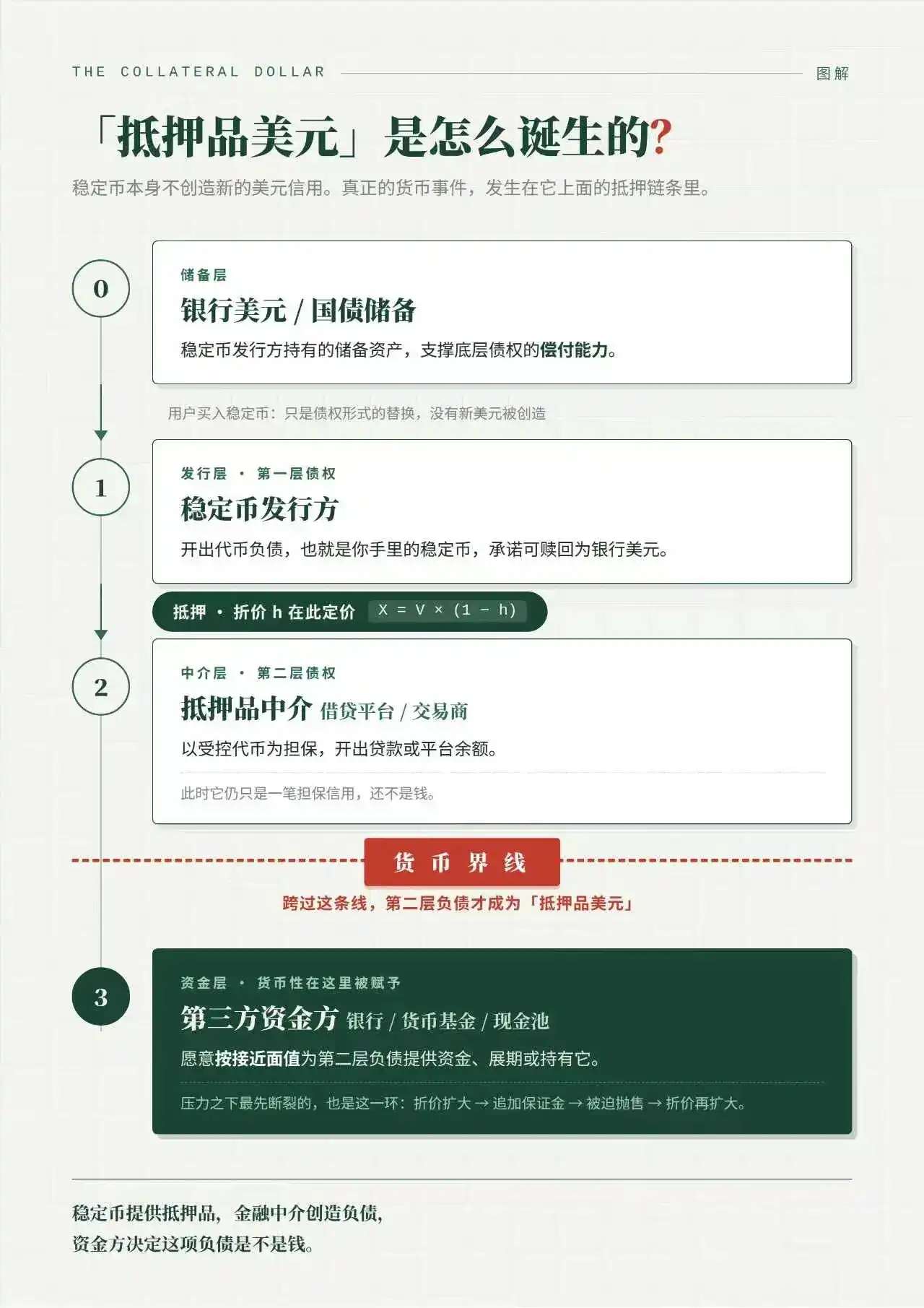
El dólar de garantía no es la stablecoin en sí. Es el pasivo de segunda capa que otro balance está dispuesto a emitir, financiar y mantener a un nivel cercano al valor nominal, respaldado por un saldo de tokens controlado.
1. El sistema del eurodólar es una jerarquía de pasivos

En sentido estricto, un eurodólar es un pasivo bancario denominado en dólares registrado fuera de la jurisdicción directa de la Reserva Federal: es una promesa privada de entregar dólares, emitida por una institución bancaria cuya ubicación legal, tratamiento regulatorio y acceso a la liquidez difieren de los de un banco estadounidense nacional.

El sistema del dólar extraterritorial en un sentido más amplio también incluye los pasivos en dólares emitidos por dealers e intermediarios de mercado, respaldados por garantías y derivados. La unidad de cuenta sigue siendo el dólar, pero los balances que emiten estos pasivos están fuera de la jurisdicción directa del banco central.

Este mercado constituye un sistema de balances privados en dólares. Una institución extraterritorial puede crear un pasivo en dólares simplemente registrando simultáneamente un pasivo y un activo coincidentes. La liquidación final aún puede pasar por el sistema de pagos estadounidense, pero la "creación" y la "liquidación" están separadas en el espacio institucional.

Esta separación permite a las instituciones no estadounidenses financiar posiciones en dólares, cubrir riesgos y liquidar sin depender constantemente de dinero del banco central nacional. Pero también crea dependencia: dependencia de la capacidad de renovación, del crédito interbancario, de la intermediación de los dealers y de la conversión a pasivos de mayor jerarquía cuando aumenta la presión de liquidación.

Los pasivos se ordenan jerárquicamente según: la fuerza de la promesa de valor nominal, la calidad de los activos subyacentes, el plazo, la liquidez de mercado y la inmediatez del acceso a dinero de mayor jerarquía. En condiciones normales, la creación de mercado (market-making) y la renovación comprimen esta estructura jerárquica. Bajo estrés, esta compresión se invierte: los límites de contraparte se estrechan, los plazos se acortan, los descuentos aumentan y la estructura jerárquica reaparece a través de diversas restricciones operativas.

La elasticidad proviene de aquellos balances dispuestos a expandir sus pasivos en dólares antes de que las duras restricciones de la liquidación final se impongan.

En el canal no garantizado, los bancos extraterritoriales emiten depósitos, certificados de depósito o pasivos interbancarios, e invierten los fondos obtenidos en activos en dólares. En el canal garantizado, un dealer emite un pasivo en dólares contra una garantía, donde el descuento determina cuánto financiamiento puede soportar dicha garantía.

En el canal de derivados, los swaps y forwards de divisas generan financiación en dólares no a través de un depósito inmediatamente visible, sino a través de compromisos a lo largo del tiempo. La pata a plazo (forward leg) permite a bancos y no bancos convertir capacidad de balance en el plano monetario en capacidad de financiación en dólares. Un saldo de stablecoin transferible es sólo un pasivo a la vista, sin ningún mercado de financiación a plazo detrás, por lo que no puede replicar esta función en absoluto.

En el contexto del eurodólar, "extraterritorial" se refiere principalmente a la ubicación legal y del balance desde donde se emite el pasivo. La ruta para que una stablecoin adquiera atributos "extraterritoriales" es diferente: lo hace a través de su uso económico: incluso si el emisor y sus reservas permanecen en EE.UU., o dependen de infraestructura bancaria y de liquidación conectada a EE.UU., sus cadenas de circulación, custodia, staking y apalancamiento pueden operar fuera de los límites legales estadounidenses.

Por lo tanto, lo que realmente vale la pena comparar es el contraste entre dos cadenas: la cadena de garantía de las stablecoins frente a la cadena de financiación del dólar extraterritorial. Comparar directamente "token" con "depósito en eurodólares" es una comparación desajustada.

Un depósito en eurodólares, desde su nacimiento, se asienta en un balance bancario capaz de expandir el crédito: tiene elasticidad desde el primer asiento contable. Una stablecoin nace en el balance de un emisor que promete respaldo de reservas, por lo que en su nacimiento sólo aporta "sustitución"; la elasticidad aparece más tarde, en otro lugar.

Sólo cuando otro intermediario emite contra ella un pasivo financiable, y más balances aceptan ese pasivo a un precio cercano al valor nominal, la stablecoin se relaciona con la elasticidad.

2. Las stablecoins interrumpen niveles específicos del sistema del dólar extraterritorial

Las stablecoins alteran la composición de los pasivos dentro de ciertos niveles específicos del sistema del dólar extraterritorial. El sistema en sí permanece en su lugar.

La sustitución más obvia ocurre en este caso: el tenedor quiere un saldo en dólares transferible, no acceder a un balance completo en dólares. Los exchanges, brokers, empresas de pagos y algunos departamentos de tesorería corporativa pueden mantener stablecoins como inventario de liquidación. En este uso, el token asume parte de la función que antes cumplían los depósitos operativos extraterritoriales.

El cambio en el balance aquí es directo. El usuario sustituye un pasivo contra un banco extraterritorial por un pasivo contra el emisor de la stablecoin. El banco pierde ese pasivo, y el emisor adquiere un nuevo pasivo en tokens, emparejado por su cartera de reservas.

La composición de estas reservas determina dónde reaparece finalmente la demanda de fondos desplazada. Si las reservas permanecen como depósitos bancarios, el sistema bancario recupera parte de esos fondos. Si las reservas se trasladan a letras del Tesoro o repos, la presión se desplaza al mercado de garantías soberanas y a los intermediarios dealers. Esta sustitución sólo redirige la "dependencia de los bancos", no la elimina.

Esta sustitución es más fuerte en el nivel de los saldos operativos: inventario de exchanges, saldos de liquidación de brokers, flotantes de pagos y fondos de rotación empresarial. Se debilita en el nivel de financiación bancaria mayorista, donde los depósitos a plazo, certificados de depósito y préstamos interbancarios construyen una estructura de plazos.

En los swaps de divisas, apenas tiene presencia: los compromisos a plazo y la capacidad de balance transmmonetaria generan conjuntamente financiación en dólares, y el token a la vista no tiene ningún papel. En el nivel del dealer, la stablecoin puede ser un activo elegible, pero sigue sujeta a las restricciones que realmente importan: capital, capacidad de liquidación, límites de contraparte, inventario de garantías. No sustituye ninguna de estas restricciones.

Una stablecoin aceptada como garantía puede respaldar un pasivo adicional en dólares. Pero hasta que otro balance esté dispuesto a financiar, renovar o mantener ese pasivo a un valor cercano al nominal, seguirá siendo sólo crédito garantizado.

3. Un saldo en dólares no crea capacidad de balance en dólares

El sistema del dólar extraterritorial sirve a dos necesidades distintas.

Una es la necesidad de "saldos en dólares": un pasivo que se puede almacenar y transferir para pagos. Las stablecoins encajan bien en esta necesidad donde la fricción en las transferencias es la principal restricción.

La otra es la necesidad de "capacidad de balance en dólares": la capacidad de obtener financiación, margen, cobertura o transformación de plazos. Esta capacidad reside en bancos, dealers y fondos. Consume capital, liquidez y límites de contraparte, y se retira cuando las condiciones se endurecen.

Hay una tercera necesidad, por encima de las dos anteriores: la necesidad de un tipo de pasivo que otros balances estén dispuestos a tratar como un activo cercano al valor nominal, sin tener que auditar la garantía subyacente desde cero cada vez. El usuario necesita un saldo en dólares. Los fondos apalancados necesitan capacidad de financiación. Y los pools de efectivo o los proveedores de fondos de segunda capa necesitan un pasivo que puedan mantener a un valor cercano al nominal. El canal de garantías sólo importa realmente cuando toca esta tercera necesidad.

Tres pruebas distinguen estos niveles.

Transferibilidad. El tenedor puede transferir este pasivo en dólares. Las stablecoins pasan esta prueba fácilmente.

Capacidad de financiación. Un intermediario está dispuesto a prestar, proporcionar margen o otorgar crédito contra este pasivo. Las stablecoins sólo pasan esta prueba bajo restricciones de elegibilidad, control y descuento.

Aceptación monetaria. Si el pasivo creado por ese intermediario puede, a su vez, ser financiado o mantenido a un valor cercano al nominal. Las stablecoins sólo adquieren significado sistémico en este paso.

La sustitución a nivel corporativo también sigue este gradiente: más fuerte para el inventario de liquidación, más débil para la banca relacional. Un saldo en tokens puede sustituir la parte de los depósitos operativos utilizada para transferir valor. Pero no sustituye nada de lo que hay detrás de la mayoría de las posiciones de efectivo corporativas: líneas de crédito, límites de divisas, bancos corresponsales, proveedores de liquidez intradía, interfaces de cumplimiento de sanciones, relaciones crediticias.

Los tokens transfieren pasivos. Los balances proporcionan elasticidad.

4. De la elasticidad del depósito a la elasticidad del descuento

En el canal extraterritorial tradicional, la elasticidad se origina en un pasivo bancario.

(Banco extraterritorial)

El depositante posee un pasivo cuasi-monetario, y el banco obtiene fondos utilizables. La elasticidad nace en el lado del pasivo de un balance expansible.

La emisión de stablecoins produce una estructura más estrecha.

(Emisor de stablecoin)

El tenedor obtiene un pasivo transferible, el emisor posee las reservas. Mientras el emisor se mantenga "estrecho" (narrow), no se crea un segundo pasivo privado en dólares: sólo cambia la forma y ubicación del primer pasivo.

El canal garantizado comienza cuando el token se utiliza para obtener financiación. El descuento determina cuánta financiación puede soportar el token controlado:

X = V_token × (1 − h)

Donde X es la capacidad de financiación de segunda capa, V_token es el valor de mercado del token controlado, y h es la tasa de descuento. La contabilidad aquí debe distinguir cuatro balances.

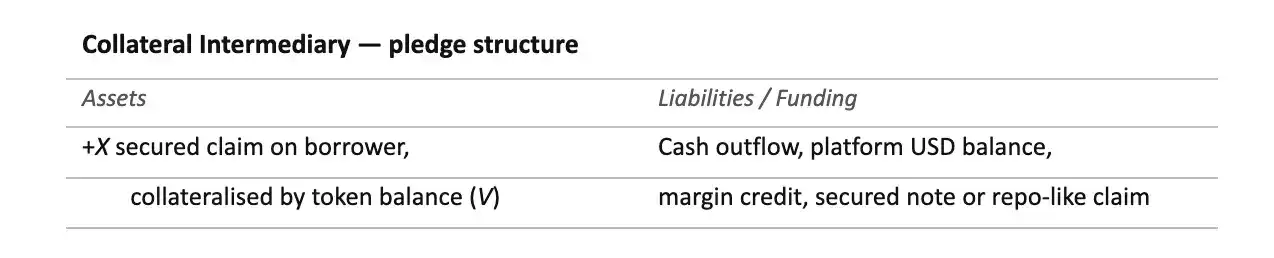
La situación del intermediario de garantías depende de la forma legal del control. La prenda (pledge) y la transferencia de propiedad (title transfer) no son el mismo balance.
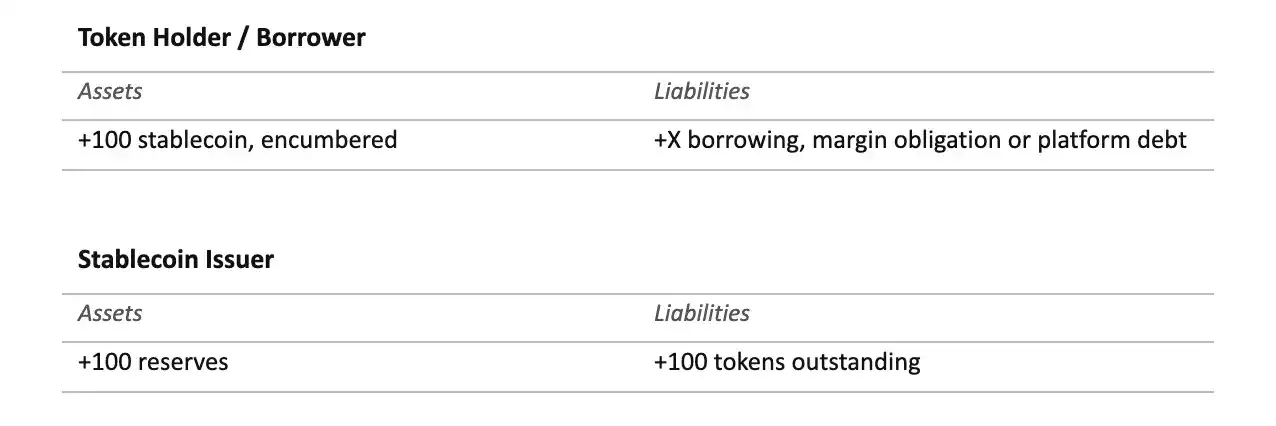
(Intermediario de garantías: estructura de prenda)

En una estructura de prenda, el prestatario sigue siendo el propietario del token. El intermediario no posee el saldo total de tokens; posee un crédito garantizado por un monto X, y tiene control o derechos de ejecución sobre la garantía con valor V. Su exposición en el balance es X, y la protección legal cubre V. La garantía excedente V − X sigue perteneciendo económicamente al prestatario, a menos que los mecanismos de incumplimiento y liquidación establezcan otra distribución.
(Intermediario de garantías: estructura de transferencia de propiedad)

En una estructura de transferencia de propiedad, el intermediario posee el token en sí. Suponiendo que el token vale 100 y el préstamo es 90, el intermediario controla el saldo total de 100 tokens, mientras que el prestatario retiene el excedente económico a través del derecho a "recuperar una garantía equivalente o el valor residual después del reembolso".

El control legal total del intermediario es V, y su exposición económica neta es X. La diferencia V − X no es patrimonio disponible libremente. Es la protección residual del prestatario, incrustada en la obligación de "devolver una garantía equivalente o liquidar el excedente tras la liquidación".

Si este préstamo se financia con efectivo existente, el intermediario no necesariamente expande su pasivo; simplemente intercambia efectivo por una exposición garantizada o una exposición por transferencia de propiedad. Si el préstamo se financia mediante la emisión de saldos en plataforma, pagarés, pasivos tipo repo u otros pasivos a corto plazo, entonces el intermediario expande su balance.

Por lo tanto, la cuestión monetaria no se detiene en si hay transferencia de propiedad. Depende de cómo se financie el préstamo en sí, y de si el pasivo resultante es aceptado a un valor cercano al nominal.

Esta distinción es importante porque sus mecanismos de estrés son diferentes. En la prenda, la ejecución del prestamista depende de sus derechos de perfeccionamiento, prioridad y realización sobre una garantía que aún está asociada al prestatario. En la transferencia de propiedad, el intermediario puede tener un control más fuerte, capacidad de repledging (reutilización como garantía) o derechos de realización, pero también carga con una obligación más clara: una vez cerrada la exposición garantizada, debe devolver una garantía equivalente o su valor.
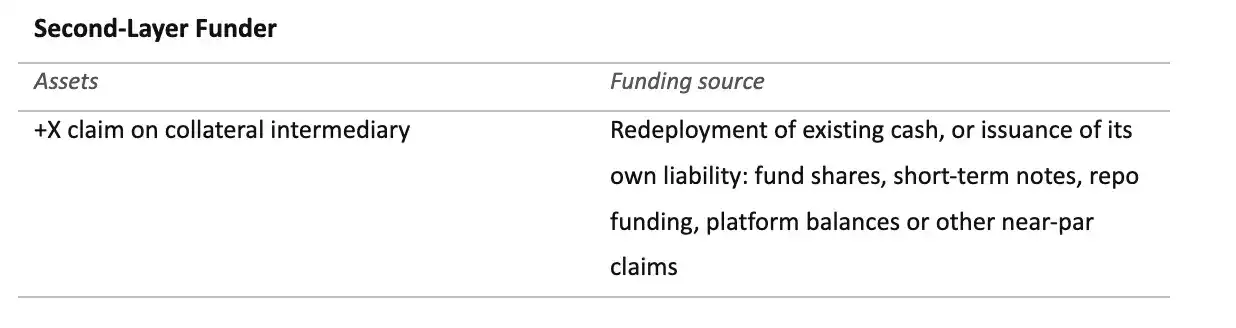
(Proveedor de fondos de segunda capa)

La elasticidad monetaria es más fuerte en el segundo escenario: el proveedor de fondos financia este crédito emitiendo su propio pasivo cercano al valor nominal. En el primer escenario, el sistema simplemente reasigna el efectivo existente a un crédito respaldado por tokens, y la cantidad de pasivos privados en dólares no necesariamente se expande.

La emisión por sí misma no crea nada más allá del token. El crédito garantizado adelanta valor contra el token. Sólo cuando el crédito del prestamista se convierte en un activo que otro balance financia a un valor cercano al nominal, se cruza esa línea hacia la creación monetaria. El paso del préstamo garantizado a la creación monetaria ocurre aquí, nunca antes.

El descuento marca el precio de la distancia entre el "control efectivo sobre el token" y su "conversión fiable a dólares bancarios", transformando el valor de la garantía en capacidad de financiación. Y la elasticidad en sí proviene del pasivo emitido contra el token, y de la disposición de otro balance a financiar ese pasivo a un valor cercano al nominal.

5. Condiciones institucionales del canal de garantías

Cuatro condiciones determinan si un pasivo de segunda capa puede ser financiado a un valor cercano al nominal.

Control legal. Tener una posición prioritaria y ejecutable sobre el prestatario, sus acreedores, custodios, plataformas y cualquier patrimonio concursal interviniente. Frente al emisor, las preguntas son diferentes: elegibilidad para el canje, transferibilidad, derechos de congelación, estado de la cuenta, riesgos de listas negras y el estatus legal del crédito del tenedor del token. El prestamista debe saber si el arreglo es una prenda, transferencia de propiedad, control de custodia, bloqueo por contrato inteligente o un pasivo de plataforma híbrido. Cada forma otorga derechos diferentes en caso de incumplimiento.

Control operativo. La ruta de realización (venta) y la ruta de canje deben distinguirse. La realización depende de la profundidad del mercado secundario, el balance de los market-makers y el acceso a las casas de cambio. El canje depende de las reglas del emisor, las listas blancas, el banco de liquidación, el horario bancario y el momento del canje. Un descuento que trata estas dos rutas de salida como equivalentes no es riguroso.

Rigor del descuento. El descuento debe cubrir: riesgo del emisor, composición de las reservas, acceso al banco de liquidación, elegibilidad para el canje, estructura de custodia, ejecutabilidad legal, profundidad del mercado, finalidad on-chain, derechos de pausa operativa, riesgo de deterioro conjunto (wrong-way risk) con el prestatario, concentración de market-makers y tiempo necesario para convertir el token en dólares bancarios.

Persistencia de la financiación. Un tercero está dispuesto a financiar el crédito del prestamista sin tener que auditar desde cero el token, el prestatario y la ruta completa de realización en cada ocasión. La comodidad del prestamista original con la garantía nunca es el criterio. Mientras cada proveedor de fondos tenga que analizar individualmente cada préstamo garantizado, el resultado es crédito bilateral garantizado, no un pasivo cercano al valor nominal.

La financiación cercana al valor nominal está ligada al plazo. Un crédito que se puede pedir prestado a un día no es lo mismo que uno que puede soportar retrasos de canje de varios días, retiradas periódicas de fondos o corridas de inversionistas. La monetaridad no es sólo una cuestión de precio, también de momento.

La verdadera prueba es: una vez que el prestatario, el emisor, el custodio, la casa de cambio y el banco de liquidación se convierten cada uno en fuentes de riesgo independientes, si el pasivo emitido contra el token sigue siendo un activo cercano al valor nominal. Que el token pueda usarse como garantía es la parte más fácil.

6. Transmisión del estrés en el canal de garantías

El estrés en el sistema del dólar extraterritorial se manifiesta como un movimiento ascendente en la estructura jerárquica. Las contrapartes más débiles pierden financiación. Los prestamistas de repos amplían los descuentos. Los dealers comienzan a racionar su capacidad de balance. Los pasivos que antes se trataban como cuasi-efectivo ahora necesitan apoyo de liquidez explícito.

En un canal de garantías construido sobre stablecoins, primero fallan los pasivos superiores. El token subyacente es la promesa del emisor de "canjear por dólares bancarios". El pasivo de segunda capa es la promesa del intermediario de "proporcionar liquidez cercana al valor nominal, respaldada por ese token". El primero puede seguir siendo solvente, el segundo ya ha perdido su estatus cuasi-monetario.

En condiciones normales, el token cotiza a la par, los descuentos son bajos, los intermediarios otorgan crédito con normalidad y el pasivo de segunda capa se trata como cuasi-efectivo. Nadie prueba simultáneamente la ruta completa de realización y la ruta de canje. La fragilidad reside en la capa que está sobre el emisor.

Lo que primero se rompe suele ser un ajuste en los términos de la garantía, mucho antes de que ocurra cualquier corrida sobre el token. Un prestamista aumenta el descuento, el prestatario recibe una llamada de margen. Un prestatario que no tiene efectivo ni puede aportar garantía adicional obliga al intermediario a realizar, canjear o financiar internamente esa posición. El pasivo de segunda capa se vuelve inmediatamente muy consumidor de balance.

La aritmética aquí es implacable. Un saldo de tokens financiado con un descuento del 2% puede respaldar 98 de crédito:

100 × (1 − 0.02) = 98

Con un descuento del 15% y un precio de mercado secundario de 99 centavos, el valor prestable cae a 84.15:

99 × (1 − 0.15) = 84.15

Los 13.85 que faltan tienen que venir de algún lado:

98 − 84.15 = 13.85

Ya sea una llamada de margen adicional, una venta forzada, un uso interno de fondos, o un pasivo de segunda capa que se rompe.

Esta fórmula estática mide la primera pérdida de capacidad de financiación. El mecanismo real de estrés es dinámico. V_token y h no son variables independientes. Un descuento mayor reduce el valor prestable y desencadena llamadas de margen que pueden forzar la venta de tokens. Las ventas forzadas deprimen aún más el precio de mercado secundario del token. Un precio más bajo, a su vez, "justifica" un aumento mayor del descuento, creando así un nuevo déficit de fondos.

X_t = V_t (1 − h_t)

Para cambios pequeños:

ΔA ≈ (1 − h_t) ΔV − V_t Δh

Bajo estrés, estos dos términos se mueven en la misma dirección. Δh aumenta porque los prestamistas exigen más protección; ΔV disminuye porque el propio proceso de llamadas de margen está generando presión vendedora. Por lo tanto, el descuento no es sólo una medida del riesgo, puede convertirse en un mecanismo de transmisión del riesgo.

La ruta de realización transforma un problema de financiación en un problema de profundidad de mercado. La ruta de canje lo transforma en un problema de canales bancarios. La financiación interna lo mantiene como un problema de capital del intermediario, que es donde se vuelve costoso. Transferir el crédito a otro proveedor de fondos sólo funciona si el crédito sigue cotizando a un valor cercano al nominal.

La salida de un dealer o plataforma retira a una institución que previamente había estado "almacenando" el desfase temporal entre la realización y el canje, transformando la garantía en financiación cercana al valor nominal. Esto no es lo mismo que una disminución de la liquidez. Una vez que este almacenamiento se detiene, la estructura jerárquica reaparece inmediatamente.

A diferencia del sistema maduro del dólar extraterritorial, la cadena de garantías de stablecoins no tiene un mecanismo establecido de "último dealer" o una arquitectura de líneas swap de bancos centrales para los pasivos emitidos sobre los tokens. El token subyacente puede tener reservas. El pasivo de segunda capa sólo tiene su propio mercado de financiación.

La calidad de las reservas respalda la solvencia del pasivo subyacente, pero no garantiza nada sobre la "liquidez a valor nominal" una vez que fallan los canales de canje, el banco de liquidación o la profundidad del mercado secundario. El emisor puede tener reservas adecuadas y, al mismo tiempo, el sistema crediticio construido sobre ellas puede colapsar.

7. Conclusión

La analogía con el eurodólar sólo es válida hasta cierto punto. Una stablecoin es un pasivo privado en dólares tokenizado que, incluso si el emisor y las reservas permanecen dentro de los límites legales de EE.UU. o dependen de infraestructura bancaria y de liquidación conectada a EE.UU., su uso puede volverse extraterritorial en sustancia económica.

La calidad de las reservas respalda la solvencia del pasivo subyacente. El apalancamiento, margen, crédito de plataforma y pasivos garantizados construidos sobre ellas responden a otro conjunto de pruebas.

La elegibilidad como garantía no alcanza la aceptación monetaria: hasta que el crédito del prestamista se convierte en un activo cercano al valor nominal para otros, un préstamo respaldado por tokens sigue siendo sólo un préstamo.

El canal de depósitos del sistema del eurodólar comienza con un pasivo bancario y se expande a través de la creación de depósitos, la financiación interbancaria y los mercados de dólares a plazo. El canal de garantías de las stablecoins comienza con un activo tokenizado controlado, y sólo se expande cuando un intermediario emite un pasivo contra ese token y otro balance trata ese pasivo como algo similar al dinero.

El emisor maneja la promesa subyacente, el intermediario de garantías emite la segunda promesa, y los proveedores de fondos deciden si esta segunda promesa tiene atributos cuasi-monetarios. El descuento marca el precio de la distancia entre el "control del token" y su "conversión a dólares bancarios". Y bajo estrés, lo que primero se amplía es precisamente esta distancia.

El dólar de garantía sólo existe realmente cuando el crédito construido sobre la stablecoin sobrevive al salto de la "liquidez del token" a la "liquidez en dólares bancarios".

Trending Cryptos

Related Questions

Q¿Cómo funciona el 'dólar colateral' en comparación con las stablecoins y qué lo diferencia del sistema del eurodólar?

AEl 'dólar colateral' no es la stablecoin en sí. Es una segunda capa de pasivos creada por otro balance financiero (un intermediario) que acepta un saldo de tokens controlados como garantía, ofrece financiación y mantiene ese pasivo cerca de su valor nominal. A diferencia del sistema del eurodólar, donde la elasticidad monetaria surge desde el inicio en el pasivo de un banco (un depósito), aquí la elasticidad surge más tarde y en otro lugar: solo cuando el pasivo creado por el intermediario es aceptado y financiado como un activo cercano a la par por un tercer balance. El descuento (haircut) refleja la distancia entre el control efectivo del token y su conversión fiable a dólares bancarios.

Q¿Qué condiciones institucionales son necesarias para que un crédito de segunda capa basado en stablecoins pueda financiarse a un valor cercano a la par?

ACuatro condiciones clave: 1) Control legal: Derechos ejecutables y prioritarios sobre el token frente a prestatarios, custodios y en caso de quiebra. 2) Control operativo: Distinguir claramente la ruta de liquidación (mercado secundario) de la ruta de reembolso (emisor). 3) Rigor en el descuento (haircut): Debe cubrir todos los riesgos (emisor, reservas, banco de liquidación, profundidad del mercado, etc.). 4) Persistencia del financiamiento: Terceros deben estar dispuestos a financiar el crédito del prestamista sin reevaluar constantemente la garantía subyacente, tratándolo como un activo cercano a la par.

Q¿Cómo se transmite el estrés en un canal de garantía construido sobre stablecoins, en contraste con el sistema tradicional del eurodólar?

AEn el sistema del eurodólar, el estrés genera un movimiento ascendente en la jerarquía de créditos (pérdida de financiación para contrapartes más débiles, ampliación de descuentos). En el canal de garantía de stablecoins, la primera capa en fallar suele ser el crédito de segunda capa (el pasivo del intermediario), mucho antes de que haya una corrida sobre el token subyacente. Un aumento en el descuento o una caída en el precio del token desencadena llamadas de margen, ventas forzadas y hace que el crédito de segunda capa deje de ser visto como 'casi dinero'. La presión es dinámica: mayores descuentos reducen el valor del préstamo, provocan ventas que deprimen el precio del token, lo que justifica descuentos aún mayores.

QSegún el artículo, ¿qué capas o funciones específicas del sistema del eurodólar están siendo sustituidas principalmente por las stablecoins?

ALas stablecoins sustituyen principalmente una función específica dentro del sistema del eurodólar: los saldos operativos en dólares para liquidación y transacciones diarias. Esto incluye inventarios en exchanges, saldos de liquidación de brókeres, flotantes de pagos y fondos de rotación corporativa. En cambio, tienen poca o ninguna presencia en capas más complejas como el financiamiento bancario mayorista a plazo (CDs, préstamos interbancarios), los swaps de divisas o la capacidad de balance general de los dealers, que involucran promesas a futuro, transformación de plazos y relaciones crediticias.

Q¿Por qué el artículo argumenta que poseer un saldo en stablecoins no equivale a tener capacidad de balance general en dólares?

APorque un saldo en stablecoins satisface la necesidad de un 'saldo en dólares' (un derecho transferible para pagos), pero no la necesidad de 'capacidad de balance general en dólares', que es la habilidad para obtener financiamiento, margen, coberturas o transformación de plazos. Esta última capacidad reside en bancos, dealers y fondos, consume capital y líneas de crédito, y puede retraerse. Un token es bueno para transferir el derecho, pero son los balances generales los que proveen la elasticidad financiera. Solo cuando un crédito basado en ese token es aceptado y financiado cerca de su valor nominal por otro balance, se acerca a tener propiedades monetarias sistémicas.

Related Reads

Trading

Spot

Hot Articles

What is LINON

Linde plc Tokenized Stock (Ondo): Revolutionizing Traditional Equity Access Through Blockchain Innovation The emergence of Linde plc Tokenized Stock (Ondo), represented by the ticker $LINON, signifies a monumental shift in the fusion of traditional financial structures and decentralized finance (DeFi). This innovative financial instrument showcases the tremendous potential of blockchain technology to democratize access to traditional equity markets while ensuring the security and regulatory compliance necessary for institutional-grade financial products. Through Ondo Finance's pioneering tokenization platform, $LINON provides a seamless pathway for global investors to engage with one of the world's leading industrial gas companies, Linde plc, creating a blockchain-native representation of the underlying equity. Introduction to Linde plc Tokenized Stock The landscape of financial markets is witnessing a groundbreaking transformation through the tokenization of real-world assets. Linde plc Tokenized Stock (Ondo) epitomizes this revolutionary approach by bridging the gap between conventional stock ownership and blockchain-enabled financial infrastructure. The $LINON token allows investors to gain exposure to one of the prominent industrial companies worldwide through decentralized technology. Operating within Ondo Finance's comprehensive ecosystem, $LINON symbolizes a practical application of tokenization technology that enhances accessibility, efficiency, and global connectivity in traditional financial markets. By leveraging blockchain infrastructure, this tokenized stock enables international investors to participate in U.S. equity markets, overcoming traditional barriers associated with cross-border investing. The significance of $LINON goes beyond technological innovation; it represents a fundamental shift in asset structuring, distribution, and trading in the digital age. This tokenized stock maintains all the economic benefits associated with traditional Linde plc shares while offering improved liquidity, programmable compliance features, and seamless integration with decentralized finance protocols. The development of $LINON indicates a growing acceptance of blockchain technology as a viable means for traditional finance, exemplifying how even well-established assets like Linde plc can integrate into blockchain systems. This approach preserves the core attributes that appeal to investors while introducing advanced capabilities that enhance the overall investment proposition. Project Overview and Objectives Linde plc Tokenized Stock (Ondo) encapsulates a strategic effort to democratize access to traditional equity markets through advanced blockchain technologies. The primary objective of $LINON is to provide approved global investors seamless access to the economic exposure associated with Linde plc shares, furthering an effort to create a more inclusive financial ecosystem. Beyond the digital representation of traditional assets, $LINON endeavors to eliminate barriers of geography and time zones that limit investor participation. Its design ensures that blockchain technology can elevate traditional investment vehicles without undermining the security or compliance requirements expected by investors. Key goals of the project include enhanced liquidity provision, programmable compliance mechanisms, and interoperability with other blockchain networks. Each $LINON token is fortified by actual Linde plc securities housed at U.S.-registered broker-dealers, allowing holders to reap economic advantages akin to traditional stockholders, such as dividend reinvestment. Furthermore, $LINON aims to establish new industry standards for institutional-grade tokenized securities, paving the way for traditional assets to embrace blockchain technology while remaining compliant with regulatory frameworks. By associating itself with a company as reputable as Linde plc, the project opens avenues for exploring tokenized equities catering to both conservative institutional players and daring retail investors. Project Creator and Development Team The vision for Linde plc Tokenized Stock (Ondo) comes from Nathan Allman, founder and CEO of Ondo Finance. His background in traditional finance coupled with expertise in blockchain technology positions him uniquely to navigate the complexities of asset tokenization. Allman's academic journey began at Brown University, focusing on Economics and Biology, equipping him with valuable analytical skills. His time at Goldman Sachs in the Digital Assets division strengthened his understanding of the interplay between financial institutions and emerging technologies, laying the groundwork for his later endeavors in alternative investment strategies. Under Allman's guidance, Ondo Finance has emerged as a leader in asset tokenization, launching $LINON as a flagship example of the company's larger mission towards revolutionizing traditional financial systems using blockchain technology. His commitment to leveraging blockchain for creating institutional-grade financial products has shaped the landscape of real-world asset tokenization. Investment and Funding Structure The growth of Ondo Finance, the platform powering Linde plc Tokenized Stock (Ondo), is bolstered by robust financial backing from prestigious venture capital firms and strategic investors. This strong investment foundation underpins the development of the key infrastructure essential for compliant tokenized securities like $LINON. In August 2021, Ondo Finance secured $4 million in seed funding led by a major venture capital firm, which enabled the company to commence platform development and establish the necessary regulatory processes for tokenizing real-world assets. This early investment cemented Ondo Finance's credibility within the industry. The Series A funding round followed, garnering $20 million with participation from renowned firms committed to transformative technology companies. This backing demonstrated substantial institutional confidence in Ondo Finance's vision, allowing it to hone its approach to asset tokenization through mechanisms that ensure compliance and accessibility. Noteworthy contributors, including institutional investors and experienced partners, have added significant value to Ondo Finance’s development efforts. Their involvement underscores the confidence across sectors in Ondo Finance's approach to bridging traditional finance with blockchain innovations. Technical Infrastructure and Innovation The technical architecture that underpins Linde plc Tokenized Stock (Ondo) represents a sophisticated melding of traditional finance systems and cutting-edge blockchain technology. The architecture's foundation is built on the Ethereum network, renowned for its security and programmability—both critical for intricate financial instruments. The $LINON tokenization process comprises creating a blockchain-native representation of Linde plc shares that preserves economic benefits while augmenting investor capabilities. Each token corresponds to actual shares held at U.S.-registered broker-dealers, creating a compliant custody structure that legitimizes the asset's existence and value. Automated compliance systems are integrated into the tokenization process, managing critical components such as know-your-customer (KYC) verification and anti-money laundering (AML) protocols. This incorporation of programmable compliance empowers $LINON to uphold regulatory standards essential for institutional proliferation. Cross-chain interoperability characterizes the advanced technical features of $LINON. While initially deployed on Ethereum, the framework is designed for expansion to other networks such as Solana and BNB Chain. This adaptability enhances liquidity and accessibility, allowing investors to select their preferred blockchain ecosystems. Historical Timeline and Development Crafting the history of Linde plc Tokenized Stock (Ondo) unfolds in parallel with the evolution of Ondo Finance's tokenization platform. The timeline's inception dates back to March 2021 when Nathan Allman laid the foundations for creating institutional-grade financial products on blockchain infrastructure. The initial funding round in August 2021 provided crucial resources for developing the platform and establishing partnerships necessary for effective tokenization. By January 2023, Ondo Finance launched its tokenized treasury products, establishing mechanisms that would facilitate future tokenized equities such as $LINON. A pivotal milestone arose in February 2025 when Ondo Chain—a Layer 1 blockchain designed specifically for asset tokenization—was introduced. This infrastructure enhances capabilities vital for institutional markets, demonstrating Ondo Finance's long-term commitment to tokenization. Subsequently, the launch of Ondo Global Markets in September 2025 marked the official debut of $LINON. This milestone showcased the successful transition from development to active trading, enabling investors around the world to access American financial markets seamlessly. Ongoing development plans include a targeted expansion of available tokenized assets to over 1,000 by the end of 2025, pointing to a bright future for Ondo Finance's ecosystem and its mission to broaden tokenized equity accessibility. Regulatory Compliance and Legal Framework The legal architecture governing Linde plc Tokenized Stock (Ondo) emphasizes a sophisticated approach to regulatory compliance, allowing tokenized securities to be implemented within a blockchain-based framework. The legal structure governing $LINON spans multiple jurisdictions while maintaining a robust legal footing. Compliance systems ensure that only eligible investors can access the token, enforced through automated verification that aligns with international regulations. This innovative regulatory technology promises real-time enforcement of complex requirements, considerably enhancing efficiency in operating within the regulatory landscape. The custody framework undergirding $LINON ensures that the underlying shares are securely held at U.S.-registered broker-dealers, complying with necessary regulations while delivering blockchain-driven access to investors. The token maintains its economic equivalency and security through this carefully structured custody arrangement. KYC and AML compliance systems are embedded within the smart contract architecture, ensuring integrity and adherence to regulatory practices while fostering transparency for investors. The jurisdictional restrictions mark a commitment to navigating the evolving landscape of international securities laws. Market Impact and Industry Significance The advent of Linde plc Tokenized Stock (Ondo) holds profound implications for the broader financial landscape, symbolizing a clear shift towards blockchain-enabled markets. $LINON serves as a proof-of-concept for integrating traditional companies into blockchain ecosystems, showcasing the potential benefits such as broader accessibility and improved efficiency. The market's response to $LINON indicates a growing acceptance of tokenization among institutional investors, contributing to the emergence of an expanding sector wherein traditional assets can be interconnected with blockchain innovations. The success of $LINON further solidifies market confidence, indicating an overarching shift towards recognizing asset tokenization as a transformative force in finance. Future Development and Expansion Plans The future trajectory for Linde plc Tokenized Stock (Ondo) centers around the expansion of the tokenization ecosystem and enhanced infrastructure supporting blockchain-enabled financial services. Plans for cross-chain integration usher in new opportunities for liquidity and flexibility within the investment framework, with existing capabilities poised for continuous enhancement. With the introduction of Ondo Chain, Ondo Finance aims to transition $LINON to an optimized blockchain environment specifically designed for asset tokenization. This new infrastructure heralds exciting prospects for the development of institutional-grade financial products, ensuring ongoing compatibility with contemporary investment strategies. Further integration with decentralized finance protocols signifies a commitment to empowering $LINON holders through advanced financial strategies. The anticipated expansion of available tokenized assets promises to broaden investor access, enhancing the utility and appeal of the platform. In alignment with ambitions for regulatory expansion, ongoing efforts to secure approvals for new jurisdictions will enhance investor access, further positioning $LINON at the forefront of the burgeoning tokenization market. Conclusion Linde plc Tokenized Stock (Ondo), as represented by the $LINON token, stands at the intersection of traditional finance and blockchain innovation. It embodies a transformative milestone in how financial assets are structured, distributed, and engaged within modern investment ecosystems. The technical sophistication behind $LINON, combined with its regulatory compliance framework, illustrates that asset tokenization can improve financial infrastructure rather than simply digitizing existing products. This pioneering effort not only enhances investor access to U.S. equity markets but also signifies an evolution of how traditional financial services can integrate blockchain technology. As the asset tokenization market grows exponentially, with prospects suggesting significant valuation increases, $LINON paves the way for a future where tokenized securities become standard fixtures in the financial landscape. The trajectory of $LINON will undoubtedly influence how traditional finance adapts to a transformed, blockchain-powered world.

3.4k Total ViewsPublished 2025.12.05Updated 2025.12.05

What is LINON

What is CRMON

Salesforce Tokenized Stock (Ondo): Revolutionising Traditional Equity Access Through Blockchain Innovation The emergence of Salesforce Tokenized Stock (CRMON) marks a pivotal advancement in integrating traditional financial markets with blockchain technology. This innovative approach offers investors unprecedented access to equity exposure through tokenisation. Developed by Ondo Finance, CRMON provides tokenholders with economic exposure equivalent to holding Salesforce stock (CRM) while automatically reinvesting dividends. This effectively bridges the gap between conventional equity markets and decentralised finance (DeFi). Introduction and Comprehensive Overview of Salesforce Tokenized Stock In recent years, the financial landscape has dramatically transformed due to blockchain technology, fundamentally altering how investors access and interact with traditional assets. The development of Salesforce Tokenized Stock (CRMON) is a prime example of this evolution, representing a sophisticated fusion of conventional equity markets with cutting-edge distributed ledger technology. CRMON is a tokenised version of Salesforce stock, emerging from the innovative work of Ondo Finance, a leading platform in the real-world asset tokenisation sector that positions itself as a bridge between traditional finance and decentralised systems. Designed to provide tokenholders with economic exposure that mirrors the performance of the underlying Salesforce stock, CRMON incorporates automatic dividend reinvestment mechanisms. This eliminates many traditional barriers associated with international equity investment, such as complex brokerage relationships, currency conversion challenges, and restricted trading hours. The tokenisation process reimagines stock ownership as a blockchain-native asset while maintaining its economic equivalence with the underlying security, offering enhanced portability and integration capabilities within decentralised finance ecosystems. CRMON transcends its individual utility as an investment instrument to represent a fundamental shift in how financial markets can operate in an increasingly digital world. By maintaining full backing through U.S.-registered broker-dealers and implementing robust compliance frameworks, CRMON demonstrates that tokenised securities can achieve the regulatory standards necessary for institutional adoption while delivering the technological advantages of blockchain infrastructure. Understanding Tokenized Real-World Assets and CRMON's Strategic Position Tokenised real-world assets signify one of the most significant innovations in modern finance, fundamentally reimagining how traditional securities are represented, traded, and utilised within digital ecosystems. CRMON operates as a tokenised equity instrument correlating directly with Salesforce stock while optimising accessibility and efficiency. This aligns with Ondo Finance's broader mission to democratise access to institutional-grade financial products through innovative tokenisation strategies. The tokenisation process guarantees complete economic equivalence with the underlying Salesforce equity. Each CRMON token represents a proportional claim on Salesforce stock held by qualified custodians, with dividend payments automatically reinvested to maintain continuous exposure to total return performance. This structure simplifies dividend management and ensures that tokenholders receive the full economic benefit of their equity exposure, encompassing both capital appreciation and income generation. Ondo Finance's strategy in tokenising Salesforce stock demonstrates its expertise in creating compliant, institutional-grade products that meet traditional financial markets' stringent requirements. The platform’s focus on merging regulatory compliance with blockchain benefits positions it at the forefront of decentralised finance, captivating both institutional and retail investors seeking blockchain-native solutions. The Technology and Innovation Framework Behind CRMON The technological infrastructure supporting CRMON integrates blockchain technology with traditional financial mechanisms, delivering institutional-grade security and compliance while maintaining the operational advantages of decentralised systems. Built on the Ethereum blockchain, CRMON utilises robust smart contract capabilities to ensure transparent, secure operations. The smart contract architecture incorporates layered security and compliance mechanisms, enabling automated compliance checks and real-time asset backing verification. Integration with oracle services maintains accurate pricing and dividend information, ensuring CRMON reflects the underlying Salesforce stock's accurate performance. This architecture delivers automated dividend reinvestments and other corporate actions, eliminating manual processing requirements and directly enhancing tokenholder benefits. Ondo Finance ensures CRMON's security structure includes daily third-party verification of holdings, independent collateral agents, and a multiple-layer custody system through partnerships with established financial institutions. This framework safeguards tokenholder interests against operational risks while providing robust asset backing. The user interface enhances integration capabilities, allowing seamless interaction between CRMON and various decentralised finance protocols, as well as cryptocurrency exchanges. This interoperability enables users to leverage their tokenised equity across multiple platforms, creating sophisticated investment strategies that marry traditional equity characteristics with blockchain-native innovation. Leadership and Corporate Structure of Ondo Finance The leadership team behind CRMON and Ondo Finance blends expertise from traditional finance and blockchain technology, presenting a robust combination of skills essential for successfully bridging conventional markets with decentralised finance. Nathan Allman, the founder and CEO, emerged from a distinguished financial background before establishing Ondo Finance in 2021. Allman's experience includes notable roles at major financial institutions, including significant contributions to developing cryptocurrency market services. His insights into regulatory compliance were paramount in developing products like CRMON that successfully unify traditional securities with blockchain technology. With a team of professionals boasting substantial experience in both conventional finance and blockchain sectors, Ondo Finance's leadership comprises diverse expertise that covers every aspect of tokenised asset development. Justin Schmidt serves as President and COO, contributing unique operational expertise, while Chris Tyrell brings essential compliance knowledge. Investment Landscape and Funding History The investment landscape surrounding Ondo Finance reflects significant institutional confidence in its mission to tokenise real-world assets. The company has raised substantial funds through various investment rounds, attracting leading venture capital firms and strategic investors that recognise the transformative potential of tokenised securities like CRMON. Notably, Ondo Finance completed a successful Series A funding round in 2022, led by well-known venture capital firms. This funding success validates Ondo Finance's innovative approach to creating compliant, institutional-grade tokenised products. In total, Ondo Finance has successfully secured substantial funding, raising significant capital for product development and market expansion, including a noteworthy token sale that reinforced its governance structure through the establishment of the ONDO token. The diverse composition of investors reflects broad market confidence in Ondo Finance's business model, demonstrating support from both traditional and blockchain-native organisations. Operational Mechanics and Technical Implementation The operational framework supporting CRMON exemplifies sophisticated integration of traditional financial mechanisms with blockchain technology. The technical implementation introduces multiple layers of security, compliance, and operational efficiency to meet institutional standards while enhancing accessibility. The tokenisation process begins by acquiring actual Salesforce stock through U.S.-registered broker-dealers, ensuring each CRMON token maintains direct correlation with the underlying equity performance. Smart contracts automate operational processes, including dividend reinvestment and corporate action processing, facilitating a streamlined user experience. The Minting and redemption processes allow authorised participants to manage CRMON tokens effectively. During U.S. trading hours, institutions can mint new tokens by depositing stablecoins that are used to purchase corresponding Salesforce equity. This structure maintains a tight correlation with underlying assets, enhancing liquidity and price discovery. Additionally, the infrastructure supports twenty-four-hour token transfer capabilities, providing CRMON holders with operations outside traditional market hours. This represents a significant advantage over conventional securities ownership, thus promoting integration with decentralised finance applications. Plans for cross-chain compatibility through partnerships signal further ambitions for CRMON's market reach. By expanding to other blockchain networks, Ondo Finance aims to enhance accessibility and user engagement with tokenised equity products. Timeline and Historical Development of Tokenized Equity Innovation The timeline of CRMON's development and Ondo Finance's broader tokenised capabilities demonstrates a systematic innovation process beginning with the company's founding in 2021. 2021: Ondo Finance is founded by Nathan Allman and co-founders, launching initial products focused on structured vault offerings on the Ethereum blockchain. 2022: The company completes substantial funding rounds—both equity and token sales—totaling significant capital and launching initial tokenised U.S. Treasury products. 2023-2024: Ondo Finance experiences substantial growth, establishing partnerships with major financial institutions while expanding its product offerings beyond fixed-income securities. February 2025: Ondo Global Markets is announced, marking the transition into equity tokenisation with plans for accessing over one hundred U.S. stocks and ETFs. September 2025: The official launch of Ondo Global Markets includes CRMON alongside other tokenised equity offerings, marking a significant evolution in Ondo Finance's product ecosystem. This timeline highlights the organisation's rapid growth and its capability to adapt its technological and compliance frameworks to accommodate different asset classes effectively while maintaining security and regulatory integrity. Regulatory Framework and Compliance Approach Ondo Finance's regulatory framework showcases a sophisticated compliance strategy, essential for achieving institutional adoption in the tokenised securities market. The company's strong partnerships with U.S.-registered broker-dealers promote adherence to Securities and Exchange Commission regulations and apply robust investor protections. Acquisitions, such as Oasis Pro—a registered broker-dealer—significantly enhance Ondo Finance's compliance capabilities, ensuring thorough alignment with existing regulatory structures. The company employs independent verification procedures that foster transparency, aiming for a solid performance standards reputation. Furthermore, Ondo Finance's commitment extends to international regulatory compliance, ensuring token access remains restricted to eligible investors while adhering to pertinent cross-border securities regulations. Comprehensive attention to tax implications and reporting requirements fortifies the security and compliance landscape of CRMON, ensuring that investor obligations remain manageable. Future Prospects and Market Positioning The forward-looking landscape for CRMON and Ondo Finance illustrates substantial growth opportunities driven by institutional adoption of blockchain technology and escalating demand for efficient alternatives to conventional securities ownership. Market projections indicate the tokenised asset sector could value multiple trillion dollars by 2030. With plans to scale CRMON offerings significantly and integrate it with a dedicated blockchain infrastructure—Ondo Chain—Ondo Finance aims to elevate its institutional-grade tokenised asset operations. Additionally, the development of strategic partnerships enhances distribution capabilities while establishing the company's credibility in the financial market. Furthermore, the integration of tokenised equity with decentralised finance protocols offers new potential for innovative financial products and strategies previously impossible with traditional securities. These factors underscore CRMON's positioning to effectively capture increased market share and deliver innovative solutions for international investment exposure. Conclusion Salesforce Tokenized Stock (CRMON) symbolises a transformative development within financial markets, successfully bridging traditional equity ownership with blockchain technology to create unprecedented accessibility for global investors. Through Ondo Finance's sophisticated tokenisation framework, CRMON provides complete economic exposure to Salesforce equity performance while enhancing operational advantages that exceed traditional ownership. The launch of CRMON reflects the broader evolution of financial markets towards blockchain infrastructures that maintain regulatory compliance while delivering increased efficiency. Ondo Finance's extensive approach to regulatory adherence, institutional-grade security, and technological innovation solidifies CRMON as a model for future tokenised securities, delivering access previously unattainable in conventional brokerage structures. As the tokenised asset sector continues to develop, CRMON is well-positioned to address historical inefficiencies in capital markets while providing investors with innovative solutions for accessing traditional securities. The outlook for CRMON looks exceptionally promising, supported by ambitious expansion plans, technological innovations, and strategic partnerships, thereby representing a pioneering model of modern financial infrastructure evolving through blockchain integration.

3.5k Total ViewsPublished 2025.12.05Updated 2025.12.05

What is CRMON

What is SHOPON

Shopify Tokenized Stock (Ondo): A Comprehensive Analysis of Real-World Asset Tokenization in Web3 This article delves into the Shopify Tokenized Stock (Ondo), recognised by its ticker symbol $SHOPON, exploring its implications at the intersection of traditional finance and blockchain technology. As a part of Ondo Finance's tokenized securities platform, Shopify’s tokenized stock exemplifies advancements in democratizing access to global capital markets through innovative digital assets. Introduction and Overview of Shopify Tokenized Stock (Ondo) Shopify Tokenized Stock (Ondo), or $SHOPON, portrays a pivotal innovation in the realm of tokenized securities, allowing investors to gain economic exposure akin to directly owning shares of Shopify Inc. This token, developed under the umbrella of Ondo Finance, not only provides investors with the ability to hold digital representations of the company’s stock but also integrates features such as automatic reinvestment of dividends. This advancement represents a substantial shift in the landscape of decentralized finance (DeFi), linking conventional equity markets with blockchain solutions designed to enhance accessibility, transparency, and liquidity. By eliminating geographical barriers and enabling 24/7 trading capabilities, $SHOPON is positioned as a bridge connecting traditional financial instruments and the emerging Web3 ecosystem. What is Shopify Tokenized Stock (Ondo), $SHOPON? The $SHOPON token serves as a digital manifestation of Shopify Inc.'s shares, engineered to provide a direct correlation to the underlying asset's performance. Through the utilization of blockchain technology, the token gives holders a mechanism to participate in the economic benefits associated with equity ownership, including capital appreciation and dividend distribution. The unique aspect of $SHOPON lies in its automatic dividend reinvestment mechanism, which allows returns to compound without necessitating active management by the investor. This feature inherently enhances its attractiveness as an investment vehicle, particularly for individuals seeking passive income growth alongside exposure to high-performing equities. The tokenization process is facilitated by the custody of actual Shopify shares through regulated intermediaries, ensuring that every $SHOPON token is verifiably backed by real equity. This structure empowers investors with the dual advantages of both traditional financial characteristics and the innovative benefits tied to blockchain technology. Who is the Creator of Shopify Tokenized Stock (Ondo)? The creator of Shopify Tokenized Stock (Ondo), Nathan Allman, is an experienced figure in the finance sector, formerly associated with Goldman Sachs. His rich background includes significant expertise in digital asset development, bridging the gap between traditional finance and cryptocurrencies. Allman’s educational journey, marked by studies at Brown University, provided him with a deep understanding of economics and biology, equipping him with analytical skills that inform his strategic vision. In 2021, he founded Ondo Finance, committing to developing tokenized securities that meet institutional-grade standards while leveraging blockchain's transformative capabilities. Under Allman's leadership, Ondo Finance has focused on creating compliant and innovative financial products that empower a diverse investor base. Who are the Investors of Shopify Tokenized Stock (Ondo)? The investment landscape surrounding Shopify Tokenized Stock (Ondo) is notably robust, underpinned by significant institutional support. Primarily, Pantera Capital stands out as a strategic partner through the Ondo Catalyst initiative, a $250 million commitment aimed at accelerating the development of on-chain capital markets. This partnership not only signifies institutional confidence in the potential of tokenized assets but also reinforces Ondo Finance's operational capabilities and market positioning. The funding pathways have included earlier rounds that amassed millions in seed funding and further structural investments, solidifying relationships with both venture capital firms and private investors. Moreover, the financial framework is complemented by strategic partnerships with established financial institutions and technology companies, enhancing Ondo’s infrastructure and operational expertise. How Does Shopify Tokenized Stock (Ondo), $SHOPON Work? At the core of $SHOPON's operational framework is a sophisticated system integrating traditional finance mechanisms with blockchain technology. The custody of actual Shopify shares ensures that token holders retain authentic economic exposure, safeguarding their investments in line with recognized legal structures. The smart contracts employed in managing $SHOPON handle various functions, including automatic dividend reinvestment and ownership transfer, offering instant settlement and increased liquidity, marking a significant departure from conventional trading systems plagued by multi-day settlement delays. By providing interoperability with other decentralized finance applications, $SHOPON empowers holders with potentially lucrative opportunities for advanced investment strategies, including lending and automated market making. This complex integration presents a unique value proposition, catering to both traditional and crypto-native investors. The innovative structure of $SHOPON also allows for real-time settlements and transactions documented on the blockchain, delivering unparalleled transparency and security—a major advancement over standard equity trading practices. Timeline of Shopify Tokenized Stock (Ondo) March 2021: Nathan Allman establishes Ondo Finance, initially focusing on decentralized finance yield optimization. August 2021: Completion of a $4 million seed funding round led by Pantera Capital. January 2023: Launch of initial tokenized treasury security products, laying the groundwork for future equity tokenization. July 2025: Announcement of the Ondo Catalyst initiative, a strategic investment program valued at $250 million, aimed at propelling the development of tokenization in capital markets. September 3, 2025: Launch of Ondo Global Markets featuring over 100 tokenized U.S. stocks and ETFs, including $SHOPON. Technical Implementation and Blockchain Infrastructure Shopify Tokenized Stock (Ondo) operates on a technical architectural framework that marries blockchain protocols with traditional financial custody arrangements. The ecosystem leverages Ethereum's smart contract capabilities, providing seamless transaction management while ensuring compliance with regulatory standards through established financial custodians. Central to this architecture are security measures and transparent transaction records that affirm the legitimacy of each tokenholder's economic stake. With automated features managed by intricate smart contracts, $SHOPON not only streamlines ownership transfers but also allows for the tactical reinvestment of dividends—a hallmark of modern investment strategies. Moreover, the incorporation of LayerZero technology facilitates cross-chain interoperability, making $SHOPON accessible across multiple blockchain environments while preserving its functional robustness. This forward-thinking technical design positions $SHOPON as an adaptable asset within the larger DeFi milieu. Regulatory Framework and Compliance Architecture $SHOPON's regulatory framework is built upon the meticulous navigation of existing financial regulations that govern securities. The custody arrangements for the underlying Shopify shares are managed by U.S.-regulated broker-dealers, ensuring compliance and protection for investors. By maintaining a separation between the blockchain tokenization process and traditional custody, $SHOPON adheres to legal requirements while offering innovative functionalities that challenge conventional constraints. This dual-layered compliance approach enhances investor confidence and underscores Ondo Finance's commitment to regulatory integrity. Notably, the availability of $SHOPON is tailored to international investors from regions such as Asia-Pacific, Europe, and Africa, as regulatory parameters in the U.S. and U.K. present challenges in accessing tokenized securities. Market Access and Global Distribution Strategy The distribution strategy of $SHOPON is keenly designed to optimize global access while conforming to regulatory standards. The platform aims to establish comprehensive coverage for eligible investors across multiple regions, effectively dismantling traditional barriers through the implementation of blockchain technology. Integration with various cryptocurrency wallets and exchanges also promotes user-friendliness and accessibility, establishing a streamlined experience for investors to manage their holdings. Moreover, the 24/7 trading capabilities afforded by the tokenized model allow participants to react promptly to market shifts, fundamentally transforming how global equities are accessed and traded. Technology Integration and Cross-Chain Functionality The remarkable technological underpinnings of $SHOPON propagate its multi-chain functionality, set to expand its reach beyond Ethereum to networks such as Solana and BNB Chain. Such cross-chain capabilities allow users flexibility when navigating between blockchains, concurrently leveraging distinct network attributes to optimize their trading experience. LayerZero serves as the backbone for ensuring decentralized transfers between networks while providing the requisite security and speed, quintessential for maintaining investor trust. This comprehensive interoperability illustrates $SHOPON's commitment to being a versatile, user-centric asset in the evolving investment landscape. Ecosystem Integration and DeFi Compatibility Incorporating $SHOPON into broader DeFi protocols signifies its potential beyond traditional stock ownership. Token holders can leverage their holdings for various sophisticated strategies and applications, enhancing investment returns and liquidity management. By establishing a presence in lending protocols and automated trading systems, $SHOPON effectively democratizes access to advanced financial strategies previously limited to institutional investors. Such integration contributes to a more competitive and dynamic financial landscape, where individual investors can capitalize on tools typically reserved for larger entities. Risk Management and Security Framework Security remains paramount in the operational infrastructure of $SHOPON. The tokenization framework employs multiple layers of protection—beginning with regulated custody of the underlying Shopify shares. The operational protocols establish rigorous auditing, key management, and transaction monitoring standards, thus safeguarding against potential vulnerabilities. Moreover, meticulous adherence to evolving regulatory requirements provides an extra layer of security, fortifying investor protections and institutional compliance. Market Impact and Industry Implications The introduction of Shopify Tokenized Stock (Ondo) heralds a transformative shift in how financial markets operate, emphasizing the potential of tokenized securities to reshape traditional investment paradigms. The successful integration of $SHOPON encapsulates the efficiencies inherent in blockchain technology and opens avenues for new user demographics previously barred from extensive market participation. The impact extends beyond the immediate benefits to token holders, indicating broader trends that may challenge the status quo of investment services, particularly in addressing geographic restrictions and operational costs typically associated with traditional brokerage platforms. Undeniably, $SHOPON encapsulates the potential for traditional institutions to innovate further, leveraging the increasing demand for seamless blockchain access to complement existing financial infrastructure. Future Development Roadmap and Strategic Vision As Ondo Finance looks forward, the trajectory of $SHOPON rests on ambitious goals aimed at broadening the spectrum of available tokenized assets significantly. Over the next few years, plans are in place to expand to more than 1,000 tokenized securities, further enhancing market participation and investment options for individuals worldwide. Continued integration with traditional financial actors, development of specialized institutional products, and enhancements in automated trading capabilities will ensure that $SHOPON maintains its position at the forefront of financial innovation. Regulatory collaboration will also remain a focal point, establishing a framework that not only supports the compliance requirements but also promotes a healthy environment for tokenized asset proliferation. Conclusion and Market Significance In summary, Shopify Tokenized Stock (Ondo), represented by the ticker $SHOPON, is more than merely a tokenized equity offering; it embodies the innovation possible when traditional finance collides with modern blockchain applications. With a robust technical architecture, a commitment to compliance, and a clear strategic vision, $SHOPON exemplifies the potential for tokenized assets to enhance liquidity, accessibility, and functionality in capital markets. As the global investment landscape evolves, the transformative implications of $SHOPON extend beyond individual investors to revolutionize how financial instruments are perceived, traded, and utilized within both traditional and decentralized frameworks.

3.4k Total ViewsPublished 2025.12.05Updated 2025.12.05

What is SHOPON

Discussions

Welcome to the HTX Community. Here, you can stay informed about the latest platform developments and gain access to professional market insights. Users' opinions on the price of LAYER (LAYER) are presented below.

活动图片