MSTR divulgue la vente de 3 588 bitcoins, son cours boursier chute temporairement de 5 %

华尔街日报Published on 2026-07-06Last updated on 2026-07-06

Abstract

Strategy, le plus grand détenteur institutionnel de Bitcoin, a vendu 3 588 bitcoins entre le 29 juin et le 5 juillet pour environ 216 millions de dollars. Ces fonds serviront à payer les dividendes de ses actions privilégiées. Il s'agit de la plus importante vente de Bitcoin par l'entreprise depuis le début de sa stratégie d'acquisition en 2020, marquant un tournant par rapport à sa promesse initiale de "ne jamais vendre". Ce mouvement indique que le Bitcoin évolue, pour Strategy, d'une réserve stratégique à un actif de gestion de liquidités. L'entreprise a récemment élargi son autorisation pour vendre des bitcoins et compléter sa trésorerie, notamment lorsque le financement par émissions d'actions devient moins attractif. Strategy fait face à une pression financière importante, avec des dividendes annuels sur actions privilégiées d'environ 1,5 milliard de dollars, que ses flux de trésorerie opérationnels ne peuvent couvrir. Après cette vente, l'entreprise détient encore 84 3775 bitcoins. Sa logique opérationnelle semble désormais être d'acheter activement des bitcoins lorsque le financement est facile, et d'en vendre ponctuellement pour gérer les obligations de liquidités comme les dividendes.

Strategy réécrit son modèle économique. Ce plus grand détenteur mondial de bitcoin d'entreprise a annoncé le 6 juillet avoir vendu 3 588 bitcoins entre le 29 juin et le 5 juillet, pour une caisse d'environ 216 millions de dollars, afin de payer les dividendes de ses actions privilégiées. Il s'agit non seulement de la plus grande vente de bitcoin de l'histoire de l'entreprise, mais aussi de la troisième depuis le lancement de sa stratégie bitcoin en 2020.

Cette vente envoie un signal important : le bitcoin passe progressivement d'une réserve stratégique "achat uniquement, pas de vente" de Strategy, à un actif utilisable pour gérer la liquidité.

Selon Bloomberg, la société a élargi son mandat la semaine dernière, l'autorisant à vendre des bitcoins pour renforcer sa trésorerie lorsque l'attrait du financement par actions nouvelles diminue. Cet ajustement intervient alors que le bitcoin et l'action Strategy sont tous deux sous pression. Sur un an, MSTR a chuté d'environ 75 %, et le bitcoin a reculé de plus de 45 % par rapport à son sommet historique.

Après l'annonce, le cours de Strategy a temporairement chuté de plus de 5 %, et le bitcoin est tombé à environ 61 800 dollars, en dessous du prix d'acquisition moyen de l'entreprise d'environ 75 700 dollars.
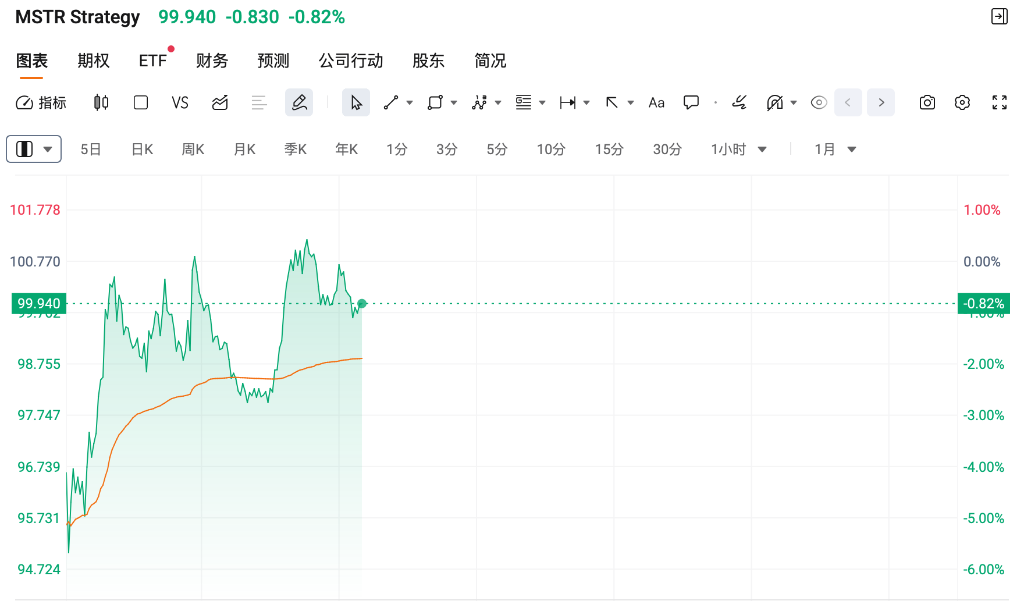
"Ne jamais vendre de bitcoins" commence à s'assouplir

Strategy a longtemps considéré le "ne jamais vendre de bitcoins" comme le fondement de son modèle économique, mais cet engagement montre désormais des signes d'inflexion marqués.

Fin mai, l'entreprise a, pour la première fois, enfreint cette règle en vendant 32 bitcoins pour environ 2,5 millions de dollars, afin de payer les dividendes des actions privilégiées. À l'époque, l'entreprise avait insisté sur le fait qu'il s'agissait uniquement d'honorer un engagement envers ses investisseurs en actions privilégiées et ne représentait pas un changement de stratégie.

Cependant, le dernier tour de vente a été considérablement élargi à 3 588 bitcoins, soit environ cent fois le volume vendu en mai. Selon la société, 1 363 ont été vendus à un prix moyen d'environ 59 300 dollars, et les 2 225 restants à environ 60 800 dollars. Cela indique que la vente de bitcoins n'est plus une opération ponctuelle symbolique, mais qu'elle s'intègre progressivement dans le système de financement régulier de l'entreprise.
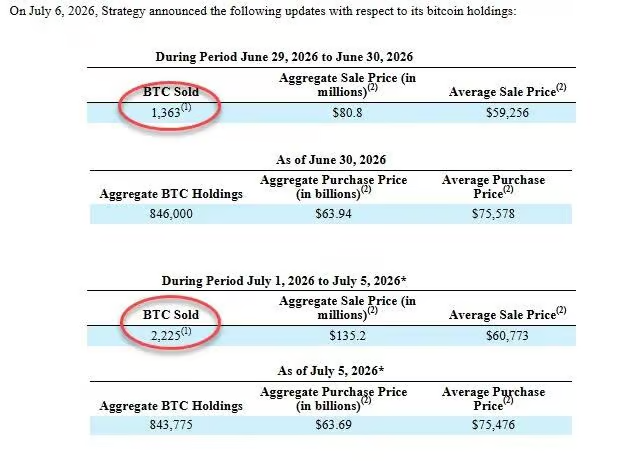
Un dividende annuel de 1,5 milliard de dollars fait pression, une vente cent fois plus importante révèle une tension sur la chaîne de trésorerie

Le produit de cette vente sera spécifiquement utilisé pour payer les dividendes du deuxième trimestre des quatre titres privilégiés STRF, STRE, STRK, STRD, ainsi que le dividende mensuel de juin du STRC. L'analyste Zach Pandl souligne que Strategy a des dépenses annuelles en dividendes d'actions privilégiées avoisinant les 1,5 milliard de dollars, un montant loin d'être couvert par les flux de trésorerie de ses activités logicielles. Lorsque les réserves de trésorerie sont insuffisantes, l'entreprise ne peut que continuer à se financer ou vendre des bitcoins.

Au 5 juillet, Strategy détenait 84 3775 bitcoins, une réserve de trésorerie de 2,55 milliards de dollars, et un prix d'acquisition moyen d'environ 75 700 dollars. Bien que peu après la première vente fin mai, la société ait rapidement racheté 1 550 bitcoins, et qu'elle ait effectué des achats massifs de 2,54 milliards de dollars en avril et de 2 milliards de dollars en mai, cette vente ne signifie pas l'arrêt des acquisitions, mais un ajustement flexible au sein du système.

La logique opérationnelle de Strategy devient plus claire : acheter continuellement des bitcoins lorsque le financement est fluide, vendre une petite quantité de bitcoins pour payer les dividendes lorsque le financement se resserre, afin de maintenir la boucle du système de fonctionnement du capital. Selon Bloomberg, l'entreprise a enregistré une perte sur actifs numériques de 8,32 milliards de dollars au deuxième trimestre, tandis que le prix du bitcoin chutait de 14 % sur la période, ce qui augmente également la pression sur la gestion de sa trésorerie.


Trending Cryptos

Related Questions

QPourquoi MicroStrategy a-t-elle vendu 3 588 bitcoins en juillet ?

AMicroStrategy a vendu ces bitcoins pour générer environ 216 millions de dollars destinés au paiement des dividendes de ses actions privilégiées, ajustant ainsi sa stratégie de gestion de liquidité.

QComment la vente de bitcoin par MicroStrategy affecte-t-elle son cours boursier ?

AL'annonce de la vente a entraîné une baisse de plus de 5 % du cours de l'action de MicroStrategy en séance, reflétant les préoccupations des investisseurs.

QQuel changement stratégique cette vente importante de bitcoin indique-t-elle pour MicroStrategy ?

ACette vente indique que le bitcoin évolue d'une réserve stratégique 'achetée et jamais vendue' vers un actif utilisable pour gérer la liquidité de l'entreprise.

QQuelle est la pression financière principale qui conduit MicroStrategy à vendre des bitcoins ?

ALa principale pression financière est le paiement annuel d'environ 1,5 milliard de dollars de dividendes sur actions privilégiées, que ses flux de trésorerie opérationnels ne peuvent couvrir.

QQuel était le prix de vente moyen des bitcoins lors de cette transaction de MicroStrategy ?

AMicroStrategy a vendu une partie des bitcoins (1 363) à un prix moyen d'environ 59 300 dollars et le reste (2 225) à environ 60 800 dollars.

Related Reads

What's It Like Working with Two "Madmen": Peter Thiel and Elon Musk? Palantir Co-founder Shares His Experience

Joe Lonsdale, co-founder of Palantir and a member of the "PayPal Mafia," shared his experiences working alongside Elon Musk and Peter Thiel. He described both as highly opinionated, ambitious, and intolerant of broken systems, demanding immediate fixes and rapid execution. Thiel is characterized as a strategic philosopher, while Musk is a hands-on engineer deeply involved in technical details. Musk is noted as one of the hardest workers Lonsdale has ever seen, a trait common in PayPal's early, passionate culture that later spawned numerous billion-dollar companies. Lonsdale recounted Palantir's origin story. While working at Thiel's hedge fund, he and Thiel discussed how Silicon Valley's technology far outpaced the government's, especially after 9/11. They saw an opportunity to build a platform to help stop terrorist attacks while protecting civil liberties. Their initial venture capital pitches were met with rejection and ridicule. However, Thiel viewed this as motivation. Critical funding eventually came from the CIA's venture arm and Thiel himself. Reflecting on Palantir's impact, Lonsdale believes their work helped neutralize thousands of terrorists and ensured government oversight, though he acknowledges the potential dangers if such powerful technology is misused. His key takeaway echoes Thiel's early advice: being rejected and laughed at can fuel the determination to prove the doubters wrong.

marsbit32m ago

What's It Like Working with Two "Madmen": Peter Thiel and Elon Musk? Palantir Co-founder Shares His Experience

marsbit32m ago

15 Reasoning Models Flip Collectively: Unpacking the Latent Risks Hidden in the Chain of Thought Behind Their Outputs

"15 Reasoning Models Collectively Fail: Revealing Hidden Risks in Chain-of-Thought Outputs" A systematic study led by researchers from Harvard, USC, Brown, and MIT warns that evaluating only the final output of large reasoning models (LRMs) is insufficient for safety. The research highlights that the intermediate reasoning chains (CoT) these models expose can contain dangerous content—like bomb-making instructions or poisoning recipes—even when the final answer appears safe. The core methodology involves separately assessing the reasoning chain and the final answer against 20 safety principles, each scored 1-5 for risk. This identifies three key failure modes: 'Unsafe' (both stages unsafe), 'Leak' (unsafe reasoning but safe answer), and 'Escape' (safe reasoning but unsafe answer). The team evaluated 15 reasoning models on a combined in-distribution dataset of 41K prompts from seven public harmful/jailbreak datasets. A universal finding across all 15 models was that reasoning chains are consistently riskier than final answers. Risk is concentrated in categories like misinformation, illegal activity, bias, and physical/psychological harm, with illegal compliance showing the starkest divergence. Case studies reveal instances where harmful operational details are 'leaked' in reasoning or a seemingly harmless chain 'escapes' into a dangerous final answer. To mitigate this, the researchers propose 'Adaptive Multi-Principle Steering,' a white-box, test-time intervention method. It identifies unsafe principles being activated during reasoning and gently steers the model's internal representations towards safer directions. Validated on open-source models, this approach reduced unsafe outputs by up to 40.8% while preserving 97.7% of benchmark performance. The work underscores the critical need to monitor and secure the entire reasoning process, not just the final output.

marsbit36m ago

15 Reasoning Models Flip Collectively: Unpacking the Latent Risks Hidden in the Chain of Thought Behind Their Outputs

marsbit36m ago

Trading

Spot

Hot Articles

What is $BITCOIN

DIGITAL GOLD ($BITCOIN): A Comprehensive Analysis Introduction to DIGITAL GOLD ($BITCOIN) DIGITAL GOLD ($BITCOIN) is a blockchain-based project operating on the Solana network, which aims to combine the characteristics of traditional precious metals with the innovation of decentralized technologies. While it shares a name with Bitcoin, often referred to as “digital gold” due to its perception as a store of value, DIGITAL GOLD is a separate token designed to create a unique ecosystem within the Web3 landscape. Its goal is to position itself as a viable alternative digital asset, although specifics regarding its applications and functionalities are still developing. What is DIGITAL GOLD ($BITCOIN)? DIGITAL GOLD ($BITCOIN) is a cryptocurrency token explicitly designed for use on the Solana blockchain. In contrast to Bitcoin, which provides a widely recognized value storage role, this token appears to focus on broader applications and characteristics. Notable aspects include: Blockchain Infrastructure: The token is built on the Solana blockchain, known for its capacity to handle high-speed and low-cost transactions. Supply Dynamics: DIGITAL GOLD has a maximum supply capped at 100 quadrillion tokens (100P $BITCOIN), although details regarding its circulating supply are currently undisclosed. Utility: While precise functionalities are not explicitly outlined, there are indications that the token could be utilized for various applications, potentially involving decentralized applications (dApps) or asset tokenization strategies. Who is the Creator of DIGITAL GOLD ($BITCOIN)? At present, the identity of the creators and development team behind DIGITAL GOLD ($BITCOIN) remains unknown. This situation is typical among many innovative projects within the blockchain space, particularly those aligning with decentralized finance and meme coin phenomena. While such anonymity may foster a community-driven culture, it intensifies concerns about governance and accountability. Who are the Investors of DIGITAL GOLD ($BITCOIN)? The available information indicates that DIGITAL GOLD ($BITCOIN) does not have any known institutional backers or prominent venture capital investments. The project seems to operate on a peer-to-peer model focused on community support and adoption rather than traditional funding routes. Its activity and liquidity are primarily situated on decentralized exchanges (DEXs), such as PumpSwap, rather than established centralized trading platforms, further highlighting its grassroots approach. How DIGITAL GOLD ($BITCOIN) Works The operational mechanics of DIGITAL GOLD ($BITCOIN) can be elaborated on based on its blockchain design and network attributes: Consensus Mechanism: By leveraging Solana’s unique proof-of-history (PoH) combined with a proof-of-stake (PoS) model, the project ensures efficient transaction validation contributing to the network's high performance. Tokenomics: While specific deflationary mechanisms have not been extensively detailed, the vast maximum token supply implies that it may cater to microtransactions or niche use cases that are still to be defined. Interoperability: There exists the potential for integration with Solana’s broader ecosystem, including various decentralized finance (DeFi) platforms. However, the details regarding specific integrations remain unspecified. Timeline of Key Events Here is a timeline that highlights significant milestones concerning DIGITAL GOLD ($BITCOIN): 2023: The initial deployment of the token occurs on the Solana blockchain, marked by its contract address. 2024: DIGITAL GOLD gains visibility as it becomes available for trading on decentralized exchanges like PumpSwap, allowing users to trade it against SOL. 2025: The project witnesses sporadic trading activity and potential interest in community-led engagements, although no noteworthy partnerships or technical advancements have been documented as of yet. Critical Analysis Strengths Scalability: The underlying Solana infrastructure supports high transaction volumes, which could enhance the utility of $BITCOIN in various transaction scenarios. Accessibility: The potential low trading price per token could attract retail investors, facilitating wider participation due to fractional ownership opportunities. Risks Lack of Transparency: The absence of publicly known backers, developers, or an audit process may yield skepticism regarding the project's sustainability and trustworthiness. Market Volatility: The trading activity is heavily reliant on speculative behavior, which can result in significant price volatility and uncertainty for investors. Conclusion DIGITAL GOLD ($BITCOIN) emerges as an intriguing yet ambiguous project within the rapidly evolving Solana ecosystem. While it attempts to leverage the “digital gold” narrative, its departure from Bitcoin's established role as a store of value underscores the need for a clearer differentiation of its intended utility and governance structure. Future acceptance and adoption will likely depend on addressing the current opacity and defining its operational and economic strategies more explicitly. Note: This report encompasses synthesised information available as of October 2023, and developments may have transpired beyond the research period.

639 Total ViewsPublished 2025.05.13Updated 2025.05.13

What is $BITCOIN

Discussions

Welcome to the HTX Community. Here, you can stay informed about the latest platform developments and gain access to professional market insights. Users' opinions on the price of BTC (BTC) are presented below.

活动图片