Cathie Wood's June $77M Investment: Are Crypto Stocks a True 'Substitute' for Bitcoin?

marsbitPublished on 2026-07-06Last updated on 2026-07-06

Abstract

In June, Cathie Wood's ARK Invest purchased $77 million worth of publicly traded crypto-related stocks, including Coinbase, Circle, and Bullish, during Bitcoin's worst monthly performance in four years. This aligns with the investment thesis that such stocks offer a compliant way to gain exposure to the crypto cycle without directly holding Bitcoin. However, data analysis reveals significant drawbacks. A group of nine U.S.-listed crypto companies showed 30-day annualized realized volatility between 68% and 90%, nearly double Bitcoin's 37.6%. Over 90 days, Circle's volatility reached 103.6% versus Bitcoin's 37.8%. Drawdowns were also more severe for stocks like Circle (-51.4%) and MicroStrategy (-48.6%) compared to Bitcoin's -36.4% from its January high. Correlation analysis shows most stocks share only a moderate link to Bitcoin. For example, Circle, Robinhood, and Bullish have a 90-day correlation coefficient of just 0.55–0.58 with BTC, meaning only about one-third of their price movement is explained by Bitcoin's action. The rest stems from company-specific risks: earnings, competition, fundraising, and equity dilution. MicroStrategy (MSTR) is the notable exception, acting as a leveraged Bitcoin proxy with a beta of 1.59 and 0.85 correlation. Coinbase offers relatively balanced exposure. Circle exemplifies "crypto-wrapped" corporate risk, with its recent crash tied to stablecoin competition, not Bitcoin. Robinhood's diversified business insulates it from crypto downturns...

Author: Andjela Radmilac, cryptoslate

Compiled by: Luffy, Foresight News

ARK Invest, led by Cathie Wood, purchased a total of $77 million worth of shares in crypto-related public companies in June. According to ARK's daily trading disclosures, during Bitcoin's worst monthly performance in four years, the fund increased its positions by $44 million in Coinbase, $25.25 million in Circle, and $8.2 million in Bullish.

Wood and several institutions have adhered to the same investment logic for years: crypto public companies provide investors with a compliant channel to participate in the crypto industry's cyclical gains without directly holding Bitcoin. However, an analysis of market data by CryptoSlate as of July 2 reveals the significant hidden costs of this stock investment path.

The 30-day annualized realized volatility for nine U.S.-listed crypto companies ranges from 68% to 90%, nearly double Bitcoin's 37.6% volatility. Over a 90-day period, Circle's volatility is as high as 103.6%, while Bitcoin's is only 37.8%. The gap in price drawdowns is also significant: Circle has fallen 51.4% from its high, MSTR is down 48.6%, and Bullish is down 43.6%; meanwhile, Bitcoin has retreated 36.4% from its near $97,000 peak in January, with all declines smaller than those of the aforementioned stocks.
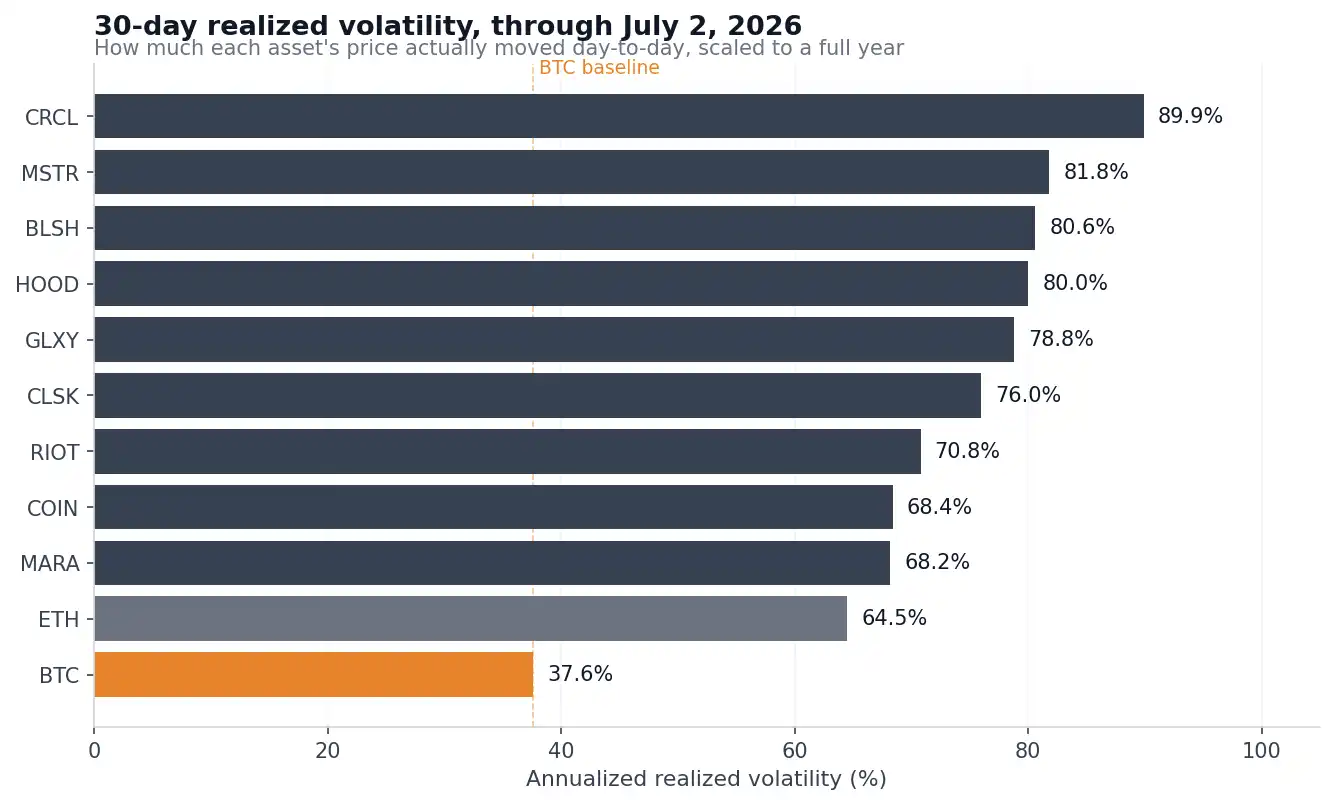
30-day annualized realized volatility of BTC, ETH, and nine U.S.-listed crypto company stocks from January 1, 2026, to July 2, 2026.

Judging by volatility alone, crypto stocks appear to be leveraged Bitcoin. However, correlation data reveals a completely different truth. Over the past 90 trading days, the correlation coefficients of Circle, Robinhood, and Bullish with Bitcoin are only 0.55–0.58 (the correlation range is 0 to 1, where 1 represents perfectly synchronized movements and 0 represents no correlation). This means Bitcoin price fluctuations can only explain about one-third of the volatility in crypto company stocks. The remaining volatility stems entirely from company-specific risks: quarterly earnings reports, industry competition, fundraising activities, share dilution, and more. Investors aiming to gain crypto industry exposure through stocks end up with only partial Bitcoin exposure while additionally bearing a full set of business risks unique to the stock market.

Only One Stock Truly Tracks Bitcoin

The table below shows the correlation of crypto company stocks with Bitcoin from the end of 2025 to the present. Beta represents the percentage change in a stock for every 1% move in Bitcoin.
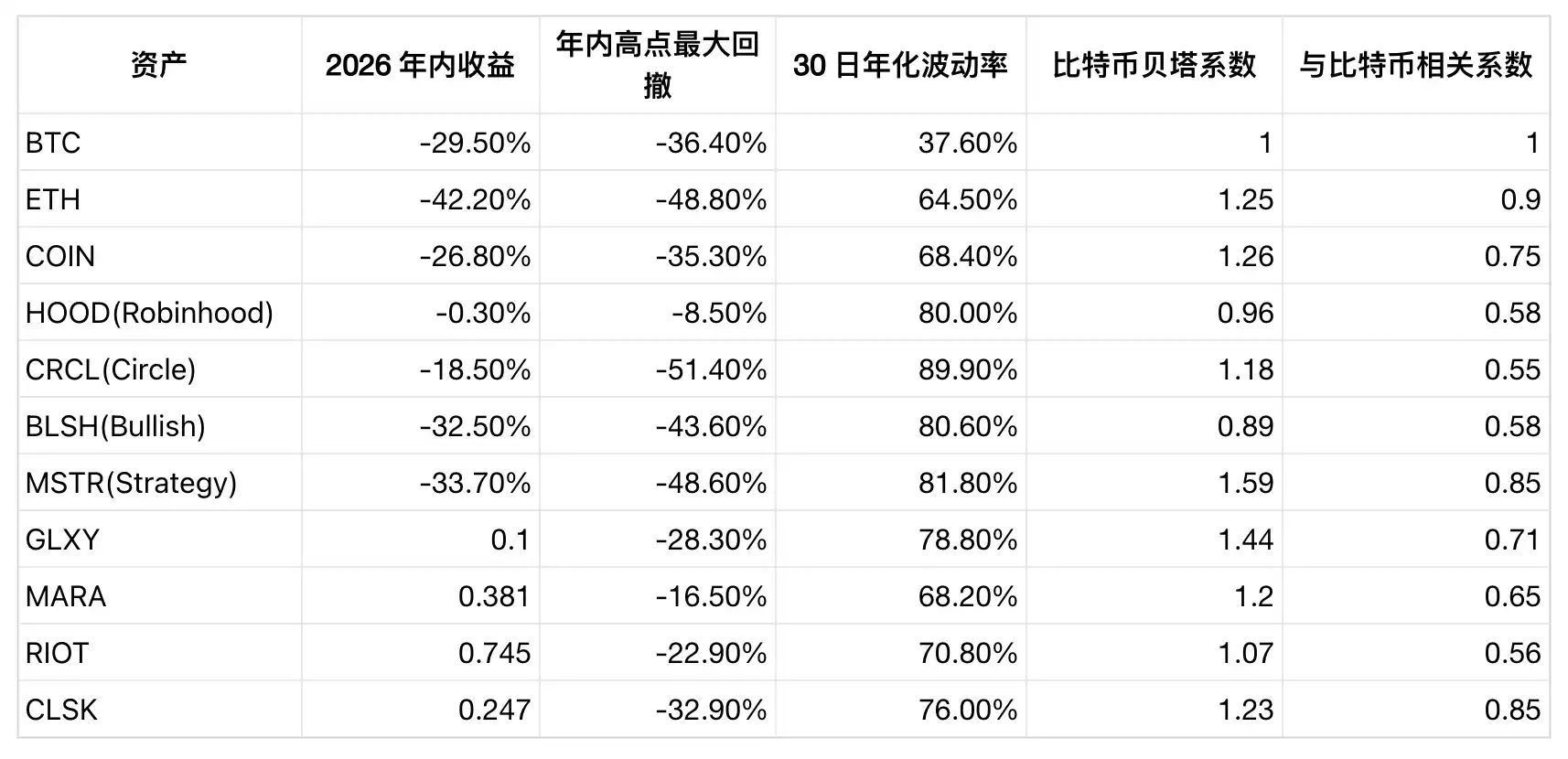
MSTR is the only stock in the entire market that can be considered a Bitcoin alternative. With a beta of 1.59 and a correlation of 0.85, it is essentially an equity tool for holding Bitcoin with leverage. In the recent downturn, its year-to-date decline and drawdown from highs have far exceeded Bitcoin's.

Coinbase is a relatively balanced choice, with a year-to-date decline of -26.8%, slightly less than BTC's. Its beta coefficient is 1.26, and its correlation coefficient is 0.75, making it the second-strongest correlated with Bitcoin within the sector. However, its volatility is still nearly double that of Bitcoin, and its stock price is down 60.6% from its all-time high of $419.78 in July 2025. Losses for investors who bought at that peak are far greater than for those who entered at Bitcoin's historical high in October 2025.

Circle perfectly illustrates 'business risk in crypto clothing.' It has the lowest correlation with Bitcoin in the sector and the highest 90-day volatility. The trigger occurred on June 30: with the official launch of the Open USD stablecoin, backed by a consortium of over 140 companies including Coinbase, Stripe, Visa, Mastercard, and BlackRock, CRCL plummeted 17.5% in a single day. This sharp drop was almost entirely unrelated to Bitcoin's performance, purely a company-specific negative driven by competition for market share in the stablecoin sector.

Robinhood is a counterexample, similarly demonstrating that individual stock performance can be independent of crypto trends. The stock has only declined slightly by 0.3% year-to-date, with a maximum drawdown of just 8.5%. Crypto business is just a small part of its overall brokerage portfolio, which includes stocks, options, and derivatives. Its diversified business has cushioned the decline; conversely, during a crypto bull market, it is unlikely to provide investors with substantial gains from crypto price movements.

Mining company trends are the most anomalous. While Bitcoin fell 29.5% year-to-date, RIOT surged 74.5%, MARA rose 38.1%, and CleanSpark gained 24.7%. The core logic is that mining companies are transforming into AI high-performance computing service providers, signing hundreds of billions in computing power leasing contracts while continuously selling their Bitcoin holdings. Although their daily price movements still follow Bitcoin (beta coefficients are all greater than 1), their annual returns are entirely driven by AI hosting business, decoupled from coin prices.
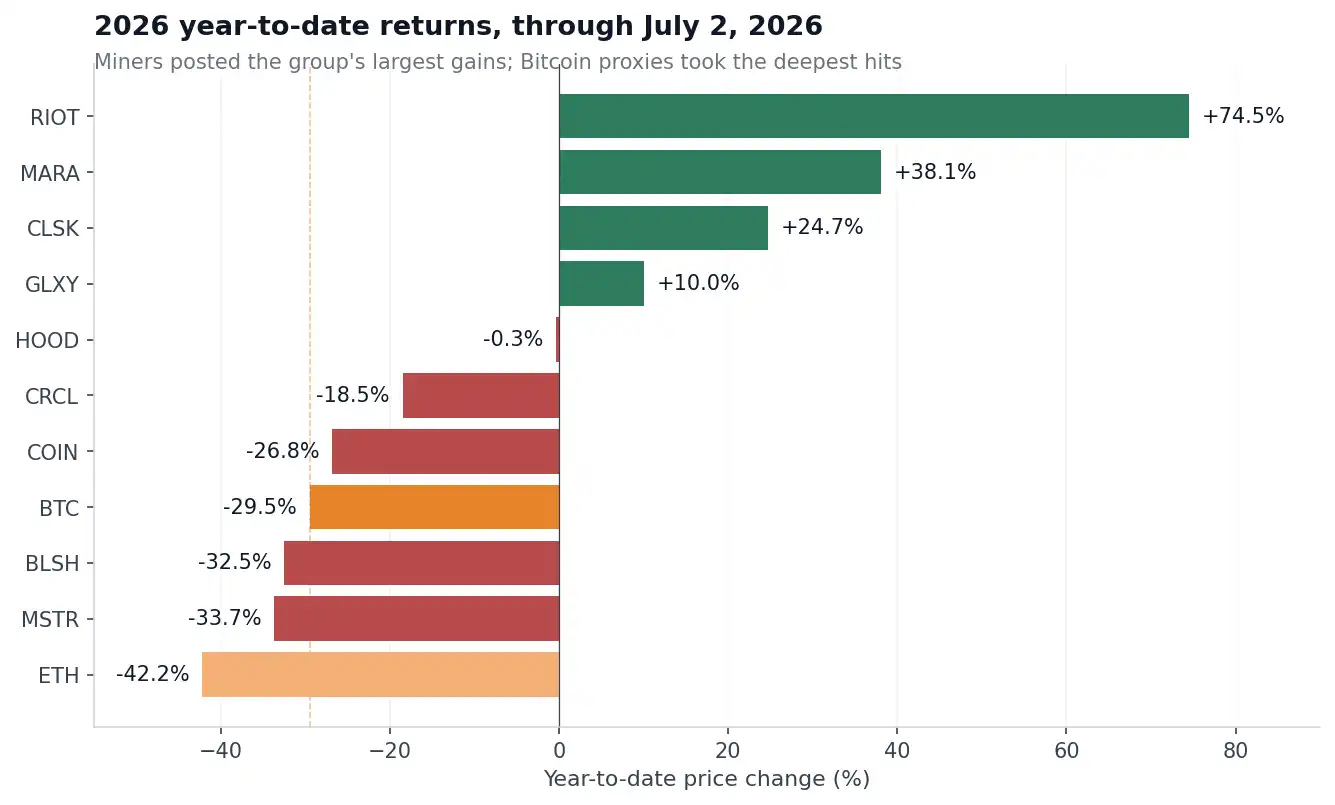
Year-to-date price changes of BTC, ETH, and nine U.S.-listed cryptocurrency stocks.

Bitcoin's own volatility is not insignificant. Volmex's Bitcoin 30-day Volatility Index dropped to a low of 24.5 in late May, peaked at 68.7 in early February, and rebounded to 41.6 in early July. Even so, the volatility of most crypto stocks remains nearly double.

Strategy Case Study: Equity Structure Adds Extra Risk

Holding Bitcoin only requires bearing the risk of price fluctuations; buying shares in crypto public companies adds multiple variables: business operations, equity dilution, disappearing valuation premiums, fundraising pressure, changes in capital structure, and more.

Strategy recently exposed all these risks in a concentrated manner over the past month. At the end of June, its price-to-book ratio (mNAV) fell below 1 for the first time. This metric measures the company's total valuation relative to its net assets. A ratio below 1 means the market values the entire company less than the cash and Bitcoin it holds. According to the June 22 disclosure, Strategy held 847,363 Bitcoins. On the day mNAV fell below 1, these Bitcoins were worth approximately $50 billion.

An mNAV greater than 1 is the foundation of Strategy's entire growth flywheel. In the past, the company could issue common and preferred shares at a premium, raise funds, and continue to acquire Bitcoin, increasing Bitcoin holdings per share. Once mNAV falls below 1, this cycle can reverse and erode shareholder value—issuing shares to raise funds for buying Bitcoin is equivalent to selling existing Bitcoin assets at a discount.

CryptoSlate reported as early as January that Bitcoin-holding companies are divided into those trading at a valuation premium and those at a discount. By the end of June, Strategy's total market capitalization was $29.54 billion, less than half of its peak of over $71 billion in 2024, with all four classes of preferred shares at historical lows.

Strategy announced countermeasures. On June 29, it unveiled a stock buyback plan of up to $1.25 billion and authorized the sale of Bitcoin to supplement liquidity, covering preferred stock dividends and debt interest. In the preceding weeks, on June 1, the company conducted its first Bitcoin sale since 2022, selling only 32 Bitcoins. After the announcement, the stock surged 12.6% in a single day, ending an eight-day losing streak. The world's largest Bitcoin holder needing to sell its holdings in a bear market to secure cash flow is a constraint not encountered when directly holding Bitcoin and is a risk unique to stocks.

This is precisely the backdrop for ARK's contrarian accumulation. On June 25, amidst a collective slump in crypto stocks, Wood's funds bought $3.27 million worth of Robinhood shares in a single day, simultaneously increasing positions in Coinbase, Circle, and Bullish. Wood believes Bitcoin's long-term target price is in the millions of dollars and is currently investing heavily at a discount in crypto public companies that have seen deep corrections since their 2025 highs.

The data reveals the true nature of these companies.

  • Strategy = Leveraged Bitcoin + Equity Dilution Risk;
  • Circle = Stablecoin sector payment company, deeply entangled in market share battles;
  • Robinhood = Comprehensive broker, crypto is just a side business.

Wood's basket purchase of these company stocks is essentially a bet on a combination of different business models, with vastly differing levels of crypto exposure.

Each individual stock has its own investment logic: Coinbase has outperformed Bitcoin year-to-date, Robinhood has maintained its price since the beginning of the year, and the mining sector has led in overall returns. But the core question remains: are crypto stocks really less risky than holding coins directly?

Data from the nine public companies shows that stocks either amplify Bitcoin's volatility or add company-specific operational risks unrelated to coin prices.

The truly strong-performing cryptocurrency stocks this year rely on independent growth businesses like AI computing power, brokerage traffic, and payment products, with Bitcoin being only a secondary influencing factor.

Trending Cryptos

Related Questions

QWhat is the main argument presented in the article regarding cryptocurrency stocks as a substitute for holding Bitcoin directly?

AThe article argues that cryptocurrency stocks are generally not a good substitute for direct Bitcoin exposure. They tend to have significantly higher volatility than Bitcoin and carry additional company-specific risks unrelated to Bitcoin's price movements, such as earnings reports, competition, and financing activities.

QWhich publicly traded company is cited as the most accurate proxy for Bitcoin investment, and what metrics support this?

AMicroStrategy (MSTR) is cited as the most accurate proxy. It has a high correlation of 0.85 with Bitcoin and a beta of 1.59, meaning it acts like a leveraged bet on Bitcoin's price.

QHow does Circle (CRCL) differ from being a simple Bitcoin investment according to the data?

ACircle shows the lowest correlation with Bitcoin among the studied stocks and the highest 90-day volatility. Its stock price is heavily influenced by company-specific factors like competition in the stablecoin market, as evidenced by a 17.5% single-day drop due to the launch of the Open USD stable币, which was largely independent of Bitcoin's price action.

QWhat unexpected trend is highlighted regarding major Bitcoin mining companies in 2026, and what is the driving factor?

ADespite Bitcoin's price decline in 2026, major mining companies like RIOT, MARA, and CleanSpark posted significant gains (e.g., RIOT up 74.5%). This is primarily driven by their successful pivot to becoming AI high-performance computing service providers, securing large compute rental contracts, which has decoupled their performance from Bitcoin's price.

QWhat unique financial risk did MicroStrategy (MSTR) face in June, according to the article, and how did it respond?

AMicroStrategy's market cap to net asset value (mNAV) ratio fell below 1, meaning the market valued the entire company for less than the value of the Bitcoin and cash it held. This threatened its growth model of issuing premium-priced shares to buy more Bitcoin. In response, it announced a $1.25 billion stock buyback plan and authorized selling some Bitcoin to cover obligations, a constraint not faced by direct Bitcoin holders.

Related Reads

Countdown to Q-Day: Will Quantum Computing End Cryptocurrencies?

The article explores the existential threat quantum computing poses to cryptocurrencies and the urgent need for "post-quantum" migration. It outlines that quantum computers, through Shor's algorithm, could break the elliptic-curve cryptography (ECC) underlying blockchain security, potentially allowing private keys to be derived from public keys. The core challenge is not a lack of post-quantum cryptography (PQC) standards—like NIST's ML-KEM and ML-DSA—but the immense complexity of upgrading entire ecosystems before "Q-Day" (when quantum computers become capable of such attacks, estimated around 2035-2045). Key points include: * **Bitcoin's** risk is concentrated in legacy UTXOs with exposed public keys (e.g., early P2PK outputs). Migration faces massive hurdles: PQC signatures are much larger, increasing transaction size and cost, and the governance dilemma of handling un-migrated assets threatens its "code is law" ethos. * **Ethereum's** strategy focuses on "cryptographic agility," using Account Abstraction for user accounts and developing compressed hash-based signatures (like leanXMSS with SNARK aggregation) for consensus. Its migration is a complex, full-stack overhaul of execution, consensus, and data layers. * The "security debt" is enormous. The comfortable engineering window for a coordinated, ecosystem-wide upgrade is only 5-8 years. High-value infrastructure (exchanges, bridges) may face pressure before mainnet protocols. In conclusion, quantum computing is not an instant "doomsday" event but a forcing function for systemic change. Bitcoin's ultimate test is social consensus and property rights governance, while Ethereum's is technical complexity. Failure to migrate in time could lead to a fundamental re-pricing of crypto assets.

链捕手3m ago

Countdown to Q-Day: Will Quantum Computing End Cryptocurrencies?

链捕手3m ago

Losing $55 Million to Sell Bitcoin, MicroStrategy's Faith Reaches Its Interest Payment Day

On July 6th, Michael Saylor's MicroStrategy announced the sale of 3,588 BTC for approximately $216 million, incurring a realized loss of around $55.45 million compared to its average cost basis. This move, contradicting Saylor's long-standing "never sell" Bitcoin philosophy, was executed to pay dividends on its digital credit securities. The article traces this shift from a small "desensitization test" sale of 32 BTC in late May to the board's authorization on June 30th to sell up to $1.25 billion in Bitcoin for corporate purposes like dividends and buybacks. Analysis reveals that MicroStrategy's previous growth "flywheel"—using stock premiums to fund more Bitcoin purchases—has stalled. With its stock trading near a critical threshold (1.22x its Bitcoin NAV), issuing new shares would dilute value. Simultaneously, its financing channels (preferred stock, common stock ATM, convertible notes) are constrained while facing rigid annual dividend/interest obligations of roughly $1.76 billion. Consequently, selling Bitcoin became the calculated "optimal solution" under its own financial model. This transforms MicroStrategy from crypto's most prominent steady buyer into a predictable seller, creating a potential overhead of ~2,400 BTC in monthly selling pressure if obligations are fully covered by sales. This shift challenges the valuation models of the entire Digital Asset Treasury (DAT) sector that emulated MicroStrategy. The company's path forward now hinges on Bitcoin's price recovery, which would allow its preferred stock to trade at par and reopen its financing flywheel, creating a cyclical dependency between the firm's financial model and the asset it holds.

链捕手31m ago

Losing $55 Million to Sell Bitcoin, MicroStrategy's Faith Reaches Its Interest Payment Day

链捕手31m ago

OUSD Fake Partnership Controversy? Stablecoins and the Credit Game of Giant Endorsements

Author: Chloe, ChainCatcher Last week, Open Standard launched the dollar stablecoin OpenUSD (OUSD) with a list of over 140 supposedly supporting companies, including major names like Visa, Mastercard, Stripe, American Express, BlackRock, BNY, Standard Chartered, Google, Shopify, Samsung, Coinbase, Solana, and Ripple. The announcement initially impacted Circle's stock price, but doubts about the list quickly emerged. Several Korean firms named, including Samsung Electronics, Shinhan Financial Group, Dunamu (Upbit's parent), and K Bank, clarified they had not formally agreed to join the alliance. Some stated they were only approached for potential interest or learned of their inclusion from news reports, expressing surprise. Similar concerns were raised by U.S. entities, suggesting the list may be misleading. OUSD, led by Zach Abrams of Bridge (acquired by Stripe in 2024), promotes zero-fee minting/redemption, no transaction limits, and sharing reserve asset yields with partners instead of keeping profits. However, this model makes listed partnership imply economic benefits, turning it into a serious credibility issue. This incident reflects a common crypto marketing tactic of leveraging big names. A Chainstory analysis found over 62% of crypto press releases in late 2025 were high-risk or scams. The situation recalls Facebook's Libra (later Diem), which collapsed in 2022 after initial heavyweight backers like Visa and PayPal withdrew under regulatory pressure. Circle CEO Jeremy Allaire welcomed the competition but highlighted the challenges. He argued stablecoin success relies on network effects and real usage, not just alliances. He criticized OUSD's "free" model and full revenue sharing as potentially starving infrastructure development. Noting the dominance of USDT (~$1.84T) and USDC (~$730B) in the ~$2.91T stablecoin market, he suggested many new entrants lack real utility despite inflated circulation from incentives. In conclusion, while OUSD has genuine backing and a distinct model, its future depends on actual adoption in B2B payments, settlements, and cross-border transactions, not just a prestigious partner list. The market will determine if it is a credible challenger or merely another marketing promise.

链捕手34m ago

OUSD Fake Partnership Controversy? Stablecoins and the Credit Game of Giant Endorsements

链捕手34m ago

Trading

Spot

Hot Articles

What is SONIC

Sonic: Pioneering the Future of Gaming in Web3 Introduction to Sonic In the ever-evolving landscape of Web3, the gaming industry stands out as one of the most dynamic and promising sectors. At the forefront of this revolution is Sonic, a project designed to amplify the gaming ecosystem on the Solana blockchain. Leveraging cutting-edge technology, Sonic aims to deliver an unparalleled gaming experience by efficiently processing millions of requests per second, ensuring that players enjoy seamless gameplay while maintaining low transaction costs. This article delves into the intricate details of Sonic, exploring its creators, funding sources, operational mechanics, and the timeline of significant events that have shaped its journey. What is Sonic? Sonic is an innovative layer-2 network that operates atop the Solana blockchain, specifically tailored to enhance the existing Solana gaming ecosystem. It accomplishes this through a customised, VM-agnostic game engine paired with a HyperGrid interpreter, facilitating sovereign game economies that roll up back to the Solana platform. The primary goals of Sonic include: Enhanced Gaming Experiences: Sonic is committed to offering lightning-fast on-chain gameplay, allowing players and developers to engage with games at previously unattainable speeds. Atomic Interoperability: This feature enables transactions to be executed within Sonic without the need to redeploy Solana programmes and accounts. This makes the process more efficient and directly benefits from Solana Layer1 services and liquidity. Seamless Deployment: Sonic allows developers to write for Ethereum Virtual Machine (EVM) based systems and execute them on Solana’s SVM infrastructure. This interoperability is crucial for attracting a broader range of dApps and decentralised applications to the platform. Support for Developers: By offering native composable gaming primitives and extensible data types - dining within the Entity-Component-System (ECS) framework - game creators can craft intricate business logic with ease. Overall, Sonic's unique approach not only caters to players but also provides an accessible and low-cost environment for developers to innovate and thrive. Creator of Sonic The information regarding the creator of Sonic is somewhat ambiguous. However, it is known that Sonic's SVM is owned by the company Mirror World. The absence of detailed information about the individuals behind Sonic reflects a common trend in several Web3 projects, where collective efforts and partnerships often overshadow individual contributions. Investors of Sonic Sonic has garnered considerable attention and support from various investors within the crypto and gaming sectors. Notably, the project raised an impressive $12 million during its Series A funding round. The round was led by BITKRAFT Ventures, with other notable investors including Galaxy, Okx Ventures, Interactive, Big Brain Holdings, and Mirana. This financial backing signifies the confidence that investment foundations have in Sonic’s potential to revolutionise the Web3 gaming landscape, further validating its innovative approaches and technologies. How Does Sonic Work? Sonic utilises the HyperGrid framework, a sophisticated parallel processing mechanism that enhances its scalability and customisability. Here are the core features that set Sonic apart: Lightning Speed at Low Costs: Sonic offers one of the fastest on-chain gaming experiences compared to other Layer-1 solutions, powered by the scalability of Solana’s virtual machine (SVM). Atomic Interoperability: Sonic enables transaction execution without redeployment of Solana programmes and accounts, effectively streamlining the interaction between users and the blockchain. EVM Compatibility: Developers can effortlessly migrate decentralised applications from EVM chains to the Solana environment using Sonic’s HyperGrid interpreter, increasing the accessibility and integration of various dApps. Ecosystem Support for Developers: By exposing native composable gaming primitives, Sonic facilitates a sandbox-like environment where developers can experiment and implement business logic, greatly enhancing the overall development experience. Monetisation Infrastructure: Sonic natively supports growth and monetisation efforts, providing frameworks for traffic generation, payments, and settlements, thereby ensuring that gaming projects are not only viable but also sustainable financially. Timeline of Sonic The evolution of Sonic has been marked by several key milestones. Below is a brief timeline highlighting critical events in the project's history: 2022: The Sonic cryptocurrency was officially launched, marking the beginning of its journey in the Web3 gaming arena. 2024: June: Sonic SVM successfully raised $12 million in a Series A funding round. This investment allowed Sonic to further develop its platform and expand its offerings. August: The launch of the Sonic Odyssey testnet provided users with the first opportunity to engage with the platform, offering interactive activities such as collecting rings—a nod to gaming nostalgia. October: SonicX, an innovative crypto game integrated with Solana, made its debut on TikTok, capturing the attention of over 120,000 users within a short span. This integration illustrated Sonic’s commitment to reaching a broader, global audience and showcased the potential of blockchain gaming. Key Points Sonic SVM is a revolutionary layer-2 network on Solana explicitly designed to enhance the GameFi landscape, demonstrating great potential for future development. HyperGrid Framework empowers Sonic by introducing horizontal scaling capabilities, ensuring that the network can handle the demands of Web3 gaming. Integration with Social Platforms: The successful launch of SonicX on TikTok displays Sonic’s strategy to leverage social media platforms to engage users, exponentially increasing the exposure and reach of its projects. Investment Confidence: The substantial funding from BITKRAFT Ventures, among others, emphasizes the robust backing Sonic has, paving the way for its ambitious future. In conclusion, Sonic encapsulates the essence of Web3 gaming innovation, striking a balance between cutting-edge technology, developer-centric tools, and community engagement. As the project continues to evolve, it is poised to redefine the gaming landscape, making it a notable entity for gamers and developers alike. As Sonic moves forward, it will undoubtedly attract greater interest and participation, solidifying its place within the broader narrative of blockchain gaming.

1.7k Total ViewsPublished 2024.04.04Updated 2024.12.03

What is SONIC

What is $S$

Understanding SPERO: A Comprehensive Overview Introduction to SPERO As the landscape of innovation continues to evolve, the emergence of web3 technologies and cryptocurrency projects plays a pivotal role in shaping the digital future. One project that has garnered attention in this dynamic field is SPERO, denoted as SPERO,$$s$. This article aims to gather and present detailed information about SPERO, to help enthusiasts and investors understand its foundations, objectives, and innovations within the web3 and crypto domains. What is SPERO,$$s$? SPERO,$$s$ is a unique project within the crypto space that seeks to leverage the principles of decentralisation and blockchain technology to create an ecosystem that promotes engagement, utility, and financial inclusion. The project is tailored to facilitate peer-to-peer interactions in new ways, providing users with innovative financial solutions and services. At its core, SPERO,$$s$ aims to empower individuals by providing tools and platforms that enhance user experience in the cryptocurrency space. This includes enabling more flexible transaction methods, fostering community-driven initiatives, and creating pathways for financial opportunities through decentralised applications (dApps). The underlying vision of SPERO,$$s$ revolves around inclusiveness, aiming to bridge gaps within traditional finance while harnessing the benefits of blockchain technology. Who is the Creator of SPERO,$$s$? The identity of the creator of SPERO,$$s$ remains somewhat obscure, as there are limited publicly available resources providing detailed background information on its founder(s). This lack of transparency can stem from the project's commitment to decentralisation—an ethos that many web3 projects share, prioritising collective contributions over individual recognition. By centring discussions around the community and its collective goals, SPERO,$$s$ embodies the essence of empowerment without singling out specific individuals. As such, understanding the ethos and mission of SPERO remains more important than identifying a singular creator. Who are the Investors of SPERO,$$s$? SPERO,$$s$ is supported by a diverse array of investors ranging from venture capitalists to angel investors dedicated to fostering innovation in the crypto sector. The focus of these investors generally aligns with SPERO's mission—prioritising projects that promise societal technological advancement, financial inclusivity, and decentralised governance. These investor foundations are typically interested in projects that not only offer innovative products but also contribute positively to the blockchain community and its ecosystems. The backing from these investors reinforces SPERO,$$s$ as a noteworthy contender in the rapidly evolving domain of crypto projects. How Does SPERO,$$s$ Work? SPERO,$$s$ employs a multi-faceted framework that distinguishes it from conventional cryptocurrency projects. Here are some of the key features that underline its uniqueness and innovation: Decentralised Governance: SPERO,$$s$ integrates decentralised governance models, empowering users to participate actively in decision-making processes regarding the project’s future. This approach fosters a sense of ownership and accountability among community members. Token Utility: SPERO,$$s$ utilises its own cryptocurrency token, designed to serve various functions within the ecosystem. These tokens enable transactions, rewards, and the facilitation of services offered on the platform, enhancing overall engagement and utility. Layered Architecture: The technical architecture of SPERO,$$s$ supports modularity and scalability, allowing for seamless integration of additional features and applications as the project evolves. This adaptability is paramount for sustaining relevance in the ever-changing crypto landscape. Community Engagement: The project emphasises community-driven initiatives, employing mechanisms that incentivise collaboration and feedback. By nurturing a strong community, SPERO,$$s$ can better address user needs and adapt to market trends. Focus on Inclusion: By offering low transaction fees and user-friendly interfaces, SPERO,$$s$ aims to attract a diverse user base, including individuals who may not previously have engaged in the crypto space. This commitment to inclusion aligns with its overarching mission of empowerment through accessibility. Timeline of SPERO,$$s$ Understanding a project's history provides crucial insights into its development trajectory and milestones. Below is a suggested timeline mapping significant events in the evolution of SPERO,$$s$: Conceptualisation and Ideation Phase: The initial ideas forming the basis of SPERO,$$s$ were conceived, aligning closely with the principles of decentralisation and community focus within the blockchain industry. Launch of Project Whitepaper: Following the conceptual phase, a comprehensive whitepaper detailing the vision, goals, and technological infrastructure of SPERO,$$s$ was released to garner community interest and feedback. Community Building and Early Engagements: Active outreach efforts were made to build a community of early adopters and potential investors, facilitating discussions around the project’s goals and garnering support. Token Generation Event: SPERO,$$s$ conducted a token generation event (TGE) to distribute its native tokens to early supporters and establish initial liquidity within the ecosystem. Launch of Initial dApp: The first decentralised application (dApp) associated with SPERO,$$s$ went live, allowing users to engage with the platform's core functionalities. Ongoing Development and Partnerships: Continuous updates and enhancements to the project's offerings, including strategic partnerships with other players in the blockchain space, have shaped SPERO,$$s$ into a competitive and evolving player in the crypto market. Conclusion SPERO,$$s$ stands as a testament to the potential of web3 and cryptocurrency to revolutionise financial systems and empower individuals. With a commitment to decentralised governance, community engagement, and innovatively designed functionalities, it paves the way toward a more inclusive financial landscape. As with any investment in the rapidly evolving crypto space, potential investors and users are encouraged to research thoroughly and engage thoughtfully with the ongoing developments within SPERO,$$s$. The project showcases the innovative spirit of the crypto industry, inviting further exploration into its myriad possibilities. While the journey of SPERO,$$s$ is still unfolding, its foundational principles may indeed influence the future of how we interact with technology, finance, and each other in interconnected digital ecosystems.

93 Total ViewsPublished 2024.12.17Updated 2024.12.17

What is $S$

What is AGENT S

Agent S: The Future of Autonomous Interaction in Web3 Introduction In the ever-evolving landscape of Web3 and cryptocurrency, innovations are constantly redefining how individuals interact with digital platforms. One such pioneering project, Agent S, promises to revolutionise human-computer interaction through its open agentic framework. By paving the way for autonomous interactions, Agent S aims to simplify complex tasks, offering transformative applications in artificial intelligence (AI). This detailed exploration will delve into the project's intricacies, its unique features, and the implications for the cryptocurrency domain. What is Agent S? Agent S stands as a groundbreaking open agentic framework, specifically designed to tackle three fundamental challenges in the automation of computer tasks: Acquiring Domain-Specific Knowledge: The framework intelligently learns from various external knowledge sources and internal experiences. This dual approach empowers it to build a rich repository of domain-specific knowledge, enhancing its performance in task execution. Planning Over Long Task Horizons: Agent S employs experience-augmented hierarchical planning, a strategic approach that facilitates efficient breakdown and execution of intricate tasks. This feature significantly enhances its ability to manage multiple subtasks efficiently and effectively. Handling Dynamic, Non-Uniform Interfaces: The project introduces the Agent-Computer Interface (ACI), an innovative solution that enhances the interaction between agents and users. Utilizing Multimodal Large Language Models (MLLMs), Agent S can navigate and manipulate diverse graphical user interfaces seamlessly. Through these pioneering features, Agent S provides a robust framework that addresses the complexities involved in automating human interaction with machines, setting the stage for myriad applications in AI and beyond. Who is the Creator of Agent S? While the concept of Agent S is fundamentally innovative, specific information about its creator remains elusive. The creator is currently unknown, which highlights either the nascent stage of the project or the strategic choice to keep founding members under wraps. Regardless of anonymity, the focus remains on the framework's capabilities and potential. Who are the Investors of Agent S? As Agent S is relatively new in the cryptographic ecosystem, detailed information regarding its investors and financial backers is not explicitly documented. The lack of publicly available insights into the investment foundations or organisations supporting the project raises questions about its funding structure and development roadmap. Understanding the backing is crucial for gauging the project's sustainability and potential market impact. How Does Agent S Work? At the core of Agent S lies cutting-edge technology that enables it to function effectively in diverse settings. Its operational model is built around several key features: Human-like Computer Interaction: The framework offers advanced AI planning, striving to make interactions with computers more intuitive. By mimicking human behaviour in tasks execution, it promises to elevate user experiences. Narrative Memory: Employed to leverage high-level experiences, Agent S utilises narrative memory to keep track of task histories, thereby enhancing its decision-making processes. Episodic Memory: This feature provides users with step-by-step guidance, allowing the framework to offer contextual support as tasks unfold. Support for OpenACI: With the ability to run locally, Agent S allows users to maintain control over their interactions and workflows, aligning with the decentralised ethos of Web3. Easy Integration with External APIs: Its versatility and compatibility with various AI platforms ensure that Agent S can fit seamlessly into existing technological ecosystems, making it an appealing choice for developers and organisations. These functionalities collectively contribute to Agent S's unique position within the crypto space, as it automates complex, multi-step tasks with minimal human intervention. As the project evolves, its potential applications in Web3 could redefine how digital interactions unfold. Timeline of Agent S The development and milestones of Agent S can be encapsulated in a timeline that highlights its significant events: September 27, 2024: The concept of Agent S was launched in a comprehensive research paper titled “An Open Agentic Framework that Uses Computers Like a Human,” showcasing the groundwork for the project. October 10, 2024: The research paper was made publicly available on arXiv, offering an in-depth exploration of the framework and its performance evaluation based on the OSWorld benchmark. October 12, 2024: A video presentation was released, providing a visual insight into the capabilities and features of Agent S, further engaging potential users and investors. These markers in the timeline not only illustrate the progress of Agent S but also indicate its commitment to transparency and community engagement. Key Points About Agent S As the Agent S framework continues to evolve, several key attributes stand out, underscoring its innovative nature and potential: Innovative Framework: Designed to provide an intuitive use of computers akin to human interaction, Agent S brings a novel approach to task automation. Autonomous Interaction: The ability to interact autonomously with computers through GUI signifies a leap towards more intelligent and efficient computing solutions. Complex Task Automation: With its robust methodology, it can automate complex, multi-step tasks, making processes faster and less error-prone. Continuous Improvement: The learning mechanisms enable Agent S to improve from past experiences, continually enhancing its performance and efficacy. Versatility: Its adaptability across different operating environments like OSWorld and WindowsAgentArena ensures that it can serve a broad range of applications. As Agent S positions itself in the Web3 and crypto landscape, its potential to enhance interaction capabilities and automate processes signifies a significant advancement in AI technologies. Through its innovative framework, Agent S exemplifies the future of digital interactions, promising a more seamless and efficient experience for users across various industries. Conclusion Agent S represents a bold leap forward in the marriage of AI and Web3, with the capacity to redefine how we interact with technology. While still in its early stages, the possibilities for its application are vast and compelling. Through its comprehensive framework addressing critical challenges, Agent S aims to bring autonomous interactions to the forefront of the digital experience. As we move deeper into the realms of cryptocurrency and decentralisation, projects like Agent S will undoubtedly play a crucial role in shaping the future of technology and human-computer collaboration.

763 Total ViewsPublished 2025.01.14Updated 2025.01.14

What is AGENT S

Discussions

Welcome to the HTX Community. Here, you can stay informed about the latest platform developments and gain access to professional market insights. Users' opinions on the price of S (S) are presented below.

活动图片