Fin d’ajustement ou poursuite de la tendance : Retour sur la structure technique du BTC et de l’HYPE | Analyse Invitée

Odaily星球日报Published on 2026-07-06Last updated on 2026-07-06

Abstract

Analyse technique hebdomadaire : BTC et HYPE Cette analyse examine les structures techniques du BTC et du HYPE. **Bitcoin (BTC) :** * **Structure journalière :** Le BTC est en phase de correction depuis le sommet du 6 mai. Le point clé est le niveau du prochain sommet de rebond ("point 4"). S'il dépasse 65 700 USD, une consolidation est probable. Dans le cas contraire, la tendance baissière pourrait se poursuivre. * **Structure sur 4H :** Un mouvement baissier en 5 vagues s'est achevé avec une divergence haussière, soutenant le rebond actuel. * **Scénarios et Niveaux clés :** * **Résistances :** 64 500-65 700 USD, 67 300 USD, 69 500-71 000 USD. * **Supports :** 60 950-62 300 USD, 57 820 USD, 55 000 USD. * **Stratégie :** Position courte moyenne maintenue à ~20%. Opportunités de trading à court terme basées sur les réactions aux niveaux de support/résistance, avec des plans précis pour les positions courtes (scénario A) et longues (scénario B). **HYPE :** * **Structure sur 4H :** Une hausse en 7 segments est observée depuis fin juin. Le prix approche de la zone de résistance historique (76.94 USD). Des signaux d'avertissement de sommet sont apparus. * **Niveaux clés :** * **Résistances :** 75-76.94 USD, 80 USD. * **Supports :** 68 USD, 65.5 USD, 60.5-61.5 USD. * **Stratégie :** Privilégier la sécurisation des profits et la gestion des risques. Un ajustement est possible près de la résistance à 75-76.94 USD. **Récapitulatif d'une transac...

Ce rapport hebdomadaire se concentre sur l’analyse de la structure technique multi-temps de deux actifs majeurs : le BTC et l’HYPE. Concernant le Bitcoin, nous abordons l’analyse structurelle à partir des cadres journalier et 4 heures, retraçant la structure d’ajustement depuis le sommet du 6 mai. En combinant cela avec notre modèle quantitatif interne, nous fournissons des prévisions sur les niveaux de résistance et de support clés de la semaine, ainsi que sur les pistes opérationnelles à court et moyen terme. Pour l’HYPE, l’analyse se concentre sur l’évolution structurelle du rebond actuel sur le cadre 4 heures, accompagnée de recommandations de gestion des risques pour les opérations à court terme de la semaine. Voici le détail.

Vérification des stratégies de la semaine dernière

  • Validation des prévisions pour le BTC : L’article de la semaine dernière indiquait clairement que l’ajustement à court terme du Bitcoin toucherait à sa fin. Le parcours réel du marché a été largement conforme aux prévisions, validant ainsi l’analyse prospective.
  • Validation des prévisions pour l’HYPE : L’article de la semaine dernière signalait que des opportunités d’entrée longues à court terme allaient apparaître pour l’HYPE. À ce jour, l’évolution du marché confirme cette analyse.

I. Analyse structurelle multi-temps du Bitcoin

1. Analyse structurelle sur le cadre journalier

Graphique en chandeliers journaliers du Bitcoin
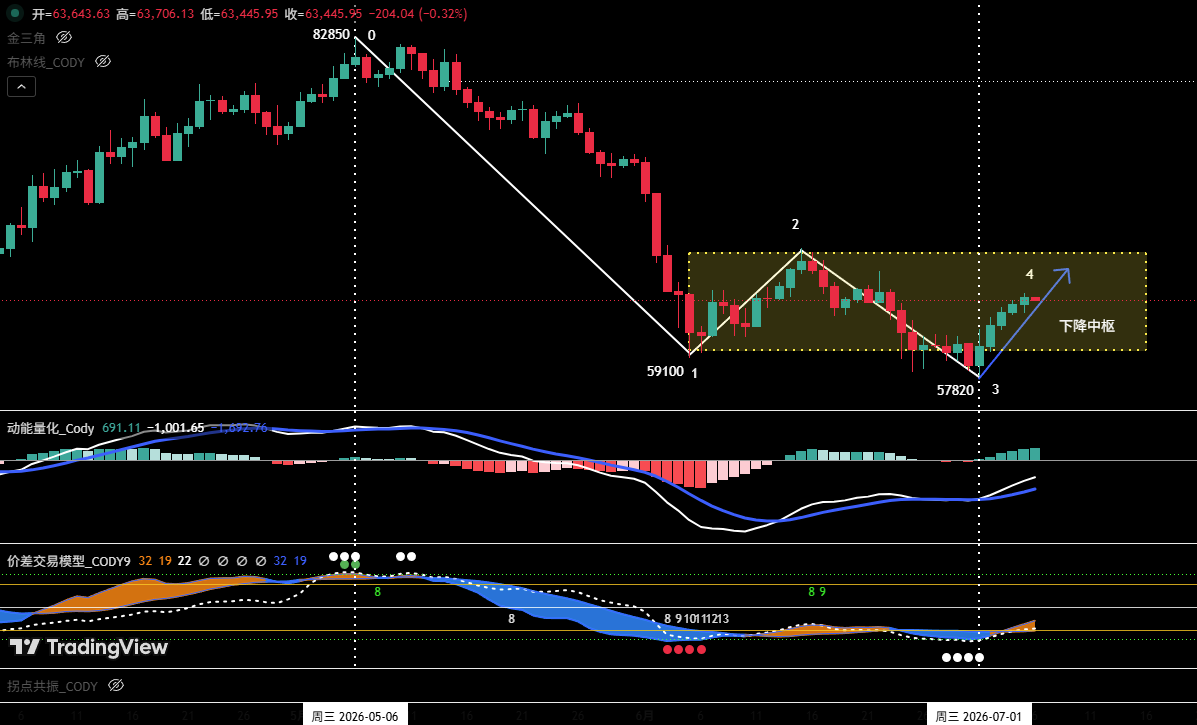
Figure 1

1 Comme le montre la Figure 1 : La phase d'ajustement amorcée depuis le sommet du 6 mai à 82 850 $ présente désormais, sur le cadre journalier, une structure d'ajustement claire en quatre segments, de « l'extrémité 0 » à « l'extrémité 4 ».

2 Le marché évolue actuellement dans la phase de rebond (3-4). La position du point terminal « Extrémité 4 » déterminera l'évolution à court terme du cours.

  • Scénario 1 : Si le prix au point « Extrémité 4 » parvient à franchir le niveau de résistance à 65 700 $, la probabilité que le cours, lors du prochain repli, casse directement le support du 1er juillet à 57 820 $ sera considérablement réduite. Dans ce cas, le marché pourrait amorcer un nouveau rebond après la fin de l'ajustement, et la tendance globale récente serait davantage encline à évoluer en consolidation latérale. Plus cette structure de consolidation dure, plus elle contribue à atténuer l'élan baissier et à accumuler des forces pour une future contre-offensive haussière.
  • Scénario 2 : Si le prix au point « Extrémité 4 » n'atteint pas 65 700 $, voire reste inférieur à 64 500 $, la probabilité d'une cassure directe du niveau de 57 820 $ lors du prochain repli augmentera significativement, et la probabilité que le marché prolonge sa tendance baissière sera plus élevée.

3 D'après l'analyse de notre modèle quantitatif interne, la probabilité que le marché entre en phase de consolidation latérale (Scénario 1) est significative.

2. Analyse approfondie de la structure des tendances sur le cadre horaire (cycle d'analyse de 4 heures)

Graphique en chandeliers 4 heures du Bitcoin
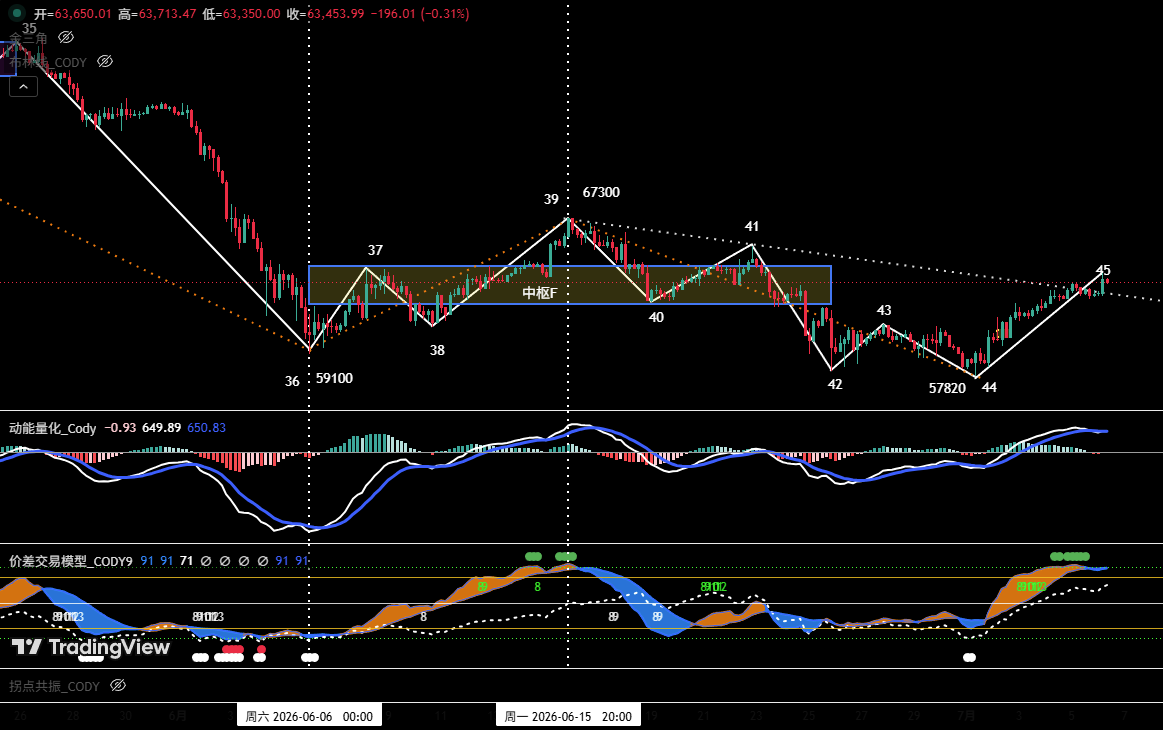
Figure 2

1 Le commentaire hebdomadaire précédent indiquait : « Si le point terminal de l'extrémité 44 se situe en dessous de 58 110 $ et qu'une divergence haussière de momentum se forme, le marché offrira une opportunité de rebond. » Les évolutions de la semaine dernière ont validé cette analyse, le parcours réel correspondant étroitement à la structure anticipée.

2 Sur le graphique en 4 heures, la vague baissière sur le cadre horaire initiée depuis le sommet du 15 juin à 67 300 $ a achevé une structure complète en cinq segments. De plus, à la fin de la phase d'ajustement, une divergence haussière de momentum claire s'est formée en comparant les deux points bas « Extrémité 44 » et « Extrémité 42 », fournissant un support technique pour le rebond qui a suivi la survente.

3 Le marché se trouve actuellement dans la phase de rebond (44-45). D'après la Figure 2, le sommet actuel du rebond « Extrémité 45 » a franchi la limite inférieure du « canal baissier F » précédent (environ 62 300 $), indiquant une évolution récente favorable aux acheteurs. Si le cours parvient ensuite à franchir le niveau « Extrémité 41 » (environ 65 700 $), cela signifierait un renforcement de l'élan du rebond, et la probabilité d'une cassure directe du niveau « Extrémité 44 » (environ 57 820 $) lors du prochain repli serait considérablement réduite.

II. Prévisions pour le Bitcoin cette semaine et stratégies opérationnelles (06.07 ~ 12.07)

1. Prévisions d'évolution du BTC cette semaine

Point central : Se concentrer sur la position du sommet du rebond journalier amorcé depuis le point bas de 57 820 $.

2. Niveaux de résistance clés :

• Première zone de résistance : Région 64 500 ~ 65 700 $ (zone de précédents points hauts/bas importants)

• Deuxième zone de résistance : Autour de 67 300 $ (zone de résistance importante précédente)

• Troisième zone de résistance : Région 69 500 ~ 71 000 $ (zone de résistance importante précédente)

3. Niveaux de support clés :

• Premier support : Région 60 950 ~ 62 300 $ (zone de support important précédent)

• Deuxième support : Autour de 57 820 $ (support important précédent)

• Troisième support : Autour de 55 000 $ (support important précédent)

4. Stratégie opérationnelle de la semaine

1 Stratégie à moyen terme :

Graphique en chandeliers journaliers du Bitcoin (Modèle de suivi de position)
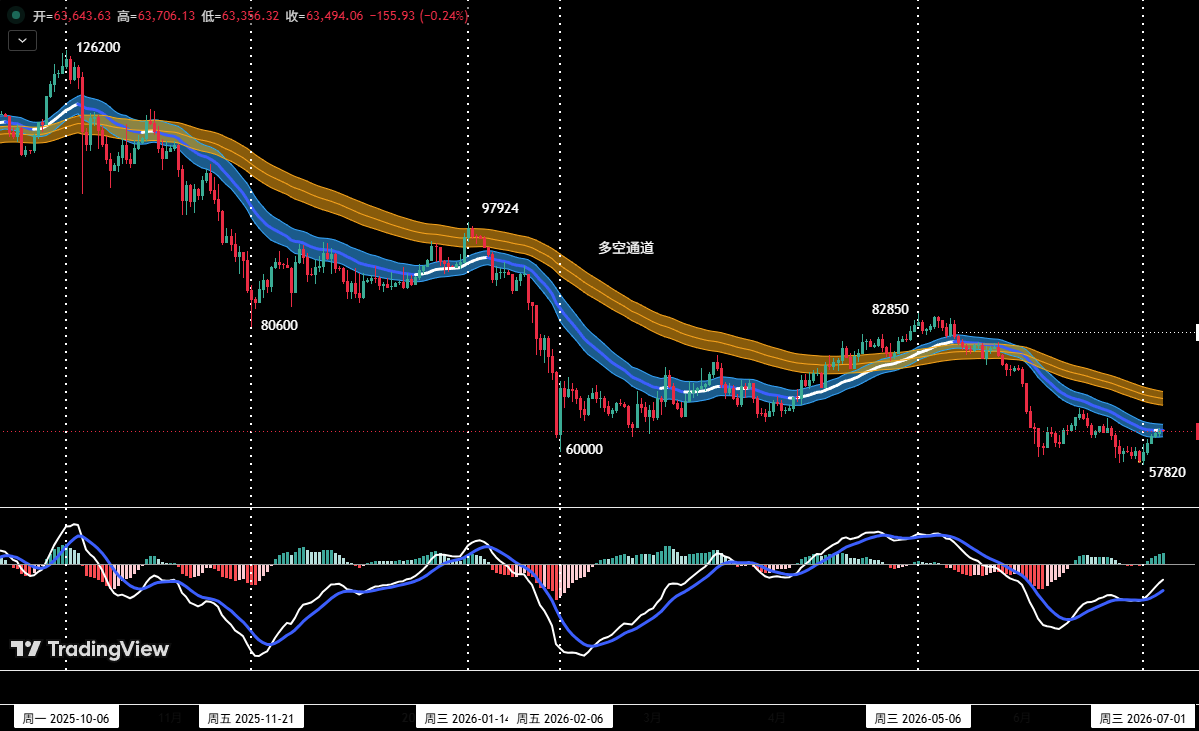
Figure 3

Comme le montre la Figure 3, le cours a effectivement cassé le « canal haussier/baissier », confirmant que la structure du marché est désormais dominée par les vendeurs.

  • Maintenir temporairement une position vendeuse à moyen terme d'environ 20%.
  • Si le cours rebondit vers la zone 65 700 ~ 67 300 $ et montre des signes d'essoufflement, combinés à un signal de sommet de notre modèle quantitatif, envisager d'augmenter la position vendeuse à moyen terme jusqu'à 50% maximum.

2 Stratégie à court terme

Utiliser 30% du capital, placer un stop-loss, et rechercher des opportunités d'« arbitrage » basées sur les niveaux de support et de résistance (en utilisant les cadres 30 minutes / 60 minutes comme cycles opérationnels).

3 Plan opérationnel à court terme

Pour faire face de manière dynamique aux évolutions complexes du marché, deux plans opérationnels concrets, A et B, sont préparés à l'avance :

  • Plan A : Test de position vendeuse en zone de forte résistance
  • Ouverture : Si le cours rencontre une résistance dans la zone 65 700 ~ 67 300 $ après un rebond, et qu'un signal de sommet de notre modèle quantitatif apparaît, ouvrir une position vendeuse d'environ 30%.
  • Gestion des risques : Placer un stop-loss initial.
  • Clôture : Lorsque l'ajustement approche un niveau de support important et qu'un signal du modèle quantitatif apparaît, réduire progressivement la position pour réaliser les gains.
  • Plan B : Test léger de position acheteuse en zone de fort support
  • Ouverture : Si, après avoir franchi la zone des 65 700 $, le cours rencontre une résistance, retrace, et montre des signaux de stabilisation près du fort support de 57 820 $, combinés à un signal de fond de notre modèle quantitatif, ouvrir une position acheteuse d'environ 15%.
  • Gestion des risques : Placer un stop-loss initial.
  • Clôture : Lorsque le rebond approche un niveau de résistance important et qu'un signal du modèle apparaît, réduire progressivement la position pour réaliser les gains.

III. Analyse de la structure des tendances sur le cadre horaire de l'HYPE

Graphique en chandeliers 4 heures de l'HYPE
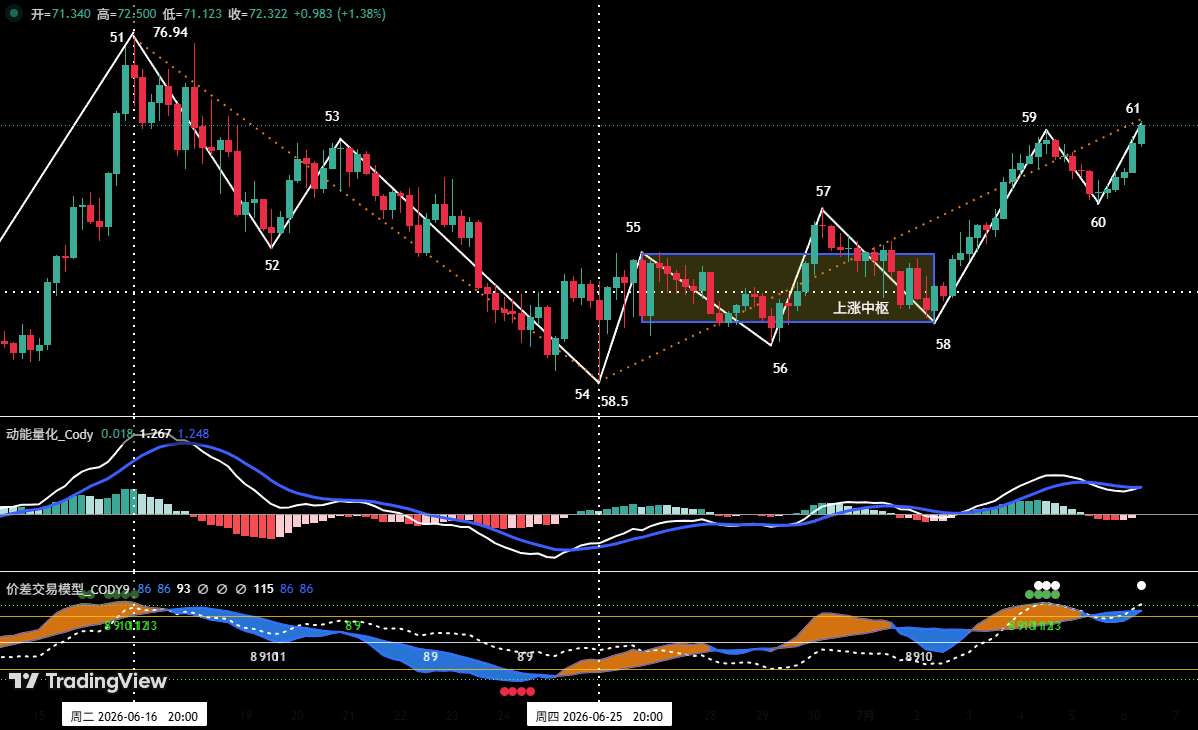
Figure 4

  1. Comme le montre la Figure 4, le commentaire hebdomadaire précédent indiquait : « Si 'l'extrémité 56' est supérieure à 'l'extrémité 54', cela constituerait une formation de 'double creux', indiquant une fin probable de la phase d'ajustement en cours, avec une forte probabilité de rebond à partir de 'l'extrémité 56'. » Jusqu'à présent, la trajectoire du marché est très conforme à cette analyse. La semaine dernière, le cours de l'HYPE est monté en dents de scie de « l'extrémité 56 » (environ 60,55 $) à « l'extrémité 59 » (environ 72,06 $), avec un gain maximal d'environ 19,01%.
  2. En analysant le graphique en 4 heures, le rebond de l'HYPE initié depuis le point bas du 25 juin à 58,5 $ (extrémité 54) peut être subdivisé, sur le cadre 4 heures, en une structure de hausse en sept segments, à savoir 54-55, 55-56, 56-57, 57-58, 58-59, 59-60, 60-61.
  3. Le cours évolue actuellement dans le segment de hausse 60-61, complétant ainsi la structure haussière globale. Cependant, notre « modèle de trading d'arbitrage » interne a détecté des signaux d'avertissement de sommet respectivement aux points « Extrémité 59 » et « Extrémité 61 », et le prix approche la zone des précédents sommets historiques autour de 76,94 $. Par conséquent, il n'est pas judicieux de se précipiter pour acheter à ce niveau, et il faut rester vigilant face aux risques d'ajustement à court terme.

IV. Prévisions pour l'HYPE cette semaine et stratégies de trading à court terme

1. Prévisions d'évolution de l'HYPE cette semaine

Niveaux de résistance clés

  • Première résistance : Autour de 75 ~ 76,94 $
  • Deuxième résistance : Autour de 80 $

Niveaux de support clés

  • Premier support : Autour de 68 $
  • Deuxième support : Autour de 65,5 $
  • Troisième support : Région 60,5 ~ 61,5 $

Point de vue central de la semaine : Observer l'issue de la confrontation entre acheteurs et vendeurs lorsque le prix atteindra la zone 75 ~ 76,94 $.

2. Stratégie de trading à court terme pour l'HYPE cette semaine

Cette semaine, l'accent est mis sur la clôture des positions pour sécuriser les profits et se prémunir contre les risques. Si des positions longues ont été prises dans des zones de support selon le plan, il est recommandé de remonter le stop-loss près de 68 $ pour protéger les bénéfices (ou selon votre propre jugement). Si le marché montre des signes d'ajustement, clôturer les positions en temps opportun pour réaliser les gains.

V. Retour d'expérience sur les opérations à court terme de l'HYPE

Nous avons strictement suivi le plan opérationnel et, en nous basant sur les signaux de trading émis par nos modèles internes « Modèle de Trading d'Arbitrage » et « Modèle Quantitatif de Momentum », nous avons réalisé une opération à court terme (position longue) la semaine dernière, avec un profit total d'environ : 10,23%.

Opération à court terme n°1 : (Voir tableau 1)

1. Résumé détaillé de l'opération à court terme sur l'HYPE : (levier *1)
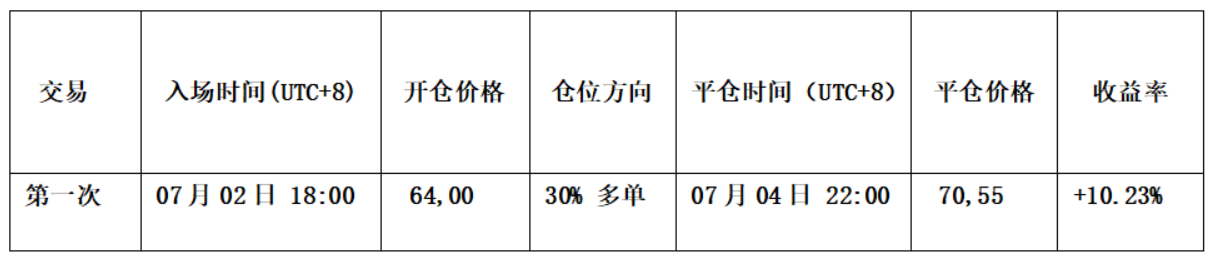
Tableau 1

2. Retour sur l'opération à court terme : (Voir figure 5)

• Stratégie d'ouverture :

a. Basée sur une analyse précise de la tendance haussière globale du prix.

b. Lorsque le prix a franchi efficacement la ligne de tendance baissière à court terme, et que le « Modèle de Trading d'Arbitrage » et le « Modèle Quantitatif de Momentum » ont émis simultanément des signaux de divergence haussière en résonance.

Par conséquent, nous avons ouvert une position longue de 30% à 64 $.

• Stratégie de clôture :

a. Lorsque le prix est monté près de la résistance à 72 $ et a montré des signes d'essoufflement, formant une configuration de « chandelier en sommet » (top pattern).

b. Le « Modèle de Trading d'Arbitrage » a déclenché un fort signal d'avertissement de sommet (points verts + points blancs), formant une résonance de sommet avec le « Modèle Quantitatif de Momentum ».

Par conséquent, nous avons clôturé l'intégralité de la position autour de 70,55 $.

• Résumé : Cette transaction a généré un profit d'environ 10,23%.

Graphique en chandeliers 60 minutes de l'HYPE : (Modèle Quantitatif de Momentum + Modèle de Trading d'Arbitrage)
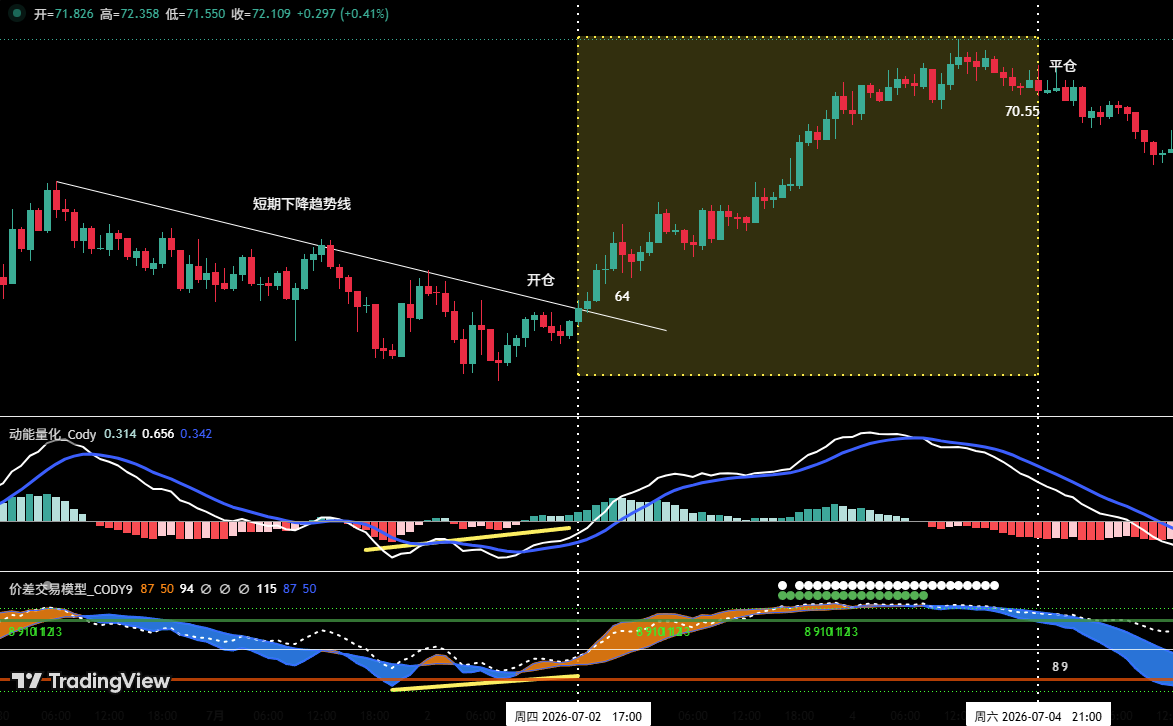
Figure 5 (Illustration de l'opération à court terme)

VI. Consignes spéciales

  1. À l'ouverture d'une position : Placer immédiatement un stop-loss initial.
  2. Lorsque le profit atteint 1% : Déplacer le stop-loss au prix d'ouverture (point d'équilibre) pour sécuriser le capital.
  3. Lorsque le profit atteint 2% : Déplacer le stop-loss à la position correspondant à un profit de 1%.
  4. Suivi continu : Par la suite, déplacer le stop-loss de 1% pour chaque 1% de profit supplémentaire, afin de protéger dynamiquement et de verrouiller les gains.

Les marchés financiers évoluent rapidement, et toutes les analyses de marché et stratégies de trading doivent être ajustées dynamiquement. Tous les points de vue, modèles d'analyse et stratégies opérationnels présentés dans cet article proviennent d'analyses techniques personnelles et sont destinés uniquement à un usage de journal de trading personnel. Ils ne constituent en aucun cas un conseil en investissement ou une base de décision. Les marchés comportent des risques, l'investissement exige de la prudence. Ne prenez pas de décisions basées uniquement sur ces informations.

Trending Cryptos

Related Questions

QQuel est l'objectif principal de l'article concernant l'analyse technique de cette semaine ?

AL'article fournit une analyse structurelle technique multi-temporelle de BTC et HYPE. Il examine la structure d'ajustement de BTC depuis les sommets de mai et les tendances de rebond de HYPE, en donnant des prévisions sur les niveaux clés et des suggestions de stratégies opérationnelles pour la semaine en cours.

QQuels sont les deux scénarios possibles (Chemin 1 et Chemin 2) pour le prix du Bitcoin selon l'analyse journalière ?

AChemin 1 : Si le rebond 'point final 4' dépasse la résistance de 65 700 USD, le marché pourrait évoluer vers une consolidation en range, réduisant la probabilité d'une chute sous les 57 820 USD. Chemin 2 : Si le rebond 'point final 4' ne peut pas atteindre 65 700 USD (voire reste sous 64 500 USD), la probabilité d'une chute sous 57 820 USD et d'une poursuite de la tendance baissière augmente considérablement.

QQuelles sont les stratégies opérationnelles à moyen terme et à court terme proposées pour le BTC cette semaine ?

AStratégie à moyen terme : Maintenir une position courte d'environ 20%. L'augmenter à moins de 50% si le prix atteint 65 700–67 300 USD avec des signaux de surachat du modèle quantitatif. Stratégie à court terme : Utiliser 30% du capital pour chercher des opportunités de 'spread' en se basant sur les niveaux de support/résistance (cycle opérationnel de 30/60 minutes), avec deux plans (A et B) détaillés pour des positions courtes ou longues selon les scénarios du marché.

QSelon l'analyse de HYPE sur 4 heures, quelle est la principale mise en garde concernant son action des prix actuelle ?

ALe modèle de trading par écart a déclenché des signaux d'avertissement de sommet aux points finaux 59 et 61, et le prix s'approche de la zone de résistance historique autour de 76,94 USD. Par conséquent, il n'est pas conseillé d'acheter aveuglément à la hausse à ce stade, et il faut se méfier des risques d'ajustement à court terme.

QQuel est le principe général de gestion des risques (spécialement le déplacement du stop-loss) énoncé dans la section 'Conseils spéciaux' ?

A1. Définir un stop-loss initial dès l'ouverture de la position. 2. Déplacer le stop-loss au prix d'entrée (seuil de rentabilité) lorsque le profit atteint 1% pour sécuriser le capital. 3. Le déplacer au niveau de profit de 1% lorsque le profit atteint 2%. 4. Continuer à suivre et ajuster le stop-loss vers le haut de 1% à chaque fois que le profit augmente de 1% supplémentaire, pour verrouiller dynamiquement les gains.

Related Reads

Examining the Open USD Partner Lineup: Follow Who's Joining to See Where the Money Flows

**Title: Deciphering the Open USD Partner Roster: Following the Money** The launch of Open USD is notable less for the stablecoin itself and more for its expansive list of over 140 founding partners, which reads like a "who's who" of global finance and tech. This coalition, including asset managers like BlackRock, card networks Visa and Mastercard, banks (BNY Mellon, Standard Chartered, etc.), tech giants (Google, IBM), merchants (Shopify), and crypto firms (Coinbase, Ripple, Aave, MetaMask), signals a strategic shift. The diverse membership reveals that stablecoins are increasingly viewed not as products to compete over, but as shared infrastructure too critical to be left to any single entity. Each partner category has distinct motives. Asset managers like BlackRock seek to manage the large, sticky cash reserves, a lucrative fee-generating opportunity. Merchants like Shopify aim for lower-cost settlement and potential yield on balances. Banks join defensively to retain custody and settlement roles, fearing deposit outflows to stablecoins. Tech companies bet on programmable money for future machine-to-machine commerce. Crypto firms gain mainstream legitimacy and distribution channels. Remarkably, the consortium includes direct competitors (Visa vs. Mastercard, Coinbase vs. Ripple), indicating that the fear of exclusion from this emerging financial layer outweighs competitive rivalries. However, this shared governance could also lead to slow decision-making. The roster's composition is the real message: it represents a collective bet that a widely accepted, consortium-owned stablecoin is preferable to proprietary versions or having none at all. For incumbents like Circle and Tether, this alliance poses a significant threat, as potential clients have collectively chosen to build their own alternative. The absence of major U.S. retail banks (busy with their own tokenized deposit networks) is equally telling. In essence, the partner list maps where the industry believes value and risk will flow in a tokenized dollar future, marking stablecoin's evolution from a product to a utility.

Foresight News10m ago

Examining the Open USD Partner Lineup: Follow Who's Joining to See Where the Money Flows

Foresight News10m ago

IOSG: Q-Day Countdown, Will Quantum Computing End Cryptocurrency?

IOSG: The Q-Day Countdown – Will Quantum Computing End Cryptocurrency? This analysis explores the looming threat quantum computing poses to blockchain technology. Quantum computers, leveraging Shor's algorithm, could theoretically break the elliptic curve cryptography (ECC) underpinning cryptocurrencies like Bitcoin and Ethereum. The article outlines a hypothetical "Q-Day" scenario where exposed public keys from dormant assets are compromised, leading to fund theft and a deep governance crisis. The core risk is not the complete erasure of blockchains but a systemic reset of public-key cryptography. Bitcoin faces significant challenges due to its "code-is-law" ethos and the immense social consensus required for migration. Its primary vulnerability lies in legacy UTXOs with publicly exposed keys. Ethereum's path involves a more complex, full-stack cryptographic agility upgrade across execution, consensus, and data layers. The industry has a limited "engineering comfort window" of 5-8 years to coordinate a migration to post-quantum cryptography (PQC), such as lattice-based or hash-based signatures. While the existential threat is often overstated, the real bottleneck is the immense coordination required across protocol developers, node operators, wallet providers, exchanges, and custodians. Market repricing of crypto assets may occur well before an actual Q-Day if quantum hardware roadmaps accelerate or regulatory pressure mounts. The article concludes that quantum computing is not a doomsday weapon but a severe stress test for blockchain's foundational security model and governance structures.

marsbit39m ago

IOSG: Q-Day Countdown, Will Quantum Computing End Cryptocurrency?

marsbit39m ago

Why 2026 could redefine Ethereum, Solana, Base and Avalanche

Blockchain infrastructure is undergoing a major coordinated transformation, driven by institutional demand for reliability, compliance, and predictable settlement. Over $30 billion in Real-World Assets (RWA) on-chain has exposed network weaknesses. Major blockchains are responding with foundational upgrades, moving beyond incremental speed improvements. Ethereum's "Glamsterdam" upgrade, planned for H1 2026, will significantly increase gas limits and introduce features like PBS (pre-blocked state) for enhanced settlement and parallel execution. Solana's "Alpenglow," targeting a mainnet launch in H2 2026, focuses on reducing finality time dramatically and freeing network resources to improve reliability. Beyond speed, compliance is critical. Base's "Beryl" upgrade in Q3 2026 will introduce a standardized, regulatory-compliant token framework (B20). Avalanche's "Octane" upgrade aims to boost transaction processing and reduce costs for enterprise applications. Even Bitcoin is evolving with the potential activation of OP_CAT by late 2026/early 2027. The competition is shifting. While technical upgrades are widespread, institutions will ultimately allocate capital based on proven execution, operational resilience, and regulatory compatibility during market stress. Ethereum currently leads in tokenized assets, while networks like Base and Solana are strengthening their institutional offerings. The blockchain that best delivers reliable, compliant, and uninterrupted service is poised to attract the greatest share of future institutional capital.

ambcrypto1h ago

Why 2026 could redefine Ethereum, Solana, Base and Avalanche

ambcrypto1h ago

Trading

Spot

Hot Articles

What is LINON

Linde plc Tokenized Stock (Ondo): Revolutionizing Traditional Equity Access Through Blockchain Innovation The emergence of Linde plc Tokenized Stock (Ondo), represented by the ticker $LINON, signifies a monumental shift in the fusion of traditional financial structures and decentralized finance (DeFi). This innovative financial instrument showcases the tremendous potential of blockchain technology to democratize access to traditional equity markets while ensuring the security and regulatory compliance necessary for institutional-grade financial products. Through Ondo Finance's pioneering tokenization platform, $LINON provides a seamless pathway for global investors to engage with one of the world's leading industrial gas companies, Linde plc, creating a blockchain-native representation of the underlying equity. Introduction to Linde plc Tokenized Stock The landscape of financial markets is witnessing a groundbreaking transformation through the tokenization of real-world assets. Linde plc Tokenized Stock (Ondo) epitomizes this revolutionary approach by bridging the gap between conventional stock ownership and blockchain-enabled financial infrastructure. The $LINON token allows investors to gain exposure to one of the prominent industrial companies worldwide through decentralized technology. Operating within Ondo Finance's comprehensive ecosystem, $LINON symbolizes a practical application of tokenization technology that enhances accessibility, efficiency, and global connectivity in traditional financial markets. By leveraging blockchain infrastructure, this tokenized stock enables international investors to participate in U.S. equity markets, overcoming traditional barriers associated with cross-border investing. The significance of $LINON goes beyond technological innovation; it represents a fundamental shift in asset structuring, distribution, and trading in the digital age. This tokenized stock maintains all the economic benefits associated with traditional Linde plc shares while offering improved liquidity, programmable compliance features, and seamless integration with decentralized finance protocols. The development of $LINON indicates a growing acceptance of blockchain technology as a viable means for traditional finance, exemplifying how even well-established assets like Linde plc can integrate into blockchain systems. This approach preserves the core attributes that appeal to investors while introducing advanced capabilities that enhance the overall investment proposition. Project Overview and Objectives Linde plc Tokenized Stock (Ondo) encapsulates a strategic effort to democratize access to traditional equity markets through advanced blockchain technologies. The primary objective of $LINON is to provide approved global investors seamless access to the economic exposure associated with Linde plc shares, furthering an effort to create a more inclusive financial ecosystem. Beyond the digital representation of traditional assets, $LINON endeavors to eliminate barriers of geography and time zones that limit investor participation. Its design ensures that blockchain technology can elevate traditional investment vehicles without undermining the security or compliance requirements expected by investors. Key goals of the project include enhanced liquidity provision, programmable compliance mechanisms, and interoperability with other blockchain networks. Each $LINON token is fortified by actual Linde plc securities housed at U.S.-registered broker-dealers, allowing holders to reap economic advantages akin to traditional stockholders, such as dividend reinvestment. Furthermore, $LINON aims to establish new industry standards for institutional-grade tokenized securities, paving the way for traditional assets to embrace blockchain technology while remaining compliant with regulatory frameworks. By associating itself with a company as reputable as Linde plc, the project opens avenues for exploring tokenized equities catering to both conservative institutional players and daring retail investors. Project Creator and Development Team The vision for Linde plc Tokenized Stock (Ondo) comes from Nathan Allman, founder and CEO of Ondo Finance. His background in traditional finance coupled with expertise in blockchain technology positions him uniquely to navigate the complexities of asset tokenization. Allman's academic journey began at Brown University, focusing on Economics and Biology, equipping him with valuable analytical skills. His time at Goldman Sachs in the Digital Assets division strengthened his understanding of the interplay between financial institutions and emerging technologies, laying the groundwork for his later endeavors in alternative investment strategies. Under Allman's guidance, Ondo Finance has emerged as a leader in asset tokenization, launching $LINON as a flagship example of the company's larger mission towards revolutionizing traditional financial systems using blockchain technology. His commitment to leveraging blockchain for creating institutional-grade financial products has shaped the landscape of real-world asset tokenization. Investment and Funding Structure The growth of Ondo Finance, the platform powering Linde plc Tokenized Stock (Ondo), is bolstered by robust financial backing from prestigious venture capital firms and strategic investors. This strong investment foundation underpins the development of the key infrastructure essential for compliant tokenized securities like $LINON. In August 2021, Ondo Finance secured $4 million in seed funding led by a major venture capital firm, which enabled the company to commence platform development and establish the necessary regulatory processes for tokenizing real-world assets. This early investment cemented Ondo Finance's credibility within the industry. The Series A funding round followed, garnering $20 million with participation from renowned firms committed to transformative technology companies. This backing demonstrated substantial institutional confidence in Ondo Finance's vision, allowing it to hone its approach to asset tokenization through mechanisms that ensure compliance and accessibility. Noteworthy contributors, including institutional investors and experienced partners, have added significant value to Ondo Finance’s development efforts. Their involvement underscores the confidence across sectors in Ondo Finance's approach to bridging traditional finance with blockchain innovations. Technical Infrastructure and Innovation The technical architecture that underpins Linde plc Tokenized Stock (Ondo) represents a sophisticated melding of traditional finance systems and cutting-edge blockchain technology. The architecture's foundation is built on the Ethereum network, renowned for its security and programmability—both critical for intricate financial instruments. The $LINON tokenization process comprises creating a blockchain-native representation of Linde plc shares that preserves economic benefits while augmenting investor capabilities. Each token corresponds to actual shares held at U.S.-registered broker-dealers, creating a compliant custody structure that legitimizes the asset's existence and value. Automated compliance systems are integrated into the tokenization process, managing critical components such as know-your-customer (KYC) verification and anti-money laundering (AML) protocols. This incorporation of programmable compliance empowers $LINON to uphold regulatory standards essential for institutional proliferation. Cross-chain interoperability characterizes the advanced technical features of $LINON. While initially deployed on Ethereum, the framework is designed for expansion to other networks such as Solana and BNB Chain. This adaptability enhances liquidity and accessibility, allowing investors to select their preferred blockchain ecosystems. Historical Timeline and Development Crafting the history of Linde plc Tokenized Stock (Ondo) unfolds in parallel with the evolution of Ondo Finance's tokenization platform. The timeline's inception dates back to March 2021 when Nathan Allman laid the foundations for creating institutional-grade financial products on blockchain infrastructure. The initial funding round in August 2021 provided crucial resources for developing the platform and establishing partnerships necessary for effective tokenization. By January 2023, Ondo Finance launched its tokenized treasury products, establishing mechanisms that would facilitate future tokenized equities such as $LINON. A pivotal milestone arose in February 2025 when Ondo Chain—a Layer 1 blockchain designed specifically for asset tokenization—was introduced. This infrastructure enhances capabilities vital for institutional markets, demonstrating Ondo Finance's long-term commitment to tokenization. Subsequently, the launch of Ondo Global Markets in September 2025 marked the official debut of $LINON. This milestone showcased the successful transition from development to active trading, enabling investors around the world to access American financial markets seamlessly. Ongoing development plans include a targeted expansion of available tokenized assets to over 1,000 by the end of 2025, pointing to a bright future for Ondo Finance's ecosystem and its mission to broaden tokenized equity accessibility. Regulatory Compliance and Legal Framework The legal architecture governing Linde plc Tokenized Stock (Ondo) emphasizes a sophisticated approach to regulatory compliance, allowing tokenized securities to be implemented within a blockchain-based framework. The legal structure governing $LINON spans multiple jurisdictions while maintaining a robust legal footing. Compliance systems ensure that only eligible investors can access the token, enforced through automated verification that aligns with international regulations. This innovative regulatory technology promises real-time enforcement of complex requirements, considerably enhancing efficiency in operating within the regulatory landscape. The custody framework undergirding $LINON ensures that the underlying shares are securely held at U.S.-registered broker-dealers, complying with necessary regulations while delivering blockchain-driven access to investors. The token maintains its economic equivalency and security through this carefully structured custody arrangement. KYC and AML compliance systems are embedded within the smart contract architecture, ensuring integrity and adherence to regulatory practices while fostering transparency for investors. The jurisdictional restrictions mark a commitment to navigating the evolving landscape of international securities laws. Market Impact and Industry Significance The advent of Linde plc Tokenized Stock (Ondo) holds profound implications for the broader financial landscape, symbolizing a clear shift towards blockchain-enabled markets. $LINON serves as a proof-of-concept for integrating traditional companies into blockchain ecosystems, showcasing the potential benefits such as broader accessibility and improved efficiency. The market's response to $LINON indicates a growing acceptance of tokenization among institutional investors, contributing to the emergence of an expanding sector wherein traditional assets can be interconnected with blockchain innovations. The success of $LINON further solidifies market confidence, indicating an overarching shift towards recognizing asset tokenization as a transformative force in finance. Future Development and Expansion Plans The future trajectory for Linde plc Tokenized Stock (Ondo) centers around the expansion of the tokenization ecosystem and enhanced infrastructure supporting blockchain-enabled financial services. Plans for cross-chain integration usher in new opportunities for liquidity and flexibility within the investment framework, with existing capabilities poised for continuous enhancement. With the introduction of Ondo Chain, Ondo Finance aims to transition $LINON to an optimized blockchain environment specifically designed for asset tokenization. This new infrastructure heralds exciting prospects for the development of institutional-grade financial products, ensuring ongoing compatibility with contemporary investment strategies. Further integration with decentralized finance protocols signifies a commitment to empowering $LINON holders through advanced financial strategies. The anticipated expansion of available tokenized assets promises to broaden investor access, enhancing the utility and appeal of the platform. In alignment with ambitions for regulatory expansion, ongoing efforts to secure approvals for new jurisdictions will enhance investor access, further positioning $LINON at the forefront of the burgeoning tokenization market. Conclusion Linde plc Tokenized Stock (Ondo), as represented by the $LINON token, stands at the intersection of traditional finance and blockchain innovation. It embodies a transformative milestone in how financial assets are structured, distributed, and engaged within modern investment ecosystems. The technical sophistication behind $LINON, combined with its regulatory compliance framework, illustrates that asset tokenization can improve financial infrastructure rather than simply digitizing existing products. This pioneering effort not only enhances investor access to U.S. equity markets but also signifies an evolution of how traditional financial services can integrate blockchain technology. As the asset tokenization market grows exponentially, with prospects suggesting significant valuation increases, $LINON paves the way for a future where tokenized securities become standard fixtures in the financial landscape. The trajectory of $LINON will undoubtedly influence how traditional finance adapts to a transformed, blockchain-powered world.

3.3k Total ViewsPublished 2025.12.05Updated 2025.12.05

What is LINON

What is CRMON

Salesforce Tokenized Stock (Ondo): Revolutionising Traditional Equity Access Through Blockchain Innovation The emergence of Salesforce Tokenized Stock (CRMON) marks a pivotal advancement in integrating traditional financial markets with blockchain technology. This innovative approach offers investors unprecedented access to equity exposure through tokenisation. Developed by Ondo Finance, CRMON provides tokenholders with economic exposure equivalent to holding Salesforce stock (CRM) while automatically reinvesting dividends. This effectively bridges the gap between conventional equity markets and decentralised finance (DeFi). Introduction and Comprehensive Overview of Salesforce Tokenized Stock In recent years, the financial landscape has dramatically transformed due to blockchain technology, fundamentally altering how investors access and interact with traditional assets. The development of Salesforce Tokenized Stock (CRMON) is a prime example of this evolution, representing a sophisticated fusion of conventional equity markets with cutting-edge distributed ledger technology. CRMON is a tokenised version of Salesforce stock, emerging from the innovative work of Ondo Finance, a leading platform in the real-world asset tokenisation sector that positions itself as a bridge between traditional finance and decentralised systems. Designed to provide tokenholders with economic exposure that mirrors the performance of the underlying Salesforce stock, CRMON incorporates automatic dividend reinvestment mechanisms. This eliminates many traditional barriers associated with international equity investment, such as complex brokerage relationships, currency conversion challenges, and restricted trading hours. The tokenisation process reimagines stock ownership as a blockchain-native asset while maintaining its economic equivalence with the underlying security, offering enhanced portability and integration capabilities within decentralised finance ecosystems. CRMON transcends its individual utility as an investment instrument to represent a fundamental shift in how financial markets can operate in an increasingly digital world. By maintaining full backing through U.S.-registered broker-dealers and implementing robust compliance frameworks, CRMON demonstrates that tokenised securities can achieve the regulatory standards necessary for institutional adoption while delivering the technological advantages of blockchain infrastructure. Understanding Tokenized Real-World Assets and CRMON's Strategic Position Tokenised real-world assets signify one of the most significant innovations in modern finance, fundamentally reimagining how traditional securities are represented, traded, and utilised within digital ecosystems. CRMON operates as a tokenised equity instrument correlating directly with Salesforce stock while optimising accessibility and efficiency. This aligns with Ondo Finance's broader mission to democratise access to institutional-grade financial products through innovative tokenisation strategies. The tokenisation process guarantees complete economic equivalence with the underlying Salesforce equity. Each CRMON token represents a proportional claim on Salesforce stock held by qualified custodians, with dividend payments automatically reinvested to maintain continuous exposure to total return performance. This structure simplifies dividend management and ensures that tokenholders receive the full economic benefit of their equity exposure, encompassing both capital appreciation and income generation. Ondo Finance's strategy in tokenising Salesforce stock demonstrates its expertise in creating compliant, institutional-grade products that meet traditional financial markets' stringent requirements. The platform’s focus on merging regulatory compliance with blockchain benefits positions it at the forefront of decentralised finance, captivating both institutional and retail investors seeking blockchain-native solutions. The Technology and Innovation Framework Behind CRMON The technological infrastructure supporting CRMON integrates blockchain technology with traditional financial mechanisms, delivering institutional-grade security and compliance while maintaining the operational advantages of decentralised systems. Built on the Ethereum blockchain, CRMON utilises robust smart contract capabilities to ensure transparent, secure operations. The smart contract architecture incorporates layered security and compliance mechanisms, enabling automated compliance checks and real-time asset backing verification. Integration with oracle services maintains accurate pricing and dividend information, ensuring CRMON reflects the underlying Salesforce stock's accurate performance. This architecture delivers automated dividend reinvestments and other corporate actions, eliminating manual processing requirements and directly enhancing tokenholder benefits. Ondo Finance ensures CRMON's security structure includes daily third-party verification of holdings, independent collateral agents, and a multiple-layer custody system through partnerships with established financial institutions. This framework safeguards tokenholder interests against operational risks while providing robust asset backing. The user interface enhances integration capabilities, allowing seamless interaction between CRMON and various decentralised finance protocols, as well as cryptocurrency exchanges. This interoperability enables users to leverage their tokenised equity across multiple platforms, creating sophisticated investment strategies that marry traditional equity characteristics with blockchain-native innovation. Leadership and Corporate Structure of Ondo Finance The leadership team behind CRMON and Ondo Finance blends expertise from traditional finance and blockchain technology, presenting a robust combination of skills essential for successfully bridging conventional markets with decentralised finance. Nathan Allman, the founder and CEO, emerged from a distinguished financial background before establishing Ondo Finance in 2021. Allman's experience includes notable roles at major financial institutions, including significant contributions to developing cryptocurrency market services. His insights into regulatory compliance were paramount in developing products like CRMON that successfully unify traditional securities with blockchain technology. With a team of professionals boasting substantial experience in both conventional finance and blockchain sectors, Ondo Finance's leadership comprises diverse expertise that covers every aspect of tokenised asset development. Justin Schmidt serves as President and COO, contributing unique operational expertise, while Chris Tyrell brings essential compliance knowledge. Investment Landscape and Funding History The investment landscape surrounding Ondo Finance reflects significant institutional confidence in its mission to tokenise real-world assets. The company has raised substantial funds through various investment rounds, attracting leading venture capital firms and strategic investors that recognise the transformative potential of tokenised securities like CRMON. Notably, Ondo Finance completed a successful Series A funding round in 2022, led by well-known venture capital firms. This funding success validates Ondo Finance's innovative approach to creating compliant, institutional-grade tokenised products. In total, Ondo Finance has successfully secured substantial funding, raising significant capital for product development and market expansion, including a noteworthy token sale that reinforced its governance structure through the establishment of the ONDO token. The diverse composition of investors reflects broad market confidence in Ondo Finance's business model, demonstrating support from both traditional and blockchain-native organisations. Operational Mechanics and Technical Implementation The operational framework supporting CRMON exemplifies sophisticated integration of traditional financial mechanisms with blockchain technology. The technical implementation introduces multiple layers of security, compliance, and operational efficiency to meet institutional standards while enhancing accessibility. The tokenisation process begins by acquiring actual Salesforce stock through U.S.-registered broker-dealers, ensuring each CRMON token maintains direct correlation with the underlying equity performance. Smart contracts automate operational processes, including dividend reinvestment and corporate action processing, facilitating a streamlined user experience. The Minting and redemption processes allow authorised participants to manage CRMON tokens effectively. During U.S. trading hours, institutions can mint new tokens by depositing stablecoins that are used to purchase corresponding Salesforce equity. This structure maintains a tight correlation with underlying assets, enhancing liquidity and price discovery. Additionally, the infrastructure supports twenty-four-hour token transfer capabilities, providing CRMON holders with operations outside traditional market hours. This represents a significant advantage over conventional securities ownership, thus promoting integration with decentralised finance applications. Plans for cross-chain compatibility through partnerships signal further ambitions for CRMON's market reach. By expanding to other blockchain networks, Ondo Finance aims to enhance accessibility and user engagement with tokenised equity products. Timeline and Historical Development of Tokenized Equity Innovation The timeline of CRMON's development and Ondo Finance's broader tokenised capabilities demonstrates a systematic innovation process beginning with the company's founding in 2021. 2021: Ondo Finance is founded by Nathan Allman and co-founders, launching initial products focused on structured vault offerings on the Ethereum blockchain. 2022: The company completes substantial funding rounds—both equity and token sales—totaling significant capital and launching initial tokenised U.S. Treasury products. 2023-2024: Ondo Finance experiences substantial growth, establishing partnerships with major financial institutions while expanding its product offerings beyond fixed-income securities. February 2025: Ondo Global Markets is announced, marking the transition into equity tokenisation with plans for accessing over one hundred U.S. stocks and ETFs. September 2025: The official launch of Ondo Global Markets includes CRMON alongside other tokenised equity offerings, marking a significant evolution in Ondo Finance's product ecosystem. This timeline highlights the organisation's rapid growth and its capability to adapt its technological and compliance frameworks to accommodate different asset classes effectively while maintaining security and regulatory integrity. Regulatory Framework and Compliance Approach Ondo Finance's regulatory framework showcases a sophisticated compliance strategy, essential for achieving institutional adoption in the tokenised securities market. The company's strong partnerships with U.S.-registered broker-dealers promote adherence to Securities and Exchange Commission regulations and apply robust investor protections. Acquisitions, such as Oasis Pro—a registered broker-dealer—significantly enhance Ondo Finance's compliance capabilities, ensuring thorough alignment with existing regulatory structures. The company employs independent verification procedures that foster transparency, aiming for a solid performance standards reputation. Furthermore, Ondo Finance's commitment extends to international regulatory compliance, ensuring token access remains restricted to eligible investors while adhering to pertinent cross-border securities regulations. Comprehensive attention to tax implications and reporting requirements fortifies the security and compliance landscape of CRMON, ensuring that investor obligations remain manageable. Future Prospects and Market Positioning The forward-looking landscape for CRMON and Ondo Finance illustrates substantial growth opportunities driven by institutional adoption of blockchain technology and escalating demand for efficient alternatives to conventional securities ownership. Market projections indicate the tokenised asset sector could value multiple trillion dollars by 2030. With plans to scale CRMON offerings significantly and integrate it with a dedicated blockchain infrastructure—Ondo Chain—Ondo Finance aims to elevate its institutional-grade tokenised asset operations. Additionally, the development of strategic partnerships enhances distribution capabilities while establishing the company's credibility in the financial market. Furthermore, the integration of tokenised equity with decentralised finance protocols offers new potential for innovative financial products and strategies previously impossible with traditional securities. These factors underscore CRMON's positioning to effectively capture increased market share and deliver innovative solutions for international investment exposure. Conclusion Salesforce Tokenized Stock (CRMON) symbolises a transformative development within financial markets, successfully bridging traditional equity ownership with blockchain technology to create unprecedented accessibility for global investors. Through Ondo Finance's sophisticated tokenisation framework, CRMON provides complete economic exposure to Salesforce equity performance while enhancing operational advantages that exceed traditional ownership. The launch of CRMON reflects the broader evolution of financial markets towards blockchain infrastructures that maintain regulatory compliance while delivering increased efficiency. Ondo Finance's extensive approach to regulatory adherence, institutional-grade security, and technological innovation solidifies CRMON as a model for future tokenised securities, delivering access previously unattainable in conventional brokerage structures. As the tokenised asset sector continues to develop, CRMON is well-positioned to address historical inefficiencies in capital markets while providing investors with innovative solutions for accessing traditional securities. The outlook for CRMON looks exceptionally promising, supported by ambitious expansion plans, technological innovations, and strategic partnerships, thereby representing a pioneering model of modern financial infrastructure evolving through blockchain integration.

3.4k Total ViewsPublished 2025.12.05Updated 2025.12.05

What is CRMON

What is SHOPON

Shopify Tokenized Stock (Ondo): A Comprehensive Analysis of Real-World Asset Tokenization in Web3 This article delves into the Shopify Tokenized Stock (Ondo), recognised by its ticker symbol $SHOPON, exploring its implications at the intersection of traditional finance and blockchain technology. As a part of Ondo Finance's tokenized securities platform, Shopify’s tokenized stock exemplifies advancements in democratizing access to global capital markets through innovative digital assets. Introduction and Overview of Shopify Tokenized Stock (Ondo) Shopify Tokenized Stock (Ondo), or $SHOPON, portrays a pivotal innovation in the realm of tokenized securities, allowing investors to gain economic exposure akin to directly owning shares of Shopify Inc. This token, developed under the umbrella of Ondo Finance, not only provides investors with the ability to hold digital representations of the company’s stock but also integrates features such as automatic reinvestment of dividends. This advancement represents a substantial shift in the landscape of decentralized finance (DeFi), linking conventional equity markets with blockchain solutions designed to enhance accessibility, transparency, and liquidity. By eliminating geographical barriers and enabling 24/7 trading capabilities, $SHOPON is positioned as a bridge connecting traditional financial instruments and the emerging Web3 ecosystem. What is Shopify Tokenized Stock (Ondo), $SHOPON? The $SHOPON token serves as a digital manifestation of Shopify Inc.'s shares, engineered to provide a direct correlation to the underlying asset's performance. Through the utilization of blockchain technology, the token gives holders a mechanism to participate in the economic benefits associated with equity ownership, including capital appreciation and dividend distribution. The unique aspect of $SHOPON lies in its automatic dividend reinvestment mechanism, which allows returns to compound without necessitating active management by the investor. This feature inherently enhances its attractiveness as an investment vehicle, particularly for individuals seeking passive income growth alongside exposure to high-performing equities. The tokenization process is facilitated by the custody of actual Shopify shares through regulated intermediaries, ensuring that every $SHOPON token is verifiably backed by real equity. This structure empowers investors with the dual advantages of both traditional financial characteristics and the innovative benefits tied to blockchain technology. Who is the Creator of Shopify Tokenized Stock (Ondo)? The creator of Shopify Tokenized Stock (Ondo), Nathan Allman, is an experienced figure in the finance sector, formerly associated with Goldman Sachs. His rich background includes significant expertise in digital asset development, bridging the gap between traditional finance and cryptocurrencies. Allman’s educational journey, marked by studies at Brown University, provided him with a deep understanding of economics and biology, equipping him with analytical skills that inform his strategic vision. In 2021, he founded Ondo Finance, committing to developing tokenized securities that meet institutional-grade standards while leveraging blockchain's transformative capabilities. Under Allman's leadership, Ondo Finance has focused on creating compliant and innovative financial products that empower a diverse investor base. Who are the Investors of Shopify Tokenized Stock (Ondo)? The investment landscape surrounding Shopify Tokenized Stock (Ondo) is notably robust, underpinned by significant institutional support. Primarily, Pantera Capital stands out as a strategic partner through the Ondo Catalyst initiative, a $250 million commitment aimed at accelerating the development of on-chain capital markets. This partnership not only signifies institutional confidence in the potential of tokenized assets but also reinforces Ondo Finance's operational capabilities and market positioning. The funding pathways have included earlier rounds that amassed millions in seed funding and further structural investments, solidifying relationships with both venture capital firms and private investors. Moreover, the financial framework is complemented by strategic partnerships with established financial institutions and technology companies, enhancing Ondo’s infrastructure and operational expertise. How Does Shopify Tokenized Stock (Ondo), $SHOPON Work? At the core of $SHOPON's operational framework is a sophisticated system integrating traditional finance mechanisms with blockchain technology. The custody of actual Shopify shares ensures that token holders retain authentic economic exposure, safeguarding their investments in line with recognized legal structures. The smart contracts employed in managing $SHOPON handle various functions, including automatic dividend reinvestment and ownership transfer, offering instant settlement and increased liquidity, marking a significant departure from conventional trading systems plagued by multi-day settlement delays. By providing interoperability with other decentralized finance applications, $SHOPON empowers holders with potentially lucrative opportunities for advanced investment strategies, including lending and automated market making. This complex integration presents a unique value proposition, catering to both traditional and crypto-native investors. The innovative structure of $SHOPON also allows for real-time settlements and transactions documented on the blockchain, delivering unparalleled transparency and security—a major advancement over standard equity trading practices. Timeline of Shopify Tokenized Stock (Ondo) March 2021: Nathan Allman establishes Ondo Finance, initially focusing on decentralized finance yield optimization. August 2021: Completion of a $4 million seed funding round led by Pantera Capital. January 2023: Launch of initial tokenized treasury security products, laying the groundwork for future equity tokenization. July 2025: Announcement of the Ondo Catalyst initiative, a strategic investment program valued at $250 million, aimed at propelling the development of tokenization in capital markets. September 3, 2025: Launch of Ondo Global Markets featuring over 100 tokenized U.S. stocks and ETFs, including $SHOPON. Technical Implementation and Blockchain Infrastructure Shopify Tokenized Stock (Ondo) operates on a technical architectural framework that marries blockchain protocols with traditional financial custody arrangements. The ecosystem leverages Ethereum's smart contract capabilities, providing seamless transaction management while ensuring compliance with regulatory standards through established financial custodians. Central to this architecture are security measures and transparent transaction records that affirm the legitimacy of each tokenholder's economic stake. With automated features managed by intricate smart contracts, $SHOPON not only streamlines ownership transfers but also allows for the tactical reinvestment of dividends—a hallmark of modern investment strategies. Moreover, the incorporation of LayerZero technology facilitates cross-chain interoperability, making $SHOPON accessible across multiple blockchain environments while preserving its functional robustness. This forward-thinking technical design positions $SHOPON as an adaptable asset within the larger DeFi milieu. Regulatory Framework and Compliance Architecture $SHOPON's regulatory framework is built upon the meticulous navigation of existing financial regulations that govern securities. The custody arrangements for the underlying Shopify shares are managed by U.S.-regulated broker-dealers, ensuring compliance and protection for investors. By maintaining a separation between the blockchain tokenization process and traditional custody, $SHOPON adheres to legal requirements while offering innovative functionalities that challenge conventional constraints. This dual-layered compliance approach enhances investor confidence and underscores Ondo Finance's commitment to regulatory integrity. Notably, the availability of $SHOPON is tailored to international investors from regions such as Asia-Pacific, Europe, and Africa, as regulatory parameters in the U.S. and U.K. present challenges in accessing tokenized securities. Market Access and Global Distribution Strategy The distribution strategy of $SHOPON is keenly designed to optimize global access while conforming to regulatory standards. The platform aims to establish comprehensive coverage for eligible investors across multiple regions, effectively dismantling traditional barriers through the implementation of blockchain technology. Integration with various cryptocurrency wallets and exchanges also promotes user-friendliness and accessibility, establishing a streamlined experience for investors to manage their holdings. Moreover, the 24/7 trading capabilities afforded by the tokenized model allow participants to react promptly to market shifts, fundamentally transforming how global equities are accessed and traded. Technology Integration and Cross-Chain Functionality The remarkable technological underpinnings of $SHOPON propagate its multi-chain functionality, set to expand its reach beyond Ethereum to networks such as Solana and BNB Chain. Such cross-chain capabilities allow users flexibility when navigating between blockchains, concurrently leveraging distinct network attributes to optimize their trading experience. LayerZero serves as the backbone for ensuring decentralized transfers between networks while providing the requisite security and speed, quintessential for maintaining investor trust. This comprehensive interoperability illustrates $SHOPON's commitment to being a versatile, user-centric asset in the evolving investment landscape. Ecosystem Integration and DeFi Compatibility Incorporating $SHOPON into broader DeFi protocols signifies its potential beyond traditional stock ownership. Token holders can leverage their holdings for various sophisticated strategies and applications, enhancing investment returns and liquidity management. By establishing a presence in lending protocols and automated trading systems, $SHOPON effectively democratizes access to advanced financial strategies previously limited to institutional investors. Such integration contributes to a more competitive and dynamic financial landscape, where individual investors can capitalize on tools typically reserved for larger entities. Risk Management and Security Framework Security remains paramount in the operational infrastructure of $SHOPON. The tokenization framework employs multiple layers of protection—beginning with regulated custody of the underlying Shopify shares. The operational protocols establish rigorous auditing, key management, and transaction monitoring standards, thus safeguarding against potential vulnerabilities. Moreover, meticulous adherence to evolving regulatory requirements provides an extra layer of security, fortifying investor protections and institutional compliance. Market Impact and Industry Implications The introduction of Shopify Tokenized Stock (Ondo) heralds a transformative shift in how financial markets operate, emphasizing the potential of tokenized securities to reshape traditional investment paradigms. The successful integration of $SHOPON encapsulates the efficiencies inherent in blockchain technology and opens avenues for new user demographics previously barred from extensive market participation. The impact extends beyond the immediate benefits to token holders, indicating broader trends that may challenge the status quo of investment services, particularly in addressing geographic restrictions and operational costs typically associated with traditional brokerage platforms. Undeniably, $SHOPON encapsulates the potential for traditional institutions to innovate further, leveraging the increasing demand for seamless blockchain access to complement existing financial infrastructure. Future Development Roadmap and Strategic Vision As Ondo Finance looks forward, the trajectory of $SHOPON rests on ambitious goals aimed at broadening the spectrum of available tokenized assets significantly. Over the next few years, plans are in place to expand to more than 1,000 tokenized securities, further enhancing market participation and investment options for individuals worldwide. Continued integration with traditional financial actors, development of specialized institutional products, and enhancements in automated trading capabilities will ensure that $SHOPON maintains its position at the forefront of financial innovation. Regulatory collaboration will also remain a focal point, establishing a framework that not only supports the compliance requirements but also promotes a healthy environment for tokenized asset proliferation. Conclusion and Market Significance In summary, Shopify Tokenized Stock (Ondo), represented by the ticker $SHOPON, is more than merely a tokenized equity offering; it embodies the innovation possible when traditional finance collides with modern blockchain applications. With a robust technical architecture, a commitment to compliance, and a clear strategic vision, $SHOPON exemplifies the potential for tokenized assets to enhance liquidity, accessibility, and functionality in capital markets. As the global investment landscape evolves, the transformative implications of $SHOPON extend beyond individual investors to revolutionize how financial instruments are perceived, traded, and utilized within both traditional and decentralized frameworks.

3.4k Total ViewsPublished 2025.12.05Updated 2025.12.05

What is SHOPON

Discussions

Welcome to the HTX Community. Here, you can stay informed about the latest platform developments and gain access to professional market insights. Users' opinions on the price of HYPE (HYPE) are presented below.

活动图片