¿Fin del ajuste o continuación de la tendencia? Revisión de las estructuras técnicas de BTC y HYPE | Análisis especial

Odaily星球日报Published on 2026-07-06Last updated on 2026-07-06

Abstract

Resumen del Análisis Técnico Semanal: BTC y HYPE (06-12 de Julio) El análisis semanal se centra en las estructuras técnicas de BTC y HYPE en múltiples marcos de tiempo. **Bitcoin (BTC):** * **Análisis Estructural:** El ajuste desde el máximo de mayo muestra una estructura de cuatro segmentos en el gráfico diario. El mercado está actualmente en el segmento de rebote (3-4). La posición final del "punto 4" es clave para la dirección a corto plazo. * **Escenarios:** Si el rebote supera los 65,700 USD, es probable un patrón de consolidación lateral. Si no alcanza esta zona, aumenta la probabilidad de continuar la tendencia bajista. * **Operativa para la Semana:** * **Niveles Clave:** Resistencia en 64,500-65,700 USD y 67,300 USD. Soporte en 60,950-62,300 USD y 57,820 USD. * **Estrategia:** Se mantiene una posición bajista moderada. Para operativas a corto plazo, se presentan dos planes: * **Plan A:** Posición corta de prueba si el precio encuentra resistencia en la zona de 65,700-67,300 USD. * **Plan B:** Posición larga ligera si el precio retrocede hacia el soporte fuerte de 57,820 USD tras un posible rechazo. **HYPE:** * **Análisis Estructural:** En el gráfico de 4 horas, el rebote desde los mínimos de junio muestra una estructura alcista de siete segmentos. El precio se acerca a una zona de resistencia histórica clave (75-76.94 USD). * **Operativa para la Semana:** El enfoque principal es proteger ganancias y gestionar riesgos. Se ac...

El informe semanal de esta semana se centra en el análisis de la estructura técnica en múltiples períodos de tiempo para dos activos clave: BTC y HYPE. En la sección de Bitcoin, se analiza la estructura de ajuste desde el máximo del 6 de mayo, examinando tanto el gráfico diario como el de 4 horas. Combinándolo con un modelo cuantitativo propio, se ofrecen predicciones sobre los niveles clave de resistencia y soporte para esta semana, así como posibles caminos operativos a corto y medio plazo. La sección de HYPE se enfoca en la evolución de la estructura de su rebote actual en el gráfico de 4 horas, proporcionando recomendaciones de gestión de riesgos para operaciones intradía esta semana. A continuación, se detalla el contenido.

Verificación de la estrategia de la semana pasada

  • Verificación de la previsión sobre BTC: El artículo de la semana pasada señaló claramente que el ajuste a corto plazo de Bitcoin estaba llegando a su fin. La trayectoria real del mercado ha coincidido básicamente con el pronóstico, verificando la precisión del análisis.
  • Verificación de la previsión sobre HYPE: El artículo de la semana pasada indicó que HYPE pronto presentaría una oportunidad de entrada en largo a corto plazo. Hasta ahora, el comportamiento del mercado ha validado este juicio.

I. Análisis de la estructura de tendencia en múltiples períodos de Bitcoin

1. Análisis de la estructura de tendencia en el gráfico diario

Gráfico diario de velas de Bitcoin
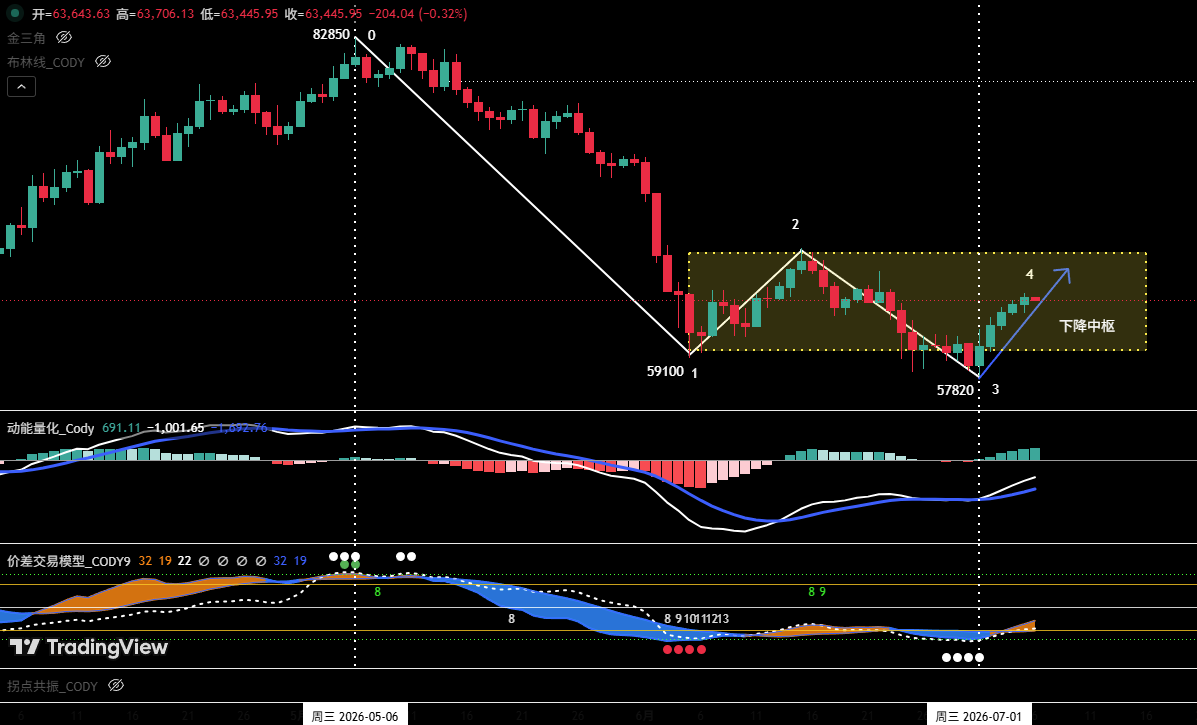
Figura uno

1. Como se muestra en la Figura uno: La tendencia de ajuste iniciada desde el máximo de $82,850 del 6 de mayo ya muestra una clara estructura de ajuste de cuatro segmentos, desde el "punto extremo 0" hasta el "punto extremo 4", en el gráfico diario.

2. El mercado se encuentra actualmente en el segmento de rebote (3-4). La posición del final del "punto extremo 4" determinará la dirección a corto plazo del precio.

  • Camino uno: Si el precio del rebote en el "punto extremo 4" logra superar el nivel de resistencia de $65,700, la probabilidad de que el precio, tras encontrar resistencia y retroceder, rompa directamente el soporte del mínimo del 1 de julio en $57,820 disminuirá significativamente. En este escenario, tras finalizar el ajuste, el mercado podría experimentar un nuevo rebote, y la tendencia general reciente tendería a entrar en una fase de consolidación lateral. Cuanto más tiempo se mantenga esta estructura de consolidación, más ayudará a ralentizar el impulso bajista y a acumular fuerzas para un posible contraataque alcista posterior.
  • Camino dos: Si el precio del rebote en el "punto extremo 4" no logra alcanzar los $65,700, o incluso se mantiene por debajo de $64,500, la probabilidad de que el precio, tras encontrar resistencia y retroceder, rompa directamente los $57,820 aumentará considerablemente, y es más probable que el mercado continúe con su tendencia bajista.

3. Según el análisis del modelo cuantitativo propio, la probabilidad de que el mercado entre en una fase de consolidación lateral (es decir, el Camino uno) es significativa.

2. Análisis profundo de la estructura de tendencia en gráficos horarios (utilizando el gráfico de 4 horas como período de análisis)

Gráfico de 4 horas de velas de Bitcoin
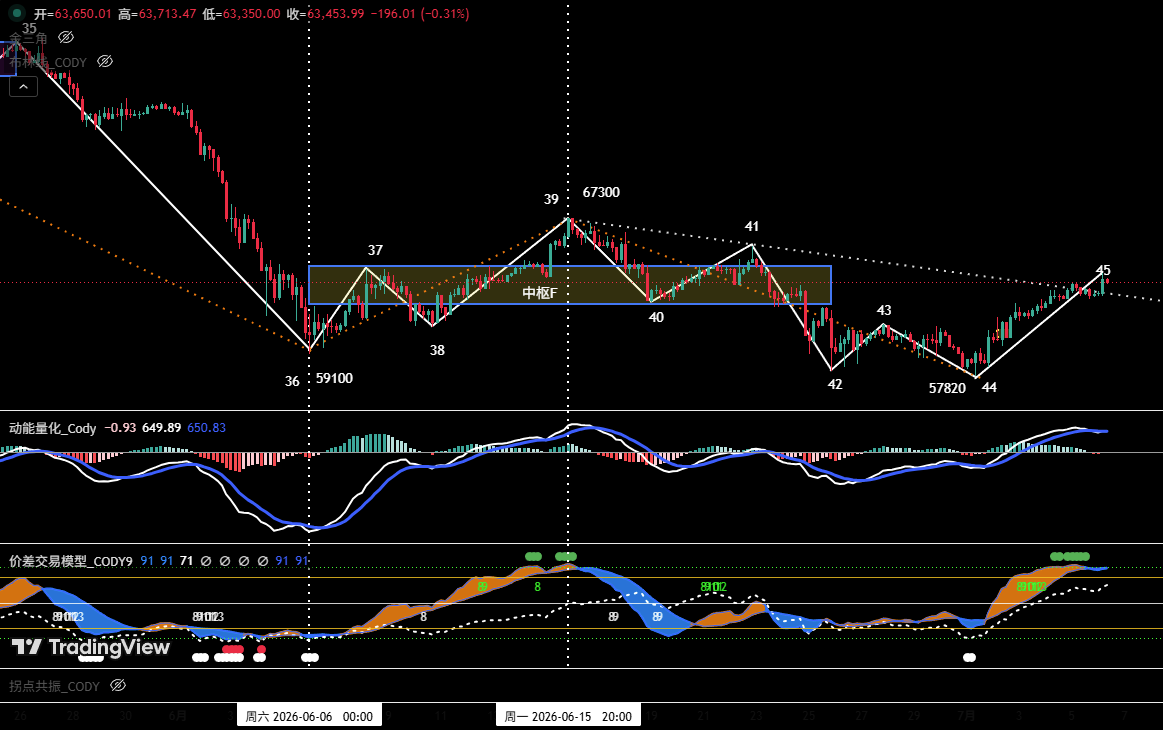
Figura dos

1. En el análisis semanal anterior se señaló: "Si el final del punto extremo 44 está por debajo de $58,110 y se forma una divergencia bajista en el impulso, el mercado presentará una oportunidad de rebote." El comportamiento del mercado de la semana pasada verificó este juicio, siendo la evolución real altamente consistente con la estructura pronosticada.

2. En el gráfico de 4 horas, la onda bajista a nivel horario que comenzó desde el máximo de $67,300 del 15 de junio ya ha completado una estructura completa de cinco segmentos; además, cerca del final del ajuste, se ha formado una clara divergencia bajista en el impulso entre los mínimos del "punto extremo 44" y el "punto extremo 42", proporcionando soporte técnico para el posterior rebote por sobreventa.

3. Actualmente, el mercado se encuentra en el segmento de rebote (44-45). Como se ve en la Figura dos, el máximo actual del rebote, "punto extremo 45", ya ha superado el límite inferior (alrededor de $62,300) del "centro bajista F" anterior, lo que indica que la situación a corto plazo se está desarrollando favorablemente para los alcistas. Si el precio logra superar posteriormente el "punto extremo 41" (alrededor de $65,700), significaría que la fuerza del rebote se ha intensificado, y la probabilidad de que una futura corrección tras encontrar resistencia rompa directamente el "punto extremo 44" (alrededor de $57,820) disminuiría considerablemente.

II. Previsión y estrategia operativa para Bitcoin esta semana (06.07~12.07)

1. Previsión de la tendencia de BTC para esta semana

Punto de vista central: Enfocarse en la posición del máximo del rebote diario por sobreventa iniciado desde el mínimo de $57,820.

2. Niveles clave de resistencia:

• Primera zona de resistencia: Región de $64,500~$65,700 (área de puntos altos/bajos importantes anteriores).

• Segunda zona de resistencia: Alrededor de $67,300 (zona de resistencia importante anterior).

• Tercera zona de resistencia: Región de $69,500~$71,000 (zona de resistencia importante anterior).

3. Niveles clave de soporte:

• Primer nivel de soporte: Región de $60,950~$62,300 (área de soporte importante anterior).

• Segundo nivel de soporte: Alrededor de $57,820 (soporte importante anterior).

• Tercer nivel de soporte: Alrededor de $55,000 (soporte importante anterior).

4. Estrategia operativa para esta semana

1. Estrategia a medio plazo:

Gráfico diario de velas de Bitcoin (modelo de seguimiento de posiciones)
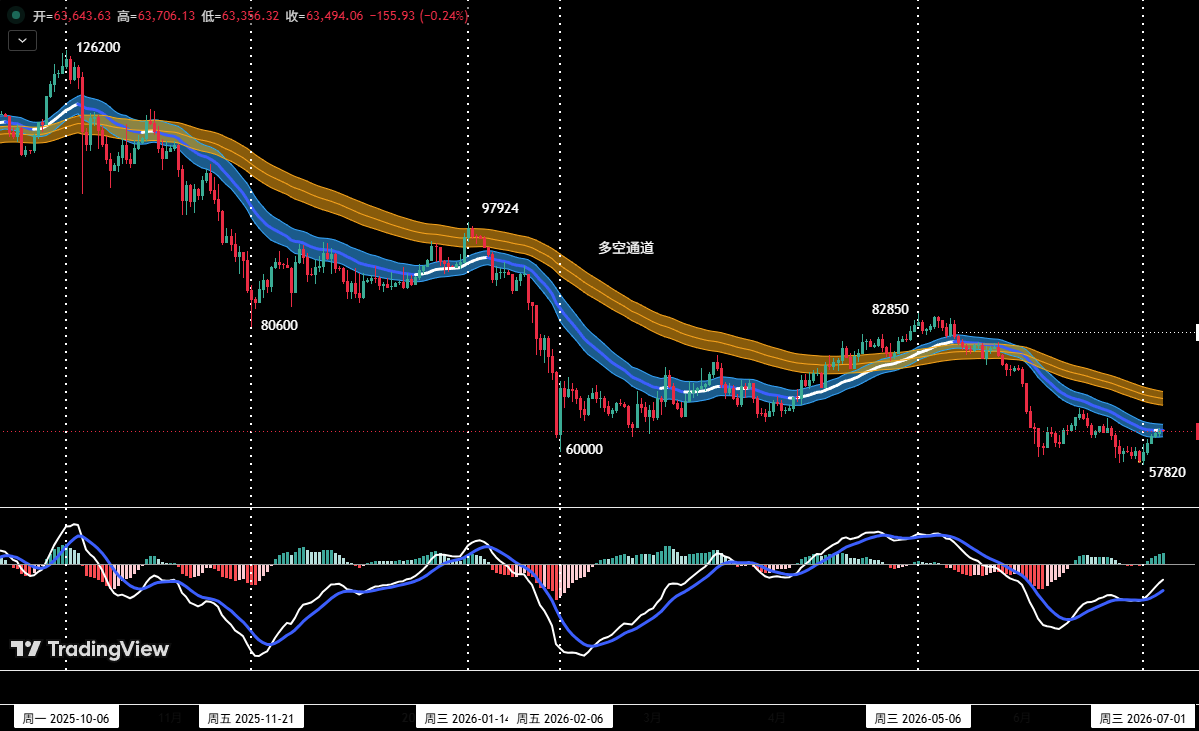
Figura tres

Como se muestra en la Figura tres, el precio actual ha roto efectivamente el "canal alcista/bajista", confirmando que la estructura del mercado ha cambiado a un entorno dominado por los bajistas.

  • Mantener temporalmente la posición corta a medio plazo alrededor del 20%.
  • Si el precio rebota hasta la zona de $65,700~$67,300 y muestra signos de agotamiento, combinado con señales de techo del modelo cuantitativo propio, se puede considerar aumentar la posición corta a medio plazo hasta un máximo del 50%.

2. Estrategia a corto plazo

Utilizando un 30% del capital, establecer puntos de stop-loss y buscar oportunidades de "diferencias de precio" basándose en niveles de soporte y resistencia (utilizando períodos de 30 minutos/60 minutos como ciclo operativo).

3. Plan operativo a corto plazo

Para responder dinámicamente a la compleja evolución del mercado, se han preparado de antemano dos planes operativos concretos, A y B:

  • Plan A: Operación corta tentativa en zona de fuerte resistencia
  • Apertura: Si el precio, tras rebotar, encuentra resistencia en la zona de $65,700~$67,300 y se combina con señales de techo del modelo cuantitativo, se puede establecer una posición corta de alrededor del 30%.
  • Gestión del riesgo: Establecer un stop-loss inicial.
  • Cierre: Cuando el ajuste se acerque a niveles importantes de soporte y se combinen con señales del modelo cuantitativo, se puede cerrar gradualmente la posición para tomar ganancias.
  • Plan B: Operación larga ligera en zona de fuerte soporte
  • Apertura: Si el precio, tras superar la zona de $65,700 y encontrar resistencia, retrocede hasta las cercanías del fuerte soporte de $57,820 mostrando señales de estabilización y de fondo del modelo cuantitativo, se puede establecer una posición larga de alrededor del 15%.
  • Gestión del riesgo: Establecer un stop-loss inicial.
  • Cierre: Cuando el rebote se acerque a niveles importantes de resistencia y se combinen con señales del modelo, se puede cerrar gradualmente la posición para tomar ganancias.

III. Análisis de la estructura de tendencia en gráficos horarios de HYPE

Gráfico de 4 horas de velas de HYPE
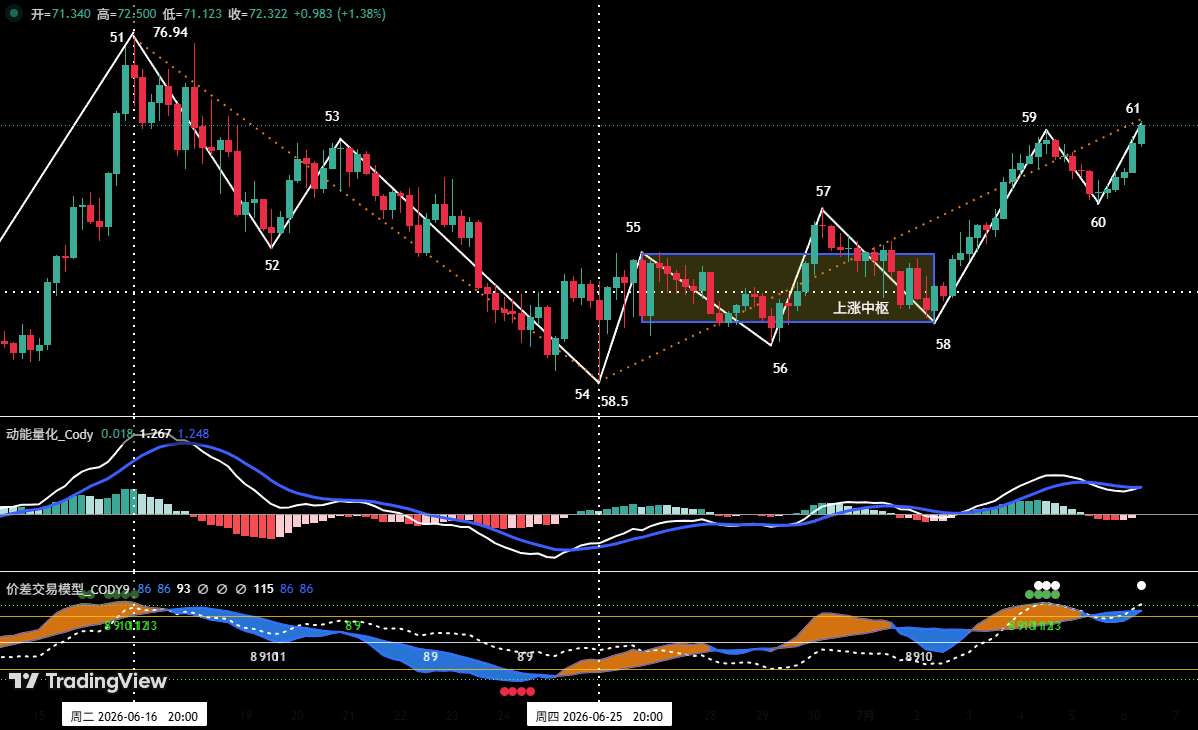
Figura cuatro

  1. Como se muestra en la Figura cuatro, en el análisis semanal anterior se señaló: "Si el 'punto extremo 56' está por encima del 'punto extremo 54', se formaría un patrón de 'doble suelo', lo que podría indicar el fin del ajuste actual, con alta probabilidad de que el rebote comience desde el 'punto extremo 56'." Hasta ahora, la trayectoria del mercado ha sido altamente consistente con el análisis. En la evolución real de la semana pasada, el precio de HYPE subió desde el "punto extremo 56" (aproximadamente $60.55) hasta el "punto extremo 59" (aproximadamente $72.06), con una ganancia máxima de alrededor del 19.01%.
  2. Analizando el gráfico de 4 horas, el rebote de HYPE iniciado desde el mínimo del 25 de junio en $58.5 (punto extremo 54) puede subdividirse, en el período de 4 horas, en una estructura alcista de siete segmentos: 54-55, 55-56, 56-57, 57-58, 58-59, 59-60, 60-61.
  3. Actualmente, el precio está en el segmento alcista 60-61, completando así la estructura alcista general. Sin embargo, el modelo propio de "trading por diferencias de precio" ha detectado señales de advertencia de techo tanto en el "punto extremo 59" como en el "punto extremo 61", y el precio ya se acerca a la zona de máximos históricos alrededor de $76.94. Por lo tanto, no es recomendable comprar de forma impulsiva en este momento y se debe estar alerta ante el riesgo de un ajuste a corto plazo.

IV. Previsión y estrategia operativa a corto plazo para HYPE esta semana

1. Previsión de la tendencia de HYPE para esta semana

Niveles clave de resistencia

  • Primer nivel de resistencia: Alrededor de $75~$76.94
  • Segundo nivel de resistencia: Alrededor de $80

Niveles clave de soporte

  • Primer nivel de soporte: Alrededor de $68
  • Segundo nivel de soporte: Alrededor de $65.5
  • Tercer nivel de soporte: Región de $60.5~$61.5

Punto de vista central para esta semana: Observar el resultado de la disputa entre alcistas y bajistas cuando el precio alcance la región de $75~$76.94.

2. Estrategia operativa a corto plazo para HYPE esta semana

Esta semana, la prioridad es cerrar posiciones para asegurar ganancias y prevenir riesgos. Si ya se establecieron posiciones largas en zonas de soporte según el plan, se recomienda mover el stop-loss a alrededor de $68 para proteger las ganancias (o decidir según criterio propio). Si el mercado muestra signos de ajuste, se deben cerrar las posiciones a tiempo para tomar ganancias.

V. Revisión de operaciones a corto plazo en HYPE

Siguiendo estrictamente el plan operativo y basándonos en las señales de trading generadas por nuestros modelos propios de "Trading por Diferencias de Precio" y "Modelo Cuantitativo de Impulso", completamos una operación a corto plazo (posición larga) la semana pasada, con una ganancia total aproximada del: 10.23%.

Operación a corto plazo uno:(Ver Tabla uno)

1. Resumen detallado de la operación a corto plazo en HYPE: (Apalancamiento *1)
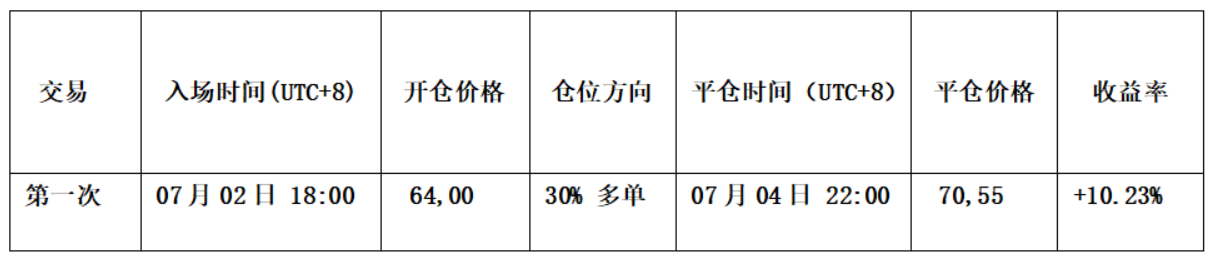
Tabla uno

2. Revisión de la operación a corto plazo: (Ver Figura cinco)

• Estrategia de apertura:

a. Basada en un análisis preciso de la tendencia alcista general del precio.

b. Cuando el precio rompió efectivamente la línea de tendencia bajista a corto plazo y tanto el "Modelo de Trading por Diferencias de Precio" como el "Modelo Cuantitativo de Impulso" emitieron señales simultáneas de divergencia bajista en resonancia.

Por lo tanto, establecimos una posición larga del 30% a $64.

• Estrategia de cierre:

a. Cuando el precio subió hasta cerca de la resistencia de $72 y mostró signos de agotamiento, formándose un patrón de "techo" en las velas.

b. El "Modelo de Trading por Diferencias de Precio" activó una fuerte señal de advertencia de techo (punto verde + punto blanco), formando una señal de resonancia en techo con el "Modelo Cuantitativo de Impulso".

Por lo tanto, cerramos toda la posición alrededor de $70.55.

• Resumen: Esta operación generó una ganancia de aproximadamente el 10.23%.

Gráfico de 60 minutos de HYPE: (Modelo Cuantitativo de Impulso + Modelo de Trading por Diferencias de Precio)
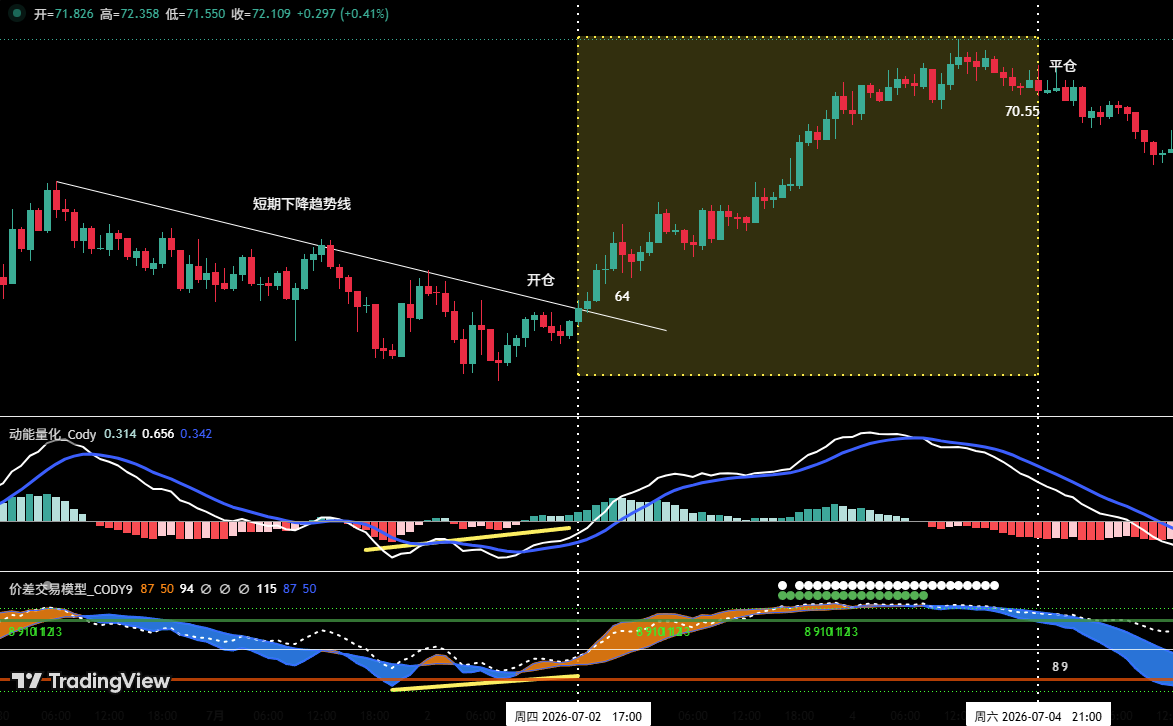
Figura cinco (Ilustración de la operación a corto plazo)

VI. Nota especial

  1. Al abrir una posición: Establecer inmediatamente un stop-loss inicial.
  2. Cuando la ganancia alcance el 1%: Mover el stop-loss al precio de apertura (punto de equilibrio), asegurando la protección del capital principal.
  3. Cuando la ganancia alcance el 2%: Mover el stop-loss a la posición del 1% de ganancia.
  4. Seguimiento continuo: A partir de ahí, por cada 1% adicional de ganancia en el precio, mover el stop-loss también un 1%, protegiendo dinámicamente y asegurando las ganancias.

Los mercados financieros cambian rápidamente, y todos los análisis de mercado y estrategias de trading requieren ajustes dinámicos. Todos los puntos de vista, modelos de análisis y estrategias operativas mencionados en este artículo se derivan del análisis técnico personal y se utilizan únicamente como registro personal de trading. No constituyen ningún tipo de recomendación de inversión ni base para operaciones. Los mercados implican riesgos; se debe invertir con precaución y no tomar decisiones basándose únicamente en este contenido.


Trending Cryptos

Related Questions

Q¿Qué dos escenarios plantea el artículo sobre la posible trayectoria del precio de BTC dependiendo del nivel de rebote desde el 'punto final 4'?

AEl artículo plantea dos posibles trayectorias para BTC dependiendo del nivel de rebote desde el 'punto final 4'. Ruta 1: Si el rebote supera la resistencia de $65,700, el precio probablemente entre en una fase de consolidación lateral (rango) tras un posible retroceso, reduciendo la probabilidad de romper el soporte de $57,820. Ruta 2: Si el rebote no logra alcanzar $65,700, o incluso se mantiene por debajo de $64,500, un posterior retroceso tendría una alta probabilidad de romper el soporte de $57,820 y continuar la tendencia bajista.

QSegún el análisis de nivel de 4 horas para BTC, ¿qué condición técnica en el 'punto final 44' precedió y apoyó el rebote subsiguiente?

AEn el análisis de 4 horas para BTC, la condición técnica que precedió y apoyó el rebote subsiguiente fue la formación de una clara divergencia alcista (divergencia de impulso) entre los puntos bajos 'final 44' y 'final 42'. Además, el 'punto final 44' terminó por debajo de $58,110, lo que completó una estructura de caída de cinco ondas y señaló una oportunidad de rebote por sobreventa.

Q¿Cuáles son las dos estrategias operativas principales (A y B) propuestas para las operaciones a corto plazo en BTC esta semana?

ALas dos estrategias operativas principales (A y B) propuestas para las operaciones a corto plazo en BTC esta semana son: Plan A (Prueba de venta en zona de fuerte resistencia): Abrir una posición corta (venta) de aproximadamente un 30% si el precio encuentra resistencia en la zona de $65,700-$67,300, confirmado con señales de techo del modelo cuantitativo. Plan B (Prueba de compra con posición ligera en zona de fuerte soporte): Abrir una posición larga (compra) de aproximadamente un 15% si, después de superar $65,700, el precio retrocede y encuentra soporte estable cerca de $57,820, confirmado con señales de fondo del modelo cuantitativo.

QPara HYPE, ¿qué señales de advertencia menciona el artículo que sugieren que no se debe comprar en la subida ('no perseguir la subida') en el entorno de precios actual?

APara HYPE, el artículo menciona que en los puntos 'final 59' y 'final 61', el modelo propio de 'transacción por diferencial' (价差交易模型) ya ha activado señales de advertencia de techo. Además, el precio se está acercando a la región de máximos históricos alrededor de $76.94. Por estas razones, no es aconsejable comprar en la subida ('perseguir la subida') en el entorno actual, ya que se debe estar alerta ante el riesgo de un ajuste a corto plazo.

Q¿Cuál fue el resultado de la operación a corto plazo en HYPE que se revisa en el artículo y en qué se basaron principalmente las señales de apertura y cierre de la posición?

AEl resultado de la operación a corto plazo en HYPE revisada en el artículo fue una ganancia total de aproximadamente el 10.23%. La señal de apertura se basó en: a) una ruptura efectiva de la línea de tendencia bajista a corto plazo, y b) una señal de resonancia de divergencia alcista emitida simultáneamente por el 'modelo de transacción por diferencial' y el 'modelo cuantitativo de impulso'. La señal de cierre se basó en: a) la aparición de signos de estancamiento cerca de la resistencia de $72, formando un patrón de 'techo de velas' (顶分型), y b) una fuerte señal de advertencia de techo del modelo de transacción por diferencial, formando una señal de resonancia de techo con el modelo cuantitativo de impulso.

Related Reads

1600 Lines of Code Create an Underwater Manhattan, Fable 5 Leaves Karpathy Stunned

Title: Fable 5 Stuns Karpathy with 3D Worlds Built from 1600 Lines of Code An AI model, Fable 5, has demonstrated a remarkable leap in generating complex, interactive 3D worlds with minimal code. Showcased by Peter Gostev of Arena.ai, the model created 63 diverse 3D environments across themes like immersive cityscapes, explorable famous paintings, natural wonders, and cosmic phenomena. Many were generated in a single attempt. A standout creation is a detailed, submerged Manhattan built with only 1600 lines of Three.js code. Other highlights include traversable versions of Van Gogh's "Starry Night," a bear catching a salmon with realistic physics, and a split Red Sea. The model's ability to cohesively manage vast numbers of elements within a scene represents a significant technical advancement. Andrej Karpathy, who recently joined Anthropic's pre-training team, expressed amazement, particularly at how the model intuitively understood and rendered complex real-world interactions like a fish struggling when caught. He coined the term "fablemaxxing" to describe this qualitative leap. While Fable 5 excels at world-building, Gostev notes current limitations in creating engaging, long-form gameplay. The model also sometimes requires prompting to fully utilize its capabilities. Having topped the Agent Arena benchmark for real-world task completion, Fable 5 signals that the boundaries of AI-generated content are rapidly expanding, with its full potential yet to be discovered.

marsbit5m ago

1600 Lines of Code Create an Underwater Manhattan, Fable 5 Leaves Karpathy Stunned

marsbit5m ago

From ANSEM to CZ, The Celebrity Coin Relay Race Between Solana and BSC

The past week was a whirlwind of on-chain activity, sparked by the meteoric rise of $ANSEM, a Solana-based meme coin that surged 600x and hit a $100 million market cap in a single day. This rally began when crypto influencer Ansem announced his return to buying Solana meme coins and publicly advocated for an airdrop from the platform pump.fun. Ansem’s subsequent "soft claim" of the token—promising to airdrop creator revenue to followers—ignited a frenzy, drawing comparisons to past community-led token distributions. However, his dual role as a co-founder of the trading terminal Bullpen, which later hosted the $ANSEM airdrop, suggests a strategic promotional element. The narrative quickly shifted to "celebrity coins," where tokens named after influencers are sent to their public addresses in hopes of endorsement. While a similar coin, $TJR, briefly gained traction, it faltered after the influencer TJR urged focus back on $ANSEM. Attention then turned to projects Ansem endorsed and coins found in his wallet, like $manlet, but momentum on Solana began to stall. The action then migrated to BSC with the viral resurgence of a 2021 tweet from former Binance CEO CZ, referencing a "final form" bull. This sparked the explosive launch of $CZ, which briefly approached a $90 million market cap despite expectations that CZ wouldn't actively engage like Ansem. Another BSC token, $TCC, gained attention due to CZ's interactions with its promoter. The BSC ecosystem saw faster-paced, albeit volatile, "celebrity coin" plays, with tokens like $dingaling experiencing rapid pumps and dumps without official endorsements. Currently, BSC shows more momentum for new token launches than Solana, with the market awaiting a new narrative to succeed the fleeting "celebrity coin" trend.

marsbit16m ago

From ANSEM to CZ, The Celebrity Coin Relay Race Between Solana and BSC

marsbit16m ago

A Decade of Change: The Demise of Crypto Startups

"The Decade-Long Transformation: The Demise of Crypto Startups" The article traces the dramatic evolution of the cryptocurrency industry from its anarchic beginnings to its current highly regulated and institutionalized state. In the early days (circa 2017), launching a crypto startup was remarkably simple: a whitepaper, a GitHub repository, and a Telegram group could attract thousands of retail investors via an Initial Coin Offering (ICO). Founders operated anonymously with near-zero regulatory and financial barriers, enabling rapid, global innovation but also widespread fraud. By 2026, the landscape is fundamentally different. To operate in major markets like the US, EU, and Asia, crypto businesses must now navigate a complex web of regulations akin to traditional finance. Compliance costs are prohibitive: estimates for a US multi-state operation range from $750,000 to $1.2 million in the first three years, with annual costs exceeding $2 million thereafter. Regulations like MiCA in the EU and New York's BitLicense have created high capital and operational hurdles that act as barriers to entry. Simultaneously, venture capital investment has shifted dramatically. Following the collapses of Terra and FTX, funding has concentrated in later-stage, established companies, creating a "barbell market." Early-stage and seed funding has shrunk significantly, while mega-funds like Andreessen Horowitz's $15 billion pool dominate. Most capital now flows to trading platforms, lending infrastructure, and B2B services. This environment favors mergers and acquisitions as the primary path for growth. Companies like Coinbase and Ripple are acquiring firms like Deribit and Hidden Road not for their technology, but for their licenses, banking relationships, and institutional trust—assets far more valuable than code. Distribution channels, compliance, and brand reputation have become the new moats, overshadowing pure technical innovation. The industry's maturation brings benefits: reduced scams, increased institutional participation, and clearer regulatory frameworks. However, it comes at a cost. The low-barrier, experimental ethos that defined crypto's first decade is fading. Entrepreneurs without substantial capital, pre-existing licenses, or institutional connections face immense challenges. Funding for exploratory fields like decentralized social media or novel governance models is drying up. Ultimately, the crypto industry is replicating the consolidation pattern seen in banking and tech after the 2008 financial crisis. While this brings stability and legitimacy, it raises a critical question: in this new, resource-intensive reality, is there still room for the disruptive, from-scratch innovation that gave birth to the sector?

Foresight News1h ago

A Decade of Change: The Demise of Crypto Startups

Foresight News1h ago

Trading

Spot

Hot Articles

What is LINON

Linde plc Tokenized Stock (Ondo): Revolutionizing Traditional Equity Access Through Blockchain Innovation The emergence of Linde plc Tokenized Stock (Ondo), represented by the ticker $LINON, signifies a monumental shift in the fusion of traditional financial structures and decentralized finance (DeFi). This innovative financial instrument showcases the tremendous potential of blockchain technology to democratize access to traditional equity markets while ensuring the security and regulatory compliance necessary for institutional-grade financial products. Through Ondo Finance's pioneering tokenization platform, $LINON provides a seamless pathway for global investors to engage with one of the world's leading industrial gas companies, Linde plc, creating a blockchain-native representation of the underlying equity. Introduction to Linde plc Tokenized Stock The landscape of financial markets is witnessing a groundbreaking transformation through the tokenization of real-world assets. Linde plc Tokenized Stock (Ondo) epitomizes this revolutionary approach by bridging the gap between conventional stock ownership and blockchain-enabled financial infrastructure. The $LINON token allows investors to gain exposure to one of the prominent industrial companies worldwide through decentralized technology. Operating within Ondo Finance's comprehensive ecosystem, $LINON symbolizes a practical application of tokenization technology that enhances accessibility, efficiency, and global connectivity in traditional financial markets. By leveraging blockchain infrastructure, this tokenized stock enables international investors to participate in U.S. equity markets, overcoming traditional barriers associated with cross-border investing. The significance of $LINON goes beyond technological innovation; it represents a fundamental shift in asset structuring, distribution, and trading in the digital age. This tokenized stock maintains all the economic benefits associated with traditional Linde plc shares while offering improved liquidity, programmable compliance features, and seamless integration with decentralized finance protocols. The development of $LINON indicates a growing acceptance of blockchain technology as a viable means for traditional finance, exemplifying how even well-established assets like Linde plc can integrate into blockchain systems. This approach preserves the core attributes that appeal to investors while introducing advanced capabilities that enhance the overall investment proposition. Project Overview and Objectives Linde plc Tokenized Stock (Ondo) encapsulates a strategic effort to democratize access to traditional equity markets through advanced blockchain technologies. The primary objective of $LINON is to provide approved global investors seamless access to the economic exposure associated with Linde plc shares, furthering an effort to create a more inclusive financial ecosystem. Beyond the digital representation of traditional assets, $LINON endeavors to eliminate barriers of geography and time zones that limit investor participation. Its design ensures that blockchain technology can elevate traditional investment vehicles without undermining the security or compliance requirements expected by investors. Key goals of the project include enhanced liquidity provision, programmable compliance mechanisms, and interoperability with other blockchain networks. Each $LINON token is fortified by actual Linde plc securities housed at U.S.-registered broker-dealers, allowing holders to reap economic advantages akin to traditional stockholders, such as dividend reinvestment. Furthermore, $LINON aims to establish new industry standards for institutional-grade tokenized securities, paving the way for traditional assets to embrace blockchain technology while remaining compliant with regulatory frameworks. By associating itself with a company as reputable as Linde plc, the project opens avenues for exploring tokenized equities catering to both conservative institutional players and daring retail investors. Project Creator and Development Team The vision for Linde plc Tokenized Stock (Ondo) comes from Nathan Allman, founder and CEO of Ondo Finance. His background in traditional finance coupled with expertise in blockchain technology positions him uniquely to navigate the complexities of asset tokenization. Allman's academic journey began at Brown University, focusing on Economics and Biology, equipping him with valuable analytical skills. His time at Goldman Sachs in the Digital Assets division strengthened his understanding of the interplay between financial institutions and emerging technologies, laying the groundwork for his later endeavors in alternative investment strategies. Under Allman's guidance, Ondo Finance has emerged as a leader in asset tokenization, launching $LINON as a flagship example of the company's larger mission towards revolutionizing traditional financial systems using blockchain technology. His commitment to leveraging blockchain for creating institutional-grade financial products has shaped the landscape of real-world asset tokenization. Investment and Funding Structure The growth of Ondo Finance, the platform powering Linde plc Tokenized Stock (Ondo), is bolstered by robust financial backing from prestigious venture capital firms and strategic investors. This strong investment foundation underpins the development of the key infrastructure essential for compliant tokenized securities like $LINON. In August 2021, Ondo Finance secured $4 million in seed funding led by a major venture capital firm, which enabled the company to commence platform development and establish the necessary regulatory processes for tokenizing real-world assets. This early investment cemented Ondo Finance's credibility within the industry. The Series A funding round followed, garnering $20 million with participation from renowned firms committed to transformative technology companies. This backing demonstrated substantial institutional confidence in Ondo Finance's vision, allowing it to hone its approach to asset tokenization through mechanisms that ensure compliance and accessibility. Noteworthy contributors, including institutional investors and experienced partners, have added significant value to Ondo Finance’s development efforts. Their involvement underscores the confidence across sectors in Ondo Finance's approach to bridging traditional finance with blockchain innovations. Technical Infrastructure and Innovation The technical architecture that underpins Linde plc Tokenized Stock (Ondo) represents a sophisticated melding of traditional finance systems and cutting-edge blockchain technology. The architecture's foundation is built on the Ethereum network, renowned for its security and programmability—both critical for intricate financial instruments. The $LINON tokenization process comprises creating a blockchain-native representation of Linde plc shares that preserves economic benefits while augmenting investor capabilities. Each token corresponds to actual shares held at U.S.-registered broker-dealers, creating a compliant custody structure that legitimizes the asset's existence and value. Automated compliance systems are integrated into the tokenization process, managing critical components such as know-your-customer (KYC) verification and anti-money laundering (AML) protocols. This incorporation of programmable compliance empowers $LINON to uphold regulatory standards essential for institutional proliferation. Cross-chain interoperability characterizes the advanced technical features of $LINON. While initially deployed on Ethereum, the framework is designed for expansion to other networks such as Solana and BNB Chain. This adaptability enhances liquidity and accessibility, allowing investors to select their preferred blockchain ecosystems. Historical Timeline and Development Crafting the history of Linde plc Tokenized Stock (Ondo) unfolds in parallel with the evolution of Ondo Finance's tokenization platform. The timeline's inception dates back to March 2021 when Nathan Allman laid the foundations for creating institutional-grade financial products on blockchain infrastructure. The initial funding round in August 2021 provided crucial resources for developing the platform and establishing partnerships necessary for effective tokenization. By January 2023, Ondo Finance launched its tokenized treasury products, establishing mechanisms that would facilitate future tokenized equities such as $LINON. A pivotal milestone arose in February 2025 when Ondo Chain—a Layer 1 blockchain designed specifically for asset tokenization—was introduced. This infrastructure enhances capabilities vital for institutional markets, demonstrating Ondo Finance's long-term commitment to tokenization. Subsequently, the launch of Ondo Global Markets in September 2025 marked the official debut of $LINON. This milestone showcased the successful transition from development to active trading, enabling investors around the world to access American financial markets seamlessly. Ongoing development plans include a targeted expansion of available tokenized assets to over 1,000 by the end of 2025, pointing to a bright future for Ondo Finance's ecosystem and its mission to broaden tokenized equity accessibility. Regulatory Compliance and Legal Framework The legal architecture governing Linde plc Tokenized Stock (Ondo) emphasizes a sophisticated approach to regulatory compliance, allowing tokenized securities to be implemented within a blockchain-based framework. The legal structure governing $LINON spans multiple jurisdictions while maintaining a robust legal footing. Compliance systems ensure that only eligible investors can access the token, enforced through automated verification that aligns with international regulations. This innovative regulatory technology promises real-time enforcement of complex requirements, considerably enhancing efficiency in operating within the regulatory landscape. The custody framework undergirding $LINON ensures that the underlying shares are securely held at U.S.-registered broker-dealers, complying with necessary regulations while delivering blockchain-driven access to investors. The token maintains its economic equivalency and security through this carefully structured custody arrangement. KYC and AML compliance systems are embedded within the smart contract architecture, ensuring integrity and adherence to regulatory practices while fostering transparency for investors. The jurisdictional restrictions mark a commitment to navigating the evolving landscape of international securities laws. Market Impact and Industry Significance The advent of Linde plc Tokenized Stock (Ondo) holds profound implications for the broader financial landscape, symbolizing a clear shift towards blockchain-enabled markets. $LINON serves as a proof-of-concept for integrating traditional companies into blockchain ecosystems, showcasing the potential benefits such as broader accessibility and improved efficiency. The market's response to $LINON indicates a growing acceptance of tokenization among institutional investors, contributing to the emergence of an expanding sector wherein traditional assets can be interconnected with blockchain innovations. The success of $LINON further solidifies market confidence, indicating an overarching shift towards recognizing asset tokenization as a transformative force in finance. Future Development and Expansion Plans The future trajectory for Linde plc Tokenized Stock (Ondo) centers around the expansion of the tokenization ecosystem and enhanced infrastructure supporting blockchain-enabled financial services. Plans for cross-chain integration usher in new opportunities for liquidity and flexibility within the investment framework, with existing capabilities poised for continuous enhancement. With the introduction of Ondo Chain, Ondo Finance aims to transition $LINON to an optimized blockchain environment specifically designed for asset tokenization. This new infrastructure heralds exciting prospects for the development of institutional-grade financial products, ensuring ongoing compatibility with contemporary investment strategies. Further integration with decentralized finance protocols signifies a commitment to empowering $LINON holders through advanced financial strategies. The anticipated expansion of available tokenized assets promises to broaden investor access, enhancing the utility and appeal of the platform. In alignment with ambitions for regulatory expansion, ongoing efforts to secure approvals for new jurisdictions will enhance investor access, further positioning $LINON at the forefront of the burgeoning tokenization market. Conclusion Linde plc Tokenized Stock (Ondo), as represented by the $LINON token, stands at the intersection of traditional finance and blockchain innovation. It embodies a transformative milestone in how financial assets are structured, distributed, and engaged within modern investment ecosystems. The technical sophistication behind $LINON, combined with its regulatory compliance framework, illustrates that asset tokenization can improve financial infrastructure rather than simply digitizing existing products. This pioneering effort not only enhances investor access to U.S. equity markets but also signifies an evolution of how traditional financial services can integrate blockchain technology. As the asset tokenization market grows exponentially, with prospects suggesting significant valuation increases, $LINON paves the way for a future where tokenized securities become standard fixtures in the financial landscape. The trajectory of $LINON will undoubtedly influence how traditional finance adapts to a transformed, blockchain-powered world.

3.3k Total ViewsPublished 2025.12.05Updated 2025.12.05

What is LINON

What is CRMON

Salesforce Tokenized Stock (Ondo): Revolutionising Traditional Equity Access Through Blockchain Innovation The emergence of Salesforce Tokenized Stock (CRMON) marks a pivotal advancement in integrating traditional financial markets with blockchain technology. This innovative approach offers investors unprecedented access to equity exposure through tokenisation. Developed by Ondo Finance, CRMON provides tokenholders with economic exposure equivalent to holding Salesforce stock (CRM) while automatically reinvesting dividends. This effectively bridges the gap between conventional equity markets and decentralised finance (DeFi). Introduction and Comprehensive Overview of Salesforce Tokenized Stock In recent years, the financial landscape has dramatically transformed due to blockchain technology, fundamentally altering how investors access and interact with traditional assets. The development of Salesforce Tokenized Stock (CRMON) is a prime example of this evolution, representing a sophisticated fusion of conventional equity markets with cutting-edge distributed ledger technology. CRMON is a tokenised version of Salesforce stock, emerging from the innovative work of Ondo Finance, a leading platform in the real-world asset tokenisation sector that positions itself as a bridge between traditional finance and decentralised systems. Designed to provide tokenholders with economic exposure that mirrors the performance of the underlying Salesforce stock, CRMON incorporates automatic dividend reinvestment mechanisms. This eliminates many traditional barriers associated with international equity investment, such as complex brokerage relationships, currency conversion challenges, and restricted trading hours. The tokenisation process reimagines stock ownership as a blockchain-native asset while maintaining its economic equivalence with the underlying security, offering enhanced portability and integration capabilities within decentralised finance ecosystems. CRMON transcends its individual utility as an investment instrument to represent a fundamental shift in how financial markets can operate in an increasingly digital world. By maintaining full backing through U.S.-registered broker-dealers and implementing robust compliance frameworks, CRMON demonstrates that tokenised securities can achieve the regulatory standards necessary for institutional adoption while delivering the technological advantages of blockchain infrastructure. Understanding Tokenized Real-World Assets and CRMON's Strategic Position Tokenised real-world assets signify one of the most significant innovations in modern finance, fundamentally reimagining how traditional securities are represented, traded, and utilised within digital ecosystems. CRMON operates as a tokenised equity instrument correlating directly with Salesforce stock while optimising accessibility and efficiency. This aligns with Ondo Finance's broader mission to democratise access to institutional-grade financial products through innovative tokenisation strategies. The tokenisation process guarantees complete economic equivalence with the underlying Salesforce equity. Each CRMON token represents a proportional claim on Salesforce stock held by qualified custodians, with dividend payments automatically reinvested to maintain continuous exposure to total return performance. This structure simplifies dividend management and ensures that tokenholders receive the full economic benefit of their equity exposure, encompassing both capital appreciation and income generation. Ondo Finance's strategy in tokenising Salesforce stock demonstrates its expertise in creating compliant, institutional-grade products that meet traditional financial markets' stringent requirements. The platform’s focus on merging regulatory compliance with blockchain benefits positions it at the forefront of decentralised finance, captivating both institutional and retail investors seeking blockchain-native solutions. The Technology and Innovation Framework Behind CRMON The technological infrastructure supporting CRMON integrates blockchain technology with traditional financial mechanisms, delivering institutional-grade security and compliance while maintaining the operational advantages of decentralised systems. Built on the Ethereum blockchain, CRMON utilises robust smart contract capabilities to ensure transparent, secure operations. The smart contract architecture incorporates layered security and compliance mechanisms, enabling automated compliance checks and real-time asset backing verification. Integration with oracle services maintains accurate pricing and dividend information, ensuring CRMON reflects the underlying Salesforce stock's accurate performance. This architecture delivers automated dividend reinvestments and other corporate actions, eliminating manual processing requirements and directly enhancing tokenholder benefits. Ondo Finance ensures CRMON's security structure includes daily third-party verification of holdings, independent collateral agents, and a multiple-layer custody system through partnerships with established financial institutions. This framework safeguards tokenholder interests against operational risks while providing robust asset backing. The user interface enhances integration capabilities, allowing seamless interaction between CRMON and various decentralised finance protocols, as well as cryptocurrency exchanges. This interoperability enables users to leverage their tokenised equity across multiple platforms, creating sophisticated investment strategies that marry traditional equity characteristics with blockchain-native innovation. Leadership and Corporate Structure of Ondo Finance The leadership team behind CRMON and Ondo Finance blends expertise from traditional finance and blockchain technology, presenting a robust combination of skills essential for successfully bridging conventional markets with decentralised finance. Nathan Allman, the founder and CEO, emerged from a distinguished financial background before establishing Ondo Finance in 2021. Allman's experience includes notable roles at major financial institutions, including significant contributions to developing cryptocurrency market services. His insights into regulatory compliance were paramount in developing products like CRMON that successfully unify traditional securities with blockchain technology. With a team of professionals boasting substantial experience in both conventional finance and blockchain sectors, Ondo Finance's leadership comprises diverse expertise that covers every aspect of tokenised asset development. Justin Schmidt serves as President and COO, contributing unique operational expertise, while Chris Tyrell brings essential compliance knowledge. Investment Landscape and Funding History The investment landscape surrounding Ondo Finance reflects significant institutional confidence in its mission to tokenise real-world assets. The company has raised substantial funds through various investment rounds, attracting leading venture capital firms and strategic investors that recognise the transformative potential of tokenised securities like CRMON. Notably, Ondo Finance completed a successful Series A funding round in 2022, led by well-known venture capital firms. This funding success validates Ondo Finance's innovative approach to creating compliant, institutional-grade tokenised products. In total, Ondo Finance has successfully secured substantial funding, raising significant capital for product development and market expansion, including a noteworthy token sale that reinforced its governance structure through the establishment of the ONDO token. The diverse composition of investors reflects broad market confidence in Ondo Finance's business model, demonstrating support from both traditional and blockchain-native organisations. Operational Mechanics and Technical Implementation The operational framework supporting CRMON exemplifies sophisticated integration of traditional financial mechanisms with blockchain technology. The technical implementation introduces multiple layers of security, compliance, and operational efficiency to meet institutional standards while enhancing accessibility. The tokenisation process begins by acquiring actual Salesforce stock through U.S.-registered broker-dealers, ensuring each CRMON token maintains direct correlation with the underlying equity performance. Smart contracts automate operational processes, including dividend reinvestment and corporate action processing, facilitating a streamlined user experience. The Minting and redemption processes allow authorised participants to manage CRMON tokens effectively. During U.S. trading hours, institutions can mint new tokens by depositing stablecoins that are used to purchase corresponding Salesforce equity. This structure maintains a tight correlation with underlying assets, enhancing liquidity and price discovery. Additionally, the infrastructure supports twenty-four-hour token transfer capabilities, providing CRMON holders with operations outside traditional market hours. This represents a significant advantage over conventional securities ownership, thus promoting integration with decentralised finance applications. Plans for cross-chain compatibility through partnerships signal further ambitions for CRMON's market reach. By expanding to other blockchain networks, Ondo Finance aims to enhance accessibility and user engagement with tokenised equity products. Timeline and Historical Development of Tokenized Equity Innovation The timeline of CRMON's development and Ondo Finance's broader tokenised capabilities demonstrates a systematic innovation process beginning with the company's founding in 2021. 2021: Ondo Finance is founded by Nathan Allman and co-founders, launching initial products focused on structured vault offerings on the Ethereum blockchain. 2022: The company completes substantial funding rounds—both equity and token sales—totaling significant capital and launching initial tokenised U.S. Treasury products. 2023-2024: Ondo Finance experiences substantial growth, establishing partnerships with major financial institutions while expanding its product offerings beyond fixed-income securities. February 2025: Ondo Global Markets is announced, marking the transition into equity tokenisation with plans for accessing over one hundred U.S. stocks and ETFs. September 2025: The official launch of Ondo Global Markets includes CRMON alongside other tokenised equity offerings, marking a significant evolution in Ondo Finance's product ecosystem. This timeline highlights the organisation's rapid growth and its capability to adapt its technological and compliance frameworks to accommodate different asset classes effectively while maintaining security and regulatory integrity. Regulatory Framework and Compliance Approach Ondo Finance's regulatory framework showcases a sophisticated compliance strategy, essential for achieving institutional adoption in the tokenised securities market. The company's strong partnerships with U.S.-registered broker-dealers promote adherence to Securities and Exchange Commission regulations and apply robust investor protections. Acquisitions, such as Oasis Pro—a registered broker-dealer—significantly enhance Ondo Finance's compliance capabilities, ensuring thorough alignment with existing regulatory structures. The company employs independent verification procedures that foster transparency, aiming for a solid performance standards reputation. Furthermore, Ondo Finance's commitment extends to international regulatory compliance, ensuring token access remains restricted to eligible investors while adhering to pertinent cross-border securities regulations. Comprehensive attention to tax implications and reporting requirements fortifies the security and compliance landscape of CRMON, ensuring that investor obligations remain manageable. Future Prospects and Market Positioning The forward-looking landscape for CRMON and Ondo Finance illustrates substantial growth opportunities driven by institutional adoption of blockchain technology and escalating demand for efficient alternatives to conventional securities ownership. Market projections indicate the tokenised asset sector could value multiple trillion dollars by 2030. With plans to scale CRMON offerings significantly and integrate it with a dedicated blockchain infrastructure—Ondo Chain—Ondo Finance aims to elevate its institutional-grade tokenised asset operations. Additionally, the development of strategic partnerships enhances distribution capabilities while establishing the company's credibility in the financial market. Furthermore, the integration of tokenised equity with decentralised finance protocols offers new potential for innovative financial products and strategies previously impossible with traditional securities. These factors underscore CRMON's positioning to effectively capture increased market share and deliver innovative solutions for international investment exposure. Conclusion Salesforce Tokenized Stock (CRMON) symbolises a transformative development within financial markets, successfully bridging traditional equity ownership with blockchain technology to create unprecedented accessibility for global investors. Through Ondo Finance's sophisticated tokenisation framework, CRMON provides complete economic exposure to Salesforce equity performance while enhancing operational advantages that exceed traditional ownership. The launch of CRMON reflects the broader evolution of financial markets towards blockchain infrastructures that maintain regulatory compliance while delivering increased efficiency. Ondo Finance's extensive approach to regulatory adherence, institutional-grade security, and technological innovation solidifies CRMON as a model for future tokenised securities, delivering access previously unattainable in conventional brokerage structures. As the tokenised asset sector continues to develop, CRMON is well-positioned to address historical inefficiencies in capital markets while providing investors with innovative solutions for accessing traditional securities. The outlook for CRMON looks exceptionally promising, supported by ambitious expansion plans, technological innovations, and strategic partnerships, thereby representing a pioneering model of modern financial infrastructure evolving through blockchain integration.

3.4k Total ViewsPublished 2025.12.05Updated 2025.12.05

What is CRMON

What is SHOPON

Shopify Tokenized Stock (Ondo): A Comprehensive Analysis of Real-World Asset Tokenization in Web3 This article delves into the Shopify Tokenized Stock (Ondo), recognised by its ticker symbol $SHOPON, exploring its implications at the intersection of traditional finance and blockchain technology. As a part of Ondo Finance's tokenized securities platform, Shopify’s tokenized stock exemplifies advancements in democratizing access to global capital markets through innovative digital assets. Introduction and Overview of Shopify Tokenized Stock (Ondo) Shopify Tokenized Stock (Ondo), or $SHOPON, portrays a pivotal innovation in the realm of tokenized securities, allowing investors to gain economic exposure akin to directly owning shares of Shopify Inc. This token, developed under the umbrella of Ondo Finance, not only provides investors with the ability to hold digital representations of the company’s stock but also integrates features such as automatic reinvestment of dividends. This advancement represents a substantial shift in the landscape of decentralized finance (DeFi), linking conventional equity markets with blockchain solutions designed to enhance accessibility, transparency, and liquidity. By eliminating geographical barriers and enabling 24/7 trading capabilities, $SHOPON is positioned as a bridge connecting traditional financial instruments and the emerging Web3 ecosystem. What is Shopify Tokenized Stock (Ondo), $SHOPON? The $SHOPON token serves as a digital manifestation of Shopify Inc.'s shares, engineered to provide a direct correlation to the underlying asset's performance. Through the utilization of blockchain technology, the token gives holders a mechanism to participate in the economic benefits associated with equity ownership, including capital appreciation and dividend distribution. The unique aspect of $SHOPON lies in its automatic dividend reinvestment mechanism, which allows returns to compound without necessitating active management by the investor. This feature inherently enhances its attractiveness as an investment vehicle, particularly for individuals seeking passive income growth alongside exposure to high-performing equities. The tokenization process is facilitated by the custody of actual Shopify shares through regulated intermediaries, ensuring that every $SHOPON token is verifiably backed by real equity. This structure empowers investors with the dual advantages of both traditional financial characteristics and the innovative benefits tied to blockchain technology. Who is the Creator of Shopify Tokenized Stock (Ondo)? The creator of Shopify Tokenized Stock (Ondo), Nathan Allman, is an experienced figure in the finance sector, formerly associated with Goldman Sachs. His rich background includes significant expertise in digital asset development, bridging the gap between traditional finance and cryptocurrencies. Allman’s educational journey, marked by studies at Brown University, provided him with a deep understanding of economics and biology, equipping him with analytical skills that inform his strategic vision. In 2021, he founded Ondo Finance, committing to developing tokenized securities that meet institutional-grade standards while leveraging blockchain's transformative capabilities. Under Allman's leadership, Ondo Finance has focused on creating compliant and innovative financial products that empower a diverse investor base. Who are the Investors of Shopify Tokenized Stock (Ondo)? The investment landscape surrounding Shopify Tokenized Stock (Ondo) is notably robust, underpinned by significant institutional support. Primarily, Pantera Capital stands out as a strategic partner through the Ondo Catalyst initiative, a $250 million commitment aimed at accelerating the development of on-chain capital markets. This partnership not only signifies institutional confidence in the potential of tokenized assets but also reinforces Ondo Finance's operational capabilities and market positioning. The funding pathways have included earlier rounds that amassed millions in seed funding and further structural investments, solidifying relationships with both venture capital firms and private investors. Moreover, the financial framework is complemented by strategic partnerships with established financial institutions and technology companies, enhancing Ondo’s infrastructure and operational expertise. How Does Shopify Tokenized Stock (Ondo), $SHOPON Work? At the core of $SHOPON's operational framework is a sophisticated system integrating traditional finance mechanisms with blockchain technology. The custody of actual Shopify shares ensures that token holders retain authentic economic exposure, safeguarding their investments in line with recognized legal structures. The smart contracts employed in managing $SHOPON handle various functions, including automatic dividend reinvestment and ownership transfer, offering instant settlement and increased liquidity, marking a significant departure from conventional trading systems plagued by multi-day settlement delays. By providing interoperability with other decentralized finance applications, $SHOPON empowers holders with potentially lucrative opportunities for advanced investment strategies, including lending and automated market making. This complex integration presents a unique value proposition, catering to both traditional and crypto-native investors. The innovative structure of $SHOPON also allows for real-time settlements and transactions documented on the blockchain, delivering unparalleled transparency and security—a major advancement over standard equity trading practices. Timeline of Shopify Tokenized Stock (Ondo) March 2021: Nathan Allman establishes Ondo Finance, initially focusing on decentralized finance yield optimization. August 2021: Completion of a $4 million seed funding round led by Pantera Capital. January 2023: Launch of initial tokenized treasury security products, laying the groundwork for future equity tokenization. July 2025: Announcement of the Ondo Catalyst initiative, a strategic investment program valued at $250 million, aimed at propelling the development of tokenization in capital markets. September 3, 2025: Launch of Ondo Global Markets featuring over 100 tokenized U.S. stocks and ETFs, including $SHOPON. Technical Implementation and Blockchain Infrastructure Shopify Tokenized Stock (Ondo) operates on a technical architectural framework that marries blockchain protocols with traditional financial custody arrangements. The ecosystem leverages Ethereum's smart contract capabilities, providing seamless transaction management while ensuring compliance with regulatory standards through established financial custodians. Central to this architecture are security measures and transparent transaction records that affirm the legitimacy of each tokenholder's economic stake. With automated features managed by intricate smart contracts, $SHOPON not only streamlines ownership transfers but also allows for the tactical reinvestment of dividends—a hallmark of modern investment strategies. Moreover, the incorporation of LayerZero technology facilitates cross-chain interoperability, making $SHOPON accessible across multiple blockchain environments while preserving its functional robustness. This forward-thinking technical design positions $SHOPON as an adaptable asset within the larger DeFi milieu. Regulatory Framework and Compliance Architecture $SHOPON's regulatory framework is built upon the meticulous navigation of existing financial regulations that govern securities. The custody arrangements for the underlying Shopify shares are managed by U.S.-regulated broker-dealers, ensuring compliance and protection for investors. By maintaining a separation between the blockchain tokenization process and traditional custody, $SHOPON adheres to legal requirements while offering innovative functionalities that challenge conventional constraints. This dual-layered compliance approach enhances investor confidence and underscores Ondo Finance's commitment to regulatory integrity. Notably, the availability of $SHOPON is tailored to international investors from regions such as Asia-Pacific, Europe, and Africa, as regulatory parameters in the U.S. and U.K. present challenges in accessing tokenized securities. Market Access and Global Distribution Strategy The distribution strategy of $SHOPON is keenly designed to optimize global access while conforming to regulatory standards. The platform aims to establish comprehensive coverage for eligible investors across multiple regions, effectively dismantling traditional barriers through the implementation of blockchain technology. Integration with various cryptocurrency wallets and exchanges also promotes user-friendliness and accessibility, establishing a streamlined experience for investors to manage their holdings. Moreover, the 24/7 trading capabilities afforded by the tokenized model allow participants to react promptly to market shifts, fundamentally transforming how global equities are accessed and traded. Technology Integration and Cross-Chain Functionality The remarkable technological underpinnings of $SHOPON propagate its multi-chain functionality, set to expand its reach beyond Ethereum to networks such as Solana and BNB Chain. Such cross-chain capabilities allow users flexibility when navigating between blockchains, concurrently leveraging distinct network attributes to optimize their trading experience. LayerZero serves as the backbone for ensuring decentralized transfers between networks while providing the requisite security and speed, quintessential for maintaining investor trust. This comprehensive interoperability illustrates $SHOPON's commitment to being a versatile, user-centric asset in the evolving investment landscape. Ecosystem Integration and DeFi Compatibility Incorporating $SHOPON into broader DeFi protocols signifies its potential beyond traditional stock ownership. Token holders can leverage their holdings for various sophisticated strategies and applications, enhancing investment returns and liquidity management. By establishing a presence in lending protocols and automated trading systems, $SHOPON effectively democratizes access to advanced financial strategies previously limited to institutional investors. Such integration contributes to a more competitive and dynamic financial landscape, where individual investors can capitalize on tools typically reserved for larger entities. Risk Management and Security Framework Security remains paramount in the operational infrastructure of $SHOPON. The tokenization framework employs multiple layers of protection—beginning with regulated custody of the underlying Shopify shares. The operational protocols establish rigorous auditing, key management, and transaction monitoring standards, thus safeguarding against potential vulnerabilities. Moreover, meticulous adherence to evolving regulatory requirements provides an extra layer of security, fortifying investor protections and institutional compliance. Market Impact and Industry Implications The introduction of Shopify Tokenized Stock (Ondo) heralds a transformative shift in how financial markets operate, emphasizing the potential of tokenized securities to reshape traditional investment paradigms. The successful integration of $SHOPON encapsulates the efficiencies inherent in blockchain technology and opens avenues for new user demographics previously barred from extensive market participation. The impact extends beyond the immediate benefits to token holders, indicating broader trends that may challenge the status quo of investment services, particularly in addressing geographic restrictions and operational costs typically associated with traditional brokerage platforms. Undeniably, $SHOPON encapsulates the potential for traditional institutions to innovate further, leveraging the increasing demand for seamless blockchain access to complement existing financial infrastructure. Future Development Roadmap and Strategic Vision As Ondo Finance looks forward, the trajectory of $SHOPON rests on ambitious goals aimed at broadening the spectrum of available tokenized assets significantly. Over the next few years, plans are in place to expand to more than 1,000 tokenized securities, further enhancing market participation and investment options for individuals worldwide. Continued integration with traditional financial actors, development of specialized institutional products, and enhancements in automated trading capabilities will ensure that $SHOPON maintains its position at the forefront of financial innovation. Regulatory collaboration will also remain a focal point, establishing a framework that not only supports the compliance requirements but also promotes a healthy environment for tokenized asset proliferation. Conclusion and Market Significance In summary, Shopify Tokenized Stock (Ondo), represented by the ticker $SHOPON, is more than merely a tokenized equity offering; it embodies the innovation possible when traditional finance collides with modern blockchain applications. With a robust technical architecture, a commitment to compliance, and a clear strategic vision, $SHOPON exemplifies the potential for tokenized assets to enhance liquidity, accessibility, and functionality in capital markets. As the global investment landscape evolves, the transformative implications of $SHOPON extend beyond individual investors to revolutionize how financial instruments are perceived, traded, and utilized within both traditional and decentralized frameworks.

3.4k Total ViewsPublished 2025.12.05Updated 2025.12.05

What is SHOPON

Discussions

Welcome to the HTX Community. Here, you can stay informed about the latest platform developments and gain access to professional market insights. Users' opinions on the price of HYPE (HYPE) are presented below.

活动图片