BIS Report Compliance Observations: The True Risks of Stablecoins Go Beyond 'De-pegging'

marsbitPublished on 2026-07-03Last updated on 2026-07-03

Abstract

The BIS report, "Anchoring trust in money: innovation beyond stablecoins," highlights that the primary risks of stablecoins extend beyond potential de-pegging. It argues that the core challenge is whether stablecoins can be integrated into a financial system that is identifiable, monitorable, accountable, and regulatable. While acknowledging efficiency gains like faster payments and programmability, BIS emphasizes that money requires an institutional framework—including legal certainty, liquidity support, and financial integrity controls—which many stablecoins currently lack. The report details compliance risks, noting that while blockchain transactions are transparent, address visibility does not equate to identity or purpose clarity. This creates a systemic risk as pseudonymity, non-custodial wallets, and cross-chain bridges can undermine AML/CFT controls. Furthermore, these risks can spill over into the traditional financial system through on- and off-ramps. The future direction, per BIS, is not to prohibit innovation but to embed regulatory rules—such as identity verification and transaction screening—directly into the technological infrastructure of tokenized finance. The key takeaway for compliance is that any new financial instrument must clearly address questions of customer identification, transaction monitoring, accountability, and cross-border rule consistency to be viable as a mainstream payment tool.

Author: compliance 小白

Recently, the Bank for International Settlements (BIS) released Chapter 3 of its Annual Economic Report:

Anchoring trust in money: innovation beyond stablecoins

This can be understood as:Anchoring Trust in Money: Innovation Paths Beyond Stablecoins. The report was published on June 23, 2026.

From a macro-financial perspective, this report discusses the future monetary system, tokenization, and stablecoins.

But viewed from a compliance standpoint, it truly reminds us of the following:

The issue with stablecoins is not just whether their price will de-peg, but whether they can be integrated into a financial system that is identifiable, monitorable, accountable, and regulatable.

I. BIS Is Not Opposed to Technology, But Rather Asks: Where Does Trust Come From?

BIS acknowledges that stablecoins and tokenization do bring efficiency improvements, such as faster payments, programmable payments, atomic settlement, and reduced reconciliation friction. The report also points out that DLT and tokenization can place assets and funds on programmable ledgers, supporting automation and 24/7 operations.

But the core view of BIS is:

Money is not merely a technological product.

Money can serve as money not just because it can be transferred, but because it is backed by a set of institutional arrangements:

A common unit of account,

Certainty of redemption at par value,

Liquidity support,

Regulatory and legal frameworks,

And financial integrity requirements.

This is crucial for compliance professionals.

Because any new payment instrument, once entering large-scale usage scenarios, will ultimately face the same question:

Who identifies the customer? Who monitors the transactions? Who handles exceptions? Who bears the responsibility?

II. The Compliance Risks of Stablecoins Go Beyond On-Chain Anonymity

When many people talk about stablecoin risks, their first reaction is "on-chain anonymity" and "wallets are hard to trace."

But the BIS report explains it more systematically.

In the traditional financial system, banks and regulated entities bear responsibilities such as customer identification, transaction monitoring, suspicious activity reporting, and, when necessary, stopping or recalling payments. In contrast, stablecoins primarily circulate on public, permissionless blockchains, where pseudonymity, non-custodial wallets, cross-chain bridges, and mixing tools may all weaken KYC and AML/CFT controls.

This means stablecoins present not a single-point risk, but a combination of risks:

Who the customer is may not be clear;

The origin of funds may not be complete;

The purpose of the transaction may not be explainable;

After crossing chains, the path may become fragmented;

In case of problems, the responsible entity may also be unclear.

Therefore, for the compliance department, we cannot just ask:

"Is this address risky?"

We should ask more:

Why does this customer use stablecoins?

How do they move funds between stablecoins and fiat currency accounts?

Who is the counterparty?

What is the relationship between wallets, trading platforms, and payment institutions?

Is the fund flow consistent with the customer's background and business model?

III. On-Chain Transparency Does Not Equal Compliance Transparency

Stablecoin proponents often say: on-chain transactions are all public, so they are more transparent.

This statement is only half true.

On-chain data is indeed visible, but "address visibility" does not equal "identity visibility."

"Transaction path visibility" also does not equal "clear transaction purpose."

BIS also mentions that blockchain analytics firms are already supporting law enforcement agencies, and some stablecoin issuers have frozen specific on-chain addresses, which indicates that on-chain technology can indeed aid risk identification.

But BIS also emphasizes that these measures cannot replace daily, large-scale AML/CFT controls.

Real compliance is not about buying a tool, but about establishing a closed loop:

Can you identify virtual asset exposure before customer onboarding?

Can you monitor on-chain and off-chain fund flows when transactions occur?

After hitting a risk flag, can you conduct manual review and explanation?

After forming a suspicious lead, can you document, escalate, and report it?

After adjusting models and rules, can they be audited and reviewed?

Technology is just one link in the compliance chain, not compliance itself.

IV. Stablecoins Will Bring "On-Chain Risks" Back to Traditional Finance

The BIS report mentions that as of the end of May 2026, the market capitalization of stablecoins was approximately $3.2 trillion; estimated annual trading volume for 2025 was about $28 trillion, but after excluding transfers between wallets of the same entity, the actual economic significance is much lower.

These numbers illustrate one thing:

Stablecoins are already large enough to not be ignored by compliance departments;

But they are not yet mature enough to completely replace the existing financial system.

More importantly, stablecoin risks will not remain confined to the blockchain.

They will re-enter traditional financial institutions through on-/off-ramps, trading platforms, payment institutions, trade scenarios, cross-border settlements, and customer accounts.

For example:

Customers frequently use bank accounts to fund virtual asset platforms;

Corporate clients claim to conduct cross-border trade, but funds ultimately flow through stablecoin channels;

Personal customer accounts receive large influxes from strangers followed by concentrated purchases of virtual assets;

Customers explain it as "investment," "settlement," "currency exchange," but the transaction behavior does not match the income source.

These scenarios are essentially not pure "virtual asset issues," but rather customer due diligence and transaction monitoring issues that traditional financial institutions must confront.

V. Future Regulatory Direction: Not Prohibiting Innovation, But "Embedding Rules"

BIS proposes a very important direction:

Future tokenized finance should not be detached from the existing trust system. Instead, tokenization technology should be introduced into the two-tier monetary system based on central bank money and regulated institutions. From a compliance perspective, this essentially means four words: rules first. A more viable future digital financial infrastructure should embed the following into the transaction process: customer identity verification,

Pre-transaction screening,

Risk rule assessment,

Auditable data trails,

Privacy and data sovereignty protection, and Cross-institutional, cross-jurisdiction collaboration mechanisms. BIS also explicitly states that permissioned platforms, if able to embed AML/CFT pre-screening, list screening, and auditable data trails into the transaction flow, are more likely to maintain financial integrity at scale. This is also where regtech's true future value lies: not in remedial action after the fact, but in embedding risk controls into the process before payment and settlement occur.

compliance 小白 Observations

The inspiration from this BIS report for compliance professionals is not actually about "whether stablecoins are good or bad," but rather:

All new financial instruments in the future, if they wish to become mainstream payment and settlement tools, must answer compliance questions.

Who identifies the customer?

Who monitors the transactions?

Who handles exceptions?

Who bears responsibility?

Who ensures consistent cross-border rules?

If these questions remain unanswered, even the most advanced technology will only transfer risks to places that are harder to regulate.

Therefore, viewed from a compliance perspective, stablecoins are not merely a "crypto topic."

They will impact bank account monitoring, payment institution risk controls, cross-border fund flows, virtual asset access, customer risk ratings, and financial crime prevention.

The truly valuable direction for the future is not using technology to circumvent compliance,

but embedding compliance capabilities into the technological infrastructure.

Compliance is not the opposite of innovation.

Compliance is the infrastructure that determines whether financial innovation can go far.

Trending Cryptos

Related Questions

QAccording to the BIS report discussed in the article, what is the 'true risk' of stablecoins beyond de-pegging?

AThe true risk is whether stablecoins can be integrated into a financial system that is identifiable, monitorable, accountable, and regulatable. The report emphasizes that the core issue is not just price stability, but the ability to embed them within a framework that includes KYC, AML/CFT controls, clear liability, and regulatory oversight.

QWhat are the key 'composite risks' associated with stablecoins that pose challenges for compliance departments?

AThe key composite risks are: unclear customer identity (who is the client), incomplete origin of funds, unexplainable transaction purposes, fragmented transaction paths due to cross-chain activities, and unclear accountability when problems arise.

QThe article states 'On-chain transparency does not equal compliance transparency.' What is the main reason for this discrepancy?

AWhile on-chain data (addresses and transaction paths) is publicly visible, this visibility does not equate to knowing the real-world identity behind an address or understanding the true purpose of a transaction. 'Address visible' does not mean 'identity visible,' and 'transaction path visible' does not mean 'transaction purpose is clear.'

QHow do stablecoin risks ultimately impact traditional financial institutions, according to the article's analysis?

AStablecoin risks do not stay isolated on-chain. They re-enter the traditional financial system through on/off ramps, exchanges, payment institutions, trade scenarios, cross-border settlements, and customer bank accounts. This forces traditional institutions to deal with associated client due diligence and transaction monitoring issues, such as frequent deposits to crypto platforms or business funds flowing to stablecoin channels without a matching background.

QWhat future regulatory direction does the BIS report suggest, as interpreted by the article's author 'compliance xiaobai'?

AThe suggested direction is not to prohibit innovation but to 'embed the rules' into the technology. Future tokenized finance should be integrated into the existing two-tier monetary system (central bank money and regulated institutions) with 'rules pre-positioned.' This involves embedding customer identification, pre-transaction screening, risk rule judgments, auditable data trails, privacy protection, and cross-jurisdictional collaboration mechanisms directly into the transaction flow infrastructure.

Related Reads

Ethereum Sheds Its Load? What Ethereum Supporters Think About the Lean Ethereum Upgrade and the Future Market

Ethereum is back in focus with the announcement of the "Lean Ethereum" upgrade roadmap, described by Vitalik Buterin as Ethereum's third major update. This proposal aims to fundamentally redesign the consensus, data, and execution layers from first principles, striving to make Ethereum **simpler, more secure (quantum-resistant), more verifiable, and more scalable.** The announcement comes amidst a broader restructuring within the ecosystem, including a 20% staff reduction at the Ethereum Foundation and the emergence of new organizations like EthLabs. This has sparked a debate among Ethereum supporters ("E-bizens"). **Optimists** view Lean Ethereum as a critical refocusing on core protocol fundamentals: * **sassal.eth** calls it the ultimate bullish catalyst, envisioning a future where running a node is so lightweight it could be done on a smartwatch, greatly enhancing decentralization. * **Ryan Sean Adams** sees it as Ethereum moving from "narrative expansion" to "protocol hardening," addressing long-term foundational issues like security and scalability. * Analysts like **BITWU** and **蓝狐 (Blue Fox)** frame it as a third-phase evolution towards a "minimal, durable, and credible base layer" designed for the next decade. * **gigi发财猪** interprets the organizational changes as Ethereum "shedding old baggage and forming new teams" for a lighter, more agile approach. * **Xiyu** notes that the roadmap itself provides a much-needed new narrative for market sentiment recovery. **Cautious voices** acknowledge the vision but emphasize execution and market timing: * **Ignas** warns that while the roadmap addresses key community requests, it overlooks tokenomics, and competitors are gaining ground in areas like RWA. Timely delivery is crucial; delays could be bearish. * **Dankrad Feist**, a former Ethereum Foundation researcher, agrees on direction but criticizes the proposed 3-4 year timeline as too slow for the current market pace, especially with AI-aided development available. **In summary,** optimists believe Lean Ethereum reaffirms Ethereum's long-term value proposition as a decentralized world computer, while the cautious argue that its success hinges on faster delivery and tangible results to maintain market relevance. Despite ongoing criticism, the move signals Ethereum's effort to regroup and reclaim initiative at the protocol level.

marsbit15m ago

Ethereum Sheds Its Load? What Ethereum Supporters Think About the Lean Ethereum Upgrade and the Future Market

marsbit15m ago

AI Folding: Fable 5 and GPT-5.6 Are Becoming the Privilege of a Few

【AI Accessibility Gap Widens: Elite Tools Like Fable 5 and GPT-5.6 Are Becoming Privileged】 We are witnessing a growing "AI divide." A stark reality is emerging: a tiny fraction of elites, primarily in tech, are using powerful next-generation models like Fable 5 or the upcoming GPT-5.6, while the vast majority of the public only has access to "toys" - free, limited models equivalent to ChatGPT's basic versions (8B to 30B parameters). This creates a massive experiential chasm and cognitive dissonance. Industry outsiders see AI as overhyped and ineffective, unable to grasp its transformative potential, while insiders leverage these advanced models for a decisive competitive edge. The gap isn't just about model quality but product functionality. Free users get a simple chatbot. Paying elites get integrated workflow systems—capable of creating specialized agents, processing complex data, and handling real-world tasks like management, coding, and planning. Demos showcasing AI planning weddings or building apps feel disconnected from everyday needs like managing bills, groceries, or health. The cost barrier is immense, with reports of engineers spending $1000 daily on Fable 5 inference. Elite users employ sophisticated multi-model workflows, combining different AIs for ideation, architecture, execution, and review, completing complex projects in minutes instead of weeks. This divide extends to critical areas like healthcare, where free models are dangerously unreliable for medical queries. However, some argue that for 90% of common business tasks, mid-tier models like GPT-5.5 are sufficient; the perceived limitation often stems from poor integration and lack of context, not model intelligence. Ultimately, unequal access to cutting-edge AI is creating a new form of social stratification, where the most powerful tools are becoming the exclusive privilege of a few.

marsbit49m ago

AI Folding: Fable 5 and GPT-5.6 Are Becoming the Privilege of a Few

marsbit49m ago

Cathie Wood's June $77M Investment: Are Crypto Stocks a True 'Substitute' for Bitcoin?

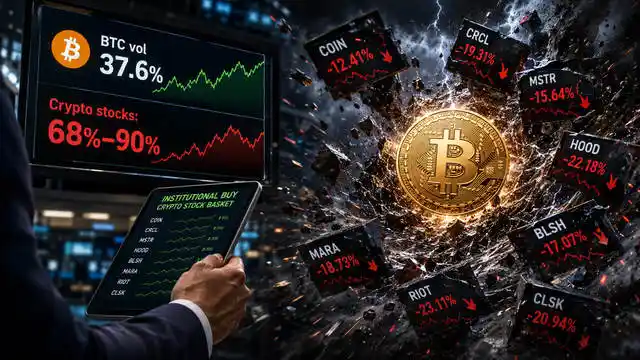
In June, Cathie Wood's ARK Invest purchased $77 million worth of publicly traded crypto-related stocks, including Coinbase, Circle, and Bullish, during Bitcoin's worst monthly performance in four years. This aligns with the investment thesis that such stocks offer a compliant way to gain exposure to the crypto cycle without directly holding Bitcoin. However, data analysis reveals significant drawbacks. A group of nine U.S.-listed crypto companies showed 30-day annualized realized volatility between 68% and 90%, nearly double Bitcoin's 37.6%. Over 90 days, Circle's volatility reached 103.6% versus Bitcoin's 37.8%. Drawdowns were also more severe for stocks like Circle (-51.4%) and MicroStrategy (-48.6%) compared to Bitcoin's -36.4% from its January high. Correlation analysis shows most stocks share only a moderate link to Bitcoin. For example, Circle, Robinhood, and Bullish have a 90-day correlation coefficient of just 0.55–0.58 with BTC, meaning only about one-third of their price movement is explained by Bitcoin's action. The rest stems from company-specific risks: earnings, competition, fundraising, and equity dilution. MicroStrategy (MSTR) is the notable exception, acting as a leveraged Bitcoin proxy with a beta of 1.59 and 0.85 correlation. Coinbase offers relatively balanced exposure. Circle exemplifies "crypto-wrapped" corporate risk, with its recent crash tied to stablecoin competition, not Bitcoin. Robinhood's diversified business insulates it from crypto downturns but also limits upside. Bitcoin miners like RIOT and MARA have posted significant gains year-to-date, driven primarily by their pivot to AI compute services, not Bitcoin's price. The article highlights that investing in crypto stocks often means accepting amplified volatility or layering on business-specific risks absent from direct Bitcoin ownership. For instance, MicroStrategy's recent challenges—its market value falling below its Bitcoin holdings (mNAV <1) and facing potential Bitcoin sales for liquidity—demonstrate equity-specific hazards like dilution and financing pressures not faced by a direct Bitcoin holder. ARK's buying spree represents a bet on a basket of different business models with varying crypto exposure, not a simple, lower-risk substitute for holding Bitcoin.

marsbit49m ago

Cathie Wood's June $77M Investment: Are Crypto Stocks a True 'Substitute' for Bitcoin?

marsbit49m ago

Trading

Spot

Hot Articles

What is $BANK

Bank AI: A Revolutionary Step in the Future of Banking Introduction In an era marked by rapid advancements in technology, Bank AI stands at the intersection of artificial intelligence (AI) and banking services. This innovative project seeks to redefine the financial landscape, enhancing operational efficiency, security measures, and customer experiences through the power of AI. As we embark on this exploration of Bank AI, we will delve into what the project entails, its operational dynamics, its historical context, and significant milestones. What is Bank AI? At its core, Bank AI represents a transformative initiative aimed at integrating artificial intelligence into various banking operations. This project harnesses the capabilities of AI to automate processes, improve risk management protocols, and enhance customer interaction through personalised services. The primary objectives of Bank AI include: Automation of Banking Functions: By leveraging AI technologies, Bank AI aims to automate routine tasks, reducing the burden on human resources and enhancing efficiency. Enhanced Risk Management: The project utilises AI algorithms to predict and identify risks, thereby fortifying security measures against fraud and other threats. Personalisation of Banking Services: Bank AI focuses on offering tailored financial products and services by analysing customer data and behaviours. Improving Customer Experience: The implementation of AI-driven solutions, such as chatbots and virtual assistants, aims to provide users with more human-like interactions, revolutionising the way customers engage with banks. With these goals, Bank AI positions itself as a crucial player in rendering banking more efficient, secure, and user-centric. Who is the Creator of Bank AI? Details regarding the creator of Bank AI remain unknown. As such, no specific individual or organisation has been identified in the available information. The anonymity surrounding the project's inception raises questions but does not detract from its ambitious vision and objectives. Who are the Investors of Bank AI? Similar to the project's creator, specific information regarding the investors or supporting organisations of Bank AI has not been disclosed. Without this information, it is challenging to outline the financial backing and institutional support that might be propelling the project forward. Nevertheless, the importance of having a robust investment foundation is pivotal for sustaining development in such an innovative field. How Does Bank AI Work? Bank AI operates on several innovative fronts, focusing on unique factors that differentiate it from traditional banking frameworks. Below are key operational features: Automation: By applying machine learning algorithms, Bank AI automates various manual processes within banks. This results in reduced operational costs and allows human workers to redirect their efforts towards more strategic activities. Advanced Risk Management: The integration of AI into risk management practices equips banks with tools to accurately predict potential threats such as fraud, ensuring that customer information and assets remain secure. Tailored Financial Recommendations: Through continuous learning from customer interactions, the AI systems develop a nuanced understanding of user needs, enabling them to offer tailored advice on financial decisions. Enhanced Customer Interactions: Utilizing chatbots and virtual assistants powered by AI, Bank AI enables a more engaging customer experience, allowing users to have their queries resolved quickly, thus reducing wait times and improving satisfaction levels. Together, these operational features position Bank AI as a pioneer in the banking sector, establishing new benchmarks for service delivery and operational excellence. Timeline of Bank AI Understanding the trajectory of Bank AI requires a look at its historical context. Below is a timeline highlighting important milestones and developments: Early 2010s: The conceptualisation of AI integration into banking services began to gain attention as banking institutions recognised the potential benefits. 2018: A marked increase in the implementation of AI technologies occurred when banks started using AI tools like chatbots for basic customer service and risk management systems for improved security handling. 2023: The sophistication of AI continued to advance, with generative AI being introduced for more complex tasks such as document processing and real-time investment analysis. This year marked a significant leap in the capabilities afforded to banks by AI technology. 2024-Current Status: As of this year, Bank AI is on an upward trajectory, with ongoing research and developments poised to further enhance capabilities in banking operations. Continued exploration of AI applications hints at exciting developments yet to come. Key Points About Bank AI Integration of AI in Banking: Bank AI focuses on adopting artificial intelligence to streamline banking processes and improve user experiences. Automation and Risk Management Focus: The project strongly emphasises these areas, aiming to shift the burden of routine tasks while enhancing security frameworks through predictive analytics. Personalised Banking Solutions: By harnessing customer data, Bank AI enables tailored banking services that cater to individual user needs. Commitment to Development: Bank AI remains committed to ongoing research and development efforts, ensuring its adaptability and ongoing relevance as technology continues to evolve. Conclusion In summary, Bank AI exemplifies a crucial step forward in the banking industry, leveraging artificial intelligence to reshape operational paradigms, enhance security, and promote customer satisfaction. Despite gaps in information surrounding the creator and investors, the clear objectives and functional mechanisms of Bank AI provide a strong foundation for its ongoing evolution. As AI technology continues to advance and merge with the banking sector, Bank AI is well-positioned to significantly impact the future of financial services, enhancing the way we understand and interact with banking.

179 Total ViewsPublished 2024.04.06Updated 2024.12.03

What is $BANK

Discussions

Welcome to the HTX Community. Here, you can stay informed about the latest platform developments and gain access to professional market insights. Users' opinions on the price of BANK (BANK) are presented below.

活动图片