¿Realmente el precio de Bitcoin alcanzó el fondo?

ambcryptoPublished on 2026-06-30Last updated on 2026-06-30

Abstract

El precio de Bitcoin (BTC) ha caído un 3,4% en las últimas 24 horas, provocando liquidaciones por valor de 104,38 millones de dólares, principalmente de posiciones largas (91,66 millones). Se observa un patrón de triángulo descendente similar al de 2021-2022, sugiriendo que el fondo del mercado podría formarse con tiempo, con una posible recuperación alcista en el cuarto trimestre de 2026. La métrica MVRV de los tenedores a largo plazo ha caído a 1,24, su nivel más bajo en tres años, lo que acerca al mercado a mínimos de ciclos anteriores, aunque aún no alcanza la zona de "capitulación". El precio ha roto la media móvil de 200 semanas, lo que refuerza la similitud con el ciclo de cuatro años. Sin embargo, un elevado ratio largo/corto en derivados podría desencadenar más liquidaciones de posiciones largas y presión bajista en las próximas semanas. En resumen, el mercado se acerca a condiciones de fondo históricas, pero probablemente necesite una mayor corrección antes de revertir la tendencia.

Bitcoin [BTC] cayó un 3,4% en las últimas 24 horas, con $104,38 millones en liquidaciones. De estos, posiciones largas por valor de $91,66 millones se vieron obligadas a cerrarse a medida que BTC caía más por debajo de los $60k.
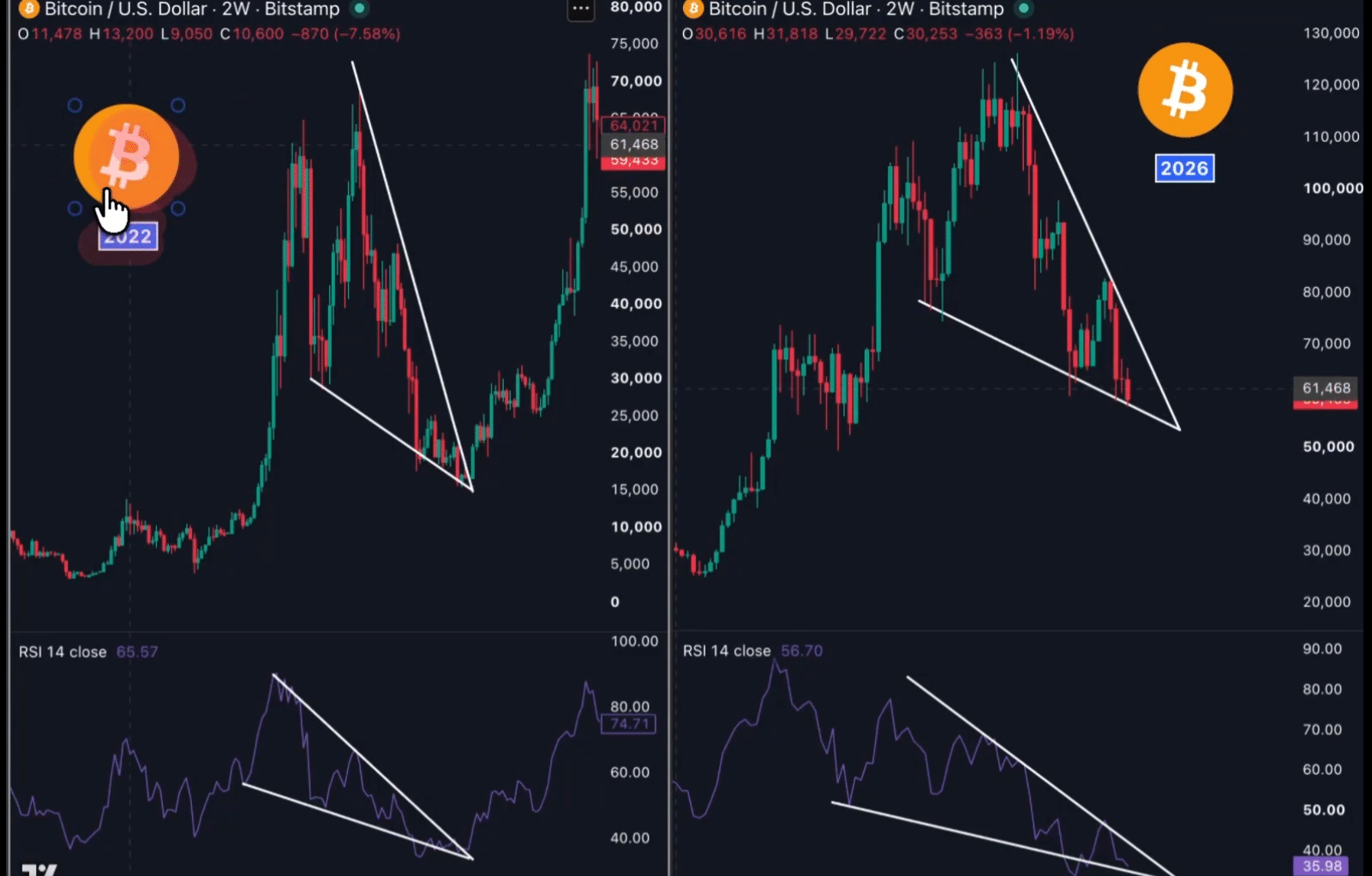
Fuente: CryptoRover en X

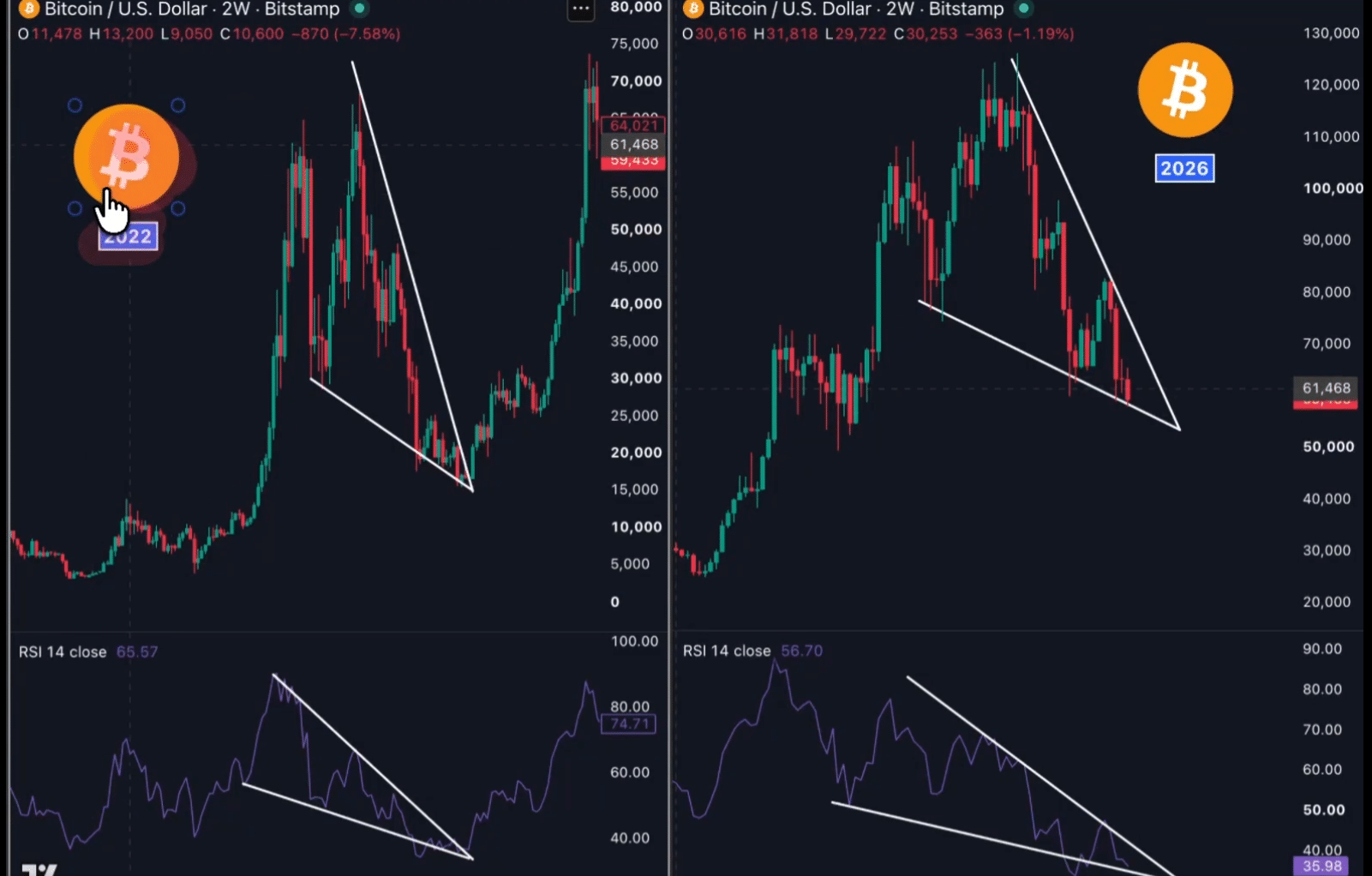
En una publicación en X, el influencer CryptoRover compartió un análisis técnico. El gráfico de precios delineaba el patrón de triángulo descendente que formó Bitcoin entre 2021 y 2022, y el RSI también formó una estructura similar.

El mismo patrón se está repitiendo en 2025-2026. Es posible que, como la vez anterior, el fondo del mercado necesite algo de tiempo para formarse antes de que rompa el patrón del triángulo.

Si el ciclo anterior se repite, un giro alcista podría comenzar en el cuarto trimestre de 2026. Cabe recordar que, tal y como están las cosas, la acumulación por parte de las ballenas estaba en marcha, pero no era lo suficientemente rápida como para justificar un cambio de tendencia del mercado.

¿Será tan sencillo para los inversores de Bitcoin?
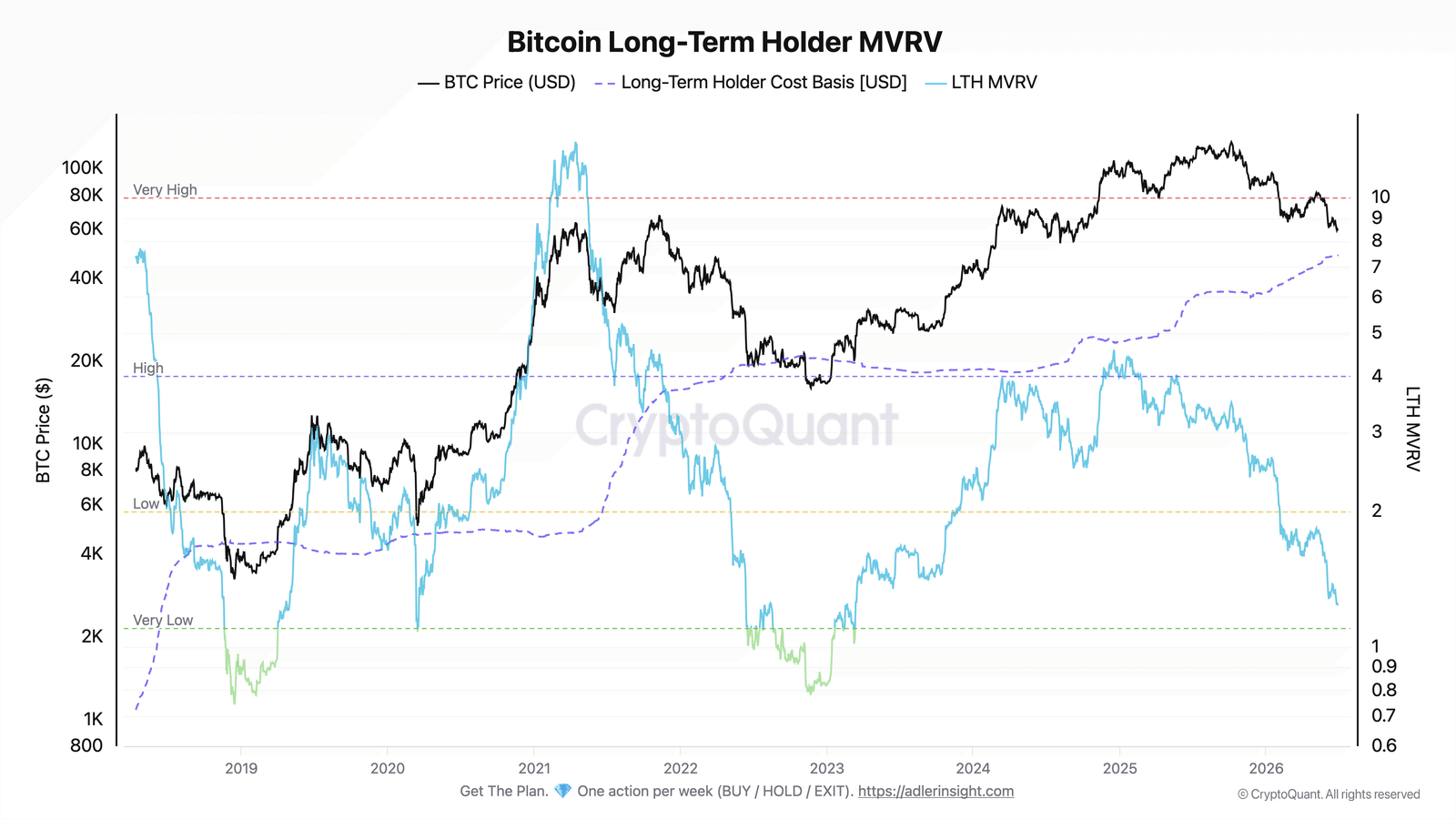
Fuente: Axel Adler Jr.

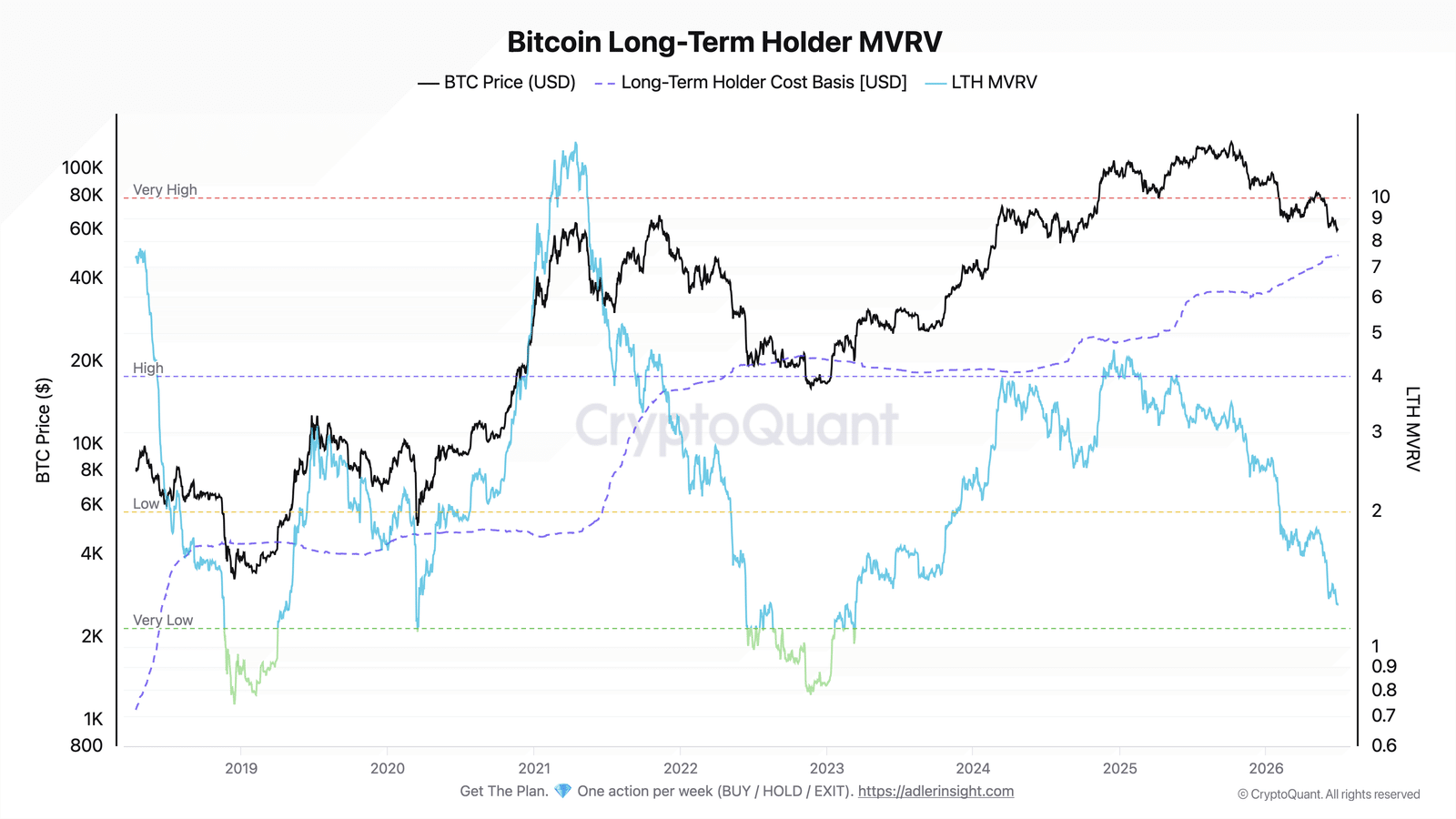
El analista cripto Axel Adler Jr. observó que el MVRV de los tenedores a largo plazo de Bitcoin se ha comprimido a 1,24. Esta métrica es la relación entre el valor de mercado de las monedas de los tenedores a largo plazo y su precio de compra promedio.

La lectura actual de 1,24 es la más baja en tres años y muestra que el mercado se está acercando a mínimos históricos de ciclo. El MVRV necesita caer en la zona verde de capitulación "Muy Baja" para dar una confirmación de fondo.

Además, el costo promedio de los tenedores a largo plazo está en $48,4k. Una caída del precio por debajo de este nivel dejaría a este grupo, en promedio, bajo el agua, y señalaría una capitulación incluso de los tenedores más acérrimos.

Bitcoin sigue la trayectoria del ciclo de 4 años
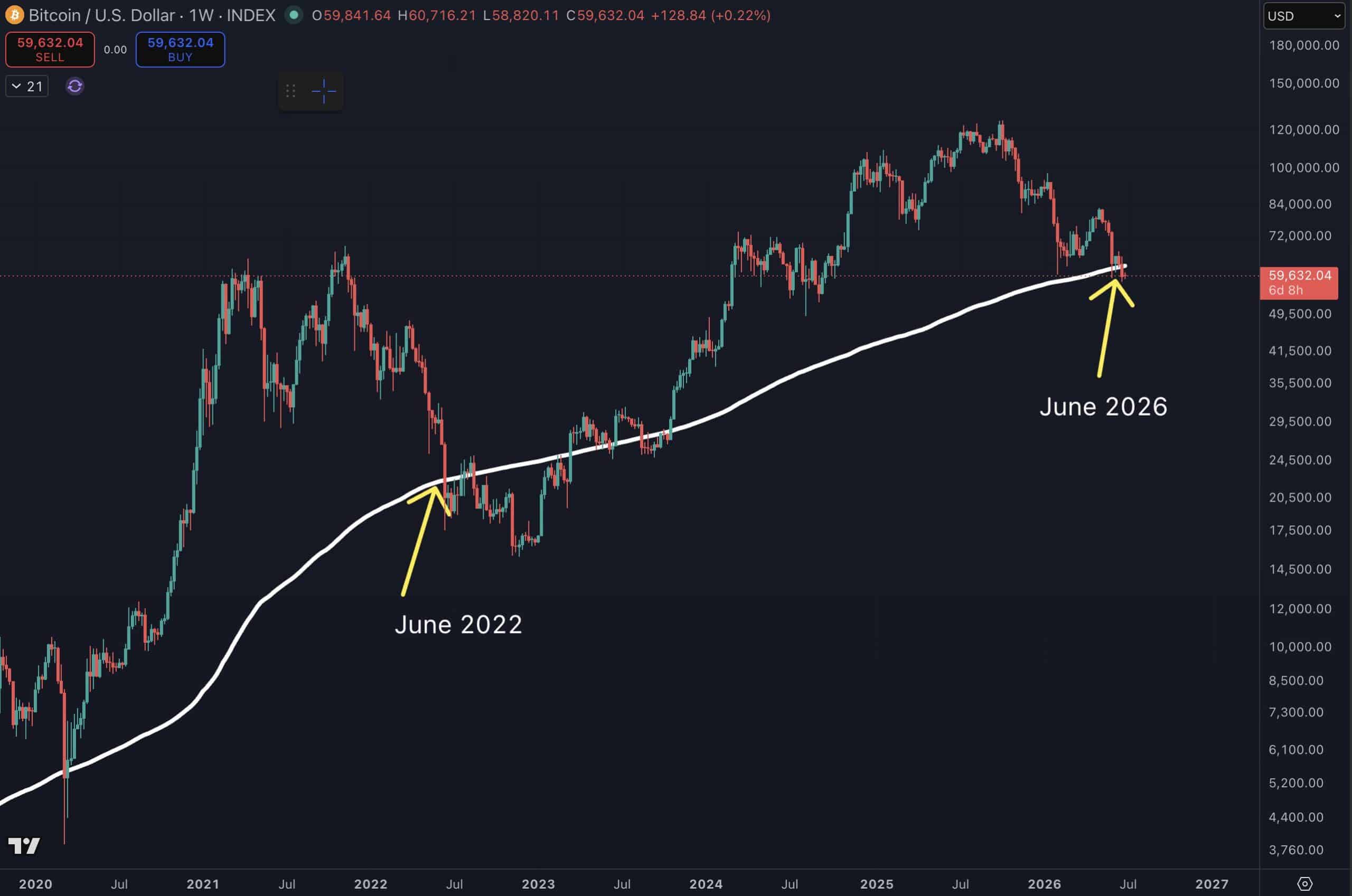
Fuente: Benjamin Cohen en X

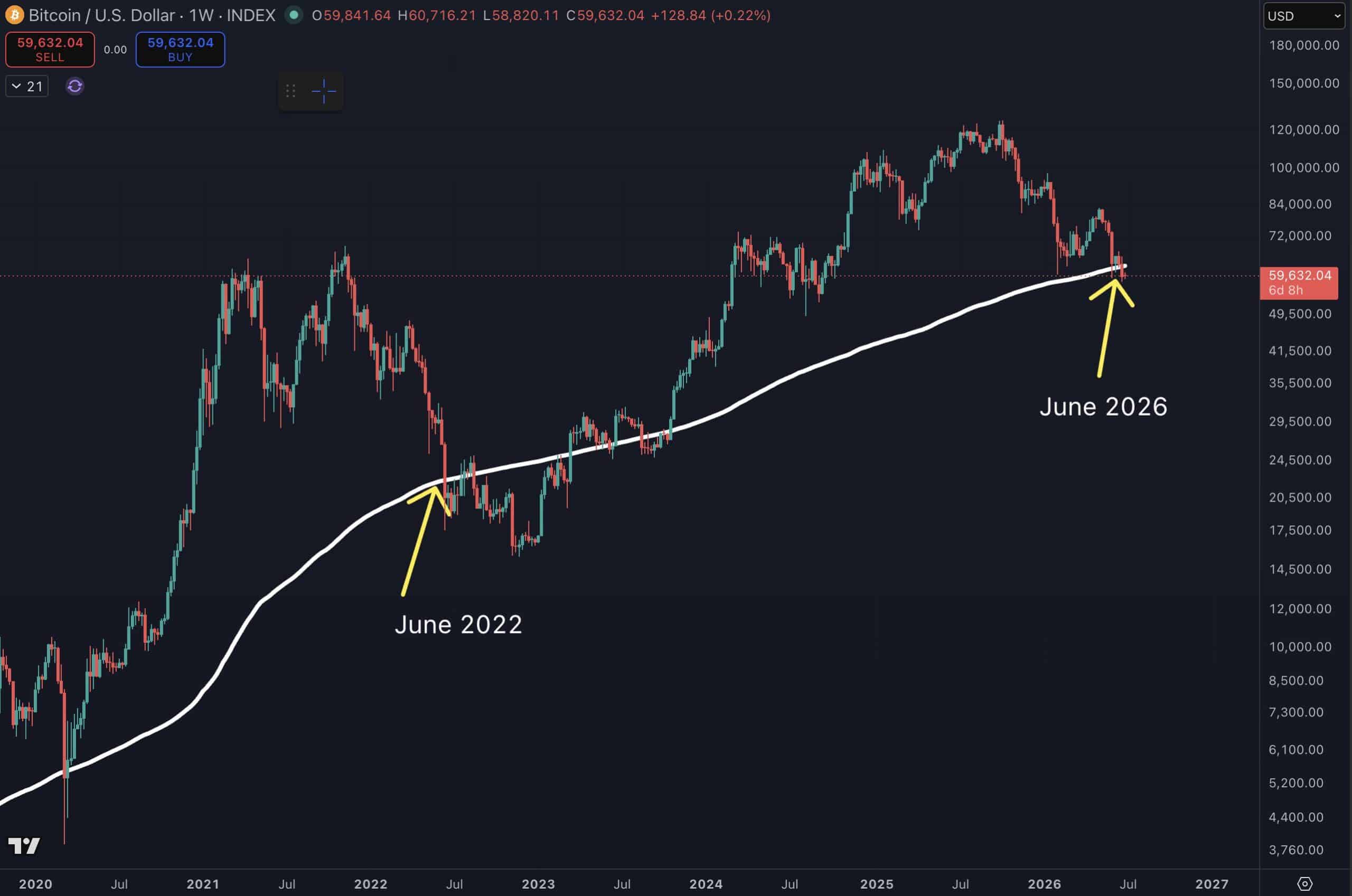
El fundador y CEO de Into The CryptoVerse, Benjamin Cohen, utilizó la media móvil de 200 semanas para resaltar que el ciclo de 4 años está justo en camino.

Junio de 2022 y 2026 vieron cómo esta media móvil fue perforada a la baja, estableciendo una similitud notable entre los ciclos.
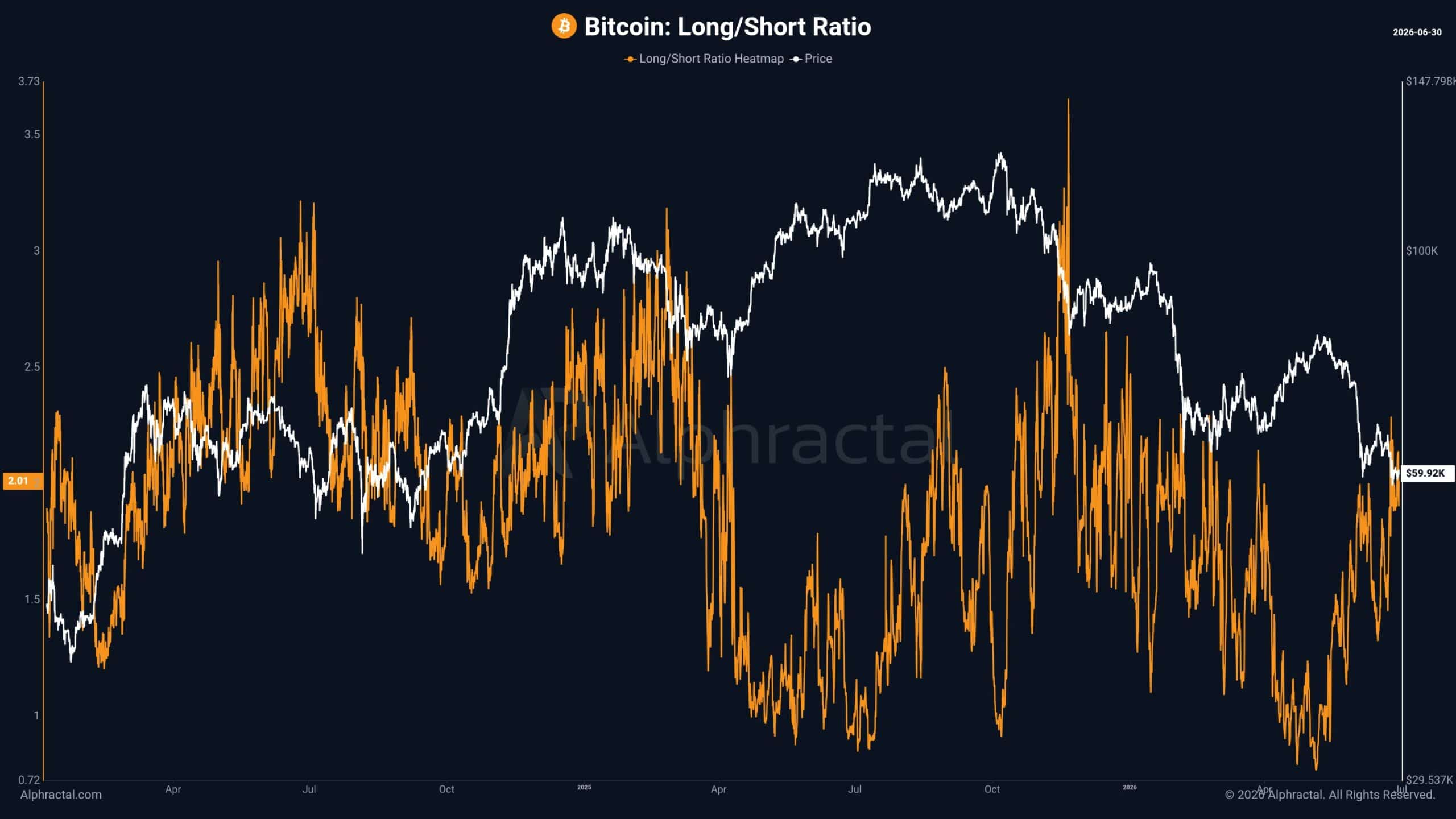
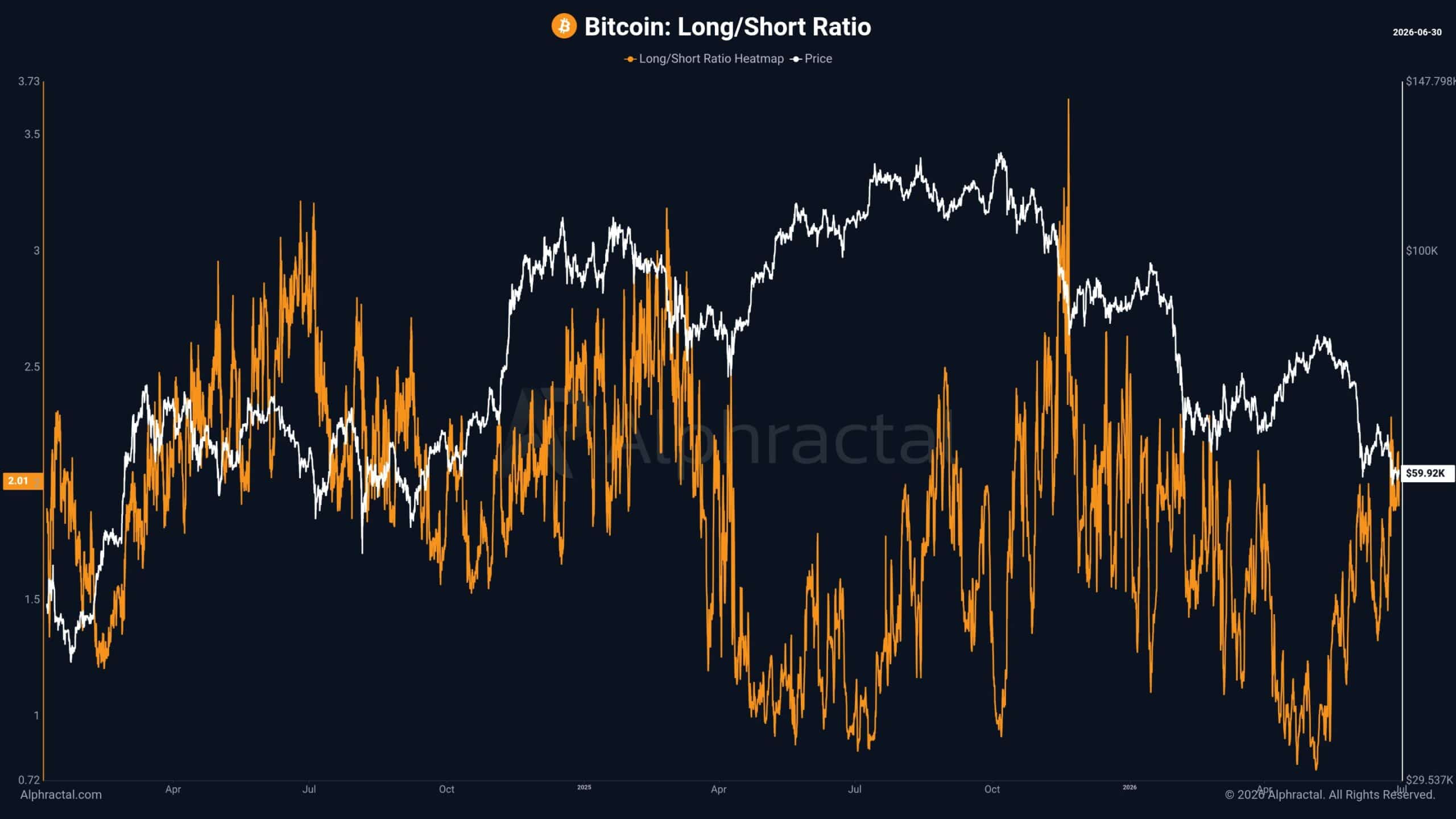
Fuente: Joao Wedson en X

El ratio largo/corto en aumento implicaba que más operadores estaban apostando largo en el mercado de derivados que posicionándose corto. "Esta exposición excesiva en posiciones largas es una de las principales razones detrás de las recientes ventas masivas", escribió Joao Wedson, CEO de Alphractal.

Implicaba que, al igual que la oleada de liquidaciones largas en la primera semana de junio, otro ajuste por compresión de posiciones largas podría comenzar en los próximos días y semanas.


Resumen Final

  • El movimiento del precio de Bitcoin ha perforado la media móvil de 200 semanas y podría bajar aún más en los próximos meses.
  • El mercado se estaba acercando a condiciones de fondo históricas, en comparación con ciclos anteriores, pero aún no estaba del todo allí.


Trending Cryptos

Related Questions

Q¿Qué patrón técnico está repitiendo Bitcoin en 2025-2026 según el artículo?

ASegún el artículo, Bitcoin está repitiendo el patrón de triángulo descendente (descending triangle pattern) en el período 2025-2026, similar al que formó en 2021-2022.

Q¿Qué indica el valor actual del MVRV para los poseedores a largo plazo de Bitcoin?

AEl MVRV de los poseedores a largo plazo se ha comprimido a 1.24, su nivel más bajo en tres años. Esto indica que el mercado se está acercando a los mínimos históricos de ciclos anteriores, aunque aún necesita caer a la zona verde de 'Muy Bajo' para confirmar un fondo definitivo.

QSegún Benjamin Cohen, ¿cómo confirma el artículo que el ciclo de 4 años de Bitcoin va por buen camino?

ABenjamin Cohen señala que el precio de Bitcoin ha roto la media móvil de 200 semanas a la baja tanto en junio de 2022 como en junio de 2026, lo que establece una similitud notable y confirma que el ciclo de 4 años va según lo previsto.

Q¿Cuál es una de las principales razones detrás de las recientes ventas masivas (selloffs) según Joao Wedson?

AJoao Wedson atribuye una de las principales razones de las recientes ventas masivas (selloffs) a la excesiva exposición larga (long exposure) en el mercado de derivados, reflejada en una ratio largo/corto (long/short ratio) en aumento.

Q¿Qué podría desencadenar la señal de capitulación de los poseedores más 'hardcore' (acuñados) de Bitcoin?

ALa capitulación de los poseedores más 'hardcore' se señalizaría si el precio de Bitcoin cae por debajo de la base de coste promedio de los poseedores a largo plazo, que actualmente se sitúa en 48.4k dólares, poniéndoles 'bajo el agua' (en pérdidas) en promedio.

Related Reads

Confirmed: Claude Code Secretly Inspects Users, Time Zone and Chinese AI Labs Are Key Factors

Today was a significant day for Anthropic. The company announced the launch of Claude Sonnet 5, described as its most agentic model yet, and separately confirmed that the U.S. Department of Commerce has lifted export controls on its Claude Fable 5 and Mythos 5 models, allowing their distribution to resume. However, a separate controversy has emerged regarding its coding assistant, Claude Code. Developers have exposed that certain versions of the tool allegedly contain hidden code designed to detect specific user data. This code reportedly checks for the use of Chinese time zones (like Asia/Shanghai), the presence of custom API proxy URLs, and connections to domains associated with Chinese tech companies and AI labs. If triggered, this information is said to be encoded into the system prompt sent to the AI cloud, using subtle, nearly indistinguishable variations in characters (like different Unicode apostrophes in the "Today's date" line) as a form of steganography. The core issue is the covert nature of this data collection. While telemetry for security and abuse prevention is common, implementing it through hidden channels within the prompt—without user awareness or documented disclosure—fundamentally breaches trust. This is particularly sensitive for a coding assistant that operates with access to source code and system commands. Following the exposure, an Anthropic engineer acknowledged the code's existence and stated it would be removed in an upcoming release. The incident raises serious questions about transparency and the boundaries of data collection in AI developer tools.

marsbit34m ago

Confirmed: Claude Code Secretly Inspects Users, Time Zone and Chinese AI Labs Are Key Factors

marsbit34m ago

Grayscale: After Halving, BTC is Nearing the Bottom of This Cycle

Grayscale Research suggests Bitcoin's recent decline below $60,000, a >50% drop from its October peak, represents a cyclical correction within a long-term uptrend rather than a trend reversal. Key factors behind the pullback include a shift in market expectations toward Federal Reserve rate hikes under new Chair Kevin Warsh, uncertainty around the CLARITY Act's Senate passage, pressure on leveraged entities like Strategy, and concerns over quantum computing risks. The path out of the current bear market hinges on upcoming catalysts. An optimistic scenario, where the CLARITY Act passes, leverage is contained, and the Fed refrains from hiking, could mean Bitcoin is nearing its cycle bottom. A pessimistic scenario, featuring legislative failure, further deleveraging, and Fed rate hikes, could lead to additional moderate downside. Grayscale does not expect a historically deep ~80% drawdown due to a more measured prior bull run and stickier institutional demand. Despite short-term headwinds, Grayscale remains highly optimistic about crypto's long-term structural prospects, driven by institutional adoption of public blockchains, unsustainable government debt, declining trust in intermediaries, and AI's potential demand for alternative systems. The report concludes that while the exact cycle low depends on near-term catalysts, current valuations present an attractive entry point for long-term investors betting on the decade-ahead growth of digital assets.

marsbit56m ago

Grayscale: After Halving, BTC is Nearing the Bottom of This Cycle

marsbit56m ago

Web3 Bear Market Survival Guide: Ten Great Books to Help You Navigate the Cycles

"Web3 Bear Market Survival Guide: Ten Books to Help You Navigate the Cycle" This article presents a curated book list aimed at helping Web3 enthusiasts and professionals endure and grow during crypto market downturns. It argues that bear markets are not just periods of waiting but crucial times for deepening one's foundational understanding beyond technical whitepapers and price charts. The ten recommended books offer perspectives on technology, economics, philosophy, and strategy to build resilience and long-term vision. The list includes: 1. **"The Inevitable" by Kevin Kelly:** For using a long-term technological lens to combat uncertainty about the future, including the role of crypto and AI. 2. **"Human Action" by Ludwig von Mises:** To upgrade one's economic and philosophical framework, understanding action, speculation, and calculation in a bear market context. 3. **"The Nature of Technology" by W. Brian Arthur:** For viewing blockchain and crypto as combinatorial evolutions of existing technologies, understanding their modular and economic development. 4. **"The Distant Savior" (Chinese novel):** Explores the cultural attributes of self-reliance ("strong culture") versus dependency ("weak culture"), crucial for surviving industry cycles. 5. **"The Sovereign Individual" by James Dale Davidson & Lord William Rees-Mogg:** A prophetic 1997 work on how technology empowers individuals and challenges nation-states, foreshadowing Bitcoin's emergence. 6. **"Japanization: What the World Can Learn from Japan's Lost Decades" (Adapted title):** Uses Japan's economic history as a case study to identify structural opportunities that persist even during broader recessions. 7. **"Denationalisation of Money" by F.A. Hayek:** The ideological blueprint for Bitcoin, arguing for competitive currency issuance beyond state monopoly. 8. **"Duan Yongping Investment Q&A" (Chinese compilation):** Emphasizes the simple discipline of "doing the right things and doing things right," focusing on fundamentals and maintaining a "stop doing list." 9. **"The Network State: How To Start a New Country" by Balaji Srinivasan:** A visionary text from a crypto insider outlining bold predictions and concrete ideas for a blockchain-based future across media, governance, and identity. 10. **"Selected Works of Mao Zedong" (Vol. 1):** Analyzed as a strategic playbook for a weak force challenging a powerful establishment, offering lessons on strategy, alliance-building, and perseverance for the crypto movement. The conclusion states that bear markets filter out those with weak conviction, not weak skills. Survival depends on cognitive depth and mental fortitude, which these books aim to provide.

Foresight News1h ago

Web3 Bear Market Survival Guide: Ten Great Books to Help You Navigate the Cycles

Foresight News1h ago

Trump's 25-Year Financial Report: Family Earns Over $1 Billion Annually from Crypto, While Retail Investors Lose Money on $TRUMP

Former President Donald Trump's family earned approximately $1.2 billion from cryptocurrency ventures in 2025, according to a financial disclosure report. This revenue stream, outlined in a 927-page filing, now surpasses income from most of his long-established real estate holdings. The crypto earnings originated from two main sources: over $500 million from the sale of products like "governance tokens" by World Liberty Financial, a DeFi project co-owned by the Trump family, and roughly $635 million in royalties from the Trump-themed meme coin $TRUMP, issued by CIC Digital LLC. While Trump's entities profited, retail investors faced significant losses. The $TRUMP token, which peaked above $74 shortly after its January 2025 launch, has plummeted to around $1.68. World Liberty Financial's token has also fallen roughly 80% since its debut. Reports indicate that the majority of meme coin buyers have lost money, with Trump-linked entities still holding about 80% of $TRUMP's supply under vesting plans. The disclosure highlights a stark contrast: Trump's crypto and real estate businesses flourished—with new international property deals bringing in tens of millions—even as his administration shifted to crypto-friendly policies, relaxing the stringent regulatory stance of the previous Biden administration. The White House maintains that Trump acts only in the public interest, with his businesses placed in a trust managed by his sons, denying any conflict of interest. However, the report notes the difficulty of assessing such conflicts, particularly regarding foreign business dealings with countries that later received favorable U.S. policy decisions.

marsbit1h ago

Trump's 25-Year Financial Report: Family Earns Over $1 Billion Annually from Crypto, While Retail Investors Lose Money on $TRUMP

marsbit1h ago

Trading

Spot

Hot Articles

What is $BITCOIN

DIGITAL GOLD ($BITCOIN): A Comprehensive Analysis Introduction to DIGITAL GOLD ($BITCOIN) DIGITAL GOLD ($BITCOIN) is a blockchain-based project operating on the Solana network, which aims to combine the characteristics of traditional precious metals with the innovation of decentralized technologies. While it shares a name with Bitcoin, often referred to as “digital gold” due to its perception as a store of value, DIGITAL GOLD is a separate token designed to create a unique ecosystem within the Web3 landscape. Its goal is to position itself as a viable alternative digital asset, although specifics regarding its applications and functionalities are still developing. What is DIGITAL GOLD ($BITCOIN)? DIGITAL GOLD ($BITCOIN) is a cryptocurrency token explicitly designed for use on the Solana blockchain. In contrast to Bitcoin, which provides a widely recognized value storage role, this token appears to focus on broader applications and characteristics. Notable aspects include: Blockchain Infrastructure: The token is built on the Solana blockchain, known for its capacity to handle high-speed and low-cost transactions. Supply Dynamics: DIGITAL GOLD has a maximum supply capped at 100 quadrillion tokens (100P $BITCOIN), although details regarding its circulating supply are currently undisclosed. Utility: While precise functionalities are not explicitly outlined, there are indications that the token could be utilized for various applications, potentially involving decentralized applications (dApps) or asset tokenization strategies. Who is the Creator of DIGITAL GOLD ($BITCOIN)? At present, the identity of the creators and development team behind DIGITAL GOLD ($BITCOIN) remains unknown. This situation is typical among many innovative projects within the blockchain space, particularly those aligning with decentralized finance and meme coin phenomena. While such anonymity may foster a community-driven culture, it intensifies concerns about governance and accountability. Who are the Investors of DIGITAL GOLD ($BITCOIN)? The available information indicates that DIGITAL GOLD ($BITCOIN) does not have any known institutional backers or prominent venture capital investments. The project seems to operate on a peer-to-peer model focused on community support and adoption rather than traditional funding routes. Its activity and liquidity are primarily situated on decentralized exchanges (DEXs), such as PumpSwap, rather than established centralized trading platforms, further highlighting its grassroots approach. How DIGITAL GOLD ($BITCOIN) Works The operational mechanics of DIGITAL GOLD ($BITCOIN) can be elaborated on based on its blockchain design and network attributes: Consensus Mechanism: By leveraging Solana’s unique proof-of-history (PoH) combined with a proof-of-stake (PoS) model, the project ensures efficient transaction validation contributing to the network's high performance. Tokenomics: While specific deflationary mechanisms have not been extensively detailed, the vast maximum token supply implies that it may cater to microtransactions or niche use cases that are still to be defined. Interoperability: There exists the potential for integration with Solana’s broader ecosystem, including various decentralized finance (DeFi) platforms. However, the details regarding specific integrations remain unspecified. Timeline of Key Events Here is a timeline that highlights significant milestones concerning DIGITAL GOLD ($BITCOIN): 2023: The initial deployment of the token occurs on the Solana blockchain, marked by its contract address. 2024: DIGITAL GOLD gains visibility as it becomes available for trading on decentralized exchanges like PumpSwap, allowing users to trade it against SOL. 2025: The project witnesses sporadic trading activity and potential interest in community-led engagements, although no noteworthy partnerships or technical advancements have been documented as of yet. Critical Analysis Strengths Scalability: The underlying Solana infrastructure supports high transaction volumes, which could enhance the utility of $BITCOIN in various transaction scenarios. Accessibility: The potential low trading price per token could attract retail investors, facilitating wider participation due to fractional ownership opportunities. Risks Lack of Transparency: The absence of publicly known backers, developers, or an audit process may yield skepticism regarding the project's sustainability and trustworthiness. Market Volatility: The trading activity is heavily reliant on speculative behavior, which can result in significant price volatility and uncertainty for investors. Conclusion DIGITAL GOLD ($BITCOIN) emerges as an intriguing yet ambiguous project within the rapidly evolving Solana ecosystem. While it attempts to leverage the “digital gold” narrative, its departure from Bitcoin's established role as a store of value underscores the need for a clearer differentiation of its intended utility and governance structure. Future acceptance and adoption will likely depend on addressing the current opacity and defining its operational and economic strategies more explicitly. Note: This report encompasses synthesised information available as of October 2023, and developments may have transpired beyond the research period.

535 Total ViewsPublished 2025.05.13Updated 2025.05.13

What is $BITCOIN

Discussions

Welcome to the HTX Community. Here, you can stay informed about the latest platform developments and gain access to professional market insights. Users' opinions on the price of BTC (BTC) are presented below.

活动图片