Le label 'chaîne fantôme' de Cardano démystifié ? Pourquoi les 34 dApps d'ADA ne racontent pas toute l'histoire

ambcryptoPublished on 2026-06-30Last updated on 2026-06-30

Abstract

L'article traite de l'étiquette de "chaîne fantôme" parfois attribuée à Cardano (ADA) en raison de son activité on-chain et de son nombre d'applications décentralisées (dApps) nettement inférieurs à ceux de ses principaux concurrents comme Ethereum et Solana. L'auteur définit d'abord une "chaîne fantôme" comme une blockchain techniquement opérationnelle mais avec très peu d'activité et de développement. Il passe ensuite en revue les forces des principales blockchains de couche 1 : Ethereum pour la DeFi, XRP pour les règlements transfrontaliers, Solana pour le débit, Tron pour les transferts USDT et Bitcoin comme réserve de valeur. Concernant Cardano, l'article reconnaît des signes de faiblesse : la fermeture de l'explorateur TapTools, des avertissements sur la possible disparition de projets et seulement 34 dApps. Cependant, il souligne que son activité de développement reste forte. L'explication principale avancée pour justifier le faible nombre de transactions et d'utilisateurs actifs est le modèle technique unique de Cardano, l'EUTXO (Extended Unspent Transaction Output), qui regroupe (batch) les transactions. Cette fonctionnalité, bien qu'avantageuse pour la sécurité et la détermination, sous-estime l'activité réelle sur la chaîne. La conclusion est que si Cardano affiche des métriques d'activité bien inférieures, son modèle technique spécifique et son approche méthodique axée sur la sécurité et la durabilité l'empêchent d'être simplement catalogué comme une "chaîne fa...

Une chaîne fantôme est une blockchain qui fonctionne techniquement mais présente très peu d'activité sur la chaîne et d'activité de développement.

Au cours de la dernière décennie, de nombreuses nouvelles blockchains brillantes ont fait leur apparition. Elles ont réussi à capter l'attention du public, attirant des entrées de capitaux, mais ont fini par s'éteindre.

Cette extinction peut être due à un manque de financement, de conviction communautaire ou à l'incapacité de résoudre des problèmes réels.

Un déclin des mises à niveau et de la communication concernant la vision future, l'incapacité à retenir l'afflux initial d'utilisateurs en raison d'une utilité douteuse, ou un incident de sécurité entraînant une perte importante due à des piratages et des exploits peuvent dévaster le sentiment des investisseurs.

Cumulé dans le temps, un déclin constant de l'utilisation et du volume des échanges peut donner lieu à une chaîne fonctionnelle qui est à peine utilisée à grande échelle.

Les chaînes qui ont résisté à l'épreuve du temps sont celles qui figurent en haut de la liste des crypto-actifs. Aucune des dizaines de soi-disant "tueurs d'Ethereum" qui ont captivé l'imagination du public n'a réussi à détrôner Ethereum de son piédestal dans l'écosystème crypto.

Un regard plus attentif sur les principaux jetons de Layer 1 actuels

En raison de sa fiabilité et de sa sécurité, et combiné à des solutions de Layer 2 qui traitent la vitesse, Ethereum est la blockchain de base dominante. Il domine les secteurs de la DeFi grâce à la liquidité et à la sécurité et traite également plus de la moitié de toute l'activité stablecoin.

XRP est optimisé pour être une couche de règlement transfrontalière en utilisant son réseau de liquidité à la demande pour convertir des monnaies fiduciaires en XRP, l'envoyer à l'échelle mondiale et le reconvertir en monnaie fiduciaire en quelques secondes.

Solana a un débit exceptionnel et est un centre d'échange. Des règlements à faible coût et à grande vitesse signifient que Solana est un leader dans la tokenisation d'actifs du monde réel.

TRON est la principale couche de règlement de Tether [USDT], avec plus de 75 % des transferts USDT se produisant sur ce réseau. Le haut débit de TRON en fait également une chaîne DeFi très active en termes de volume de transactions.

Et bien sûr, le réseau Bitcoin a la sécurité la plus forte de tous. L'actif lui-même est principalement utilisé comme réserve de valeur et une couverture contre l'inflation et agit également comme une garantie de qualité institutionnelle.

Cardano joue un rôle plus unique dans l'écosystème crypto. Son accent est mis sur la durabilité, la sécurité et une méthodologie de développement rigoureuse et examinée par les pairs. En conséquence, il est bien adapté à la conformité institutionnelle et aux exigences des entreprises.

Les facteurs que les critiques pointent pour jeter l'ombre de "chaîne fantôme" sur Cardano

Début juin, TapTools, l'explorateur de blockchain principal de l'écosystème Cardano, a commencé à fermer. Le départ des cadres supérieurs a emporté un savoir-faire technique précieux.

Cette connaissance n'a pas pu être remplacée assez rapidement pour permettre à la plateforme de continuer à être exploitée de manière responsable. C'était inquiétant.

Le fondateur Charles Hoskinson a averti que davantage de dApps et de DeFi sur Cardano mourraient au second semestre de l'année. Les systèmes de gouvernance du trésor et de la communauté n'ont pas pu réagir assez rapidement pour aider à sauver des projets en difficulté.

Dans un contexte de détérioration du sentiment du marché, la pression sur les petits projets aux revenus limités pourrait s'ajouter aux préoccupations qui entourent l'écosystème Cardano.
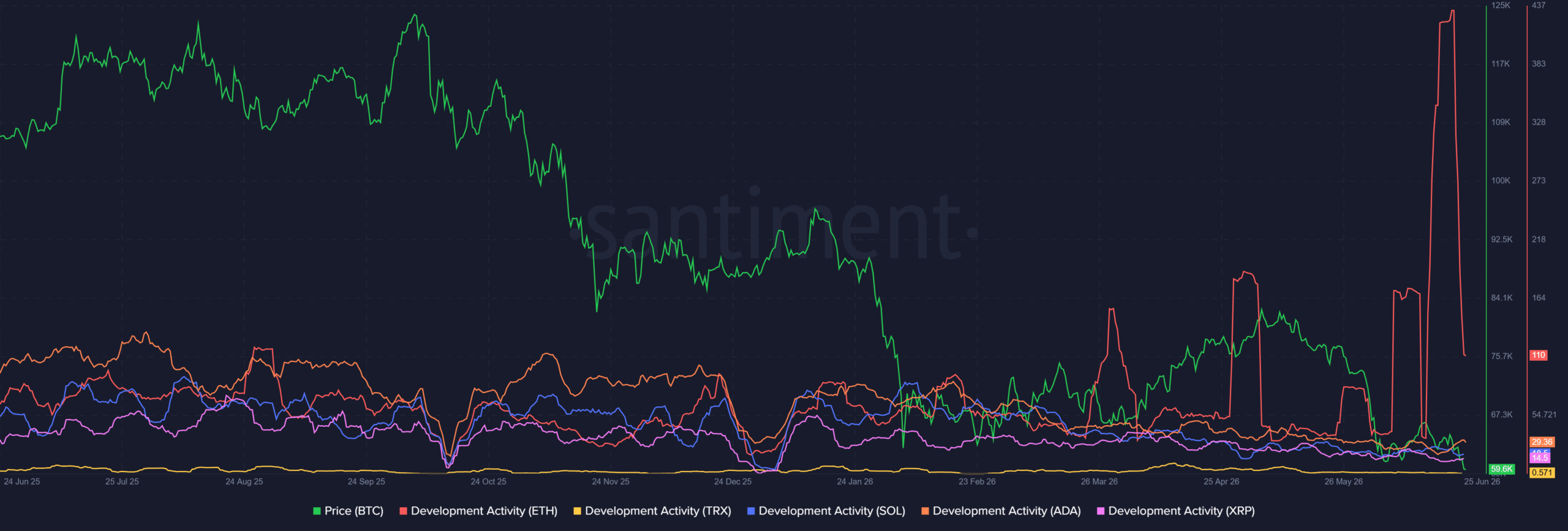
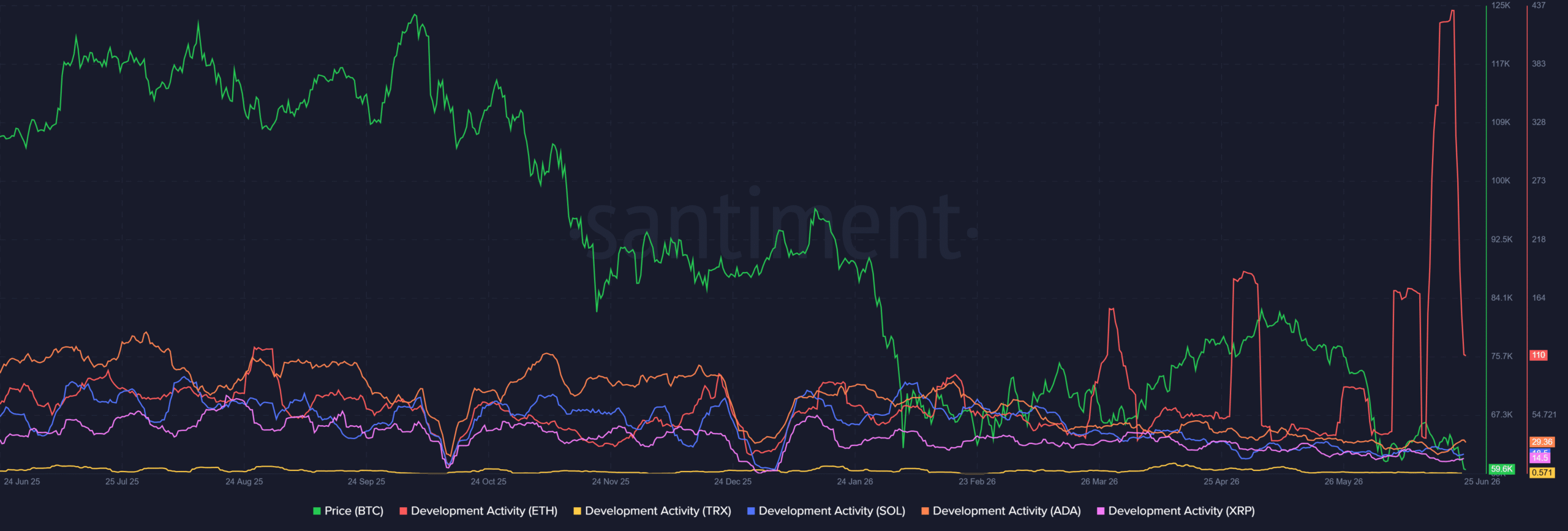
Source : Santiment

Du côté positif, les statistiques d'activité de développement pour Cardano étaient solides. Les données de Santiment ont montré qu'il n'était que deuxième sur la liste des principaux réseaux de Layer 1 discutés précédemment, en termes d'activité de développement.

Pourtant, Cardano a beaucoup moins de dApps, n'en comptant que 34, contre 442 pour Solana et 1564 pour Ethereum, selon la plateforme de données blockchain Moralis.
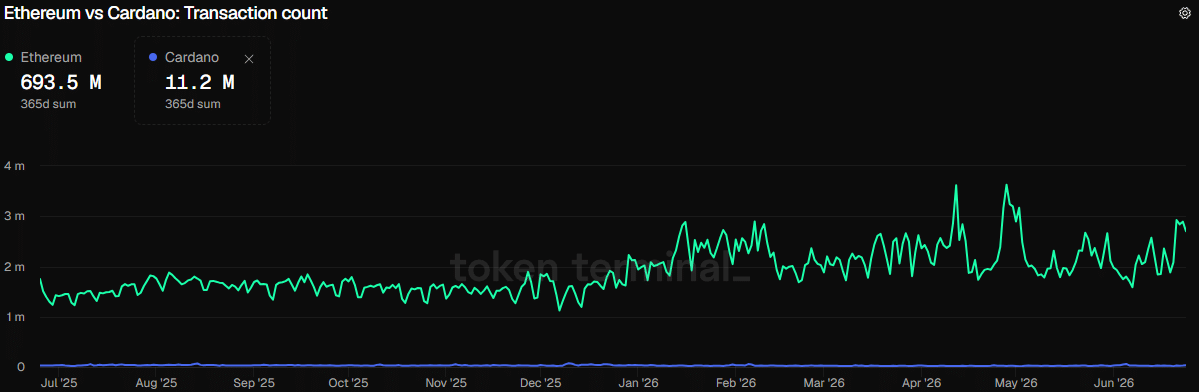
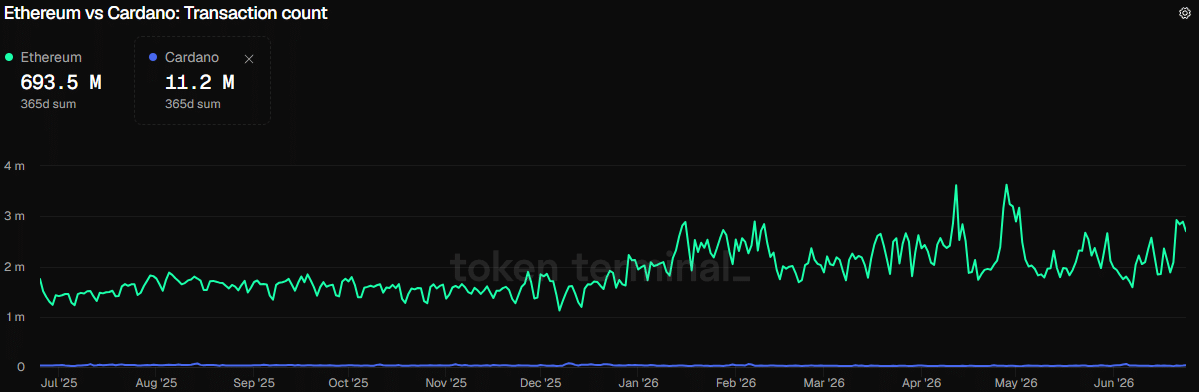
Source : Token Terminal

Pourtant, la comparaison du nombre de transactions entre Ethereum et Cardano a montré un gouffre énorme. Solana était l'un des leaders sur ce front, avec 103,2 milliards de transactions au cours de l'année écoulée, selon les données de Token Terminal.
Source : Token Terminal

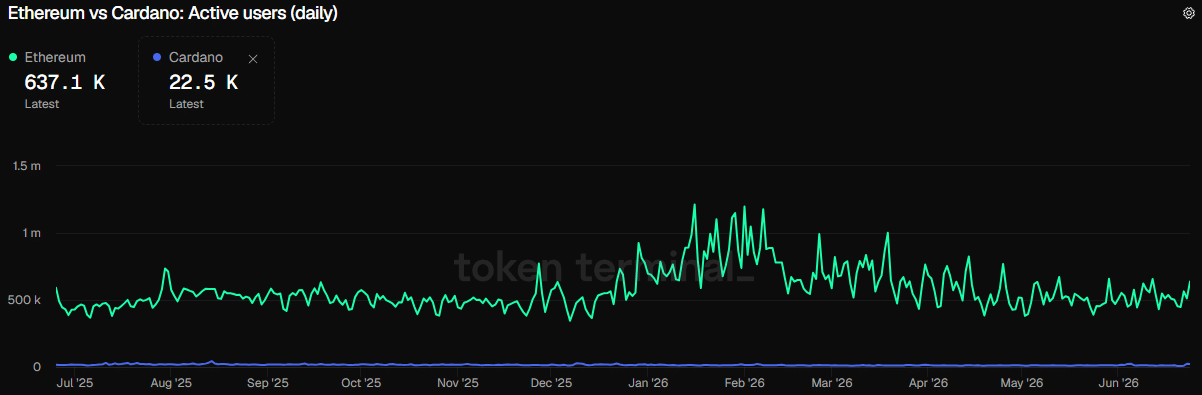
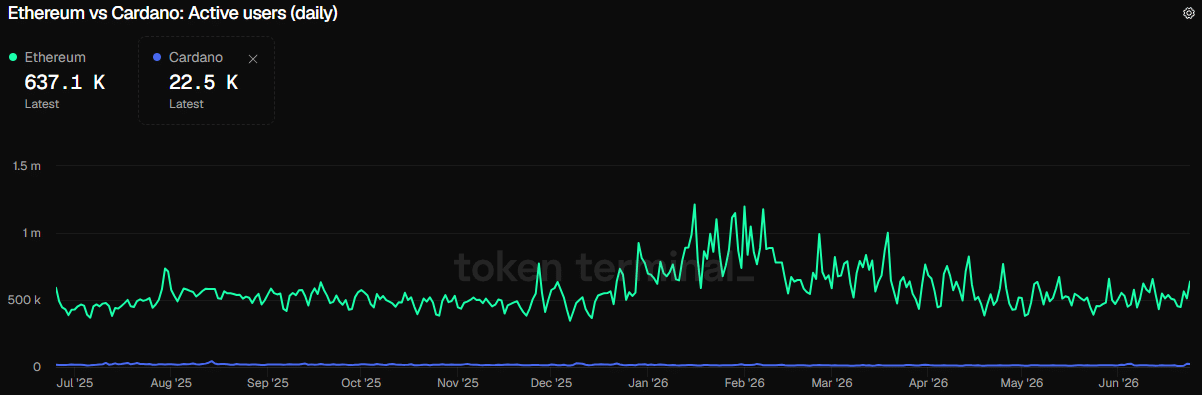
De même, les utilisateurs actifs quotidiens ont également montré un énorme écart dans les chiffres sur les deux chaînes. Sur ce front, TRON était le gagnant, avec 3,9 millions d'utilisateurs actifs, beaucoup plus élevés même qu'Ethereum.

Expliquer le vaste gouffre entre Cardano et les autres blockchains leaders

Si l'extrême différence d'activité sur la chaîne peut être alarmante au premier abord, ce n'est pas une raison suffisante pour conclure que Cardano est une chaîne fantôme. Le réseau utilise un modèle de sortie de transaction non dépensée étendue (EUTXO).

Les protocoles de regroupement (batchers) rassemblent les ordres ouverts sur la blockchain, les agrégeant en une transaction optimisée qui peut être soumise au registre de Cardano.

Effectivement, la différence d'un facteur 50 que nous avons vue dans quelques métriques examinées peut s'expliquer par le modèle EUTXO. Les capacités de regroupement du réseau offrent des avantages en termes de déterminisme et de sécurité, mais sous-estiment également l'activité sur la chaîne.

Par le passé, les blockchains qui n'ont pas réussi à occuper une niche et à dominer un segment du marché se sont éteintes. Les survivants établis se portaient relativement bien, mais il reste à voir s'ils pourront conserver leur statut dans les années à venir.


Résumé final

  • Le trilemme de la blockchain signifie que les différentes Layer 1 doivent faire leurs propres compromis. Les chaînes dominantes ont réussi à s'emparer d'une niche pour elles-mêmes.
  • L'activité du réseau Cardano était beaucoup plus faible que celle de ses pairs, mais cela seul n'était pas une raison suffisante pour que les critiques le qualifient de "chaîne fantôme".


Trending Cryptos

Related Questions

QQu'est-ce qu'une "chaîne fantôme" dans le contexte de la blockchain ?

AUne "chaîne fantôme" est une blockchain qui fonctionne techniquement, mais qui présente très peu d'activité sur la chaîne et d'activité de développement.

QSelon l'article, quel est le rôle unique de Cardano dans l'écosystème crypto ?

ACardano se concentre sur la durabilité, la sécurité et une méthodologie de développement rigoureuse et évaluée par des pairs. Il est donc bien adapté à la conformité institutionnelle et aux besoins des entreprises.

QPourquoi le nombre limité de dApps (34) sur Cardano ne raconte-t-il pas toute l'histoire selon l'article ?

AParce que Cardano utilise un modèle EUTXO (Extended Unspent Transaction Output) avec des protocoles de regroupement qui agrément les transactions. Cela signifie que l'activité sur la chaîne est sous-estimée dans les métriques comparatives directes avec d'autres blockchains comme Ethereum ou Solana.

QQuels facteurs les critiques invoquent-ils pour qualifier Cardano de "chaîne fantôme" ?

ALes critiques pointent la fermeture de l'explorateur de blocs TapTools, l'avertissement du fondateur sur la possible disparition de davantage de dApps, le faible nombre total de dApps (34), et un nombre de transactions et d'utilisateurs actifs quotidien nettement inférieur à celui d'autres grandes blockchains de couche 1.

QSelon la conclusion de l'article, pourquoi ne faut-il pas qualifier Cardano de "chaîne fantôme" uniquement sur la base de sa faible activité apparente ?

AParce que l'écart important dans les métriques d'activité peut s'expliquer par le modèle EUTXO unique de Cardano, qui regroupe les transactions. Cet avantage en termes de déterminisme et de sécurité entraîne une sous-estimation de l'activité réelle sur la chaîne par rapport à d'autres blockchains.

Related Reads

Chainlink Adds 6,100 Wallets In Two Days In Strongest Growth Burst Of 2026

Chainlink experienced its strongest wallet growth burst of 2026, adding approximately 6,100 new addresses in just two days. This notable increase in network participation occurred despite LINK's price trading in a difficult market environment alongside other altcoins. The surge in new wallets is seen as a positive signal for user and investor interest, suggesting the ecosystem continues to attract attention even when price action is weak. Wallet growth is considered a useful metric as it measures real participation rather than just price speculation. For an infrastructure project like Chainlink, whose value is tied to oracle services, data, and real-world assets, such growth indicates ongoing engagement with its core technology. However, the article notes that this data point, while constructive, is not conclusive on its own. The nature of the new wallets—whether they belong to small holders, new users, or exchange-related entities—remains unclear. The report maintains a balanced perspective, stating that while this wallet growth is a positive adoption signal for LINK bulls, it does not guarantee a price increase. Skeptics may question whether this user growth translates into value capture for the token. The key takeaway is that this burst of activity should be monitored alongside other factors like transaction volume, price structure, and broader market trends for a more complete picture. The signal requires follow-through in price and demand to be fully validated.

bitcoinist22m ago

Chainlink Adds 6,100 Wallets In Two Days In Strongest Growth Burst Of 2026

bitcoinist22m ago

In the AI Era, What's Left for Bitcoin?

As Bitcoin falls below $60,000, the author reflects on the relationship between AI and Bitcoin, seeing them as two sides of the same coin. In the AI era, the cost of generating content has plummeted, making fake text, images, and videos increasingly easy and cheap to produce. This has led to a fundamental shift: while AI dramatically lowers the cost of information production, it also undermines trust and authenticity online. What becomes truly valuable is not more content, but the ability to verify what is real—"verifiability." This perspective offers a new lens for Bitcoin. Its massive energy consumption, often criticized as wasteful, is reinterpreted. While AI burns energy to enhance "capability" and efficiency, Bitcoin burns energy to produce "verifiability." Its purpose is not to be trusted but to enable a system where no trust in intermediaries—banks, platforms, or developers—is needed. Every transaction and the entire ledger's history is secured by cryptography and a decentralized network of nodes, making it independently verifiable. AI cannot forge a transaction on the Bitcoin network because the system is designed for proof, not generation. The author draws a historical parallel to the Renaissance: the printing press drastically reduced the cost of copying knowledge, while double-entry bookkeeping reduced the cost of trust in commerce. Today, AI is the new printing press, reducing content creation costs to near zero. Blockchain, and Bitcoin as its pioneer, may be the modern equivalent of double-entry bookkeeping—a foundational technology for verifying digital asset ownership and historical records without centralized authorities. Thus, AI and blockchain are not competitors. AI lowers the cost of creation; blockchain lowers the cost of verification. In an age where AI can generate anything, true scarcity may lie not in more content, but in independently verifiable facts. Whether the market will reprice Bitcoin accordingly remains uncertain, but its core value proposition as a "machine for producing verifiability" becomes strikingly relevant.

marsbit1h ago

In the AI Era, What's Left for Bitcoin?

marsbit1h ago

In the Age of AI, What's Left for Bitcoin?

Author: Sevclub, Seven Research Amid Bitcoin's recent drop below $60k, the author reflects on a growing sense that AI and Bitcoin are two sides of the same coin. Today, encountering any content triggers a new default question: "Was this made by AI?" The cost of generating convincing text, images, and video is now negligible. While the internet lowered information *distribution* costs, AI is crashing information *production* costs to near zero. The consequence is a flood of content where truth and falsehood are increasingly indistinguishable. In this environment, what becomes truly valuable is not more information, but the ability to verify what is real—"verifiability." This reframes the common criticism that Bitcoin "wastes electricity." AI consumes power to produce "capability" (e.g., more powerful models). Bitcoin consumes power to produce something else: "verifiability." Bitcoin's core purpose isn't about belief or trust in any institution, developer, or even its creator. It's about enabling independent verification. Every bitcoin's origin, every transaction, and the integrity of the entire ledger are secured by mathematics, cryptography, and a global network of nodes. AI can fabricate convincing media, but it cannot falsify a transaction on the Bitcoin network. The expended energy makes篡改历史 (tampering with history) prohibitively expensive, purchasing a globally verifiable ledger. The author draws a historical parallel to the Renaissance. The printing press drastically reduced the cost of copying knowledge, while double-entry bookkeeping reduced the cost of trust in commerce—one enabled creation, the other verification. Today, AI is the new printing press, driving content production costs toward zero. The question becomes: what is this era's "double-entry bookkeeping"? Blockchain appears to be the leading candidate. It doesn't verify which news is true or which image is real, but it provides a foundational layer for independently verifying asset ownership and historical records in the digital realm without centralized authorities. Therefore, AI and blockchain are not in competition. AI lowers the cost of *generation*. Blockchain (and Bitcoin as a prime example) lowers the cost of *verification*. One creates, the other proves. Whether Bitcoin ultimately succeeds remains uncertain, facing potential challenges from quantum computing, regulation, and technical evolution. However, the author now sees it less as a "machine for making bitcoin" and more as a "machine for making verifiability." In an age where AI can generate anything, true scarcity may no longer be "more content," but "more independently verifiable facts." Whether the market will price this accordingly is a separate question.

链捕手1h ago

In the Age of AI, What's Left for Bitcoin?

链捕手1h ago

Trading

Spot

Hot Articles

What is SONIC

Sonic: Pioneering the Future of Gaming in Web3 Introduction to Sonic In the ever-evolving landscape of Web3, the gaming industry stands out as one of the most dynamic and promising sectors. At the forefront of this revolution is Sonic, a project designed to amplify the gaming ecosystem on the Solana blockchain. Leveraging cutting-edge technology, Sonic aims to deliver an unparalleled gaming experience by efficiently processing millions of requests per second, ensuring that players enjoy seamless gameplay while maintaining low transaction costs. This article delves into the intricate details of Sonic, exploring its creators, funding sources, operational mechanics, and the timeline of significant events that have shaped its journey. What is Sonic? Sonic is an innovative layer-2 network that operates atop the Solana blockchain, specifically tailored to enhance the existing Solana gaming ecosystem. It accomplishes this through a customised, VM-agnostic game engine paired with a HyperGrid interpreter, facilitating sovereign game economies that roll up back to the Solana platform. The primary goals of Sonic include: Enhanced Gaming Experiences: Sonic is committed to offering lightning-fast on-chain gameplay, allowing players and developers to engage with games at previously unattainable speeds. Atomic Interoperability: This feature enables transactions to be executed within Sonic without the need to redeploy Solana programmes and accounts. This makes the process more efficient and directly benefits from Solana Layer1 services and liquidity. Seamless Deployment: Sonic allows developers to write for Ethereum Virtual Machine (EVM) based systems and execute them on Solana’s SVM infrastructure. This interoperability is crucial for attracting a broader range of dApps and decentralised applications to the platform. Support for Developers: By offering native composable gaming primitives and extensible data types - dining within the Entity-Component-System (ECS) framework - game creators can craft intricate business logic with ease. Overall, Sonic's unique approach not only caters to players but also provides an accessible and low-cost environment for developers to innovate and thrive. Creator of Sonic The information regarding the creator of Sonic is somewhat ambiguous. However, it is known that Sonic's SVM is owned by the company Mirror World. The absence of detailed information about the individuals behind Sonic reflects a common trend in several Web3 projects, where collective efforts and partnerships often overshadow individual contributions. Investors of Sonic Sonic has garnered considerable attention and support from various investors within the crypto and gaming sectors. Notably, the project raised an impressive $12 million during its Series A funding round. The round was led by BITKRAFT Ventures, with other notable investors including Galaxy, Okx Ventures, Interactive, Big Brain Holdings, and Mirana. This financial backing signifies the confidence that investment foundations have in Sonic’s potential to revolutionise the Web3 gaming landscape, further validating its innovative approaches and technologies. How Does Sonic Work? Sonic utilises the HyperGrid framework, a sophisticated parallel processing mechanism that enhances its scalability and customisability. Here are the core features that set Sonic apart: Lightning Speed at Low Costs: Sonic offers one of the fastest on-chain gaming experiences compared to other Layer-1 solutions, powered by the scalability of Solana’s virtual machine (SVM). Atomic Interoperability: Sonic enables transaction execution without redeployment of Solana programmes and accounts, effectively streamlining the interaction between users and the blockchain. EVM Compatibility: Developers can effortlessly migrate decentralised applications from EVM chains to the Solana environment using Sonic’s HyperGrid interpreter, increasing the accessibility and integration of various dApps. Ecosystem Support for Developers: By exposing native composable gaming primitives, Sonic facilitates a sandbox-like environment where developers can experiment and implement business logic, greatly enhancing the overall development experience. Monetisation Infrastructure: Sonic natively supports growth and monetisation efforts, providing frameworks for traffic generation, payments, and settlements, thereby ensuring that gaming projects are not only viable but also sustainable financially. Timeline of Sonic The evolution of Sonic has been marked by several key milestones. Below is a brief timeline highlighting critical events in the project's history: 2022: The Sonic cryptocurrency was officially launched, marking the beginning of its journey in the Web3 gaming arena. 2024: June: Sonic SVM successfully raised $12 million in a Series A funding round. This investment allowed Sonic to further develop its platform and expand its offerings. August: The launch of the Sonic Odyssey testnet provided users with the first opportunity to engage with the platform, offering interactive activities such as collecting rings—a nod to gaming nostalgia. October: SonicX, an innovative crypto game integrated with Solana, made its debut on TikTok, capturing the attention of over 120,000 users within a short span. This integration illustrated Sonic’s commitment to reaching a broader, global audience and showcased the potential of blockchain gaming. Key Points Sonic SVM is a revolutionary layer-2 network on Solana explicitly designed to enhance the GameFi landscape, demonstrating great potential for future development. HyperGrid Framework empowers Sonic by introducing horizontal scaling capabilities, ensuring that the network can handle the demands of Web3 gaming. Integration with Social Platforms: The successful launch of SonicX on TikTok displays Sonic’s strategy to leverage social media platforms to engage users, exponentially increasing the exposure and reach of its projects. Investment Confidence: The substantial funding from BITKRAFT Ventures, among others, emphasizes the robust backing Sonic has, paving the way for its ambitious future. In conclusion, Sonic encapsulates the essence of Web3 gaming innovation, striking a balance between cutting-edge technology, developer-centric tools, and community engagement. As the project continues to evolve, it is poised to redefine the gaming landscape, making it a notable entity for gamers and developers alike. As Sonic moves forward, it will undoubtedly attract greater interest and participation, solidifying its place within the broader narrative of blockchain gaming.

1.7k Total ViewsPublished 2024.04.04Updated 2024.12.03

What is SONIC

What is $S$

Understanding SPERO: A Comprehensive Overview Introduction to SPERO As the landscape of innovation continues to evolve, the emergence of web3 technologies and cryptocurrency projects plays a pivotal role in shaping the digital future. One project that has garnered attention in this dynamic field is SPERO, denoted as SPERO,$$s$. This article aims to gather and present detailed information about SPERO, to help enthusiasts and investors understand its foundations, objectives, and innovations within the web3 and crypto domains. What is SPERO,$$s$? SPERO,$$s$ is a unique project within the crypto space that seeks to leverage the principles of decentralisation and blockchain technology to create an ecosystem that promotes engagement, utility, and financial inclusion. The project is tailored to facilitate peer-to-peer interactions in new ways, providing users with innovative financial solutions and services. At its core, SPERO,$$s$ aims to empower individuals by providing tools and platforms that enhance user experience in the cryptocurrency space. This includes enabling more flexible transaction methods, fostering community-driven initiatives, and creating pathways for financial opportunities through decentralised applications (dApps). The underlying vision of SPERO,$$s$ revolves around inclusiveness, aiming to bridge gaps within traditional finance while harnessing the benefits of blockchain technology. Who is the Creator of SPERO,$$s$? The identity of the creator of SPERO,$$s$ remains somewhat obscure, as there are limited publicly available resources providing detailed background information on its founder(s). This lack of transparency can stem from the project's commitment to decentralisation—an ethos that many web3 projects share, prioritising collective contributions over individual recognition. By centring discussions around the community and its collective goals, SPERO,$$s$ embodies the essence of empowerment without singling out specific individuals. As such, understanding the ethos and mission of SPERO remains more important than identifying a singular creator. Who are the Investors of SPERO,$$s$? SPERO,$$s$ is supported by a diverse array of investors ranging from venture capitalists to angel investors dedicated to fostering innovation in the crypto sector. The focus of these investors generally aligns with SPERO's mission—prioritising projects that promise societal technological advancement, financial inclusivity, and decentralised governance. These investor foundations are typically interested in projects that not only offer innovative products but also contribute positively to the blockchain community and its ecosystems. The backing from these investors reinforces SPERO,$$s$ as a noteworthy contender in the rapidly evolving domain of crypto projects. How Does SPERO,$$s$ Work? SPERO,$$s$ employs a multi-faceted framework that distinguishes it from conventional cryptocurrency projects. Here are some of the key features that underline its uniqueness and innovation: Decentralised Governance: SPERO,$$s$ integrates decentralised governance models, empowering users to participate actively in decision-making processes regarding the project’s future. This approach fosters a sense of ownership and accountability among community members. Token Utility: SPERO,$$s$ utilises its own cryptocurrency token, designed to serve various functions within the ecosystem. These tokens enable transactions, rewards, and the facilitation of services offered on the platform, enhancing overall engagement and utility. Layered Architecture: The technical architecture of SPERO,$$s$ supports modularity and scalability, allowing for seamless integration of additional features and applications as the project evolves. This adaptability is paramount for sustaining relevance in the ever-changing crypto landscape. Community Engagement: The project emphasises community-driven initiatives, employing mechanisms that incentivise collaboration and feedback. By nurturing a strong community, SPERO,$$s$ can better address user needs and adapt to market trends. Focus on Inclusion: By offering low transaction fees and user-friendly interfaces, SPERO,$$s$ aims to attract a diverse user base, including individuals who may not previously have engaged in the crypto space. This commitment to inclusion aligns with its overarching mission of empowerment through accessibility. Timeline of SPERO,$$s$ Understanding a project's history provides crucial insights into its development trajectory and milestones. Below is a suggested timeline mapping significant events in the evolution of SPERO,$$s$: Conceptualisation and Ideation Phase: The initial ideas forming the basis of SPERO,$$s$ were conceived, aligning closely with the principles of decentralisation and community focus within the blockchain industry. Launch of Project Whitepaper: Following the conceptual phase, a comprehensive whitepaper detailing the vision, goals, and technological infrastructure of SPERO,$$s$ was released to garner community interest and feedback. Community Building and Early Engagements: Active outreach efforts were made to build a community of early adopters and potential investors, facilitating discussions around the project’s goals and garnering support. Token Generation Event: SPERO,$$s$ conducted a token generation event (TGE) to distribute its native tokens to early supporters and establish initial liquidity within the ecosystem. Launch of Initial dApp: The first decentralised application (dApp) associated with SPERO,$$s$ went live, allowing users to engage with the platform's core functionalities. Ongoing Development and Partnerships: Continuous updates and enhancements to the project's offerings, including strategic partnerships with other players in the blockchain space, have shaped SPERO,$$s$ into a competitive and evolving player in the crypto market. Conclusion SPERO,$$s$ stands as a testament to the potential of web3 and cryptocurrency to revolutionise financial systems and empower individuals. With a commitment to decentralised governance, community engagement, and innovatively designed functionalities, it paves the way toward a more inclusive financial landscape. As with any investment in the rapidly evolving crypto space, potential investors and users are encouraged to research thoroughly and engage thoughtfully with the ongoing developments within SPERO,$$s$. The project showcases the innovative spirit of the crypto industry, inviting further exploration into its myriad possibilities. While the journey of SPERO,$$s$ is still unfolding, its foundational principles may indeed influence the future of how we interact with technology, finance, and each other in interconnected digital ecosystems.

74 Total ViewsPublished 2024.12.17Updated 2024.12.17

What is $S$

What is AGENT S

Agent S: The Future of Autonomous Interaction in Web3 Introduction In the ever-evolving landscape of Web3 and cryptocurrency, innovations are constantly redefining how individuals interact with digital platforms. One such pioneering project, Agent S, promises to revolutionise human-computer interaction through its open agentic framework. By paving the way for autonomous interactions, Agent S aims to simplify complex tasks, offering transformative applications in artificial intelligence (AI). This detailed exploration will delve into the project's intricacies, its unique features, and the implications for the cryptocurrency domain. What is Agent S? Agent S stands as a groundbreaking open agentic framework, specifically designed to tackle three fundamental challenges in the automation of computer tasks: Acquiring Domain-Specific Knowledge: The framework intelligently learns from various external knowledge sources and internal experiences. This dual approach empowers it to build a rich repository of domain-specific knowledge, enhancing its performance in task execution. Planning Over Long Task Horizons: Agent S employs experience-augmented hierarchical planning, a strategic approach that facilitates efficient breakdown and execution of intricate tasks. This feature significantly enhances its ability to manage multiple subtasks efficiently and effectively. Handling Dynamic, Non-Uniform Interfaces: The project introduces the Agent-Computer Interface (ACI), an innovative solution that enhances the interaction between agents and users. Utilizing Multimodal Large Language Models (MLLMs), Agent S can navigate and manipulate diverse graphical user interfaces seamlessly. Through these pioneering features, Agent S provides a robust framework that addresses the complexities involved in automating human interaction with machines, setting the stage for myriad applications in AI and beyond. Who is the Creator of Agent S? While the concept of Agent S is fundamentally innovative, specific information about its creator remains elusive. The creator is currently unknown, which highlights either the nascent stage of the project or the strategic choice to keep founding members under wraps. Regardless of anonymity, the focus remains on the framework's capabilities and potential. Who are the Investors of Agent S? As Agent S is relatively new in the cryptographic ecosystem, detailed information regarding its investors and financial backers is not explicitly documented. The lack of publicly available insights into the investment foundations or organisations supporting the project raises questions about its funding structure and development roadmap. Understanding the backing is crucial for gauging the project's sustainability and potential market impact. How Does Agent S Work? At the core of Agent S lies cutting-edge technology that enables it to function effectively in diverse settings. Its operational model is built around several key features: Human-like Computer Interaction: The framework offers advanced AI planning, striving to make interactions with computers more intuitive. By mimicking human behaviour in tasks execution, it promises to elevate user experiences. Narrative Memory: Employed to leverage high-level experiences, Agent S utilises narrative memory to keep track of task histories, thereby enhancing its decision-making processes. Episodic Memory: This feature provides users with step-by-step guidance, allowing the framework to offer contextual support as tasks unfold. Support for OpenACI: With the ability to run locally, Agent S allows users to maintain control over their interactions and workflows, aligning with the decentralised ethos of Web3. Easy Integration with External APIs: Its versatility and compatibility with various AI platforms ensure that Agent S can fit seamlessly into existing technological ecosystems, making it an appealing choice for developers and organisations. These functionalities collectively contribute to Agent S's unique position within the crypto space, as it automates complex, multi-step tasks with minimal human intervention. As the project evolves, its potential applications in Web3 could redefine how digital interactions unfold. Timeline of Agent S The development and milestones of Agent S can be encapsulated in a timeline that highlights its significant events: September 27, 2024: The concept of Agent S was launched in a comprehensive research paper titled “An Open Agentic Framework that Uses Computers Like a Human,” showcasing the groundwork for the project. October 10, 2024: The research paper was made publicly available on arXiv, offering an in-depth exploration of the framework and its performance evaluation based on the OSWorld benchmark. October 12, 2024: A video presentation was released, providing a visual insight into the capabilities and features of Agent S, further engaging potential users and investors. These markers in the timeline not only illustrate the progress of Agent S but also indicate its commitment to transparency and community engagement. Key Points About Agent S As the Agent S framework continues to evolve, several key attributes stand out, underscoring its innovative nature and potential: Innovative Framework: Designed to provide an intuitive use of computers akin to human interaction, Agent S brings a novel approach to task automation. Autonomous Interaction: The ability to interact autonomously with computers through GUI signifies a leap towards more intelligent and efficient computing solutions. Complex Task Automation: With its robust methodology, it can automate complex, multi-step tasks, making processes faster and less error-prone. Continuous Improvement: The learning mechanisms enable Agent S to improve from past experiences, continually enhancing its performance and efficacy. Versatility: Its adaptability across different operating environments like OSWorld and WindowsAgentArena ensures that it can serve a broad range of applications. As Agent S positions itself in the Web3 and crypto landscape, its potential to enhance interaction capabilities and automate processes signifies a significant advancement in AI technologies. Through its innovative framework, Agent S exemplifies the future of digital interactions, promising a more seamless and efficient experience for users across various industries. Conclusion Agent S represents a bold leap forward in the marriage of AI and Web3, with the capacity to redefine how we interact with technology. While still in its early stages, the possibilities for its application are vast and compelling. Through its comprehensive framework addressing critical challenges, Agent S aims to bring autonomous interactions to the forefront of the digital experience. As we move deeper into the realms of cryptocurrency and decentralisation, projects like Agent S will undoubtedly play a crucial role in shaping the future of technology and human-computer collaboration.

753 Total ViewsPublished 2025.01.14Updated 2025.01.14

What is AGENT S

Discussions

Welcome to the HTX Community. Here, you can stay informed about the latest platform developments and gain access to professional market insights. Users' opinions on the price of S (S) are presented below.

活动图片