Bitmine 增持至 570 万枚 ETH,纳入罗素 1000 指数,Tom Lee 称离「5% 目标」只差一步

marsbitPublished on 2026-06-30Last updated on 2026-06-30

Abstract

全球最大的以太坊企业金库Bitmine近期增持27,084枚ETH,总持仓达570万枚,占ETH总供应量的4.7%,正接近其“持有5% ETH流通供应”的目标。尽管上周ETH价格下跌8%,公司股价亦大幅回落,但董事长Tom Lee将其归因于季末调仓,并强调公司将在2026年保持稳定买入节奏。 同期,Bitmine被纳入罗素1000大盘股指数,Lee预计此举将吸引大量被动机构资金流入。公司持有的ETH大部分处于质押状态,预计年化质押收入可观。Bitmine目前是全球最大的企业以太坊金库,在整体企业加密资产持仓中排名第二。

作者:Naga Avan-Nomayo

编译:深潮 TechFlow

深潮导读:全球最大的以太坊企业金库 Bitmine 上周又买了 27,084 枚 ETH,持仓达 570 万枚,占 ETH 总供应的 4.7%,离 Tom Lee 立下的「拿下 5% 供应量」目标还差 6%。同一周 ETH 跌了 8%,BMNR 股价跌 13%、较高点已腰斩九成。Bitmine 还被纳入罗素 1000 大盘股指数,Lee 认为这会带来成百上千的被动机构资金。买买买的逻辑能否扛住价格的持续下行,是这篇财报点评的看点。

Bitmine Immersion Technologies(BMNR)过去一周增持 27,084 枚 ETH,总持仓达到 5,700,040 枚,完成了「拥有 ETH 流通供应量 5%」这一目标的 94%。

截至 6 月 28 日,Bitmine 持有的 570 万枚 ETH 按每枚 1,569 美元计价,占 ETH 总供应量的 4.7%。当前 ETH 总供应为 1.207 亿枚。公司在周一披露了这组数据。

加密资产、现金、可交易证券以及「moonshot」仓位合计达到 98 亿美元。其中包括对 Beast Industries 的 1.8 亿美元持股、对 Eightco Holdings 的 7,400 万美元持股,以及 5.55 亿美元的现金和可交易证券。
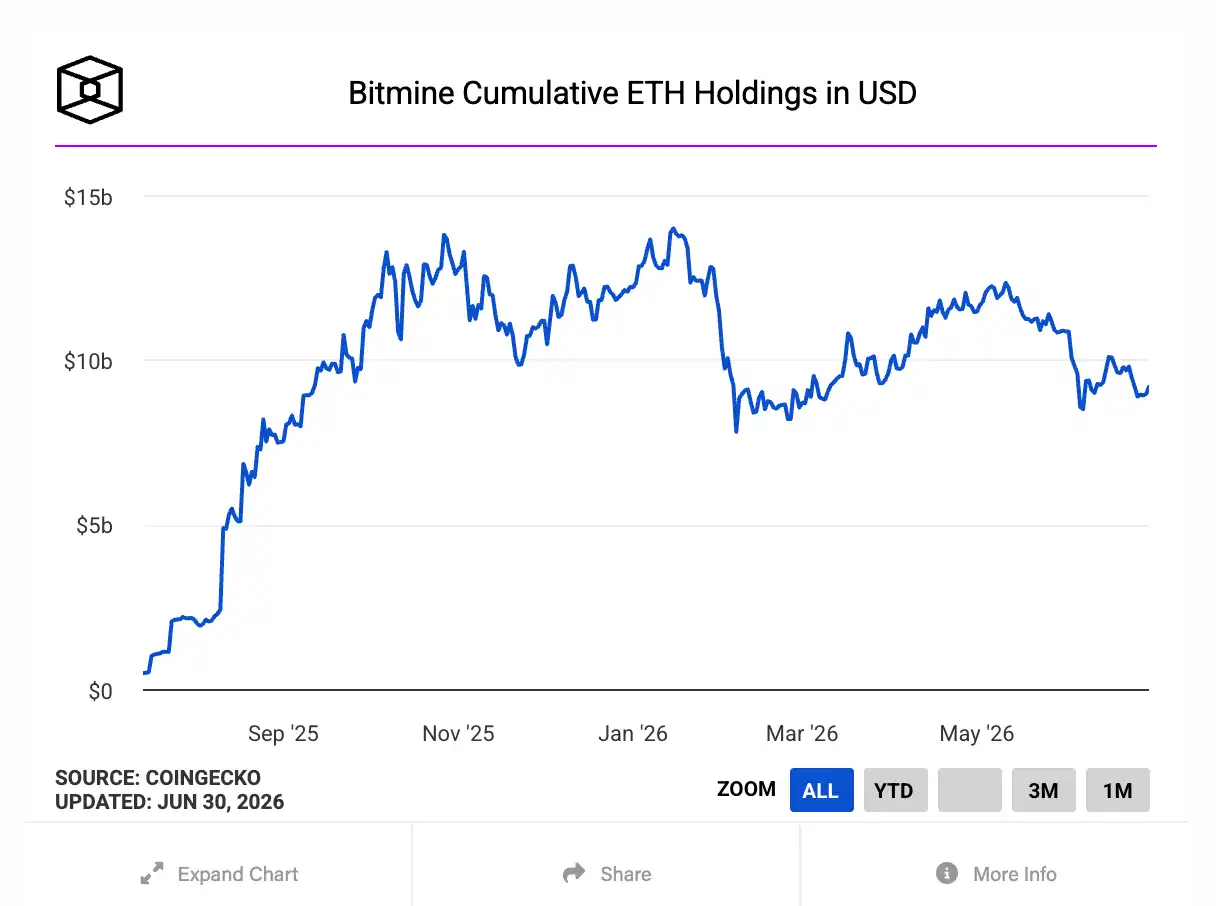
图注:Bitmine ETH 持仓增长情况

原文图表,数据来源 The Block

ETH 一周跌 8%,Lee 归因于季末调仓

「对加密投资者来说,过去这一周不好过,ETH 跌了 8%。哪怕这期间以太坊有不少利好,比如 Ethlabs 成立,连英格兰银行对稳定币的态度都软化了。」董事长 Tom Lee 说。

Lee 把价格走弱归结为季末的「橱窗粉饰」(window dressing),也就是投资者在季末抛掉过去三个月里下跌的资产、做账面好看。Bitmine 这周的买入节奏比上一周慢了下来,上周它一口气买了 52,203 枚 ETH。

「整个 2026 年,我们会保持稳定的买入节奏。」Lee 说,「我们认为现在还处在加密春天的早期。Bitmine 预计会在 2026 年内达成『5% 的炼金术』。」

纳入罗素 1000,Lee 看的是被动资金的再平衡

6 月 26 日,在罗素指数的年度成分股调整中,Bitmine 被纳入罗素 1000 大盘股指数。

Lee 说,这次纳入预计会把成百上千的机构投资者带进这只股票。原因是被动基金和 ETF 会按指数变动做再平衡——根据投资公司协会(ICI)的估算,这类资金通常持有一家公司 18% 到 20% 的流通股。

在 570 万枚 ETH 中,目前有 4,879,157 枚处于质押状态,按 6 月 28 日价格约值 77 亿美元。Lee 称,这部分质押的年化收入预计为 2.11 亿美元。

Lee 还提到,等到所有 ETH 通过 MAVAN(Bitmine 的机构级验证者网络)及其质押伙伴全部质押后,按 7 天年化 2.75% 的收益率算,预计年化质押奖励会升到 2.46 亿美元。

Bitmine 仍是全球最大的企业以太坊金库,也是整体规模第二大的企业加密金库。排在它前面的是 Strategy,后者持有 847,363 枚 BTC,价值约 500 亿美元(数据来自 The Block)。
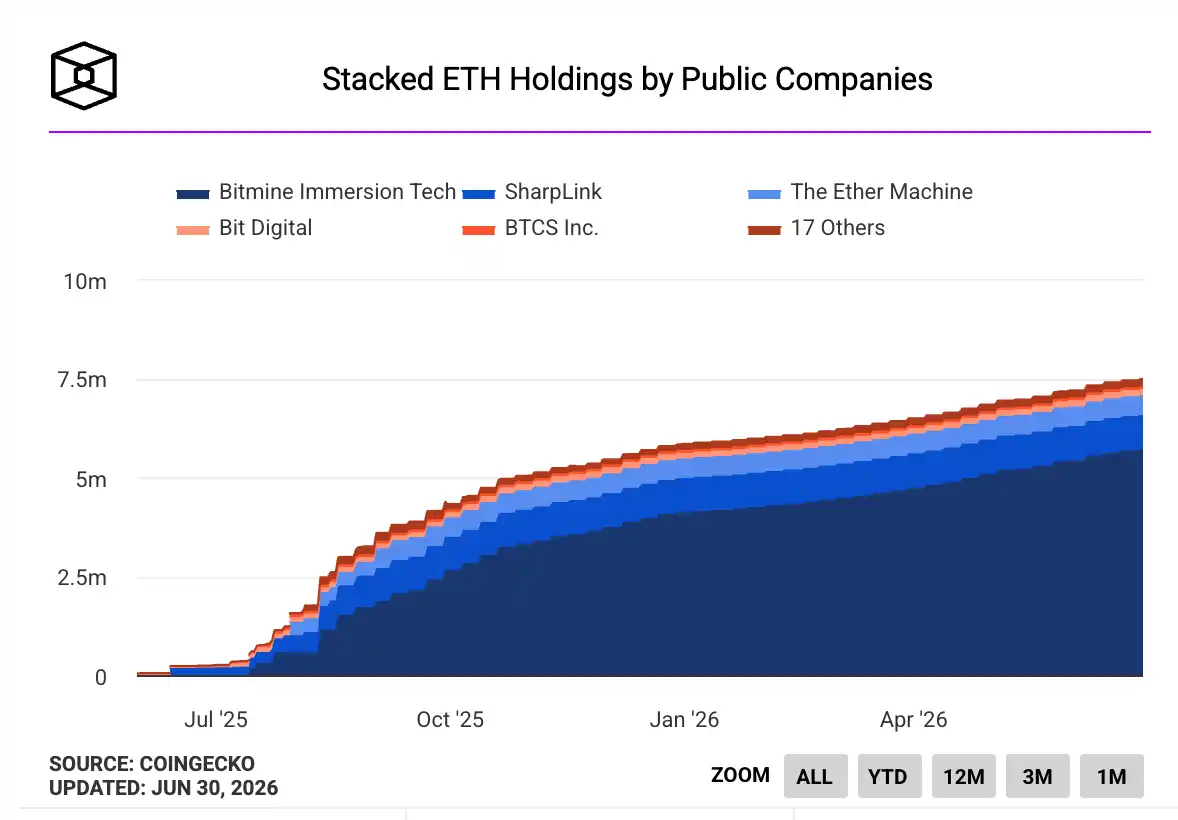
图注:企业加密金库规模排名

原文图表,数据来源 The Block

发稿时,ETH 价格约为 1,565 美元(据 The Block 价格页)。BMNR 周一报价约 13.56 美元,过去一周跌约 13%,较 52 周高点 161.00 美元已跌去九成以上。

Trending Cryptos

Related Questions

QBitmine 目前持有多少枚 ETH,占以太坊总供应量的百分之多少?

ABitmine 目前持有 5,700,040 枚 ETH,占以太坊总供应量的 4.7%。

QTom Lee 将过去一周 ETH 价格下跌的主要原因归结为什么?

ATom Lee 将过去一周 ETH 价格下跌的主要原因归结为季末的“橱窗粉饰”,即投资者在季末抛售表现不佳的资产以美化投资组合报表。

QBitmine 被纳入罗素 1000 指数,Tom Lee 认为这会带来什么影响?

ATom Lee 认为,被纳入罗素 1000 指数预计会为 Bitmine 带来成百上千的机构投资者,因为被动基金和 ETF 会依据指数变动进行资产再平衡,通常会持有指数成分股公司相当比例的流通股。

Q根据文章,Bitmine 持有的 ETH 中,有多少枚处于质押状态?预计年化质押收入是多少?

ABitmine 持有的 ETH 中,有 4,879,157 枚处于质押状态。按 6 月 28 日价格计算,这部分质押预计的年化收入为 2.11 亿美元。

Q在“企业加密金库规模排名”中,哪家公司排名第一,其持有的主要资产是什么?

A在“企业加密金库规模排名”中,排名第一的公司是 Strategy,其主要持有 847,363 枚 BTC,价值约 500 亿美元。

Related Reads

You Use Claude and Codex Every Day, but Meta Has Restricted Internal Use

In May, Meta imposed internal restrictions on its engineers regarding the use of Claude Code and Codex, two widely used AI programming tools. Despite being a major client, Meta's guidelines, still in effect, prohibit these external models from being used for specific tasks to prevent potential "escalations with partners." The core concern is "distillation"—the risk that outputs from Claude or Codex could inadvertently contaminate the training data and evaluation processes for Meta's in-house AI coding assistant, MetaCode. If MetaCode is trained or evaluated using data generated by these external models, it risks learning their capabilities rather than developing its own, blurring the line of intellectual origin. The restrictions are precise: engineers cannot use the external models to generate test questions, debug source code, or suggest test cases. AI-generated content is also barred from environments accessible to MetaCode. However, AI can still assist with peripheral tasks like workflow setup and code organization, provided all outputs are manually reviewed. This caution reflects a broader industry dilemma. While distillation is a common technique, using a competitor's model output for training raises legal and ethical questions about the ownership of derived capabilities. Contractual terms from companies like OpenAI and Anthropic explicitly forbid using their outputs to build competing products, putting enforcement power in the hands of rivals. The move is also financially motivated, as Meta seeks to reduce its hefty internal AI spending, estimated in the billions this year. Meta's policy illustrates the delicate balance companies must strike: leveraging powerful external AI tools while safeguarding the integrity and independence of their own AI development. As AI systems increasingly help build other AIs, distinguishing the origin of capabilities becomes a fundamental challenge for the entire industry.

marsbit1h ago

You Use Claude and Codex Every Day, but Meta Has Restricted Internal Use

marsbit1h ago

Why Do We Need an AI Content Perspective Today?

The article "Why Do We Need an AI Content Perspective Today?" explores the complex and often contentious integration of AI into the cultural and creative industries, particularly film and television. It begins with the cancellation of Amazon's AI-generated animation "Punky Duck," highlighting the ethical debates surrounding AI content. AI's rapid advancement is transforming video production, enabling cost-effective, full-length AI films (e.g., "RAPHAEL," "Dreams of Violets") while sparking industry resistance over issues like "synthetic actors." The core debate has shifted from whether to use AI to how to use it responsibly. The article analyzes why AI's entry into film is uniquely unsettling. It distinguishes between "cultural fast food" (short-form, fast-paced content like micro-dramas) and "cultural main courses" (traditional, long-form film/TV). AI currently excels at the former, matching its fragmented narratives, shallow emotional needs, and free-to-consumer models. However, venturing into the latter challenges the human-centric essence of storytelling—creativity, emotional depth, and the unique value of human labor and experience. While AI can generate massive volumes of content and lower costs, it risks devaluing human creativity, leading to homogenized output, and creating unfair competition through potential intellectual property infringement. Its efficiency also amplifies content safety risks, making preemptive governance crucial. To counter these risks, the article proposes establishing clear boundaries guided by a human-centered AI content perspective. It outlines four principles: 1) Amplify, rather than displace, human creative space; 2) Respect and protect human creative output; 3) Ensure human creative control and responsibility remain paramount; and 4) Guarantee transparency and traceability in AI creation. The conclusion emphasizes that humans must act as the "helmsmen" of technology, steering AI development to enhance, not replace, the core human values at the heart of cultural expression.

marsbit2h ago

Why Do We Need an AI Content Perspective Today?

marsbit2h ago

Trading

Spot

Hot Articles

Discussions

Welcome to the HTX Community. Here, you can stay informed about the latest platform developments and gain access to professional market insights. Users' opinions on the price of ETH (ETH) are presented below.

活动图片