CFTC AS Lanjutkan Investigasi Luas terhadap Polymarket, Musim Pesta Pasar Prediksi Akan Berakhir?

marsbitPublished on 2026-06-30Last updated on 2026-06-30

Abstract

Platform prediksi Polymarket kini sedang diselidiki secara luas oleh CFTC AS, menyusul tuduhan pemasaran menipu dan promosi produk mirip perjudian kepada pengguna AS. Investigasi ini terjadi di tengah lonjakan volume perdagangan pasar prediksi, didorong oleh Piala Dunia, dengan platform seperti Kalshi dan Polymarket mencatat pertumbuhan pesat. Pemeriksaan CFTC menandai potensi berakhirnya fase ekspansi liar industri ini, dengan regulator diperkirakan akan memperketat aturan pemasaran, konten kontrak, dan perlindungan investor. Konflik yurisdiksi juga memanas antara regulator federal (CFTC) dan otoritas negara bagian AS (seperti Kentucky), yang memperdebatkan apakah pasar prediksi termasuk dalam kategori derivatif komoditas federal atau perjudian ilegal tingkat negara bagian. Perselisihan ini melibatkan kepentingan pajak negara bagian dan batasan definisi regulasi. Sementara itu, ketegangan juga muncul antara CFTC dan bursa tradisional seperti CME, yang menggugat persetujuan CFTC atas kontrak berjangka Kalshi. Di balik layar, keluarga Trump, melalui Donald Trump Jr., memiliki kepentingan investasi di kedua platform utama (Kalshi dan Polymarket), menjembatani hubungan antara modal dan regulator. Intinya, penyelidikan terhadap Polymarket mungkin merupakan langkah penertiban dalam perjalanan industri pasar prediksi menuju fase pertumbuhan yang lebih matang dan teregulasi.

Original|Odaily Planet Daily (@OdailyChina)

Penulis|Wenser(@wenser2010 )
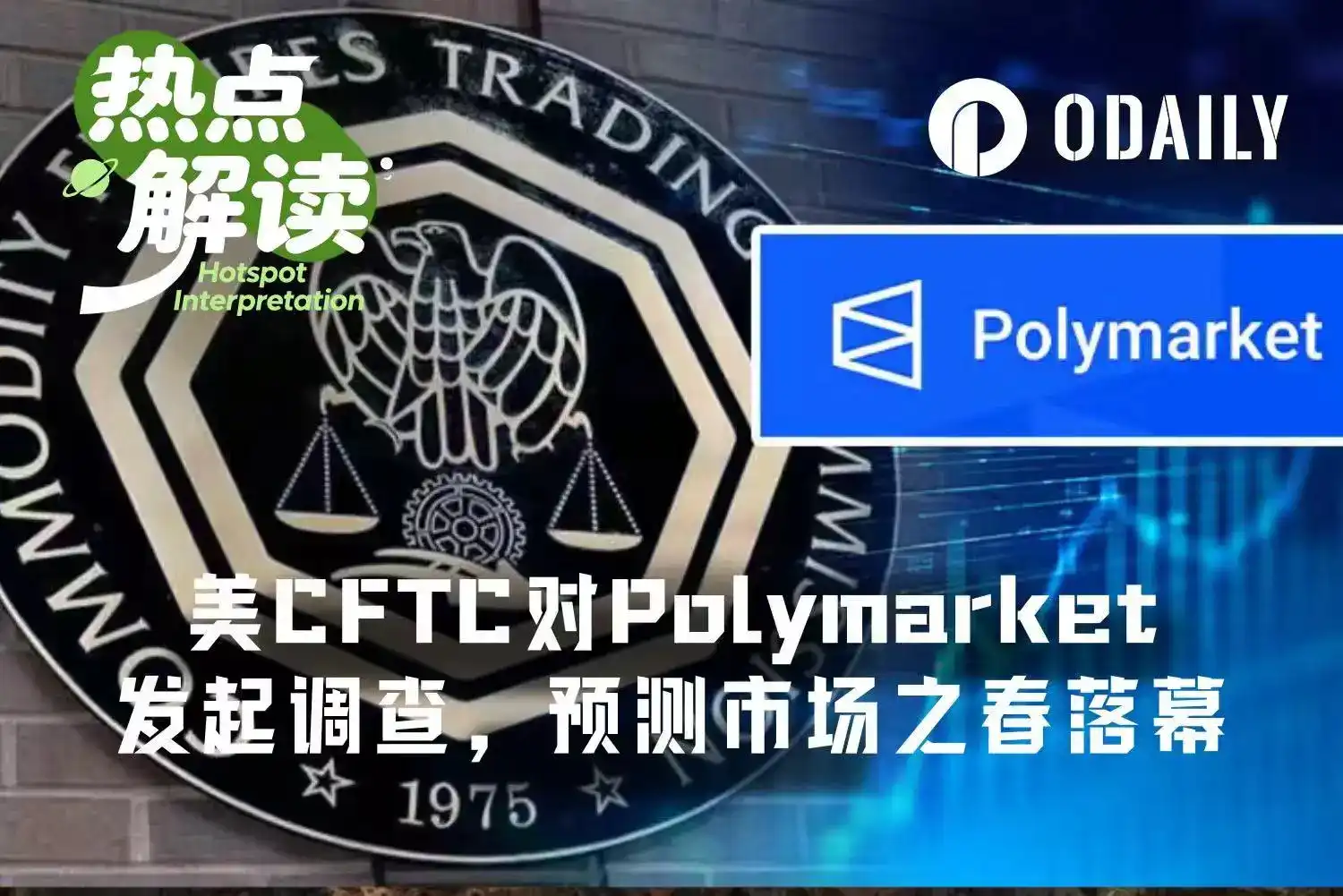
Pemasaran palsu Polymarket akhirnya menarik perhatian palu regulator.

Baru-baru ini, Komisi Perdagangan Berjangka Komoditas AS (CFTC) melakukan investigasi luas terhadap platform pasar prediksi Polymarket, mencakup aktivitas media sosialnya dan aspek bisnis lainnya. Sebelumnya, Senator Republik AS John Curtis dan Senator Demokrat Adam Schiff secara bersama-sama mengirim surat kepada Ketua CFTC AS Mike Selig, mendesak penyelidikan terhadap tindakan Polymarket membayar KOL untuk pemasaran palsu dan menggunakan taktik pemasaran curang untuk mempromosikan produk mirip perjudian kepada audiens AS.

Di tengah volume perdagangan pasar prediksi yang terus meningkat didorong oleh Piala Dunia, langkah ini mungkin akan mendinginkan perkembangan sektor ini. Yang lebih penting, investigasi CFTC terhadap Polymarket mengungkapkan konflik kepentingan antara pemerintah federal dan negara bagian AS, serta antara pejabat dan modal. (Baca rekomendasi: WSJ: Situs Web Palsu, Transaksi Palsu, Promosi Asli, Skema Popularitas Polymarket).

Berakhirnya Era Liar Pemasaran Pasar Prediksi, Kebijakan Regulatori atau Masuk ke Fase Mendalam

Jika sebelumnya kasus Polymarket yang melibatkan mahasiswa memposting video keuntungan palsu dan membayar KOL untuk membesar-besarkan keuntungan prediksi adalah upaya liar ekspansi awal pasar prediksi, maka investigasi resmi oleh CFTC AS adalah bukti nyata berakhirnya fase pertumbuhan liar pasar prediksi.

Data Platform Pasar Prediksi Mengalami Pertumbuhan Eksplosif, Raksasa Internet Tradisional Memberikan Perhatian Serius

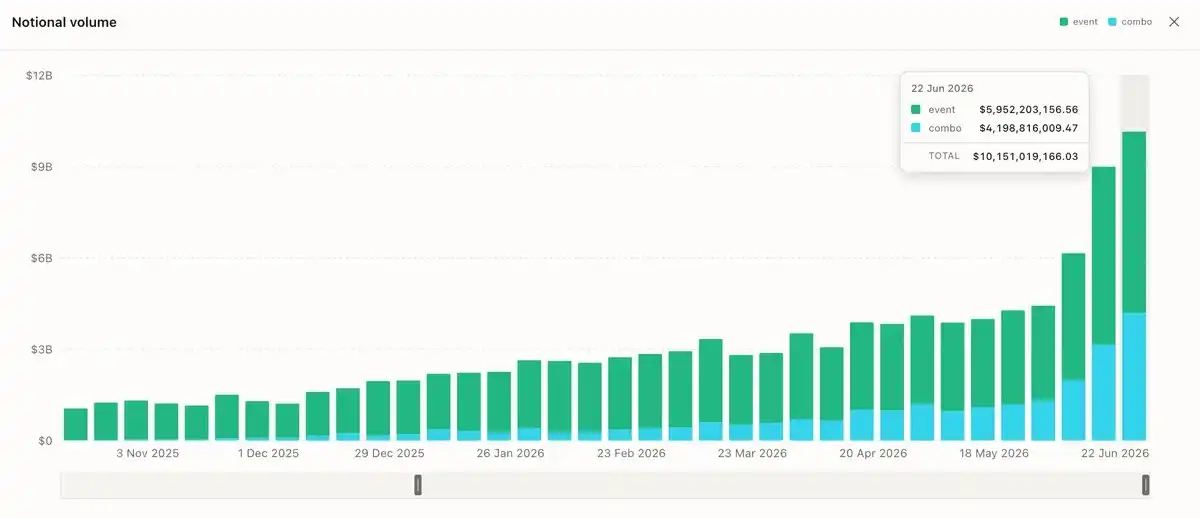
Memasuki Juni 2026, seiring dimulainya Piala Dunia resmi, pasar prediksi mendapat perhatian yang belum pernah terjadi sebelumnya, dan volume perdagangan pun terus meroket.

Data a16z crypto menunjukkan bahwa volume perdagangan pasar prediksi telah mencapai rekor tertinggi baru untuk ketiga minggu berturut-turut. Volume pasar total dua minggu lalu untuk pertama kalinya mencapai $144 miliar, meningkat signifikan dari sekitar $50-60 miliar di awal tahun, sementara rekor tertinggi sebelumnya sekitar $100 miliar baru saja diperbarui seminggu sebelumnya. Dari sisi platform, data mereka juga mengalami peningkatan besar:

  • Data terbaru menunjukkan, volume perdagangan nominal mingguan Kalshi untuk pertama kalinya menembus $100 miliar.
  • Polymarket secara resmi menyatakan, pendapatan tahunannya telah jauh melebihi $10 miliar, kemajuan ini hanya enam minggu setelah platform perdagangan AS-nya menghapus daftar tunggu; data menunjukkan, volume perdagangan harian platform AS telah tumbuh dari sekitar $50 juta pertengahan Mei menjadi lebih dari $200 juta pada 20 Juni (berdasarkan data Dune Analytics).
  • Bisnis platform pasar prediksi anak perusahaan Robinhood berkembang pesat, pendapatan tahunan telah mencapai $5 miliar. Hingga 25 Juni pada kuartal Q2, volume kontrak aktif Robinhood mencapai sekitar 12,3 miliar transaksi. Dengan tarif standar 1 sen per kontrak, pendapatan pasar prediksi kuartal ini diperkirakan setidaknya $123 juta. Platform pasar prediksi Rothera yang baru diluncurkan baru-baru ini mencapai volume perdagangan lebih dari 900 juta transaksi di minggu pertama, memberikan Robinhood pertumbuhan volume kontrak aktif hampir 60%.
Data yang begitu cemerlang juga menarik perhatian raksasa saham AS, Meta. Menurut pemberitaan media, CEO Meta Mark Zuckerberg telah mendesak perusahaan untuk mengeksplorasi kemitraan dengan pasar prediksi Polymarket dan Kalshi. Sementara itu, Meta sedang mengembangkan aplikasi serupa pasar prediksi bernama Arena.

Berbagai tanda menunjukkan bahwa pasar prediksi telah melompat dari sektor niche beberapa tahun lalu menjadi industri populer yang berkembang secara eksponensial. Menghadapi tren ini, otoritas pengawas pasti tidak akan tinggal diam, dan insiden pemasaran palsu yang baru-baru ini meledak di Polymarket, ibarat "pisau tumpul" yang tepat, memberikan peluang bagi intervensi regulator. Penulis berpendapat, ke depan otoritas pengawas mungkin akan secara bertahap memperjelas batas pengawasan terhadap platform pasar prediksi dalam hal pemasaran, konten kontrak acara, dan biaya perdagangan, dengan tujuan memperkuat perlindungan investor, dan membuat garis pemisah yang jelas dengan bisnis perjudian tradisional.

Sementara itu, seiring penyelidikan yang mendalam, tarik-menarik wewenang antara lembaga regulator federal yang diwakili oleh CFTC AS dan otoritas regulator tingkat negara bagian juga semakin terlihat.

Ketika CFTC AS Berhadap-hadapan dengan Sembilan Negara Bagian AS: Perang Perebutan Kekuasaan Pengawasan Pasar Prediksi

Selasa lalu, CFTC AS secara resmi mengajukan gugatan terhadap Negara Bagian Kentucky, berusaha menegaskan kembali yurisdiksi lembaga tersebut atas platform pasar prediksi.

Dalam gugatan yang diajukan ke Pengadilan Distrik Federal Distrik Timur Kentucky, CFTC AS menyatakan bahwa upaya Kentucky untuk menutup pasar kontrak yang ditunjuk dan diatur federal telah mengganggu sistem pengaturan federal yang ditetapkan Kongres untuk pasar swap nasional. Mereka mengklaim memiliki "yurisdiksi eksklusif" atas kontrak acara terkait dan produk pasar prediksi.

Sebelumnya, Kentucky menggugat platform seperti Kalshi dan Polymarket, menuduh mereka menjalankan bisnis taruhan olahraga dan perjudian ilegal yang tidak berizin di dalam negara bagian. Hingga Juni, lebih dari 12 negara bagian AS termasuk Kentucky dan New York telah mengambil tindakan hukum terhadap Polymarket dan Kalshi, menuduh mereka menjalankan taruhan olahraga ilegal. Kentucky telah menjadi negara bagian kesembilan yang digugat oleh CFTC dalam perselisihan pengawasan pasar prediksi.

Tindakan ini menyoroti bahwa konflik antara regulasi derivatif federal dan regulasi perjudian negara bagian terus meningkat.

Ada dua penyebab utama di balik perselisihan ini:

  • Pertama, adalah kepentingan praktis seperti pajak industri perjudian daerah negara bagian. Sebelumnya, taruhan olahraga tradisional memberikan pendapatan pajak besar (misalnya, taruhan online dengan tarif pajak tinggi) ke berbagai daerah. Jika pasar prediksi sepenuhnya menggantikan industri perjudian, potensi kerugian pajak tahunan setiap negara bagian bisa mencapai ratusan juta dolar (sekitar $600 juta).
  • Kedua, adalah definisi batas pengawasan antara industri perjudian dan pasar prediksi sebagai industri baru. Yang ingin dipertahankan oleh CFTC AS adalah memasukkan "kontrak acara" ke dalam kategori derivatif komoditas, futures, atau swaps, menerapkan kebijakan supremasi hukum federal.

Bagaimana hasil akhir dan definisi spesifiknya, mungkin bergantung pada interpretasi dan penilaian pengadilan negara bagian hingga Mahkamah Agung AS terhadap Undang-Undang Perdagangan Komoditas (Commodity Exchange Act, CEA).

Selain itu, perselisihan antara bursa dan CFTC AS juga telah menyala. Sebelumnya CFTC telah menyetujui aplikasi perdagangan futures perpetual Kalshi, tindakan ini memicu gugatan CME Group terhadap yang pertama —

Diketahui, CME Group telah menggugat Komisi Perdagangan Berjangka Komoditas AS dan ketuanya, Michael Selig, di Pengadilan Distrik Federal Distrik Columbia, AS. Terkait persetujuan CFTC pada 29 Mei terhadap platform pasar prediksi Kalshi untuk meluncurkan kontrak futures perpetual yang terkait dengan harga spot Bitcoin, antara lain, CFTC memperlakukan "futures" dengan tanggal jatuh tempo sebagai "swap", yang melanggar instruksi Kongres AS dan Undang-Undang Perdagangan Komoditas, dan meminta pengadilan membatalkan tindakan futures perpetual terkait. CME juga menyatakan, Selig mengambil tindakan sepihak dalam kondisi kurangnya panel lengkap lima komisioner.

Juru bicara CFTC menanggapi, CME mengambil "perang hukum" terhadap lembaga tersebut dan kebijakan kripto pemerintah, "tindakan mengajukan gugatan sangat gegabah." (Hampir menuliskan "kasusmu terlalu terburu-buru" di dahinya)

Tentu, tidak heran CME begitu meradang, karena tindakan CFTC AS membuka perdagangan kontrak perpetual kripto Kalshi telah membuat platform pasar prediksi seperti Kalshi dan bursa kripto seperti Coinbase, Kraken memasuki "wilayah perdagangan" mereka. Adapun kekuatan pendorong di baliknya, mungkin juga terkait dengan keluarga Trump.

"Metode Taruhan Ganda" Keluarga Trump di Pasar Prediksi: Trump Jr. Bertaruh pada Kalshi dan Polymarket

Belum lama ini, Kalshi dikabarkan sedang merundingkan putaran pendanaan baru dengan valuasi sekitar $40 miliar, transaksi kemungkinan tercepat selesai pada Q3. Setelah baru menyelesaikan pendanaan $10 miliar pada Mei (investor termasuk Sequoia Capital, Andreessen Horowitz, Coatue, dan Morgan Stanley), valuasi Kalshi naik dari sebelumnya $12 miliar menjadi $22 miliar, dan sekarang, angka ini akan berlipat ganda.

CEO Kalshi Tarek Mansour menyatakan, perusahaan sedang mempertimbangkan IPO tidak lebih awal dari akhir 2027 atau 2028. Kalshi secara resmi menyatakan, hingga April 2026, volume perdagangan tahunannya mencapai $178 miliar, meningkat 32 kali lipat year-on-year.

Data pasar yang begitu cemerlang dan sambutan hangat dari pasar modal, sulit dikatakan tidak ada hubungannya dengan salah satu tokoh penting keluarga Trump, Donald Trump Jr.

Diketahui, Trump Jr. di sektor pasar prediksi seolah "makan di dua tempat":

Di satu sisi, dia menjabat sebagai penasihat strategis berbayar di Kalshi awal tahun 2025, dan bahkan mendapatkan sekitar $300.000 ekuitas perusahaan, saat itu valuasi Kalshi kurang dari $2 miliar, hanya investasi ini saja sudah memberikan keuntungan lebih dari 10 kali lipat;

Di sisi lain, dia juga menjabat sebagai penasihat di Polymarket, dan melakukan investasi strategis di perusahaan terakhir melalui perusahaan modal ventura tempatnya menjadi mitra, 1789 Capital.

Ditambah Trump sebelumnya telah berulang kali menekankan kekuasaan pengawasan departemen pemerintah federal atas pasar prediksi, dan bahkan pernah menyebut: "Kalshi dan Polymarket akan berkembang pesat di bawah kepemimpinannya."

Pada tingkat tertentu, konflik kepentingan antara modal dan lembaga regulator resmi menjadi mereda berkat ini; dan keluarga Trump adalah "pelumas terbaik" dalam peristiwa kontradiksi ini.

Dengan demikian, jaringan kepentingan yang menghubungkan lembaga regulator federal seperti CFTC AS, negara bagian AS, dan lembaga investasi keluarga Trump perlahan terbentuk.

Adapun kegiatan investigasi CFTC terhadap Polymarket, mungkin hanyalah jalan yang harus dilalui untuk menstandarkan industri pasar prediksi.

"Musim Semi" pasar prediksi yang tumbuh liar akan segera berakhir, sementara "Musim Panas" yang makmur untuk industri pasar prediksi perlahan datang.


Trending Cryptos

Related Questions

QApa alasan utama CFTC menyelidiki Polymarket?

ACFTC menyelidiki Polymarket atas dugaan praktik pemasaran palsu dan menyesatkan. Investigasi ini mencakup kegiatan di media sosial dan cara mereka mempromosikan produk yang dianggap sebagai bentuk perjudian kepada masyarakat AS.

QBagaimana pertumbuhan pasar prediksi baru-baru ini berdasarkan data dalam artikel?

APasar prediksi mengalami pertumbuhan eksponensial. Volume perdagangan mingguan mencapai rekor baru sebesar $144 miliar pada pertengahan 2026. Platform seperti Kalshi dan Polymarket juga mencatat volume dan pendapatan yang meningkat signifikan, didorong oleh acara besar seperti Piala Dunia.

QApa konflik antara regulator federal (CFTC) dan pemerintah negara bagian AS terkait pasar prediksi?

AAda konflik yurisdiksi antara CFTC (badan federal) yang menganggap kontrak peristiwa sebagai derivatif komoditas, dengan negara bagian (seperti Kentucky) yang menganggap operasi platform seperti Polymarket dan Kalshi sebagai perjudian ilegal. Negara bagian khawatir kehilangan pendapatan pajak dari taruhan olahraga tradisional.

QApa peran Donald Trump Jr. dalam industri pasar prediksi seperti yang dijelaskan dalam artikel?

ADonald Trump Jr. berperan sebagai penasihat berbayar untuk Kalshi (memegang saham senilai sekitar $300,000) dan juga penasihat serta investor di Polymarket melalui perusahaan modal ventura miliknya. Ini menciptakan jaringan kepentingan yang menghubungkan industri, modal, dan arena politik.

QApa tindakan hukum yang diambil oleh CME terhadap CFTC dan apa alasannya?

ACME menggugat CFTC karena menyetujui aplikasi Kalshi untuk memperdagangkan kontrak berjangka abadi (perpetual futures) yang terkait dengan harga spot Bitcoin. CME berargumen bahwa keputusan CFTC melanggar undang-undang dengan memperlakukan 'kontrak berjangka' sebagai 'swap', dan tindakan ini dianggap menyerang wilayah bisnis utama CME.

Related Reads

YouTube Crypto Channel Views Drop 70% by 2026, Retail Attention Crisis Reshaping Next Cycle

Major cryptocurrency YouTube channels are experiencing a severe decline in viewership, signaling a potential crisis in retail investor attention for the next market cycle. Analysis of six top channels shows monthly view counts have plummeted 27% to 79% compared to January 2025, with four channels down approximately 75%. While subscriber counts remain high (e.g., Coin Bureau with 2.72M, Altcoin Daily with 1.65M), current engagement tells a different story. Recent 30-day view counts are significantly lower: Coin Bureau at 1.24M views, Crypto Banter at 1.06M, with Altcoin Daily and Benjamin Cowen performing relatively better at 1.79M and 1.8M respectively. The core issue is that subscriber numbers are cumulative and reflect past interest, while views measure current demand. The dramatic drop indicates a fragmented and more selective retail audience. This contrasts sharply with the 2021 bull market, where channels reportedly garnered 3-4 million daily views. Now, daily views for major channels range from roughly 35,000 to 60,000. This divergence suggests a new type of market cycle. Bitcoin's price can be sustained by ETFs and institutional activity, but without strong retail engagement via content channels, the dynamics of the next bull run will be fundamentally different. The real signal for a retail resurgence will be a sustained increase in daily and monthly view counts, not subscriber growth. If viewership fails to recover, long-form YouTube content may become a lagging indicator, with retail attention shifting to other, faster formats.

marsbit39m ago

YouTube Crypto Channel Views Drop 70% by 2026, Retail Attention Crisis Reshaping Next Cycle

marsbit39m ago

Confirmed: Claude Code Secretly Inspects Users, Time Zone and Chinese AI Labs Are Key Factors

Today was a significant day for Anthropic. The company announced the launch of Claude Sonnet 5, described as its most agentic model yet, and separately confirmed that the U.S. Department of Commerce has lifted export controls on its Claude Fable 5 and Mythos 5 models, allowing their distribution to resume. However, a separate controversy has emerged regarding its coding assistant, Claude Code. Developers have exposed that certain versions of the tool allegedly contain hidden code designed to detect specific user data. This code reportedly checks for the use of Chinese time zones (like Asia/Shanghai), the presence of custom API proxy URLs, and connections to domains associated with Chinese tech companies and AI labs. If triggered, this information is said to be encoded into the system prompt sent to the AI cloud, using subtle, nearly indistinguishable variations in characters (like different Unicode apostrophes in the "Today's date" line) as a form of steganography. The core issue is the covert nature of this data collection. While telemetry for security and abuse prevention is common, implementing it through hidden channels within the prompt—without user awareness or documented disclosure—fundamentally breaches trust. This is particularly sensitive for a coding assistant that operates with access to source code and system commands. Following the exposure, an Anthropic engineer acknowledged the code's existence and stated it would be removed in an upcoming release. The incident raises serious questions about transparency and the boundaries of data collection in AI developer tools.

marsbit1h ago

Confirmed: Claude Code Secretly Inspects Users, Time Zone and Chinese AI Labs Are Key Factors

marsbit1h ago

Grayscale: After Halving, BTC is Nearing the Bottom of This Cycle

Grayscale Research suggests Bitcoin's recent decline below $60,000, a >50% drop from its October peak, represents a cyclical correction within a long-term uptrend rather than a trend reversal. Key factors behind the pullback include a shift in market expectations toward Federal Reserve rate hikes under new Chair Kevin Warsh, uncertainty around the CLARITY Act's Senate passage, pressure on leveraged entities like Strategy, and concerns over quantum computing risks. The path out of the current bear market hinges on upcoming catalysts. An optimistic scenario, where the CLARITY Act passes, leverage is contained, and the Fed refrains from hiking, could mean Bitcoin is nearing its cycle bottom. A pessimistic scenario, featuring legislative failure, further deleveraging, and Fed rate hikes, could lead to additional moderate downside. Grayscale does not expect a historically deep ~80% drawdown due to a more measured prior bull run and stickier institutional demand. Despite short-term headwinds, Grayscale remains highly optimistic about crypto's long-term structural prospects, driven by institutional adoption of public blockchains, unsustainable government debt, declining trust in intermediaries, and AI's potential demand for alternative systems. The report concludes that while the exact cycle low depends on near-term catalysts, current valuations present an attractive entry point for long-term investors betting on the decade-ahead growth of digital assets.

marsbit1h ago

Grayscale: After Halving, BTC is Nearing the Bottom of This Cycle

marsbit1h ago

Web3 Bear Market Survival Guide: Ten Great Books to Help You Navigate the Cycles

"Web3 Bear Market Survival Guide: Ten Books to Help You Navigate the Cycle" This article presents a curated book list aimed at helping Web3 enthusiasts and professionals endure and grow during crypto market downturns. It argues that bear markets are not just periods of waiting but crucial times for deepening one's foundational understanding beyond technical whitepapers and price charts. The ten recommended books offer perspectives on technology, economics, philosophy, and strategy to build resilience and long-term vision. The list includes: 1. **"The Inevitable" by Kevin Kelly:** For using a long-term technological lens to combat uncertainty about the future, including the role of crypto and AI. 2. **"Human Action" by Ludwig von Mises:** To upgrade one's economic and philosophical framework, understanding action, speculation, and calculation in a bear market context. 3. **"The Nature of Technology" by W. Brian Arthur:** For viewing blockchain and crypto as combinatorial evolutions of existing technologies, understanding their modular and economic development. 4. **"The Distant Savior" (Chinese novel):** Explores the cultural attributes of self-reliance ("strong culture") versus dependency ("weak culture"), crucial for surviving industry cycles. 5. **"The Sovereign Individual" by James Dale Davidson & Lord William Rees-Mogg:** A prophetic 1997 work on how technology empowers individuals and challenges nation-states, foreshadowing Bitcoin's emergence. 6. **"Japanization: What the World Can Learn from Japan's Lost Decades" (Adapted title):** Uses Japan's economic history as a case study to identify structural opportunities that persist even during broader recessions. 7. **"Denationalisation of Money" by F.A. Hayek:** The ideological blueprint for Bitcoin, arguing for competitive currency issuance beyond state monopoly. 8. **"Duan Yongping Investment Q&A" (Chinese compilation):** Emphasizes the simple discipline of "doing the right things and doing things right," focusing on fundamentals and maintaining a "stop doing list." 9. **"The Network State: How To Start a New Country" by Balaji Srinivasan:** A visionary text from a crypto insider outlining bold predictions and concrete ideas for a blockchain-based future across media, governance, and identity. 10. **"Selected Works of Mao Zedong" (Vol. 1):** Analyzed as a strategic playbook for a weak force challenging a powerful establishment, offering lessons on strategy, alliance-building, and perseverance for the crypto movement. The conclusion states that bear markets filter out those with weak conviction, not weak skills. Survival depends on cognitive depth and mental fortitude, which these books aim to provide.

Foresight News2h ago

Web3 Bear Market Survival Guide: Ten Great Books to Help You Navigate the Cycles

Foresight News2h ago

Trading

Spot

Hot Articles

What is LINON

Linde plc Tokenized Stock (Ondo): Revolutionizing Traditional Equity Access Through Blockchain Innovation The emergence of Linde plc Tokenized Stock (Ondo), represented by the ticker $LINON, signifies a monumental shift in the fusion of traditional financial structures and decentralized finance (DeFi). This innovative financial instrument showcases the tremendous potential of blockchain technology to democratize access to traditional equity markets while ensuring the security and regulatory compliance necessary for institutional-grade financial products. Through Ondo Finance's pioneering tokenization platform, $LINON provides a seamless pathway for global investors to engage with one of the world's leading industrial gas companies, Linde plc, creating a blockchain-native representation of the underlying equity. Introduction to Linde plc Tokenized Stock The landscape of financial markets is witnessing a groundbreaking transformation through the tokenization of real-world assets. Linde plc Tokenized Stock (Ondo) epitomizes this revolutionary approach by bridging the gap between conventional stock ownership and blockchain-enabled financial infrastructure. The $LINON token allows investors to gain exposure to one of the prominent industrial companies worldwide through decentralized technology. Operating within Ondo Finance's comprehensive ecosystem, $LINON symbolizes a practical application of tokenization technology that enhances accessibility, efficiency, and global connectivity in traditional financial markets. By leveraging blockchain infrastructure, this tokenized stock enables international investors to participate in U.S. equity markets, overcoming traditional barriers associated with cross-border investing. The significance of $LINON goes beyond technological innovation; it represents a fundamental shift in asset structuring, distribution, and trading in the digital age. This tokenized stock maintains all the economic benefits associated with traditional Linde plc shares while offering improved liquidity, programmable compliance features, and seamless integration with decentralized finance protocols. The development of $LINON indicates a growing acceptance of blockchain technology as a viable means for traditional finance, exemplifying how even well-established assets like Linde plc can integrate into blockchain systems. This approach preserves the core attributes that appeal to investors while introducing advanced capabilities that enhance the overall investment proposition. Project Overview and Objectives Linde plc Tokenized Stock (Ondo) encapsulates a strategic effort to democratize access to traditional equity markets through advanced blockchain technologies. The primary objective of $LINON is to provide approved global investors seamless access to the economic exposure associated with Linde plc shares, furthering an effort to create a more inclusive financial ecosystem. Beyond the digital representation of traditional assets, $LINON endeavors to eliminate barriers of geography and time zones that limit investor participation. Its design ensures that blockchain technology can elevate traditional investment vehicles without undermining the security or compliance requirements expected by investors. Key goals of the project include enhanced liquidity provision, programmable compliance mechanisms, and interoperability with other blockchain networks. Each $LINON token is fortified by actual Linde plc securities housed at U.S.-registered broker-dealers, allowing holders to reap economic advantages akin to traditional stockholders, such as dividend reinvestment. Furthermore, $LINON aims to establish new industry standards for institutional-grade tokenized securities, paving the way for traditional assets to embrace blockchain technology while remaining compliant with regulatory frameworks. By associating itself with a company as reputable as Linde plc, the project opens avenues for exploring tokenized equities catering to both conservative institutional players and daring retail investors. Project Creator and Development Team The vision for Linde plc Tokenized Stock (Ondo) comes from Nathan Allman, founder and CEO of Ondo Finance. His background in traditional finance coupled with expertise in blockchain technology positions him uniquely to navigate the complexities of asset tokenization. Allman's academic journey began at Brown University, focusing on Economics and Biology, equipping him with valuable analytical skills. His time at Goldman Sachs in the Digital Assets division strengthened his understanding of the interplay between financial institutions and emerging technologies, laying the groundwork for his later endeavors in alternative investment strategies. Under Allman's guidance, Ondo Finance has emerged as a leader in asset tokenization, launching $LINON as a flagship example of the company's larger mission towards revolutionizing traditional financial systems using blockchain technology. His commitment to leveraging blockchain for creating institutional-grade financial products has shaped the landscape of real-world asset tokenization. Investment and Funding Structure The growth of Ondo Finance, the platform powering Linde plc Tokenized Stock (Ondo), is bolstered by robust financial backing from prestigious venture capital firms and strategic investors. This strong investment foundation underpins the development of the key infrastructure essential for compliant tokenized securities like $LINON. In August 2021, Ondo Finance secured $4 million in seed funding led by a major venture capital firm, which enabled the company to commence platform development and establish the necessary regulatory processes for tokenizing real-world assets. This early investment cemented Ondo Finance's credibility within the industry. The Series A funding round followed, garnering $20 million with participation from renowned firms committed to transformative technology companies. This backing demonstrated substantial institutional confidence in Ondo Finance's vision, allowing it to hone its approach to asset tokenization through mechanisms that ensure compliance and accessibility. Noteworthy contributors, including institutional investors and experienced partners, have added significant value to Ondo Finance’s development efforts. Their involvement underscores the confidence across sectors in Ondo Finance's approach to bridging traditional finance with blockchain innovations. Technical Infrastructure and Innovation The technical architecture that underpins Linde plc Tokenized Stock (Ondo) represents a sophisticated melding of traditional finance systems and cutting-edge blockchain technology. The architecture's foundation is built on the Ethereum network, renowned for its security and programmability—both critical for intricate financial instruments. The $LINON tokenization process comprises creating a blockchain-native representation of Linde plc shares that preserves economic benefits while augmenting investor capabilities. Each token corresponds to actual shares held at U.S.-registered broker-dealers, creating a compliant custody structure that legitimizes the asset's existence and value. Automated compliance systems are integrated into the tokenization process, managing critical components such as know-your-customer (KYC) verification and anti-money laundering (AML) protocols. This incorporation of programmable compliance empowers $LINON to uphold regulatory standards essential for institutional proliferation. Cross-chain interoperability characterizes the advanced technical features of $LINON. While initially deployed on Ethereum, the framework is designed for expansion to other networks such as Solana and BNB Chain. This adaptability enhances liquidity and accessibility, allowing investors to select their preferred blockchain ecosystems. Historical Timeline and Development Crafting the history of Linde plc Tokenized Stock (Ondo) unfolds in parallel with the evolution of Ondo Finance's tokenization platform. The timeline's inception dates back to March 2021 when Nathan Allman laid the foundations for creating institutional-grade financial products on blockchain infrastructure. The initial funding round in August 2021 provided crucial resources for developing the platform and establishing partnerships necessary for effective tokenization. By January 2023, Ondo Finance launched its tokenized treasury products, establishing mechanisms that would facilitate future tokenized equities such as $LINON. A pivotal milestone arose in February 2025 when Ondo Chain—a Layer 1 blockchain designed specifically for asset tokenization—was introduced. This infrastructure enhances capabilities vital for institutional markets, demonstrating Ondo Finance's long-term commitment to tokenization. Subsequently, the launch of Ondo Global Markets in September 2025 marked the official debut of $LINON. This milestone showcased the successful transition from development to active trading, enabling investors around the world to access American financial markets seamlessly. Ongoing development plans include a targeted expansion of available tokenized assets to over 1,000 by the end of 2025, pointing to a bright future for Ondo Finance's ecosystem and its mission to broaden tokenized equity accessibility. Regulatory Compliance and Legal Framework The legal architecture governing Linde plc Tokenized Stock (Ondo) emphasizes a sophisticated approach to regulatory compliance, allowing tokenized securities to be implemented within a blockchain-based framework. The legal structure governing $LINON spans multiple jurisdictions while maintaining a robust legal footing. Compliance systems ensure that only eligible investors can access the token, enforced through automated verification that aligns with international regulations. This innovative regulatory technology promises real-time enforcement of complex requirements, considerably enhancing efficiency in operating within the regulatory landscape. The custody framework undergirding $LINON ensures that the underlying shares are securely held at U.S.-registered broker-dealers, complying with necessary regulations while delivering blockchain-driven access to investors. The token maintains its economic equivalency and security through this carefully structured custody arrangement. KYC and AML compliance systems are embedded within the smart contract architecture, ensuring integrity and adherence to regulatory practices while fostering transparency for investors. The jurisdictional restrictions mark a commitment to navigating the evolving landscape of international securities laws. Market Impact and Industry Significance The advent of Linde plc Tokenized Stock (Ondo) holds profound implications for the broader financial landscape, symbolizing a clear shift towards blockchain-enabled markets. $LINON serves as a proof-of-concept for integrating traditional companies into blockchain ecosystems, showcasing the potential benefits such as broader accessibility and improved efficiency. The market's response to $LINON indicates a growing acceptance of tokenization among institutional investors, contributing to the emergence of an expanding sector wherein traditional assets can be interconnected with blockchain innovations. The success of $LINON further solidifies market confidence, indicating an overarching shift towards recognizing asset tokenization as a transformative force in finance. Future Development and Expansion Plans The future trajectory for Linde plc Tokenized Stock (Ondo) centers around the expansion of the tokenization ecosystem and enhanced infrastructure supporting blockchain-enabled financial services. Plans for cross-chain integration usher in new opportunities for liquidity and flexibility within the investment framework, with existing capabilities poised for continuous enhancement. With the introduction of Ondo Chain, Ondo Finance aims to transition $LINON to an optimized blockchain environment specifically designed for asset tokenization. This new infrastructure heralds exciting prospects for the development of institutional-grade financial products, ensuring ongoing compatibility with contemporary investment strategies. Further integration with decentralized finance protocols signifies a commitment to empowering $LINON holders through advanced financial strategies. The anticipated expansion of available tokenized assets promises to broaden investor access, enhancing the utility and appeal of the platform. In alignment with ambitions for regulatory expansion, ongoing efforts to secure approvals for new jurisdictions will enhance investor access, further positioning $LINON at the forefront of the burgeoning tokenization market. Conclusion Linde plc Tokenized Stock (Ondo), as represented by the $LINON token, stands at the intersection of traditional finance and blockchain innovation. It embodies a transformative milestone in how financial assets are structured, distributed, and engaged within modern investment ecosystems. The technical sophistication behind $LINON, combined with its regulatory compliance framework, illustrates that asset tokenization can improve financial infrastructure rather than simply digitizing existing products. This pioneering effort not only enhances investor access to U.S. equity markets but also signifies an evolution of how traditional financial services can integrate blockchain technology. As the asset tokenization market grows exponentially, with prospects suggesting significant valuation increases, $LINON paves the way for a future where tokenized securities become standard fixtures in the financial landscape. The trajectory of $LINON will undoubtedly influence how traditional finance adapts to a transformed, blockchain-powered world.

3.3k Total ViewsPublished 2025.12.05Updated 2025.12.05

What is LINON

What is CRMON

Salesforce Tokenized Stock (Ondo): Revolutionising Traditional Equity Access Through Blockchain Innovation The emergence of Salesforce Tokenized Stock (CRMON) marks a pivotal advancement in integrating traditional financial markets with blockchain technology. This innovative approach offers investors unprecedented access to equity exposure through tokenisation. Developed by Ondo Finance, CRMON provides tokenholders with economic exposure equivalent to holding Salesforce stock (CRM) while automatically reinvesting dividends. This effectively bridges the gap between conventional equity markets and decentralised finance (DeFi). Introduction and Comprehensive Overview of Salesforce Tokenized Stock In recent years, the financial landscape has dramatically transformed due to blockchain technology, fundamentally altering how investors access and interact with traditional assets. The development of Salesforce Tokenized Stock (CRMON) is a prime example of this evolution, representing a sophisticated fusion of conventional equity markets with cutting-edge distributed ledger technology. CRMON is a tokenised version of Salesforce stock, emerging from the innovative work of Ondo Finance, a leading platform in the real-world asset tokenisation sector that positions itself as a bridge between traditional finance and decentralised systems. Designed to provide tokenholders with economic exposure that mirrors the performance of the underlying Salesforce stock, CRMON incorporates automatic dividend reinvestment mechanisms. This eliminates many traditional barriers associated with international equity investment, such as complex brokerage relationships, currency conversion challenges, and restricted trading hours. The tokenisation process reimagines stock ownership as a blockchain-native asset while maintaining its economic equivalence with the underlying security, offering enhanced portability and integration capabilities within decentralised finance ecosystems. CRMON transcends its individual utility as an investment instrument to represent a fundamental shift in how financial markets can operate in an increasingly digital world. By maintaining full backing through U.S.-registered broker-dealers and implementing robust compliance frameworks, CRMON demonstrates that tokenised securities can achieve the regulatory standards necessary for institutional adoption while delivering the technological advantages of blockchain infrastructure. Understanding Tokenized Real-World Assets and CRMON's Strategic Position Tokenised real-world assets signify one of the most significant innovations in modern finance, fundamentally reimagining how traditional securities are represented, traded, and utilised within digital ecosystems. CRMON operates as a tokenised equity instrument correlating directly with Salesforce stock while optimising accessibility and efficiency. This aligns with Ondo Finance's broader mission to democratise access to institutional-grade financial products through innovative tokenisation strategies. The tokenisation process guarantees complete economic equivalence with the underlying Salesforce equity. Each CRMON token represents a proportional claim on Salesforce stock held by qualified custodians, with dividend payments automatically reinvested to maintain continuous exposure to total return performance. This structure simplifies dividend management and ensures that tokenholders receive the full economic benefit of their equity exposure, encompassing both capital appreciation and income generation. Ondo Finance's strategy in tokenising Salesforce stock demonstrates its expertise in creating compliant, institutional-grade products that meet traditional financial markets' stringent requirements. The platform’s focus on merging regulatory compliance with blockchain benefits positions it at the forefront of decentralised finance, captivating both institutional and retail investors seeking blockchain-native solutions. The Technology and Innovation Framework Behind CRMON The technological infrastructure supporting CRMON integrates blockchain technology with traditional financial mechanisms, delivering institutional-grade security and compliance while maintaining the operational advantages of decentralised systems. Built on the Ethereum blockchain, CRMON utilises robust smart contract capabilities to ensure transparent, secure operations. The smart contract architecture incorporates layered security and compliance mechanisms, enabling automated compliance checks and real-time asset backing verification. Integration with oracle services maintains accurate pricing and dividend information, ensuring CRMON reflects the underlying Salesforce stock's accurate performance. This architecture delivers automated dividend reinvestments and other corporate actions, eliminating manual processing requirements and directly enhancing tokenholder benefits. Ondo Finance ensures CRMON's security structure includes daily third-party verification of holdings, independent collateral agents, and a multiple-layer custody system through partnerships with established financial institutions. This framework safeguards tokenholder interests against operational risks while providing robust asset backing. The user interface enhances integration capabilities, allowing seamless interaction between CRMON and various decentralised finance protocols, as well as cryptocurrency exchanges. This interoperability enables users to leverage their tokenised equity across multiple platforms, creating sophisticated investment strategies that marry traditional equity characteristics with blockchain-native innovation. Leadership and Corporate Structure of Ondo Finance The leadership team behind CRMON and Ondo Finance blends expertise from traditional finance and blockchain technology, presenting a robust combination of skills essential for successfully bridging conventional markets with decentralised finance. Nathan Allman, the founder and CEO, emerged from a distinguished financial background before establishing Ondo Finance in 2021. Allman's experience includes notable roles at major financial institutions, including significant contributions to developing cryptocurrency market services. His insights into regulatory compliance were paramount in developing products like CRMON that successfully unify traditional securities with blockchain technology. With a team of professionals boasting substantial experience in both conventional finance and blockchain sectors, Ondo Finance's leadership comprises diverse expertise that covers every aspect of tokenised asset development. Justin Schmidt serves as President and COO, contributing unique operational expertise, while Chris Tyrell brings essential compliance knowledge. Investment Landscape and Funding History The investment landscape surrounding Ondo Finance reflects significant institutional confidence in its mission to tokenise real-world assets. The company has raised substantial funds through various investment rounds, attracting leading venture capital firms and strategic investors that recognise the transformative potential of tokenised securities like CRMON. Notably, Ondo Finance completed a successful Series A funding round in 2022, led by well-known venture capital firms. This funding success validates Ondo Finance's innovative approach to creating compliant, institutional-grade tokenised products. In total, Ondo Finance has successfully secured substantial funding, raising significant capital for product development and market expansion, including a noteworthy token sale that reinforced its governance structure through the establishment of the ONDO token. The diverse composition of investors reflects broad market confidence in Ondo Finance's business model, demonstrating support from both traditional and blockchain-native organisations. Operational Mechanics and Technical Implementation The operational framework supporting CRMON exemplifies sophisticated integration of traditional financial mechanisms with blockchain technology. The technical implementation introduces multiple layers of security, compliance, and operational efficiency to meet institutional standards while enhancing accessibility. The tokenisation process begins by acquiring actual Salesforce stock through U.S.-registered broker-dealers, ensuring each CRMON token maintains direct correlation with the underlying equity performance. Smart contracts automate operational processes, including dividend reinvestment and corporate action processing, facilitating a streamlined user experience. The Minting and redemption processes allow authorised participants to manage CRMON tokens effectively. During U.S. trading hours, institutions can mint new tokens by depositing stablecoins that are used to purchase corresponding Salesforce equity. This structure maintains a tight correlation with underlying assets, enhancing liquidity and price discovery. Additionally, the infrastructure supports twenty-four-hour token transfer capabilities, providing CRMON holders with operations outside traditional market hours. This represents a significant advantage over conventional securities ownership, thus promoting integration with decentralised finance applications. Plans for cross-chain compatibility through partnerships signal further ambitions for CRMON's market reach. By expanding to other blockchain networks, Ondo Finance aims to enhance accessibility and user engagement with tokenised equity products. Timeline and Historical Development of Tokenized Equity Innovation The timeline of CRMON's development and Ondo Finance's broader tokenised capabilities demonstrates a systematic innovation process beginning with the company's founding in 2021. 2021: Ondo Finance is founded by Nathan Allman and co-founders, launching initial products focused on structured vault offerings on the Ethereum blockchain. 2022: The company completes substantial funding rounds—both equity and token sales—totaling significant capital and launching initial tokenised U.S. Treasury products. 2023-2024: Ondo Finance experiences substantial growth, establishing partnerships with major financial institutions while expanding its product offerings beyond fixed-income securities. February 2025: Ondo Global Markets is announced, marking the transition into equity tokenisation with plans for accessing over one hundred U.S. stocks and ETFs. September 2025: The official launch of Ondo Global Markets includes CRMON alongside other tokenised equity offerings, marking a significant evolution in Ondo Finance's product ecosystem. This timeline highlights the organisation's rapid growth and its capability to adapt its technological and compliance frameworks to accommodate different asset classes effectively while maintaining security and regulatory integrity. Regulatory Framework and Compliance Approach Ondo Finance's regulatory framework showcases a sophisticated compliance strategy, essential for achieving institutional adoption in the tokenised securities market. The company's strong partnerships with U.S.-registered broker-dealers promote adherence to Securities and Exchange Commission regulations and apply robust investor protections. Acquisitions, such as Oasis Pro—a registered broker-dealer—significantly enhance Ondo Finance's compliance capabilities, ensuring thorough alignment with existing regulatory structures. The company employs independent verification procedures that foster transparency, aiming for a solid performance standards reputation. Furthermore, Ondo Finance's commitment extends to international regulatory compliance, ensuring token access remains restricted to eligible investors while adhering to pertinent cross-border securities regulations. Comprehensive attention to tax implications and reporting requirements fortifies the security and compliance landscape of CRMON, ensuring that investor obligations remain manageable. Future Prospects and Market Positioning The forward-looking landscape for CRMON and Ondo Finance illustrates substantial growth opportunities driven by institutional adoption of blockchain technology and escalating demand for efficient alternatives to conventional securities ownership. Market projections indicate the tokenised asset sector could value multiple trillion dollars by 2030. With plans to scale CRMON offerings significantly and integrate it with a dedicated blockchain infrastructure—Ondo Chain—Ondo Finance aims to elevate its institutional-grade tokenised asset operations. Additionally, the development of strategic partnerships enhances distribution capabilities while establishing the company's credibility in the financial market. Furthermore, the integration of tokenised equity with decentralised finance protocols offers new potential for innovative financial products and strategies previously impossible with traditional securities. These factors underscore CRMON's positioning to effectively capture increased market share and deliver innovative solutions for international investment exposure. Conclusion Salesforce Tokenized Stock (CRMON) symbolises a transformative development within financial markets, successfully bridging traditional equity ownership with blockchain technology to create unprecedented accessibility for global investors. Through Ondo Finance's sophisticated tokenisation framework, CRMON provides complete economic exposure to Salesforce equity performance while enhancing operational advantages that exceed traditional ownership. The launch of CRMON reflects the broader evolution of financial markets towards blockchain infrastructures that maintain regulatory compliance while delivering increased efficiency. Ondo Finance's extensive approach to regulatory adherence, institutional-grade security, and technological innovation solidifies CRMON as a model for future tokenised securities, delivering access previously unattainable in conventional brokerage structures. As the tokenised asset sector continues to develop, CRMON is well-positioned to address historical inefficiencies in capital markets while providing investors with innovative solutions for accessing traditional securities. The outlook for CRMON looks exceptionally promising, supported by ambitious expansion plans, technological innovations, and strategic partnerships, thereby representing a pioneering model of modern financial infrastructure evolving through blockchain integration.

3.4k Total ViewsPublished 2025.12.05Updated 2025.12.05

What is CRMON

What is SHOPON

Shopify Tokenized Stock (Ondo): A Comprehensive Analysis of Real-World Asset Tokenization in Web3 This article delves into the Shopify Tokenized Stock (Ondo), recognised by its ticker symbol $SHOPON, exploring its implications at the intersection of traditional finance and blockchain technology. As a part of Ondo Finance's tokenized securities platform, Shopify’s tokenized stock exemplifies advancements in democratizing access to global capital markets through innovative digital assets. Introduction and Overview of Shopify Tokenized Stock (Ondo) Shopify Tokenized Stock (Ondo), or $SHOPON, portrays a pivotal innovation in the realm of tokenized securities, allowing investors to gain economic exposure akin to directly owning shares of Shopify Inc. This token, developed under the umbrella of Ondo Finance, not only provides investors with the ability to hold digital representations of the company’s stock but also integrates features such as automatic reinvestment of dividends. This advancement represents a substantial shift in the landscape of decentralized finance (DeFi), linking conventional equity markets with blockchain solutions designed to enhance accessibility, transparency, and liquidity. By eliminating geographical barriers and enabling 24/7 trading capabilities, $SHOPON is positioned as a bridge connecting traditional financial instruments and the emerging Web3 ecosystem. What is Shopify Tokenized Stock (Ondo), $SHOPON? The $SHOPON token serves as a digital manifestation of Shopify Inc.'s shares, engineered to provide a direct correlation to the underlying asset's performance. Through the utilization of blockchain technology, the token gives holders a mechanism to participate in the economic benefits associated with equity ownership, including capital appreciation and dividend distribution. The unique aspect of $SHOPON lies in its automatic dividend reinvestment mechanism, which allows returns to compound without necessitating active management by the investor. This feature inherently enhances its attractiveness as an investment vehicle, particularly for individuals seeking passive income growth alongside exposure to high-performing equities. The tokenization process is facilitated by the custody of actual Shopify shares through regulated intermediaries, ensuring that every $SHOPON token is verifiably backed by real equity. This structure empowers investors with the dual advantages of both traditional financial characteristics and the innovative benefits tied to blockchain technology. Who is the Creator of Shopify Tokenized Stock (Ondo)? The creator of Shopify Tokenized Stock (Ondo), Nathan Allman, is an experienced figure in the finance sector, formerly associated with Goldman Sachs. His rich background includes significant expertise in digital asset development, bridging the gap between traditional finance and cryptocurrencies. Allman’s educational journey, marked by studies at Brown University, provided him with a deep understanding of economics and biology, equipping him with analytical skills that inform his strategic vision. In 2021, he founded Ondo Finance, committing to developing tokenized securities that meet institutional-grade standards while leveraging blockchain's transformative capabilities. Under Allman's leadership, Ondo Finance has focused on creating compliant and innovative financial products that empower a diverse investor base. Who are the Investors of Shopify Tokenized Stock (Ondo)? The investment landscape surrounding Shopify Tokenized Stock (Ondo) is notably robust, underpinned by significant institutional support. Primarily, Pantera Capital stands out as a strategic partner through the Ondo Catalyst initiative, a $250 million commitment aimed at accelerating the development of on-chain capital markets. This partnership not only signifies institutional confidence in the potential of tokenized assets but also reinforces Ondo Finance's operational capabilities and market positioning. The funding pathways have included earlier rounds that amassed millions in seed funding and further structural investments, solidifying relationships with both venture capital firms and private investors. Moreover, the financial framework is complemented by strategic partnerships with established financial institutions and technology companies, enhancing Ondo’s infrastructure and operational expertise. How Does Shopify Tokenized Stock (Ondo), $SHOPON Work? At the core of $SHOPON's operational framework is a sophisticated system integrating traditional finance mechanisms with blockchain technology. The custody of actual Shopify shares ensures that token holders retain authentic economic exposure, safeguarding their investments in line with recognized legal structures. The smart contracts employed in managing $SHOPON handle various functions, including automatic dividend reinvestment and ownership transfer, offering instant settlement and increased liquidity, marking a significant departure from conventional trading systems plagued by multi-day settlement delays. By providing interoperability with other decentralized finance applications, $SHOPON empowers holders with potentially lucrative opportunities for advanced investment strategies, including lending and automated market making. This complex integration presents a unique value proposition, catering to both traditional and crypto-native investors. The innovative structure of $SHOPON also allows for real-time settlements and transactions documented on the blockchain, delivering unparalleled transparency and security—a major advancement over standard equity trading practices. Timeline of Shopify Tokenized Stock (Ondo) March 2021: Nathan Allman establishes Ondo Finance, initially focusing on decentralized finance yield optimization. August 2021: Completion of a $4 million seed funding round led by Pantera Capital. January 2023: Launch of initial tokenized treasury security products, laying the groundwork for future equity tokenization. July 2025: Announcement of the Ondo Catalyst initiative, a strategic investment program valued at $250 million, aimed at propelling the development of tokenization in capital markets. September 3, 2025: Launch of Ondo Global Markets featuring over 100 tokenized U.S. stocks and ETFs, including $SHOPON. Technical Implementation and Blockchain Infrastructure Shopify Tokenized Stock (Ondo) operates on a technical architectural framework that marries blockchain protocols with traditional financial custody arrangements. The ecosystem leverages Ethereum's smart contract capabilities, providing seamless transaction management while ensuring compliance with regulatory standards through established financial custodians. Central to this architecture are security measures and transparent transaction records that affirm the legitimacy of each tokenholder's economic stake. With automated features managed by intricate smart contracts, $SHOPON not only streamlines ownership transfers but also allows for the tactical reinvestment of dividends—a hallmark of modern investment strategies. Moreover, the incorporation of LayerZero technology facilitates cross-chain interoperability, making $SHOPON accessible across multiple blockchain environments while preserving its functional robustness. This forward-thinking technical design positions $SHOPON as an adaptable asset within the larger DeFi milieu. Regulatory Framework and Compliance Architecture $SHOPON's regulatory framework is built upon the meticulous navigation of existing financial regulations that govern securities. The custody arrangements for the underlying Shopify shares are managed by U.S.-regulated broker-dealers, ensuring compliance and protection for investors. By maintaining a separation between the blockchain tokenization process and traditional custody, $SHOPON adheres to legal requirements while offering innovative functionalities that challenge conventional constraints. This dual-layered compliance approach enhances investor confidence and underscores Ondo Finance's commitment to regulatory integrity. Notably, the availability of $SHOPON is tailored to international investors from regions such as Asia-Pacific, Europe, and Africa, as regulatory parameters in the U.S. and U.K. present challenges in accessing tokenized securities. Market Access and Global Distribution Strategy The distribution strategy of $SHOPON is keenly designed to optimize global access while conforming to regulatory standards. The platform aims to establish comprehensive coverage for eligible investors across multiple regions, effectively dismantling traditional barriers through the implementation of blockchain technology. Integration with various cryptocurrency wallets and exchanges also promotes user-friendliness and accessibility, establishing a streamlined experience for investors to manage their holdings. Moreover, the 24/7 trading capabilities afforded by the tokenized model allow participants to react promptly to market shifts, fundamentally transforming how global equities are accessed and traded. Technology Integration and Cross-Chain Functionality The remarkable technological underpinnings of $SHOPON propagate its multi-chain functionality, set to expand its reach beyond Ethereum to networks such as Solana and BNB Chain. Such cross-chain capabilities allow users flexibility when navigating between blockchains, concurrently leveraging distinct network attributes to optimize their trading experience. LayerZero serves as the backbone for ensuring decentralized transfers between networks while providing the requisite security and speed, quintessential for maintaining investor trust. This comprehensive interoperability illustrates $SHOPON's commitment to being a versatile, user-centric asset in the evolving investment landscape. Ecosystem Integration and DeFi Compatibility Incorporating $SHOPON into broader DeFi protocols signifies its potential beyond traditional stock ownership. Token holders can leverage their holdings for various sophisticated strategies and applications, enhancing investment returns and liquidity management. By establishing a presence in lending protocols and automated trading systems, $SHOPON effectively democratizes access to advanced financial strategies previously limited to institutional investors. Such integration contributes to a more competitive and dynamic financial landscape, where individual investors can capitalize on tools typically reserved for larger entities. Risk Management and Security Framework Security remains paramount in the operational infrastructure of $SHOPON. The tokenization framework employs multiple layers of protection—beginning with regulated custody of the underlying Shopify shares. The operational protocols establish rigorous auditing, key management, and transaction monitoring standards, thus safeguarding against potential vulnerabilities. Moreover, meticulous adherence to evolving regulatory requirements provides an extra layer of security, fortifying investor protections and institutional compliance. Market Impact and Industry Implications The introduction of Shopify Tokenized Stock (Ondo) heralds a transformative shift in how financial markets operate, emphasizing the potential of tokenized securities to reshape traditional investment paradigms. The successful integration of $SHOPON encapsulates the efficiencies inherent in blockchain technology and opens avenues for new user demographics previously barred from extensive market participation. The impact extends beyond the immediate benefits to token holders, indicating broader trends that may challenge the status quo of investment services, particularly in addressing geographic restrictions and operational costs typically associated with traditional brokerage platforms. Undeniably, $SHOPON encapsulates the potential for traditional institutions to innovate further, leveraging the increasing demand for seamless blockchain access to complement existing financial infrastructure. Future Development Roadmap and Strategic Vision As Ondo Finance looks forward, the trajectory of $SHOPON rests on ambitious goals aimed at broadening the spectrum of available tokenized assets significantly. Over the next few years, plans are in place to expand to more than 1,000 tokenized securities, further enhancing market participation and investment options for individuals worldwide. Continued integration with traditional financial actors, development of specialized institutional products, and enhancements in automated trading capabilities will ensure that $SHOPON maintains its position at the forefront of financial innovation. Regulatory collaboration will also remain a focal point, establishing a framework that not only supports the compliance requirements but also promotes a healthy environment for tokenized asset proliferation. Conclusion and Market Significance In summary, Shopify Tokenized Stock (Ondo), represented by the ticker $SHOPON, is more than merely a tokenized equity offering; it embodies the innovation possible when traditional finance collides with modern blockchain applications. With a robust technical architecture, a commitment to compliance, and a clear strategic vision, $SHOPON exemplifies the potential for tokenized assets to enhance liquidity, accessibility, and functionality in capital markets. As the global investment landscape evolves, the transformative implications of $SHOPON extend beyond individual investors to revolutionize how financial instruments are perceived, traded, and utilized within both traditional and decentralized frameworks.

3.4k Total ViewsPublished 2025.12.05Updated 2025.12.05

What is SHOPON

Discussions

Welcome to the HTX Community. Here, you can stay informed about the latest platform developments and gain access to professional market insights. Users' opinions on the price of POL (POL) are presented below.

活动图片