Réorganisation épique de l'EF : 20 % de licenciements, budget divisé par deux, Ethereum se prépare-t-il à voyager léger ?

Odaily星球日报Published on 2026-06-24Last updated on 2026-06-24

Abstract

La Fondation Ethereum (EF) a annoncé une restructuration majeure, réduisant ses effectifs d'environ 20% (54 employés) et divisant son budget futur de près de moitié. L'objectif est de passer à un modèle de fonctionnement plus léger et ciblé, axé sur les biens publics et la recherche fondamentale, tout en transférant davantage de responsabilités de développement à l'écosystème élargi. Cette réforme, présentée comme un recentrage nécessaire, répond aux critiques récurrentes sur le rôle flou et l'efficacité perçue de la fondation. La nouvelle structure se organise autour de cinq pôles : protocole, accès, utilisateur, communauté et institutions. Vitalik Buterin a reconnu que ce resserrement entraînerait la fin de certains projets, comme l'équipe PSE, et une refonte d'événements comme le Devcon. Cependant, il souligne que cela permet à l'EF de se concentrer sur ses missions essentielles, tandis que de nouveaux acteurs indépendants (comme Ethlabs) émergent pour combler le vide et stimuler l'innovation. Cette évolution vers un écosystème plus décentralisé et résilient a même été saluée par des figures de la concurrence, tel que le co-fondateur de Solana, qui y voit un moyen pour l'EF d'être plus agile et décisive.

Original | Odaily Galaxy Daily(@OdailyChina)

Auteur | Azuma(@azuma_eth)
La Fondation Ethereum (EF) a connu sa plus importante restructuration organisationnelle de ces dernières années.

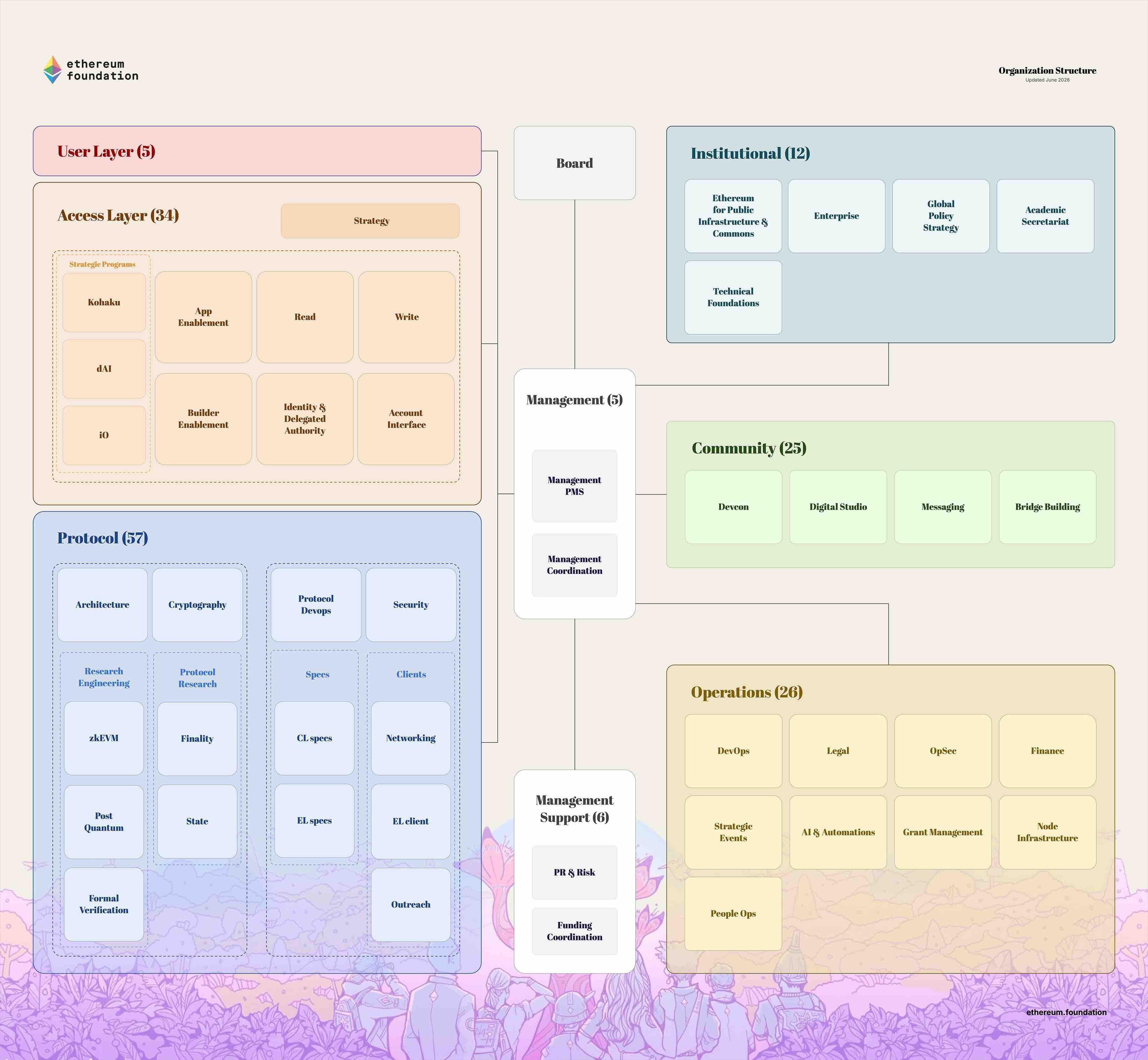
Le 23 juin au soir, l'EF a officiellement annoncé une réorganisation complète de sa structure interne, la divisant en plusieurs pôles fonctionnels tels que la couche protocole, la couche d'accès, la couche utilisateur, la couche communauté et la couche institutionnelle. Parallèlement, l'effectif global de la Fondation a été réduit d'environ 20 %, avec le départ d'environ 54 employés.
Au même moment, le cofondateur d'Ethereum, Vitalik Buterin, a dévoilé sur X une réflexion plus détaillée sur la réforme : L'EF réduira progressivement son échelle de dépenses au cours des prochaines années, avec un budget diminué d'environ 40 % par rapport à avant, et prévoit de faire baisser progressivement son taux de dépenses annuel d'environ 15 % par le passé à environ 5 % après 2030, évoluant ainsi vers un modèle opérationnel piloté par une dotation.

Il s'agit manifestement d'une refonte organisationnelle majeure d'une nature inhabituelle. Et si l'on considère les controverses et défis auxquels Ethereum a été confronté au cours de l'année écoulée, cette réforme ressemble davantage à une correction de positionnement tardive.

De la sous-performance prolongée du prix de l'ETH aux débats sur le succès ou l'échec des voies de mise à l'échelle ; des doutes persistants de la communauté sur la capacité d'exécution de la Fondation, jusqu'aux départs successifs de membres clés... L'année dernière, les critiques à l'encontre de l'EF n'ont pratiquement jamais cessé. Et cette réduction d'effectifs, restructuration et ajustement budgétaire de l'EF sont perçus par beaucoup comme la première réponse systémique de l'EF à ces problèmes.

Pourquoi l'EF est-elle toujours entourée de controverses ?

Ces dernières années, en tant qu'entité de « conscience supérieure » la plus influente de tout l'écosystème Ethereum, chaque action de l'EF a été accompagnée de controverses.

Certains critiquent la Fondation pour avoir vendu de l'ETH sur le long terme, sapant la confiance de la communauté ; d'autres remettent en question le fait que l'EF mette trop l'accent sur les biens publics et la recherche à long terme, négligeant la compétition sur le marché et la croissance de l'écosystème ; d'autres encore estiment que face à une concurrence sectorielle de plus en plus féroce, l'EF a toujours manqué d'une expression stratégique et d'une capacité d'exécution suffisamment claires... Chaque fois que le marché exprime un mécontentement envers Ethereum, l'EF devient souvent la cible directe des critiques.

Ces controverses semblent différentes, mais elles pointent toutes vers la même réalité : au cours des dix dernières années, l'EF a joué un rôle extrêmement particulier. Elle est à la fois un acteur majeur de la recherche sur le protocole et un financeur du développement de l'écosystème ; elle assume à la fois la responsabilité de coordonner les intérêts des différentes parties et représente aussi, dans une large mesure, la perception qu'à le monde extérieur d'Ethereum.

Dans les premiers temps du développement d'Ethereum, ce positionnement a joué un rôle important. Mais alors qu'Ethereum est devenu un réseau mondial doté d'une vaste communauté de développeurs, d'une capitalisation de plusieurs milliers de milliards de dollars et de nombreux participants institutionnels, les attentes du marché envers l'EF ont imperceptiblement changé.

Quel rôle l'EF devrait-elle jouer exactement ? Est-elle simplement une organisation à but non lucratif axée sur la recherche, ou doit-elle être le centre de coordination de facto de tout l'écosystème ? Est-elle responsable envers les détenteurs d'ETH ? Et doit-elle répondre aux attentes du marché concernant la croissance, l'adoption et l'accumulation de valeur ?

L'EF n'a longtemps pas fourni de réponses claires à ces questions. Ainsi, les polémiques sur la vente de tokens, la capacité d'exécution, la gouvernance, voire les départs de personnel, n'ont cessé de s'accumuler pour finalement se transformer en guerres verbales autour de la Fondation elle-même. De plus, avec le prix de l'ETH restant faible, la communauté avait besoin d'une cible pour évacuer sa frustration, et l'EF était précisément le rôle idéal.

La réponse de l'EF : Redéfinir les limites

Si toutes les interrogations de la communauté envers l'EF ces dernières années pointaient finalement vers le flou du positionnement de la Fondation, alors le cœur de cette réforme est que l'EF commence enfin à se redéfinir, en précisant ce qu'elle doit faire et ce qu'elle ne doit pas faire.

D'après la nouvelle structure organisationnelle publiée, l'EF a clairement identifié ses futures priorités selon les cinq axes suivants :

  • Couche Protocole : Responsable de l'avancement de la R&D du protocole central et de la sécurité du réseau.
  • Couche Accès : Centrée sur les portefeuilles, les outils de développement et l'expérience des infrastructures.
  • Couche Utilisateur : Concentrée sur les applications et l'expérience utilisateur.
  • Couche Communauté : Assure la coordination des développeurs et de l'écosystème.
  • Couche Institutionnelle : Chargée de promouvoir l'adoption d'Ethereum par les gouvernements, les entreprises et les institutions traditionnelles.

Tout en définissant clairement ses pôles fonctionnels, l'EF réduit aussi activement ses effectifs (licenciement de 20 %) et son budget (réduction de 40 %). Il est à noter que Vitalik n'a pas présenté cette réforme comme un simple « amélioration de la qualité et de l'efficacité », mais a admis qu'elle impliquait de réelles pertes : certains projets s'arrêteront, certaines capacités disparaîtront, et certains contributeurs de longue date partiront.

Vitalik a donné des exemples à ce sujet : l'équipe PSE (Privacy and Scaling Explorations), longtemps focalisée sur la recherche de pointe en matière de confidentialité et de mise à l'échelle, disparaîtra progressivement ; le Devcon évoluera également à l'avenir vers un modèle à plus petite échelle et moins coûteux ; les investissements de la Fondation dans de grands projets extérieurs à Ethereum seront réduits ; les travaux de coopération institutionnelle seront également recentrés et limités.

Mais Vitalik souligne également que cela ne signifie pas que l'ensemble de l'écosystème Ethereum réduira ses investissements dans ces domaines. Au contraire, de nombreux travaux passent simplement de la phase d'« exploration » à la phase de « mise en œuvre », et de l'intérieur de l'EF vers un écosystème plus large.

Pour une organisation qui a longtemps assumé à la fois des rôles de recherche, de financement, de coordination et même une partie de la promotion de l'écosystème, cela signifie un net recul de son rôle. L'EF ne cherche plus à être un centre éclectique qui veut tout embrasser, mais souhaite revenir à ses fonctions essentielles : la recherche sur le protocole, le soutien aux biens publics et la coordination de l'écosystème. Quant aux travaux de construction plus concrets, ils seront progressivement confiés à des équipes indépendantes et aux forces du marché au sein de l'écosystème.

Les forces de l'écosystème prennent le relais

Si la réforme de l'EF signifie un recul volontaire, alors la question qui mérite également d'être posée est : qui occupera l'espace qu'elle laisse vacant ? La réponse apparaît maintenant clairement : l'écosystème.

Juste avant l'annonce de la restructuration par la Fondation, Ethlabs, fondé par d'anciens chercheurs clés de l'EF, a officiellement vu le jour et a rapidement obtenu le soutien de forces de l'écosystème telles que BitMine, SharpLink et Joseph Lubin. (Lecture recommandée : « La Fondation Ethereum se scinde-t-elle ?! Comprendre le « futur radieux » d'Ethlabs en un article »)

Dans le passé, un tel exode de talents aurait facilement été interprété comme un signe de déclin de l'influence de la Fondation, mais cette fois, la réaction du marché a été exactement inverse. Pour beaucoup, l'émergence d'Ethlabs est considérée comme une bonne nouvelle pour Ethereum, car cela signifie que les talents, les ressources et les capacités de recherche autrefois très concentrés au sein de la Fondation se diffusent désormais vers davantage d'organisations indépendantes.

Outre Ethlabs, plusieurs autres organisations indépendantes ont émergé au sein de l'écosystème Ethereum au cours de l'année écoulée, comme Argot Collective ou Ethereum Applications Guild. Parallèlement, des sociétés trésorières cotées comme BitMine et SharpLink commencent également à participer à la construction de l'écosystème via des financements, des subventions à la recherche, etc.

Comparé à il y a dix ans, la structure de pouvoir d'Ethereum a fondamentalement changé. Autrefois, Ethereum équivalait presque à l'EF. Mais aujourd'hui, le développement d'Ethereum ne peut plus dépendre d'une institution unique ; il nécessite de plus en plus la collaboration et la division du travail entre différentes organisations au sein de l'écosystème.

La reconnaissance des concurrents

Bien sûr, la réforme de l'EF ne signifie pas que les problèmes d'Ethereum sont résolus.

Que ce soit les débats sur la capture de valeur de l'ETH, le processus d'adoption par les institutions, ou les questions de compétitivité de l'écosystème et d'efficacité opérationnelle, rien ne disparaîtra automatiquement après une simple réorganisation. Mais au moins, l'EF commence à admettre une chose : avec la croissance d'Ethereum, les capacités de la Fondation sont de plus en plus limitées ; elle ne peut plus continuer à jouer le rôle de « celui qui résout tous les problèmes ».
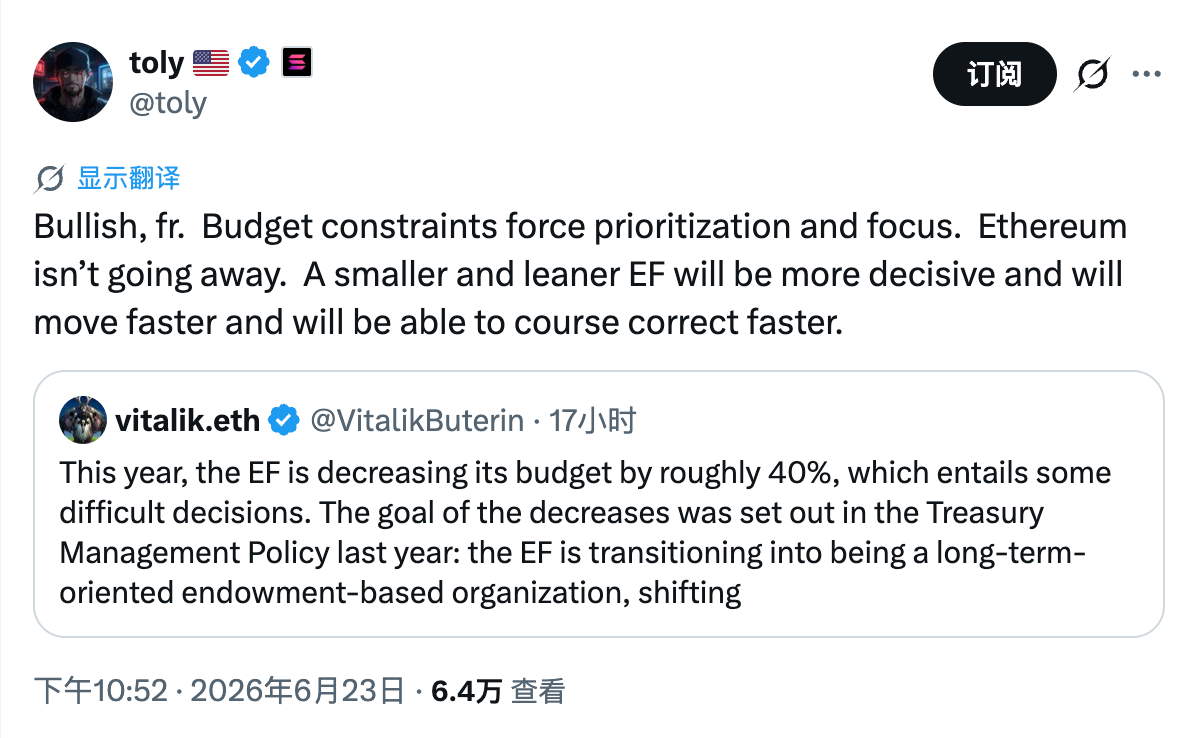
Juste après l'annonce de la réforme par l'EF, le cofondateur de Solana, toly, a publié sur X : « Haussière (Bullish), les contraintes budgétaires nous obligent à établir des priorités et à nous concentrer. Ethereum ne va pas disparaître. Une Fondation Ethereum plus petite et plus légère sera plus décisive, agira plus vite et pourra aussi changer de direction plus rapidement. »

La reconnaissance d'un vieux rival est peut-être le plus bel hommage que l'on puisse rendre à cette réforme de l'EF.


Trending Cryptos

Related Questions

QQuelles sont les principales mesures de restructuration annoncées par l'Ethereum Foundation (EF) ?

AL'EF a annoncé une réorganisation complète de sa structure interne en plusieurs clusters fonctionnels (couche protocole, accès, utilisateur, communauté, institution), une réduction d'environ 20% de ses effectifs (soit environ 54 départs), et une diminution de son budget d'environ 40% sur les prochaines années, visant à réduire son taux de dépenses annuel à environ 5% après 2030.

QQuelle est la raison fondamentale des critiques et des réformes au sein de l'Ethereum Foundation selon l'article ?

ALa raison fondamentale est le flou persistant concernant le rôle et le positionnement de l'EF. Alors qu'elle était perçue comme un centre de coordination quasi omniscient pour l'écosystème, la communauté attendait désormais des réponses plus claires sur sa stratégie, son exécution et sa responsabilité envers les détenteurs d'ETH, ce qui a généré des controverses répétées.

QComment Vitalik Buterin décrit-il les conséquences de la restructuration ?

AVitalik Buterin ne présente pas la réforme comme une simple optimisation, mais reconnaît qu'elle entraînera des pertes réelles : l'arrêt de certains projets, la disparition de certaines capacités et le départ de contributeurs de longue date. Il cite notamment la fin progressive de l'équipe PSE (Privacy and Scaling Explorations) et la transformation de Devcon en un événement plus petit et moins coûteux.

QQuelle organisation récemment créée est présentée comme un exemple de transfert de compétences hors de l'EF ?

AEthlabs, une organisation fondée par d'anciens chercheurs principaux de l'EF, est citée comme un exemple. Son apparition, soutenue par des acteurs comme BitMine et Joseph Lubin, est perçue comme un signe positif de diffusion des talents et des ressources de recherche vers des organisations indépendantes au sein de l'écosystème.

QQuel a été le commentaire notable d'un concurrent à propos de la restructuration de l'EF ?

AToly (Anatoly Yakovenko), le co-fondateur de Solana, a commenté sur X en disant : « Hausier (Bullish), les contraintes budgétaires nous obligent à prioriser et à nous concentrer. Ethereum ne disparaîtra pas. Une Fondation Ethereum plus petite et plus agile sera plus décisive, agira plus vite et pourra ajuster sa direction plus rapidement. »

Related Reads

Trading

Spot

Hot Articles

What is SONIC

Sonic: Pioneering the Future of Gaming in Web3 Introduction to Sonic In the ever-evolving landscape of Web3, the gaming industry stands out as one of the most dynamic and promising sectors. At the forefront of this revolution is Sonic, a project designed to amplify the gaming ecosystem on the Solana blockchain. Leveraging cutting-edge technology, Sonic aims to deliver an unparalleled gaming experience by efficiently processing millions of requests per second, ensuring that players enjoy seamless gameplay while maintaining low transaction costs. This article delves into the intricate details of Sonic, exploring its creators, funding sources, operational mechanics, and the timeline of significant events that have shaped its journey. What is Sonic? Sonic is an innovative layer-2 network that operates atop the Solana blockchain, specifically tailored to enhance the existing Solana gaming ecosystem. It accomplishes this through a customised, VM-agnostic game engine paired with a HyperGrid interpreter, facilitating sovereign game economies that roll up back to the Solana platform. The primary goals of Sonic include: Enhanced Gaming Experiences: Sonic is committed to offering lightning-fast on-chain gameplay, allowing players and developers to engage with games at previously unattainable speeds. Atomic Interoperability: This feature enables transactions to be executed within Sonic without the need to redeploy Solana programmes and accounts. This makes the process more efficient and directly benefits from Solana Layer1 services and liquidity. Seamless Deployment: Sonic allows developers to write for Ethereum Virtual Machine (EVM) based systems and execute them on Solana’s SVM infrastructure. This interoperability is crucial for attracting a broader range of dApps and decentralised applications to the platform. Support for Developers: By offering native composable gaming primitives and extensible data types - dining within the Entity-Component-System (ECS) framework - game creators can craft intricate business logic with ease. Overall, Sonic's unique approach not only caters to players but also provides an accessible and low-cost environment for developers to innovate and thrive. Creator of Sonic The information regarding the creator of Sonic is somewhat ambiguous. However, it is known that Sonic's SVM is owned by the company Mirror World. The absence of detailed information about the individuals behind Sonic reflects a common trend in several Web3 projects, where collective efforts and partnerships often overshadow individual contributions. Investors of Sonic Sonic has garnered considerable attention and support from various investors within the crypto and gaming sectors. Notably, the project raised an impressive $12 million during its Series A funding round. The round was led by BITKRAFT Ventures, with other notable investors including Galaxy, Okx Ventures, Interactive, Big Brain Holdings, and Mirana. This financial backing signifies the confidence that investment foundations have in Sonic’s potential to revolutionise the Web3 gaming landscape, further validating its innovative approaches and technologies. How Does Sonic Work? Sonic utilises the HyperGrid framework, a sophisticated parallel processing mechanism that enhances its scalability and customisability. Here are the core features that set Sonic apart: Lightning Speed at Low Costs: Sonic offers one of the fastest on-chain gaming experiences compared to other Layer-1 solutions, powered by the scalability of Solana’s virtual machine (SVM). Atomic Interoperability: Sonic enables transaction execution without redeployment of Solana programmes and accounts, effectively streamlining the interaction between users and the blockchain. EVM Compatibility: Developers can effortlessly migrate decentralised applications from EVM chains to the Solana environment using Sonic’s HyperGrid interpreter, increasing the accessibility and integration of various dApps. Ecosystem Support for Developers: By exposing native composable gaming primitives, Sonic facilitates a sandbox-like environment where developers can experiment and implement business logic, greatly enhancing the overall development experience. Monetisation Infrastructure: Sonic natively supports growth and monetisation efforts, providing frameworks for traffic generation, payments, and settlements, thereby ensuring that gaming projects are not only viable but also sustainable financially. Timeline of Sonic The evolution of Sonic has been marked by several key milestones. Below is a brief timeline highlighting critical events in the project's history: 2022: The Sonic cryptocurrency was officially launched, marking the beginning of its journey in the Web3 gaming arena. 2024: June: Sonic SVM successfully raised $12 million in a Series A funding round. This investment allowed Sonic to further develop its platform and expand its offerings. August: The launch of the Sonic Odyssey testnet provided users with the first opportunity to engage with the platform, offering interactive activities such as collecting rings—a nod to gaming nostalgia. October: SonicX, an innovative crypto game integrated with Solana, made its debut on TikTok, capturing the attention of over 120,000 users within a short span. This integration illustrated Sonic’s commitment to reaching a broader, global audience and showcased the potential of blockchain gaming. Key Points Sonic SVM is a revolutionary layer-2 network on Solana explicitly designed to enhance the GameFi landscape, demonstrating great potential for future development. HyperGrid Framework empowers Sonic by introducing horizontal scaling capabilities, ensuring that the network can handle the demands of Web3 gaming. Integration with Social Platforms: The successful launch of SonicX on TikTok displays Sonic’s strategy to leverage social media platforms to engage users, exponentially increasing the exposure and reach of its projects. Investment Confidence: The substantial funding from BITKRAFT Ventures, among others, emphasizes the robust backing Sonic has, paving the way for its ambitious future. In conclusion, Sonic encapsulates the essence of Web3 gaming innovation, striking a balance between cutting-edge technology, developer-centric tools, and community engagement. As the project continues to evolve, it is poised to redefine the gaming landscape, making it a notable entity for gamers and developers alike. As Sonic moves forward, it will undoubtedly attract greater interest and participation, solidifying its place within the broader narrative of blockchain gaming.

1.8k Total ViewsPublished 2024.04.04Updated 2024.12.03

What is SONIC

What is $S$

Understanding SPERO: A Comprehensive Overview Introduction to SPERO As the landscape of innovation continues to evolve, the emergence of web3 technologies and cryptocurrency projects plays a pivotal role in shaping the digital future. One project that has garnered attention in this dynamic field is SPERO, denoted as SPERO,$$s$. This article aims to gather and present detailed information about SPERO, to help enthusiasts and investors understand its foundations, objectives, and innovations within the web3 and crypto domains. What is SPERO,$$s$? SPERO,$$s$ is a unique project within the crypto space that seeks to leverage the principles of decentralisation and blockchain technology to create an ecosystem that promotes engagement, utility, and financial inclusion. The project is tailored to facilitate peer-to-peer interactions in new ways, providing users with innovative financial solutions and services. At its core, SPERO,$$s$ aims to empower individuals by providing tools and platforms that enhance user experience in the cryptocurrency space. This includes enabling more flexible transaction methods, fostering community-driven initiatives, and creating pathways for financial opportunities through decentralised applications (dApps). The underlying vision of SPERO,$$s$ revolves around inclusiveness, aiming to bridge gaps within traditional finance while harnessing the benefits of blockchain technology. Who is the Creator of SPERO,$$s$? The identity of the creator of SPERO,$$s$ remains somewhat obscure, as there are limited publicly available resources providing detailed background information on its founder(s). This lack of transparency can stem from the project's commitment to decentralisation—an ethos that many web3 projects share, prioritising collective contributions over individual recognition. By centring discussions around the community and its collective goals, SPERO,$$s$ embodies the essence of empowerment without singling out specific individuals. As such, understanding the ethos and mission of SPERO remains more important than identifying a singular creator. Who are the Investors of SPERO,$$s$? SPERO,$$s$ is supported by a diverse array of investors ranging from venture capitalists to angel investors dedicated to fostering innovation in the crypto sector. The focus of these investors generally aligns with SPERO's mission—prioritising projects that promise societal technological advancement, financial inclusivity, and decentralised governance. These investor foundations are typically interested in projects that not only offer innovative products but also contribute positively to the blockchain community and its ecosystems. The backing from these investors reinforces SPERO,$$s$ as a noteworthy contender in the rapidly evolving domain of crypto projects. How Does SPERO,$$s$ Work? SPERO,$$s$ employs a multi-faceted framework that distinguishes it from conventional cryptocurrency projects. Here are some of the key features that underline its uniqueness and innovation: Decentralised Governance: SPERO,$$s$ integrates decentralised governance models, empowering users to participate actively in decision-making processes regarding the project’s future. This approach fosters a sense of ownership and accountability among community members. Token Utility: SPERO,$$s$ utilises its own cryptocurrency token, designed to serve various functions within the ecosystem. These tokens enable transactions, rewards, and the facilitation of services offered on the platform, enhancing overall engagement and utility. Layered Architecture: The technical architecture of SPERO,$$s$ supports modularity and scalability, allowing for seamless integration of additional features and applications as the project evolves. This adaptability is paramount for sustaining relevance in the ever-changing crypto landscape. Community Engagement: The project emphasises community-driven initiatives, employing mechanisms that incentivise collaboration and feedback. By nurturing a strong community, SPERO,$$s$ can better address user needs and adapt to market trends. Focus on Inclusion: By offering low transaction fees and user-friendly interfaces, SPERO,$$s$ aims to attract a diverse user base, including individuals who may not previously have engaged in the crypto space. This commitment to inclusion aligns with its overarching mission of empowerment through accessibility. Timeline of SPERO,$$s$ Understanding a project's history provides crucial insights into its development trajectory and milestones. Below is a suggested timeline mapping significant events in the evolution of SPERO,$$s$: Conceptualisation and Ideation Phase: The initial ideas forming the basis of SPERO,$$s$ were conceived, aligning closely with the principles of decentralisation and community focus within the blockchain industry. Launch of Project Whitepaper: Following the conceptual phase, a comprehensive whitepaper detailing the vision, goals, and technological infrastructure of SPERO,$$s$ was released to garner community interest and feedback. Community Building and Early Engagements: Active outreach efforts were made to build a community of early adopters and potential investors, facilitating discussions around the project’s goals and garnering support. Token Generation Event: SPERO,$$s$ conducted a token generation event (TGE) to distribute its native tokens to early supporters and establish initial liquidity within the ecosystem. Launch of Initial dApp: The first decentralised application (dApp) associated with SPERO,$$s$ went live, allowing users to engage with the platform's core functionalities. Ongoing Development and Partnerships: Continuous updates and enhancements to the project's offerings, including strategic partnerships with other players in the blockchain space, have shaped SPERO,$$s$ into a competitive and evolving player in the crypto market. Conclusion SPERO,$$s$ stands as a testament to the potential of web3 and cryptocurrency to revolutionise financial systems and empower individuals. With a commitment to decentralised governance, community engagement, and innovatively designed functionalities, it paves the way toward a more inclusive financial landscape. As with any investment in the rapidly evolving crypto space, potential investors and users are encouraged to research thoroughly and engage thoughtfully with the ongoing developments within SPERO,$$s$. The project showcases the innovative spirit of the crypto industry, inviting further exploration into its myriad possibilities. While the journey of SPERO,$$s$ is still unfolding, its foundational principles may indeed influence the future of how we interact with technology, finance, and each other in interconnected digital ecosystems.

99 Total ViewsPublished 2024.12.17Updated 2024.12.17

What is $S$

What is AGENT S

Agent S: The Future of Autonomous Interaction in Web3 Introduction In the ever-evolving landscape of Web3 and cryptocurrency, innovations are constantly redefining how individuals interact with digital platforms. One such pioneering project, Agent S, promises to revolutionise human-computer interaction through its open agentic framework. By paving the way for autonomous interactions, Agent S aims to simplify complex tasks, offering transformative applications in artificial intelligence (AI). This detailed exploration will delve into the project's intricacies, its unique features, and the implications for the cryptocurrency domain. What is Agent S? Agent S stands as a groundbreaking open agentic framework, specifically designed to tackle three fundamental challenges in the automation of computer tasks: Acquiring Domain-Specific Knowledge: The framework intelligently learns from various external knowledge sources and internal experiences. This dual approach empowers it to build a rich repository of domain-specific knowledge, enhancing its performance in task execution. Planning Over Long Task Horizons: Agent S employs experience-augmented hierarchical planning, a strategic approach that facilitates efficient breakdown and execution of intricate tasks. This feature significantly enhances its ability to manage multiple subtasks efficiently and effectively. Handling Dynamic, Non-Uniform Interfaces: The project introduces the Agent-Computer Interface (ACI), an innovative solution that enhances the interaction between agents and users. Utilizing Multimodal Large Language Models (MLLMs), Agent S can navigate and manipulate diverse graphical user interfaces seamlessly. Through these pioneering features, Agent S provides a robust framework that addresses the complexities involved in automating human interaction with machines, setting the stage for myriad applications in AI and beyond. Who is the Creator of Agent S? While the concept of Agent S is fundamentally innovative, specific information about its creator remains elusive. The creator is currently unknown, which highlights either the nascent stage of the project or the strategic choice to keep founding members under wraps. Regardless of anonymity, the focus remains on the framework's capabilities and potential. Who are the Investors of Agent S? As Agent S is relatively new in the cryptographic ecosystem, detailed information regarding its investors and financial backers is not explicitly documented. The lack of publicly available insights into the investment foundations or organisations supporting the project raises questions about its funding structure and development roadmap. Understanding the backing is crucial for gauging the project's sustainability and potential market impact. How Does Agent S Work? At the core of Agent S lies cutting-edge technology that enables it to function effectively in diverse settings. Its operational model is built around several key features: Human-like Computer Interaction: The framework offers advanced AI planning, striving to make interactions with computers more intuitive. By mimicking human behaviour in tasks execution, it promises to elevate user experiences. Narrative Memory: Employed to leverage high-level experiences, Agent S utilises narrative memory to keep track of task histories, thereby enhancing its decision-making processes. Episodic Memory: This feature provides users with step-by-step guidance, allowing the framework to offer contextual support as tasks unfold. Support for OpenACI: With the ability to run locally, Agent S allows users to maintain control over their interactions and workflows, aligning with the decentralised ethos of Web3. Easy Integration with External APIs: Its versatility and compatibility with various AI platforms ensure that Agent S can fit seamlessly into existing technological ecosystems, making it an appealing choice for developers and organisations. These functionalities collectively contribute to Agent S's unique position within the crypto space, as it automates complex, multi-step tasks with minimal human intervention. As the project evolves, its potential applications in Web3 could redefine how digital interactions unfold. Timeline of Agent S The development and milestones of Agent S can be encapsulated in a timeline that highlights its significant events: September 27, 2024: The concept of Agent S was launched in a comprehensive research paper titled “An Open Agentic Framework that Uses Computers Like a Human,” showcasing the groundwork for the project. October 10, 2024: The research paper was made publicly available on arXiv, offering an in-depth exploration of the framework and its performance evaluation based on the OSWorld benchmark. October 12, 2024: A video presentation was released, providing a visual insight into the capabilities and features of Agent S, further engaging potential users and investors. These markers in the timeline not only illustrate the progress of Agent S but also indicate its commitment to transparency and community engagement. Key Points About Agent S As the Agent S framework continues to evolve, several key attributes stand out, underscoring its innovative nature and potential: Innovative Framework: Designed to provide an intuitive use of computers akin to human interaction, Agent S brings a novel approach to task automation. Autonomous Interaction: The ability to interact autonomously with computers through GUI signifies a leap towards more intelligent and efficient computing solutions. Complex Task Automation: With its robust methodology, it can automate complex, multi-step tasks, making processes faster and less error-prone. Continuous Improvement: The learning mechanisms enable Agent S to improve from past experiences, continually enhancing its performance and efficacy. Versatility: Its adaptability across different operating environments like OSWorld and WindowsAgentArena ensures that it can serve a broad range of applications. As Agent S positions itself in the Web3 and crypto landscape, its potential to enhance interaction capabilities and automate processes signifies a significant advancement in AI technologies. Through its innovative framework, Agent S exemplifies the future of digital interactions, promising a more seamless and efficient experience for users across various industries. Conclusion Agent S represents a bold leap forward in the marriage of AI and Web3, with the capacity to redefine how we interact with technology. While still in its early stages, the possibilities for its application are vast and compelling. Through its comprehensive framework addressing critical challenges, Agent S aims to bring autonomous interactions to the forefront of the digital experience. As we move deeper into the realms of cryptocurrency and decentralisation, projects like Agent S will undoubtedly play a crucial role in shaping the future of technology and human-computer collaboration.

767 Total ViewsPublished 2025.01.14Updated 2025.01.14

What is AGENT S

Discussions

Welcome to the HTX Community. Here, you can stay informed about the latest platform developments and gain access to professional market insights. Users' opinions on the price of S (S) are presented below.

活动图片