EF Tái cấu trúc ở cấp độ Sử thi: Cắt giảm 20% nhân sự, cắt ngân sách một nửa, Liệu Ethereum sẽ nhẹ gánh tiến bước?

Odaily星球日报Published on 2026-06-24Last updated on 2026-06-24

Abstract

Quỹ Ethereum (EF) vừa công bố cơ cấu tổ chức lại lớn nhất trong những năm gần đây, bao gồm cắt giảm 20% nhân sự (khoảng 54 người) và chia thành các cụm chức năng: giao thức, truy cập, người dùng, cộng đồng và thể chế. Đồng sáng lập Vitalik Buterin tiết lộ thêm: EF sẽ giảm dần quy mô chi tiêu, cắt ngân sách khoảng 40% và dự kiến giảm tỷ lệ chi tiêu hàng năm từ ~15% xuống còn ~5% sau năm 2030, chuyển sang mô hình vận hành dựa vào quỹ tài trợ. Động thái này được xem là sự điều chỉnh vị trí cần thiết trước những tranh cãi kéo dài về hiệu suất ETH, lộ trình mở rộng quy mô và sự rời đi của các thành viên chủ chốt. EF từ lâu đối mặt với chỉ trích về việc bán ETH, tập trung quá mức vào nghiên cứu dài hạn, và thiếu chiến lược rõ ràng trong môi trường cạnh tranh. Qua cuộc tái cấu trúc, EF xác định lại ranh giới, rút về các chức năng cốt lõi: nghiên cứu giao thức, hỗ trợ hàng hóa công cộng và điều phối sinh thái. Nhiều công việc xây dựng cụ thể sẽ được chuyển giao cho các lực lượng thị trường và đội ngũ độc lập trong hệ sinh thái. Sự xuất hiện của Ethlabs (do các cựu nghiên cứu viên EF sáng lập) và các tổ chức độc lập khác như Argot Collective cho thấy năng lực và nguồn lực đang được phân tán, giảm bớt sự phụ thuộc vào một tổ chức duy nhất. Ngay cả đối thủ Solana cũng đánh giá tích cực, cho rằng EF tinh gọn hơn sẽ quyết đoán và linh hoạt hơn. Tóm lại, đây là bước đi quan trọng để EF thích ứng với giai đoạn phát triển mới của Ethereum, nơi hệ sinh thái đã đủ trưởng thành để chia sẻ ...

Bản gốc | Odaily Planet Daily(@OdailyChina)

Tác giả|Azuma(@azuma_eth)
Quỹ Ethereum (EF) đã trải qua một cuộc điều chỉnh cơ cấu tổ chức lớn nhất trong những năm gần đây.

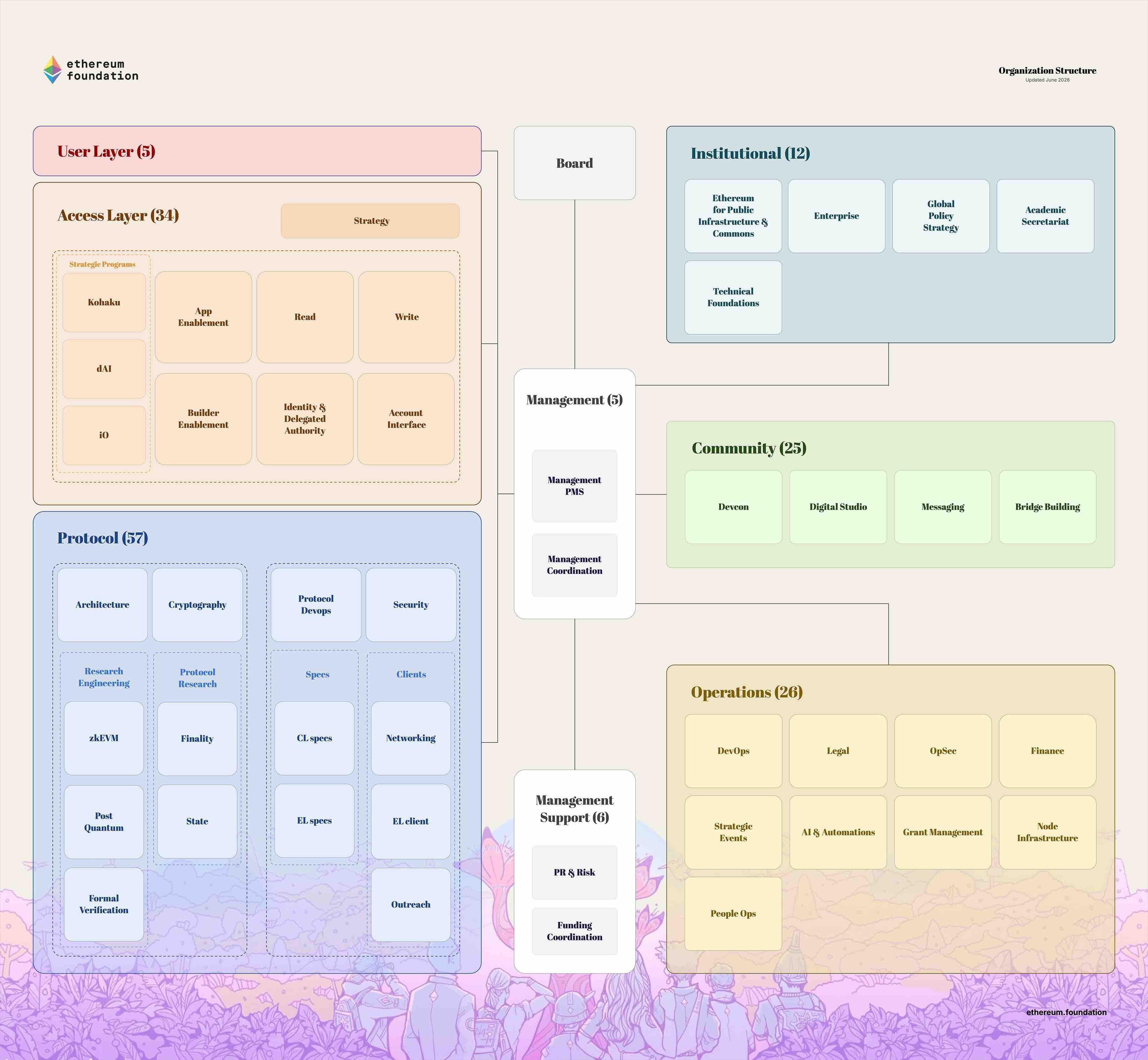
Vào tối ngày 23 tháng 6, EF đã chính thức công bố việc tái cấu trúc toàn diện nội bộ, chia thành các cụm chức năng như Lớp giao thức, Lớp truy cập, Lớp người dùng, Lớp cộng đồng, Lớp thể chế, v.v.Cùng lúc đó, toàn bộ quỹ đã cắt giảm khoảng 20% nhân sự, với khoảng 54 nhân viên rời đi.
Cùng thời điểm, đồng sáng lập Ethereum Vitalik Buterin cũng tiết lộ ý tưởng cải cách chi tiết hơn trên X:EF sẽ dần giảm quy mô chi tiêu trong những năm tới, ngân sách bị cắt khoảng 40% so với trước đây, và dự kiến giảm tỷ lệ chi tiêu hàng năm từ khoảng 15% trước đây xuống khoảng 5% sau năm 2030, chuyển đổi sang mô hình vận hành được tài trợ bởi quỹ tài trợ.

Rõ ràng, đây là một cuộc đại cải tổ cơ cấu tổ chức không theo thông lệ.Và nếu kết hợp với những tranh cãi và thách thức mà Ethereum đã phải đối mặt trong năm qua, cuộc cải cách này dường như giống một sự điều chỉnh vị trí đã bị trì hoãn từ lâu.

Từ việc giá ETH dài hạn ảm đạm, cho đến những tranh luận về thành bại của lộ trình mở rộng; từ những nghi ngờ liên tục của cộng đồng về năng lực thực thi của Quỹ, cho đến việc các thành viên chủ chốt lần lượt rời đi...... Năm qua, làn sóng chỉ trích xung quanh EF hầu như chưa bao giờ ngừng. Và việc cắt giảm nhân sự, tái cấu trúc và điều chỉnh ngân sách lần này của EF, được nhiều người coi là phản ứng có hệ thống đầu tiên của EF trước những vấn đề này.

Tại sao EF luôn bị tranh cãi vây quanh?

Trong vài năm qua, với tư cách là chủ thể ý thức cấp cao có ảnh hưởng nhất trong toàn bộ hệ sinh thái Ethereum, mọi hành động của EF luôn đi kèm với tranh cãi.

Một số người chỉ trích Quỹ liên tục bán ETH, làm suy yếu niềm tin cộng đồng; một số nghi ngờ EF quá nhấn mạnh vào hàng hóa công cộng và nghiên cứu dài hạn, bỏ qua cạnh tranh thị trường và tăng trưởng hệ sinh thái; cũng có người cho rằng, trước sự cạnh tranh ngày càng gay gắt trong ngành, EF luôn thiếu năng lực biểu đạt và thực thi chiến lược đủ rõ ràng...... Mỗi khi thị trường bất mãn với Ethereum, EF thường trở thành đối tượng chỉ trích trực tiếp nhất.

Những tranh cãi này thoạt nhìn có vẻ khác nhau, nhưng phía sau đều hướng đến một thực tế —— trong hơn mười năm qua, EF luôn đóng một vai trò cực kỳ đặc biệt. Nó vừa là động lực quan trọng thúc đẩy nghiên cứu giao thức, vừa là nhà tài trợ cho xây dựng hệ sinh thái; vừa đảm nhận trách nhiệm điều phối lợi ích các bên, cũng đại diện phần lớn cho nhận thức của thế giới bên ngoài về Ethereum.

Ở giai đoạn đầu phát triển của Ethereum, định vị vai trò như vậy từng phát huy tác dụng quan trọng, nhưng khi Ethereum dần trưởng thành thành một mạng lưới toàn cầu với cộng đồng nhà phát triển khổng lồ, quy mô tài sản hàng nghìn tỷ đô la và sự tham gia của nhiều tổ chức, kỳ vọng của thị trường đối với EF đã âm thầm thay đổi.

Chính xác thì EF nên đóng vai trò gì? Nó chỉ đơn thuần là một tổ chức phi lợi nhuận tập trung vào nghiên cứu, hay còn là trung tâm điều phối trên thực tế của toàn bộ hệ sinh thái? Nó có trách nhiệm với những người nắm giữ ETH không? Và có nên đáp lại kỳ vọng của thị trường về tăng trưởng, ứng dụng và tích lũy giá trị?

Với những câu hỏi này, EF trong thời gian dài đã không đưa ra câu trả lời rõ ràng. Do đó, các tranh cãi về việc bán coin, năng lực thực thi, quản trị thậm chí là sóng gió nhân sự liên tục chồng chất, cuối cùng đều biến thành những cuộc khẩu chiến xoay quanh chính bản thân Quỹ.Thêm vào đó, giá ETH liên tục ở mức thấp, cộng đồng cần một đối tượng để giải tỏa cảm xúc, và EF chính là vai trò phù hợp nhất.

Câu trả lời của EF: Vạch lại ranh giới

Nếu tất cả những nghi ngờ của cộng đồng đối với EF trong vài năm qua cuối cùng đều hướng đến sự mơ hồ trong định vị vai trò của Quỹ, thì nội dung cốt lõi nhất của cuộc cải cách lần này chính là việc EF cuối cùng đã bắt đầu tự định nghĩa lại, làm rõ nên làm gì và không nên làm gì.

Từ cơ cấu tổ chức mới nhất được công bố, EF đã xác định rõ trọng tâm công việc trong tương lai theo năm hướng sau:

  • Lớp giao thức: Chịu trách nhiệm thúc đẩy nghiên cứu và phát triển giao thức cốt lõi và an ninh mạng;
  • Lớp truy cập: Tập trung vào ví, công cụ phát triển và trải nghiệm cơ sở hạ tầng;
  • Lớp người dùng: Tập trung vào ứng dụng và trải nghiệm người dùng;
  • Lớp cộng đồng: Đảm nhận công việc điều phối nhà phát triển và hệ sinh thái;
  • Lớp thể chế: Chịu trách nhiệm thúc đẩy việc chính phủ, doanh nghiệp và các tổ chức truyền thống áp dụng Ethereum.

Trong khi xác định rõ các cụm chức năng, EF cũng đang chủ động thu hẹp quy mô thông qua việc cắt giảm 20% nhân sự, cắt giảm 40% ngân sách. Điều đáng chú ý là,Vitalik đã không "đóng gói" cuộc cải cách này như một cuộc "nâng cao chất lượng và hiệu quả" đơn thuần, mà thẳng thắn thừa nhận điều này đồng nghĩa với tổn thất thực sự —— một số dự án sẽ kết thúc, một số năng lực sẽ biến mất, một số người đóng góp lâu dài sẽ ra đi.

Vitalik lấy ví dụ rằng, nhóm PSE (Privacy and Scaling Explorations) vốn lâu nay tập trung vào nghiên cứu tiên phong về quyền riêng tư và mở rộng sẽ dần bước ra khỏi lịch sử; Devcon trong tương lai cũng sẽ chuyển đổi sang mô hình quy mô nhỏ hơn, chi phí thấp hơn; đầu tư của Quỹ vào các dự án lớn bên ngoài Ethereum sẽ giảm bớt; công việc hợp tác thể chế cũng sẽ tập trung và thu hẹp hơn nữa.

Nhưng Vitalik cũng nhấn mạnh, điều này không có nghĩa là toàn bộ Ethereum sẽ giảm đầu tư đồng thời vào các hướng này, ngược lại, nhiều công việc chỉ đang chuyển từ giai đoạn "khám phá" sang giai đoạn "triển khai", từ nội bộ EF sang hệ thống sinh thái rộng lớn hơn.

Đối với một tổ chức lâu nay đồng thời đảm nhận trách nhiệm nghiên cứu, tài trợ, điều phối và thậm chí một phần thúc đẩy hệ sinh thái, điều này đồng nghĩa với một sự nhượng bộ vai trò rõ rệt.EF không còn cố gắng trở thành một trung tâm hệ sinh thái bao trùm mọi thứ, mà hy vọng quay trở lại các chức năng cốt lõi như nghiên cứu giao thức, hỗ trợ hàng hóa công cộng và điều phối hệ sinh thái. Còn việc xây dựng cụ thể hơn, sẽ dần giao cho các nhóm độc lập trong hệ sinh thái và lực lượng thị trường đảm nhận.

Sức mạnh hệ sinh thái đang bù đắp vị trí

Nếu cải cách của EF đồng nghĩa với việc chủ động lùi lại, thì một vấn đề đáng quan tâm khác là, ai sẽ lấp đầy không gian mà nó để lại? Câu trả lời hiện cũng đã xuất hiện —— hệ sinh thái.

Ngay trước khi Quỹ công bố tái cấu trúc, Ethlabs do nhiều cựu nhà nghiên cứu cốt cán của EF sáng lập đã chính thức thành lập, và nhanh chóng nhận được sự hỗ trợ từ các lực lượng trong hệ sinh thái như BitMine, SharpLink, Joseph Lubin.(Đề xuất đọc bài viết《Quỹ Ethereum đang chia tách?! Một bài viết hiểu về "Tương lai tươi sáng" của Ethlabs》)

Nếu đặt trong quá khứ, việc chảy máu chất xám như vậy dễ dàng bị diễn giải là tín hiệu ảnh hưởng của Quỹ suy giảm, nhưng phản ứng của thị trường lần này lại trái ngược. Nhiều người hơn đã coi sự xuất hiện của Ethlabs là tin tốt cho Ethereum, bởi vì nó có nghĩa là nhân tài, tài nguyên và năng lực nghiên cứu vốn tập trung cao độ trong nội bộ Quỹ, đang lan tỏa đến nhiều tổ chức độc lập hơn.

Bên cạnh Ethlabs, trong năm qua, hệ sinh thái Ethereum nội bộ cũng lần lượt xuất hiện nhiều tổ chức độc lập như Argot Collective, Ethereum Applications Guild. Cùng lúc đó, các công ty quỹ tài chính niêm yết tiêu biểu như BitMine, SharpLink cũng bắt đầu tham gia xây dựng hệ sinh thái thông qua tài trợ vốn, nghiên cứu.

So với mười năm trước, cấu trúc quyền lực của Ethereum đã thay đổi căn bản. Ethereum ngày xưa hầu như đồng nhất với EF,nhưng Ethereum ngày nay, sự phát triển của nó không thể tiếp tục dựa vào một tổ chức duy nhất, mà ngày càng cần sự hợp tác và phân công giữa các tổ chức khác nhau trong hệ sinh thái.

Sự công nhận từ đối thủ cạnh tranh

Tất nhiên, cải cách của EF không có nghĩa là các vấn đề của Ethereum đã được giải quyết.

Dù là tranh cãi về việc nắm bắt giá trị ETH, tiến trình áp dụng thể chế, hay vấn đề năng lực cạnh tranh và hiệu quả thực thi của hệ sinh thái, đều không thể tự động biến mất chỉ vì một lần tái cấu trúc tổ chức, nhưng ít nhất EF đã bắt đầu thừa nhận một điều —— cùng với sự trưởng thành của Ethereum, sức mạnh của Quỹ ngày càng hạn chế, nó từ lâu đã không thể tiếp tục đóng vai trò "người giải quyết mọi vấn đề".
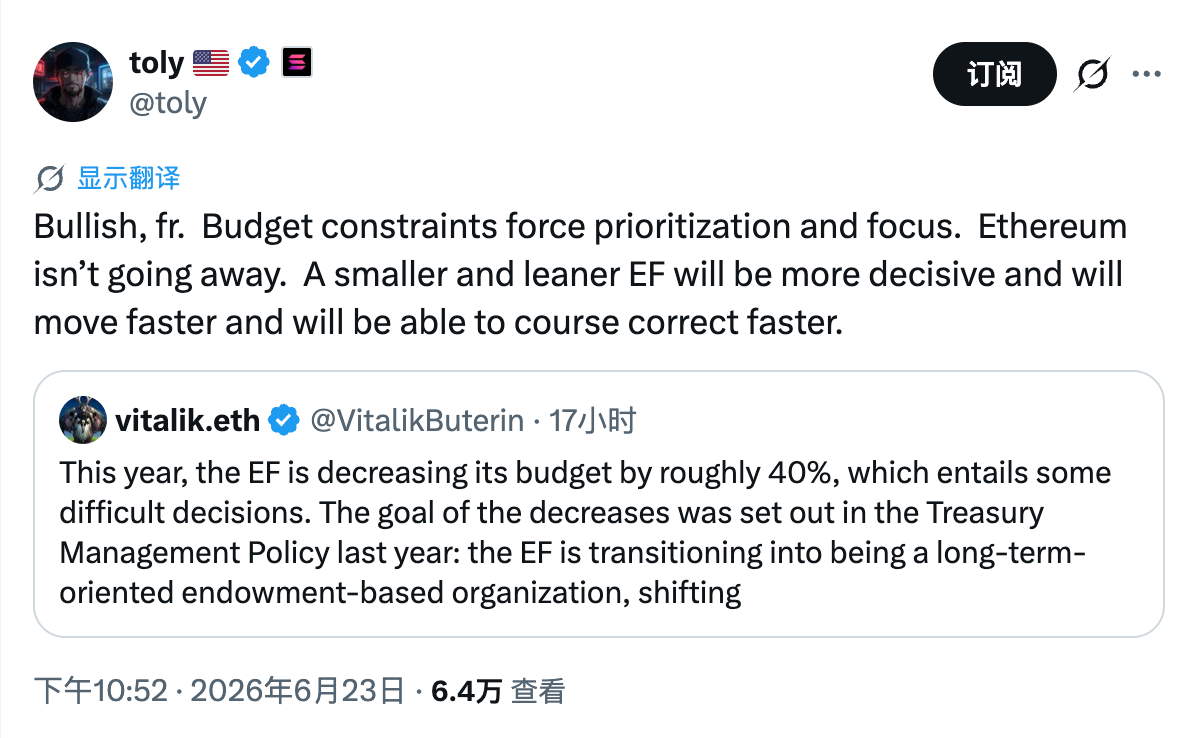
Ngay sau khi EF công bố cải cách, đồng sáng lập Solana toly đã đăng bài trên X rằng: "Bullish, hạn chế ngân sách buộc chúng ta phải phân biệt ưu tiên, tập trung tinh lực. Ethereum sẽ không biến mất. Quỹ Ethereum với quy mô nhỏ hơn, tinh gọn hơn sẽ quyết đoán hơn, hành động nhanh hơn, cũng có thể điều chỉnh hướng đi nhanh hơn."

Sự công nhận từ đối thủ lâu năm, có lẽ chính là đánh giá cao nhất dành cho cuộc cải cách lần này của EF.


Trending Cryptos

Related Questions

QTổ chức Ethereum Foundation (EF) đã thực hiện những thay đổi lớn nào về cơ cấu và nhân sự?

AEthereum Foundation đã tiến hành tái cấu trúc tổ chức toàn diện, chia thành các cụm chức năng như lớp giao thức, lớp truy cập, lớp người dùng, lớp cộng đồng và lớp thể chế. Đồng thời, EF cắt giảm khoảng 20% nhân sự, tương đương với 54 nhân viên rời đi.

QMục tiêu tài chính dài hạn của Ethereum Foundation sau cải cách là gì?

ATheo Vitalik Buterin, EF sẽ giảm dần quy mô chi tiêu trong vài năm tới, cắt giảm ngân sách khoảng 40% so với trước đây. Kế hoạch là giảm tỷ lệ chi tiêu hàng năm từ khoảng 15% xuống còn khoảng 5% sau năm 2030, chuyển đổi sang mô hình vận hành dựa trên quỹ tài trợ.

QNhững lĩnh vực trọng tâm mới của Ethereum Foundation sau khi tái cấu trúc là gì?

ACác lĩnh vực trọng tâm mới được EF xác định bao gồm: Lớp giao thức (nghiên cứu và bảo mật lõi), Lớp truy cập (ví, công cụ phát triển, trải nghiệm cơ sở hạ tầng), Lớp người dùng (ứng dụng và trải nghiệm người dùng), Lớp cộng đồng (điều phối nhà phát triển và hệ sinh thái), và Lớp thể chế (thúc đẩy việc áp dụng Ethereum bởi chính phủ, doanh nghiệp và các tổ chức truyền thống).

QViệc thành lập Ethlabs được cộng đồng đánh giá như thế nào trong bối cảnh EF tái cấu trúc?

AThay vì bị coi là dấu hiệu suy yếu của EF, việc thành lập Ethlabs bởi các cựu nghiên cứu viên cốt cán của EF được nhiều người trong thị trường đánh giá là một tín hiệu tích cực cho Ethereum. Nó cho thấy nguồn nhân lực, tài nguyên và năng lực nghiên cứu vốn tập trung cao độ trong nội bộ EF đang được phân tán ra các tổ chức độc lập khác trong hệ sinh thái.

QĐồng sáng lập Solana, toly, đã có phản hồi gì về cuộc cải cách của Ethereum Foundation?

ASau khi EF công bố cải cách, đồng sáng lập Solana là toly đã đăng trên X rằng: 'Tăng giá (Bullish). Những hạn chế về ngân sách buộc chúng ta phải xác định rõ thứ tự ưu tiên và tập trung nỗ lực. Ethereum sẽ không biến mất. Một Ethereum Foundation nhỏ hơn, tinh gọn hơn sẽ quyết đoán hơn, hành động nhanh hơn và cũng có khả năng điều chỉnh hướng đi nhanh hơn.'

Related Reads

Trading

Spot

Hot Articles

What is SONIC

Sonic: Pioneering the Future of Gaming in Web3 Introduction to Sonic In the ever-evolving landscape of Web3, the gaming industry stands out as one of the most dynamic and promising sectors. At the forefront of this revolution is Sonic, a project designed to amplify the gaming ecosystem on the Solana blockchain. Leveraging cutting-edge technology, Sonic aims to deliver an unparalleled gaming experience by efficiently processing millions of requests per second, ensuring that players enjoy seamless gameplay while maintaining low transaction costs. This article delves into the intricate details of Sonic, exploring its creators, funding sources, operational mechanics, and the timeline of significant events that have shaped its journey. What is Sonic? Sonic is an innovative layer-2 network that operates atop the Solana blockchain, specifically tailored to enhance the existing Solana gaming ecosystem. It accomplishes this through a customised, VM-agnostic game engine paired with a HyperGrid interpreter, facilitating sovereign game economies that roll up back to the Solana platform. The primary goals of Sonic include: Enhanced Gaming Experiences: Sonic is committed to offering lightning-fast on-chain gameplay, allowing players and developers to engage with games at previously unattainable speeds. Atomic Interoperability: This feature enables transactions to be executed within Sonic without the need to redeploy Solana programmes and accounts. This makes the process more efficient and directly benefits from Solana Layer1 services and liquidity. Seamless Deployment: Sonic allows developers to write for Ethereum Virtual Machine (EVM) based systems and execute them on Solana’s SVM infrastructure. This interoperability is crucial for attracting a broader range of dApps and decentralised applications to the platform. Support for Developers: By offering native composable gaming primitives and extensible data types - dining within the Entity-Component-System (ECS) framework - game creators can craft intricate business logic with ease. Overall, Sonic's unique approach not only caters to players but also provides an accessible and low-cost environment for developers to innovate and thrive. Creator of Sonic The information regarding the creator of Sonic is somewhat ambiguous. However, it is known that Sonic's SVM is owned by the company Mirror World. The absence of detailed information about the individuals behind Sonic reflects a common trend in several Web3 projects, where collective efforts and partnerships often overshadow individual contributions. Investors of Sonic Sonic has garnered considerable attention and support from various investors within the crypto and gaming sectors. Notably, the project raised an impressive $12 million during its Series A funding round. The round was led by BITKRAFT Ventures, with other notable investors including Galaxy, Okx Ventures, Interactive, Big Brain Holdings, and Mirana. This financial backing signifies the confidence that investment foundations have in Sonic’s potential to revolutionise the Web3 gaming landscape, further validating its innovative approaches and technologies. How Does Sonic Work? Sonic utilises the HyperGrid framework, a sophisticated parallel processing mechanism that enhances its scalability and customisability. Here are the core features that set Sonic apart: Lightning Speed at Low Costs: Sonic offers one of the fastest on-chain gaming experiences compared to other Layer-1 solutions, powered by the scalability of Solana’s virtual machine (SVM). Atomic Interoperability: Sonic enables transaction execution without redeployment of Solana programmes and accounts, effectively streamlining the interaction between users and the blockchain. EVM Compatibility: Developers can effortlessly migrate decentralised applications from EVM chains to the Solana environment using Sonic’s HyperGrid interpreter, increasing the accessibility and integration of various dApps. Ecosystem Support for Developers: By exposing native composable gaming primitives, Sonic facilitates a sandbox-like environment where developers can experiment and implement business logic, greatly enhancing the overall development experience. Monetisation Infrastructure: Sonic natively supports growth and monetisation efforts, providing frameworks for traffic generation, payments, and settlements, thereby ensuring that gaming projects are not only viable but also sustainable financially. Timeline of Sonic The evolution of Sonic has been marked by several key milestones. Below is a brief timeline highlighting critical events in the project's history: 2022: The Sonic cryptocurrency was officially launched, marking the beginning of its journey in the Web3 gaming arena. 2024: June: Sonic SVM successfully raised $12 million in a Series A funding round. This investment allowed Sonic to further develop its platform and expand its offerings. August: The launch of the Sonic Odyssey testnet provided users with the first opportunity to engage with the platform, offering interactive activities such as collecting rings—a nod to gaming nostalgia. October: SonicX, an innovative crypto game integrated with Solana, made its debut on TikTok, capturing the attention of over 120,000 users within a short span. This integration illustrated Sonic’s commitment to reaching a broader, global audience and showcased the potential of blockchain gaming. Key Points Sonic SVM is a revolutionary layer-2 network on Solana explicitly designed to enhance the GameFi landscape, demonstrating great potential for future development. HyperGrid Framework empowers Sonic by introducing horizontal scaling capabilities, ensuring that the network can handle the demands of Web3 gaming. Integration with Social Platforms: The successful launch of SonicX on TikTok displays Sonic’s strategy to leverage social media platforms to engage users, exponentially increasing the exposure and reach of its projects. Investment Confidence: The substantial funding from BITKRAFT Ventures, among others, emphasizes the robust backing Sonic has, paving the way for its ambitious future. In conclusion, Sonic encapsulates the essence of Web3 gaming innovation, striking a balance between cutting-edge technology, developer-centric tools, and community engagement. As the project continues to evolve, it is poised to redefine the gaming landscape, making it a notable entity for gamers and developers alike. As Sonic moves forward, it will undoubtedly attract greater interest and participation, solidifying its place within the broader narrative of blockchain gaming.

1.8k Total ViewsPublished 2024.04.04Updated 2024.12.03

What is SONIC

What is $S$

Understanding SPERO: A Comprehensive Overview Introduction to SPERO As the landscape of innovation continues to evolve, the emergence of web3 technologies and cryptocurrency projects plays a pivotal role in shaping the digital future. One project that has garnered attention in this dynamic field is SPERO, denoted as SPERO,$$s$. This article aims to gather and present detailed information about SPERO, to help enthusiasts and investors understand its foundations, objectives, and innovations within the web3 and crypto domains. What is SPERO,$$s$? SPERO,$$s$ is a unique project within the crypto space that seeks to leverage the principles of decentralisation and blockchain technology to create an ecosystem that promotes engagement, utility, and financial inclusion. The project is tailored to facilitate peer-to-peer interactions in new ways, providing users with innovative financial solutions and services. At its core, SPERO,$$s$ aims to empower individuals by providing tools and platforms that enhance user experience in the cryptocurrency space. This includes enabling more flexible transaction methods, fostering community-driven initiatives, and creating pathways for financial opportunities through decentralised applications (dApps). The underlying vision of SPERO,$$s$ revolves around inclusiveness, aiming to bridge gaps within traditional finance while harnessing the benefits of blockchain technology. Who is the Creator of SPERO,$$s$? The identity of the creator of SPERO,$$s$ remains somewhat obscure, as there are limited publicly available resources providing detailed background information on its founder(s). This lack of transparency can stem from the project's commitment to decentralisation—an ethos that many web3 projects share, prioritising collective contributions over individual recognition. By centring discussions around the community and its collective goals, SPERO,$$s$ embodies the essence of empowerment without singling out specific individuals. As such, understanding the ethos and mission of SPERO remains more important than identifying a singular creator. Who are the Investors of SPERO,$$s$? SPERO,$$s$ is supported by a diverse array of investors ranging from venture capitalists to angel investors dedicated to fostering innovation in the crypto sector. The focus of these investors generally aligns with SPERO's mission—prioritising projects that promise societal technological advancement, financial inclusivity, and decentralised governance. These investor foundations are typically interested in projects that not only offer innovative products but also contribute positively to the blockchain community and its ecosystems. The backing from these investors reinforces SPERO,$$s$ as a noteworthy contender in the rapidly evolving domain of crypto projects. How Does SPERO,$$s$ Work? SPERO,$$s$ employs a multi-faceted framework that distinguishes it from conventional cryptocurrency projects. Here are some of the key features that underline its uniqueness and innovation: Decentralised Governance: SPERO,$$s$ integrates decentralised governance models, empowering users to participate actively in decision-making processes regarding the project’s future. This approach fosters a sense of ownership and accountability among community members. Token Utility: SPERO,$$s$ utilises its own cryptocurrency token, designed to serve various functions within the ecosystem. These tokens enable transactions, rewards, and the facilitation of services offered on the platform, enhancing overall engagement and utility. Layered Architecture: The technical architecture of SPERO,$$s$ supports modularity and scalability, allowing for seamless integration of additional features and applications as the project evolves. This adaptability is paramount for sustaining relevance in the ever-changing crypto landscape. Community Engagement: The project emphasises community-driven initiatives, employing mechanisms that incentivise collaboration and feedback. By nurturing a strong community, SPERO,$$s$ can better address user needs and adapt to market trends. Focus on Inclusion: By offering low transaction fees and user-friendly interfaces, SPERO,$$s$ aims to attract a diverse user base, including individuals who may not previously have engaged in the crypto space. This commitment to inclusion aligns with its overarching mission of empowerment through accessibility. Timeline of SPERO,$$s$ Understanding a project's history provides crucial insights into its development trajectory and milestones. Below is a suggested timeline mapping significant events in the evolution of SPERO,$$s$: Conceptualisation and Ideation Phase: The initial ideas forming the basis of SPERO,$$s$ were conceived, aligning closely with the principles of decentralisation and community focus within the blockchain industry. Launch of Project Whitepaper: Following the conceptual phase, a comprehensive whitepaper detailing the vision, goals, and technological infrastructure of SPERO,$$s$ was released to garner community interest and feedback. Community Building and Early Engagements: Active outreach efforts were made to build a community of early adopters and potential investors, facilitating discussions around the project’s goals and garnering support. Token Generation Event: SPERO,$$s$ conducted a token generation event (TGE) to distribute its native tokens to early supporters and establish initial liquidity within the ecosystem. Launch of Initial dApp: The first decentralised application (dApp) associated with SPERO,$$s$ went live, allowing users to engage with the platform's core functionalities. Ongoing Development and Partnerships: Continuous updates and enhancements to the project's offerings, including strategic partnerships with other players in the blockchain space, have shaped SPERO,$$s$ into a competitive and evolving player in the crypto market. Conclusion SPERO,$$s$ stands as a testament to the potential of web3 and cryptocurrency to revolutionise financial systems and empower individuals. With a commitment to decentralised governance, community engagement, and innovatively designed functionalities, it paves the way toward a more inclusive financial landscape. As with any investment in the rapidly evolving crypto space, potential investors and users are encouraged to research thoroughly and engage thoughtfully with the ongoing developments within SPERO,$$s$. The project showcases the innovative spirit of the crypto industry, inviting further exploration into its myriad possibilities. While the journey of SPERO,$$s$ is still unfolding, its foundational principles may indeed influence the future of how we interact with technology, finance, and each other in interconnected digital ecosystems.

99 Total ViewsPublished 2024.12.17Updated 2024.12.17

What is $S$

What is AGENT S

Agent S: The Future of Autonomous Interaction in Web3 Introduction In the ever-evolving landscape of Web3 and cryptocurrency, innovations are constantly redefining how individuals interact with digital platforms. One such pioneering project, Agent S, promises to revolutionise human-computer interaction through its open agentic framework. By paving the way for autonomous interactions, Agent S aims to simplify complex tasks, offering transformative applications in artificial intelligence (AI). This detailed exploration will delve into the project's intricacies, its unique features, and the implications for the cryptocurrency domain. What is Agent S? Agent S stands as a groundbreaking open agentic framework, specifically designed to tackle three fundamental challenges in the automation of computer tasks: Acquiring Domain-Specific Knowledge: The framework intelligently learns from various external knowledge sources and internal experiences. This dual approach empowers it to build a rich repository of domain-specific knowledge, enhancing its performance in task execution. Planning Over Long Task Horizons: Agent S employs experience-augmented hierarchical planning, a strategic approach that facilitates efficient breakdown and execution of intricate tasks. This feature significantly enhances its ability to manage multiple subtasks efficiently and effectively. Handling Dynamic, Non-Uniform Interfaces: The project introduces the Agent-Computer Interface (ACI), an innovative solution that enhances the interaction between agents and users. Utilizing Multimodal Large Language Models (MLLMs), Agent S can navigate and manipulate diverse graphical user interfaces seamlessly. Through these pioneering features, Agent S provides a robust framework that addresses the complexities involved in automating human interaction with machines, setting the stage for myriad applications in AI and beyond. Who is the Creator of Agent S? While the concept of Agent S is fundamentally innovative, specific information about its creator remains elusive. The creator is currently unknown, which highlights either the nascent stage of the project or the strategic choice to keep founding members under wraps. Regardless of anonymity, the focus remains on the framework's capabilities and potential. Who are the Investors of Agent S? As Agent S is relatively new in the cryptographic ecosystem, detailed information regarding its investors and financial backers is not explicitly documented. The lack of publicly available insights into the investment foundations or organisations supporting the project raises questions about its funding structure and development roadmap. Understanding the backing is crucial for gauging the project's sustainability and potential market impact. How Does Agent S Work? At the core of Agent S lies cutting-edge technology that enables it to function effectively in diverse settings. Its operational model is built around several key features: Human-like Computer Interaction: The framework offers advanced AI planning, striving to make interactions with computers more intuitive. By mimicking human behaviour in tasks execution, it promises to elevate user experiences. Narrative Memory: Employed to leverage high-level experiences, Agent S utilises narrative memory to keep track of task histories, thereby enhancing its decision-making processes. Episodic Memory: This feature provides users with step-by-step guidance, allowing the framework to offer contextual support as tasks unfold. Support for OpenACI: With the ability to run locally, Agent S allows users to maintain control over their interactions and workflows, aligning with the decentralised ethos of Web3. Easy Integration with External APIs: Its versatility and compatibility with various AI platforms ensure that Agent S can fit seamlessly into existing technological ecosystems, making it an appealing choice for developers and organisations. These functionalities collectively contribute to Agent S's unique position within the crypto space, as it automates complex, multi-step tasks with minimal human intervention. As the project evolves, its potential applications in Web3 could redefine how digital interactions unfold. Timeline of Agent S The development and milestones of Agent S can be encapsulated in a timeline that highlights its significant events: September 27, 2024: The concept of Agent S was launched in a comprehensive research paper titled “An Open Agentic Framework that Uses Computers Like a Human,” showcasing the groundwork for the project. October 10, 2024: The research paper was made publicly available on arXiv, offering an in-depth exploration of the framework and its performance evaluation based on the OSWorld benchmark. October 12, 2024: A video presentation was released, providing a visual insight into the capabilities and features of Agent S, further engaging potential users and investors. These markers in the timeline not only illustrate the progress of Agent S but also indicate its commitment to transparency and community engagement. Key Points About Agent S As the Agent S framework continues to evolve, several key attributes stand out, underscoring its innovative nature and potential: Innovative Framework: Designed to provide an intuitive use of computers akin to human interaction, Agent S brings a novel approach to task automation. Autonomous Interaction: The ability to interact autonomously with computers through GUI signifies a leap towards more intelligent and efficient computing solutions. Complex Task Automation: With its robust methodology, it can automate complex, multi-step tasks, making processes faster and less error-prone. Continuous Improvement: The learning mechanisms enable Agent S to improve from past experiences, continually enhancing its performance and efficacy. Versatility: Its adaptability across different operating environments like OSWorld and WindowsAgentArena ensures that it can serve a broad range of applications. As Agent S positions itself in the Web3 and crypto landscape, its potential to enhance interaction capabilities and automate processes signifies a significant advancement in AI technologies. Through its innovative framework, Agent S exemplifies the future of digital interactions, promising a more seamless and efficient experience for users across various industries. Conclusion Agent S represents a bold leap forward in the marriage of AI and Web3, with the capacity to redefine how we interact with technology. While still in its early stages, the possibilities for its application are vast and compelling. Through its comprehensive framework addressing critical challenges, Agent S aims to bring autonomous interactions to the forefront of the digital experience. As we move deeper into the realms of cryptocurrency and decentralisation, projects like Agent S will undoubtedly play a crucial role in shaping the future of technology and human-computer collaboration.

767 Total ViewsPublished 2025.01.14Updated 2025.01.14

What is AGENT S

Discussions

Welcome to the HTX Community. Here, you can stay informed about the latest platform developments and gain access to professional market insights. Users' opinions on the price of S (S) are presented below.

活动图片