La Coupe du Monde crée la surprise ! Les joueurs de Polymarket perdent 1 million de dollars

marsbitPublished on 2026-06-16Last updated on 2026-06-16

Abstract

Lors de la Coupe du Monde de football, l'égalité inattendue entre l'Espagne, grande favorite, et le modeste Cap-Vert a entraîné des pertes considérables sur le marché de prédiction Polymarket. Un trader, utilisant le pseudonyme "betoor619", a subi une perte d'environ 1 million de dollars après avoir massivement parié sur la victoire espagnole alors que sa probabilité était estimée à 92%. Cette stratégie à faible risque et faible rendement s'est retournée contre lui. D'autres traders ont mieux limité leurs pertes grâce à des paris de couverture. La performance héroïque du gardien cap-verdien de 40 ans, Vozinha, a été décisive dans ce résultat. La plateforme Polymarket, qui utilise des cryptomonnaies et permet l'anonymat, voit son volume d'activité exploser lors de tels événements sportifs majeurs, avec 64 millions de dollars échangés pour ce seul match, soulignant à la fois sa popularité croissante et les risques encourus par ses utilisateurs.

Auteur : Bao Yilong,Wallstreetcn

Le match nul entre le Cap-Vert et l'Espagne en phase de groupes de la Coupe du Monde a coûté près de 1 million de dollars à un trader sur le marché des prédictions.

Le 16 juin à Pékin, aux petites heures, lors du premier match du groupe H de la Coupe du Monde 2026 en Amérique du Nord, le Cap-Vert, qui participe pour la première fois à une phase finale et dont la valeur totale de l'équipe est inférieure à 55 millions d'euros, a tenu en échec (0-0) la très favorite Espagne, deuxième au classement mondial FIFA et dont la valeur totale de l'équipe atteint 1,22 milliard d'euros.

Ce résultat a bouleversé la structure des cotes sur le marché des prédictions et infligé des pertes importantes à plusieurs traders ayant massivement parié sur une victoire espagnole. Les données de Polymarket montrent qu'un trader ayant misé sur la victoire de l'Espagne a perdu près d'un million de dollars.

Un pari d'un million : la stratégie de faible rendement pour une « certitude » a échoué

Selon les registres publics de transactions de Polymarket, un utilisateur nommé « betoor619 » a construit une position longue importante de près de 1,1 million de dollars alors que la probabilité de victoire de l'Espagne était d'environ 92 %.
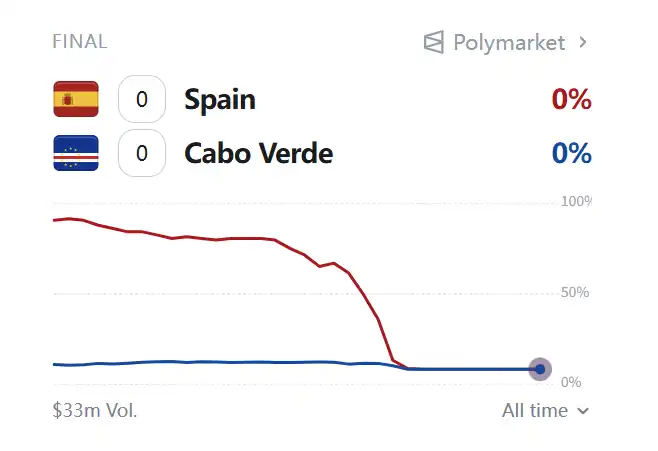
Évolution de la courbe des probabilités de victoire de l'Espagne contre le Cap-Vert sur Polymarket

Si l'Espagne avait gagné, cet utilisateur n'aurait probablement réalisé qu'un profit d'environ 85 000 dollars. Il s'agissait d'une stratégie typique « à faible risque et faible rendement » : miser sur un événement très probable, en engageant un capital important pour un gain stable mais modeste.

Mais finalement, cet utilisateur a terminé avec une perte de près de 1 million de dollars.
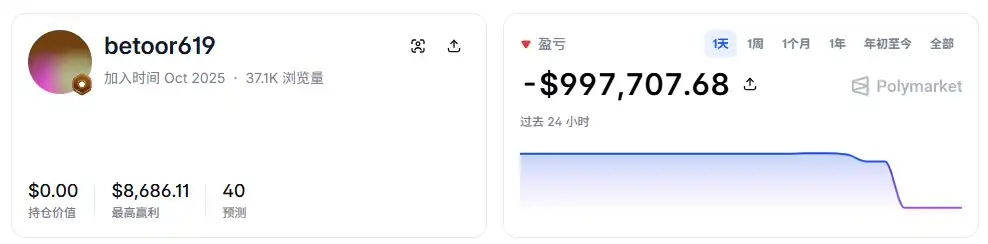
L'utilisateur Polymarket « betoor619 » a perdu 997 000 dollars au cours des dernières 24 heures

Les registres montrent que ce compte a été ouvert en octobre dernier et que ses gains ou pertes sur un seul événement n'avaient jamais dépassé 9 000 dollars auparavant. L'ampleur de ce pari est plus de cent fois supérieure à ses records historiques.

D'autres traders ont également misé massivement sur une victoire espagnole, mais la plupart ont simultanément exécuté des transactions de couverture, compensant ainsi partiellement leurs pertes.

Polymarket permet aux gros traders d'agir en tant que market makers, en détenant simultanément des positions longues et courtes sur le même pari, un mécanisme similaire à celui utilisé par les institutions de Wall Street pour réaliser des profits sur les écarts de prix en achetant et vendant la même action.

Derrière la surprise, le gardien de 40 ans du Cap-Vert fait des miracles

L'Espagne était largement considérée comme la favorite pour remporter cette Coupe du Monde.

Comme le rapportait Wallstreetcn, le modèle de Goldman Sachs lui attribuait une probabilité de victoire de 25 %, la plus élevée parmi toutes les équipes participantes. Le Cap-Vert, quant à lui, non seulement participe pour la première fois à la Coupe du Monde, mais ne compte aucun joueur professionnel renommé dans son effectif.

Le personnage clé ayant inversé la tendance est le gardien de but Josimar José Évora Dias, surnommé Vozinha. Ce vétéran de 40 ans a réalisé sept arrêts décisifs lors du match et a quitté le terrain en larmes après la rencontre, remportant le titre de meilleur joueur du match.

Vozinha a déclaré après le match que des problèmes de visa avaient empêché sa mère d'assister en personne à ce moment historique. Selon la réglementation applicable, les visiteurs de certains pays, dont le Cap-Vert, doivent déposer une caution remboursable pouvant atteindre 15 000 dollars. Il a décrit ce match comme l'objectif pour lequel il avait « travaillé toute sa carrière ».

Ce match nul est également l'une des nombreuses surprises des premiers jours de cette Coupe du Monde, après le retournement spectaculaire du Japon qui a égalisé dans le temps additionnel contre les Pays-Bas dimanche.

L'expansion de la plateforme : du pari politique à la normalisation des paris sportifs

Les plateformes de marchés prédictifs comme Polymarket ont rapidement quitté leur niche ces dernières années. Connues auparavant principalement comme outils de pari sur des événements géopolitiques et économiques, elles sont désormais devenues des plateformes populaires pour les paris sur les grands événements sportifs mondiaux comme la Coupe du Monde.

Les utilisateurs de la plateforme effectuent des transactions via des portefeuilles de cryptomonnaies, peuvent utiliser des comptes anonymes et n'ont pas besoin de révéler leur véritable identité ou leur localisation. Ce mécanisme a suscité des critiques de la part de certains législateurs, qui estiment que la plateforme ne collecte pas les informations nécessaires sur les utilisateurs, contrairement aux courtiers traditionnels ou aux sociétés de paris.

Les registres de transactions publics offrent également une fenêtre d'observation unique, permettant de constater l'ampleur des mises et le niveau de risque pris par les utilisateurs lors des compétitions. Rien que pour le match de l'Espagne lundi, le volume total des transactions des utilisateurs de Polymarket a atteint 64 millions de dollars.


Related Questions

QPourquoi le résultat du match entre l'Espagne et le Cap-Vert a-t-il causé de lourdes pertes sur Polymarket ?

AParce que le Cap-Vert, une équipe débutante et largement sous-estimée, a réussi à faire match nul 0-0 contre l'Espagne, grande favorite de la compétition. Ce résultat inattendu a invalidé les paris à forte probabilité placés sur une victoire espagnole, entraînant des pertes substantielles pour ceux qui avaient massivement misé sur l'Espagne.

QQuel était le pari spécifique de l'utilisateur 'betoor619' et quelle en a été la conséquence ?

AL'utilisateur 'betoor619' a établi une position longue d'environ 1,1 million de dollars lorsque la probabilité de victoire de l'Espagne était d'environ 92%, espérant un gain modeste d'environ 85 000 dollars. Après le match nul, cette stratégie a entraîné une perte de près de 1 million de dollars pour cet utilisateur.

QQuel joueur a été décisif dans le résultat du match et pourquoi ?

ALe gardien de but du Cap-Vert, Josimar José Évora Dias, surnommé Vozinha, a été décisif. Âgé de 40 ans, il a réalisé sept arrêts cruciaux lors du match, a été élu homme du match et a permis à son équipe de préserver le match nul face à l'Espagne.

QQu'est-ce qui distingue Polymarket des plateformes de paris sportifs traditionnelles selon l'article ?

APolymarket se distingue par le fait qu'il s'agit d'un marché de prédiction où les utilisateurs peuvent négocier via des portefeuilles cryptographiques et utiliser des comptes anonymes, sans avoir à divulguer leur identité ou leur localisation réelle. Cela contraste avec les bookmakers traditionnels qui collectent généralement des informations sur leurs clients.

QQuelle était l'importance commerciale de ce match particulier sur la plateforme Polymarket ?

ALe volume total des transactions des utilisateurs de Polymarket pour le seul match entre l'Espagne et le Cap-Vert ce lundi-là a atteint 64 millions de dollars, ce qui illustre l'importance et l'ampleur des paris sur ces grands événements sportifs sur la plateforme.

Related Reads

Wintermute Market Weekly: Iran War Ends, Inflation Meets Expectations, BTC Rebounds to Lower 60ks But Don’t Rush to Buy the Dip

**Wintermute Market Weekly: BTC Rebounds to $60K Lows, But Caution Advised** This week saw a broad market rebound, primarily driven by two converging factors: a US CPI inflation reading that met expectations (4.2% YoY) and former President Trump's announcement of a deal to end the Iran conflict. The latter triggered a sharp drop in oil prices, reducing geopolitical risk premiums and easing inflation fears. Consequently, risk assets like equities and cryptocurrencies rallied, with Bitcoin recovering from lows around $60,000 to close the week up 1.9%, while altcoins gained 3.1%. Despite the price bounce, the underlying liquidity picture for crypto remains weak. Key funding channels—stablecoin flows, ETF inflows, and Digital Asset Treasury (DAT) activity—show no signs of structural improvement. ETF outflows recently hit a record streak, and DAT assets have declined significantly. The rally from $60K to $83K earlier is now viewed as a bear-market rally that has failed. The current environment is characterized by low directional conviction and choppy, range-bound trading, likely persisting into summer. The report advises caution against aggressively buying the dip. While the $60K area offers attractive long-term risk/reward, a sustained bull run requires a visible turnaround in capital inflows, which hasn't materialized. The upcoming FOMC meeting and Powell's commentary, alongside the formal Iran deal signing, are noted as near-term catalysts. The core takeaway is to watch fund flows rather than price action and avoid being whipsawed by volatility before clear signs of institutional or retail capital returning emerge.

marsbit8m ago

Wintermute Market Weekly: Iran War Ends, Inflation Meets Expectations, BTC Rebounds to Lower 60ks But Don’t Rush to Buy the Dip

marsbit8m ago

Cursor, Why Boarded Musk's Starship?

SpaceX announced its acquisition of AI programming startup Cursor's parent company, Anysphere, for $60 billion in an all-stock deal, just days after its record-breaking IPO. The move sent SpaceX's stock soaring, briefly making it the most valuable U.S. company. Cursor, founded in 2022 by MIT graduate Michael Truell and his classmates, is a popular AI coding assistant that allows developers to switch between models from OpenAI, Anthropic, and others. It saw explosive revenue growth, reaching a $4 billion annualized run rate in early 2026. However, its market share was eroded by the launch of competitor Claude Code from its key AI supplier, Anthropic. This dependence prompted Cursor to develop its own AI model, Composer, in early 2026. To scale Composer, Cursor needed immense computing power. In April 2026, it struck a deal with SpaceX, granting the latter an option to acquire it post-IPO. SpaceX exercised this option, offering Cursor access to its Colossus supercomputer, powered by hundreds of thousands of top-tier Nvidia AI chips. For SpaceX, the acquisition is a strategic move to bolster its AI capabilities, particularly for its xAI division, and advance its broader ambition of building orbital, solar-powered data centers. While the deal surprised some employees and investors given Truell's earlier stance on independence, it represents a high-stakes partnership. SpaceX CEO Elon Musk has projected the company could reach $1 trillion in revenue by 2030. For Truell, joining forces with SpaceX is a monumental gamble on an unprecedented scale in the race for AI dominance.

链捕手11m ago

Cursor, Why Boarded Musk's Starship?

链捕手11m ago

The More It Rises, the More Dangerous? The Systemic Risks Behind SpaceX's Soaring Valuation

Summary: The article raises concerns about the systemic risks posed by SpaceX's skyrocketing valuation, arguing that modern market mechanics, rather than fundamentals, are driving its price discovery. Following SpaceX's market capitalization surpassing $3 trillion in after-hours trading, the author contends that the market is no longer functioning properly. The core issue is not SpaceX's business prospects but the unhealthy market structure surrounding it. With limited float and the imminent launch of options trading, the stage is set for a potential "gamma squeeze"—a feedback loop where market makers hedging call options are forced to buy shares, pushing the price higher and attracting more speculative momentum traders. This mechanism, seen previously with Tesla and meme stocks, can decouple valuation from financial reality. The danger escalates as extreme valuations force passive funds, ETFs, pensions, and major indices to hold the stock. If SpaceX grows large enough—hypothetically reaching $5 or even $10 trillion—its performance would increasingly dictate broader market indices, embedding systemic risk. The author warns that when price appreciation itself becomes the primary bullish thesis, the market transforms from a capital allocation mechanism into a self-reinforcing speculative machine, endangering the retirement savings of ordinary investors tied to passive strategies. The piece questions whether such a system can still perform its fundamental role of price discovery.

marsbit15m ago

The More It Rises, the More Dangerous? The Systemic Risks Behind SpaceX's Soaring Valuation

marsbit15m ago

OpenAI's Hyperliquid Pre-IPO Pricing Venture: Why Did It Last Only Half a Year?

The article discusses the rise and fall of Pre-IPO pricing markets on the Hyperliquid blockchain. Trade.xyz, an anonymous team, successfully built the largest pre-market for SpaceX (SPCX) by launching a contract with a clear anchor: the eventual Nasdaq listing price. This provided inherent price stability and validation. In contrast, Ventuals, a team backed by Paradigm, failed despite holding exclusive contracts for highly sought-after companies like OpenAI and Anthropic. Its key mistake was its pricing mechanism. For companies with no near-term IPO date, Ventuals' oracle relied partly on opaque private market transactions and, critically, partly on its own contract's moving average price. This created a self-referential feedback loop where prices were artificially propped up and detached from genuine supply and demand, leading to illiquid markets. Ventuals shut down after nine months, settling positions at final prices of $1,341.80 for OpenAI and $1,618.90 for Anthropic. Ironically, some employees and late-stage investors of these very companies reportedly used these flawed Ventuals prices for valuation reference, highlighting the acute demand for any price signal in illiquid private markets. The article concludes that while demand for pre-IPO trading is real and growing, with players like Coinbase now entering the space, the fundamental challenge remains: without a public listing to provide a definitive price anchor, these markets struggle to establish truly accurate and liquid pricing. The need for a transparent, self-correcting market is the critical lesson from Ventuals' failure.

marsbit42m ago

OpenAI's Hyperliquid Pre-IPO Pricing Venture: Why Did It Last Only Half a Year?

marsbit42m ago

Trading

Spot
Futures

Hot Articles

What is USDC(WORMHOLE)

USD Coin (Wormhole): A Comprehensive Overview Introduction In the rapidly evolving world of cryptocurrencies, USD Coin (Wormhole), referred to as $USDC(Wormhole), stands out as a pioneering solution within the DeFi (Decentralized Finance) landscape. Operating on several blockchain platforms, including Solana, USD Coin (Wormhole) is more than just a digital representation of the United States dollar. It embodies the innovative spirit of modern finance, enabling seamless cross-chain transactions and enhanced interoperability among diverse blockchain ecosystems through the advanced Wormhole protocol. What is USD Coin (Wormhole)? USD Coin (Wormhole) is a tokenized version of the US dollar designed to facilitate frictionless transactions across different blockchain networks. Its primary aim is to bolster liquidity and enhance the functionality of the DeFi ecosystem. By leveraging the Wormhole protocol, which establishes a robust cross-chain communication network, users can effortlessly transfer USDC tokens across various platforms. This cross-chain capability marks a significant advancement in cryptocurrency use, promoting a more interconnected and efficient ecosystem where assets can flow freely between different blockchains. The value proposition of USD Coin (Wormhole) lies not only in its stability, being pegged to the US dollar, but also in its ability to bridge gaps between disparate blockchain environments. This innovative approach fosters a greater level of participation among users and developers, paving the way for new and exciting applications within decentralized finance. Who is the creator of USD Coin (Wormhole)? The origins of USD Coin (Wormhole) are intricately tied to the Wormhole network, which was developed by Jump Crypto. While specific individual creators are not prominently documented, Jump Crypto is notable for its involvement in advancing blockchain technology and supporting its applications in finance. By creating the Wormhole network, Jump Crypto has played a vital role in promoting cross-chain asset transfers, enhancing the efficiency and diversity of cryptocurrency usage. Who are the investors of USD Coin (Wormhole)? The success of USD Coin (Wormhole) is supported by investments from several notable funds and organizations within the cryptocurrency realm. Key investors include: Coinbase Ventures: A prominent venture capital arm backed by one of the leading cryptocurrency exchanges in the industry, Coinbase Ventures provides essential capital and strategic support to promising blockchain projects. Arrington XRP Capital: Specializing in digital assets, Arrington XRP Capital recognizes the potential of innovative projects like USD Coin (Wormhole) and has invested accordingly to back its development. Jump Trading: As the parent organization of Jump Crypto, Jump Trading brings not only investment but a wealth of expertise in trading technology and market dynamics to bolster the Wormhole project. How Does USD Coin (Wormhole) Work? The operational framework of USD Coin (Wormhole) is intricately designed to facilitate effective cross-chain transactions, maximizing security and efficiency. Here’s a simplified overview of how it functions: Asset Locking: When a user wishes to transfer USDC from one blockchain to another, they first lock their tokens on the source blockchain. This process ensures that the assets are secure and are set to be either burned or moved later. Token Minting: After the tokens are locked, an equivalent amount of USDC is minted on the destination blockchain. This provides the user with access to their funds on a new platform, reflecting the flexibility that the Wormhole protocol enables. Cross-Chain Transfer: The Wormhole protocol efficiently facilitates the entire transfer process. It ensures that once the USDC is minted on the destination chain, the equivalent tokens are burned on the source chain. The result is a seamless transfer of value between two distinct blockchain environments. This cross-chain methodology ensures that transactions remain secure and transparent, significantly enhancing liquidity within the different DeFi ecosystems. Timeline of USD Coin (Wormhole) Understanding the evolution of USD Coin (Wormhole) provides vital context for its significance in the cryptocurrency arena. Here’s a timeline highlighting important milestones in the project’s history: 2021: The Wormhole project is launched, establishing a framework for cross-chain asset transfers and setting the stage for the development of USD Coin (Wormhole). 2022: The Wormhole network experiences a significant challenge with a security breach that results in a $325 million theft. However, the incident is later addressed and refunded by Jump Crypto, showcasing the project’s commitment to security and transparency. 2023: USD Coin (Wormhole) integrates with Circle’s Cross-Chain Transfer Protocol (CCTP), enhancing its capabilities for cross-chain transfers and further solidifying its place within the DeFi ecosystem. 2024: Ongoing development and expansion of the Wormhole network continue, aimed at increasing the utility and reach of USD Coin (Wormhole) as well as enhancing its operational framework. Key Features The success of USD Coin (Wormhole) can be attributed to several key features that differentiate it from other cryptocurrency offerings: Cross-Chain Interoperability At the core of USD Coin (Wormhole) is its ability to facilitate seamless transfers across multiple blockchain networks. This interoperability serves as a cornerstone for decentralized finance, allowing various platforms to interact with each other, thereby accelerating the evolution of financial services. Security Wormhole employs a well-designed Guardian Network comprised of node validators that ensure secure cross-chain transactions. This collective oversight minimizes the risk of fraud and provides users with confidence that their assets are protected during cross-chain transfers. Liquidity Enhancement By enabling USDC to circulate freely across different blockchains, USD Coin (Wormhole) enhances liquidity in the DeFi ecosystem. This increased liquidity can foster more efficient trading, contribute to better pricing strategies, and improve the overall market dynamics encompassing various digital assets. Conclusion USD Coin (Wormhole) is a pivotal innovation in the blockchain space, reinforcing the capabilities of decentralized finance (DeFi) and establishing a more connected financial ecosystem. With its robust framework for cross-chain transactions, security features, and strong backing from reputable investors, USD Coin (Wormhole) is positioned to play a key role in the future of cryptocurrency. As the digital finance landscape continues to evolve, USD Coin (Wormhole) not only embraces the future of interconnectivity among blockchain networks but also reaffirms the power of tokenization and blockchain technology in transforming how we perceive and utilize value in a digital world. By navigating the complexities of cross-chain functionality, it demonstrates a sophisticated approach to enabling financial inclusivity and innovation in the world of cryptocurrencies.

1.2k Total ViewsPublished 2024.04.01Updated 2024.12.03

What is USDC(WORMHOLE)

What is W$C

World$tateCoin ($W$C): A Comprehensive Exploration of the Emerging Cryptocurrency Project Introduction In the ever-evolving landscape of cryptocurrencies, World$tateCoin ($W$C) has emerged as a project that aims to harness the power of web3 technologies to create a distinctive digital ecosystem. As traditional models of online interaction undergo significant transformation, World$tateCoin seeks to establish itself in this budding third generation of the internet. This article will delve into the intricacies of World$tateCoin, providing an overview of the project, its objectives, and its potential impact on the web3 space. What is World$tateCoin ($W$C)? World$tateCoin ($W$C) is designed as a cryptocurrency that facilitates seamless transactions within a web3 environment. Aimed at creating a decentralized platform where users can interact with various web3 applications, $W$C intends to streamline user experience and enhance accessibility to digital services. While the project aspires to become an integral part of the web3 landscape, detailed insights into its specific objectives and use cases remain limited, raising questions regarding its potential role and utility in a rapidly advancing digital context. The essence of web3 revolves around decentralization and empowering users with greater control over their interactions online. World$tateCoin intends to align with these principles, although specific applications and functionalities of the currency are still under discussion within the community. Who is the Creator of World$tateCoin ($W$C)? In exploring the origins of World$tateCoin, information regarding its creator remains elusive. As of now, there is no publicly available data identifying the individuals or organizations behind the project. This obscurity may cast a shadow of uncertainty over the project’s credibility, but the commitment to innovation within the cryptocurrency framework could be a driving force for its adoption in the future. The lack of identifiable leadership may result in hurdles related to trust and transparency—elements that are crucial for establishing a strong community in the crypto space. Who are the Investors of World$tateCoin ($W$C)? Current research does not reveal any specific investors or backing organizations involved with World$tateCoin. It is not uncommon for emerging cryptocurrency projects to either attract discreet investments or operate in a minimalist financial structure during their initial phase. The ambiguity surrounding investment supports and funding methodologies could affect the project’s sustainability and growth prospects. When assessing new projects within the cryptocurrency domain, investors generally look for transparency regarding financial backing and support from established entities. The absence of this information might necessitate a cautious approach for potential users and stakeholders interested in the future of World$tateCoin. How Does World$tateCoin ($W$C) Work? The operational mechanics of World$tateCoin are grounded in the principles of decentralization, a hallmark of web3 technologies. By facilitating transactions directly between users without the intervention of intermediaries, $W$C is designed to enhance trust and efficiency. However, comprehensive documentation detailing the unique features and operational framework that distinguish World$tateCoin from other cryptocurrencies is markedly sparse. This lack of information complicates the understanding of how $W$C functions within the broader web3 ecosystem and what unique propositions it brings to users and developers alike. Nevertheless, the fundamental goal of allowing for decentralized transactions holds the promise of a more liberated financial landscape, should the project deliver on its aspirations of implementing robust mechanisms and user-friendly interfaces. Timeline of World$tateCoin ($W$C) Constructing a timeline that encapsulates the historical progression of World$tateCoin poses challenges due to an absence of significant documentation on key events and milestones. Nevertheless, an approximate sequence of hypothetical phases can be envisaged, constituting a path forward for the project: Initial Concept (Date Unknown): Conceptualization of the World$tateCoin framework in the broader context of web3 technologies. Development Phase (Date Unknown): Commencement of technical development and coding processes. Community Engagement (Date Unknown): Outreach to potential users and stakeholders to foster community interest in the project. Launch Target (Date Unknown): Announcing an expected launch date, contingent on the progress of development and testing phases. Due to the lack of substantiated dates and details surrounding these phases, stakeholders will need to remain vigilant and engaged with the project's communications for updates regarding its trajectory. Key Topics About World$tateCoin ($W$C) As the project unfolds, certain key subjects arise that embody the potential and aspirations of World$tateCoin: Decentralization: The core philosophy driving the project, aimed at fostering direct user interactions. Web3 Integration: The goal of mirroring web3 principles and enabling seamless user access to an array of digital services. Digital Currency: Positioned as a currency to facilitate internet-based transactions, World$tateCoin aims to inject additional liquidity into the web3 market. Challenge of Information Scarcity: The notable absence of detailed information regarding the project's foundations, creators, and operational methods, necessitating increased transparency from developers to build community trust. Conclusion World$tateCoin ($W$C) is positioned within an exciting yet uncertain terrain of cryptocurrency and web3 integration. While it aims to cultivate a decentralized environment, the limited availability of information regarding its creators, investors, and specific functionalities presents challenges for potential stakeholders and users. In the dynamic world of cryptocurrencies, transparency, engagement, and well-structured communication are vital for the success of projects such as World$tateCoin. As the landscape continues to evolve, stakeholders will be eager to see how the project can solidify its place within the web3 narrative and contribute to the ongoing transformation of the digital ecosystem.

1.0k Total ViewsPublished 2024.04.01Updated 2024.12.03

What is W$C

How to Buy W

Welcome to HTX.com! We've made purchasing Wormhole (W) simple and convenient. Follow our step-by-step guide to embark on your crypto journey.Step 1: Create Your HTX AccountUse your email or phone number to sign up for a free account on HTX. Experience a hassle-free registration journey and unlock all features.Get My AccountStep 2: Go to Buy Crypto and Choose Your Payment MethodCredit/Debit Card: Use your Visa or Mastercard to buy Wormhole (W) instantly.Balance: Use funds from your HTX account balance to trade seamlessly.Third Parties: We've added popular payment methods such as Google Pay and Apple Pay to enhance convenience.P2P: Trade directly with other users on HTX.Over-the-Counter (OTC): We offer tailor-made services and competitive exchange rates for traders.Step 3: Store Your Wormhole (W)After purchasing your Wormhole (W), store it in your HTX account. Alternatively, you can send it elsewhere via blockchain transfer or use it to trade other cryptocurrencies.Step 4: Trade Wormhole (W)Easily trade Wormhole (W) on HTX's spot market. Simply access your account, select your trading pair, execute your trades, and monitor in real-time. We offer a user-friendly experience for both beginners and seasoned traders.

6.0k Total ViewsPublished 2024.04.02Updated 2026.06.02

How to Buy W

Discussions

Welcome to the HTX Community. Here, you can stay informed about the latest platform developments and gain access to professional market insights. Users' opinions on the price of W (W) are presented below.

活动图片