Giá Solana Dưới $65 Lần Đầu Tiên Kể Từ Năm 2023: Các Mức Giá Quan Trọng Cần Theo Dõi

bitcoinistPublished on 2026-06-06Last updated on 2026-06-06

Abstract

Giá Solana (SOL) đã giảm mạnh cùng với thị trường tiền điện tử chung, chạm mức khoảng 60 USD vào ngày 5 tháng 6, lần đầu tiên xuống dưới 65 USD kể từ cuối năm 2023. Phân tích on-chain từ Ali Martinez chỉ ra rằng SOL đã mất đi vùng hỗ trợ quan trọng quanh 77 USD. Mức hỗ trợ tiếp theo và quan trọng nhất hiện nay nằm ở khoảng 53 USD, với rất ít điểm đỡ giữa giá hiện tại và ngưỡng này. Nếu mức 53 USD bị phá vỡ, các mức hỗ trợ quan trọng tiếp theo có thể nằm ở vùng 35 USD và 24 USD. Tuy nhiên, để có sự phục hồi, thị trường cần sự trở lại của lực cầu mua. Tại thời điểm bài viết, giá SOL giao dịch quanh 63,23 USD, giảm gần 8% trong 24 giờ qua.

Không có gì ngạc nhiên khi giá Solana đã tan vỡ dưới sức ép của phe gấu, khi thị trường tiền điện tử nói chung chứng kiến một làn sóng áp lực giảm trong tuần qua. Đồng altcoin này đã lao dốc xuống gần mốc 60 USD vào thứ Sáu, ngày 5 tháng 6, mức giá thấp nhất kể từ cuối năm 2023.

Xét theo sức mạnh của đợt điều chỉnh giảm gần đây, kỳ vọng thị trường đang nghiêng về việc đà suy thoái sẽ tiếp diễn trong vài tuần tới. Với suy nghĩ đó, dưới đây là một số mức giá Solana quan trọng cần theo dõi trong ngắn hạn.

Dữ Liệu On-Chain Chỉ Ra Mức Hỗ Trợ Tiếp Theo Của SOL Nằm Quanh $53

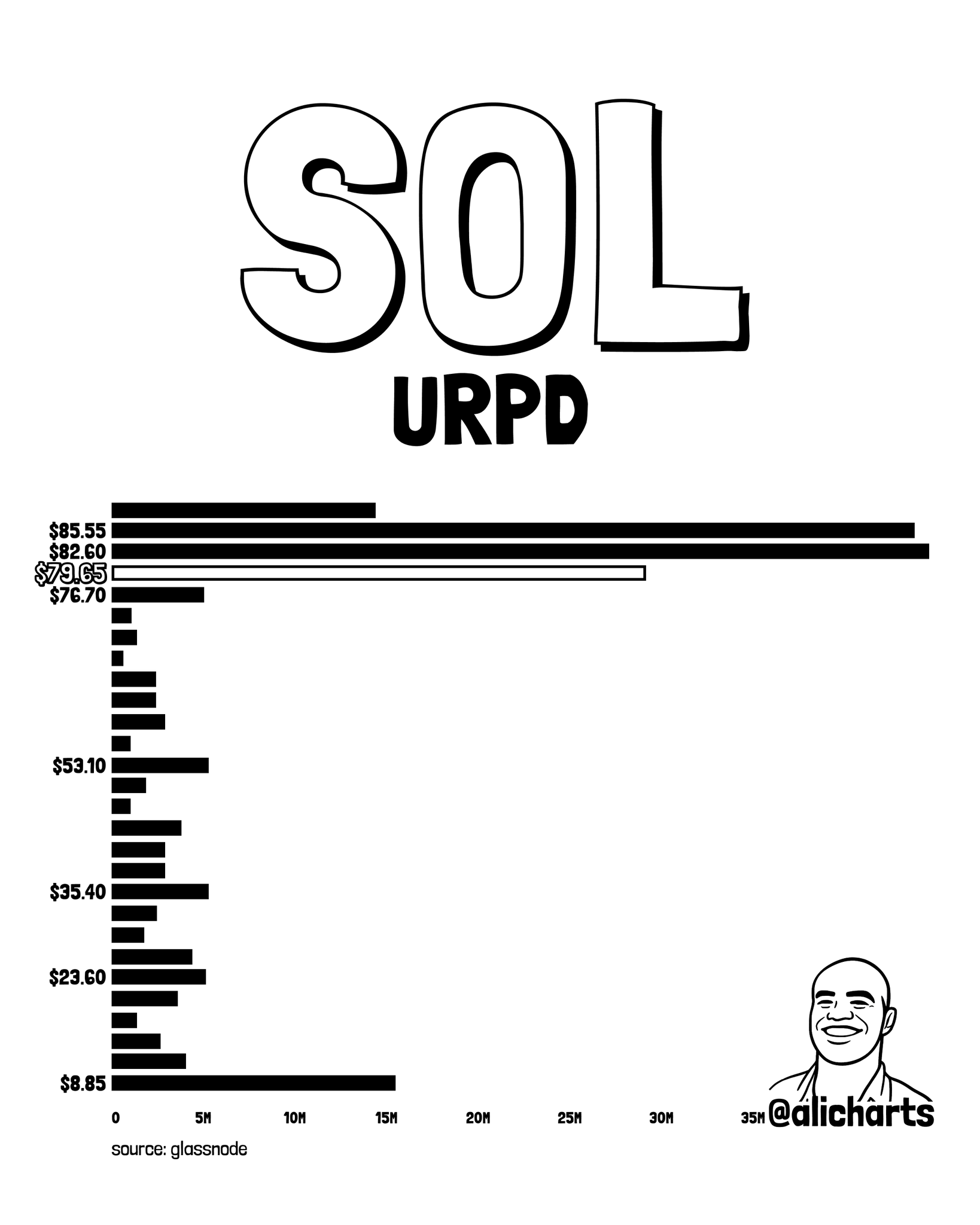
Trong một bài đăng vào ngày 5 tháng 6 trên nền tảng X, nhà phân tích tiền điện tử Ali Martinez đã chia sẻ một thông tin on-chain về các mức giá tiếp theo rất quan trọng đối với tương lai của giá Solana. Nhận xét này dựa trên chỉ số Phân Phối Giá Thực Hiện UTXO (URPD), chỉ số này theo dõi khối lượng của một loại tiền điện tử cụ thể được mua ở một mức giá cụ thể.

Sử dụng dữ liệu on-chain này, chỉ báo URPD lập bản đồ các vùng giá có hoạt động của nhà đầu tư đáng kể (nơi nhiều nhà đầu tư có giá vốn của họ). Do hoạt động đáng kể của nhà đầu tư trong khu vực, các mức giá vốn này thường đóng vai trò là hỗ trợ và kháng cự cho giá của đồng tiền điện tử (trong trường hợp này là Solana).

Cơ chế đằng sau điều này là các nhà đầu tư có xu hướng hành động trên thị trường khi giá tài sản quay trở lại mức giá vốn của họ.

Nếu các nhà đầu tư đang có lãi và giá tài sản giảm xuống điểm vào lệnh của họ, họ có xu hướng mua thêm, bảo vệ mức giá vốn và tạo thành một đệm hỗ trợ. Trong khi đó, những nhà đầu tư đang bị lỗ có xu hướng bán ra khi giá tiến gần mức giá vốn của họ, dẫn đến sự kháng cự về giá.

Nguồn: @alicharts trên X

Trong bài đăng trên X, Martinez nhấn mạnh rằng giá Solana vừa mất một đệm hỗ trợ quan trọng quanh mức 77 USD. Nhà phân tích thị trường sau đó xác định 53 USD là mức hỗ trợ giá quan trọng tiếp theo đối với altcoin này, với hầu như không có đệm nào giữa giá hiện tại của SOL và mức sàn ngay lập tức này.

Trong trường hợp giá Solana giảm và mất đi mức hỗ trợ 53 USD, các mức quan trọng tiếp theo nằm quanh 35 USD và 24 USD. Mặc dù sẽ cần một đợt bán tháo nghiêm trọng hơn nữa để giá SOL giảm xuống các mức đã xác định này, nhưng sự trở lại của nhu cầu trên thị trường giao ngay là cần thiết để bất kỳ sự phục hồi nào bắt đầu.

Giá Solana Nhìn Nhanh

Tại thời điểm viết bài, giá SOL đang đứng ở mức khoảng 63,23 USD, với mức giảm gần 8% trong 24 giờ qua.

Giá của SOL trên khung thời gian hàng ngày | Nguồn: Biểu đồ SOLUSDT trên TradingView

Related Questions

QTại sao giá Solana lại giảm xuống dưới 65 đô la vào tháng 6 năm 2025?

AGiá Solana giảm xuống dưới 65 đô la lần đầu tiên kể từ năm 2023, chủ yếu do áp lực bán mạnh từ phe gấu và làn sóng giảm áp lên toàn bộ thị trường tiền điện tử trong tuần qua.

QMức hỗ trợ quan trọng tiếp theo cho giá Solana theo dữ liệu on-chain là bao nhiêu?

ATheo nhà phân tích Ali Martinez dựa trên chỉ số URPD, mức hỗ trợ quan trọng tiếp theo cho giá Solana nằm quanh vùng 53 đô la.

QChỉ báo URPD (UTXO Realized Price Distribution) đo lường điều gì và nó giúp xác định các mức giá then chốt như thế nào?

AChỉ báo URPD theo dõi khối lượng của một loại tiền điện tử cụ thể được mua ở một mức giá nhất định. Nó xác định các vùng giá có hoạt động của nhà đầu tư đáng kể (nơi nhiều nhà đầu tư có giá vốn của họ). Những mức giá vốn này thường đóng vai trò là hỗ trợ và kháng cự cho giá.

QĐiều gì có thể xảy ra nếu giá Solana phá vỡ mức hỗ trợ 53 đô la?

ANếu giá Solana mất mức hỗ trợ 53 đô la, các mức quan trọng tiếp theo cần theo dõi sẽ nằm quanh vùng 35 đô la và 24 đô la, mặc dù việc giảm xuống các mức này sẽ cần thêm một đợt bán tháo nghiêm trọng.

QGiá Solana tại thời điểm bài báo được viết là bao nhiêu và biến động trong 24 giờ ra sao?

ATại thời điểm bài báo được viết, giá SOL đứng ở mức khoảng 63.23 đô la, giảm gần 8% trong 24 giờ qua.

Related Reads

Warsh's Debut: Will the FED Chair Who Knows Crypto Best Bring Surprises or Shocks to the Market?

Kevin Warsh, the new Federal Reserve Chairman, prepares for his inaugural press conference amidst a challenging macroeconomic landscape: resurgent inflation, a bond market sell-off, and political pressure from President Trump for rate cuts. Uniquely, Warsh holds indirect investments in over 20 crypto and Web3 entities (e.g., Solana, dYdX), making him the first Fed Chair with disclosed crypto exposure. His stance may combine a hawkish, inflation-focused monetary policy with a crypto-friendly regulatory philosophy that shifts from Powell’s “same risk, same rule” approach toward a framework acknowledging blockchain’s productivity value. Warsh’s leadership could impact crypto markets across three dimensions: a paradigm shift in regulation (potentially accelerating pro-innovation legislation and stable币 rules), a re-pricing of risk premiums based on clearer communication and his view of AI as a structural disinflationary force, and a long-term reallocation of global institutional capital driven by increased legitimacy. Two potential scenarios for the press conference are outlined. A “positive surprise” would involve a dovish-leaning tone on rates coupled with signals of regulatory openness, potentially boosting crypto asset valuations. Conversely, a “negative shock” would see a more hawkish-than-expected stance on inflation and rates, triggering a broad risk-asset selloff that crypto markets would not escape. While ethics rules required Warsh to divest his crypto holdings upon confirmation, his deep understanding of the technology may fundamentally lower policy uncertainty and build a more receptive long-term foundation for digital assets’ integration into the mainstream financial system.

marsbit4h ago

Warsh's Debut: Will the FED Chair Who Knows Crypto Best Bring Surprises or Shocks to the Market?

marsbit4h ago

Trading

Spot
Futures

Hot Articles

What is G$

Understanding GoodDollar ($G$): A Blueprint for Decentralised Universal Basic Income Introduction In the ever-evolving landscape of cryptocurrency and blockchain technology, initiatives that seek to address pressing social issues have garnered increased attention. One such project is GoodDollar ($G$), a Web3-based universal basic income (UBI) solution. GoodDollar endeavours to tackle inequality and bridge the wealth gap by creating and distributing accessible economic resources to those most in need. Through its innovative use of decentralised finance (DeFi), GoodDollar presents a unique model that could potentially reshape the way financial assistance is perceived and delivered globally. What is GoodDollar ($G$)? GoodDollar is a cryptocurrency protocol that facilitates the issuance and distribution of digital tokens, referred to as $G$, to its registered users on a daily basis. These tokens function as a form of universal basic income, promoting financial empowerment for individuals from various backgrounds, especially those traditionally excluded from the financial system. Operating on the blockchain, GoodDollar utilises multiple chains, including Ethereum, Celo, and Fuse, ensuring broad access and usability. The fundamental goal of GoodDollar is to make cryptocurrency accessible and beneficial to everyone, irrespective of their economic starting point. The Creator of GoodDollar ($G$) Details concerning the creator of GoodDollar remain somewhat obscure. However, it is notably highlighted that the project has strong backing from eToro, a widely recognised investment platform that provided the initial funding and foundational support for GoodDollar's development. The vision behind the project is not solely profit-driven but leans heavily towards social entrepreneurship, aiming for a systemic change in economic accessibility. Investors of GoodDollar ($G$) GoodDollar enjoys the financial backing and operational support of eToro. This partnership has played a significant role in launching the protocol and its subsequent developments. While eToro was instrumental in establishing the foundation of the project, GoodDollar envisions transitioning towards a model funded by its community in the long run. This shift to community funding is in line with GoodDollar's commitment to decentralisation, allowing its users to have a direct stake in the project's future. How Does GoodDollar ($G$) Work? GoodDollar's operational framework relies heavily on DeFi principles to generate interest from staked cryptocurrencies. This mechanism allows the project to mint and distribute $G$ tokens as a digital basic income for users worldwide. Several key features contribute to GoodDollar's uniqueness and innovation: Universal Basic Income (UBI): Every day, registered users receive free tokens, establishing an automatic income stream intended to alleviate financial pressures. Sustainable Economic Model: The project’s tokenomics aim to balance supply and demand for $G$ tokens, ensuring that the value remains stable over time. Reserve-Backed Tokens: Each $G$ token is backed by a reserve of cryptocurrencies, providing it with inherent value and reliability, a crucial aspect for maintaining user trust. Decentralised Governance: GoodDollar incorporates a democratic approach to decision-making through token-powered decentralised governance. This allows community members to actively participate in the shaping of the project's trajectory, making it truly community-driven. Global Accessibility: GoodDollar has established a considerable community footprint, boasting over 640,000 members spanning 181 countries. Such widespread reach is instrumental in facilitating UBI on a global scale. Timeline of GoodDollar ($G$) The evolution of GoodDollar is marked by several significant milestones throughout its history: 2019: The launch of the GoodDollar wallet marked the first step in operationalising its vision of delivering UBI through cryptocurrency. 2020: Following the successful wallet rollout, the GoodDollar protocol officially debuted. This marked a crucial phase in its mission to provide daily distributed income. 2021: The project advanced further with the introduction of its Decentralised Autonomous Organization (DAO), fostering a greater level of community involvement and governance. 2022: GoodDollar unveiled its DeFi-friendly version 2 (V2), striving for enhanced user engagement and operational efficiency. The same year also saw the transition to a decentralised governance structure via GoodDAO. 2022: A new roadmap was conceptualised, focusing on initiatives like a grant program designed to promote $G$-related entrepreneurial ventures and an upgraded GoodDollar Marketplace. Key Features of GoodDollar ($G$) The GoodDollar project introduces numerous critical features aimed at redefining the landscape of basic income: Universal Basic Income: Delivering daily free tokens to its users fundamentally underscores its mission to eliminate economic precarity. Multi-Chain Operation: Leveraging multiple blockchain networks enhances accessibility and scalability, ensuring broader participation. Engagement with Decentralised Finance: The use of DeFi allows for sustainable funding of the UBI model, reinforcing its viability as an economic solution. Community Engagement and Governance: GoodDollar envisions a model where the community influences operations through democratic participation, fostering transparency and accountability. Global Community: Boasting a diverse global community enables the project to implement UBI solutions tailored to various cultural and economic contexts. Conclusion GoodDollar represents a transformative leap towards incorporating the principles of universal basic income through the innovative lens of blockchain technology. By harnessing decentralised finance, the project not only provides a solution to financial inequality but also actively engages users in its governance and operations. With a growing community and evolving roadmap, GoodDollar stands as a significant player in the intersection of cryptocurrency and social good, paving the way for a more equitable financial future. As it continues to evolve, GoodDollar’s journey may ultimately inspire other initiatives to consider similar models, furthering the cause of economic empowerment for all.

208 Total ViewsPublished 2024.04.05Updated 2024.12.03

What is G$

What is @G

Graphite Network, $@G: Bridging TradFi and Web3 Introduction to Graphite Network, $@G In the vibrant world of cryptocurrencies and web3 projects, Graphite Network emerges as a beacon of innovation. With its native token, $@G, this Layer-1, Proof-of-Authority (PoA) blockchain is tailored to bridge the gap between traditional finance (TradFi) and the rapidly evolving Web3 ecosystem. As digital currencies gain traction, Graphite Network strives to offer a blockchain platform that prioritises security, compliance, and speed, presenting itself as a facilitator of trust and accountability. What is Graphite Network, $@G? Graphite Network is not merely another blockchain project; it aims to redefine how decentralisation, security, and user accountability are perceived in the digital finance realm. The project boasts a series of distinctive features: Reputation-Based Blockchain: At its core, Graphite Network implements a one-user, one-account policy, fortified with integrated Know Your Customer (KYC) verification and scoring mechanisms. This design ensures a balance between user privacy and transparency—a critical aspect of financial operations in today’s digital world. Entry-Point Node Income: The network incentivises users to set up entry-point nodes, allowing operators to earn rewards from network transactions. This income generation model not only boosts user engagement but also reinforces network health and decentralisation. EVM Compatibility: With an Ethereum-compatible virtual machine (VM), Graphite Network enables seamless integration of existing Solidity decentralised applications (dApps) and smart contracts, thereby inviting developers to leverage its capabilities without extensive modifications. KYC Integration: In an era where compliance is paramount, the integrated KYC framework with multiple verification tiers enhances control over financial operations without mandatory participation, setting a precedent for user autonomy. Who is the Creator of Graphite Network, $@G? The Graphite Network is borne out of the endeavours of the Graphite Foundation, a non-profit organisation dedicated to the development, maintenance, and evolution of the Graphite Network. The foundation’s commitment underscores the project’s vision to create a secure and sustainable blockchain environment focused on genuine user engagement and compliance. Who are the Investors of Graphite Network, $@G? Currently, there is limited information available on the specific investors backing the Graphite Network initiative. The founding organisation, the Graphite Foundation, functions independently in fostering the project’s growth while seeking partnerships that resonate with its vision of a compliant and accessible blockchain platform. How Does Graphite Network, $@G Work? Graphite Network’s operation is grounded in its unique Proof-of-Authority consensus mechanism, which strikes an impressive balance between high throughput and decentralisation. Let's delve into the various components that define its operation: Transport Nodes: Serving as the entry-point nodes, these are critical to the ecosystem. Operators can earn revenue from transactions that traverse the network, which not only empowers individual users but also bolsters network decentralisation. Authorised Nodes: At the heart of the Graphite Network are core validators who undergo rigorous compliance tests, encompassing robust KYC verification along with technical assessments. This layer of trust is essential for ensuring that transactions within the network maintain a high level of integrity. Ticker System: Graphite Network employs a distinctive ticker system for its wrapped tokens, denoted as @G. This feature enhances clarity in asset integration, making user transactions comprehensible and straightforward. Graphite Network’s innovative approach reflects a significant step in addressing the crucial issues of digital finance, positioning itself favourably for the future as more users transition from traditional forms of finance into the world of decentralised applications. Timeline of Graphite Network, $@G To understand the progression and milestones of Graphite Network, it is beneficial to overview key events in its timeline: 2021: The inception of Graphite Network by the Graphite Foundation marks the commencement of a new chapter in blockchain development, focusing on compliance and user empowerment. Key Developments: Following its launch, the introduction of entry-point node income, the establishment of a reputation-based model, integrated KYC verification, and the provision of EVM compatibility represent significant advancements in the project. Recent Activities: The continuous development and nurturing efforts of the Graphite Foundation have focused on augmenting network features while fostering the ecosystem's growth, demonstrating a long-term commitment to sustainability and innovation. Additional Key Points Beyond its foundational components, Graphite Network encompasses several tools and features that bolster its usability: Graphite Wallet: A user-friendly Chrome extension that facilitates access to various network features and applications across Ethereum-compatible chains, enhancing user convenience. Graphite Bridge: This utility allows seamless transfers of Graphite assets across different networks, fostering an integrated and interoperable ecosystem. Graphite Explorer: Serving as an essential tool within the ecosystem, this feature enables users to view and verify smart contract source code, track transactions, and explore other vital information in real-time. Graphite Testnet: The project provides a robust testing environment for developers, allowing them to ensure stability and scalability prior to mainnet deployment. This initiative not only empowers developers but also enhances the reliability of the entire network. Conclusion Graphite Network, with its native token $@G, represents a significant stride toward bridging traditional finance and cutting-edge blockchain technology. By focusing on security, compliance, and decentralisation, this innovative platform is set to lead the transition into the Web3 era. As user engagement grows and more projects leverage its capabilities, Graphite Network is poised to make lasting contributions to the rapidly evolving digital landscape. In conclusion, Graphite Network stands as a testament to what can be achieved when innovative thinking meets the growing demands of modern finance and technology. As the world explores the potential of decentralised finance, Graphite Network will undoubtedly remain a noteworthy player in this arena.

14 Total ViewsPublished 2025.01.06Updated 2025.01.06
What is @G

Discussions

Welcome to the HTX Community. Here, you can stay informed about the latest platform developments and gain access to professional market insights. Users' opinions on the price of G (G) are presented below.

活动图片