Un ancien d'Ethereum dormant sur un gain de 630 000 % se réveille après 10 ans

bitcoinistPublished on 2026-05-27Last updated on 2026-05-27

Abstract

Une ancienne adresse Ethereum, inactive depuis près de 11 ans et classée comme « pré-minée » pour avoir reçu ses tokens avant le lancement public du réseau en 2015, vient de se réactiver. Elle contenait 2 000 ETH, achetés pour environ 620 dollars à l'époque, dont la valeur actuelle dépasse 4,2 millions de dollars, soit une plus-value d'environ 630 000 %. L'activité a repris par une transaction test de 1 ETH, suivie d'un transfert de 1 997,9 ETH qui a presque vidé le portefeuille. Pour l'instant, les fonds n'ont pas été envoyés vers un échange centralisé, laissant incertaine l'intention de vente. La raison la plus probable de cette soudaine réactivation est la redécouverte récente des clés d'accès, ce portefeuille ayant probablement été perdu ou oublié pendant toutes ces années. Une hypothèse moins probable serait celle d'un investisseur ayant délibérément conservé ses actifs aussi longtemps. Parallèlement, le prix de l'Ethereum, après un récent recul vers 2 000 dollars, se négocie désormais autour de 2 130 dollars.

Les données on-chain montrent qu'un ancien portefeuille Ethereum contenant 2 000 ETH, inactif pendant près de 11 ans, vient soudainement de se réveiller.

Le portefeuille d'un OG Ethereum a transformé 620 $ en 4,2 millions $

Selon les données du service de suivi de transactions cryptographiques Whale Alert, un ancien portefeuille Ethereum vient de mettre fin à une période d'inactivité de 10,8 ans. L'adresse en question détenait un total de 2 000 ETH, d'une valeur de 620 $ en 2015.

Le portefeuille est si ancien que Whale Alert le classe comme une adresse de pré-minage. Dans le contexte d'ETH, une « adresse de pré-minage » désigne une adresse qui a reçu ses tokens avant que le minage ne commence sur le réseau lors de son lancement public en 2015. Ces portefeuilles ont reçu ces coins car ils appartenaient à des contributeurs et participants précoces de la prévente de 2014.

Curieusement, malgré son entrée précoce dans la cryptomonnaie, cet investisseur particulier n'a jamais participé à la moindre activité, sa seule transaction en plus de 10 ans étant le dépôt qu'il a reçu lors de la genèse de la blockchain.

Désormais, l'adresse de pré-minage a soudainement été réactivée. Voici ci-dessous les détails relatifs à la transaction qui a rompu le long silence du portefeuille.
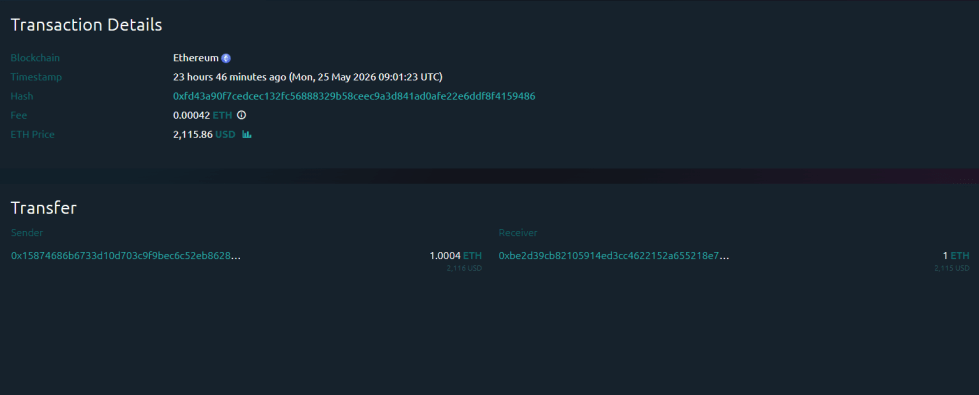
Il semblerait que l'investisseur ait déplacé une petite somme avec ce transfert | Source : Whale Alert

Comme on peut le voir, le transfert impliquait une somme de seulement 1 ETH, ce qui suggère qu'il s'agissait probablement d'une transaction de test. Après ce transfert, le portefeuille a suivi avec quelques autres transactions, notamment un déplacement de 1 997,9 ETH qui a presque complètement vidé son solde. Jusqu'à présent, ces coins n'ont pas atterri sur un exchange centralisé, il est donc difficile de dire si l'investisseur cherche à les vendre.

Comme mentionné précédemment, la stack d'Ethereum détenue par l'adresse ne valait que 620 $ en 2015. Aujourd'hui, le même montant se convertit en plus de 4,2 millions $, représentant un gain de près de 630 000 %.

Quelle pourrait être la raison du retour soudain de cet OG ? Eh bien, la réponse à cette question résiderait dans ce qui est arrivé au portefeuille après son silence. Souvent, les adresses aussi anciennes atteignent cet âge non pas grâce à un HODLing résolu, mais parce qu'elles ont été perdues ou oubliées. Ainsi, il est possible que cette adresse était simplement inaccessible pendant sa période d'inactivité et que ses clés n'aient été redécouvertes que récemment.

Un scénario moins probable, mais pas impossible, est que le solde d'Ethereum ait effectivement atteint cet âge grâce à une détention à long terme. Si c'est le cas, l'investisseur serait parmi les « diamants » les plus endurants du secteur des actifs numériques.

Prix de l'ETH

Ethereum a décliné vers le niveau des 2 000 $ il y a quelques jours, mais la cryptomonnaie a réussi à remonter progressivement, son prix s'échangeant actuellement autour de 2 130 $.

Le prix de la crypto semble avoir globalement suivi une trajectoire latérale ces derniers jours | Source : ETHUSDT sur TradingView

Trending Cryptos

Related Questions

QQu'est-ce que les données on-chain révèlent concernant un ancien portefeuille Ethereum ?

ALes données on-chain révèlent qu'un ancien portefeuille Ethereum, contenant 2 000 ETH et inactif depuis près de 11 ans, vient soudainement de se réactiver.

QCombien valait le portefeuille en 2015 et quelle est sa valeur estimée aujourd'hui ?

AEn 2015, les 2 000 ETH du portefeuille valaient environ 620 dollars. Aujourd'hui, la même quantité vaut plus de 4,2 millions de dollars.

QQuelle est la signification d'une « adresse de pré-extraction » (pre-mine address) dans le contexte d'Ethereum ?

ADans le contexte d'Ethereum, une « adresse de pré-extraction » désigne un portefeuille qui a reçu ses jetons ETH avant le début de l'extraction minière sur le réseau, lors de son lancement public en 2015. Ces portefeuilles appartenaient généralement à des contributeurs précoces et à des participants à la prévente de 2014.

QPourquoi la première transaction du portefeuille après 10,8 ans était-elle probablement un « test » ?

ALa première transaction après 10,8 ans n'a impliqué que 1 ETH, ce qui suggère fortement qu'il s'agissait d'une transaction test, probablement pour vérifier que les clés du portefeuille fonctionnaient toujours avant d'effectuer des transferts plus importants.

QQuelles sont les deux hypothèses principales expliquant la longue période d'inactivité de ce portefeuille ?

ALes deux hypothèses principales sont : 1) Le portefeuille était perdu ou oublié, et ses clés n'ont été redécouvertes que récemment. 2) Moins probable mais possible, l'investisseur a délibérément conservé (HODL) ses ETH pendant toute cette période, ce qui en ferait un détenteur extrêmement patient.

Related Reads

When the Market Begins to Question AI Capex: A Full Analysis of Q2 Earnings Reports from Five Tech Giants

In late July 2026, five major US tech giants—Alphabet, Intel, Microsoft, Meta, and Apple—released their Q2 earnings reports. While all companies exceeded revenue and profit expectations, driven by strong AI-related business growth, investor reactions diverged sharply due to concerns over escalating AI capital expenditures (capex) and their impact on free cash flow. Alphabet reported strong revenue growth and a surging cloud business, but its stock fell after announcing a doubled year-on-year capex and negative quarterly free cash flow for the first time. Intel posted its strongest revenue growth in over 15 years, but its stock experienced volatile trading after significantly raising its full-year capex guidance. Microsoft saw its stock surge after beating estimates and, crucially, lowering its capex forecast while projecting positive free cash flow. Meta faced the most severe sell-off as its profits declined despite revenue beats, with free cash flow plunging over 90% and its capex guidance raised. Apple reported record June-quarter results, but its stock plummeted after providing Q4 revenue guidance that fell short of expectations, citing supply chain constraints and forex headwinds. The overall takeaway is that the market's focus has shifted from validating AI demand to scrutinizing the timeline for returns on massive AI investments. Companies demonstrating a clearer path to managing capex and preserving free cash flow, like Microsoft, were rewarded, while those signaling continued aggressive spending faced investor skepticism.

Odaily星球日报3m ago

When the Market Begins to Question AI Capex: A Full Analysis of Q2 Earnings Reports from Five Tech Giants

Odaily星球日报3m ago

a16z: From Companies to DAOs, DUNA May Become the Next Generation Organizational Form

This article, "From Companies to DAOs: How DUNA Could Become the Next Organizational Form," traces the 500-year evolution of business collaboration. It begins with medieval structures like the *commenda* and Florentine *compagnia*, which exposed partners to personal risk. The modern corporation, exemplified by the Dutch East India Company (VOC), was a revolutionary leap, enabling large-scale, capital-intensive ventures by offering limited liability and reducing coordination costs. However, corporations introduced new challenges like principal-agent problems and bureaucratic overhead. The piece argues that software and internet-native protocols are now reducing these traditional overheads. Decentralized Autonomous Organizations (DAOs) emerged as a new model for coordination without centralized management. Yet, DAOs face a significant legal vacuum: they lack legal recognition, leaving members exposed to unlimited personal liability, and their tokens are vulnerable to being classified as securities under unclear regulations (e.g., the Howey Test). This has forced projects into suboptimal workarounds like offshore foundations. The article identifies the Decentralized Unincorporated Nonprofit Association (DUNA) as a potential solution. Recently legalized in states like Wyoming, the DUNA provides a legal wrapper for decentralized networks. It grants key protections—legal personality, limited liability, and perpetual existence—to a group without imposing a traditional hierarchical management structure. This allows token-holder communities to govern, hold assets, and contract as a single legal entity, aligning with their decentralized nature. While DUNA doesn't solve all governance challenges or magically resolve securities law questions, it represents a crucial step. It fills the legal recognition gap, offering a native legal form for internet-scale, decentralized collaboration and extending the separation of personal risk from organizational venture into a new domain.

marsbit48m ago

a16z: From Companies to DAOs, DUNA May Become the Next Generation Organizational Form

marsbit48m ago

2026 Mid-Year Report On-Chain RWA: Tokenized Stock Market Cap Doubles in a Year, But 90% of Rights Are Hollow Shells

The 2026 Mid-Year Report on On-Chain RWA highlights a significant growth in tokenized stock market capitalization, which nearly doubled from $951 million in March to $1.89 billion by July. However, the report reveals a fundamental contradiction in this "layer 2.5" ecosystem: products with the strongest legal foundation (like regulated U.S. infrastructure) lack liquidity and distribution, while freely tradable offshored wrapper products often lack substantive ownership rights. The increase is driven largely by a few products (SECZ, FGRS, STRCx) and platforms (Ondo, xStocks, Securitize collectively hold over 85% share). While distributed value across networks like Ethereum, Solana, and BNB Chain has grown, the market remains fragmented. Products referencing the same underlying asset (e.g., Apple stock) are distinct legal liabilities with different intermediaries and jurisdictional rules, offering varying degrees of legal claim. The report cautions that headline numbers are misleading, as they reflect changes in distributed token value—driven by issuance, conversions, and price movements—not pure investor inflows. True "canonical shares" with legal ownership, wide wallet distribution, institutional liquidity, and independent on-chain price discovery do not yet exist at scale. Tokenized treasuries show stronger product-market fit, and ETFs may be easier to scale than single stocks. The core takeaway is a trade-off: legal certainty versus liquidity and composability.

marsbit1h ago

2026 Mid-Year Report On-Chain RWA: Tokenized Stock Market Cap Doubles in a Year, But 90% of Rights Are Hollow Shells

marsbit1h ago

Trading

Spot

Hot Articles

How to Buy GAIN

Welcome to HTX.com! We've made purchasing GriffinAI (GAIN) simple and convenient. Follow our step-by-step guide to embark on your crypto journey.Step 1: Create Your HTX AccountUse your email or phone number to sign up for a free account on HTX. Experience a hassle-free registration journey and unlock all features.Get My AccountStep 2: Go to Buy Crypto and Choose Your Payment MethodCredit/Debit Card: Use your Visa or Mastercard to buy GriffinAI (GAIN) instantly.Balance: Use funds from your HTX account balance to trade seamlessly.Third Parties: We've added popular payment methods such as Google Pay and Apple Pay to enhance convenience.P2P: Trade directly with other users on HTX.Over-the-Counter (OTC): We offer tailor-made services and competitive exchange rates for traders.Step 3: Store Your GriffinAI (GAIN)After purchasing your GriffinAI (GAIN), store it in your HTX account. Alternatively, you can send it elsewhere via blockchain transfer or use it to trade other cryptocurrencies.Step 4: Trade GriffinAI (GAIN)Easily trade GriffinAI (GAIN) on HTX's spot market. Simply access your account, select your trading pair, execute your trades, and monitor in real-time. We offer a user-friendly experience for both beginners and seasoned traders.

4.3k Total ViewsPublished 2025.09.24Updated 2026.06.02

How to Buy GAIN

Discussions

Welcome to the HTX Community. Here, you can stay informed about the latest platform developments and gain access to professional market insights. Users' opinions on the price of GAIN (GAIN) are presented below.

活动图片