OpenSea lance ERC-8257 : le magasin d'outils pour agents d'IA, achetez un NFT pour débloquer une API

marsbitPublished on 2026-05-27Last updated on 2026-05-27

Abstract

**OpenSea lance ERC-8257 : une place de marché d'outils pour agents IA** Le standard ERC-8257, récemment approuvé par OpenSea, constitue une infrastructure clé pour l'économie des agents IA. Il s'agit d'un registre d'outils sur la blockchain où les développeurs peuvent publier des services (API, etc.) et définir des règles d'accès et de tarification exécutées de manière décentralisée. Les agents IA peuvent alors parcourir ce registre, acquérir automatiquement les droits d'accès nécessaires (par exemple en achetant un NFT spécifique) et utiliser les outils sans intervention humaine. Un cas concret illustre son fonctionnement : un agent cherchant à évaluer un NFT se voit refuser l'accès à un outil de pricing professionnel, à moins de détenir un NFT particulier (CHONK). L'agent achète alors le NFT sur une place de marché et obtient instantanément l'accès à un tarif préférentiel. Ce système ouvre de nouvelles utilités pour les NFT existants, transformant la détention en clé d'accès à des services pour agents. Il fonctionne en tandem avec d'autres standards comme MCP (découverte d'outils), ERC-8004 (identité de l'agent) et x402 (micro-paiements). Déjà déployé sur Ethereum et Base, OpenSea encourage les développeurs à expérimenter avec le SDK fourni pour construire de nouveaux outils (oracles, abonnements d'analyse, etc.).

Auteur : OpenSea

Compilation : Deep Tide TechFlow

Guide de Deep Tide : Un agent d'IA se voit refuser l'accès à une API par manque d'autorisation, il va donc sur la blockchain acheter un NFT, puis réessaie et réussit — ce n'est pas de la science-fiction, le nouveau standard ERC-8257, récemment fusionné par OpenSea, rend cela réalité. Pour les détenteurs de NFT, votre JPG peut soudainement devenir une clé de l'économie des agents ; pour les développeurs, la publication, la tarification et le contrôle d'accès aux outils sont entièrement intégrés à la chaîne, sans plus besoin de la validation d'une plateforme centralisée.

L'App Store offre aux développeurs un endroit pour publier des outils, aux utilisateurs un endroit pour naviguer, et intègre le contrôle d'accès et le paiement. L'écosystème d'outils pour agents d'IA nécessite la même infrastructure.

Mais aujourd'hui, les outils pour agents sont dispersés dans la documentation, les dépôts GitHub et des répertoires centralisés. Il n'existe pas de registre d'outils ouvert, pas de contrôle d'accès standardisé, et les agents ne peuvent pas parcourir les outils disponibles et y accéder à la demande.

Voir un logiciel payer de manière autonome un autre logiciel pour obtenir un accès, sans aucune intervention humaine — cela peut sembler un peu étrange. Mais c'est exactement le point crucial.

ERC-8257 : Agent Tool Registry est la couche de base qui fait fonctionner tout cela. C'est notre norme ouverte Ethereum récemment fusionnée : un registre sur chaîne où n'importe qui peut publier un outil, déclarer des règles d'accès et des tarifs, permettant aux agents de satisfaire ces exigences de manière autonome.

Pour les développeurs d'outils : Publiez une fois, définissez des conditions d'accès pour les détenteurs de vos NFT, proposez des abonnements, limitez le nombre de places, faites-les échanger sur le marché ouvert. Vos règles, exécutées sur la chaîne.

Pour les agents : Parcourez le registre, voyez ce qui est requis, puis agissez. Achetez un NFT, frappez un abonnement, signez un paiement. Aucune intervention humaine nécessaire.

Imaginez cette scène

Un agent d'IA vous aide à évaluer le prix d'un NFT. Il tente d'appeler un outil de tarification professionnel. L'outil répond : Accès refusé, vous devez détenir un NFT spécifique pour bénéficier d'un tarif réduit. L'agent achète immédiatement un NFT sur la chaîne, réessaie et obtient la réponse.

Quelques secondes, pas quelques jours. Sans aucune participation humaine du début à la fin.

C'est le monde que ERC-8257 rend possible. Pas dans cinq ans. Aujourd'hui même.

Pourquoi le faire sur la chaîne ?

La cryptographie est la seule infrastructure qui permette de rendre les règles d'accès à la fois riches et en libre-service. x402 l'a prouvé : paiement à l'usage, accès immédiat. Mais le paiement à l'usage n'est qu'une forme d'accès. Les signaux de transaction peuvent nécessiter un nombre de places limité. Une API partenaire peut n'être accessible qu'aux détenteurs. Un abonnement à des études peut nécessiter une tarification par paliers. ERC-8257 gère tout cela.

Comment ça marche

Vous enregistrez un outil avec un manifeste (fonctionnalités de l'outil, mode d'appel, frais) et un "prédicat d'accès". Le prédicat d'accès est un contrat intelligent qui ne répond qu'à une seule question : cette adresse a-t-elle le droit d'accès ?

Le prédicat peut vérifier n'importe quelle condition : propriété d'un NFT, abonnement actif (ERC-5643), liste blanche, preuve ZK, vote DAO, montant mis en jeu. Les prédicats sont interchangeables, selon le même modèle que les zones Seaport ou les hooks Uniswap v4 : un point d'extension, un espace de conception ouvert.

ERC-8257 s'occupe de la découverte et du contrôle d'accès. Le paiement est géré par le protocole le plus approprié : x402 pour les micro-paiements, MPP pour la facturation à l'usage, d'autres protocoles peuvent s'intégrer selon les besoins. Ces couches sont composables.

Ce que cela signifie pour les NFT

Chaque collection de NFT vient d'acquérir une nouvelle utilité potentielle.

Détenez le bon jeton, et votre agent bénéficiera de forfaits API moins chers. Frappez une place limitée, et votre agent obtient un accès qu'aucun autre ne peut acheter à n'importe quel prix. Les collections PFP, les passes de membre, les œuvres d'art CC0, n'importe quel actif sur chaîne peut devenir la clé d'accès aux outils dont un agent a besoin pour accomplir sa tâche.

Les projets construits autour d'une identité communautaire disposent désormais d'un moyen d'étendre leur adhésion à l'économie des agents.

Sa place dans la pile technologique
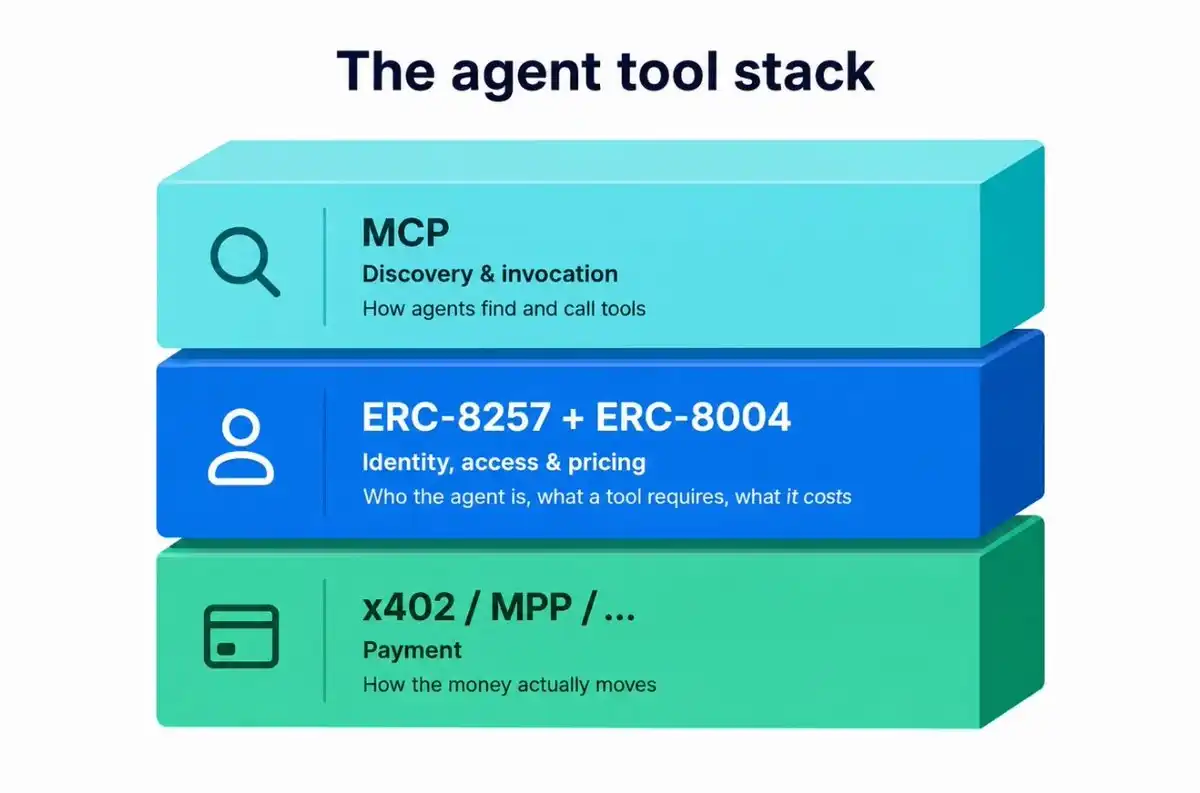
Le MCP indique à votre agent quels outils existent. ERC-8004 définit l'identité de votre agent. ERC-8257 explique comment utiliser réellement les outils. x402 s'occupe du paiement. Chaque couche est composable.

Un agent enregistré via ERC-8004 peut lier, dans son tableau "services", des outils restreints provenant du registre ERC-8257. Vous n'avez pas à choisir entre eux. Ce sont différentes couches de la même pile technologique.

Voyez-le en action

nft-appraisal-tool : pointez vers n'importe quel NFT, il renvoie une évaluation de prix, avec des fourchettes basse / moyenne / haute, un niveau de confiance, les transactions récentes et des cas comparables. Deux niveaux : 0,05 $ par appel pour tout le monde, 0,01 $ par appel pour les détenteurs de CHONK sur Base.

Un agent sans CHONK appelle l'endpoint pour détenteurs. Réponse : 403 — refusé par la porte de prédicat. Vous avez besoin de CHONK sur Base.

L'agent en achète un, réessaie, le même appel réussit.

$ npx @opensea/tool-sdk pay https://nft-appraisal-tool.vercel.app/api/holder --auth siwe \

--body '{"chain":"ethereum","contractAddress":"0x79fcdef22feed20eddacbb2587640e45491b757f","tokenId":"4707"}'

Wallet : 0x3184...0465

Response (403) :

{"error":"Predicate gate: access predicate denied","toolId":"2","predicate":"0xc872..."}

Le prédicat lui indique clairement ce dont il a besoin : CHONK sur Base. L'agent achète un CHONK sur OpenSea et réessaie, l'appel passe.

$ npx @opensea/tool-sdk pay https://nft-appraisal-tool.vercel.app/api/holder --auth siwe \
--body '{"chain":"ethereum","contractAddress":"0x79fcdef22feed20eddacbb2587640e45491b757f","tokenId":"4707"}'
Wallet : 0x5eca...e2a8

Response (200) :
{
"low": {"amount": "1.8", "currency": "ETH", "usd": 5460},
"mid": {"amount": "2.3", "currency": "ETH", "usd": 6970},
"high": {"amount": "3.1", "currency": "ETH", "usd": 9400},
"confidence": "medium",
"reasoning": "Des Squiggles comparables dans cette gamme de couleurs ont été vendus entre 1.9 et 2.6 ETH...",
...
}

Aucun être humain entre le 403 et le 200. Qui détient le NFT d'accès, a l'accès.

Ce qui peut être construit ensuite

Des oracles de tarification professionnels. Des abonnements à des analyses sur chaîne. Des abonnements à des études. Des API partenaire en liste blanche. Des outils à places limitées, échangeables sur le marché libre comme tout autre actif.

Il y a un an, aucun de ces services n'avait besoin d'exister. Dès l'instant où le registre sera en ligne, tous deviennent possibles.

Commencez à construire

Déjà en ligne sur Ethereum et Base.

@opensea/tool-sdk gère les détails de bas niveau, fournit une structure, des portes, l'enregistrement, le déploiement sur Vercel, Cloudflare ou Express. Inclut des exemples utilisables.

npx @opensea/tool-sdk init my-tool

Consultez les spécifications complètes sur 8257.ai.

Participez

ERC-8257 est encore à l'état de brouillon. Aidez-nous à améliorer la spécification avant de publier la version officielle 1.0 du registre. Publiez un outil, même petit. Nous mettrons en avant les projets intéressants.

Rejoignez le groupe Telegram t.me/ERC8257 pour discuter de l'ERC, du SDK d'outils et d'autres sujets avec les auteurs @CodinCowboy et @ralxz.

Avertissement : Ce contenu est fourni à titre informatif uniquement et ne constitue pas un conseil financier ou transactionnel. La mention de projets, produits, services ou jetons spécifiques ne constitue pas une approbation, un parrainage ou une recommandation de la part d'OpenSea. OpenSea ne garantit pas l'exactitude ou l'exhaustivité des informations présentées, et les lecteurs doivent vérifier de manière indépendante toute déclaration avant d'agir. Les lecteurs doivent effectuer leur propre diligence raisonnable et assumer l'entière responsabilité de leurs décisions.


Related Questions

QQu'est-ce que l'ERC-8257 et quel est son objectif principal ?

AL'ERC-8257, ou Agent Tool Registry, est un standard ouvert sur Ethereum conçu pour fonctionner comme une infrastructure de base pour l'écosystème des outils d'IA Agent. Son objectif principal est de créer un registre on-chain où les développeurs peuvent publier des outils, définir des règles d'accès (comme la possession de NFT ou des abonnements) et des prix, permettant aux Agents IA de naviguer, d'acquérir et d'utiliser ces outils de manière autonome sans intervention humaine.

QQuel problème l'ERC-8257 vise-t-il à résoudre dans l'écosystème actuel des outils pour Agents IA ?

AL'ERC-8257 vise à résoudre le problème de la dispersion et du manque de normalisation des outils pour Agents IA. Actuellement, ces outils sont éparpillés dans de la documentation, des dépôts GitHub et des annuaires centralisés, sans registre ouvert ni contrôle d'accès standardisé. Cela empêche les Agents de parcourir et d'obtenir des outils de manière efficace et automatisée.

QComment l'ERC-8257 fonctionne-t-il techniquement pour contrôler l'accès à un outil ?

ATechniquement, lorsqu'un outil est enregistré sur l'ERC-8257, il est associé à un 'prédicat d'accès'. Il s'agit d'un contrat intelligent qui répond à une seule question : 'Cette adresse (celle de l'Agent ou de son utilisateur) a-t-elle le droit d'accès ?'. Ce prédicat peut vérifier diverses conditions sur la blockchain, comme la propriété d'un NFT, un abonnement actif (via l'ERC-5643), une liste blanche, une preuve ZK, un vote DAO, etc. Si la condition est remplie, l'accès est accordé.

QQuel impact l'ERC-8257 pourrait-il avoir sur la valeur et l'utilité des NFTs existants ?

AL'ERC-8257 pourrait considérablement augmenter l'utilité et potentiellement la valeur des collections NFT existantes. En effet, tout NFT (PFP, pass de membre, œuvre d'art CC0, etc.) peut devenir une clé d'accès pour des outils ou des services premium dans l'économie des Agents. Par exemple, posséder un NFT spécifique peut permettre à un Agent d'accéder à des tarifs réduits sur une API, à un accès exclusif limité ou à des fonctionnalités spéciales.

QQuel exemple concret l'article donne-t-il pour illustrer le fonctionnement de l'ERC-8257 ?

AL'article donne l'exemple d'un outil d'évaluation de prix NFT. Il propose deux niveaux tarifaires : 0,05 $ par appel pour tout le monde, et 0,01 $ par appel pour les détenteurs du NFT 'CHONK' sur Base. Un Agent IA tentant d'appeler l'endpoint réservé aux détenteurs sans posséder le NFT reçoit d'abord une réponse '403 Accès refusé'. L'Agent achète alors automatiquement un NFT CHONK sur un marché comme OpenSea, réessaie l'appel, et obtient cette fois une réponse '200 Succès' avec l'évaluation du prix, le tout sans intervention humaine.

Related Reads

Sharplink CEO: One Million Ethereum Developers, Who Can Compete?

Etherean Ecosystem: One Million Developers and a Formidable Moat The Ethereum network has surpassed a significant milestone: over one million unique lifetime developers, with approximately 232,000 active in the past year. This vast and growing talent pool is Ethereum's core advantage, far more critical than transient metrics like speed or transaction fees. The central question is not which blockchain is fastest, but where the best builders choose to build long-term. Ethereum's answer lies in a decade-long accumulation of infrastructure, standards, tools, liquidity, and collaborative culture that is exceptionally difficult to replicate. It has become the default operating system for programmable finance. This massive developer base is actively working on complex, high-risk challenges that deepen Ethereum's strategic moat: * **Glamsterdam Upgrade (2026):** Focused on core protocol scalability (ePBS, parallel execution) while preserving core values like credible neutrality. * **Synchronous Composability:** Aims to make numerous Rollups interoperate like a single chain, directly addressing fragmentation concerns. * **Quantum Resistance:** Ethereum leads mainstream ecosystems in coordinated preparation for post-quantum cryptography, with a targeted migration plan around 2029. This developer advantage is self-reinforcing, fueled by: * **Deep Composability:** Applications interact like interoperable financial Lego bricks via shared standards (e.g., EVM, Solidity). * **Credible Neutrality:** Secured by over 900,000 validators, making it trusted by major institutions. * **Modularity:** Rollups (Base, Arbitrium, etc.) expand, rather than fracture, the ecosystem into a tightly connected modular internet economy. * **Culture:** Attracts top-tier researchers and standard-setters who guide the entire industry. In essence, while other chains generate activity, Ethereum is consolidating as the trusted, long-term coordination layer for internet-native finance. Its future is being built now by the architects of the next-generation financial infrastructure.

Odaily星球日报34m ago

Sharplink CEO: One Million Ethereum Developers, Who Can Compete?

Odaily星球日报34m ago

Ethereum Reaches the Milestone of One Million Developers, Sharplink CEO Delves Deep into Ethereum's Future Possibilities

Ethereum Surpasses One Million Developers Milestone: A Look at Its Unshakeable Dominance and Future Joseph Chalom, CEO of Sharplink, reflects on his recent Asia trip where he engaged deeply with Ethereum developers and ecosystem leaders. The most striking takeaway was not just the industry's vibrancy, but the rigorous, long-term vision of local builders. This context brings to life a pivotal statistic: Ethereum has now surpassed one million cumulative developers (1,012,824), with approximately 232,000 remaining active in the past year—a talent pool unmatched by any other crypto ecosystem. The critical question isn't which blockchain is fastest, but where top developers choose to build long-term. Ethereum's answer is unequivocal. Its decade-long lead stems from a unique convergence of technology, institutional culture, economic systems, and composability, cementing its role as the foundational operating system for programmable finance. This massive developer base is tackling the industry's hardest problems, continuously strengthening Ethereum's moat. Key initiatives include: * **The Glamsterdam Upgrade (planned 2026):** Introducing ePBS and Block-level Access Lists for parallel execution and higher throughput while preserving core values like credible neutrality and fair MEV distribution. * **Synchronous Composability:** Projects are working to enable atomic transactions across dozens of Rollups, making them function as one unified chain and eliminating ecosystem fragmentation. * **Post-Quantum Security:** Ethereum is far ahead in preparing for quantum computing threats, with a dedicated foundation working group and testnets targeting a full migration by ~2029—a crucial factor for institutional adoption. Beyond developers, Ethereum's core network effects are its unparalleled composability and unified standards (like EVM and Solidity), which create a powerful flywheel: more developers → better tools → greater liquidity → more institutional participation. Its other decisive advantages include credible neutrality (over 900k validators), a secure modular architecture with interconnected Rollups, and a deeply entrenched culture shaped by top-tier researchers. Ultimately, there's a vast difference between generating short-term activity and becoming the trusted, long-term coordination layer for global native finance. Major institutions prioritize security, trust, and liquidity—areas where Ethereum holds dominant mindshare. The industry's trajectory shows resources consolidating around unified standards, deep liquidity, and developer consensus. After meeting the builders in Seoul and Hong Kong, Chalom is more convinced than ever: Ethereum's unshakeable future is being built right now.

Foresight News45m ago

Ethereum Reaches the Milestone of One Million Developers, Sharplink CEO Delves Deep into Ethereum's Future Possibilities

Foresight News45m ago

Saylor's Latest Long Read: Bitcoin is Not Money, It's Digital Capital, and Money is Built Upon It

Michael Saylor presents his "Digital Asset Stack" theory, positioning Bitcoin as the foundational layer of digital capital. He argues Bitcoin itself should remain unchanged—no staking, inflation, or protocol alterations. Instead, a five-layer financial architecture should be built atop it: Digital Capital (BTC), Digital Credit (e.g., yield instruments like STRC), Digital Currency (stable, yield-bearing instruments pegged to fiat), Digital Yield (leveraged/structured products), and Digital Equity (e.g., MSTR stock, absorbing residual volatility). Saylor asserts this stack transforms Bitcoin's high-volatility, high-energy capital into tailored products: stable currencies for payments/savings, yield instruments for income seekers, and equity for growth investors. This approach meets diverse needs—corporate treasuries, banks, retirees, emerging market users—without compromising Bitcoin's core properties (scarcity, decentralization). The "killer use case" is rebuilding global money, credit, and capital markets on Bitcoin, bridging the fiat world with a superior digital asset foundation. The system leverages traditional finance principles (risk layering, structured products) while using Bitcoin as the ultimate collateral. This expands Bitcoin's utility, drives adoption, and offers a better monetary experience: digital, yield-bearing, stable-value tools for everyday use.

marsbit58m ago

Saylor's Latest Long Read: Bitcoin is Not Money, It's Digital Capital, and Money is Built Upon It

marsbit58m ago

Can SK Hynix's Stock Double Again in This Rally?

The article discusses the highly optimistic price target of approximately $3,500 for SK Hynix stock, set by Aletheia Capital. This target is significantly above the consensus range of $2,000-$2,520 from major brokerages. The core debate is whether SK Hynix deserves a fundamental re-rating beyond its traditional cyclical discount, based on the long-term impact of AI-driven demand. The $3,500 target hinges on three key assumptions holding simultaneously until at least 2027: 1) Continued shortage and high pricing for HBM (High Bandwidth Memory), a critical component for AI chips; 2) Sustained high prices for standard DRAM, as HBM production consumes capacity and constrains general supply; and 3) Strong AI server demand generating substantial, above-expectation free cash flow. SK Hynix's leading ~58% market share in HBM and its early certification with key clients like Nvidia provide a competitive advantage, allowing it to capture significant supply chain premiums. The HBM shortage is seen not just as a niche growth driver but as a catalyst that amplifies profitability across the entire memory business by tightening overall DRAM supply. However, the article cautions that this target represents an optimistic "tail scenario." Key risks include potential supply increases from competitors (Samsung, Micron) by 2027, a possible slowdown in HBM price growth, and high capital expenditures that could erode the projected free cash flow. The divergence in analyst targets reflects the market's uncertainty over whether the current AI-driven boom will temporarily elevate earnings or permanently raise the memory industry's profit baseline.

marsbit1h ago

Can SK Hynix's Stock Double Again in This Rally?

marsbit1h ago

Trading

Spot
Futures

Hot Articles

How to Buy NFT

Welcome to HTX.com! We've made purchasing AINFT (NFT) simple and convenient. Follow our step-by-step guide to embark on your crypto journey.Step 1: Create Your HTX AccountUse your email or phone number to sign up for a free account on HTX. Experience a hassle-free registration journey and unlock all features.Get My AccountStep 2: Go to Buy Crypto and Choose Your Payment MethodCredit/Debit Card: Use your Visa or Mastercard to buy AINFT (NFT) instantly.Balance: Use funds from your HTX account balance to trade seamlessly.Third Parties: We've added popular payment methods such as Google Pay and Apple Pay to enhance convenience.P2P: Trade directly with other users on HTX.Over-the-Counter (OTC): We offer tailor-made services and competitive exchange rates for traders.Step 3: Store Your AINFT (NFT)After purchasing your AINFT (NFT), store it in your HTX account. Alternatively, you can send it elsewhere via blockchain transfer or use it to trade other cryptocurrencies.Step 4: Trade AINFT (NFT)Easily trade AINFT (NFT) on HTX's spot market. Simply access your account, select your trading pair, execute your trades, and monitor in real-time. We offer a user-friendly experience for both beginners and seasoned traders.

7.0k Total ViewsPublished 2024.03.29Updated 2026.06.02

How to Buy NFT

What is Altura NFT?

Altura: Providing One-Stop NFT Solutions for Game Developers

56.0k Total ViewsPublished 2024.06.12Updated 2024.06.12

What is Altura NFT?

What is AINFT

EternaFi Agents and $AINFT: A Comprehensive Analysis of AI-Powered NFT Infrastructure in the Web3 Ecosystem The intersection of artificial intelligence (AI) and blockchain technology is rapidly evolving, establishing innovative platforms that redefine ownership models and economic participation. EternaFi Agents, along with its native token $AINFT, exemplifies a groundbreaking approach to the tokenization of AI infrastructures through the means of non-fungible tokens (NFTs). Launched in July 2025 by the development team at Nova Club, EternaFi merges the advancements of AI with the decentralized financial mechanisms of blockchain, presenting a unique investment opportunity for participants within the web3 ecosystem. This article aims to provide an in-depth assessment of EternaFi Agents, covering its core components, functionality, and significance within the crypto landscape. Introduction and Project Overview EternaFi Agents stands as a salient example of how blockchain technology can democratize access to advanced AI capabilities. The project endeavors to reshape the paradigm of AI ownership by diversifying economic participation, making sophisticated AI systems accessible to a larger pool of stakeholders. At its core, the project tokenizes a proprietary large language model (LLM) developed by Nova Club, allowing NFT holders to gain fractional exposure to the model's economic performance. By utilizing NFTs representing stakes in the LLM, EternaFi Agents fosters a model wherein stakeholders not only participate in AI service consumption but also enjoy sharing in the economic rewards generated by the platform. This transformative approach enables the development of sustainable revenue models for AI services, all the while promoting broad community engagement and facilitating transparent governance. What is EternaFi Agents? EternaFi Agents represents an AI-NFT infrastructure project that aims to blend the capabilities of AI with blockchain technology in a coherent ecosystem. The essential feature of this project is the creation of NFTs that serve as financial instruments, representing fractions of ownership in Nova Club's proprietary AI infrastructure. Each NFT symbolizes direct exposure to the economic performance of the underlying AI system, providing a lucrative opportunity for investors. The project operates on the Base blockchain, known for its scalability and efficiency, thus ensuring manageable transaction costs while facilitating a seamless operational experience. One of the notable features includes a revenue-sharing mechanism, wherein NFT holders can receive portions of subscription income generated by the AI services provided on the platform. This innovative approach establishes a connection between the success of the AI services and the economic dividends distributed among the holders, thus ensuring an alignment of interests across the community. Who is the Creator of EternaFi Agents? The creative force behind EternaFi Agents is Nova Club, a development team based in Singapore proficient in the amalgamation of AI and blockchain technology. Their prior experience in AI development and cryptocurrency analysis gives credence to the project, contributing a breadth of expertise to the creation of EternaFi Agents. Nova Club’s mission centers on democratizing access to cutting-edge AI technologies while building sustainable economic models that benefit users alongside developers. Their commitment to transparency, community governance, and innovation is reflected in the design and implementation of the EternaFi platform, aiming to establish a unique ecosystem that fosters positive engagement and long-term value creation. Who are the Investors of EternaFi Agents? The specific details concerning investors or investment organizations backing EternaFi Agents are not publicly available. However, EternaFi has adopted an inclusive approach to funding its development through the sale of NFTs to the public, allowing a wide array of participants to invest in the ecosystem. The project’s architecture ensures that core infrastructure is funded responsibly while allowing community members to partake in the ownership and economic returns generated from the AI services. This model emphasizes community engagement by aligning the interests of investors and project developers, creating a collaborative environment where long-term participation is incentivized. How Does EternaFi Agents Work? EternaFi Agents operates through a multifaceted ecosystem where NFTs serve as a primary means of ownership representation within the project. Each NFT holder is entitled to a share of the monthly subscription income produced by the underlying AI-powered platform, thereby positioning NFT ownership as a lucrative investment vehicle. Revenue Generation Mechanism The primary source of revenue generation for the EternaFi platform stems from subscription fees related to the AI services provided. Users can access various tiered services, ranging from basic market analysis tools to comprehensive AI-assisted trading solutions. These services are monetized and form the basis for the revenue-sharing framework, which distributes profits to NFT holders through automated smart contracts. An innovative feature of the EternaFi ecosystem is the revenue-sharing mechanism that operates transparently, ensuring that rewards are allocated based on verifiable metrics from the AI platform's operations. This creates a direct link between the performance of AI services and the returns available to community investors, establishing a sustainable economic model. Staking and Vesting Mechanisms Participants within EternaFi can engage in staking their NFTs to unlock additional economic benefits. The vesting schedule is designed to promote long-term commitment among participants, rewarding those who exhibit ongoing support for the project. This ensures a robust alignment of interests and fosters a sense of community engagement essential for achieving the project's long-term goals. Transparent Governance EternaFi Agents embraces decentralized governance, allowing NFT holders to play an active role in decision-making regarding the platform's development and future directions. The governing structure includes community voting mechanisms, providing NFT holders with the opportunity to influence significant decisions and contributing to a collaborative approach to project growth. Timeline of EternaFi Agents The development trajectory of EternaFi Agents showcases a systematic approach toward building a sustainable AI infrastructure while meeting the needs of community participants. Below is a timeline of important milestones in the project’s history: July 2025: Launch of EternaFi Agents, including the public sale of NFTs and deployment of the $AINFT token on the Base blockchain. Q4 2025: Establishment of market infrastructure including liquidity pools and launch of staking dashboards for NFT holders. 2026: Initiation of community engagement programs, expanding AI capabilities, and integration with cross-chain technologies. Q4 2026: Implementation of the dividend distribution system, allowing NFT holders to reap economic benefits from their investments. These milestones signify the focus on establishing a functional and participative ecosystem while ensuring continuous evolution to meet market demands. Technological Infrastructure and Blockchain Integration EternaFi Agents is anchored in an advanced technological framework combining AI systems with blockchain capabilities. Operating on the Base blockchain, the project leverages the advantages of scalability and low transaction costs. The underlying smart contract architecture governs the NFT ownership, revenue sharing, and community management features, ensuring efficiency and transparency. AI System Development The proprietary large language model underpinning EternaFi Agents has been independently developed and designed to cater to revenue-generating applications without reliance on proprietary external frameworks. This endeavor reflects a commitment to creating a versatile and adaptable AI infrastructure capable of delivering meaningful services to users, thus generating economic value for investors. Security Measures The robustness of EternaFi’s security infrastructure is paramount. Regular audits and stringent security measures ensure the integrity of the AI systems and blockchain mechanisms, safeguarding against potential vulnerabilities while fostering confidence among participants. Conclusion EternaFi Agents signifies a landmark innovation within the realm of artificial intelligence and blockchain technology, opening avenues for community ownership and economic participation in advanced AI capabilities. The project’s comprehensive strategy to tokenize AI infrastructure via NFTs establishes a precedent for future decentralized ecosystems. By harmonizing technical sophistication with user-centric economic models, EternaFi not only fosters engagement but also generates a sustainable revenue-sharing framework for community participants. The significance of EternaFi extends well beyond its operational success as it exemplifies how blockchain can democratize cutting-edge AI technologies, paving the way for future ventures in this intersectional space. The evolution of EternaFi Agents may herald a new era of AI development characterized by participant-driven governance, sustainable economic models, and transparent verification, ultimately contributing to the broader democratization of AI and technology accessibility across industries.

4.0k Total ViewsPublished 2025.08.14Updated 2025.08.14

What is AINFT

Discussions

Welcome to the HTX Community. Here, you can stay informed about the latest platform developments and gain access to professional market insights. Users' opinions on the price of NFT (NFT) are presented below.

活动图片