加密冲击波:Circle因2.8亿美元Drift黑客事件被起诉

bitcoinistPublished on 2026-04-17Last updated on 2026-04-17

Abstract

美国马萨诸塞州联邦法院近日受理了一起针对稳定币发行商Circle的集体诉讼。原告方指控Circle在4月1日发生的Drift Protocol遭黑客攻击事件中未能及时冻结约2.8亿美元的被盗USDC,尽管其具备相关技术能力。该攻击被指由朝鲜国家支持的黑客实施,资金通过Circle的跨链转移协议从Solana转移至以太坊,并最终通过混币器Tornado Cash洗钱。 诉讼核心争议点在于:Circle在事发前一周曾应法院要求冻结过涉案钱包,原告认为其完全有能力在此次事件中采取行动。诉状指控Circle存在疏忽及协助转移非法资金的行为。但亦有行业人士(如ARK Invest分析师)认为,若赋予企业自主冻结权限可能引发政治化决策,强调需以法院指令为依据。目前具体赔偿金额尚未确定,案件将进入审理阶段。

朝鲜黑客可能窃取了数亿美元加密货币——现在美国法院被要求裁定稳定币巨头是否本应阻止他们。

Circle自身记录成为关键武器

本周在马萨诸塞州联邦法院提起的集体诉讼将Circle Internet Group列为被告,原告认为该公司既有手段也有机会阻止约2.8亿美元被盗USDC在区块链间转移——但却无所作为。

此案由Drift Protocol投资者Joshua McCollum代表100多名受影响成员提起。他们的律师直言不讳:Circle允许了其技术被用于犯罪活动。
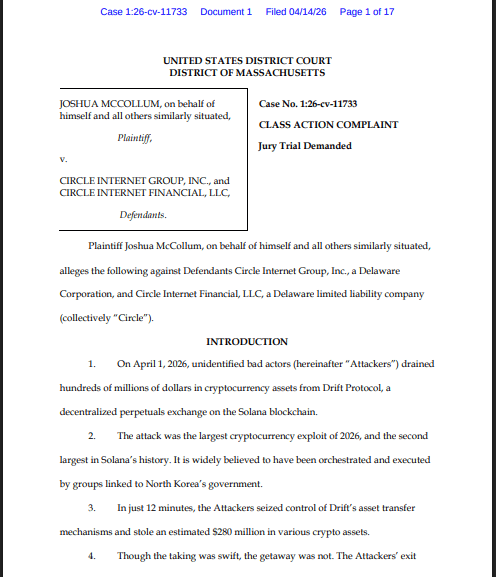
该诉状于周三由Drift投资者Joshua McCollum代表100多名成员向马萨诸塞州美国地方法院提交。

4月1日对Drift Protocol的攻击中,攻击者通过Circle的跨链传输协议(该公司运营的桥接工具)将资金从Solana转移至以太坊。据报道,这些转移持续了数小时。时间窗口完全敞开。

使这起诉讼尤为尖锐的是黑客事件发生前几天的情况。大约一周前,Circle冻结了与美国一起密封民事案件相关的16个USDC钱包。原告抓住了这一细节。他们认为,如果Circle能为法院相关事务迅速行动,那么在此案中本也可以采取行动。这一事实成为法律斗争的核心。

指控从疏忽到协助犯罪

该诉讼提出两项主要罪名:疏忽和协助促成侵权转换——这是一个法律术语,指帮助他人非法占有他人财产。Mira Gibb律师事务所正在为McCollum和其他Drift投资者处理此案。损害赔偿尚未确定,将在审判中决定。

BTCUSD在24小时图表上交易价格为75,081美元:TradingView

Circle未回应置评请求。

加密分析公司Elliptic将此攻击标记为朝鲜国家支持的黑客所为。根据Elliptic的分析,黑客在美国正常工作时间通过Circle的桥接基础设施执行了100多笔交易。资金转移到以太坊后,被盗资产被转换并通过Tornado Cash(一种用于混淆交易轨迹的隐私协议)转移。
图片来源:SOPA Images/Getty Images

ARK Invest为Circle辩护,但道德风险仍然很高

并非所有人都在指责Circle。ARK Invest数字资产研究总监Lorenzo Valente认为,Circle在没有法律命令的情况下不采取行动是正确的决定。

他的担忧在于:如果赋予像Circle这样的公司仅凭判断就冻结资金的权力,那么每个决定都将变得政治化。他公开质疑界限将划在哪里——在朝鲜黑客和世界其他地方的可疑钱包之间。

特色图片来自B&G Lawyers,图表来自TradingView

Trending Cryptos

Related Questions

Q针对Circle公司的诉讼主要指控是什么?

A诉讼主要指控Circle公司存在疏忽(negligence)以及协助和教唆侵占(aiding and abetting conversion)行为,即原告认为Circle既有手段也有机会阻止约2.8亿美元被盗USDC在区块链间转移,但却未采取行动。

Q为什么原告认为Circle本可以阻止这次黑客攻击?

A原告指出,在黑客攻击发生前几天,Circle曾根据美国法院的民事案件冻结了16个USDC钱包。他们认为,既然Circle能因法院相关事务迅速采取行动,那么在这次黑客事件中同样有能力冻结被盗资金。

Q这次黑客事件被归咎于谁?被盗资金最终如何被处理?

A加密货币分析公司Elliptic将此次攻击归咎于朝鲜国家支持的黑客。被盗资金通过Circle的跨链传输协议从Solana转移到以太坊,随后被转换为其他资产并通过隐私协议Tornado Cash进行洗钱以掩盖交易痕迹。

QARK Invest对Circle的行为持何种观点?

AARK Invest的数字资产研究主管Lorenzo Valente为Circle辩护,认为Circle在没有法律命令的情况下不采取行动是正确的决定。他担心如果赋予Circle仅凭判断就冻结资金的权力,会使每个决定都变得政治化,并质疑如何在不同情况(如朝鲜黑客与世界其他地区的可疑钱包)之间划清界限。

Q这起诉讼的案件背景和原告是谁?

A这起集体诉讼由Drift Protocol投资者Joshua McCollum代表100多名受影响成员在美国马萨诸塞州联邦法院提起,被告是Circle Internet Group。案件源于2026年4月1日Drift Protocol遭黑客攻击,导致约2.8亿美元资金被盗。

Related Reads

Weekly Selection丨Epic Stock Market Volatility, Changxin Tech's IPO Reshapes Storage Landscape, Saylor Aims to Re-Anchor STRC Around September 8th

PANews Weekly Digest: Market Turmoil, Tech Breakthroughs, and Crypto Developments. The week saw significant volatility across global markets. South Korea's KOSPI index experienced extreme turbulence, including multiple trading halts, largely driven by sharp declines in AI hardware stocks like SK Hynix. In contrast, China's Changxin Xinqiao (CXC) achieved a landmark IPO with a market cap surpassing 4 trillion yuan, marking a major success for the domestic DRAM industry after a decade of losses. In the crypto and Web3 space, several key narratives emerged. AI is driving demand for new infrastructure, with projects like AI agent wallets and programmable payments gaining traction, attracting interest from firms like Coinbase. The Bitcoin mining sector is pivoting, with companies like MARA focusing on energy management as electricity becomes a core AI-era asset. Meanwhile, the RWA (Real World Assets) sector faces a "utilization puzzle," with hundreds of billions in on-chain assets remaining dormant. Notable market movements included a historic single-day surge of over 17% for the KOSPI index and a significant migration of $16.5 billion in staked ETH within the Lido ecosystem. Michael Saylor announced a target to re-peg the STRC stablecoin around September 8th. Other highlights include discussions on Ethereum's ambitious 2030 roadmap for scaling and privacy, analysis showing high protocol revenues not always translating to token price gains, and warnings from Citi about potential extreme commodity price shocks by late 2026.

marsbit3m ago

Weekly Selection丨Epic Stock Market Volatility, Changxin Tech's IPO Reshapes Storage Landscape, Saylor Aims to Re-Anchor STRC Around September 8th

marsbit3m ago

When the Market Begins to Question AI Capex: A Full Analysis of Q2 Earnings Reports from Five Tech Giants

In late July 2026, five major US tech giants—Alphabet, Intel, Microsoft, Meta, and Apple—released their Q2 earnings reports. While all companies exceeded revenue and profit expectations, driven by strong AI-related business growth, investor reactions diverged sharply due to concerns over escalating AI capital expenditures (capex) and their impact on free cash flow. Alphabet reported strong revenue growth and a surging cloud business, but its stock fell after announcing a doubled year-on-year capex and negative quarterly free cash flow for the first time. Intel posted its strongest revenue growth in over 15 years, but its stock experienced volatile trading after significantly raising its full-year capex guidance. Microsoft saw its stock surge after beating estimates and, crucially, lowering its capex forecast while projecting positive free cash flow. Meta faced the most severe sell-off as its profits declined despite revenue beats, with free cash flow plunging over 90% and its capex guidance raised. Apple reported record June-quarter results, but its stock plummeted after providing Q4 revenue guidance that fell short of expectations, citing supply chain constraints and forex headwinds. The overall takeaway is that the market's focus has shifted from validating AI demand to scrutinizing the timeline for returns on massive AI investments. Companies demonstrating a clearer path to managing capex and preserving free cash flow, like Microsoft, were rewarded, while those signaling continued aggressive spending faced investor skepticism.

Odaily星球日报12m ago

When the Market Begins to Question AI Capex: A Full Analysis of Q2 Earnings Reports from Five Tech Giants

Odaily星球日报12m ago

a16z: From Companies to DAOs, DUNA May Become the Next Generation Organizational Form

This article, "From Companies to DAOs: How DUNA Could Become the Next Organizational Form," traces the 500-year evolution of business collaboration. It begins with medieval structures like the *commenda* and Florentine *compagnia*, which exposed partners to personal risk. The modern corporation, exemplified by the Dutch East India Company (VOC), was a revolutionary leap, enabling large-scale, capital-intensive ventures by offering limited liability and reducing coordination costs. However, corporations introduced new challenges like principal-agent problems and bureaucratic overhead. The piece argues that software and internet-native protocols are now reducing these traditional overheads. Decentralized Autonomous Organizations (DAOs) emerged as a new model for coordination without centralized management. Yet, DAOs face a significant legal vacuum: they lack legal recognition, leaving members exposed to unlimited personal liability, and their tokens are vulnerable to being classified as securities under unclear regulations (e.g., the Howey Test). This has forced projects into suboptimal workarounds like offshore foundations. The article identifies the Decentralized Unincorporated Nonprofit Association (DUNA) as a potential solution. Recently legalized in states like Wyoming, the DUNA provides a legal wrapper for decentralized networks. It grants key protections—legal personality, limited liability, and perpetual existence—to a group without imposing a traditional hierarchical management structure. This allows token-holder communities to govern, hold assets, and contract as a single legal entity, aligning with their decentralized nature. While DUNA doesn't solve all governance challenges or magically resolve securities law questions, it represents a crucial step. It fills the legal recognition gap, offering a native legal form for internet-scale, decentralized collaboration and extending the separation of personal risk from organizational venture into a new domain.

marsbit57m ago

a16z: From Companies to DAOs, DUNA May Become the Next Generation Organizational Form

marsbit57m ago

2026 Mid-Year Report On-Chain RWA: Tokenized Stock Market Cap Doubles in a Year, But 90% of Rights Are Hollow Shells

The 2026 Mid-Year Report on On-Chain RWA highlights a significant growth in tokenized stock market capitalization, which nearly doubled from $951 million in March to $1.89 billion by July. However, the report reveals a fundamental contradiction in this "layer 2.5" ecosystem: products with the strongest legal foundation (like regulated U.S. infrastructure) lack liquidity and distribution, while freely tradable offshored wrapper products often lack substantive ownership rights. The increase is driven largely by a few products (SECZ, FGRS, STRCx) and platforms (Ondo, xStocks, Securitize collectively hold over 85% share). While distributed value across networks like Ethereum, Solana, and BNB Chain has grown, the market remains fragmented. Products referencing the same underlying asset (e.g., Apple stock) are distinct legal liabilities with different intermediaries and jurisdictional rules, offering varying degrees of legal claim. The report cautions that headline numbers are misleading, as they reflect changes in distributed token value—driven by issuance, conversions, and price movements—not pure investor inflows. True "canonical shares" with legal ownership, wide wallet distribution, institutional liquidity, and independent on-chain price discovery do not yet exist at scale. Tokenized treasuries show stronger product-market fit, and ETFs may be easier to scale than single stocks. The core takeaway is a trade-off: legal certainty versus liquidity and composability.

marsbit1h ago

2026 Mid-Year Report On-Chain RWA: Tokenized Stock Market Cap Doubles in a Year, But 90% of Rights Are Hollow Shells

marsbit1h ago

Trading

Spot

Hot Articles

How to Buy DRIFT

Welcome to HTX.com! We've made purchasing Drift Protocol (DRIFT) simple and convenient. Follow our step-by-step guide to embark on your crypto journey.Step 1: Create Your HTX AccountUse your email or phone number to sign up for a free account on HTX. Experience a hassle-free registration journey and unlock all features.Get My AccountStep 2: Go to Buy Crypto and Choose Your Payment MethodCredit/Debit Card: Use your Visa or Mastercard to buy Drift Protocol (DRIFT) instantly.Balance: Use funds from your HTX account balance to trade seamlessly.Third Parties: We've added popular payment methods such as Google Pay and Apple Pay to enhance convenience.P2P: Trade directly with other users on HTX.Over-the-Counter (OTC): We offer tailor-made services and competitive exchange rates for traders.Step 3: Store Your Drift Protocol (DRIFT)After purchasing your Drift Protocol (DRIFT), store it in your HTX account. Alternatively, you can send it elsewhere via blockchain transfer or use it to trade other cryptocurrencies.Step 4: Trade Drift Protocol (DRIFT)Easily trade Drift Protocol (DRIFT) on HTX's spot market. Simply access your account, select your trading pair, execute your trades, and monitor in real-time. We offer a user-friendly experience for both beginners and seasoned traders.

5.6k Total ViewsPublished 2024.05.17Updated 2026.06.02

How to Buy DRIFT

Discussions

Welcome to the HTX Community. Here, you can stay informed about the latest platform developments and gain access to professional market insights. Users' opinions on the price of DRIFT (DRIFT) are presented below.

活动图片