Qubic Starts Dogecoin Mining Phase 2, Shifting Rewards Away From XMR

bitcoinistPublished on 2026-04-16Last updated on 2026-04-16

Abstract

Qubic has entered phase 2 of its Dogecoin mining rollout, shifting miner rewards from Monero (XMR) to DOGE-based incentives. Starting with epoch 209, computors can operate in either XMR or DOGE mode, with only the higher-yielding contribution counted per index—effectively phasing out XMR if DOGE is more profitable. All block rewards are used for QUBIC buybacks, which are then distributed proportionally based on Dogecoin shares submitted. This transition, part of a three-phase plan announced in March, aims to fully migrate from XMR to DOGE, allowing parallel operation of DOGE mining (via Scrypt ASICs) and AI training (on CPUs/GPUs). Phase 2 introduces weekly reward windows, aligning with Qubic’s goal of scaling toward full-capacity dual-workstream operations.

Qubic has moved its Dogecoin mining rollout into phase 2, a step that begins redirecting miner economics away from Monero and toward DOGE-linked rewards. For Qubic, the change matters because phase 2 is where the migration stops being a live test and starts becoming a real incentive shift.

In an April 15 Discord update shared on X by community member Rayyan, Qubic tech lead Joetom said phase 2 began with epoch 209 and that, from this point, “each computor can operate in either legacy XMR mode or Doge mode.” He added: “For every computor index, only one contribution is counted: max(XMR, DOGE). This effectively replaces XMR participation if Doge yields a higher contribution. No dual counting.”

Qubic Activates Dogecoin Phase 2

The move lines up with the transition plan Qubic published ahead of launch. In its March 27 rollout note, the team described a three-phase migration from XMR to DOGE. Phase 1 was a testing period in which XMR revenue remained intact while Dogecoin mining ran on mainnet in a non-rewarded validation mode.

Phase 2 was framed as the decision point, where computors could opt into DOGE rewards while XMR began phasing out. Phase 3 is the end state: XMR removed, DOGE running at full production, and Qubic’s CPU and GPU resources returned to full-time AI training.

That broader architecture is central to Qubic’s pitch. Under the old model, the network alternated between Monero hashing and AI-related work. With Dogecoin, Qubic says the jobs can run in parallel because DOGE mining relies on Scrypt ASICs, while the network’s AI training stack runs on CPUs and GPUs. The result, in Qubic’s telling, is a cleaner division of labor and a path toward running both workstreams at full capacity rather than splitting general-purpose compute between them.

Joetom’s April 15 message also clarified how rewards are now being routed. “All block rewards are used for Qubic buybacks,” he wrote. “The acquired Qubic is distributed proportionally based on delivered Doge shares.”

He then outlined how accounting will evolve as the system scales: “Target state is a daily reward window from 12:00 to 12:00 UTC. All blocks mined within a window are allocated to shares submitted within the same window. Phase 2 starts with a weekly window aligned to epochs.”

That mechanism fits the buyback structure Qubic had already outlined publicly. The network has said DOGE mined through its system is sold, the proceeds are used to buy back QUBIC, and those tokens are then distributed to participants based on contribution.

The timing also tracks the roadmap. Qubic launched Dogecoin mining on April 1 and said the full migration from Monero would likely play out across roughly four weeks, with phase lengths flexible depending on stability and network conditions. Phase 2 arriving in mid-April suggests that schedule is broadly holding, even if reward windows and other parameters remain adjustable.

At press time, DOGE traded at $0.09618.
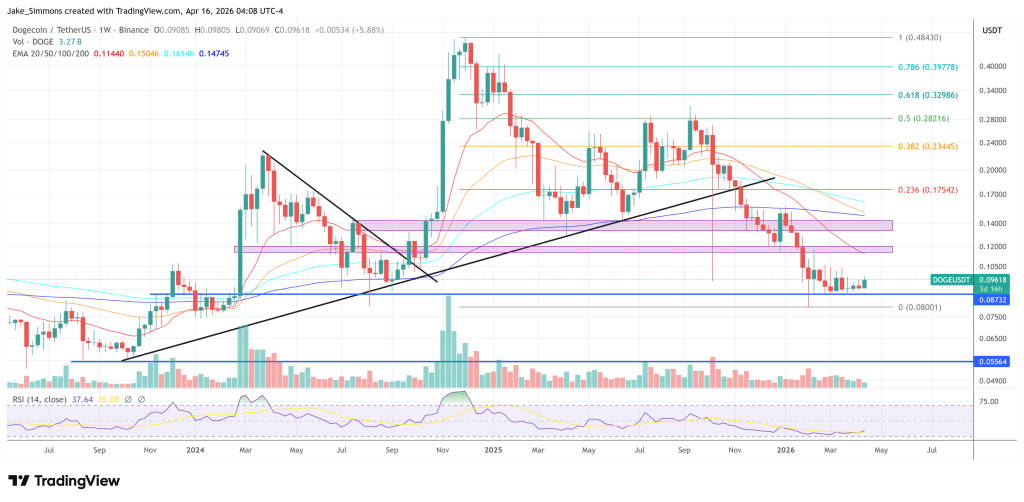
DOGE holds above key support, 1-month chart | Source: DOGEUSDT on TradingView.com

Trending Cryptos

Related Questions

QWhat is the main change introduced in Qubic's Dogecoin mining phase 2?

APhase 2 begins redirecting miner economics away from Monero (XMR) and toward DOGE-linked rewards, allowing computors to operate in either legacy XMR mode or Doge mode, with only the higher-yielding contribution being counted.

QHow does Qubic's reward distribution mechanism work in the new Dogecoin mining system?

AAll Dogecoin block rewards are used for Qubic buybacks. The acquired QUBIC tokens are then distributed proportionally to participants based on the Doge shares they delivered.

QWhat is the stated benefit of switching from Monero to Dogecoin mining for the Qubic network?

AThe switch allows Dogecoin mining (which relies on Scrypt ASICs) and AI training (which runs on CPUs and GPUs) to operate in parallel, creating a cleaner division of labor and enabling both workstreams to run at full capacity instead of splitting general-purpose compute between them.

QWhat are the three phases of Qubic's migration from XMR to DOGE mining?

APhase 1 was a testing period with XMR revenue intact. Phase 2 is the decision point where computors can opt into DOGE rewards while XMR phases out. Phase 3 is the end state with XMR completely removed and DOGE running at full production.

QHow does the reward window system work in the target state of phase 2?

AThe target state is a daily reward window from 12:00 to 12:00 UTC. All blocks mined within a window are allocated to shares submitted within that same window, though phase 2 starts with a weekly window aligned to epochs.

Related Reads

a16z: From Companies to DAOs, DUNA May Become the Next Generation Organizational Form

This article, "From Companies to DAOs: How DUNA Could Become the Next Organizational Form," traces the 500-year evolution of business collaboration. It begins with medieval structures like the *commenda* and Florentine *compagnia*, which exposed partners to personal risk. The modern corporation, exemplified by the Dutch East India Company (VOC), was a revolutionary leap, enabling large-scale, capital-intensive ventures by offering limited liability and reducing coordination costs. However, corporations introduced new challenges like principal-agent problems and bureaucratic overhead. The piece argues that software and internet-native protocols are now reducing these traditional overheads. Decentralized Autonomous Organizations (DAOs) emerged as a new model for coordination without centralized management. Yet, DAOs face a significant legal vacuum: they lack legal recognition, leaving members exposed to unlimited personal liability, and their tokens are vulnerable to being classified as securities under unclear regulations (e.g., the Howey Test). This has forced projects into suboptimal workarounds like offshore foundations. The article identifies the Decentralized Unincorporated Nonprofit Association (DUNA) as a potential solution. Recently legalized in states like Wyoming, the DUNA provides a legal wrapper for decentralized networks. It grants key protections—legal personality, limited liability, and perpetual existence—to a group without imposing a traditional hierarchical management structure. This allows token-holder communities to govern, hold assets, and contract as a single legal entity, aligning with their decentralized nature. While DUNA doesn't solve all governance challenges or magically resolve securities law questions, it represents a crucial step. It fills the legal recognition gap, offering a native legal form for internet-scale, decentralized collaboration and extending the separation of personal risk from organizational venture into a new domain.

marsbit20m ago

a16z: From Companies to DAOs, DUNA May Become the Next Generation Organizational Form

marsbit20m ago

2026 Mid-Year Report On-Chain RWA: Tokenized Stock Market Cap Doubles in a Year, But 90% of Rights Are Hollow Shells

The 2026 Mid-Year Report on On-Chain RWA highlights a significant growth in tokenized stock market capitalization, which nearly doubled from $951 million in March to $1.89 billion by July. However, the report reveals a fundamental contradiction in this "layer 2.5" ecosystem: products with the strongest legal foundation (like regulated U.S. infrastructure) lack liquidity and distribution, while freely tradable offshored wrapper products often lack substantive ownership rights. The increase is driven largely by a few products (SECZ, FGRS, STRCx) and platforms (Ondo, xStocks, Securitize collectively hold over 85% share). While distributed value across networks like Ethereum, Solana, and BNB Chain has grown, the market remains fragmented. Products referencing the same underlying asset (e.g., Apple stock) are distinct legal liabilities with different intermediaries and jurisdictional rules, offering varying degrees of legal claim. The report cautions that headline numbers are misleading, as they reflect changes in distributed token value—driven by issuance, conversions, and price movements—not pure investor inflows. True "canonical shares" with legal ownership, wide wallet distribution, institutional liquidity, and independent on-chain price discovery do not yet exist at scale. Tokenized treasuries show stronger product-market fit, and ETFs may be easier to scale than single stocks. The core takeaway is a trade-off: legal certainty versus liquidity and composability.

marsbit1h ago

2026 Mid-Year Report On-Chain RWA: Tokenized Stock Market Cap Doubles in a Year, But 90% of Rights Are Hollow Shells

marsbit1h ago

Coldcard Hardware Wallet Hacked: 594 Bitcoin Withdrawn in 25 Minutes

The Coldcard hardware wallet has been compromised, with hackers stealing approximately 594.5 Bitcoin (~$40 million) from 500 addresses in just 25 minutes. The root cause was a critical software bug, undetected for five years, which disabled the device's secure chip for generating true random numbers. This led to the creation of private keys based on predictable data like the processor's serial number, drastically reducing cryptographic security. The attackers exploited this offline by brute-forcing possible seed phrases, finding active addresses on the public ledger, and signing transactions. Initially, Coinkite (Coldcard's maker) claimed only older models were at risk but later admitted all devices running the compromised firmware were vulnerable. CEO Rodolphe Novak (NVK) apologized but ruled out financial compensation for affected users. To secure funds, owners must urgently update their firmware to specific safe versions, generate a completely new seed phrase on the updated device, and transfer all assets to new addresses created with that new seed. While a BIP-39 passphrase can help, it does not replace this migration process. Other Coinkite products like TAPSIGNER were not affected. This incident underscores that even specialized hardware requires rigorous, independent code audits, especially for cryptographic functions. It parallels past failures, like a 2006 OpenSSL bug in Debian, and raises questions about whether automated code analysis can ever fully replace human scrutiny in critical security areas.

cryptonews.ru3h ago

Coldcard Hardware Wallet Hacked: 594 Bitcoin Withdrawn in 25 Minutes

cryptonews.ru3h ago

Trading

Spot

Hot Articles

How to Buy XMR

Welcome to HTX.com! We've made purchasing Monero (XMR) simple and convenient. Follow our step-by-step guide to embark on your crypto journey.Step 1: Create Your HTX AccountUse your email or phone number to sign up for a free account on HTX. Experience a hassle-free registration journey and unlock all features.Get My AccountStep 2: Go to Buy Crypto and Choose Your Payment MethodCredit/Debit Card: Use your Visa or Mastercard to buy Monero (XMR) instantly.Balance: Use funds from your HTX account balance to trade seamlessly.Third Parties: We've added popular payment methods such as Google Pay and Apple Pay to enhance convenience.P2P: Trade directly with other users on HTX.Over-the-Counter (OTC): We offer tailor-made services and competitive exchange rates for traders.Step 3: Store Your Monero (XMR)After purchasing your Monero (XMR), store it in your HTX account. Alternatively, you can send it elsewhere via blockchain transfer or use it to trade other cryptocurrencies.Step 4: Trade Monero (XMR)Easily trade Monero (XMR) on HTX's spot market. Simply access your account, select your trading pair, execute your trades, and monitor in real-time. We offer a user-friendly experience for both beginners and seasoned traders.

5.2k Total ViewsPublished 2024.03.29Updated 2026.06.02

How to Buy XMR

Discussions

Welcome to the HTX Community. Here, you can stay informed about the latest platform developments and gain access to professional market insights. Users' opinions on the price of XMR (XMR) are presented below.

活动图片