Nearly $300 Million Aimed at U.S. Midterm Elections, Tether Executive Takes Helm of Crypto Industry's Second-Largest Political Fund

marsbitPublished on 2026-04-03Last updated on 2026-04-03

Abstract

A crypto super PAC named Fellowship, which claims to have raised over $100 million but has reported zero spending to the FEC, has appointed Jesse Spiro, Tether’s VP of Regulatory Affairs, as its chairman. This marks the first official public link between Tether and the PAC, despite earlier denials. Meanwhile, another major crypto PAC, Fairshake—backed by Coinbase, Ripple, and a16z—has amassed $193 million and has already spent over $8.6 million in Illinois primary races. Combined, the two PACs control nearly $300 million aimed at influencing the November midterm elections. The move comes as the crypto industry faces a critical legislative battle over the CLARITY Act, currently stalled in the Senate. A key point of contention is whether stablecoins can pay yields to users—a issue directly affecting Tether, the issuer of the world’s largest stablecoin, USDT. A recent Senate proposal would ban passive yield but allow transaction-based rewards, a compromise the industry finds too restrictive. With the White House’s top crypto advocate departing and the legislative window narrowing, Tether’s heightened political engagement signals a strategic push to shape regulation and protect its business interests through financial influence.

Deep Tide Guide: Fellowship, a crypto super PAC that was established seven months ago and claimed to have raised over $100 million but has yet to spend a single dollar, announced on Wednesday the appointment of Jesse Spiro, Vice President of Regulatory Affairs at Tether US, as its chairman. This marks the first official and public connection between Tether and the PAC. Meanwhile, another major crypto PAC, Fairshake, has amassed a war chest of $193 million. Combined, the two PACs are targeting the November midterm elections with nearly $300 million in political funds, while legislative battles over stablecoin yields in Congress remain unresolved.

The political arms race in the crypto industry is escalating.

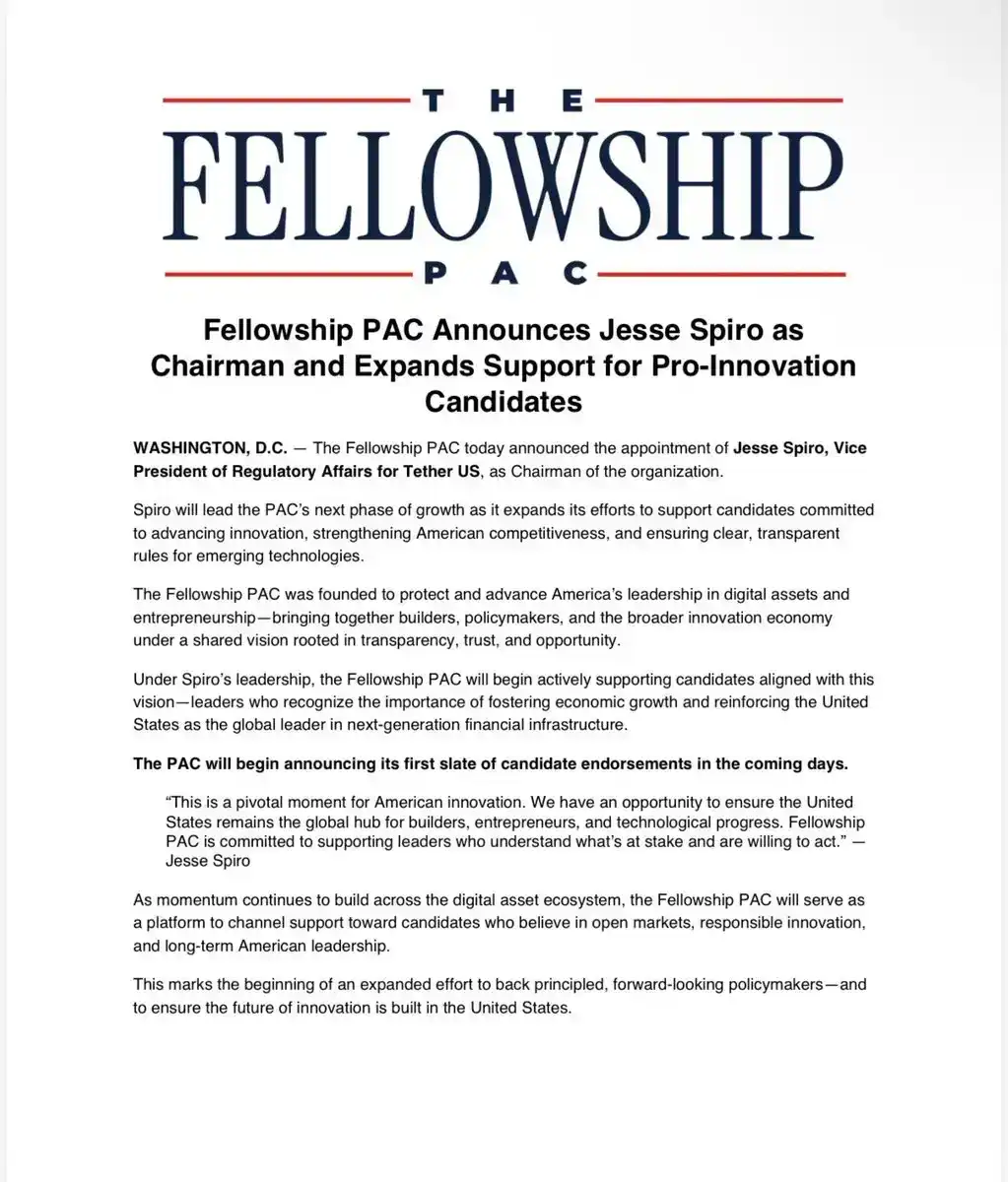
According to a Cointelegraph report on April 1, Fellowship PAC announced on Wednesday that Jesse Spiro, Vice President of Regulatory Affairs at Tether US, will assume the role of chairman, leading the organization's next phase of expansion. The first list of endorsed candidates will be announced in the coming days. Fellowship is a super PAC founded in August 2025, which claimed last September that it had raised "over $100 million" from unnamed donors aligned with the crypto industry.

Spiro stated in a declaration: "This is a critical moment for American innovation. We have the opportunity to ensure that the United States continues to be the global hub for builders, entrepreneurs, and technological progress. Fellowship PAC is committed to supporting leaders who understand what is at stake and are willing to take action."
From 'Denying Ties' to 'Executive Leadership': Tether's Relationship with Fellowship Comes to Light

Since its high-profile debut last September, the identity of Fellowship PAC's backers has been one of the industry's biggest mysteries.

At its inception, the PAC did not disclose any management, donors, or key employees. Early reports listed Tether as an expected supporter, but Tether International subsequently formally denied any connection to the PAC. According to a CoinDesk report in February, a Tether International spokesperson explicitly stated that "Tether International has no affiliation whatsoever with Fellowship."

But FEC records tell a different story. Fellowship's registered treasurer, Mitchell Nobel, is an executive at Cantor Fitzgerald, the custodian institution managing Tether's multi-billion dollar reserves. The PAC's registered address is in Bethesda, Maryland.

Now, with a current Tether US executive officially taking the helm as PAC chairman, the previous rumors have finally solidified into public record. According to BeInCrypto, this marks the first formal, public connection between Fellowship PAC and Tether officially.

Spiro joined Tether in 2024 as Head of Government Affairs. Prior to that, he was responsible for blockchain and digital asset regulatory relations at PayPal and held a leadership role in government affairs at the on-chain analytics company Chainalysis.

$100 Million 'War Chest' Yet to Fire a Single Shot, FEC Records Show Zero Expenditures

Despite Fellowship's assertion of holding $100 million in funds, FEC records show that as of December 31 last year, the PAC reported no donation income or expenditures. Since last September's announcement, Fellowship has only made three public statements on platform X, operating almost "invisibly."

This contrast has raised widespread questions. CoinDesk's investigative report on February 25 pointed out that Fellowship had "never shown up" in its seven months of existence, with its promised $100 million showing no trace in Federal Election Commission disclosures.

Spiro's appointment is seen as a signal of Fellowship's return to the public eye from its period of dormancy. The PAC stated it will announce its first endorsements of candidates in the coming days, with just over seven months remaining until the November midterm elections.

Bo Hines, Executive Director of the White House Digital Asset Advisory Council, expressed support for the appointment on platform X, posting: "The fight for American innovation needs serious advocates. Looking forward to seeing leaders who truly understand the stakes get elected."

Crypto PAC Arms Race: Fairshake Holds $193 Million, Already Spent $8.6 Million in Illinois

Fellowship is not the crypto industry's only political funding machine. The Fairshake PAC and its affiliated organizations, backed by Coinbase, Ripple, and a16z, reported holding $193 million in cash as of January this year, making it the crypto industry's largest super PAC by funding size.

Fairshake has already begun taking action. According to Cointelegraph, the PAC and its affiliates have spent approximately $8.6 million on a congressional race in Illinois, six times its spending in the state in 2024. In the Illinois primary in March, some candidates supported by Fairshake did not win, but there is still a seven-month window until the midterm elections.
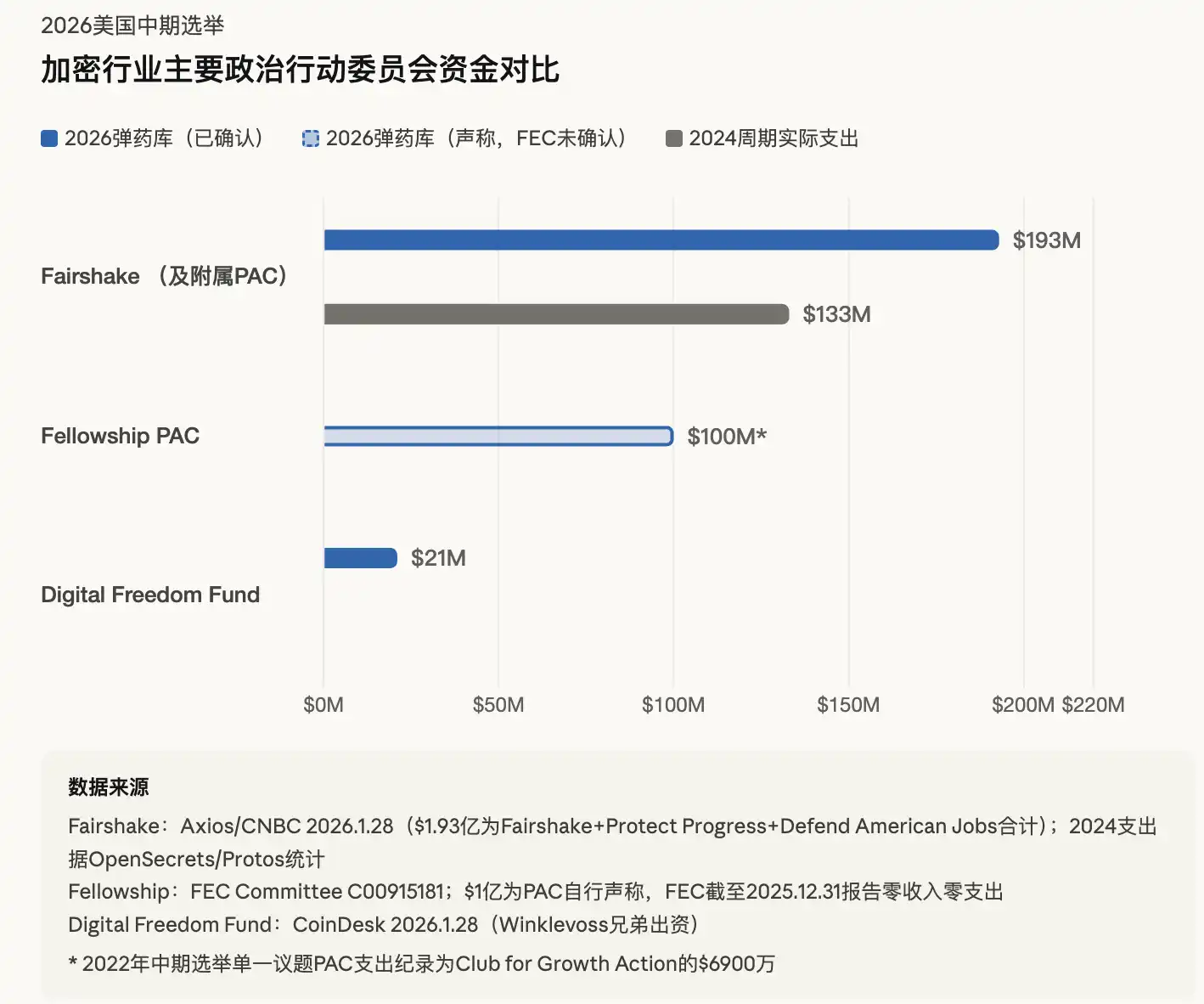
During the 2024 election cycle, Fairshake spent over $130 million on media placements, with the majority of the more than 50 candidates it supported successfully elected. According to statistics from the non-profit oversight organization Public Citizen, nearly half of the corporate money flowing into the 2024 elections came from the crypto industry.

Now, with the combined war chest of nearly $300 million from Fellowship and Fairshake, plus other political donation forces in the crypto industry, the 2026 midterm elections are expected to set a new record for industry political spending.

Legislative Battle: Stablecoin Yield Dispute Stalls CLARITY Act, Tether's Interests at Stake

Spiro's appointment is not coincidental in its timing. The Clarity Act for Digital Asset Markets (CLARITY Act), the crypto industry's core legislative priority, is currently stalled in the Senate, with one of the contentious points being stablecoin yields, which directly impacts Tether's business model.

The CLARITY Act passed the House of Representatives in July 2025 by a vote of 294 to 134 and passed review in the Senate Agriculture Committee in January this year. However, at the Senate Banking Committee level, a fierce battle is underway between the banking industry and the crypto industry over whether stablecoins can pay yields to users.

On March 20, Senators Thom Tillis and Angela Alsobrooks reached a principled compromise on stablecoin yields: prohibiting passive yield payments based on holding balances, but allowing reward programs based on transaction activity. According to CoinDesk, after crypto industry representatives reviewed the latest text behind closed doors on Capitol Hill on March 23, they found the language too narrow and ambiguous. Coinbase has stated twice that it does not support the current draft.

The markup in the Senate Banking Committee is currently scheduled for after the Easter recess in late April. Senator Bernie Moreno warned that if the bill does not advance by May, crypto legislation may not receive serious consideration again during the midterm election cycle.

Compounding the issue, the White House AI and Crypto Tsar, David Sacks, confirmed on March 26 that his 130-day term had expired and the administration would not appoint a successor. The crypto industry's most critical legislative sprint will proceed without its chief advocate in the White House.

Tether's USDT is the world's largest stablecoin, with a market cap of approximately $184 billion, but it is not available to U.S. residents. Tether launched a compliant stablecoin for the U.S. market, USAT, last year. The final outcome of the stablecoin yield provisions will directly determine the operating space for Tether and its competitors in the U.S. market.

Against this backdrop, by having an executive assume the chairmanship of the PAC, Tether is pushing its political influence building from behind the scenes to the forefront, sending a clear signal: during the critical window of legislative博弈 (game/struggle), using political funds to protect industry interests.


Trending Cryptos

Related Questions

QWho was appointed as the new chairman of the crypto super PAC Fellowship, and what is his role at Tether?

AJesse Spiro, the Regulatory Affairs Vice President of Tether US, was appointed as the chairman of Fellowship PAC.

QHow much combined political funding do Fellowship and Fairshake PACs have for the midterm elections, and what are their reported amounts?

AFellowship and Fairshake PACs have a combined nearly $300 million in political funds, with Fellowship claiming over $100 million and Fairshake holding $193 million.

QWhat discrepancy was reported regarding Fellowship PAC's fundraising claims and FEC records?

AFellowship PAC claimed to have raised over $100 million, but FEC records showed zero reported donations or expenditures as of December 31.

QWhat is the key legislative issue affecting stablecoins like Tether's USDT, and what is the compromise proposed in the CLARITY Act?

AThe key issue is whether stablecoins can pay yields to users. The proposed compromise in the CLARITY Act prohibits passive yield based on holdings but allows reward programs based on transaction activity.

QWhy is Jesse Spiro's appointment significant for Tether and the crypto industry's political strategy?

AIt marks the first formal, public link between Tether and Fellowship PAC, signaling Tether's move to openly influence politics during a critical legislative period for crypto regulations, particularly affecting stablecoin operations.

Related Reads

Gate Research Institute: Analysis of Chart Patterns and Breakout Trading Strategies

Gate Research Institute: Chart Pattern Analysis and Breakout Trading Strategies Chart patterns are crucial tools in technical analysis for observing market supply and demand shifts, trend continuations, and reversals. This analysis involves a comprehensive evaluation of trend, volume, support/resistance, time cycles, and breakout validity, not just rote pattern recognition. Patterns are broadly categorized into reversal patterns (e.g., Double Tops/Bottoms, Head and Shoulders) and continuation patterns (e.g., Flags, Triangles, Rectangles). An effective breakout, key for trading, requires clear support/resistance, prolonged consolidation, a prevailing trend backdrop, and volume confirmation. However, breakouts are not guaranteed, as false breakouts are common. Risk must be managed through position sizing, stop-loss orders, pullback confirmations, and profit-taking in stages. Key pattern types discussed include: * **Rectangle Patterns:** Indicate market indecision within parallel support and resistance, with breakouts projecting a move equal to the pattern's width. * **Flag & Pennant Patterns:** Short-term continuation patterns following sharp price moves ("flagpoles"). * **Triangle Patterns:** Symmetrical, Ascending (bullish bias), and Descending (bearish bias) triangles, representing consolidation before a directional move. * **Head and Shoulders Patterns:** Major reversal patterns signaling trend exhaustion. The article details breakout trading strategies, defining valid breakouts by price closing beyond a key level with increased volume and minimal immediate re-entry into the prior range. It contrasts range trading with breakout trading and outlines entry methods (immediate entry, pullback entry, scaling in), stop-loss placement (based on pattern failure), and profit-taking techniques (target-based, structure-based, trend-following). It further classifies breakout outcomes: 1. **Valid Breakouts:** Strong, sustained moves in the breakout direction. 2. **Pullback Breakouts:** Price breaks out, retests the breakout level as support/resistance, then resumes the trend—offering a lower-risk entry. 3. **False Breakouts:** Price briefly breaches a level but quickly reverses back into the prior range, a common risk managed by strict stop-losses. Key validation tools for breakouts include volume analysis, the principle of support/resistance role reversal, and momentum indicators like ATR, Moving Averages, Bollinger Bands, and RSI. In conclusion, while chart patterns and breakout analysis provide a structured framework, their effectiveness relies on multiple confirming factors—trend context, volume, and proper risk management. They should be integrated into a broader trading system rather than used as standalone signals.

marsbit10m ago

Gate Research Institute: Analysis of Chart Patterns and Breakout Trading Strategies

marsbit10m ago

Joseph Chalom: Ethereum is Becoming the "Settlement Layer of Trust" for Global Finance

In a speech titled "The Industrialization of Trust," Sharplink CEO Joseph Chalom (former BlackRock digital assets head) discussed the future transformation of global finance. Drawing from 20 years at BlackRock, where he led the launch of Bitcoin/ETH ETFs and tokenized funds, Chalom highlighted the immense hidden costs of establishing trust in traditional finance—estimated at over $9.3 trillion annually in the US alone due to fragmented systems, multi-day settlements, and countless reconciliations. He argued that Ethereum is emerging as the global financial "settlement layer for trust," with its robust, decentralized infrastructure securing over $300 billion in on-chain assets and most stablecoins and tokenized assets. The future, he stated, will be driven by three accelerating pillars: stablecoins (evolving beyond crypto gateways to become efficient cross-border payment rails), tokenized assets (enabling 24/7 trading and reshaping capital markets), and DeFi (providing automated, accessible financial services). A potential game-changer, Chalom added, is the fourth pillar: "Agentic Finance," where AI agents autonomously execute programmable financial transactions via smart contracts and stablecoins. He envisions individuals soon having AI-powered "CFOs in their pockets" to optimize idle capital and manage tokenized portfolios. This shift, facilitated by Ethereum's trustless settlement, could multiply on-chain transaction volume 1000x within a year, moving finance toward a seamless, digitized future.

marsbit10m ago

Joseph Chalom: Ethereum is Becoming the "Settlement Layer of Trust" for Global Finance

marsbit10m ago

STRC Severely Unpegged, What Risks Is the Market Pricing In?

The article analyzes the recent significant de-pegging of Strategy's perpetual preferred stock, STRC, whose price fell to approximately $89, far below its $100 face value. This discount has pushed its simple yield to around 12.9%, creating a paradox. The stock was designed as a high-yield instrument trading near par, and Strategy maintains an 11.5% annual dividend, even recently switching to semi-monthly payments to support the price. The author explores several reasons why the high yield hasn't attracted enough buying pressure to restore the par value. A key factor is potential reverse deleveraging from carry trades, where leveraged investors may be forced to sell due to margin calls as the price falls, creating a self-reinforcing downward spiral. Additionally, the tokenization and integration of STRC into DeFi protocols (like Apyx, Saturn, Pendle) have introduced faster, more transparent, and potentially more volatile price adjustment mechanisms through leverage and yield-splitting products. The emergence of a competing product, Strive's SATA, offering a 13% yield with daily dividends, has also changed the yield benchmark, challenging STRC's unique high-yield narrative. Furthermore, the market is questioning the distinction between Strategy's substantial Bitcoin reserves, which provide long-term balance sheet coverage, and the certainty of stable near-term cash flow for dividends. Ultimately, the price dip represents a stress test for this type of BTC-backed, high-yield financing tool. The future path of STRC depends on whether Strategy acts to reinforce the $100 peg (e.g., by adjusting dividends), whether DeFi-related leverage unwinds further, and how investors ultimately price the risks of leverage, competition, and cash flow uncertainty against the offered yield.

marsbit21m ago

STRC Severely Unpegged, What Risks Is the Market Pricing In?

marsbit21m ago

LIT Token Hits Six-Month High: How Long Can the Buyback Flywheel Keep Burning Fuel?

The LIT token of decentralized perpetual exchange Lighter surged to a six-month high above $1.90 on June 18th, with a market cap of $425 million. After a price correction earlier this year, the recent rebound is attributed to its core "buyback flywheel" mechanism. All protocol fee revenue is used for programmatic, hourly market buybacks of LIT. Since its TGE in December 2025, approximately 15 million LIT (6% of circulating supply) has been repurchased for around $21 million. Additional price support comes from the LLP (Lighter Liquidity Pool), where providers must stake LIT worth 10% of their deposited USDC, locking significant token supply. However, challenges persist. Trading volume has declined amidst a sluggish market, with total volume at $1.68 trillion, significantly lower than leading competitor Hyperliquid's $4.37 trillion. While Lighter focuses on perpetual contracts, RWA, and Pre-IPO markets, Hyperliquid has expanded into prediction markets and boasts a U.S. spot ETF, attracting institutional investment and influencer endorsements like from Arthur Hayes. In contrast, LIT currently lacks similar high-profile backing. With 75% of LIT's total 1 billion supply still locked (team and investor tokens begin a 3-year linear unlock in December 2026), there is no immediate unlock selling pressure. The token's future performance hinges on sustaining trading volume growth, successful product iteration, and executing its transparent buyback strategy against a dominant competitor.

Foresight News41m ago

LIT Token Hits Six-Month High: How Long Can the Buyback Flywheel Keep Burning Fuel?

Foresight News41m ago

Trading

Spot
Futures

Hot Articles

How to Buy SUPER

Welcome to HTX.com! We've made purchasing SuperFarm (SUPER) simple and convenient. Follow our step-by-step guide to embark on your crypto journey.Step 1: Create Your HTX AccountUse your email or phone number to sign up for a free account on HTX. Experience a hassle-free registration journey and unlock all features.Get My AccountStep 2: Go to Buy Crypto and Choose Your Payment MethodCredit/Debit Card: Use your Visa or Mastercard to buy SuperFarm (SUPER) instantly.Balance: Use funds from your HTX account balance to trade seamlessly.Third Parties: We've added popular payment methods such as Google Pay and Apple Pay to enhance convenience.P2P: Trade directly with other users on HTX.Over-the-Counter (OTC): We offer tailor-made services and competitive exchange rates for traders.Step 3: Store Your SuperFarm (SUPER)After purchasing your SuperFarm (SUPER), store it in your HTX account. Alternatively, you can send it elsewhere via blockchain transfer or use it to trade other cryptocurrencies.Step 4: Trade SuperFarm (SUPER)Easily trade SuperFarm (SUPER) on HTX's spot market. Simply access your account, select your trading pair, execute your trades, and monitor in real-time. We offer a user-friendly experience for both beginners and seasoned traders.

5.3k Total ViewsPublished 2024.03.29Updated 2026.06.02

How to Buy SUPER

Discussions

Welcome to the HTX Community. Here, you can stay informed about the latest platform developments and gain access to professional market insights. Users' opinions on the price of SUPER (SUPER) are presented below.

活动图片












