TRON Amplía su Fondo de IA a $1.000 Millones, Dirigiéndose a la Infraestructura Central para la Economía Agente

bitcoinistPublished on 2026-03-24Last updated on 2026-03-24

Abstract

TRON ha anunciado la expansión de su Fondo de IA de 100 millones a 1.000 millones de dólares, reafirmando su apuesta estratégica por la economía agentic. El fondo se centrará en infraestructuras clave para sistemas autónomos, incluyendo identidad digital agentic, stablecoins, activos tokenizados y herramientas de desarrollo. TRON sostiene que la convergencia entre IA y blockchain demandará infraestructura programable y sin permisos para transacciones entre agentes autónomos. La red, con más de 370 millones de cuentas y 85.000 millones en USDT circulante, busca posicionarse como capa de liquidez para esta nueva economía. Mientras, el precio de TRX muestra recuperación técnica tras estabilizarse en la zona de 0,27–0,28 dólares.

El lunes, TRON anunció una expansión significativa de su Fondo de IA, aumentando su asignación de $100 millones a $1.000 millones, lo que señala un importante giro estratégico hacia la emergente economía agente. Este movimiento refleja una creciente convicción de que la convergencia de la inteligencia artificial y la tecnología blockchain requerirá una nueva generación de infraestructura financiera construida específicamente para sistemas autónomos.

El fondo ampliado se centrará en inversiones y adquisiciones de empresas en etapas iniciales que desarrollen componentes centrales de este ecosistema. TRON está priorizando áreas consideradas fundamentales para la actividad económica impulsada por máquinas, incluyendo sistemas de identidad de agentes, vías de pago basadas en stablecoins, activos del mundo real tokenizados y herramientas de desarrollo para sistemas financieros autónomos.

La tesis subyacente es clara: a medida que los agentes de IA se vuelven cada vez más capaces de participar en procesos económicos, requerirán infraestructura programable y sin permisos para transaccionar, gestionar activos y verificar identidades sin depender de intermediarios tradicionales. Las redes blockchain, particularmente aquellas con liquidez y escalabilidad establecidas, están posicionadas para apoyar esta transición.

Al escalar su compromiso de capital diez veces, TRON no solo está reforzando su posicionamiento temprano en esta narrativa, sino que también apunta a desempeñar un papel central en la configuración de la capa de infraestructura de una economía digital en rápida evolución.

TRON Reafirma su Tesis sobre la Convergencia IA-Blockchain

El anuncio enfatiza además que esta expansión se basa en una tesis esbozada por primera vez en 2023: la convergencia de la IA y el blockchain creará una demanda estructural de infraestructura financiera programable y sin permisos. Lo que comenzó como una convicción temprana ahora ha evolucionado hacia un compromiso estratégico, con TRON posicionándose para un futuro donde los agentes de IA participen activamente en la economía global.

Esta visión se ancla en tres tesis centrales. Primero, las stablecoins son la forma de dinero más viable para el comercio entre agentes. Mientras los sistemas de IA no pueden acceder a las vías bancarias tradicionales, sí pueden operar billeteras digitales, haciendo de las stablecoins la capa de liquidación por defecto. Segundo, las stablecoins también sirven como la infraestructura de pago primaria para individuos y pequeños equipos, particularmente a medida que la IA permite operaciones lean y de alta eficiencia sin depender de intermediarios.

Tercero, el capital tokenizado está posicionado como la capa de propiedad de la economía agente. A medida que los agentes de IA gestionan y transaccionan valor, requieren estructuras de propiedad programables, divisibles y continuamente transferibles—capacidades inherentes a los activos tokenizados.

El posicionamiento de TRON está reforzado por la escala. Con más de 370 millones de cuentas de usuario, más de $21 mil millones en volumen de transacciones diarias y más de $85 mil millones en USDT en circulación, la red ya opera una de las capas de liquidez de stablecoins más grandes. Esta infraestructura existente proporciona una base para que los sistemas financieros impulsados por agentes escalen eficientemente.

TRON Prueba una Resistencia Clave Mientras el Precio se Recupera Dentro del Rango

TRX se está negociando actualmente alrededor del rango de $0.30–$0.31, mostrando signos de recuperación después de una prolongada fase correctiva que siguió a sus máximos de finales de 2025 cerca de $0.36. El gráfico refleja una transición de una clara tendencia bajista a una estructura más lateral, con el precio estabilizándose gradualmente después de formar una base cerca de la zona de $0.27–$0.28.
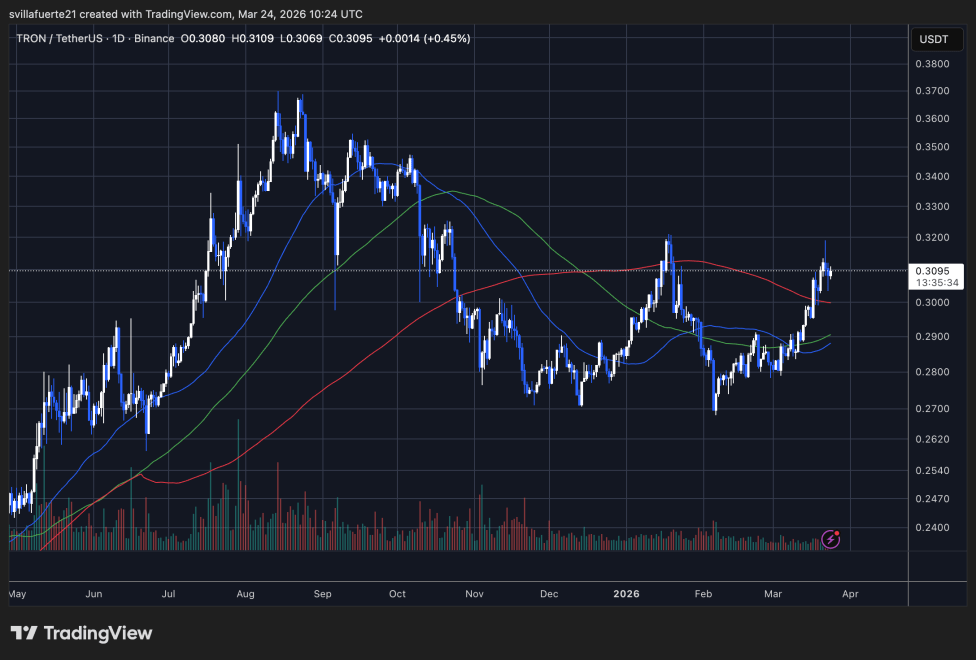
Precio de TRON probando una resistencia clave | Fuente: Gráfico TRXUSDT en TradingView

Desde una perspectiva técnica, TRX está probando ahora un área crítica. El precio se ha movido por encima de las medias móviles de corto plazo (50 días y 100 días), que están comenzando a aplanarse, indicando un potencial cambio en el momentum a corto plazo. Sin embargo, la media móvil de 200 días permanece por encima, actuando como resistencia dinámica y limitando mayores subidas.

El movimiento alcista reciente parece constructivo pero aún no decisivo. El precio se ha acercado a la región de $0.31 múltiples veces, sugiriendo que este nivel funciona como resistencia inmediata, mientras que la zona de $0.28–$0.29 actúa ahora como soporte a corto plazo.

Las tendencias de volumen muestran una participación moderada durante la fase de recuperación, careciendo de la fuerte expansión típicamente asociada con condiciones de ruptura. Esto sugiere que el movimiento actual puede aún estar en las etapas iniciales de acumulación más que en una reversión de tendencia confirmada.

Se requeriría una ruptura sostenida por encima de $0.31–$0.32 para confirmar la continuación alcista, mientras que la incapacidad de mantenerse por encima de $0.29 podría reintroducir presión a la baja.

Imagen destacada de ChatGPT, gráfico de TradingView.com

Related Questions

Q¿Qué anunció TRON en relación con su Fondo de IA y cuál es el nuevo monto asignado?

ATRON anunció una expansión significativa de su Fondo de IA, aumentando su asignación de 100 millones de dólares a 1.000 millones de dólares.

Q¿En qué áreas se enfocará el fondo expandido de TRON para la economía agéntica?

AEl fondo expandido se centrará en inversiones y adquisiciones de empresas en etapas iniciales que desarrollen componentes clave como sistemas de identidad para agentes, infraestructuras de pago con stablecoins, activos del mundo real tokenizados y herramientas para desarrolladores de sistemas financieros autónomos.

Q¿Cuáles son las tres tesis centrales que sustentan la visión de TRON sobre la convergencia de IA y blockchain?

APrimero, los stablecoins son la forma de dinero más viable para el comercio entre agentes. Segundo, los stablecoins sirven como infraestructura de pago principal para individuos y pequeños equipos. Tercero, las acciones tokenizadas son la capa de propiedad de la economía agéntica.

Q¿Qué datos de escala refuerzan la posición de TRON en el ecosistema de stablecoins?

ATRON tiene más de 370 millones de cuentas de usuario, más de 21.000 millones de dólares en volumen de transacciones diarias y más de 85.000 millones de dólares en USDT en circulación.

Q¿En qué rango de precio se encuentra TRX actualmente y qué nivel es crítico para una continuación alcista?

ATRX se está negociando alrededor del rango de 0,30 a 0,31 dólares, y una ruptura sostenida por encima de 0,31 a 0,32 dólares confirmaría una continuación alcista.

Related Reads

Sharplink CEO: One Million Ethereum Developers, Who Can Compete?

Etherean Ecosystem: One Million Developers and a Formidable Moat The Ethereum network has surpassed a significant milestone: over one million unique lifetime developers, with approximately 232,000 active in the past year. This vast and growing talent pool is Ethereum's core advantage, far more critical than transient metrics like speed or transaction fees. The central question is not which blockchain is fastest, but where the best builders choose to build long-term. Ethereum's answer lies in a decade-long accumulation of infrastructure, standards, tools, liquidity, and collaborative culture that is exceptionally difficult to replicate. It has become the default operating system for programmable finance. This massive developer base is actively working on complex, high-risk challenges that deepen Ethereum's strategic moat: * **Glamsterdam Upgrade (2026):** Focused on core protocol scalability (ePBS, parallel execution) while preserving core values like credible neutrality. * **Synchronous Composability:** Aims to make numerous Rollups interoperate like a single chain, directly addressing fragmentation concerns. * **Quantum Resistance:** Ethereum leads mainstream ecosystems in coordinated preparation for post-quantum cryptography, with a targeted migration plan around 2029. This developer advantage is self-reinforcing, fueled by: * **Deep Composability:** Applications interact like interoperable financial Lego bricks via shared standards (e.g., EVM, Solidity). * **Credible Neutrality:** Secured by over 900,000 validators, making it trusted by major institutions. * **Modularity:** Rollups (Base, Arbitrium, etc.) expand, rather than fracture, the ecosystem into a tightly connected modular internet economy. * **Culture:** Attracts top-tier researchers and standard-setters who guide the entire industry. In essence, while other chains generate activity, Ethereum is consolidating as the trusted, long-term coordination layer for internet-native finance. Its future is being built now by the architects of the next-generation financial infrastructure.

Odaily星球日报26m ago

Sharplink CEO: One Million Ethereum Developers, Who Can Compete?

Odaily星球日报26m ago

Ethereum Reaches the Milestone of One Million Developers, Sharplink CEO Delves Deep into Ethereum's Future Possibilities

Ethereum Surpasses One Million Developers Milestone: A Look at Its Unshakeable Dominance and Future Joseph Chalom, CEO of Sharplink, reflects on his recent Asia trip where he engaged deeply with Ethereum developers and ecosystem leaders. The most striking takeaway was not just the industry's vibrancy, but the rigorous, long-term vision of local builders. This context brings to life a pivotal statistic: Ethereum has now surpassed one million cumulative developers (1,012,824), with approximately 232,000 remaining active in the past year—a talent pool unmatched by any other crypto ecosystem. The critical question isn't which blockchain is fastest, but where top developers choose to build long-term. Ethereum's answer is unequivocal. Its decade-long lead stems from a unique convergence of technology, institutional culture, economic systems, and composability, cementing its role as the foundational operating system for programmable finance. This massive developer base is tackling the industry's hardest problems, continuously strengthening Ethereum's moat. Key initiatives include: * **The Glamsterdam Upgrade (planned 2026):** Introducing ePBS and Block-level Access Lists for parallel execution and higher throughput while preserving core values like credible neutrality and fair MEV distribution. * **Synchronous Composability:** Projects are working to enable atomic transactions across dozens of Rollups, making them function as one unified chain and eliminating ecosystem fragmentation. * **Post-Quantum Security:** Ethereum is far ahead in preparing for quantum computing threats, with a dedicated foundation working group and testnets targeting a full migration by ~2029—a crucial factor for institutional adoption. Beyond developers, Ethereum's core network effects are its unparalleled composability and unified standards (like EVM and Solidity), which create a powerful flywheel: more developers → better tools → greater liquidity → more institutional participation. Its other decisive advantages include credible neutrality (over 900k validators), a secure modular architecture with interconnected Rollups, and a deeply entrenched culture shaped by top-tier researchers. Ultimately, there's a vast difference between generating short-term activity and becoming the trusted, long-term coordination layer for global native finance. Major institutions prioritize security, trust, and liquidity—areas where Ethereum holds dominant mindshare. The industry's trajectory shows resources consolidating around unified standards, deep liquidity, and developer consensus. After meeting the builders in Seoul and Hong Kong, Chalom is more convinced than ever: Ethereum's unshakeable future is being built right now.

Foresight News38m ago

Ethereum Reaches the Milestone of One Million Developers, Sharplink CEO Delves Deep into Ethereum's Future Possibilities

Foresight News38m ago

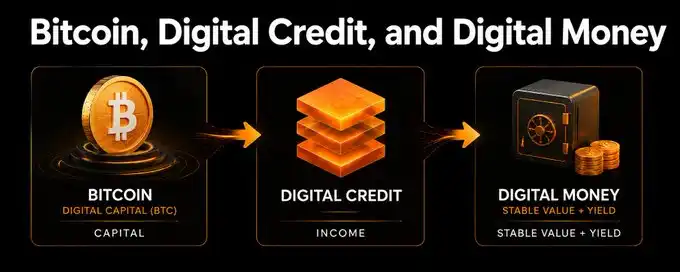
Saylor's Latest Long Read: Bitcoin is Not Money, It's Digital Capital, and Money is Built Upon It

Michael Saylor presents his "Digital Asset Stack" theory, positioning Bitcoin as the foundational layer of digital capital. He argues Bitcoin itself should remain unchanged—no staking, inflation, or protocol alterations. Instead, a five-layer financial architecture should be built atop it: Digital Capital (BTC), Digital Credit (e.g., yield instruments like STRC), Digital Currency (stable, yield-bearing instruments pegged to fiat), Digital Yield (leveraged/structured products), and Digital Equity (e.g., MSTR stock, absorbing residual volatility). Saylor asserts this stack transforms Bitcoin's high-volatility, high-energy capital into tailored products: stable currencies for payments/savings, yield instruments for income seekers, and equity for growth investors. This approach meets diverse needs—corporate treasuries, banks, retirees, emerging market users—without compromising Bitcoin's core properties (scarcity, decentralization). The "killer use case" is rebuilding global money, credit, and capital markets on Bitcoin, bridging the fiat world with a superior digital asset foundation. The system leverages traditional finance principles (risk layering, structured products) while using Bitcoin as the ultimate collateral. This expands Bitcoin's utility, drives adoption, and offers a better monetary experience: digital, yield-bearing, stable-value tools for everyday use.

marsbit50m ago

Saylor's Latest Long Read: Bitcoin is Not Money, It's Digital Capital, and Money is Built Upon It

marsbit50m ago

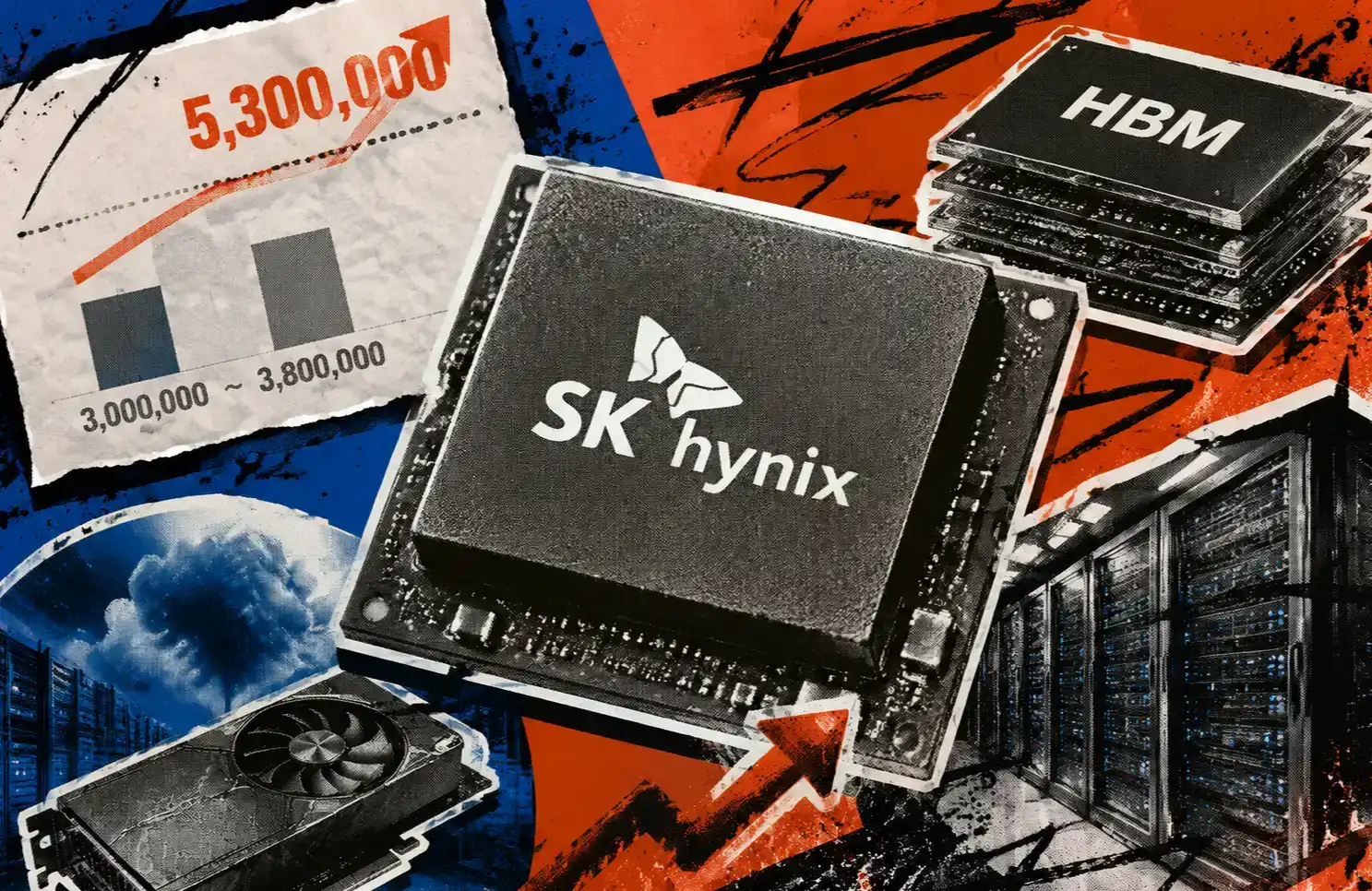
Can SK Hynix's Stock Double Again in This Rally?

The article discusses the highly optimistic price target of approximately $3,500 for SK Hynix stock, set by Aletheia Capital. This target is significantly above the consensus range of $2,000-$2,520 from major brokerages. The core debate is whether SK Hynix deserves a fundamental re-rating beyond its traditional cyclical discount, based on the long-term impact of AI-driven demand. The $3,500 target hinges on three key assumptions holding simultaneously until at least 2027: 1) Continued shortage and high pricing for HBM (High Bandwidth Memory), a critical component for AI chips; 2) Sustained high prices for standard DRAM, as HBM production consumes capacity and constrains general supply; and 3) Strong AI server demand generating substantial, above-expectation free cash flow. SK Hynix's leading ~58% market share in HBM and its early certification with key clients like Nvidia provide a competitive advantage, allowing it to capture significant supply chain premiums. The HBM shortage is seen not just as a niche growth driver but as a catalyst that amplifies profitability across the entire memory business by tightening overall DRAM supply. However, the article cautions that this target represents an optimistic "tail scenario." Key risks include potential supply increases from competitors (Samsung, Micron) by 2027, a possible slowdown in HBM price growth, and high capital expenditures that could erode the projected free cash flow. The divergence in analyst targets reflects the market's uncertainty over whether the current AI-driven boom will temporarily elevate earnings or permanently raise the memory industry's profit baseline.

marsbit54m ago

Can SK Hynix's Stock Double Again in This Rally?

marsbit54m ago

Trading

Spot
Futures

Hot Articles

How to Buy TRX

Welcome to HTX.com! We've made purchasing TRON (TRX) simple and convenient. Follow our step-by-step guide to embark on your crypto journey.Step 1: Create Your HTX AccountUse your email or phone number to sign up for a free account on HTX. Experience a hassle-free registration journey and unlock all features.Get My AccountStep 2: Go to Buy Crypto and Choose Your Payment MethodCredit/Debit Card: Use your Visa or Mastercard to buy TRON (TRX) instantly.Balance: Use funds from your HTX account balance to trade seamlessly.Third Parties: We've added popular payment methods such as Google Pay and Apple Pay to enhance convenience.P2P: Trade directly with other users on HTX.Over-the-Counter (OTC): We offer tailor-made services and competitive exchange rates for traders.Step 3: Store Your TRON (TRX)After purchasing your TRON (TRX), store it in your HTX account. Alternatively, you can send it elsewhere via blockchain transfer or use it to trade other cryptocurrencies.Step 4: Trade TRON (TRX)Easily trade TRON (TRX) on HTX's spot market. Simply access your account, select your trading pair, execute your trades, and monitor in real-time. We offer a user-friendly experience for both beginners and seasoned traders.

26.0k Total ViewsPublished 2024.03.29Updated 2026.06.02

How to Buy TRX

Discussions

Welcome to the HTX Community. Here, you can stay informed about the latest platform developments and gain access to professional market insights. Users' opinions on the price of TRX (TRX) are presented below.

活动图片