Ethereum Reaches the Milestone of One Million Developers, Sharplink CEO Delves Deep into Ethereum's Future Possibilities

Foresight NewsPublished on 2026-06-16Last updated on 2026-06-16

Abstract

Ethereum Surpasses One Million Developers Milestone: A Look at Its Unshakeable Dominance and Future Joseph Chalom, CEO of Sharplink, reflects on his recent Asia trip where he engaged deeply with Ethereum developers and ecosystem leaders. The most striking takeaway was not just the industry's vibrancy, but the rigorous, long-term vision of local builders. This context brings to life a pivotal statistic: Ethereum has now surpassed one million cumulative developers (1,012,824), with approximately 232,000 remaining active in the past year—a talent pool unmatched by any other crypto ecosystem. The critical question isn't which blockchain is fastest, but where top developers choose to build long-term. Ethereum's answer is unequivocal. Its decade-long lead stems from a unique convergence of technology, institutional culture, economic systems, and composability, cementing its role as the foundational operating system for programmable finance. This massive developer base is tackling the industry's hardest problems, continuously strengthening Ethereum's moat. Key initiatives include: * **The Glamsterdam Upgrade (planned 2026):** Introducing ePBS and Block-level Access Lists for parallel execution and higher throughput while preserving core values like credible neutrality and fair MEV distribution. * **Synchronous Composability:** Projects are working to enable atomic transactions across dozens of Rollups, making them function as one unified chain and eliminating ecosystem fragme...


Author: Joseph Chalom, Sharplink CEO

Compiled by: Saoirse, Foresight News


I just concluded my Asia tour, during which I engaged in in-depth discussions with Ethereum developers and ecosystem leaders. Special thanks to the teams at Nonce Classic, Four Pillars, and DSRV in Seoul, as well as our partners at SNZ, and the newly established Hong Kong Ethereum Community Hub. Supported by the Ethereum Foundation, this hub is Asia's first permanent, physical offline Ethereum community.


What struck me most during this trip was not only the vibrant atmosphere of the industry but also the meticulous, pragmatic attitude and ambitious vision of the local builders. The global Ethereum ecosystem is teeming with high-quality projects, innovative experiments, and long-term strategic thinking, which moved and inspired me deeply.


A set of data also came alive through these offline interactions: According to data provided by Electric Capital, the total number of cumulative contributors to Ethereum has exceeded one million, specifically 1,012,824 individuals; no other ecosystem in the crypto industry comes close.


A Milestone Worth Noting


Although a million is a round number, and many such figures can be hollow, this statistic is profoundly significant. Behind the number lies the world's largest and continuously expanding pool of technical talent, gathered by a global, open, permissionless blockchain network. More crucially, the scale and professional depth of this talent pool are still growing.


Of these one million developers, approximately 232,000 remained active in development over the past 12 months.
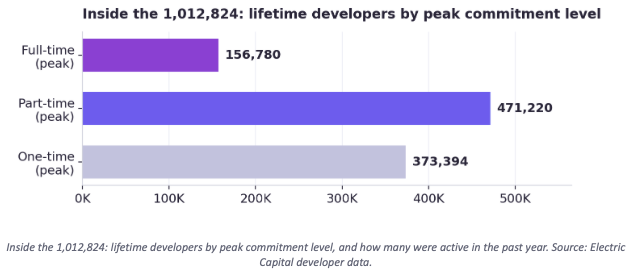

Ethereum's cumulative 1,012,824 developers: Full-time peak 156,780, Part-time peak 471,220, One-time participant peak 373,394. Part-time developers constitute the largest proportion of the total group. Source: Electric Capital


Why Ethereum? This is the Truly Critical Question


For a long time, discussions within the crypto industry have revolved around transaction speed, fees, and throughput. Every emerging public chain claims to be "faster than Ethereum." However, the most critical question in the crypto space has never been which chain has the best performance, but another core inquiry:


On which chain will top-tier developers choose to build and innovate for the long term?


On this point, Ethereum stands alone, irreplaceable. Its advantages extend beyond the technical layer, encompassing institutional, cultural, economic, and composability dimensions. This is the result of a decade-long accumulation of developers, infrastructure, industry standards, development tools, liquidity, academic research, various applications, and collaborative efforts within the industry—a complex ecosystem that others cannot replicate.


Ethereum has already become the underlying universal operating system for programmable finance and the issuance of native on-chain assets.


What Are the Million Developers Building Now? And How Are They Continuously Fortifying the Industry's Moat


The value of the million-developer community is primarily reflected in the industry's most challenging and far-reaching problems they are tackling today: underlying protocol scaling, privacy technology, post-quantum security, and the future intelligent autonomous systems that will run on-chain.


The Glamsterdam Upgrade: Innovating While Upholding Core Foundations


The Glamsterdam upgrade, planned for 2026, perfectly illustrates how Ethereum innovates while adhering to its core values. The core changes in this upgrade include the standardization of the proposer-builder separation mechanism (ePBS) and block-level access lists (BALs). These will enable parallel execution, significantly increasing network throughput. Additionally, there are plans to raise the gas limit, substantially enhancing the capacity of the Layer 1 mainnet.


While meeting future market scaling demands, it ensures network credibly neutrality, security, stability, and fair MEV distribution—this is a clear manifestation of Ethereum's continuously strengthening moat.


Synchronous Composability: Making Dozens of Rollups Feel Like a Single, Complete Public Chain


Composability has always been Ethereum's trump card, and the next breakthrough is extending this capability to all Layer 2 networks. Native, foundational Rollups combined with synchronous composability can solve the problem of ecosystem fragmentation: within a single atomic transaction, a smart contract on one Rollup can directly call a contract on the mainnet or another Layer 2 network, without cross-chain bridges or waiting periods.


Teams like Linea, the Ethereum Economic Zone, Gnosis, and Zisk, in collaboration with the Ethereum Foundation, are advancing related research and development, integrating this architecture with real-time proof technology. The final result will be: dozens of Rollups are no longer isolated networks but merge into one, directly addressing external skepticism about Ethereum's ecosystem fragmentation.


Post-Quantum Security: Ethereum's Most Prominent Leading Track


No other major public chain ecosystem has prepared for the post-quantum era's security framework as proactively as Ethereum. Relying on the "Purge Ethereum" development roadmap, the dedicated Post-Quantum Security Working Group established by the Ethereum Foundation in early 2026, the official website pq.ethereum.org, and over a dozen client teams running weekly post-quantum interoperability devnets, an open-source collaborative migration plan has taken shape, aiming for completion around 2029.


Once quantum computing poses security risks, institutions managing trillions of dollars in custodial assets will focus on one thing: which public chain was the earliest and most comprehensive in its protective preparations.


Moat Beyond Developers: Composability, Unified Standards, and Industry Trust


Ethereum's developer talent advantage will continue to compound, rooted in its underlying architectural design. Its most critical network effect is not liquidity, but extreme composability: applications like lending, stablecoins, exchanges, wallets, tokenized assets, oracles, and Layer 2 Rollups function like freely combinable financial building blocks, interoperable through unified industry standards, allowing developers to avoid building entire systems from scratch.


The EVM is the crypto industry's universal application layer, and the Solidity programming language is applicable across hundreds of networks like Base, Arbitrum, Optimism, Polygon, ZKsync, Scroll, and Linea.


Mastering Ethereum development maximizes development options, creating a virtuous cycle: more developers enter → supporting tools continuously improve → market liquidity increases → institutions continue to enter → attracting more developers to build interoperable protocols and assets. Liquidity begets more liquidity, and composability amplifies the advantages of composability.


Ethereum firmly occupies the core position for value accumulation, not just short-term on-chain activity.
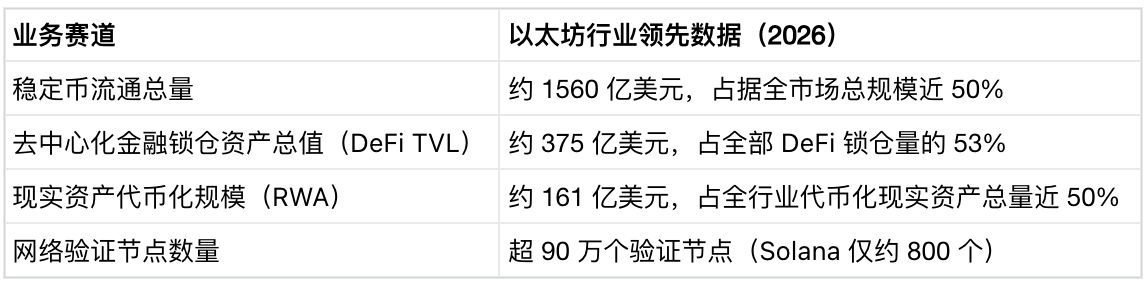


Three core advantages continue to widen the lead:


  • Credible Neutrality: Ethereum has over 900,000 validator nodes, while Solana has only about 800. This highly decentralized, neutral, and unbiased platform attribute is a core trait highly valued by large financial institutions;
  • Modular Architecture: Rollups like Base, Arbitrum, and Optimism do not fragment the Ethereum ecosystem; instead, they expand it into an interconnected, modular on-chain economy where all Layer 2 networks can inherit the mainnet's security guarantees;
  • Industry Ecosystem Culture: Ethereum gathers the industry's top researchers, cryptographers, and EIP standard-setters. This group defines the direction of the entire crypto industry. This cultural barrier, formed through the accumulation of talent, is difficult for any forked project to replicate.


The Uniqueness of Ethereum


There's a world of difference between merely generating short-term on-chain activity and becoming the long-term coordination layer for global native finance, earning the trust of leading financial institutions. In the minds of the largest asset-holding institutions, Ethereum holds an absolute mainstream position. These institutions prioritize security, trust, and liquidity most highly. I witnessed this industry trend firsthand during my previous tenure at BlackRock.


The law of technology industry development is: In the long run, ecosystem resources converge towards unified standards, sufficient liquidity, and developer consensus. This is precisely Ethereum's impregnable moat.


After meeting with local developers, builders, and ecosystem leaders in Seoul and Hong Kong, I am more convinced than ever of Ethereum's competitive advantages. I met the top talent building the next generation of financial infrastructure—the future entrepreneurs of the industry, the designers of intelligent autonomous financial systems. It is precisely these teams and practitioners who will reshape the entire world.


Ethereum's future is happening right now.

Related Questions

QAccording to the article, what is the current total number of developers who have contributed to Ethereum, and why is this milestone significant?

AAccording to data from Electric Capital, Ethereum has surpassed a total of 1,012,824 contributing developers. This milestone is significant because it represents the largest and most professional talent pool concentrated in a global, open, permissionless blockchain network, and this pool continues to grow in both scale and depth of expertise.

QWhat does the article identify as the most important question in the crypto space, and how does Ethereum fare in answering it?

AThe article identifies the most important question as: 'Where will top developers choose to build and dedicate themselves long-term?' On this question, Ethereum is in a league of its own and irreplaceable. Its advantage is not just technical, but also encompasses institutional, cultural, economic, and composability dimensions, built on a decade of accumulated infrastructure, standards, tools, liquidity, and collaboration.

QWhat are the three key areas where Ethereum's million developers are currently working to build its 'moat' or competitive advantage?

AThe three key areas are: 1) Core protocol scaling and upgrades (e.g., the Glamsterdam upgrade), 2) Synchronous composability across rollups to unify the ecosystem, and 3) Post-quantum security, where Ethereum is the most advanced among mainstream public chains in preparing for future quantum computing threats.

QBeyond the developer talent pool, what three core advantages does the article highlight that continuously widen Ethereum's lead?

AThe three core advantages are: 1) Credible Neutrality, supported by over 900,000 validator nodes compared to far fewer on other chains, which is crucial for institutional trust. 2) Modular Architecture, where rollups like Base and Arbitrum extend rather than fragment the economy, inheriting mainnet security. 3) Industry Ecosystem & Culture, defined by top researchers, cryptographers, and standard-setters, creating a cultural moat that is hard to replicate.

QHow does the article describe Ethereum's fundamental network effect, and what is the resulting positive cycle it creates?

AThe article describes Ethereum's fundamental network effect as its extreme composability, where applications like lending, stablecoins, and exchanges act like interoperable financial building blocks based on unified standards. This creates a positive cycle: more developers enter → supporting tools improve → market liquidity increases → institutions continue to enter → attracting more developers to build interoperable protocols and assets. Liquidity begets more liquidity, and composability amplifies the advantages of composability.

Related Reads

Do Robots Also Need Encrypted Wallets? Stablecoin Giant Tether Bets on German Company NEURA Robotics

Do Robots Need Crypto Wallets? Stablecoin Giant Tether Bets on German Firm NEURA Robotics German robotics company NEURA Robotics has secured up to $1.4 billion in what is claimed to be the largest-ever funding round in the full-stack robotics industry, valuing the company at $7 billion. The Series C round attracted major investors like Tether, Qualcomm, Amazon, NVIDIA, Bosch, and the European Investment Bank. NEURA, founded in 2019, initially focused on AI-powered collaborative robots (cobots) for industrial automation, later expanding to autonomous mobile robots, service robots, and humanoid robots. Its core strategy is evolving from a hardware manufacturer to the operator of "Neuraverse," a platform designed to enable different robots to share learned experiences and data, creating network effects. A key, crypto-focused aspect of this investment is Tether's involvement. Tether plans to integrate its open-source Wallet Development Kit (WDK) into NEURA's robot platforms. This would embed self-custody wallet functionality, allowing robots to autonomously handle payments and settlements for tasks under pre-set rules—envisioning use cases in logistics or Robotics-as-a-Service (RaaS) models. This move could position stablecoins and crypto wallets as potential "machine payment infrastructure." Additionally, the partnership will see Tether's QVAC (QuantumVerse Automatic Computer) edge-AI framework tested and deployed within Neuraverse. This aims to enable low-latency, offline-capable AI decision-making directly on robots, reducing reliance on cloud computing for critical, time-sensitive operations. The investment underscores Tether's broader ambition to expand beyond being just a stablecoin issuer into AI, energy, and digital infrastructure, with NEURA's robotics network serving as a testbed for merging crypto-based financial layers with edge-based intelligence for the future of automation.

marsbit7m ago

Do Robots Also Need Encrypted Wallets? Stablecoin Giant Tether Bets on German Company NEURA Robotics

marsbit7m ago

AMD Launches Compact AI Host, Directly Challenging NVIDIA DGX Spark

In June 2026, AMD announced the Ryzen AI Halo, a compact AI developer desktop to rival NVIDIA's DGX Spark. Both feature 128GB unified memory for running 200B+ parameter models locally. Priced from $2,949 to $3,999, AMD undercuts NVIDIA's $3,999+ DGX Spark. The core divergence lies in architecture and philosophy. Ryzen AI Halo uses an x86-based Ryzen AI Max+ 395 APU (CPU+GPU+NPU), runs standard Windows/Linux, and emphasizes general-purpose PC flexibility. DGX Spark uses an ARM-based Grace Blackwell Superchip, runs a custom DGX OS, and includes a high-speed ConnectX-7 NIC for cluster prototyping, anchoring it to NVIDIA's full-stack CUDA ecosystem. AMD's ROCm software has improved, with simpler installation and support for major frameworks, but still lags behind CUDA's 17-year maturity in community support and cutting-edge library availability. AMD's broader strategy focuses on becoming a viable second-source supplier. Key moves include acquiring design capabilities via ZT Systems (while outsourcing manufacturing) and securing two major 6GW GPU supply deals with OpenAI and Meta in late 2025/early 2026. These contracts validate AMD's role in diversifying the AI supply chain, rather than outright beating NVIDIA. NVIDIA counters with a tightly integrated stack from desktop (DGX Spark) to data center, emphasizing seamless scalability and enterprise software subscriptions (AI Enterprise). In summary, Ryzen AI Halo represents AMD's pragmatic path: offering a cost-effective, open-ecosystem alternative for developers wary of vendor lock-in, while its large data center contracts aim to capture share from customers seeking a second GPU supplier. The choice boils down to a familiar, flexible PC environment with potential software gaps (AMD) versus a premium, optimized, but locked-in ecosystem (NVIDIA).

marsbit7m ago

AMD Launches Compact AI Host, Directly Challenging NVIDIA DGX Spark

marsbit7m ago

Sharplink CEO: One Million Ethereum Developers, Who Can Compete?

Etherean Ecosystem: One Million Developers and a Formidable Moat The Ethereum network has surpassed a significant milestone: over one million unique lifetime developers, with approximately 232,000 active in the past year. This vast and growing talent pool is Ethereum's core advantage, far more critical than transient metrics like speed or transaction fees. The central question is not which blockchain is fastest, but where the best builders choose to build long-term. Ethereum's answer lies in a decade-long accumulation of infrastructure, standards, tools, liquidity, and collaborative culture that is exceptionally difficult to replicate. It has become the default operating system for programmable finance. This massive developer base is actively working on complex, high-risk challenges that deepen Ethereum's strategic moat: * **Glamsterdam Upgrade (2026):** Focused on core protocol scalability (ePBS, parallel execution) while preserving core values like credible neutrality. * **Synchronous Composability:** Aims to make numerous Rollups interoperate like a single chain, directly addressing fragmentation concerns. * **Quantum Resistance:** Ethereum leads mainstream ecosystems in coordinated preparation for post-quantum cryptography, with a targeted migration plan around 2029. This developer advantage is self-reinforcing, fueled by: * **Deep Composability:** Applications interact like interoperable financial Lego bricks via shared standards (e.g., EVM, Solidity). * **Credible Neutrality:** Secured by over 900,000 validators, making it trusted by major institutions. * **Modularity:** Rollups (Base, Arbitrium, etc.) expand, rather than fracture, the ecosystem into a tightly connected modular internet economy. * **Culture:** Attracts top-tier researchers and standard-setters who guide the entire industry. In essence, while other chains generate activity, Ethereum is consolidating as the trusted, long-term coordination layer for internet-native finance. Its future is being built now by the architects of the next-generation financial infrastructure.

Odaily星球日报1h ago

Sharplink CEO: One Million Ethereum Developers, Who Can Compete?

Odaily星球日报1h ago

Saylor's Latest Long Read: Bitcoin is Not Money, It's Digital Capital, and Money is Built Upon It

Michael Saylor presents his "Digital Asset Stack" theory, positioning Bitcoin as the foundational layer of digital capital. He argues Bitcoin itself should remain unchanged—no staking, inflation, or protocol alterations. Instead, a five-layer financial architecture should be built atop it: Digital Capital (BTC), Digital Credit (e.g., yield instruments like STRC), Digital Currency (stable, yield-bearing instruments pegged to fiat), Digital Yield (leveraged/structured products), and Digital Equity (e.g., MSTR stock, absorbing residual volatility). Saylor asserts this stack transforms Bitcoin's high-volatility, high-energy capital into tailored products: stable currencies for payments/savings, yield instruments for income seekers, and equity for growth investors. This approach meets diverse needs—corporate treasuries, banks, retirees, emerging market users—without compromising Bitcoin's core properties (scarcity, decentralization). The "killer use case" is rebuilding global money, credit, and capital markets on Bitcoin, bridging the fiat world with a superior digital asset foundation. The system leverages traditional finance principles (risk layering, structured products) while using Bitcoin as the ultimate collateral. This expands Bitcoin's utility, drives adoption, and offers a better monetary experience: digital, yield-bearing, stable-value tools for everyday use.

marsbit1h ago

Saylor's Latest Long Read: Bitcoin is Not Money, It's Digital Capital, and Money is Built Upon It

marsbit1h ago

Can SK Hynix's Stock Double Again in This Rally?

The article discusses the highly optimistic price target of approximately $3,500 for SK Hynix stock, set by Aletheia Capital. This target is significantly above the consensus range of $2,000-$2,520 from major brokerages. The core debate is whether SK Hynix deserves a fundamental re-rating beyond its traditional cyclical discount, based on the long-term impact of AI-driven demand. The $3,500 target hinges on three key assumptions holding simultaneously until at least 2027: 1) Continued shortage and high pricing for HBM (High Bandwidth Memory), a critical component for AI chips; 2) Sustained high prices for standard DRAM, as HBM production consumes capacity and constrains general supply; and 3) Strong AI server demand generating substantial, above-expectation free cash flow. SK Hynix's leading ~58% market share in HBM and its early certification with key clients like Nvidia provide a competitive advantage, allowing it to capture significant supply chain premiums. The HBM shortage is seen not just as a niche growth driver but as a catalyst that amplifies profitability across the entire memory business by tightening overall DRAM supply. However, the article cautions that this target represents an optimistic "tail scenario." Key risks include potential supply increases from competitors (Samsung, Micron) by 2027, a possible slowdown in HBM price growth, and high capital expenditures that could erode the projected free cash flow. The divergence in analyst targets reflects the market's uncertainty over whether the current AI-driven boom will temporarily elevate earnings or permanently raise the memory industry's profit baseline.

marsbit1h ago

Can SK Hynix's Stock Double Again in This Rally?

marsbit1h ago

Trading

Spot
Futures

Hot Articles

Discussions

Welcome to the HTX Community. Here, you can stay informed about the latest platform developments and gain access to professional market insights. Users' opinions on the price of ETH (ETH) are presented below.

活动图片















