Plasma bondit de 12 % – XPL peut-il franchir CETTE résistance ?

ambcryptoPublished on 2026-03-17Last updated on 2026-03-17

Abstract

Le token Plasma (XPL) a enregistré une hausse significative de 12,89% le 17 mars, atteignant 0,1238 $, accompagnée d'une augmentation de plus de 155% du volume d'échanges. Cette reprise marque un retour d'intérêt après une période de consolidation, les acheteurs intervenant activement. La structure des prix montre des creux plus élevés, indiquant un renforcement du contrôle des acheteurs. Le niveau de résistance clé à surveiller est de 0,1259 $ ; un dépassement pourrait déclencher une accélération haussière en liquidant les positions short situées vers 0,128 $. Les flux nets négatifs (environ 664 000 $ sortis des plateformes) réduisent l'offre disponible, soutenant une dynamique d'accumulation. Les indicateurs techniques, comme le DMI, confirment la domination des acheteurs, tandis que l'ADX suggère un renforcement de la tendance. Le maintien au-dessus du support de 0,1045 $ est essentiel pour toute poursuite de la hausse.

Le 17 mars, Plasma [XPL] a bondi de 12,89 % pour atteindre 0,1238 $, tandis que le volume d'échange a grimpé de plus de 155 %, reflétant une forte hausse de la participation.

Le jeton a rebondi après des creux récents, et les acheteurs sont intervenus de manière agressive lors des dernières séances. Ce mouvement suggère que l'intérêt est revenu après une longue phase de refroidissement.

Cependant, la hausse ne s'est pas produite de manière isolée, car la structure du marché et la dynamique de liquidité ont commencé à s'aligner sur la hausse.

L'expansion de l'activité indique que les traders se repositionnent plutôt qu'ils ne sortent.

En conséquence, ce changement place XPL dans une phase critique où la poursuite de la tendance dépend de la manière dont le prix interagit avec les zones de résistance proches et la force de la demande sous-jacente.

XPL peut-il maintenir le support et défier la résistance ?

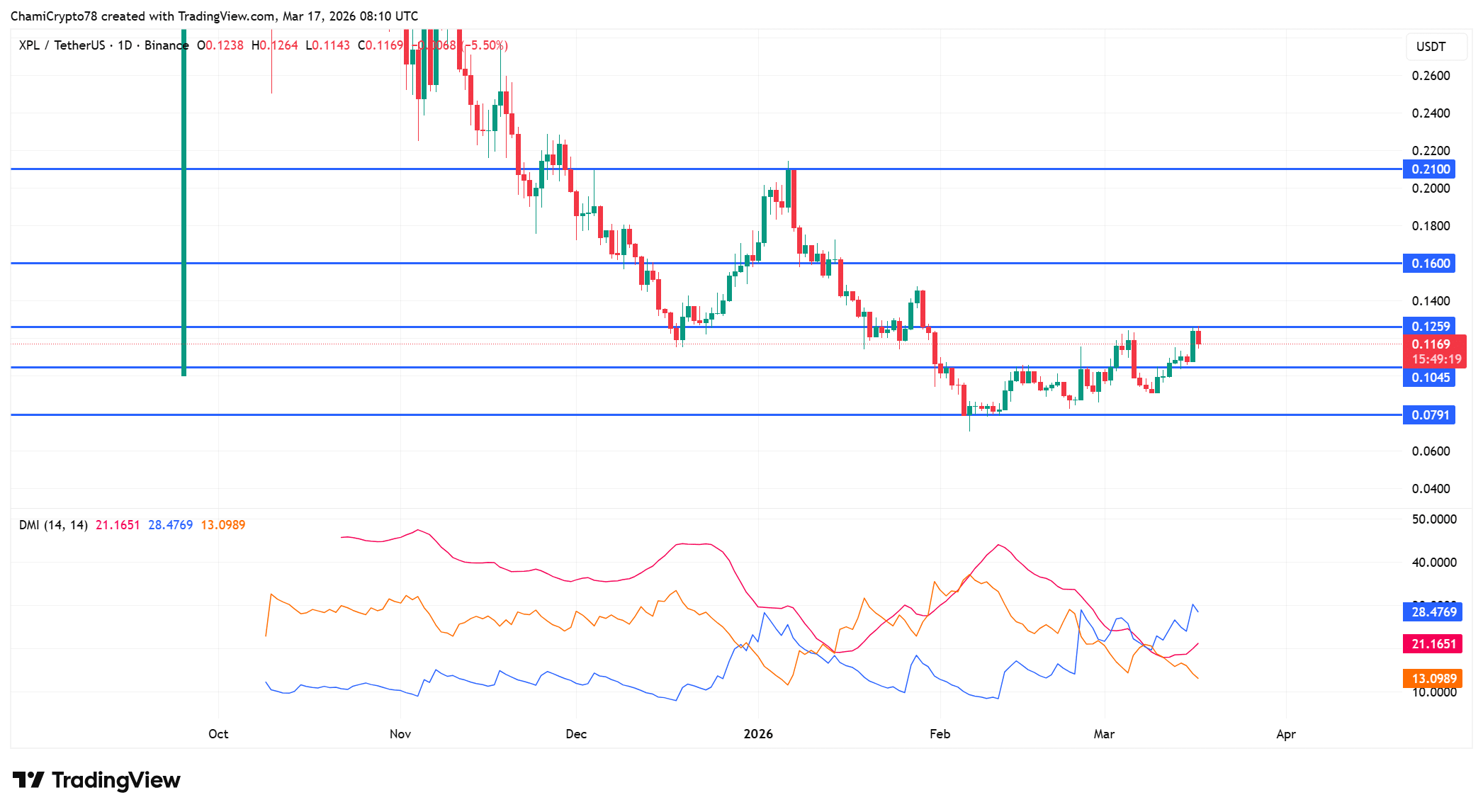
Le prix a repris le niveau de 0,1045 $, qui servait auparavant de base de support solide pendant la consolidation.

Depuis lors, XPL a poussé vers la résistance de 0,1259 $, où un rejet s'est déjà produit.

Cette zone sert désormais de barrière clé qui pourrait définir le prochain mouvement directionnel.

Cependant, la structure montre la formation de plus bas plus hauts, ce qui reflète un renforcement du contrôle des acheteurs. Chaque baisse a attiré la demande, empêchant des retracements plus profonds.

La structure DMI a changé notablement, car la ligne +DI est passée au-dessus de la ligne -DI, signalant que les acheteurs ont commencé à dominer l'action récente des prix.

Dans le même temps, l'ADX a oscillé autour de 21, indiquant que la force de la tendance a commencé à se construire plutôt qu'à s'estomper.

Cet alignement reflète une transition d'une phase neutre vers une tendance directionnelle en développement.

Alors que le prix se comprime sous la résistance, la pression continue de s'accumuler dans cette fourchette.

Un maintien durable au-dessus de 0,1045 $ garde la structure intacte, tandis que des tests répétés de 0,1259 $ augmentent la probabilité d'une rupture.

Cette configuration suggère que XPL se positionne pour un mouvement décisif plutôt que de dériver latéralement.
Source : TradingView

Les sorties des exchanges resserrent l'offre disponible

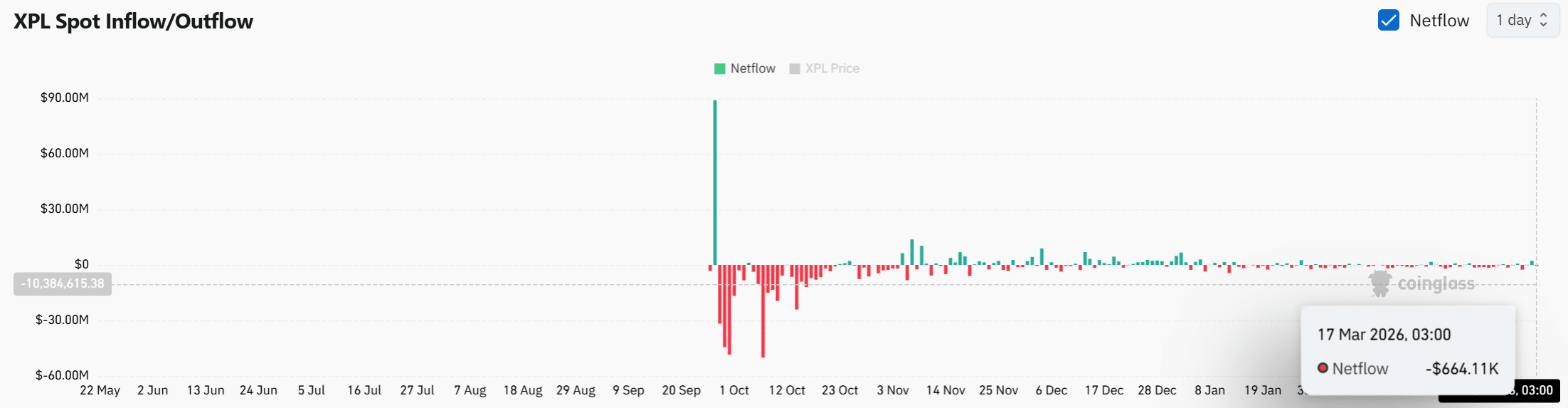
Les flux nets au comptant (Spot Netflows) sont restés négatifs au moment de la rédaction, avec des sorties récentes d'environ 664 000 $ des exchanges.

Ce changement indique que les jetons ont été déplacés des plateformes de trading plutôt que d'être préparés pour une vente immédiate.

Alors que l'offre sur les exchanges diminue, la liquidité disponible se resserre, ce qui peut amplifier les réactions des prix pendant les périodes de forte demande.

De plus, une pression réduite du côté vendeur crée des conditions où les mouvements haussiers rencontrent moins de résistance.

Cependant, cette dynamique dépend également de la poursuite ou non de la demande pour correspondre à l'offre réduite.

Tant que les sorties persistent, la structure du marché soutient un comportement d'accumulation plutôt que de distribution.

Ce modèle renforce le contexte haussier déjà visible dans l'action des prix et les indicateurs techniques.
Source : CoinGlass

Les grappes de liquidité au-dessus du prix signalent une configuration de squeeze

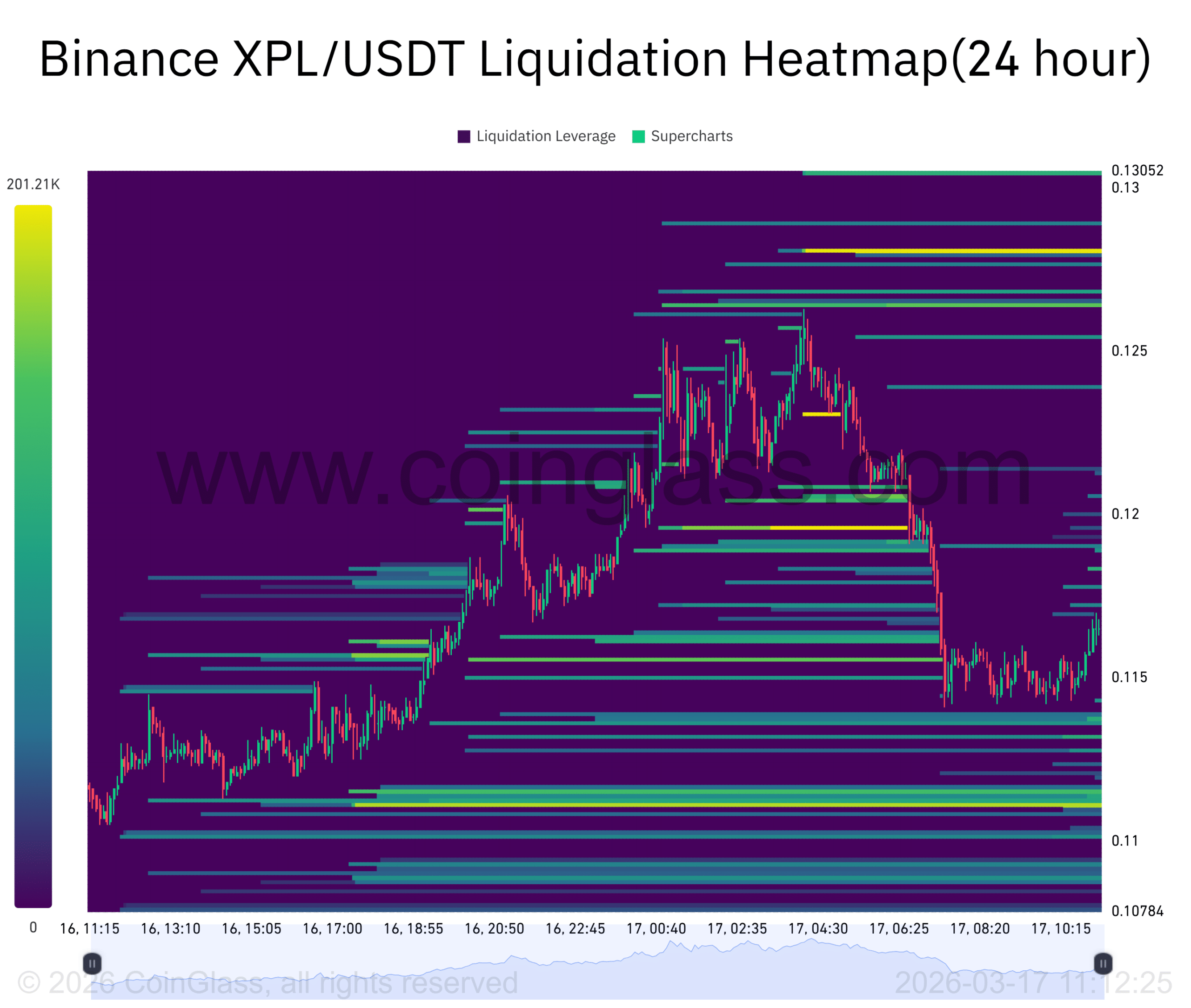
La Carte thermique des liquidations (Liquidation Heatmap) a révélé de denses grappes de liquidité situées au-dessus du prix actuel, en particulier autour de la région des 0,128 $.

Ces zones représentent des zones où les positions courtes pourraient faire face à des fermetures forcées si le prix monte. Alors que XPL approche de ces niveaux, la pression à la hausse pourrait s'accélérer en raison de liquidations en cascade.

Cependant, le prix doit d'abord franchir la résistance proche pour déclencher cet effet.

La présence de liquidité empilée au-dessus des niveaux actuels crée un effet d'aimant, attirant le prix vers ces zones.
Source : CoinGlass

XPL semble se positionner pour une continuation alors que le renforcement de la structure, la demande croissante et le resserrement de l'offre s'alignent avec la pression haussière.

Un mouvement décisif au-dessus de 0,1259 $ débloquerait probablement la liquidité autour de 0,128 $, accélérant la hausse.

Cependant, une force soutenue dépend du maintien du support à 0,1045 $. Tant que les acheteurs défendent cette base, la configuration actuelle favorise une expansion supplémentaire à la hausse.


Résumé final

  • La structure de XPL montre que les acheteurs interviennent tôt, construisant une pression qui pourrait conduire à une continuation au-delà des niveaux de résistance proches.
  • La liquidité située au-dessus du prix de Plasma [XPL] crée une voie pour une expansion rapide à la hausse si la force haussière reste soutenue.


Trending Cryptos

Related Questions

QQuel a été le pourcentage d'augmentation du prix de Plasma (XPL) le 17 mars et à quel prix s'est-il négocié ?

ALe 17 mars, Plasma (XPL) a augmenté de 12,89 % pour atteindre un prix de 0,1238 $.

QQuel est le niveau de résistance clé que XPL doit surmonter pour confirmer une poursuite de la tendance haussière ?

ALe niveau de résistance clé que XPL doit surmonter est de 0,1259 $.

QQue signifient les flux nets négatifs (Netflows) observés sur les exchanges pour le token XPL ?

ALes flux nets négatifs signifient que les jetons quittent les plateformes d'échange, ce qui indique une accumulation et une réduction de la pression de vente immédiate.

QSelon la Carte de Chaleur des Liquidations (Liquidation Heatmap), où se situe un important cluster de liquidations qui pourrait amplifier une hausse des prix ?

AUn important cluster de liquidations se situe autour de la région de 0,128 $, ce qui pourrait créer un effet d'accélération haussière si le prix atteint ce niveau.

QQuel est le niveau de support crucial que le prix de XPL doit maintenir pour que la structure haussière reste intacte ?

ALe niveau de support crucial que XPL doit maintenir est de 0,1045 $.

Related Reads

The Hunter Becomes the Hunted: The Most Profitable MEV Bot Gets Hacked

A well-known and highly profitable Ethereum MEV Bot, Jaredfromsubway.eth, suffered a sophisticated on-chain attack this Saturday, losing over $7.5 million. Analysis by Blockaid and others reveals this was not a conventional phishing or smart contract exploit, but a targeted "counter-MEV honeypot attack." The attacker meticulously laid a trap over several weeks, deploying 66 fake token contracts and liquidity pools disguised as major assets like WETH and USDC. These pools created the illusion of arbitrage opportunities. The MEV Bot's automated system detected these signals, executed trades, and in the process, granted approval permissions to attacker-controlled contracts. These approvals were not revoked, creating a persistent vulnerability. The attacker then exploited this in a single transaction, draining the bot's ETH, USDC, and USDT holdings. Jaredfromsubway.eth is notorious as one of Ethereum's most active and profitable MEV Bots, primarily known for executing "sandwich attacks" to profit from transaction slippage. Estimates suggest it has earned tens of millions in MEV revenue. The incident highlights escalating crypto security threats, demonstrating that even top-tier automated "predators" are vulnerable to novel, logic-based attacks designed to exploit their own operational rules. Following the hack, an unverified X account impersonating Jaredfromsubway.eth emerged, falsely offering a bounty for the return of funds, prompting developer warnings for users to stay vigilant.

marsbit33m ago

The Hunter Becomes the Hunted: The Most Profitable MEV Bot Gets Hacked

marsbit33m ago

The Reality of Payments in Latin America Is Not What You Think

The payment landscape in Latin America is undergoing a fundamental shift, driven by on-the-ground realities that challenge common perceptions. Based on over 500 hours of field research across the region, key insights emerge. Firstly, QR code payments, like Brazil's Pix, are becoming the dominant payment method in most emerging markets, overtaking cards. However, these domestic instant payment systems lack international interoperability, creating a significant gap for cross-border users. Secondly, the narrative around crypto cards is often misunderstood; their primary volume comes from high-net-worth professionals using them for salary conversions (e.g., USDT to local currency via Pix), not retail micro-payments. Competition in payments is shifting from customer acquisition to controlling the settlement layer, leading fintechs to acquire banking licenses for efficiency. Thirdly, treating "Latin America" as a single market is a mistake. Countries like Argentina, Brazil, and Mexico have distinct economic realities, user segments, and regulatory approaches. Brazil alone has at least five distinct user segments with different financial flows. Overlooked markets like Guatemala, Honduras, and El Salvador (the "forgotten five") offer high remittance volumes with lower competitive density. Finally, regulation in Latin America is often ahead of the US, with clearer frameworks for digital assets and a pragmatic approach from regulators focused on safety rather than obstruction. The margin on stablecoin forex is rapidly compressing toward zero, meaning future winners will be those building value-added services on top of the infrastructure, not just the cheapest exchange.

marsbit48m ago

The Reality of Payments in Latin America Is Not What You Think

marsbit48m ago

Making Music in a Bear Market: The Survival Experiment of a Bitcoin Band

"Orange Pill Jam: A Bitcoin Band's Survival in the Bear Market" Orange Pill Jam is a musical group exploring themes of financial sovereignty and privacy, born from the Bitcoin community. Formed after singer Mermaid performed her song "Dollar Apocalypse" at a 2022 conference, the band creates music intended for both Bitcoin enthusiasts and general audiences. Their creative process involves Mermaid writing lyrics and melodies, which producer/multi-instrumentalist Michi then shapes with a precise, rhythm-focused approach, often demanding numerous retakes to achieve his unique standard of timing. Their songs, like "Cypherpunks' Manifesto" and "Fire of Freedom," tackle concepts of digital privacy, the pitfalls of "free" services, and personal sovereignty, influenced by experiences in places like El Salvador. Despite operating in a crypto bear market with a Copyleft model (offering music for free sharing/remixing and accepting optional Bitcoin donations), they face practical challenges. Their growth is slow on platforms like YouTube and Spotify, which aren't optimized for their niche content. The band also navigates the rise of AI-generated music. While acknowledging AI's efficiency for certain tasks, they believe human creativity occupies a unique space that algorithms cannot replicate—the ability to create new genres and capture intangible rhythmic feeling. For Orange Pill Jam, the core argument for both Bitcoin in a downturn and human artistry in the AI age lies in this irreplaceable, intentional, and imperfectly human creative process. Their project persists as an anti-algorithm experiment, valuing the unquantifiable impact of music over scalable metrics.

marsbit54m ago

Making Music in a Bear Market: The Survival Experiment of a Bitcoin Band

marsbit54m ago

Trading

Spot
Futures

Hot Articles

What is PLASMA

Plasma: A Cutting-Edge Solution for Blockchain Scalability Introduction to Plasma As the cryptocurrency landscape evolves, there is an increasing need for enhanced efficiency within blockchain networks. Plasma, a Layer 2 scaling solution, emerges as a pioneering player in this area, particularly in the sphere of Web3 development. By strategically shifting a significant portion of tasks from the main chain to a series of smaller chains, Plasma aims to significantly enhance the scalability and performance of Ethereum—a widely-used blockchain platform that is at the forefront of decentralised applications. What is Plasma? Plasma is an innovative off-chain scaling solution specifically designed for the Ethereum blockchain. It was introduced in August 2017 by Vitalik Buterin, co-founder of Ethereum, and Joseph Poon, a prominent advocate of scaling solutions like the Lightning Network. Plasma serves as a framework that enables the creation of scalable applications by establishing a hierarchical structure of child chains that sit above the main Ethereum chain. At its core, Plasma facilitates the development of potentially unlimited side chains that can operate independently while still relying on the Ethereum network for security and consensus. This architecture is supported by smart contracts and Merkle Trees, which efficiently manage transactions and data storage. Core Objectives of Plasma The primary goal of Plasma is to increase the throughput of the Ethereum network. By diverting a significant volume of transactions away from the congested main chain, Plasma's architecture offers higher transaction speeds, more efficient data processing, and lower transaction costs. This is particularly crucial in an age where the demand for decentralised applications—especially in finance, gaming, and supply chain management—is reaching unprecedented levels. Creator of Plasma Plasma is the brainchild of two renowned figures in the blockchain community: Vitalik Buterin and Joseph Poon. Buterin is celebrated primarily for co-founding Ethereum and pushing the boundaries of what blockchain technology can achieve. Poon, on the other hand, is known for advocating scalable solutions that enable faster and more cost-effective transactions on blockchain networks. Their collaboration on the Plasma framework has significantly contributed to its innovative nature, merging advanced technical insights with practical applications. Investors of Plasma While the specific investment foundations or organisations supporting Plasma remain undisclosed, the project has attracted interest from various prominent figures and players in the blockchain and cryptocurrency space. With its potential for enhancing scalability within Ethereum, it has captured the attention of various entities aiming to push the boundaries of blockchain technology. How Does Plasma Work? Plasma's unique functionality stems from its architectural framework that relies on child chains and their interaction with the main Ethereum network. Below are some key factors that contribute to Plasma's innovative approach: Child Chains: Plasma establishes numerous child chains that can execute transactions independently of the main Ethereum chain. Each child chain operates as a separate smart contract with unique features, allowing developers to create tailored solutions based on their specific requirements. Smart Contracts and Merkle Trees: The framework utilises smart contracts, which are self-executing agreements with predefined conditions, combined with Merkle Trees that enable efficient verification of data. This technology allows Plasma to achieve both high scalability and security. Transaction Compression: By batching transactions on the child chains, Plasma reduces the data load on the Ethereum network. This implies that fewer transactions need to be recorded on the main chain—thereby freeing up space and alleviating congestion. Enhanced Security: Despite being off-chain, Plasma leverages the security measures of the main Ethereum network, ensuring that all transactions on child chains maintain a high level of integrity and security. Timeline of Plasma Understanding the development of Plasma involves tracing its significant milestones: August 2017: Plasma was first introduced by Vitalik Buterin and Joseph Poon as a scalable solution to address Ethereum's performance challenges. 2018: The Plasma framework was officially developed and made available on GitHub, marking a crucial step towards its implementation in practical applications. 2019: As awareness about Plasma grew, it began to attract developers interested in scaling Ethereum applications, thus increasing its adoption. 2020: Plasma continued evolving, with substantial enhancements made to its architecture and functionality—making it even more appealing to developers. Key Features of Plasma Plasma boasts several characteristics that position it as a transformative solution in the blockchain space: Scalability: By creating multiple child chains, Plasma can handle a higher volume of transactions without placing further strain on the main Ethereum chain. Speed: Each child chain can process transactions more rapidly, providing users with a better experience and service. Lower Transaction Costs: Plasma's structure effectively reduces the costs associated with transactions by minimising the burden on the main chain. Interoperability: The architecture allows Plasma to seamlessly interact with multiple blockchains, enhancing cross-network functionality. Security: By harnessing the security of Ethereum’s main chain, Plasma ensures the integrity of its operations while using its child chains. Use Cases for Plasma The innovative architecture of Plasma opens the door for various practical applications across different sectors: Decentralised Finance (DeFi): Plasma has the capacity to enhance the scalability and efficiency of DeFi applications, creating smoother and more effective trading processes. Gaming: The framework facilitates the development of quick and cost-efficient gaming experiences, making it appealing to developers in the gaming industry. Supply Chain Management: With the ability to achieve efficient transaction processing, Plasma can promote the development of decentralised supply chain management solutions. Conclusion Plasma stands at the forefront of blockchain technology, positioned as a pivotal Layer 2 scaling solution aimed at enhancing the efficiency of the Ethereum network and beyond. Through its unique structure of child chains, smart contracts, and Merkle Trees, Plasma presents a compelling solution to the scalability crisis that has long plagued blockchain networks. As blockchain technology continues to advance, solutions like Plasma promise to reshape how developers approach scalability challenges, potentially revolutionising how decentralised applications function. The ongoing efforts by its creators and the interest of various stakeholders indicate a bright future for Plasma as it seeks to elevate blockchain capabilities to new heights in the digital realm.

187 Total ViewsPublished 2024.12.03Updated 2024.12.03

What is PLASMA

Discussions

Welcome to the HTX Community. Here, you can stay informed about the latest platform developments and gain access to professional market insights. Users' opinions on the price of XPL (XPL) are presented below.

活动图片