Plasma暴涨12% – XPL能否突破这一阻力位?

ambcryptoPublished on 2026-03-17Last updated on 2026-03-18

Abstract

3月17日,Plasma(XPL)价格大幅上涨12.89%,达到$0.1238,同时交易量激增超过155%,显示市场参与度显著提升。该代币已从近期低点反弹,买家在最新交易时段积极入场,表明市场兴趣在长期冷却后重新回归。 价格已重新站上$0.1045的关键支撑位,并正测试$0.1259的阻力区域。技术指标显示,+DI线已上穿-DI线,表明买方力量增强,ADX指标约为21,反映趋势强度正在积累。 交易所出现净流出约66.4万美元,表明代币正被提离交易平台,流通供应收紧,这可能放大价格上涨动力。此外,清算热图显示在$0.128附近存在密集流动性区域,若价格突破阻力,可能引发空头清算,加速上涨。 整体来看,XPL目前处于关键阶段。若能站稳$0.1045支撑并突破$0.1259阻力,则有望进一步上行至$0.128区域。市场结构、需求增强和供应紧缩共同支撑看涨预期。

3月17日,Plasma [XPL] 暴涨12.89%至0.1238美元,同时交易量飙升超过155%,反映出市场参与度急剧上升。

该代币已从近期低点反弹,买家在最近交易时段积极介入。这一动向表明,在经历长时间的冷却期后,市场兴趣已经回归。

然而,这轮上涨并非孤立事件,市场结构和流动性动态已开始与上行趋势保持一致。

活动的扩张表明交易者正在重新布局而非退出市场。

因此,这一转变使XPL进入关键阶段,其持续走势将取决于价格如何与附近阻力区域及潜在需求强度相互作用。

XPL能否守住支撑并挑战阻力?

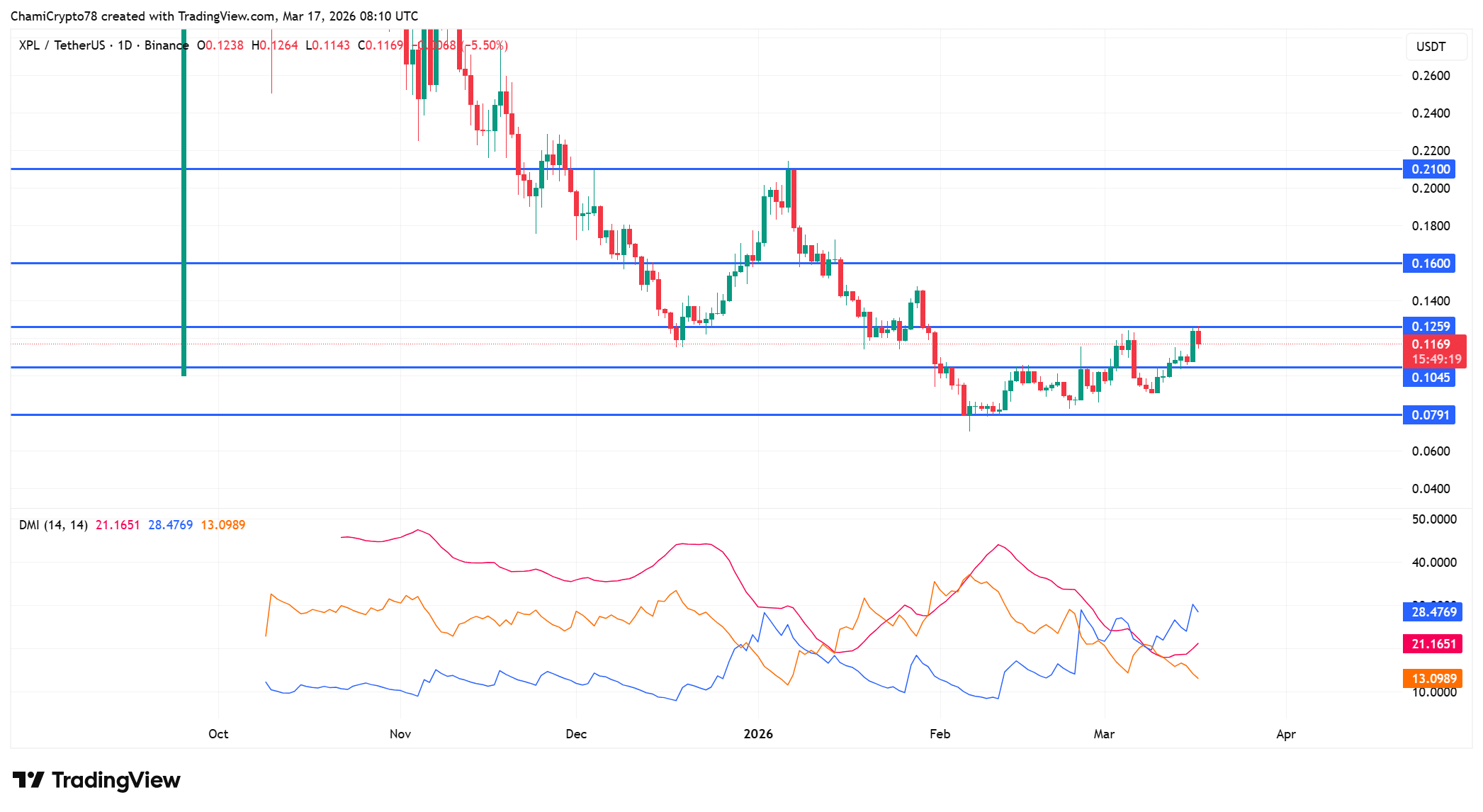
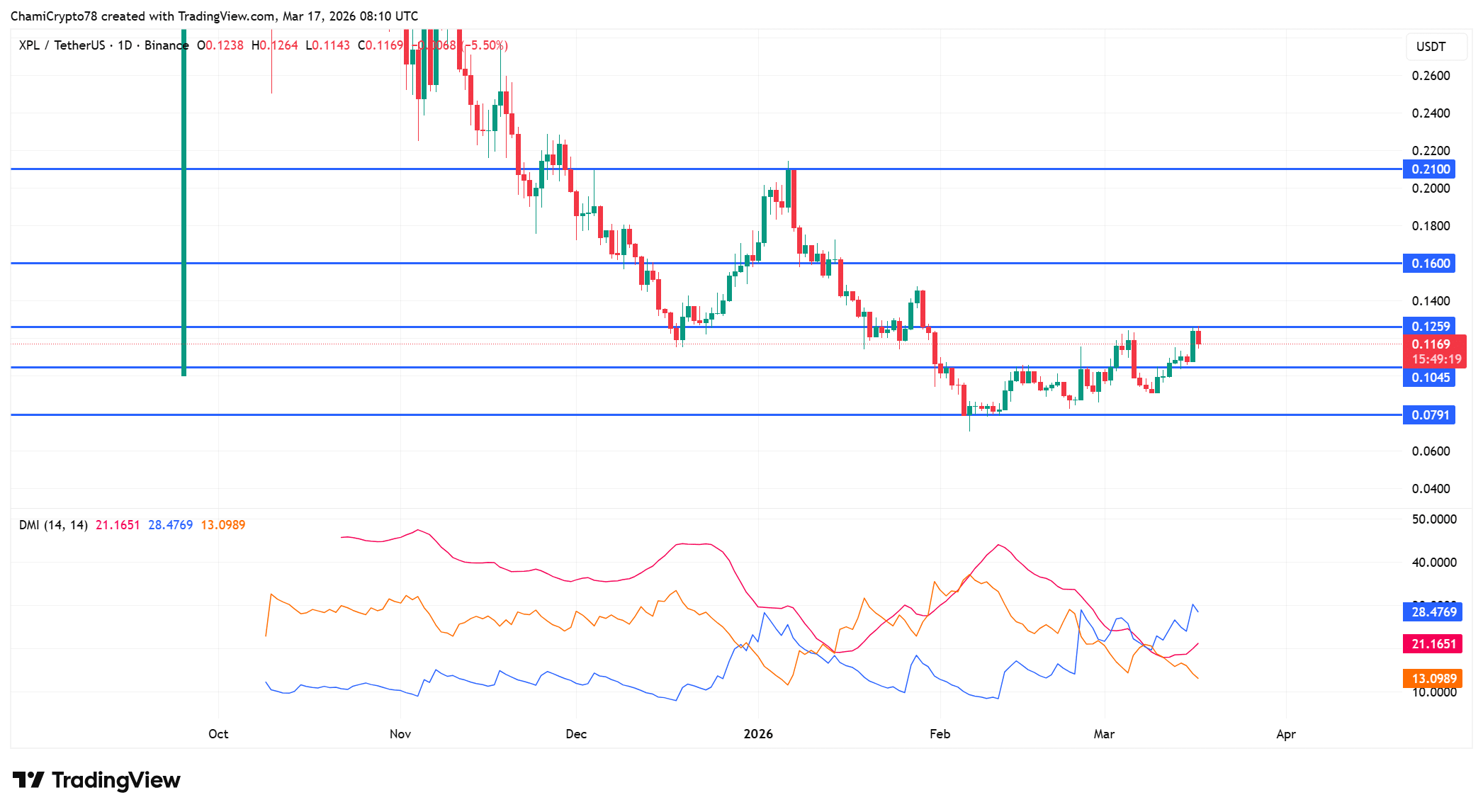
价格已重新站上0.1045美元水平,该位置此前在盘整期间曾是强力支撑基础。

此后XPL推升至0.1259美元阻力位,该位置此前曾出现抛压。

该区域现成为决定后续方向性走势的关键屏障。

但市场结构显示更高的低点正在形成,反映出买方控制力增强。每次回调都吸引需求,阻止了更深度的回撤。

DMI指标结构显著变化,+DI线已上穿-DI线,表明买家开始主导近期价格走势。

同时ADX指标徘徊在21附近,显示趋势强度正在积累而非消退。

这种协调态势反映出市场正从中性阶段向发展的方向性趋势过渡。

随着价格在阻力位下方收敛,该区间内的压力持续积聚。

若能持续维持在0.1045美元上方,则结构保持完整,而对0.1259美元的反复测试将增加突破概率。

这种形态表明XPL正在为决定性走势做准备,而非横向盘整。

来源:TradingView

交易所流出收紧可用供应

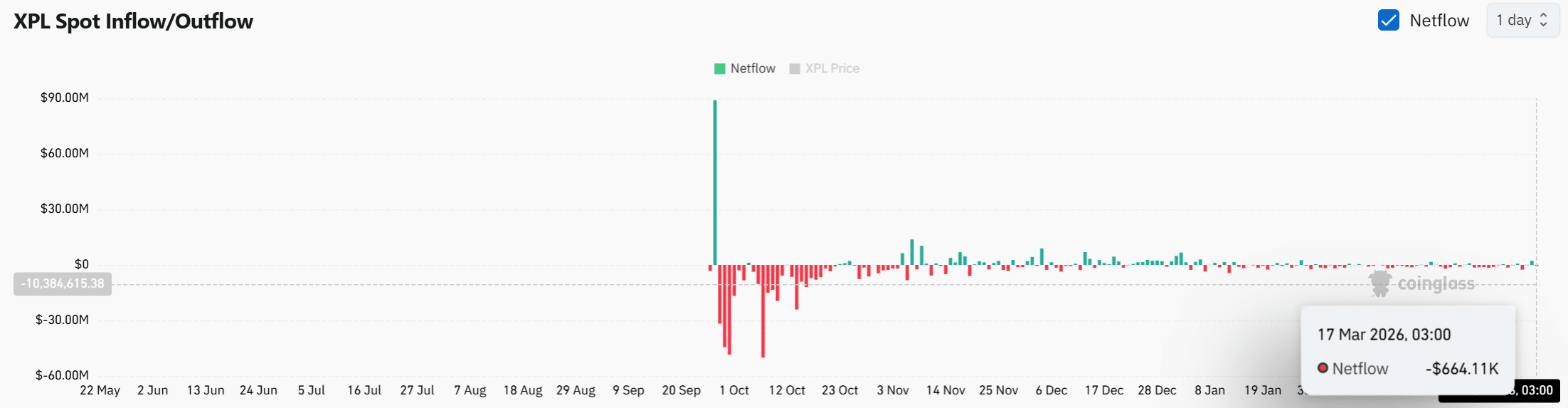
现货净流量在发布时仍为负值,近期从交易所流出约66.4万美元。

这一转变表明代币正转移出交易平台,而非为立即抛售做准备。

随着交易所供应减少,可用流动性收紧,这可能在需求旺盛时期放大价格反应。

此外,卖压减轻创造了上行运动阻力更小的环境。

但这种动态还取决于需求是否能持续匹配减少的供应。

只要流出持续,市场结构支持积累行为而非派发行为。

这种模式强化了价格走势和技术指标中已显现的看涨背景。

来源:CoinGlass

价格上方的流动性集群预示轧空布局

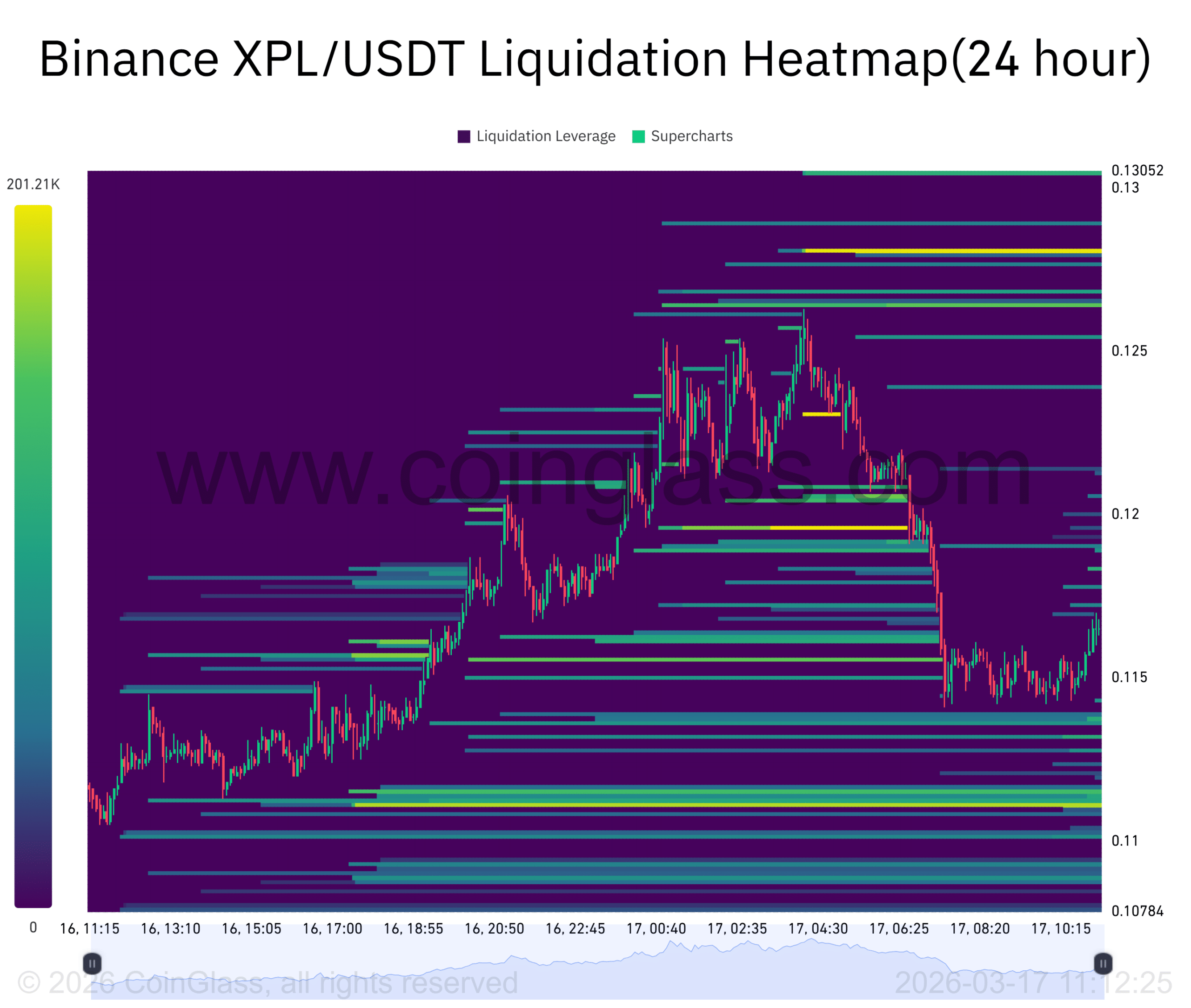
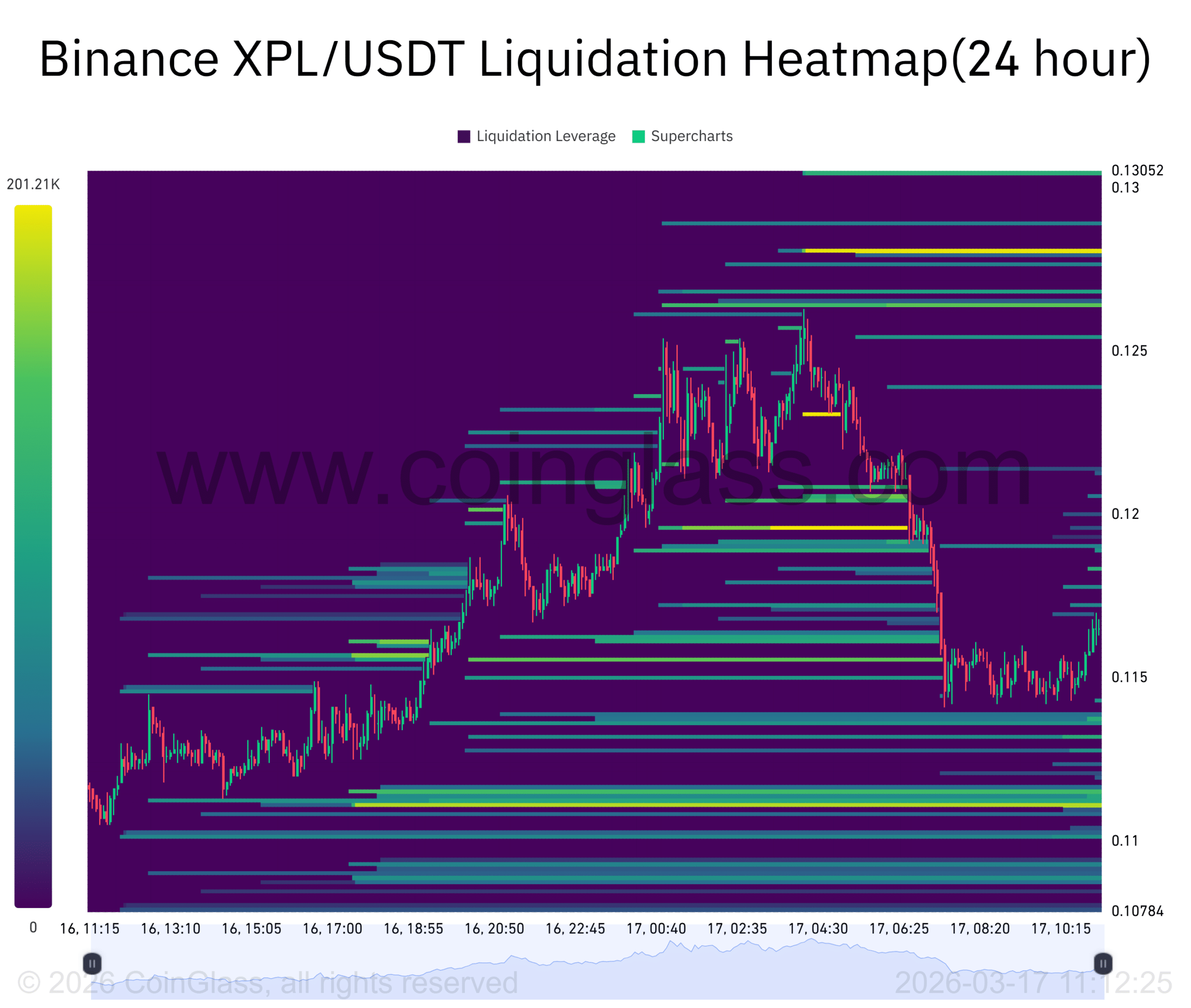
清算热力图显示密集的流动性集群位于当前价格上方,特别是在0.128美元区域附近。

这些区域代表若价格继续上涨,空头头寸可能面临强制平仓。随着XPL接近这些水平,由于连锁清算效应,上行压力可能加速。

但价格必须首先突破附近阻力才能触发这种效应。

当前水平上方堆叠的流动性产生磁吸效应,将价格吸引至这些区域。

来源:CoinGlass

XPL似乎为延续涨势做好准备,不断增强的结构、上升的需求与收紧的供应共同形成了看涨压力。

若果断突破0.1259美元,很可能释放0.128美元附近的流动性,加速上涨行情。

但持续走强取决于能否守住0.1045美元支撑位。只要买家守住该基础,当前形态支持进一步向上扩张。

最终总结

  • XPL结构显示买家提前介入,积聚的压力可能推动价格突破附近阻力位
  • Plasma [XPL]价格上方的流动性为快速上行扩张创造了条件——只要看涨力量在此持续

Trending Cryptos

Related Questions

QPlasma (XPL) 在3月17日的价格涨幅和交易量变化分别是多少?

APlasma (XPL) 在3月17日上涨了12.89%,价格达到$0.1238,同时交易量增长了超过155%。

QXPL当前面临的关键阻力位是什么?

AXPL当前面临的关键阻力位是$0.1259,这是一个之前曾出现价格回落的区域。

Q根据DMI指标,XPL的市场趋势发生了什么变化?

ADMI指标显示,+DI线已经上穿-DI线,表明买家开始主导近期的价格走势,同时ADX值约为21,说明趋势强度正在增强。

Q交易所的净流出数据说明了什么?

A交易所的净流出为负值,约有66.4万美元的XPL从交易所流出,这表明代币正在被转移出交易平台,减少了即时卖压,可能支持价格进一步上涨。

Q流动性热图显示的上方密集清算区域在什么位置?这对XPL价格可能产生什么影响?

A流动性热图显示,在$0.128附近存在密集的流动性集群,如果XPL价格突破当前阻力并接近该区域,可能引发空头头寸的强制平仓,从而加速价格上涨。

Related Reads

Vitalik's Algorithmic Stablecoin Vision: Interpreting the Mechanism and Challenges from an Options Perspective

Vitalik Buterin's recent algorithmic stablecoin proposal envisions using an option-like mechanism to create a stablecoin without the liquidation risks inherent in traditional collateralized debt position (CDP) models. The design splits one unit of ETH into two components: a 'stable' leg (P) that maintains value up to a certain strike price, and an 'upside' leg (N) that captures any appreciation above that price. Together, they always sum to one ETH, eliminating the need for debt or liquidation mechanisms. From an options perspective, the stable leg essentially functions as a synthetic, covered call position. However, significant challenges exist. For the stable asset to maintain its peg, it must continuously roll deep in-the-money call options, leading to potential rollover slippage, predictable trading paths vulnerable to front-running, and liquidity issues. Crucially, the system's scalability depends on a constant demand for the upside leg—a form of leveraged ETH long position without funding rates or liquidation risk. It's unclear if such persistent, specific demand will materialize from speculators or market makers who have simpler alternatives like perpetual swaps. The author, drawing from experience with Rysk, argues that DeFi options have struggled as standalone trading products due to complexity and fragmented liquidity. Their potential lies instead as foundational infrastructure underpinning more complex financial primitives like stablecoins, structured yields, or index products—transforming from a direct product into a core pricing and risk distribution engine for the next generation of on-chain finance.

marsbit1h ago

Vitalik's Algorithmic Stablecoin Vision: Interpreting the Mechanism and Challenges from an Options Perspective

marsbit1h ago

GPT-5.6 Countdown: Abandon the Illusion of a Single API, Computational Iteration Can't Outpace a Single Page of Compliance

In mid-June, three seemingly independent industry events—the compliance-driven throttling of Fable 5, the open-sourcing of GLM-5.2, and the leaked release timeline for GPT-5.6—are pushing the global AI industry toward a watershed moment. These shifts signal a fundamental restructuring of the industry's underlying logic. First, **"usability" has substantially overtaken "advanced capabilities"** as the primary weight, pushing the global large language model (LLM) supply chain into a "dual-track" phase of controlled closed-source and local open-source coexistence. Second, **the competitive moats of closed-source giants are shifting**. Their technical focus is moving from "language intelligence" toward "spatial intelligence (world models)"—a domain heavily reliant on computing power. Third, faced with常态化 transnational compliance risks, **a "model-agnostic" decoupled design has become a survival necessity for application-layer developers to maintain business continuity.** The article details how Anthropic's Fable 5, despite its advanced engineering feats, was restricted for non-U.S. citizens within 72 hours of launch, highlighting how geopolitical compliance can instantly limit even the most advanced models. In response, the open-source camp, exemplified by Zhipu AI's MIT-licensed GLM-5.2, is gaining market share by offering stable performance improvements and significant cost advantages (up to 70% savings for enterprises), while achieving full adaptation with domestic semiconductor platforms. Meanwhile, closed-source leaders like OpenAI are pivoting. The anticipated GPT-5.6 reportedly shifts focus from language to spatial intelligence and world models, aiming to rebuild a generational gap in areas like 3D understanding, simulation, and industrial design that demand immense compute. The core conclusion is that the LLM supply chain's logic has changed. Enterprises must now evaluate infrastructure based on a composite of technical performance and policy compliance. For developers, complete reliance on a single closed-source API poses unacceptable risk. Implementing a truly model-agnostic architecture—enabling swift switches to compliant, locally deployable open-source alternatives—is no longer just good practice but a fundamental baseline for business continuity.

marsbit3h ago

GPT-5.6 Countdown: Abandon the Illusion of a Single API, Computational Iteration Can't Outpace a Single Page of Compliance

marsbit3h ago

Is the 'Token Subsidy War' Among AI Giants Almost Over?

The article discusses the ongoing "token subsidy war" among AI giants like OpenAI and Anthropic, questioning whether it's nearing its end. It reveals that current AI subscription prices are heavily subsidized, with some plans offering tokens at up to 70 times the actual cost to attract and retain heavy users, especially developers and enterprises. This strategy mirrors past internet-era subsidy battles, but with a key difference: AI tokens lack "lock-in" effects. Unlike ride-hailing or food delivery apps, users can easily switch between AI providers as APIs become standardized, making it difficult for companies to raise prices post-subsidy. The piece highlights a structural asymmetry in the competition. Giants like Google, with massive advertising revenue, can afford to subsidize tokens indefinitely, akin to using "tokens as a weapon." In contrast, venture-backed companies like OpenAI and Anthropic face pressure to become profitable, especially as they approach IPO. The article cites Google Ventures founder Bill Maris, who suggests Google could slash token prices by 80%, putting immense pressure on competitors. Two potential endgames are presented: the "internet service" model (subsidize, monopolize, then raise prices) and the "utility" model (tokens become a standardized, low-margin commodity like electricity). Given the low switching costs, the latter seems more likely. The competition may not have a single winner but could instead accelerate AI's evolution into a foundational, infrastructure-level technology, akin to a public utility. For now, users continue to benefit from heavily subsidized token costs.

marsbit4h ago

Is the 'Token Subsidy War' Among AI Giants Almost Over?

marsbit4h ago

Trading

Spot
Futures

Hot Articles

What is PLASMA

Plasma: A Cutting-Edge Solution for Blockchain Scalability Introduction to Plasma As the cryptocurrency landscape evolves, there is an increasing need for enhanced efficiency within blockchain networks. Plasma, a Layer 2 scaling solution, emerges as a pioneering player in this area, particularly in the sphere of Web3 development. By strategically shifting a significant portion of tasks from the main chain to a series of smaller chains, Plasma aims to significantly enhance the scalability and performance of Ethereum—a widely-used blockchain platform that is at the forefront of decentralised applications. What is Plasma? Plasma is an innovative off-chain scaling solution specifically designed for the Ethereum blockchain. It was introduced in August 2017 by Vitalik Buterin, co-founder of Ethereum, and Joseph Poon, a prominent advocate of scaling solutions like the Lightning Network. Plasma serves as a framework that enables the creation of scalable applications by establishing a hierarchical structure of child chains that sit above the main Ethereum chain. At its core, Plasma facilitates the development of potentially unlimited side chains that can operate independently while still relying on the Ethereum network for security and consensus. This architecture is supported by smart contracts and Merkle Trees, which efficiently manage transactions and data storage. Core Objectives of Plasma The primary goal of Plasma is to increase the throughput of the Ethereum network. By diverting a significant volume of transactions away from the congested main chain, Plasma's architecture offers higher transaction speeds, more efficient data processing, and lower transaction costs. This is particularly crucial in an age where the demand for decentralised applications—especially in finance, gaming, and supply chain management—is reaching unprecedented levels. Creator of Plasma Plasma is the brainchild of two renowned figures in the blockchain community: Vitalik Buterin and Joseph Poon. Buterin is celebrated primarily for co-founding Ethereum and pushing the boundaries of what blockchain technology can achieve. Poon, on the other hand, is known for advocating scalable solutions that enable faster and more cost-effective transactions on blockchain networks. Their collaboration on the Plasma framework has significantly contributed to its innovative nature, merging advanced technical insights with practical applications. Investors of Plasma While the specific investment foundations or organisations supporting Plasma remain undisclosed, the project has attracted interest from various prominent figures and players in the blockchain and cryptocurrency space. With its potential for enhancing scalability within Ethereum, it has captured the attention of various entities aiming to push the boundaries of blockchain technology. How Does Plasma Work? Plasma's unique functionality stems from its architectural framework that relies on child chains and their interaction with the main Ethereum network. Below are some key factors that contribute to Plasma's innovative approach: Child Chains: Plasma establishes numerous child chains that can execute transactions independently of the main Ethereum chain. Each child chain operates as a separate smart contract with unique features, allowing developers to create tailored solutions based on their specific requirements. Smart Contracts and Merkle Trees: The framework utilises smart contracts, which are self-executing agreements with predefined conditions, combined with Merkle Trees that enable efficient verification of data. This technology allows Plasma to achieve both high scalability and security. Transaction Compression: By batching transactions on the child chains, Plasma reduces the data load on the Ethereum network. This implies that fewer transactions need to be recorded on the main chain—thereby freeing up space and alleviating congestion. Enhanced Security: Despite being off-chain, Plasma leverages the security measures of the main Ethereum network, ensuring that all transactions on child chains maintain a high level of integrity and security. Timeline of Plasma Understanding the development of Plasma involves tracing its significant milestones: August 2017: Plasma was first introduced by Vitalik Buterin and Joseph Poon as a scalable solution to address Ethereum's performance challenges. 2018: The Plasma framework was officially developed and made available on GitHub, marking a crucial step towards its implementation in practical applications. 2019: As awareness about Plasma grew, it began to attract developers interested in scaling Ethereum applications, thus increasing its adoption. 2020: Plasma continued evolving, with substantial enhancements made to its architecture and functionality—making it even more appealing to developers. Key Features of Plasma Plasma boasts several characteristics that position it as a transformative solution in the blockchain space: Scalability: By creating multiple child chains, Plasma can handle a higher volume of transactions without placing further strain on the main Ethereum chain. Speed: Each child chain can process transactions more rapidly, providing users with a better experience and service. Lower Transaction Costs: Plasma's structure effectively reduces the costs associated with transactions by minimising the burden on the main chain. Interoperability: The architecture allows Plasma to seamlessly interact with multiple blockchains, enhancing cross-network functionality. Security: By harnessing the security of Ethereum’s main chain, Plasma ensures the integrity of its operations while using its child chains. Use Cases for Plasma The innovative architecture of Plasma opens the door for various practical applications across different sectors: Decentralised Finance (DeFi): Plasma has the capacity to enhance the scalability and efficiency of DeFi applications, creating smoother and more effective trading processes. Gaming: The framework facilitates the development of quick and cost-efficient gaming experiences, making it appealing to developers in the gaming industry. Supply Chain Management: With the ability to achieve efficient transaction processing, Plasma can promote the development of decentralised supply chain management solutions. Conclusion Plasma stands at the forefront of blockchain technology, positioned as a pivotal Layer 2 scaling solution aimed at enhancing the efficiency of the Ethereum network and beyond. Through its unique structure of child chains, smart contracts, and Merkle Trees, Plasma presents a compelling solution to the scalability crisis that has long plagued blockchain networks. As blockchain technology continues to advance, solutions like Plasma promise to reshape how developers approach scalability challenges, potentially revolutionising how decentralised applications function. The ongoing efforts by its creators and the interest of various stakeholders indicate a bright future for Plasma as it seeks to elevate blockchain capabilities to new heights in the digital realm.

187 Total ViewsPublished 2024.12.03Updated 2024.12.03
What is PLASMA

Discussions

Welcome to the HTX Community. Here, you can stay informed about the latest platform developments and gain access to professional market insights. Users' opinions on the price of XPL (XPL) are presented below.

活动图片