Axie Infinity peut-il prolonger sa hausse de 15 % malgré l'activité croissante du réseau AXS ?

ambcryptoPublished on 2026-02-09Last updated on 2026-02-09

Abstract

L'activité sur le réseau Axie Infinity (AXS) a connu une expansion rapide, avec le nombre d'adresses actives ayant presque doublé en 24 heures. Cette hausse soudaine, portée principalement par les gros détenteurs (portefeuilles détenant entre 10 000 et 100 000 AXS), suggère une accumulation plutôt qu'une spéculation à court terme. La concentration de l'activité parmi ces acteurs majeurs indique une confiance accrue dans les niveaux de prix actuels. Au moment de la rédaction, le prix de l'AXS avait déjà enregistré une hausse de plus de 15%. La combinaison de l'augmentation des adresses actives, de la domination des gros porteurs et d'une forte activité commerciale laisse présager une poursuite de la tendance haussière. Un bref repli ou une consolidation ne remettrait pas nécessairement en cause cette dynamique, d'autant plus que l'indicateur Stochastic RSI vient de rebondir depuis une zone de survente. Les signaux on-chain semblent indiquer une intention solide, qui précède souvent une extension de la tendance.

Le nombre d'adresses actives sur le réseau Axie Infinity [AXS] a presque doublé au cours des dernières 24 heures.

La flambée de l'activité de trading, combinée à la concentration de l'offre entre les mains des gros détenteurs, pourrait-elle garantir qu'AXS maintienne son élan haussier ?

Les adresses actives en forte hausse

L'activité du réseau Axie Infinity s'est rapidement développée en peu de temps. Selon les récentes données d'activité de trading de Santiment, le nombre d'adresses actives sur le réseau a presque doublé par rapport au jour précédent.

Il ne s'agit pas d'une augmentation graduelle mais d'un pic soudain. Dans la plupart des cas, de tels mouvements ont tendance à signaler une participation renouvelée. Soit les traders d'AXS reviennent, soit les gros joueurs se repositionnent pour un mouvement plus important.
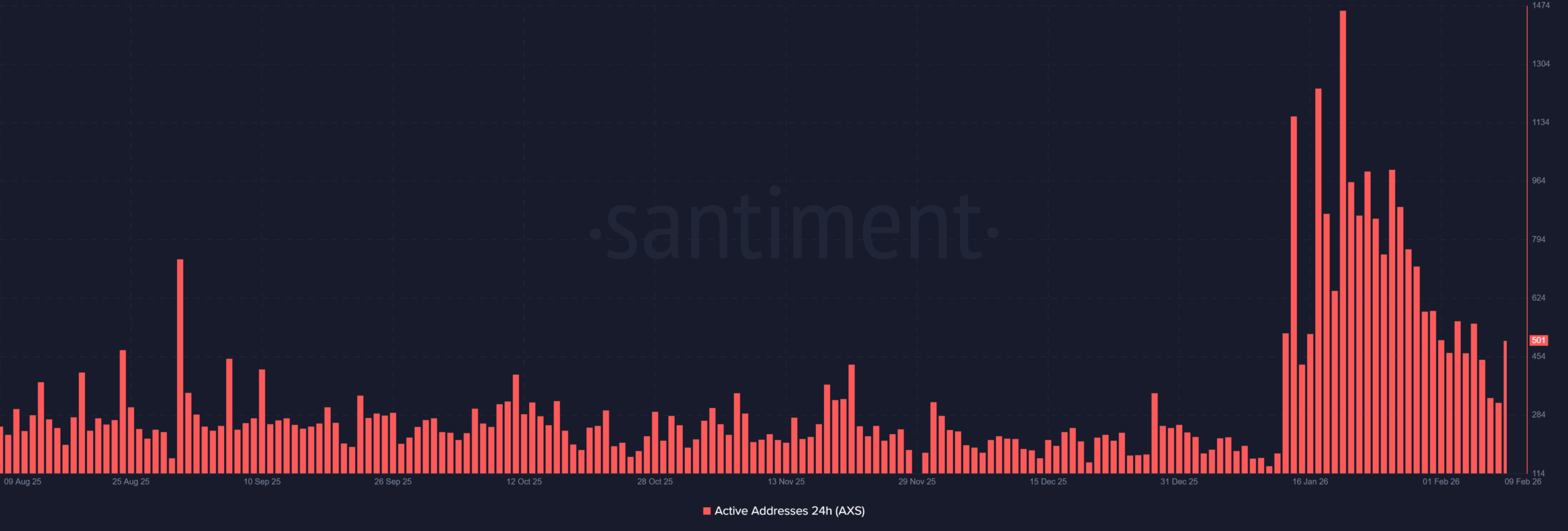
Source : Santiment

Les gros joueurs prennent le contrôle

Malgré la hausse des adresses actives, la distribution de l'offre joue un rôle crucial. Dans le cas d'AXS, la majeure partie de l'activité récente provient de gros détenteurs, les portefeuilles contenant entre 10 000 et 100 000 AXS dominant le volume des échanges.

Cela dit, une continuation haussière explosive plus importante est plus que probable. Habituellement, lorsque les gros joueurs stimulent la croissance des adresses, cela signale une accumulation plutôt qu'une spéculation. Ces participants ont tendance à agir avec intention, et ils poursuivent rarement le bruit à court terme.

La domination des gros joueurs suggère une confiance accrue dans les niveaux de prix actuels d'AXS.

La hausse peut-elle se poursuivre ?

Au moment de la rédaction, les prix d'AXS ont gagné plus de 15 %, mais des replis à court terme restent possibles.

Cependant, la combinaison de l'explosion des adresses actives, de la domination des gros détenteurs et d'une forte activité de trading indique une continuation de la tendance haussière.

Si les gros joueurs continuent de diriger l'activité du réseau, l'élan pourrait se poursuivre. Une brève consolidation n'affaiblirait pas nécessairement la tendance. D'autant plus que le RSI stochastique du token vient de rebondir depuis une zone de survente.

Pour l'instant, Axie Infinity semble soutenu par plus que le simple mouvement des prix. Les signaux on-chain suggèrent une intention. Et l'intention précède souvent l'extension.


Réflexions finales

  • Les adresses actives d'AXS ont presque doublé en 24 heures.
  • Les gros détenteurs ont dominé l'activité du marché alors que les prix d'AXS affichaient une hausse quotidienne de 15 %.


Related Questions

QQu'est-ce qui a presque doublé sur le réseau Axie Infinity au cours des dernières 24 heures ?

ALe nombre d'adresses actives sur le réseau Axie Infinity a presque doublé au cours des dernières 24 heures.

QQuel type de portefeuilles a dominé le volume d'échanges récent d'AXS ?

ALes portefeuilles contenant entre 10 000 et 100 000 AXS ont dominé le volume d'échanges récent.

QDe combien le prix d'AXS a-t-il augmenté au moment de la rédaction de l'article ?

AAu moment de la rédaction de l'article, le prix d'AXS avait gagné plus de 15%.

QQue suggère la domination des grands détenteurs sur le marché d'AXS ?

ALa domination des grands détenteurs suggère une confiance accrue dans les niveaux de prix actuels d'AXS et signale une accumulation plutôt qu'une spéculation.

QQuel indicateur technique vient de rebondir après une zone de survente ?

ALe Stochastic RSI du jeton vient de rebondir après une zone de survente.

Related Reads

Behind HYPE's Repeated Record Highs, the 'Minions' in the Ecosystem Can't Keep Up

While HYPE, the native token of the Hyperliquid ecosystem, surges to new all-time highs above $76 and attracts significant institutional ETF inflows, a starkly different reality unfolds within its HyperEVM application layer. Multiple core DeFi protocols across lending, NFTs, stablecoins, and DEXs have announced shutdowns between May and June. The article argues HYPE functions more like an "application stock" than a traditional ecosystem token. Its value is anchored to the trading fees from Hyperliquid's core perpetual contracts platform (HyperCore), which boasts a diversified revenue stream from crypto, commodities, and indices. Approximately 97% of protocol fees fund buybacks and burns of HYPE. This means HYPE's price is largely decoupled from the health of projects built on HyperEVM. The closures of significant projects like lending protocol HypurrFi (peak TVL >$300M) and NFT marketplace Drip.Trade highlight a structural tension. Hyperliquid's minimalist philosophy offers infrastructure without official grants, liquidity support, or marketing coordination for HyperEVM projects. This forces protocols into a fiercely competitive environment from day one. Furthermore, the success of HyperCore creates a liquidity vacuum, and mechanisms like HIP-3 (allowing direct perpetual market deployment) divert user attention and capital away from application-layer projects. The stronger the core perpetual trading business becomes, the more difficult it is for peripheral "DeFi lego" projects to survive and capture value, despite the flagship token's rising price.

Foresight News3m ago

Behind HYPE's Repeated Record Highs, the 'Minions' in the Ecosystem Can't Keep Up

Foresight News3m ago

Conversation with Arthur Hayes: AI Has Drained Market Liquidity, BTC Will Be Below 100k by Year-End

In this June 2026 podcast interview, BitMEX co-founder Arthur Hayes explains his decision to sell his major crypto holdings (HYPE, NEAR, Worldcoin, Zcash). His rationale is based on a macro view linking oil prices, the Iran conflict, US politics, and an impending AI bubble burst. Hayes argues that high oil prices, driven by the ongoing war, will pressure domestic US inflation. To salvage the Republican Party's chances in the midterm elections, he believes Donald Trump may pivot to a populist, anti-AI stance—advocating for taxes and regulation—which would deflate the AI investment narrative. He sees the AI sector, particularly massive capital expenditure on data centers, as having absorbed nearly all excess market liquidity (around $1.5 trillion in debt issuance since 2025), starving other assets like Bitcoin. He highlights the upcoming SpaceX IPO at a ~$1.8 trillion valuation and 100x price-to-sales ratio as a potential tipping point. If these hyped IPOs underperform, it could shatter market confidence in AI. In such a scenario, all risk assets, including crypto, would fall together as correlations converge to 1 during a broad correction. Hayes has moved his portfolio into Treasuries and energy stocks (like ExxonMobil), predicting Bitcoin will be below $100k by year-end. He sees a potential crypto bull market only after the AI frenzy cools, liquidity stops flowing exclusively into AI, and possibly after a significant market downturn prompts new monetary stimulus.

marsbit14m ago

Conversation with Arthur Hayes: AI Has Drained Market Liquidity, BTC Will Be Below 100k by Year-End

marsbit14m ago

Fed's Internal Doves Flock to Hawkish Stance, Warsh's Debut "Between a Rock and a Hard Place"

U.S. Federal Reserve officials who previously advocated for rate cuts, including Governor Christopher Waller, have recently shifted their stance, with many now not ruling out the possibility of future rate hikes. This sets a challenging stage for new Fed Chair Kevin Warsh's first policy meeting. Appointed by President Trump based on his dovish views, Warsh now faces a committee where the debate has pivoted from "when to cut" to "whether to hike," driven by persistent inflation above 3%, a strong labor market, and supply-side pressures from AI infrastructure demands and geopolitical tensions. Key figures illustrate the shift. Governor Waller, once concerned about employment, now says data has pushed him toward considering rate increases. Even moderate voices like Governor Lisa Cook, while expecting inflation to ease, have indicated readiness to hike if it fails to do so. Long-time hawks such as regional Fed presidents Beth Hammack, Lorie Logan, and Neel Kashkari have grown more vocal, arguing that the real policy rate is effectively falling and that action may soon be needed. The upcoming Fed meeting is expected to keep rates steady but will likely remove the "easing bias" from its statement, signaling a neutral stance between cuts and hikes. The quarterly "dot plot" is anticipated to show most officials projecting no cuts this year, with some potentially indicating hikes. Chair Warsh, a critic of the Fed's reliance on forward guidance like the dot plot, must navigate communicating this pivot using tools he has questioned, all while steering policy in a direction counter to the preferences of the president who appointed him. The consensus suggests the Fed's next move could well be a rate increase.

marsbit1h ago

Fed's Internal Doves Flock to Hawkish Stance, Warsh's Debut "Between a Rock and a Hard Place"

marsbit1h ago

The Trillion-Yuan Market Cap 'Yi Zhong Tian': Who is the True Value King?

The article analyzes the three leading Chinese optical module companies, collectively nicknamed "Yi Zhong Tian": Xinyisheng, Zhongji Innolight, and TFC Optical Communication. It evaluates their "cost-performance" not by current stock price, but through three lenses: PEG ratio (growth vs. valuation), earnings quality, and premium/discount for certainty. Xinyisheng shows the most attractive PEG ratio and high profitability, but its valuation reflects discounts for risks like high customer concentration and reliance on overseas markets. Zhongji Innolight, the most expensive, commands a premium for its market leadership, dominant share in key products like 800G/1.6T modules, and higher earnings certainty, though it faces geopolitical risks. TFC Optical, as an upstream component supplier ("water seller"), has the highest gross margin and bets on the long-term CPO/NPO architecture trend, but trades at a high valuation with more stable, less explosive growth. The core argument is that while these companies dominate module assembly, the true profit pool and technological moat lie upstream in laser and switch chips, currently controlled by U.S. firms like Lumentum and Coherent. The long-term "cost-performance" for these Chinese leaders hinges on whether the domestic industry, exemplified by companies like Yuanjie Technology, can successfully move up the value chain into high-power laser chips. Otherwise, their high growth may remain confined to the lower-margin assembly segment.

marsbit1h ago

The Trillion-Yuan Market Cap 'Yi Zhong Tian': Who is the True Value King?

marsbit1h ago

Trading

Spot
Futures

Hot Articles

How to Buy AXS

Welcome to HTX.com! We've made purchasing Axie Infinity (AXS) simple and convenient. Follow our step-by-step guide to embark on your crypto journey.Step 1: Create Your HTX AccountUse your email or phone number to sign up for a free account on HTX. Experience a hassle-free registration journey and unlock all features.Get My AccountStep 2: Go to Buy Crypto and Choose Your Payment MethodCredit/Debit Card: Use your Visa or Mastercard to buy Axie Infinity (AXS) instantly.Balance: Use funds from your HTX account balance to trade seamlessly.Third Parties: We've added popular payment methods such as Google Pay and Apple Pay to enhance convenience.P2P: Trade directly with other users on HTX.Over-the-Counter (OTC): We offer tailor-made services and competitive exchange rates for traders.Step 3: Store Your Axie Infinity (AXS)After purchasing your Axie Infinity (AXS), store it in your HTX account. Alternatively, you can send it elsewhere via blockchain transfer or use it to trade other cryptocurrencies.Step 4: Trade Axie Infinity (AXS)Easily trade Axie Infinity (AXS) on HTX's spot market. Simply access your account, select your trading pair, execute your trades, and monitor in real-time. We offer a user-friendly experience for both beginners and seasoned traders.

5.2k Total ViewsPublished 2024.03.29Updated 2026.06.02

How to Buy AXS

Discussions

Welcome to the HTX Community. Here, you can stay informed about the latest platform developments and gain access to professional market insights. Users' opinions on the price of AXS (AXS) are presented below.

活动图片












