Giải phóng Token Trong Tuần: STRK Giải phóng Khoảng 4.6% Lượng Token Đang Lưu Hành

marsbitPublished on 2026-02-07Last updated on 2026-02-07

Abstract

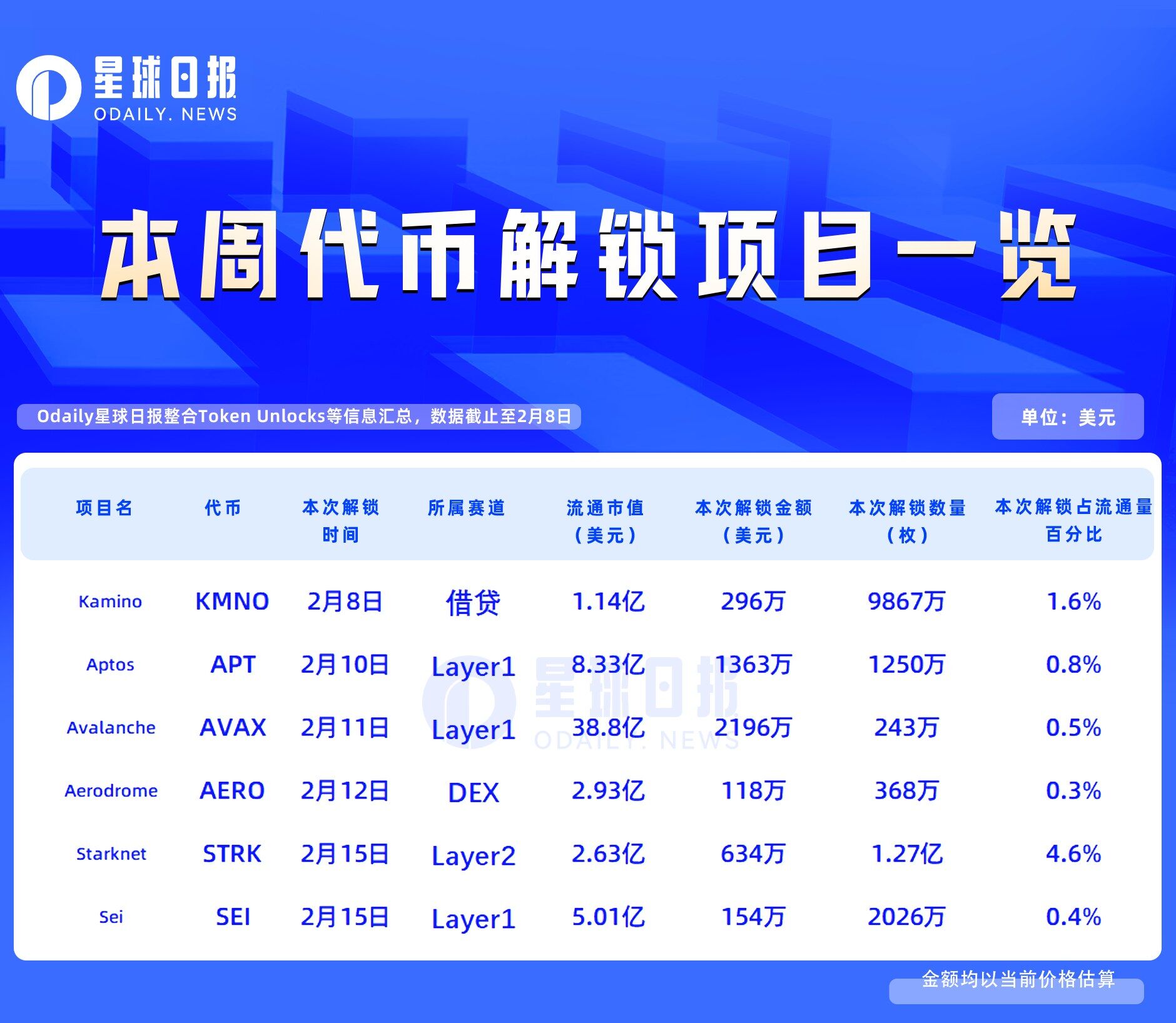
Tuần này, hai dự án tiền mã hóa sẽ mở khóa lượng token đáng kể. Starknet (STRK) sẽ mở khóa 127 triệu token, trị giá khoảng 6,34 triệu USD, tương đương 4,6% nguồn cung lưu hành. Đây là Layer 2 của Ethereum, sử dụng công nghệ zk-STARKs để tăng tốc độ giao dịch và giảm phí. Dự án thứ hai là Kamino (KMNO) với 12,5 triệu token được mở khóa, trị giá khoảng 13,63 triệu USD. Kamino là giải pháp thanh khoản tự động hoạt động trên cơ chế nhà tạo lập thị trường tập trung thanh khoản (CLMM), được ấp ủ bởi Hubble Protocol. Cả hai dự án đều có lịch trình phát hành token cụ thể đã được công bố.

Starknet

Twitter dự án:https://twitter.com/Starknet

Trang web chính thức:https://starknet.io/

Số lượng giải phóng lần này: 127 triệu token

Giá trị giải phóng lần này: Khoảng 6.34 triệu USD

Starknet là Layer2 của Ethereum, sử dụng công nghệ zk-STARKs để giúp giao dịch trên Ethereum nhanh hơn và giảm chi phí. Công ty mẹ của StarkNet, StarkWare, được thành lập vào năm 2018, có trụ sở chính tại Israel, và các sản phẩm chính được nghiên cứu và phát triển bao gồm Starknet và StarkEx. Bằng cách sử dụng STARK, Starknet xác minh giao dịch và tính toán mà không cần tất cả các nút mạng xác minh từng hoạt động. Điều này giảm đáng kể gánh nặng tính toán và tăng thông lượng của mạng lưới blockchain.

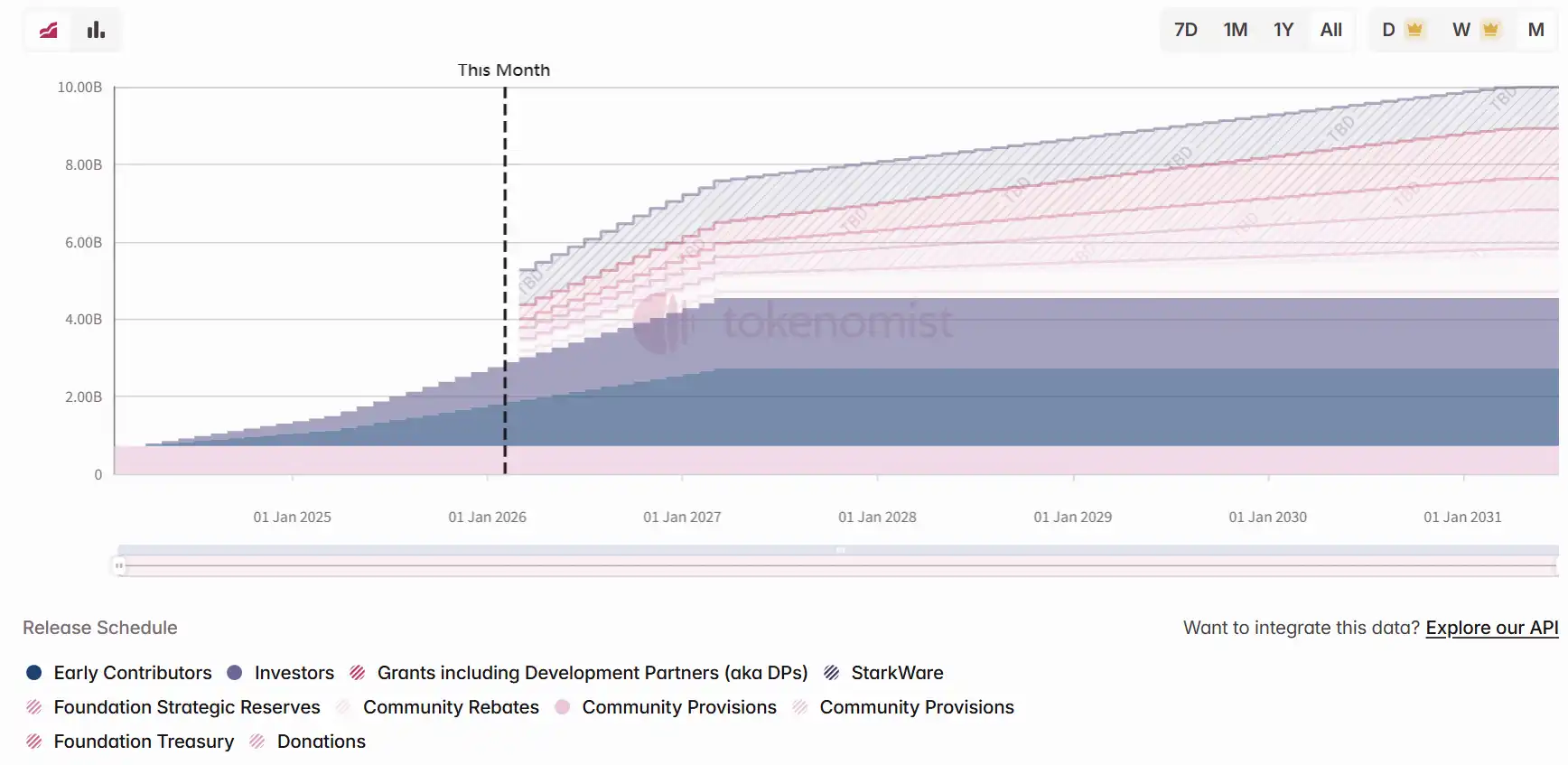
Đường cong giải phóng cụ thể như sau:
Kamino

Twitter dự án:https://x.com/kamino

Trang web chính thức:https://kamino.finance/

Số lượng giải phóng lần này: 12.5 triệu token

Giá trị giải phóng lần này: Khoảng 13.63 triệu USD

Kamino là một giải pháp thanh khoản tự động, dựa trên cơ chế nhà tạo lập thị trường thanh khoản tập trung (CLMM). Các nhà cung cấp thanh khoản (LP) tìm cách nâng cao hiệu quả vốn có thể tận dụng kho tạo lập thị trường tự động của Kamino để tăng phí và kỳ vọng lợi nhuận. Kamino được ấp ủ bởi Hubble Protocol.

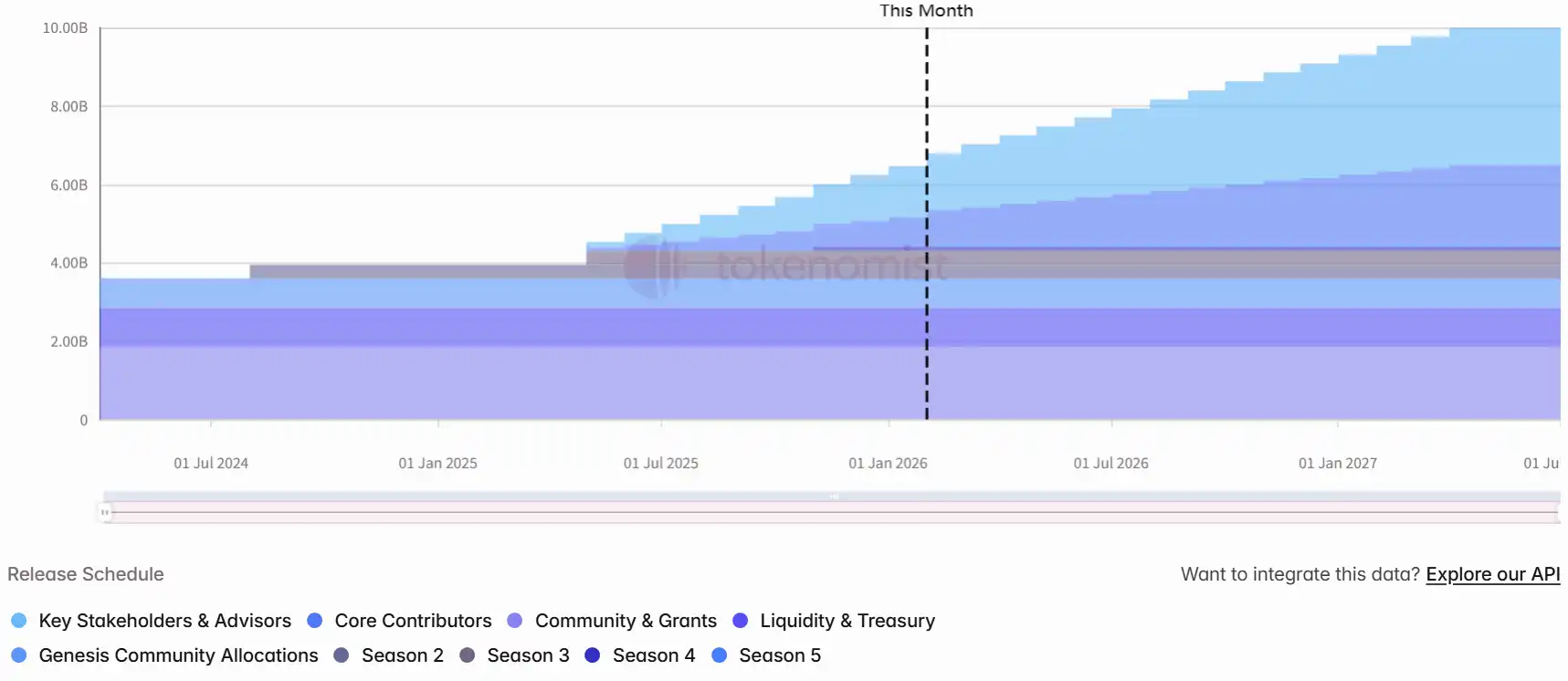
Đường cong giải phóng cụ thể như sau:
Trending Cryptos

Related Questions

QStarknet là gì và nó hoạt động như thế nào?

AStarknet là Layer2 của Ethereum, sử dụng công nghệ zk-STARKs để giúp giao dịch trên Ethereum nhanh hơn và giảm chi phí. Nó xác minh giao dịch và tính toán mà không cần tất cả các nút mạng xác minh từng thao tác, giúp tăng đáng kể khả năng xử lý của mạng blockchain.

QSố lượng token STRK mở khóa lần này là bao nhiêu và giá trị tương ứng?

ALần mở khóa này có 1.27 tỷ token STRK, với giá trị ước tính khoảng 634 triệu USD.

QKamino là gì và nó được phát triển bởi ai?

AKamino là một giải pháp thanh khoản tự động, hoạt động dựa trên cơ chế nhà tạo lập thị trường thanh khoản tập trung (CLMM). Nó được ấp ủ bởi Hubble Protocol.

QSố lượng token KMNO được mở khóa trong đợt này và giá trị của chúng?

AĐợt mở khóa này có 12.5 triệu token KMNO, với giá trị ước tính khoảng 13.63 triệu USD.

QCông nghệ cốt lõi mà Starknet sử dụng là gì và lợi ích của nó?

ACông nghệ cốt lõi mà Starknet sử dụng là zk-STARKs (Zero-Knowledge Scalable Transparent Arguments of Knowledge). Lợi ích chính là khả năng mở rộng, giảm đáng kể chi phí giao dịch và tăng tốc độ xử lý trong khi vẫn đảm bảo tính bảo mật và minh bạch.

Related Reads

Why Is the World Nervous About Japan Raising Interest Rates?

In June 2026, the Bank of Japan raised its policy rate to 1%, marking its first hike to this level since 1995. While this rate remains low compared to global peers like the US and Europe, the move signals a profound shift for a nation that has been a global source of ultra-cheap funding for decades. Japan's long-standing near-zero or negative interest rates had facilitated massive "yen carry trades," where international investors borrowed low-cost yen to invest in higher-yielding assets worldwide, such as US tech stocks and emerging market bonds. This made Japan a critical, often overlooked, source of global liquidity. Japan's ultra-loose policy stemmed from structural challenges post-1990s asset bubble: aging demographics, chronic low inflation/deflation, and high public debt. Recent shifts, including sustained wage growth (exceeding 5% in recent years) and inflation consistently above the 2% target, have created a "wage-price spiral" possibility, prompting the policy normalization. The global market's concern lies not in the absolute rate but in the potential unwinding of the yen carry trade. As Japanese borrowing costs rise, the economics of these leveraged global investments change, potentially triggering deleveraging and capital outflows from risk assets. Market anxiety focuses on the end of a thirty-year consensus that Japan would perpetually provide cheap funding. Ultimately, the global impact will depend on the interplay with US monetary policy. While Japan is tightening, the significant interest rate differential with the US remains. The key future dynamic is whether simultaneous Japanese hikes and eventual US rate cuts will narrow this gap, forcing a major recalibration of global capital flows and asset pricing built on an era of abundant, cheap yen liquidity.

marsbit1h ago

Why Is the World Nervous About Japan Raising Interest Rates?

marsbit1h ago

Research Report Analysis: MRVL's Optical AI Booming, Why High Valuation Keeps Morgan Stanley's Star Analyst Sidelined?

Report Recap: MRVL Optical AI Boom - Why High Valuation Led Morgan Stanley's Star Analyst to Stay Neutral? Morgan Stanley analyst Joseph Moore maintained an "Equal-weight" (Neutral) rating on Marvell Technology (MRVL) on May 28, raising the price target from $172 to $195, below the trading price. This stance comes despite Marvell reporting a record quarter and significantly raising its full-year outlook (FY27 revenue ~$11.5B, up ~40%). Moore's neutral view is based on valuation. The $195 target implies ~40x CY2027 P/E. He contrasts MRVL with NVDA: both trade near ~$200, but Nvidia's forward EPS is more than double Marvell's. For MRVL's valuation to hold, it needs consistent earnings upgrades, proof of networking market share gains, or certainty on large-scale custom AI chip shipments—none of which are confirmed yet. Growth is driven by two pillars: **1) Optical Interconnect** (the faster runner): Moore raised FY27 growth expectations to >70%, with the optical module product line nearing a $1B annualized run rate. **2) Custom AI Chips** (the climber): Confidence in FY28 is growing, but a major new customer project only ramps in FY28, with no current revenue visibility. Key risks are the underperforming Storage, Enterprise, and legacy Networking segments. Moore acknowledges the real AI opportunity but believes the current price already reflects it. For the stock to work from here, investors need to see the optical business hit its targets, custom chips ramp as planned, and a recovery in the weaker business units.

marsbit2h ago

Research Report Analysis: MRVL's Optical AI Booming, Why High Valuation Keeps Morgan Stanley's Star Analyst Sidelined?

marsbit2h ago

qinbaFrank: Review and Outlook of the AI Computing Power Wave — From the Three Debates on NVIDIA to Optical Interconnect and SpaceX IPO, How is Capital Rotating?

**Summary: Retrospective and Outlook on the AI Computing Wave - A Framework for Capital Rotation** Based on a presentation by investor qinbaFrank, this analysis reviews the AI computing market trajectory since 2023 and outlines a forward-looking framework. **Key Phases and Market Debates:** The AI bull market progressed through three major debates: 1) The necessity of massive capital expenditure (late 2023). 2) The sustainability of tech giants' spending (early 2024-early 2025). 3) Potential overestimation of compute needs (early 2025). Consensus solidified in late 2025 as model capabilities and utility demonstrably improved. **Core Thesis: Penetration Rate Drives Commercialization.** Unlike the 2000 dot-com bubble, the current AI wave benefits from mature digital infrastructure, enabling faster adoption. The critical threshold is 10% penetration; surpassing it (with recent enterprise intent surveys showing ~18%) indicates entry into a rapid growth "golden period" where user scale and willingness to pay increase simultaneously. **AI vs. Internet: A Fundamental Difference.** While the internet enhanced connection efficiency, AI directly substitutes human cognition and labor. Once AI performance exceeds the "societal average" human level, its commercial value scales exponentially as payment shifts from human labor costs to AI service fees. **Investment Logic Evolution in the Compute Chain.** The focus has expanded from GPUs to a systemic re-rating of the entire hardware stack: storage/HBM, CPUs, interconnects, power, and advanced packaging. The framework is: **short-term "scarcity pricing," mid-term "upgrade pricing" (e.g., optical interconnects, power networks), and long-term "Physical AI" pricing** (edge computing, robotics). **Market Focus Shift and Adjustment Framework.** The market is transitioning from "hardware scarcity" to "commercialization validation." The ultimate anchor for the narrative is sustained high growth in model providers' Annual Recurring Revenue (ARR) and cloud business revenue, which justifies continued capital expenditure. Adjustments are categorized into three levels: * **L1 (Minor):** Driven by valuation compression or macro noise (e.g., single CPI print). Fundamentals intact. * **L2 (Moderate):** Triggered by significant macro events requiring risk repricing. Requires new data for confidence restoration. * **L3 (Major):** Involves a reset of the core industrial narrative or macro regime (e.g., AI commercialization growth stalling). The **crucial dividing line** is whether AI commercialization growth slows. Without a slowdown, pullbacks are likely L1/L2 "repricing" events. A genuine growth deceleration would signal an L2/L3 narrative reset. **Conclusion: A Foundational Civilizational Leap.** AI represents a foundational upgrade to "intelligence" itself—akin to humanity mastering fire—rather than a single-point industrial revolution. This底层能力跃迁 (underlying capability leap) will spawn successive waves of innovation (Agent, robotics, industry workflow重构). The journey will be波浪式的 (wavelike), driven by cycles of scarcity, technological upgrades, and远期兑现 (long-term realization).

marsbit2h ago

qinbaFrank: Review and Outlook of the AI Computing Power Wave — From the Three Debates on NVIDIA to Optical Interconnect and SpaceX IPO, How is Capital Rotating?

marsbit2h ago

Trading

Spot
Futures

Hot Articles

How to Buy STRK

Welcome to HTX.com! We've made purchasing Starknet (STRK) simple and convenient. Follow our step-by-step guide to embark on your crypto journey.Step 1: Create Your HTX AccountUse your email or phone number to sign up for a free account on HTX. Experience a hassle-free registration journey and unlock all features.Get My AccountStep 2: Go to Buy Crypto and Choose Your Payment MethodCredit/Debit Card: Use your Visa or Mastercard to buy Starknet (STRK) instantly.Balance: Use funds from your HTX account balance to trade seamlessly.Third Parties: We've added popular payment methods such as Google Pay and Apple Pay to enhance convenience.P2P: Trade directly with other users on HTX.Over-the-Counter (OTC): We offer tailor-made services and competitive exchange rates for traders.Step 3: Store Your Starknet (STRK)After purchasing your Starknet (STRK), store it in your HTX account. Alternatively, you can send it elsewhere via blockchain transfer or use it to trade other cryptocurrencies.Step 4: Trade Starknet (STRK)Easily trade Starknet (STRK) on HTX's spot market. Simply access your account, select your trading pair, execute your trades, and monitor in real-time. We offer a user-friendly experience for both beginners and seasoned traders.

2.9k Total ViewsPublished 2024.03.29Updated 2026.06.02

How to Buy STRK

Discussions

Welcome to the HTX Community. Here, you can stay informed about the latest platform developments and gain access to professional market insights. Users' opinions on the price of STRK (STRK) are presented below.

活动图片













