Idole dorée et mème à zéro : l'absurde comédie cryptomonnaie derrière la statue géante de Trump

比推Published on 2026-02-05Last updated on 2026-02-05

Abstract

Résumé : Une statue géante et dorée de Donald Trump, surnommée "Don Colossus", a été commandée pour 300 000 $ par un groupe d'investisseurs en cryptomonnaie pour promouvoir une meme coin nommée PATRIOT. Ce projet visait à capitaliser sur le soutien de Trump aux cryptos. Bien qu'une base ait été installée sur son terrain de golf en Floride et que Trump ait semblé enthousiaste, la valeur du jeton PATRIOT s'est effondrée de plus de 90%. Le projet a été entaché de retards, de conflits internes et d'un différend avec le sculpteur, Alan Cottrill, qui affirme ne pas avoir été entièrement payé pour les droits d'utilisation de son œuvre. Malgré les dénégations de la Trump Organization, les promoteurs continuent de faire la promotion du projet sur les réseaux sociaux, espérant voir la statue inaugurée et une version miniature offerte au président.

Titre original : "Don Colossus"a Golden Statue of President Trump, Waits for Its Home

Auteur original : David Yaffe-Bellany, The New York Times

Compilation originale : Luffy, Foresight News

Titre original : 镀金的偶像与归零的MEME币:特朗普巨型雕像背后的荒诞剧


Cette statue du président Trump est appelée « Don Colossus ». Haute de 15 pieds, posée sur un piédestal pesant 7000 livres, sa hauteur totale est comparable à un bâtiment de deux étages. Cette statue colossale est coulée en bronze et recouverte d'une épaisse couche de feuilles d'or. (Note : Don Colossus se traduit littéralement par « le Géant Don », signifiant que Trump est un géant.)

Pendant plus d'un an, cette statue dorée a été au cœur de l'un des plans les plus étranges pour capitaliser sur l'ère Trump. Un groupe d'investisseurs en cryptomonnaie a dépensé 300 000 dollars pour faire sculpter cette statue, en hommage à Trump, connu pour son soutien franc à la cryptomonnaie.

Ensuite, ils ont utilisé cette statue pour promouvoir une cryptomonnaie de type mème appelée PATRIOT.

Aujourd'hui, de manière inattendue, ce projet semble sur le point d'aboutir. Le mois dernier, un piédestal en béton et acier inoxydable a été installé au complexe de golf de Trump à Doral, en Floride. Selon des messages consultés par le New York Times, l'un des organisateurs du projet et ami de Trump, Mark Burns, a informé ses collaborateurs que le président prévoyait d'assister à la cérémonie d'inauguration de la statue sur place.

« Cette statue a l'air géniale. » a écrit Trump dans un message à Burns en décembre dernier.
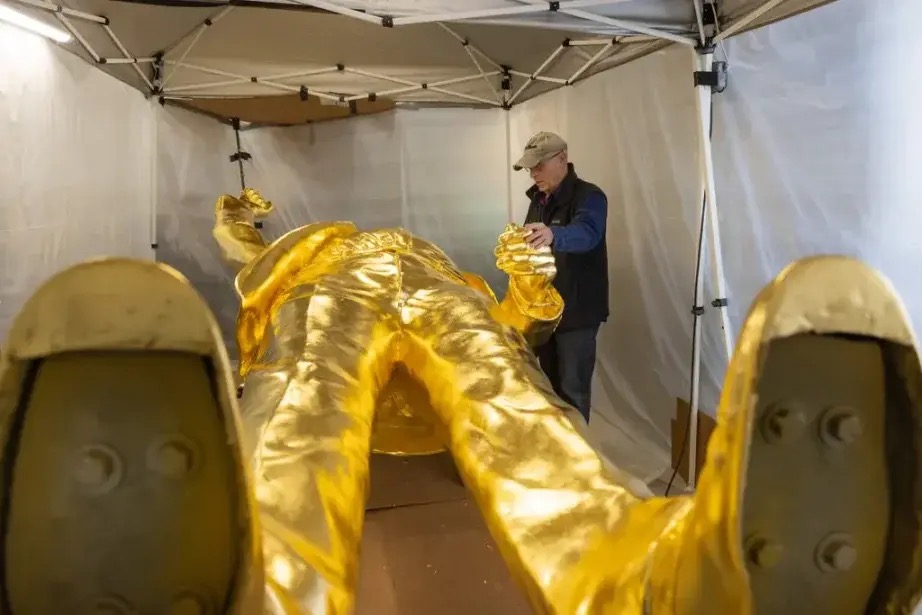
Alan Cottrill inspecte sa statue dorée du président Trump à Zanesville, Ohio

Presque tout le monde dans le domaine de la cryptomonnaie a tenté de tirer profit de la présidence de Trump : soit en concluant des affaires avec sa famille, soit en cherchant un assouplissement réglementaire auprès de son administration. Mais peu ont agi avec autant d'audace que les partisans de PATRIOT.

Un mème coin est une cryptomonnaie qui n'a pratiquement aucune autre utilité que la spéculation, généralement créée autour d'un mème viral ou de l'image d'une célébrité, sa valeur dépendant entièrement du prix que les fans en ligne sont prêts à payer. La clé pour créer un mème coin est de générer suffisamment de buzz sur les réseaux sociaux pour convaincre les acheteurs potentiels que son prix continuera d'augmenter.

Créer une statue géante est un moyen coûteux de faire du buzz sur les réseaux sociaux, mais aussi un plan potentiellement lucratif. Selon l'un des organisateurs du projet, les investisseurs qui ont financé la statue ont reçu de grandes quantités de ce jeton, dont le prix a parfois grimpé en flèche. Pendant des mois, les partisans de « Don Colossus » ont posté sur la plateforme X des images de l'avancement de la fabrication de la statue et ont forgé des alliances au sein de la mouvance « Make America Great Again », dans le but de réaliser un coup marketing majeur : installer cette statue sur une propriété officielle de Trump.

Fin 2024, le mème coin PATRIOT a été officiellement lancé, coïncidant avec la promesse de Trump de faire des États-Unis « la capitale mondiale de la cryptomonnaie », et le prix du jeton a momentanément grimpé en flèche. Lors d'un événement à Washington pendant le week-end d'investiture, les partisans du jeton ont offert une mini-statue en bronze à l'ancien conseiller de Trump, Steve Bannon, et ont interagi avec d'autres personnalités conservatrices.

Mais les retards répétés du projet et les conflits internes ont assombri ce plan lucratif, offrant un aperçu de la volatilité du marché des mème coins : un marché regorgeant d'arnaques, où les investisseurs finissent souvent ruinés. L'année dernière, le prix de PATRIOT s'est effondré, frôlant le zéro. Pour terminer la statue dans les délais et relancer le jeton, les investisseurs sont également entrés en conflit avec le sculpteur Alan Cottrill, basé dans l'Ohio.

Dans des messages textes consultés par le New York Times, Cottrill a affirmé que les investisseurs lui devaient encore 75 000 dollars pour les droits de propriété intellectuelle de la statue.

« Vous utilisez l'image de ma statue, protégée par le droit d'auteur, pour faire la promotion de votre jeton ! » a-t-il écrit le mois dernier dans un message à l'un des partisans du jeton.

« Ouais, haha, c'était prévu depuis le premier jour. » a répondu Ashley Sansalone. Sansalone est un développeur de cryptomonnaie qui, en plus de PATRIOT, est impliqué dans un autre projet de jeton appelé Elon GOAT.
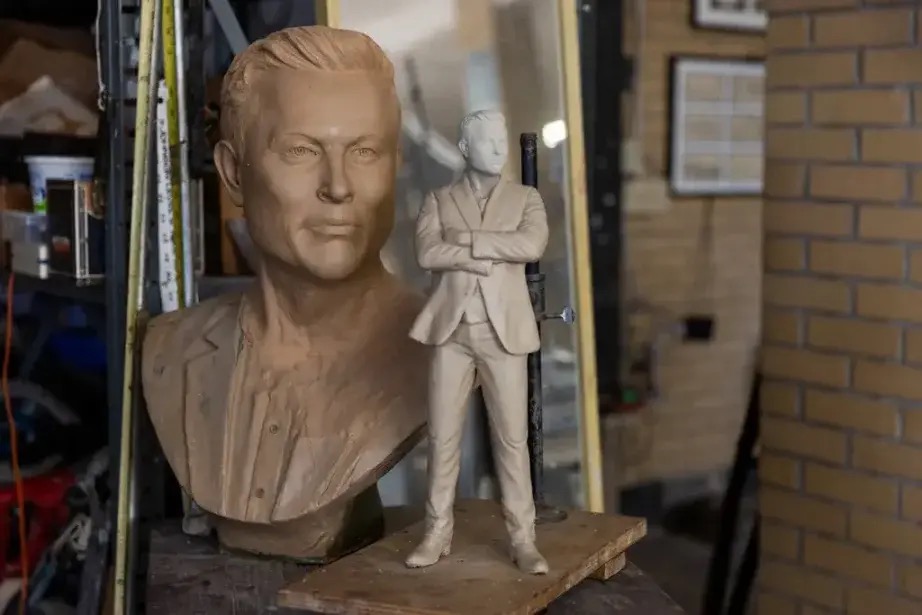
Sculpture d'Elon Musk conçue sur commande par Alan Cottrill

Sansalone a déclaré dans un communiqué que Cottrill serait intégralement payé avant le dévoilement de la statue. « Dans tout accord commercial, une partie du paiement est retenue jusqu'à la livraison finale du produit. » a-t-il dit.

Mais il n'est pas clair quand la statue sera finalement exposée.

Lundi, après que le New York Times ait interrogé la Maison Blanche et la Trump Organization au sujet du jeton PATRIOT, le fils du président, Eric Trump, a publié une déclaration sur X.

« Nous apprécions le soutien et l'enthousiasme de tous, » a-t-il dit, « mais il doit être clair que nous ne sommes impliqués d'aucune manière dans ce jeton. »

Créer « Don Colossus »

Le plan pour créer « Don Colossus » est né dans un chat sur l'application de messagerie Telegram, où les amateurs de cryptomonnaie échangent souvent des conseils d'investissement et font la promotion de jetons. C'était en juillet 2024, juste après que Trump ait échappé de justesse à une tentative d'assassinat à Butler, en Pennsylvanie, brandissant le poing avec détermination.

Sansalone voulait faire de cette image de défi le visage central d'un mème coin. Il a collaboré avec l'activiste de droite Dustin Stockton, et l'investisseur en cryptomonnaie bien connecté Brock Pierce, souvent empêtré dans des problèmes juridiques et financiers, s'est joint à eux.

Peu après que la balle ait frôlé l'oreille de Trump, Sansalone a contacté Cottrill, 73 ans, dont la statue en bronze de Thomas Edison est exposée au Capitole des États-Unis. Au fil des ans, Cottrill a créé des statues pour une douzaine de présidents américains, notamment des monuments de 10 pieds de haut pour George Washington et Thomas Jefferson.

Cottrill dans une pièce remplie de sculptures

Les investisseurs en cryptomonnaie voulaient que la statue de Trump soit plus grande que ses œuvres précédentes et ont demandé quelques modifications esthétiques.

« Ma sculpture initiale était très réaliste. » a déclaré Cottrill dans une interview le mois dernier, « Les gens de la crypto m'ont demandé de réduire un peu la graisse sur son cou et d'affiner sa silhouette. »

Au moment de l'investiture de Trump, Cottrill avait terminé la statue, cette immense figure de bronze pas encore dorée était alors la plus grande qu'il ait jamais créée. En décembre dernier, Trump a partagé sur les réseaux sociaux un article de Breitbart News sur le projet, qui disait que Stockton était en contact avec le comité d'investiture pour organiser un dévoilement de la statue pendant le week-end de l'investiture.

Le timing de ce partage était parfait : le jeton PATRIOT venait tout juste d'être lancé.

Le site web proclamait : « Le jeton crypto du peuple, cette statue que personne ne peut effacer. »

Mais ensuite, le projet a subi deux revers majeurs. Le froid hivernal à Washington a causé des problèmes logistiques, forçant le report du dévoilement ; et peu avant l'investiture, Trump a lancé son propre mème coin, TRUMP.

Alors que les traders de crypto s'arrachaient le jeton officiel, Stockton et Pierce organisaient un événement « Patriots Awards » au National Press Club de Washington, distribuant des miniatures de la statue.

« L'ambiance est tombée à plat parce que le prix du jeton de Trump a soudainement décollé. » a déclaré Cottrill.

Fin janvier, le prix de PATRIOT avait chuté de plus de 90%.

« Un emplacement de choix »

Malgré ce revers, les investisseurs en cryptomonnaie ont continué leur marketing. En février dernier, l'ancien membre du Congrès discrédité George Santos a présenté une mini-statue de Trump sur Fox News, mentionnant spécifiquement le jeton PATRIOT.

Une petite statue dorée de Trump brandissant le poing, entourée de plusieurs statues plus sombres de la même figure

Stockton a partagé la vidéo sur X, proclamant : « Une exposition médiatique qu'on ne peut pas acheter ! » Dans un bref entretien téléphonique, Santos a déclaré : « J'ai été payé pour faire de la publicité pour eux, je suis toujours très transparent là-dessus. »

Les investisseurs ont également courtisé un autre allié influent : Burns. Ce pasteur connu est un proche de Trump, parfois appelé le « conseiller spirituel » informel du président.

Après que Pierce l'ait présenté à l'équipe du projet, Burns a commencé à participer aux travaux sur la statue. Il est rapidement devenu une figure clé pour relancer le projet, proposant de dorer la statue de bronze à la feuille d'or.

« Le président vient de me demander des photos de la statue une fois dorée. » a écrit Burns dans un message à ses collaborateurs en novembre dernier.

Le souhait de Trump s'est finalement réalisé. Sansalone a informé l'équipe qu'il avait consulté un fournisseur de feuilles d'or de New York qui avait travaillé pour Trump Tower. Cottrill a partagé des photos de la statue terminée.

« Tellement brillante, tellement exquise, » a répondu Sansalone.

« Wow...... J'envoie ça au président, » a écrit Burns.

Apparemment, Trump a été impressionné par la statue. Le mois dernier, Cottrill s'est rendu en Floride pour installer le piédestal de 7000 livres au complexe de golf Trump National Doral. Stockton a vanté sur les réseaux sociaux qu'il s'agissait d'un « emplacement de choix ». Burns a déclaré dans un message texte à ses collaborateurs en janvier que les planificateurs de la Maison Blanche « finalisaient activement » la date de la cérémonie officielle de dévoilement de la statue à laquelle le président assisterait.

Trump National Doral Golf Club, Floride

Cela aurait dû être le moment de gloire de Cottrill, mais il dit en avoir assez des investisseurs en cryptomonnaie derrière tout cela.

Cottrill a déclaré que ce n'est qu'à l'automne 2024 qu'il a découvert que ces investisseurs utilisaient l'image de son œuvre pour promouvoir une monnaie numérique, ce qu'il considère comme une violation de sa propriété intellectuelle.

Finalement, il a conclu un accord avec les investisseurs : ils paieraient 150 000 dollars pour les droits d'image de la statue. Mais il affirme ne pas avoir encore reçu le solde, et avec d'autres frais impayés, ils lui devraient environ 90 000 dollars au total.

Les investisseurs en cryptomonnaie ont demandé que la statue de Trump soit suffisamment grande et ont demandé des modifications esthétiques

« De mon point de vue, ils n'ont pas acheté ces droits de propriété intellectuelle et les utilisent illégalement. » a-t-il dit, « À moins que toutes les dettes ne soient payées, cette statue ne quittera pas ma fonderie. »

Mais les organisateurs du projet soutiennent qu'il n'a en réalité pas été très rentable.

Burns a déclaré qu'il n'avait jamais demandé ni reçu de paiement. Stockton, interrogé, a déclaré que le jeton PATRIOT n'était qu'un outil de financement visant à « soutenir les diverses activités liées à la statue ».

« Je n'ai vu personne devenir riche avec ça. » a déclaré Stockton.

La porte-parole de Trump Organization, Kimberly Benza, a déclaré que l'entreprise n'avait pris connaissance de l'existence de ce mème coin que cette semaine, après les questions du New York Times. Elle n'a pas répondu à la question de savoir si la cérémonie de dévoilement de la statue aurait lieu comme prévu.

Cette controverse n'a pas empêché la promotion du projet sur les réseaux sociaux. Un compte X associé au jeton a récemment publié des photos du piédestal de la statue à Doral, et a épinglé un message détaillant comment acheter le mème coin.

« Le rêve est toujours vivant, » a déclaré Sansalone le 16 janvier lors d'un stream en direct avec Burns.

Outre la statue géante, l'équipe espère offrir à Trump une miniature dorée identique. « Nous aimerions qu'un exemplaire soit exposé dans le Bureau ovale, » a déclaré Sansalone.

Lien original :https://www.bitpush.news/articles/7608937

Trending Cryptos

Related Questions

QQuel est le nom de la statue géante de Donald Trump et quelle est sa signification ?

ALa statue s'appelle 'Don Colossus', ce qui signifie 'le géant Don', en référence à Donald Trump comme une figure imposante.

QQuel était l'objectif principal derrière la création de la statue et du meme coin PATRIOT ?

AL'objectif était de créer une opération marketing pour promouvoir le meme coin PATRIOT, en utilisant la statue comme symbole pour générer de l'engagement en ligne et attirer les investisseurs.

QQuels problèmes ont surgi lors de la réalisation de ce projet ?

ALe projet a rencontré des retards, des conflits internes, une chute drastique de la valeur du PATRIOT coin, et un différend avec le sculpteur Alan Cottrill concernant le paiement des droits de propriété intellectuelle.

QQuel a été le rôle de Mark Burns dans ce projet ?

AMark Burns, un pasteur et proche de Donald Trump, a servi d'intermédiaire avec l'ancien président, a suggéré de dorer la statue et a travaillé à l'organisation d'une cérémonie de dévoilement.

QQuelle a été la réaction de la Trump Organization face à ce meme coin et à la statue ?

ALa Trump Organization a déclaré qu'elle n'était pas au courant de l'existence du meme coin PATRIOT avant d'être contactée par le New York Times et n'a pas confirmé si la cérémonie de dévoilement de la statue aurait lieu.

Related Reads

New Fire Group Chief Economist Fu Peng's Latest Speech: Crypto Assets Deeply Bound to Liquidity, Global Assets 'Shrink Circle' with Widening Divergence

The chief economist of Sinovation Group delivered a speech at Wiki Finance EXPO Hong Kong 2026, analyzing the global market through the lens of liquidity. He argues that all major assets, including cryptocurrencies, are fundamentally tied to global liquidity, which is now shifting from an era of extreme post-2008 ease to sustained tightening under new Fed leadership. This marks the end of widespread "asset flooding" and ushers in a "shrinking circle" dynamic: capital is abandoning speculative, low-quality assets and concentrating in a few high-conviction, value-driven core holdings. The only dominant global investment theme is AI, viewed as a 20-25 year productivity cycle. However, a critical inflection point has been reached in Q2, where major tech firms' free cash flow has turned negative. The market narrative has pivoted from rewarding pure capital expenditure growth to demanding proof of future revenue generation and returns. While the AI super-cycle's long-term thesis remains intact, the initial hardware-driven phase (e.g., Nvidia, memory chips) is maturing. The speaker warns of significant volatility risk not from industry fundamentals, but from excessive financial leverage built up in these "certain" assets. He emphasizes that investment strategy must evolve from broad diversification to focused, cyclical allocation within the AI value chain (upstream hardware, midstream, downstream applications), avoiding blind long-term holds on single names. For crypto, this liquidity paradigm shift means the era of speculative "air coin" mania is over; the market is maturing, with institutional participation increasing and volatility stabilizing for core assets like Bitcoin and Ethereum. The core takeaway is that understanding the top-down liquidity framework is essential for navigating the current era of market分化 and focused capital allocation.

链捕手2m ago

New Fire Group Chief Economist Fu Peng's Latest Speech: Crypto Assets Deeply Bound to Liquidity, Global Assets 'Shrink Circle' with Widening Divergence

链捕手2m ago

4 Hours, 118 Responses: Liang Wenfeng’s Internal Q&A Addresses Everything

**DeepSeek Founder Liang Wenfeng's Candid Reflections on the Company's Path to AGI** DeepSeek has recently completed its first external funding round, raising over 500 billion RMB (approx. $74B) at a pre-money valuation of 3.675 trillion RMB ($543B). Founder Liang Wenfeng personally invested 200 billion RMB. This marks a strategic shift from its initial "no financing, no IPO, no commercialization" principle. In a recent investor Q&A, Liang articulated DeepSeek's core philosophy and roadmap. The company is driven by a powerful, unwritten vision for beneficial AGI rather than pure commercial maximization. He emphasizes "strategic restraint"—avoiding unnecessary conflicts, prioritizing long-term AGI success over short-term gains, and maintaining an open, cooperative stance even with competitors. Liang outlined the AGI technical roadmap: current focus on Agent capabilities, followed by solving "continual learning," which he sees as the key to unlocking models that can learn and adapt like humans. This could lead to a gradual "singularity" where AI accelerates its own research, and eventually to embodied intelligence. DeepSeek will strictly focus on this "AGI mainline," avoiding distractions like video generation which, while commercially viable, don't directly advance core intelligence. He identifies team stability as the single most critical factor for success, now bolstered by the recent funding. While talent is not a bottleneck, the primary constraint compared to the US is compute resources. Liang is optimistic about domestic AI chips, stating that Nvidia's CUDA moat is eroding and that within a year, the viability of the Chinese chip ecosystem will be proven, with Huawei's offerings being key. The main issue is production capacity. On competition, Liang believes the final differentiators will be cost, time-to-market, and user experience. He foresees Chinese companies playing a major role by offering systematically lower-cost AI services globally. DeepSeek's commercialization strategy involves offering API services at a "reasonable profit" and focusing on coding Agents. He remains committed to open-sourcing even their strongest models, seeing no downside as the barriers to effective deployment remain high. The company operates with a unique dual management structure combining top-down direction with significant bottom-up, unstructured research time for employees. Data quality and post-training are identified as major current challenges, with half of core researchers involved in data labeling efforts. Liang concludes that DeepSeek aims to be one of several trillion-dollar companies in the AI era, achieved through extreme focus on its chosen path.

链捕手9m ago

4 Hours, 118 Responses: Liang Wenfeng’s Internal Q&A Addresses Everything

链捕手9m ago

After Three Consecutive Quarters of Decline, Can the Crypto Market Find a Window for Stabilization in Q3?

The cryptocurrency market has just concluded its worst-performing quarter since 2022, with total capitalization dropping 12.6% to $2.1 trillion. All core metrics indicate capital is leaving the sector, not just rotating within it. Bitcoin fell 14.2% and Ethereum dropped 25.4% in Q2, breaking their previous correlation with US tech stocks. A key driver is the reversal in US spot Bitcoin ETF flows, which saw a net outflow of approximately $4.67 billion in Q2, including a record monthly outflow near $4.5 billion in June. While recent data suggests long-term holders are accumulating again, sustained ETF outflows mean continued selling pressure. Market focus is now singularly on the Federal Reserve. The upcoming July FOMC meeting is seen as the most critical event for Q3. A dovish signal could support Bitcoin reclaiming a $68,000-$84,000 range, while a hawkish stance might establish a new trading band around $50,000-$56,000. Additionally, regulatory uncertainty persists, with the progress of the crucial *CLARITY Act* stalling in the Senate, reducing its perceived 2026 passage probability to 40-45%. Despite the broad downturn, a few sectors showed growth. Prediction markets saw nominal volume surge 48.7% year-over-year to $113.8 billion, and tokenized collectibles transaction volume rose 143% quarterly to $1.4 billion. The Real-World Asset (RWA) tokenization sector also continued steady growth, now representing ~$28.1 billion in on-chain value. The market's foundation for an extreme crash appears limited, with Bitcoin price hovering near its 200-week moving average. However, the trading paradigm has shifted from narrative-driven speculation to decisions based on price action, policy developments, and interest rate expectations, making a broad sentiment-driven rally unlikely in the near term.

marsbitYesterday 08:36

After Three Consecutive Quarters of Decline, Can the Crypto Market Find a Window for Stabilization in Q3?

marsbitYesterday 08:36

Trading

Spot

Hot Articles

What is SONIC

Sonic: Pioneering the Future of Gaming in Web3 Introduction to Sonic In the ever-evolving landscape of Web3, the gaming industry stands out as one of the most dynamic and promising sectors. At the forefront of this revolution is Sonic, a project designed to amplify the gaming ecosystem on the Solana blockchain. Leveraging cutting-edge technology, Sonic aims to deliver an unparalleled gaming experience by efficiently processing millions of requests per second, ensuring that players enjoy seamless gameplay while maintaining low transaction costs. This article delves into the intricate details of Sonic, exploring its creators, funding sources, operational mechanics, and the timeline of significant events that have shaped its journey. What is Sonic? Sonic is an innovative layer-2 network that operates atop the Solana blockchain, specifically tailored to enhance the existing Solana gaming ecosystem. It accomplishes this through a customised, VM-agnostic game engine paired with a HyperGrid interpreter, facilitating sovereign game economies that roll up back to the Solana platform. The primary goals of Sonic include: Enhanced Gaming Experiences: Sonic is committed to offering lightning-fast on-chain gameplay, allowing players and developers to engage with games at previously unattainable speeds. Atomic Interoperability: This feature enables transactions to be executed within Sonic without the need to redeploy Solana programmes and accounts. This makes the process more efficient and directly benefits from Solana Layer1 services and liquidity. Seamless Deployment: Sonic allows developers to write for Ethereum Virtual Machine (EVM) based systems and execute them on Solana’s SVM infrastructure. This interoperability is crucial for attracting a broader range of dApps and decentralised applications to the platform. Support for Developers: By offering native composable gaming primitives and extensible data types - dining within the Entity-Component-System (ECS) framework - game creators can craft intricate business logic with ease. Overall, Sonic's unique approach not only caters to players but also provides an accessible and low-cost environment for developers to innovate and thrive. Creator of Sonic The information regarding the creator of Sonic is somewhat ambiguous. However, it is known that Sonic's SVM is owned by the company Mirror World. The absence of detailed information about the individuals behind Sonic reflects a common trend in several Web3 projects, where collective efforts and partnerships often overshadow individual contributions. Investors of Sonic Sonic has garnered considerable attention and support from various investors within the crypto and gaming sectors. Notably, the project raised an impressive $12 million during its Series A funding round. The round was led by BITKRAFT Ventures, with other notable investors including Galaxy, Okx Ventures, Interactive, Big Brain Holdings, and Mirana. This financial backing signifies the confidence that investment foundations have in Sonic’s potential to revolutionise the Web3 gaming landscape, further validating its innovative approaches and technologies. How Does Sonic Work? Sonic utilises the HyperGrid framework, a sophisticated parallel processing mechanism that enhances its scalability and customisability. Here are the core features that set Sonic apart: Lightning Speed at Low Costs: Sonic offers one of the fastest on-chain gaming experiences compared to other Layer-1 solutions, powered by the scalability of Solana’s virtual machine (SVM). Atomic Interoperability: Sonic enables transaction execution without redeployment of Solana programmes and accounts, effectively streamlining the interaction between users and the blockchain. EVM Compatibility: Developers can effortlessly migrate decentralised applications from EVM chains to the Solana environment using Sonic’s HyperGrid interpreter, increasing the accessibility and integration of various dApps. Ecosystem Support for Developers: By exposing native composable gaming primitives, Sonic facilitates a sandbox-like environment where developers can experiment and implement business logic, greatly enhancing the overall development experience. Monetisation Infrastructure: Sonic natively supports growth and monetisation efforts, providing frameworks for traffic generation, payments, and settlements, thereby ensuring that gaming projects are not only viable but also sustainable financially. Timeline of Sonic The evolution of Sonic has been marked by several key milestones. Below is a brief timeline highlighting critical events in the project's history: 2022: The Sonic cryptocurrency was officially launched, marking the beginning of its journey in the Web3 gaming arena. 2024: June: Sonic SVM successfully raised $12 million in a Series A funding round. This investment allowed Sonic to further develop its platform and expand its offerings. August: The launch of the Sonic Odyssey testnet provided users with the first opportunity to engage with the platform, offering interactive activities such as collecting rings—a nod to gaming nostalgia. October: SonicX, an innovative crypto game integrated with Solana, made its debut on TikTok, capturing the attention of over 120,000 users within a short span. This integration illustrated Sonic’s commitment to reaching a broader, global audience and showcased the potential of blockchain gaming. Key Points Sonic SVM is a revolutionary layer-2 network on Solana explicitly designed to enhance the GameFi landscape, demonstrating great potential for future development. HyperGrid Framework empowers Sonic by introducing horizontal scaling capabilities, ensuring that the network can handle the demands of Web3 gaming. Integration with Social Platforms: The successful launch of SonicX on TikTok displays Sonic’s strategy to leverage social media platforms to engage users, exponentially increasing the exposure and reach of its projects. Investment Confidence: The substantial funding from BITKRAFT Ventures, among others, emphasizes the robust backing Sonic has, paving the way for its ambitious future. In conclusion, Sonic encapsulates the essence of Web3 gaming innovation, striking a balance between cutting-edge technology, developer-centric tools, and community engagement. As the project continues to evolve, it is poised to redefine the gaming landscape, making it a notable entity for gamers and developers alike. As Sonic moves forward, it will undoubtedly attract greater interest and participation, solidifying its place within the broader narrative of blockchain gaming.

1.9k Total ViewsPublished 2024.04.04Updated 2024.12.03

What is SONIC

What is $S$

Understanding SPERO: A Comprehensive Overview Introduction to SPERO As the landscape of innovation continues to evolve, the emergence of web3 technologies and cryptocurrency projects plays a pivotal role in shaping the digital future. One project that has garnered attention in this dynamic field is SPERO, denoted as SPERO,$$s$. This article aims to gather and present detailed information about SPERO, to help enthusiasts and investors understand its foundations, objectives, and innovations within the web3 and crypto domains. What is SPERO,$$s$? SPERO,$$s$ is a unique project within the crypto space that seeks to leverage the principles of decentralisation and blockchain technology to create an ecosystem that promotes engagement, utility, and financial inclusion. The project is tailored to facilitate peer-to-peer interactions in new ways, providing users with innovative financial solutions and services. At its core, SPERO,$$s$ aims to empower individuals by providing tools and platforms that enhance user experience in the cryptocurrency space. This includes enabling more flexible transaction methods, fostering community-driven initiatives, and creating pathways for financial opportunities through decentralised applications (dApps). The underlying vision of SPERO,$$s$ revolves around inclusiveness, aiming to bridge gaps within traditional finance while harnessing the benefits of blockchain technology. Who is the Creator of SPERO,$$s$? The identity of the creator of SPERO,$$s$ remains somewhat obscure, as there are limited publicly available resources providing detailed background information on its founder(s). This lack of transparency can stem from the project's commitment to decentralisation—an ethos that many web3 projects share, prioritising collective contributions over individual recognition. By centring discussions around the community and its collective goals, SPERO,$$s$ embodies the essence of empowerment without singling out specific individuals. As such, understanding the ethos and mission of SPERO remains more important than identifying a singular creator. Who are the Investors of SPERO,$$s$? SPERO,$$s$ is supported by a diverse array of investors ranging from venture capitalists to angel investors dedicated to fostering innovation in the crypto sector. The focus of these investors generally aligns with SPERO's mission—prioritising projects that promise societal technological advancement, financial inclusivity, and decentralised governance. These investor foundations are typically interested in projects that not only offer innovative products but also contribute positively to the blockchain community and its ecosystems. The backing from these investors reinforces SPERO,$$s$ as a noteworthy contender in the rapidly evolving domain of crypto projects. How Does SPERO,$$s$ Work? SPERO,$$s$ employs a multi-faceted framework that distinguishes it from conventional cryptocurrency projects. Here are some of the key features that underline its uniqueness and innovation: Decentralised Governance: SPERO,$$s$ integrates decentralised governance models, empowering users to participate actively in decision-making processes regarding the project’s future. This approach fosters a sense of ownership and accountability among community members. Token Utility: SPERO,$$s$ utilises its own cryptocurrency token, designed to serve various functions within the ecosystem. These tokens enable transactions, rewards, and the facilitation of services offered on the platform, enhancing overall engagement and utility. Layered Architecture: The technical architecture of SPERO,$$s$ supports modularity and scalability, allowing for seamless integration of additional features and applications as the project evolves. This adaptability is paramount for sustaining relevance in the ever-changing crypto landscape. Community Engagement: The project emphasises community-driven initiatives, employing mechanisms that incentivise collaboration and feedback. By nurturing a strong community, SPERO,$$s$ can better address user needs and adapt to market trends. Focus on Inclusion: By offering low transaction fees and user-friendly interfaces, SPERO,$$s$ aims to attract a diverse user base, including individuals who may not previously have engaged in the crypto space. This commitment to inclusion aligns with its overarching mission of empowerment through accessibility. Timeline of SPERO,$$s$ Understanding a project's history provides crucial insights into its development trajectory and milestones. Below is a suggested timeline mapping significant events in the evolution of SPERO,$$s$: Conceptualisation and Ideation Phase: The initial ideas forming the basis of SPERO,$$s$ were conceived, aligning closely with the principles of decentralisation and community focus within the blockchain industry. Launch of Project Whitepaper: Following the conceptual phase, a comprehensive whitepaper detailing the vision, goals, and technological infrastructure of SPERO,$$s$ was released to garner community interest and feedback. Community Building and Early Engagements: Active outreach efforts were made to build a community of early adopters and potential investors, facilitating discussions around the project’s goals and garnering support. Token Generation Event: SPERO,$$s$ conducted a token generation event (TGE) to distribute its native tokens to early supporters and establish initial liquidity within the ecosystem. Launch of Initial dApp: The first decentralised application (dApp) associated with SPERO,$$s$ went live, allowing users to engage with the platform's core functionalities. Ongoing Development and Partnerships: Continuous updates and enhancements to the project's offerings, including strategic partnerships with other players in the blockchain space, have shaped SPERO,$$s$ into a competitive and evolving player in the crypto market. Conclusion SPERO,$$s$ stands as a testament to the potential of web3 and cryptocurrency to revolutionise financial systems and empower individuals. With a commitment to decentralised governance, community engagement, and innovatively designed functionalities, it paves the way toward a more inclusive financial landscape. As with any investment in the rapidly evolving crypto space, potential investors and users are encouraged to research thoroughly and engage thoughtfully with the ongoing developments within SPERO,$$s$. The project showcases the innovative spirit of the crypto industry, inviting further exploration into its myriad possibilities. While the journey of SPERO,$$s$ is still unfolding, its foundational principles may indeed influence the future of how we interact with technology, finance, and each other in interconnected digital ecosystems.

157 Total ViewsPublished 2024.12.17Updated 2024.12.17

What is $S$

What is AGENT S

Agent S: The Future of Autonomous Interaction in Web3 Introduction In the ever-evolving landscape of Web3 and cryptocurrency, innovations are constantly redefining how individuals interact with digital platforms. One such pioneering project, Agent S, promises to revolutionise human-computer interaction through its open agentic framework. By paving the way for autonomous interactions, Agent S aims to simplify complex tasks, offering transformative applications in artificial intelligence (AI). This detailed exploration will delve into the project's intricacies, its unique features, and the implications for the cryptocurrency domain. What is Agent S? Agent S stands as a groundbreaking open agentic framework, specifically designed to tackle three fundamental challenges in the automation of computer tasks: Acquiring Domain-Specific Knowledge: The framework intelligently learns from various external knowledge sources and internal experiences. This dual approach empowers it to build a rich repository of domain-specific knowledge, enhancing its performance in task execution. Planning Over Long Task Horizons: Agent S employs experience-augmented hierarchical planning, a strategic approach that facilitates efficient breakdown and execution of intricate tasks. This feature significantly enhances its ability to manage multiple subtasks efficiently and effectively. Handling Dynamic, Non-Uniform Interfaces: The project introduces the Agent-Computer Interface (ACI), an innovative solution that enhances the interaction between agents and users. Utilizing Multimodal Large Language Models (MLLMs), Agent S can navigate and manipulate diverse graphical user interfaces seamlessly. Through these pioneering features, Agent S provides a robust framework that addresses the complexities involved in automating human interaction with machines, setting the stage for myriad applications in AI and beyond. Who is the Creator of Agent S? While the concept of Agent S is fundamentally innovative, specific information about its creator remains elusive. The creator is currently unknown, which highlights either the nascent stage of the project or the strategic choice to keep founding members under wraps. Regardless of anonymity, the focus remains on the framework's capabilities and potential. Who are the Investors of Agent S? As Agent S is relatively new in the cryptographic ecosystem, detailed information regarding its investors and financial backers is not explicitly documented. The lack of publicly available insights into the investment foundations or organisations supporting the project raises questions about its funding structure and development roadmap. Understanding the backing is crucial for gauging the project's sustainability and potential market impact. How Does Agent S Work? At the core of Agent S lies cutting-edge technology that enables it to function effectively in diverse settings. Its operational model is built around several key features: Human-like Computer Interaction: The framework offers advanced AI planning, striving to make interactions with computers more intuitive. By mimicking human behaviour in tasks execution, it promises to elevate user experiences. Narrative Memory: Employed to leverage high-level experiences, Agent S utilises narrative memory to keep track of task histories, thereby enhancing its decision-making processes. Episodic Memory: This feature provides users with step-by-step guidance, allowing the framework to offer contextual support as tasks unfold. Support for OpenACI: With the ability to run locally, Agent S allows users to maintain control over their interactions and workflows, aligning with the decentralised ethos of Web3. Easy Integration with External APIs: Its versatility and compatibility with various AI platforms ensure that Agent S can fit seamlessly into existing technological ecosystems, making it an appealing choice for developers and organisations. These functionalities collectively contribute to Agent S's unique position within the crypto space, as it automates complex, multi-step tasks with minimal human intervention. As the project evolves, its potential applications in Web3 could redefine how digital interactions unfold. Timeline of Agent S The development and milestones of Agent S can be encapsulated in a timeline that highlights its significant events: September 27, 2024: The concept of Agent S was launched in a comprehensive research paper titled “An Open Agentic Framework that Uses Computers Like a Human,” showcasing the groundwork for the project. October 10, 2024: The research paper was made publicly available on arXiv, offering an in-depth exploration of the framework and its performance evaluation based on the OSWorld benchmark. October 12, 2024: A video presentation was released, providing a visual insight into the capabilities and features of Agent S, further engaging potential users and investors. These markers in the timeline not only illustrate the progress of Agent S but also indicate its commitment to transparency and community engagement. Key Points About Agent S As the Agent S framework continues to evolve, several key attributes stand out, underscoring its innovative nature and potential: Innovative Framework: Designed to provide an intuitive use of computers akin to human interaction, Agent S brings a novel approach to task automation. Autonomous Interaction: The ability to interact autonomously with computers through GUI signifies a leap towards more intelligent and efficient computing solutions. Complex Task Automation: With its robust methodology, it can automate complex, multi-step tasks, making processes faster and less error-prone. Continuous Improvement: The learning mechanisms enable Agent S to improve from past experiences, continually enhancing its performance and efficacy. Versatility: Its adaptability across different operating environments like OSWorld and WindowsAgentArena ensures that it can serve a broad range of applications. As Agent S positions itself in the Web3 and crypto landscape, its potential to enhance interaction capabilities and automate processes signifies a significant advancement in AI technologies. Through its innovative framework, Agent S exemplifies the future of digital interactions, promising a more seamless and efficient experience for users across various industries. Conclusion Agent S represents a bold leap forward in the marriage of AI and Web3, with the capacity to redefine how we interact with technology. While still in its early stages, the possibilities for its application are vast and compelling. Through its comprehensive framework addressing critical challenges, Agent S aims to bring autonomous interactions to the forefront of the digital experience. As we move deeper into the realms of cryptocurrency and decentralisation, projects like Agent S will undoubtedly play a crucial role in shaping the future of technology and human-computer collaboration.

827 Total ViewsPublished 2025.01.14Updated 2025.01.14

What is AGENT S

Discussions

Welcome to the HTX Community. Here, you can stay informed about the latest platform developments and gain access to professional market insights. Users' opinions on the price of S (S) are presented below.

活动图片