Analyst Who Nailed 2018 Bitcoin Bottom Issues Warning to Crypto Traders

dailyhodlPublished on 2022-07-26Last updated on 2022-07-26

Abstract

A crypto strategist who accurately called the 2018 bear market bottom for Bitcoin (BTC) is issuing a fresh warning for the king crypto.

A crypto strategist who accurately called the 2018 bear market bottom for Bitcoin (BTC) is issuing a fresh warning for the king crypto.

Pseudonymous analyst Smart Contracter tells his 210,000 Twitter followers that Bitcoin’s rally to around $24,000 last week now appears to be a trap set for BTC bulls.

“BTC back into last week’s breakout range indicating it was a bearish fakeout, closing this thread off now and will buy any new lows.”
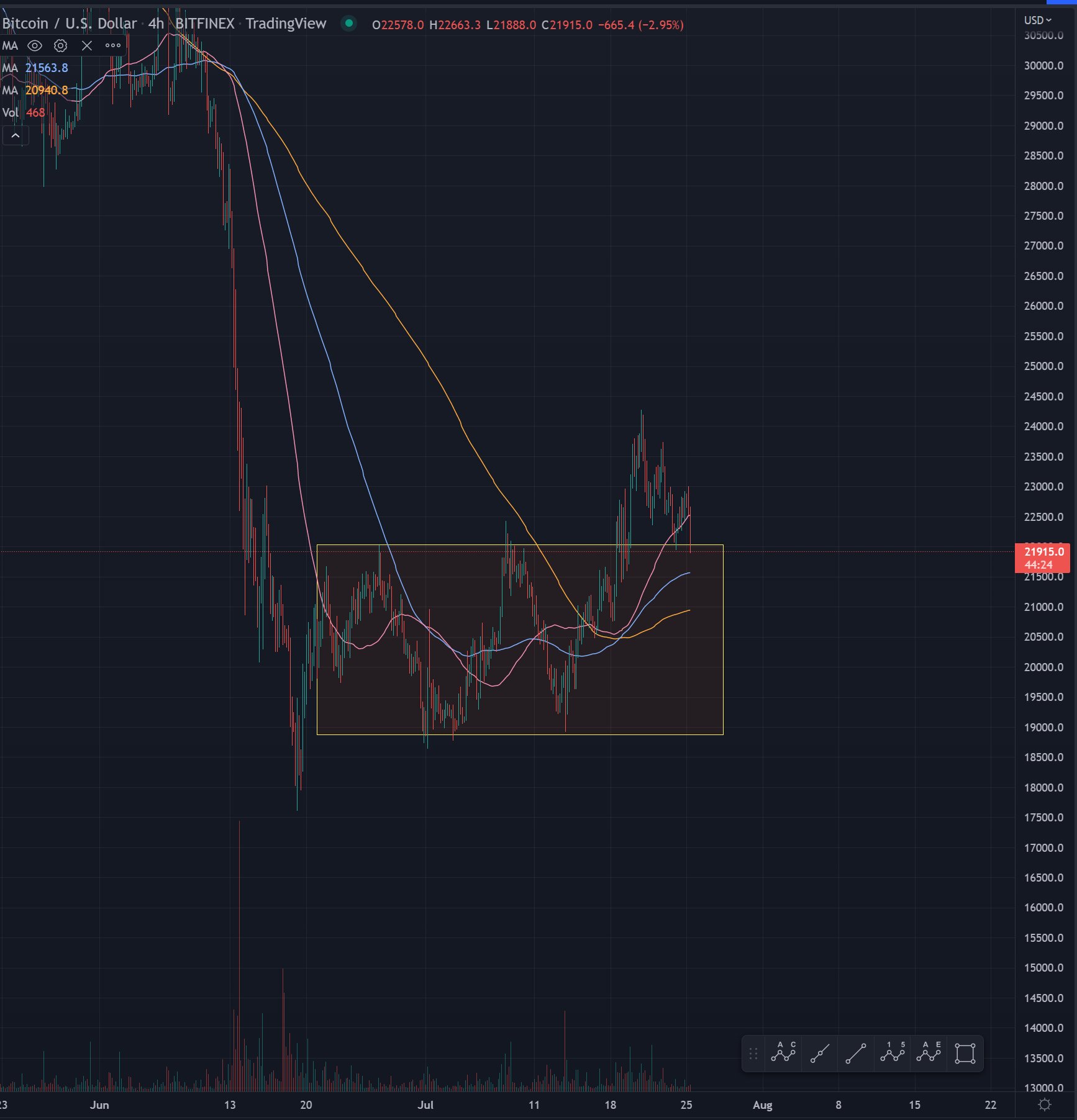
The analyst highlights that he’s seeing bull traps in other cryptocurrencies, not just BTC, warning that new bear market lows for digital assets could be on the table.

“Back in stablecoins. Price action on everything is starting to look like last week’s breakouts were fakeouts. Had a good few weeks, not willing to give it all back. Will aggressively buy new lows ‘if’ they happen over the next week or two… It’s a hard market to trade right now but if we get a new low it will be such a high-conviction, all-in buy. I hope it happens.”

While Smart Contracter has flipped bearish on BTC, fellow crypto analyst Credible tells his 337,400 Twitter followers that he’s still bullish on Bitcoin as long as it stays above his invalidation level of $19,615.

“[BTC] may dip below first local support here [$21,600] as the reaction off it thus far has been pretty lackluster. That being said, looks to have completed a five-wave move to the upside, volume peak on the fifth [wave] and declining since, so looking for a higher low and continuation. Invalidation level on [the] chart.”
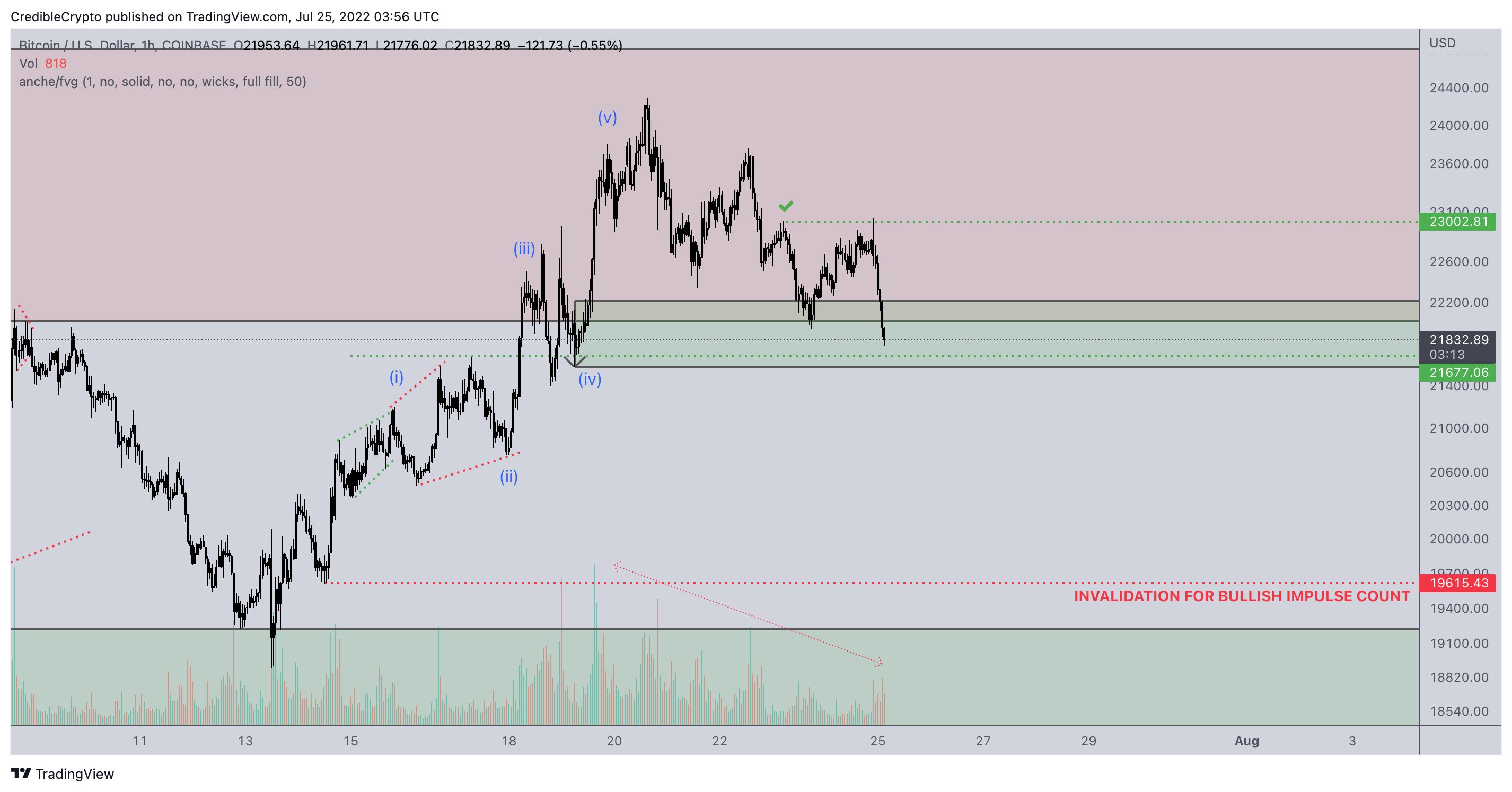
At time of writing, BTC is swapping hands for $21,081, down over 4% on the day.


Related Reads

The Real Battlefield of AI Lies in the 'Dark Forest'

The article "AI's Real Battlefield is in the 'Dark Forest'" discusses the shifting dynamics in the global AI landscape, contrasting the strategic directions of Chinese and U.S. AI developers. Chinese companies like Alibaba (with its "HappyHorse" video model), ByteDance (Seedance 2.0), and Kuaishou (Kling 3.0) have taken the lead in text-to-video generation, surpassing OpenAI’s now-discontinued Sora. These models are deeply integrated into their parent companies’ content ecosystems (e.g., Douyin, Kuaishou), serving to reduce content creation costs and enhance user engagement rather than operating as standalone profit centers. In contrast, U.S. firms are pivoting toward high-stakes enterprise and security applications. Anthropic’s Claude Mythos model demonstrates advanced capabilities in autonomously discovering and exploiting software vulnerabilities, prompting concern at the highest levels of U.S. financial and governmental institutions. OpenAI responded with its own GPT-5.4-Cyber, signaling a strategic shift from consumer-facing products to enterprise-grade tools focused on cybersecurity and programming. The divergence is attributed to fundamental differences in resources and market structures. U.S. companies, backed by vast computational resources (e.g., Amazon and Google supply Anthropic with substantial funding and TPU access), can pursue deep, specialized R&D in high-value B2B sectors. Chinese firms, facing significant compute power constraints and a less mature enterprise SaaS market, have found success by leveraging their massive consumer platforms and optimizing for cost-efficiency. The article warns that the AI race is entering a "dark forest" phase—a reference to competitive dynamics where cybersecurity capabilities could determine digital sovereignty. While Chinese models like Zhipu AI’s GLM-5.1 show promise in narrowing the gap in coding proficiency, the author stresses that achieving parity in security-critical AI will require asymmetric strategies, including greater investment in coding models, adaptation to domestic hardware, and exploring international markets in the Global South.

marsbit25m ago

The Real Battlefield of AI Lies in the 'Dark Forest'

marsbit25m ago

Trading

Spot
Futures

Hot Articles

What is $BITCOIN

DIGITAL GOLD ($BITCOIN): A Comprehensive Analysis Introduction to DIGITAL GOLD ($BITCOIN) DIGITAL GOLD ($BITCOIN) is a blockchain-based project operating on the Solana network, which aims to combine the characteristics of traditional precious metals with the innovation of decentralized technologies. While it shares a name with Bitcoin, often referred to as “digital gold” due to its perception as a store of value, DIGITAL GOLD is a separate token designed to create a unique ecosystem within the Web3 landscape. Its goal is to position itself as a viable alternative digital asset, although specifics regarding its applications and functionalities are still developing. What is DIGITAL GOLD ($BITCOIN)? DIGITAL GOLD ($BITCOIN) is a cryptocurrency token explicitly designed for use on the Solana blockchain. In contrast to Bitcoin, which provides a widely recognized value storage role, this token appears to focus on broader applications and characteristics. Notable aspects include: Blockchain Infrastructure: The token is built on the Solana blockchain, known for its capacity to handle high-speed and low-cost transactions. Supply Dynamics: DIGITAL GOLD has a maximum supply capped at 100 quadrillion tokens (100P $BITCOIN), although details regarding its circulating supply are currently undisclosed. Utility: While precise functionalities are not explicitly outlined, there are indications that the token could be utilized for various applications, potentially involving decentralized applications (dApps) or asset tokenization strategies. Who is the Creator of DIGITAL GOLD ($BITCOIN)? At present, the identity of the creators and development team behind DIGITAL GOLD ($BITCOIN) remains unknown. This situation is typical among many innovative projects within the blockchain space, particularly those aligning with decentralized finance and meme coin phenomena. While such anonymity may foster a community-driven culture, it intensifies concerns about governance and accountability. Who are the Investors of DIGITAL GOLD ($BITCOIN)? The available information indicates that DIGITAL GOLD ($BITCOIN) does not have any known institutional backers or prominent venture capital investments. The project seems to operate on a peer-to-peer model focused on community support and adoption rather than traditional funding routes. Its activity and liquidity are primarily situated on decentralized exchanges (DEXs), such as PumpSwap, rather than established centralized trading platforms, further highlighting its grassroots approach. How DIGITAL GOLD ($BITCOIN) Works The operational mechanics of DIGITAL GOLD ($BITCOIN) can be elaborated on based on its blockchain design and network attributes: Consensus Mechanism: By leveraging Solana’s unique proof-of-history (PoH) combined with a proof-of-stake (PoS) model, the project ensures efficient transaction validation contributing to the network's high performance. Tokenomics: While specific deflationary mechanisms have not been extensively detailed, the vast maximum token supply implies that it may cater to microtransactions or niche use cases that are still to be defined. Interoperability: There exists the potential for integration with Solana’s broader ecosystem, including various decentralized finance (DeFi) platforms. However, the details regarding specific integrations remain unspecified. Timeline of Key Events Here is a timeline that highlights significant milestones concerning DIGITAL GOLD ($BITCOIN): 2023: The initial deployment of the token occurs on the Solana blockchain, marked by its contract address. 2024: DIGITAL GOLD gains visibility as it becomes available for trading on decentralized exchanges like PumpSwap, allowing users to trade it against SOL. 2025: The project witnesses sporadic trading activity and potential interest in community-led engagements, although no noteworthy partnerships or technical advancements have been documented as of yet. Critical Analysis Strengths Scalability: The underlying Solana infrastructure supports high transaction volumes, which could enhance the utility of $BITCOIN in various transaction scenarios. Accessibility: The potential low trading price per token could attract retail investors, facilitating wider participation due to fractional ownership opportunities. Risks Lack of Transparency: The absence of publicly known backers, developers, or an audit process may yield skepticism regarding the project's sustainability and trustworthiness. Market Volatility: The trading activity is heavily reliant on speculative behavior, which can result in significant price volatility and uncertainty for investors. Conclusion DIGITAL GOLD ($BITCOIN) emerges as an intriguing yet ambiguous project within the rapidly evolving Solana ecosystem. While it attempts to leverage the “digital gold” narrative, its departure from Bitcoin's established role as a store of value underscores the need for a clearer differentiation of its intended utility and governance structure. Future acceptance and adoption will likely depend on addressing the current opacity and defining its operational and economic strategies more explicitly. Note: This report encompasses synthesised information available as of October 2023, and developments may have transpired beyond the research period.

363 Total ViewsPublished 2025.05.13Updated 2025.05.13

What is $BITCOIN

Discussions

Welcome to the HTX Community. Here, you can stay informed about the latest platform developments and gain access to professional market insights. Users' opinions on the price of BTC (BTC) are presented below.

活动图片