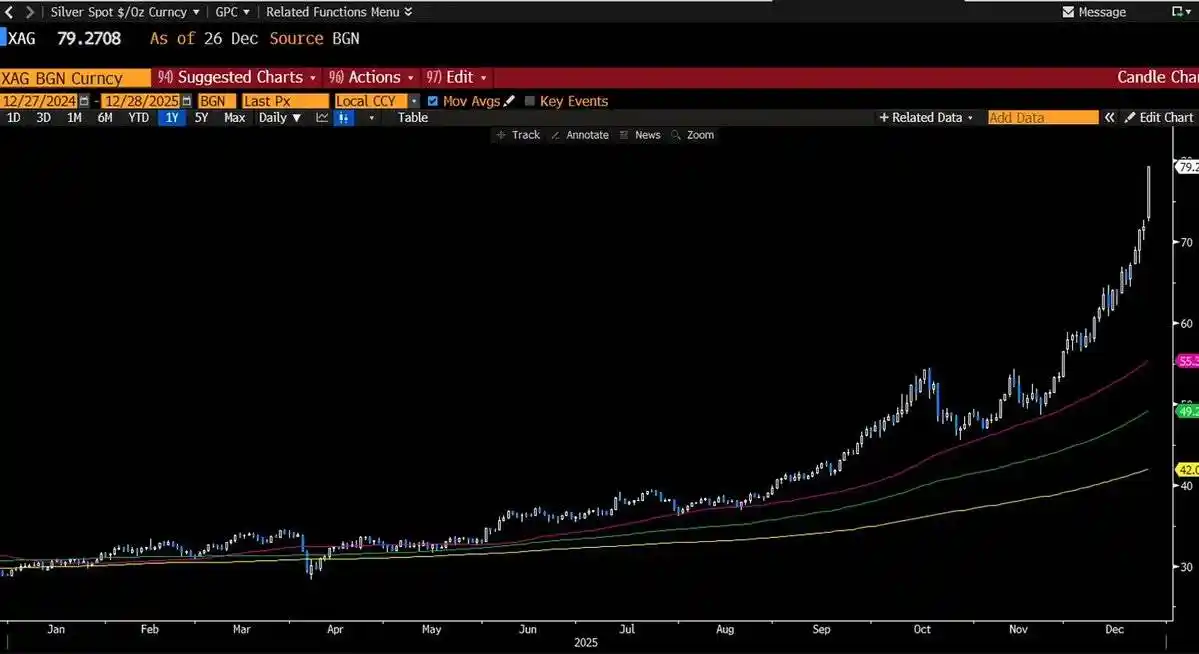
La plata se dispara: un aumento del 25% en 10 días, ¿deberías comprar o vender ahora?

marsbitPublished on 2025-12-29Last updated on 2025-12-29

Abstract

Resumen: La plata se dispara un 25% en 10 días. El autor recomienda no entrar en nuevas posiciones a corto plazo, anticipando una posible corrección. Factores bajistas incluyen ventas por impuestos en enero, un dólar fuerte y el aumento de requisitos de margen (aunque su impacto es menor que en 2011). Sin embargo, los fundamentos alcistas siguen sólidos: China impondrá licencias de exportación desde el 1 de enero, primas físicas de $10-14 en Asia, un mercado físico en backwardation extremo en Londres, y una demanda solar inelástica que no se destruirá hasta los $134/oz. La sustitución por cobre llevaría al menos 4 años. La plata tiene un camino claro hacia subidas mayores, pero la volatilidad será alta. Ajusta posiciones en consecuencia.

Autor:Campbell

Compilado por: Deep Tide TechFlow

Han pasado 10 días desde nuestro último análisis sobre la plata.

La dinámica del mercado de hace 10 días parece ser cosa del pasado. Sin embargo, en este corto período, el mercado de la plata ha experimentado una serie de eventos importantes:

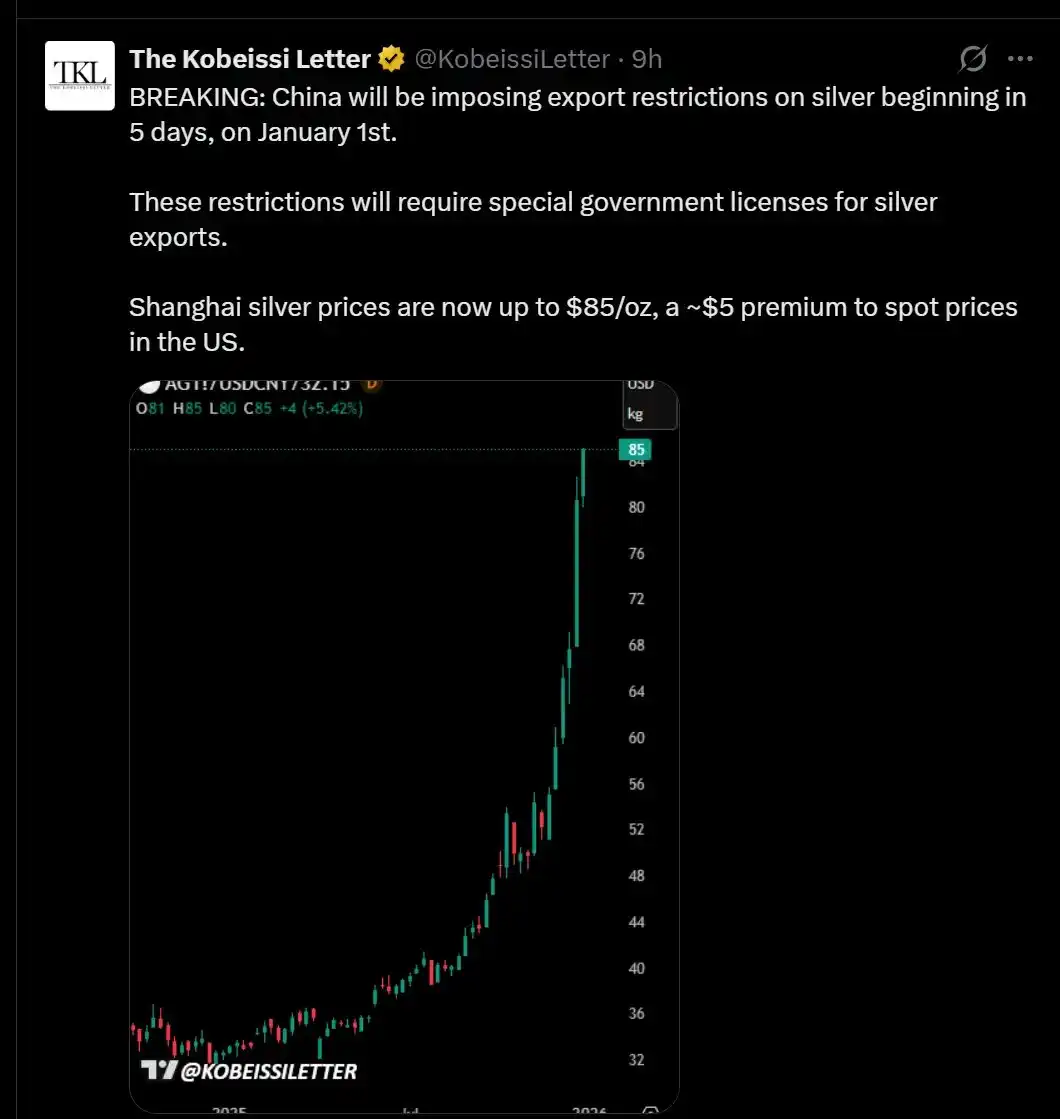
  • China anunció que implementará un sistema de licencias para las exportaciones de plata a partir del 1 de enero del próximo año.

  • El precio físico de la plata en Shanghái se disparó a 91 dólares, mientras que el precio de liquidación en COMEX (Bolsa Mercantil de Nueva York) fue de 77 dólares.

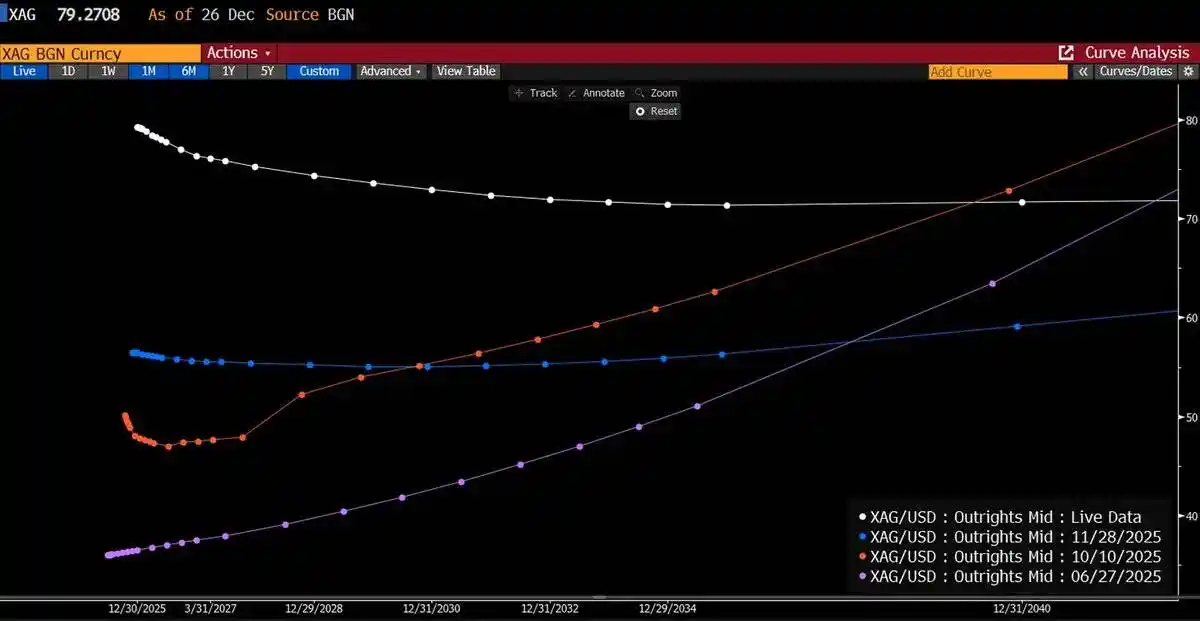
  • La curva forward de Londres sigue en backwardation (mercado invertido), aunque no tan extrema como en octubre, pero aún invertida.

  • CME (Chicago Mercantile Exchange) aumentó los requisitos de margen para la plata.

  • Después de una merecida "desintoxicación" digital, pasé toda la tarde mirando Bloomberg y Rose, tratando de averiguar si estos cambios afectarían nuestra visión del mercado.

Conclusión a corto plazo: ahora no es un buen momento para nuevas compras.

Esperaré una próxima corrección para seguir posicionándome y mantendré flexibilidad al operar con opciones.

Esta es la parte que los libros de trading no te cuentan: cuando tu lógica de inversión funciona, e incluso funciona demasiado bien, necesitas no solo gestionar el dinero, sino también tu capacidad emocional. En este punto, los modelos matemáticos teóricos ya no son solo una distribución de probabilidad, sino una opción call de "ganancias realizadas".

Esta etapa es incómoda porque necesitas hacer más trabajo: verificar tus cálculos, evaluar narrativas contrarias que podrían perjudicarte.

Esta es la situación actual.

Advertencia bajista (o: factores de riesgo potencialmente "fatales")

En las próximas dos semanas, los alcistas de la plata tendrán que enfrentar algunas narrativas y presiones que podrían generar sentimientos bajistas a corto plazo.

Por favor, no te sorprendas por las próximas "velas rojas", es muy probable que ocurran. La clave es si elegirás comprar en los mínimos. Hemos trasladado parte de nuestro "Delta" (exposición al precio) al oro, reequilibrando la cartera. Actualmente tenemos alrededor de un 15% de exposición al oro y un 30%-40% a la plata, mientras que antes esta proporción era más cercana a 10:1.

Además, compramos algunas mariposas alcistas (upside butterflies) y compramos significativamente opciones call sobre el dólar. La lógica detrás de estas operaciones se aclarará gradualmente más adelante.

De todos modos, aquí están los principales factores que podrían generar presión bajista en este momento:

  1. Presión de ventas por impuestos

Esta operación ya te ha dado buenas ganancias, incluso tantas que podrían hacer que tu contador se sienta incómodo. Para aquellos inversores que compraron plata ejerciendo opciones call a largo plazo, podrían sentir resistencia a vender sus posiciones antes del 31 de diciembre.
Especialmente si estas posiciones se han mantenido por menos de un año, ya que esto no solo implica impuestos sobre las ganancias de capital, sino que también puede enfrentar diferencias en el tratamiento fiscal a corto y largo plazo.
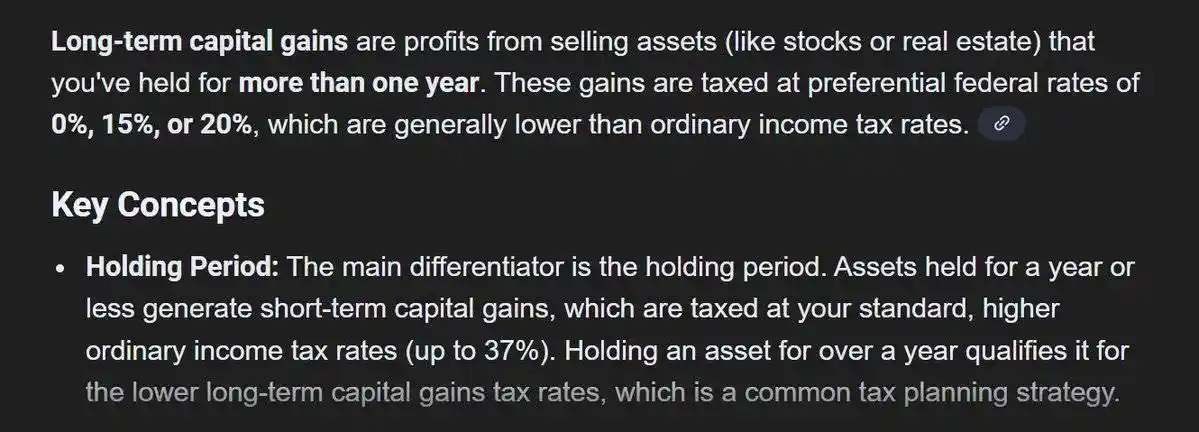
Esto significa que actualmente hay presión alcista, pero después del 2 de enero, se convertirá en presión bajista.

  1. Problemas con el dólar y las tasas de interés

Los últimos datos del PIB fueron sólidos, lo que podría debilitar las expectativas de flexibilización en la curva de rendimiento de los bonos del Tesoro a 2 años, obligando a los formuladores de políticas a elegir entre un dólar más fuerte y tasas de interés a corto plazo más altas. Cualquiera de las dos opciones no es buena noticia a corto plazo para los metales preciosos denominados en dólares, como la plata y el oro.
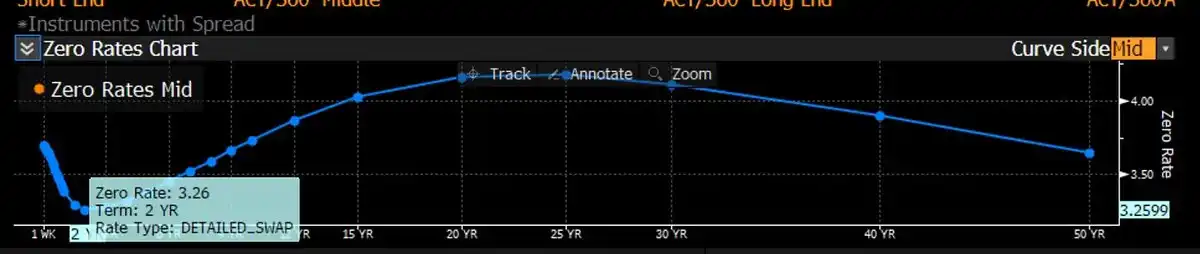
  1. Aumento de los márgenes

CME (Chicago Mercantile Exchange) anunció que aumentará los requisitos de margen para metales preciosos a partir del 29 de diciembre.
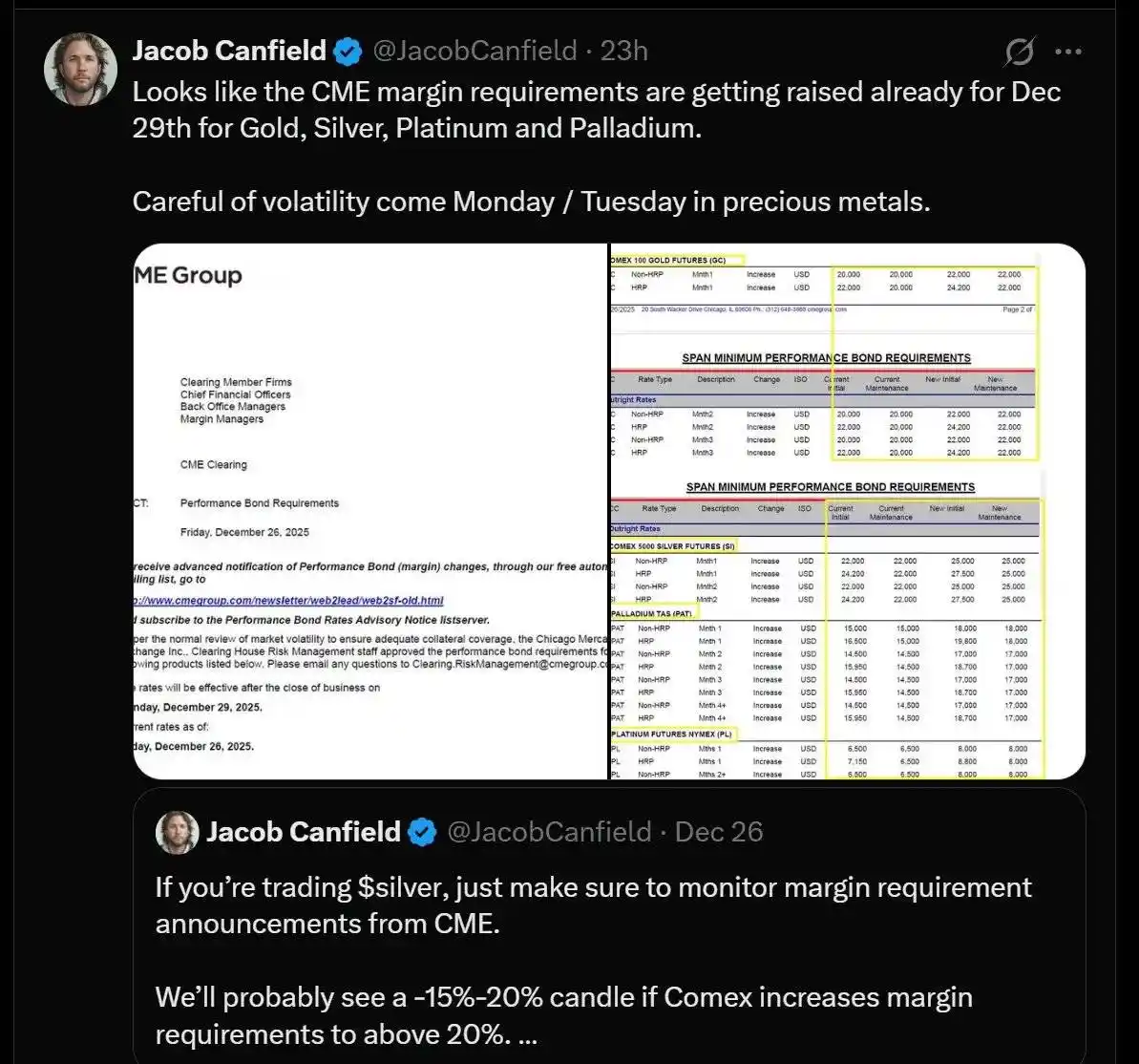
Si estás utilizando apalancamiento en el mercado de futuros, este cambio podría afectarte significativamente. Mayores requisitos de margen = Mayor necesidad de capital = Liquidaciones forzadas para inversores con fondos insuficientes. Esto es similar a lo que sucedió durante el colapso del mercado de plata en 2011, cuando el CME aumentó los requisitos de margen cinco veces consecutivas en 8 días, lo que provocó una caída en el apalancamiento y puso fin abrupto al rally alcista de la plata.

Entonces, ¿vale la pena preocuparse? En realidad, no es tan malo. La razón es que los requisitos de margen para la plata ya estaban muy por encima de los niveles de 2011, por lo que el reciente aumento, aunque tiene un impacto, es relativamente menor. Además, la mayor parte de la demanda del mercado de plata ahora es principalmente demanda física, lo cual es muy diferente a la situación de 2011.
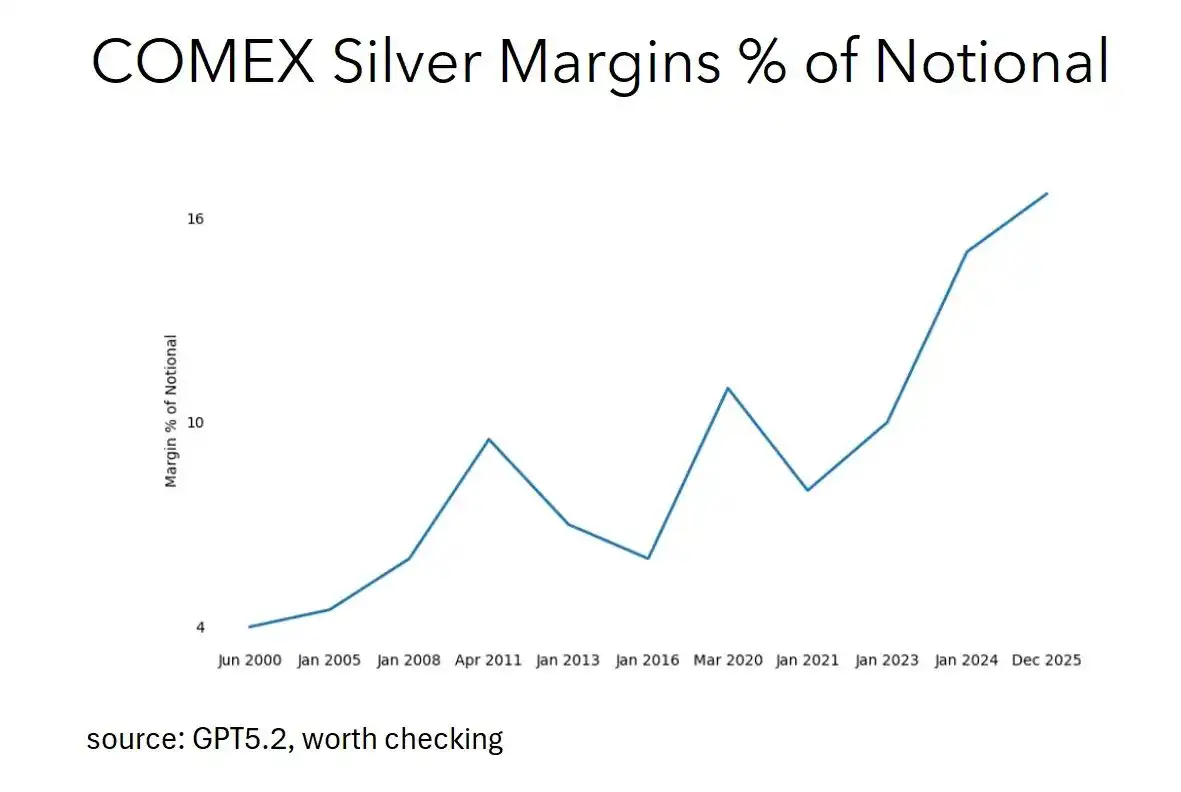
En 2011, el margen inicial para la plata era de solo alrededor del 4% del valor nominal, lo que significa que con solo 4 dólares de capital se podía controlar plata por valor de 100 dólares: un apalancamiento de 25 veces, extremadamente riesgoso. Luego, el CME aumentó el margen a alrededor del 10% en unas semanas, reduciendo el apalancamiento de 25 veces a 10 veces, y la reacción en cadena de liquidaciones forzadas acabó directamente con el rally alcista de la plata en ese momento.

¿Y hoy? Actualmente, el margen para la plata es de alrededor del 17%, equivalente a un apalancamiento de 6 veces, lo que es incluso más estricto que los requisitos de margen más severos de 2011.
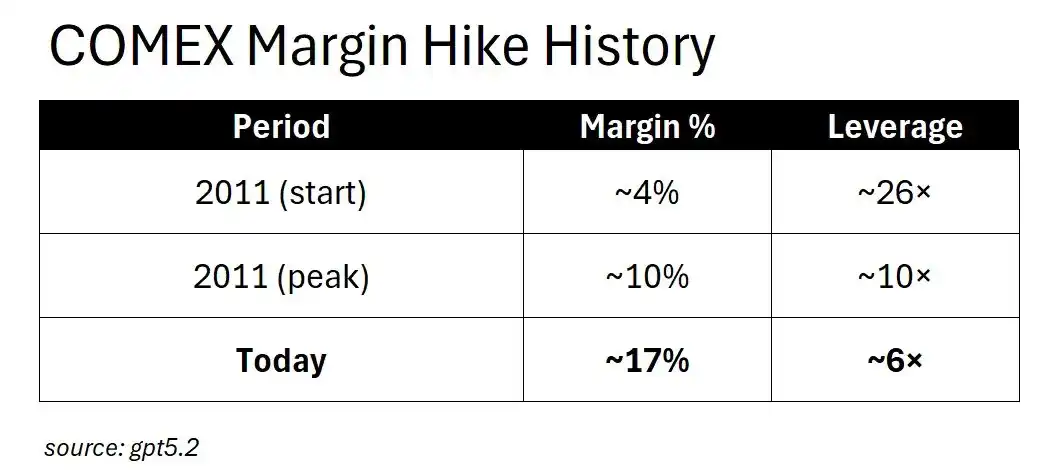
El entorno actual del mercado ya está en la fase de márgenes "post-squeeze", entonces, ¿qué efecto tendría seguir aumentando los márgenes? La respuesta es: ya no provocará ventas de pánico por parte de los especuladores, porque no queda mucho apalancamiento especulativo que limpiar. En cambio, estos ajustes afectarán más a los coberturistas, como los productores que intentan fijar precios, los refinadores que gestionan el riesgo de inventario y los actores comerciales que dependen del mercado de futuros para operar.

Si el margen se aumenta al 20%, no verás una reacción en cadena de liquidaciones forzadas como en 2011. El resultado real es: menos liquidez, mayor diferencial entre precios de compra y venta (bid-ask spread), y los actores comerciales se mudan al mercado extrabursátil (OTC). El mecanismo del mercado ha cambiado fundamentalmente.

Por lo tanto, aquellos que advierten sobre los aumentos de margen están librando la "última guerra" (si el análisis anterior es correcto). Aunque este argumento puede ayudar a construir una "narrativa contraria" a corto plazo, su significado práctico es limitado.

  1. Aparición de comentarios de "sobrecompra"

Cuando los factores mencionados anteriormente comiencen a manifestarse, escucharás a los "adivinos técnicos" de FinTwit (Financial Twitter) hablar de "sobrecompra". Y las ventas técnicas suelen provocar más ventas técnicas, creando un ciclo negativo.

Pero la pregunta es, ¿"sobrecomprado" en comparación con qué?
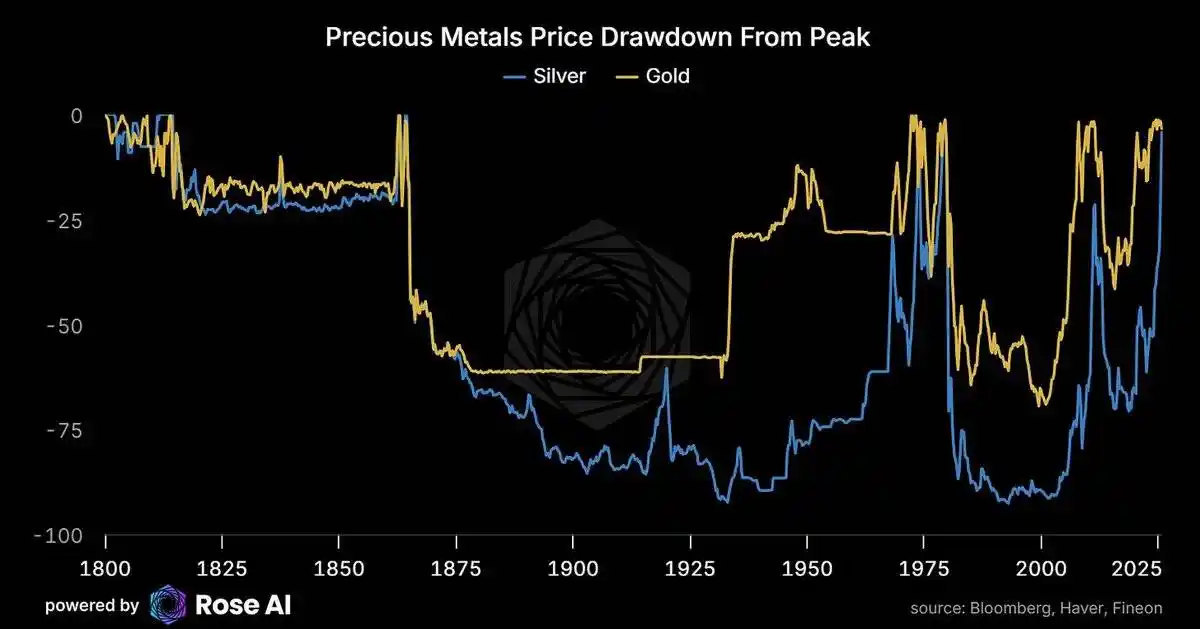
La lógica de inversión en plata no se basa en "líneas" de gráficos técnicos o "adivinación con hojas de té". El motor central de la plata está en sus fundamentos de oferta y demanda: la colisión entre la economía de los paneles solares (demanda inelástica, el costo de la plata representa solo alrededor del 10% del precio del panel) y la rigidez de la oferta de plata (el 75% de la plata es un subproducto de otros metales). Estos son los verdaderos impulsores de los movimientos de precios a corto plazo.

Además, la plata acaba de alcanzar un máximo histórico. ¿Sabes qué más alcanza máximos históricos? Los activos que siguen subiendo.

  1. Teoría de la sustitución por cobre

Este es uno de los argumentos más utilizados por los bajistas: "Usarán cobre para reemplazar la plata".

Bueno, este punto tiene cierto sentido, pero hagamos las cuentas detenidamente.

La realidad de la sustitución por cobre (o: cuatro años es mucho tiempo)

El argumento bajista de la sustitución por cobre existe, pero el problema es que es lento.

Aquí está el cálculo matemático real, no la especulación sensacionalista:

El tiempo es el factor limitante clave

Incluso con fondos ilimitados, la conversión todavía está sujeta a condiciones físicas:

  • Hay alrededor de 300 fábricas que fabrican células solares en el mundo;

  • Convertir cada fábrica para usar revestimiento de cobre toma 1.5 años;

  • La capacidad máxima de conversión en paralelo es de 60 fábricas por año;

  • Se necesitan al menos 4 años para lograr una tasa de sustitución de cobre del 50%.

Desde la perspectiva de estos períodos de retorno, un tiempo de conversión de 1.5 años es una decisión obvia de asignación de capital. En otras palabras, los directores financieros deberían competir por aprobar estos planes de reconversión.
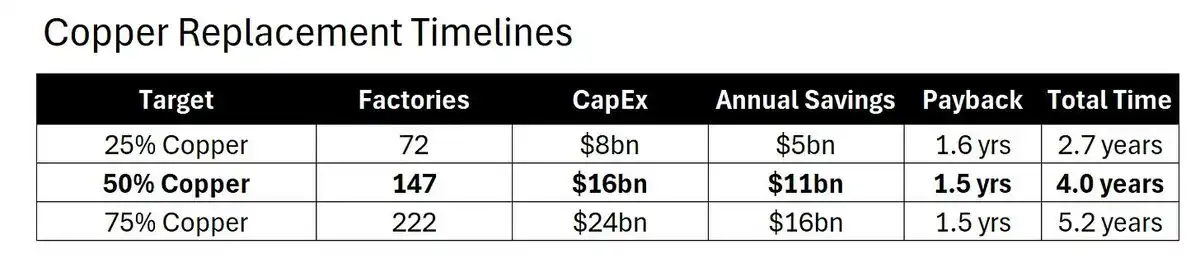
Pero el problema es que, incluso así, se necesitan al menos 4 años para completar la mitad de la conversión.

Las fábricas necesitan ser reconvertidas una por una, los ingenieros necesitan ser reentrenados, las fórmulas de revestimiento de cobre necesitan ser validadas, las cadenas de suministro necesitan reajustarse. Todo esto lleva tiempo.

Cálculo de la elasticidad de la demanda

Los fabricantes solares ya han absorbido el impacto de un aumento de 3 veces en el precio de la plata. Podemos ver el efecto en sus ganancias:
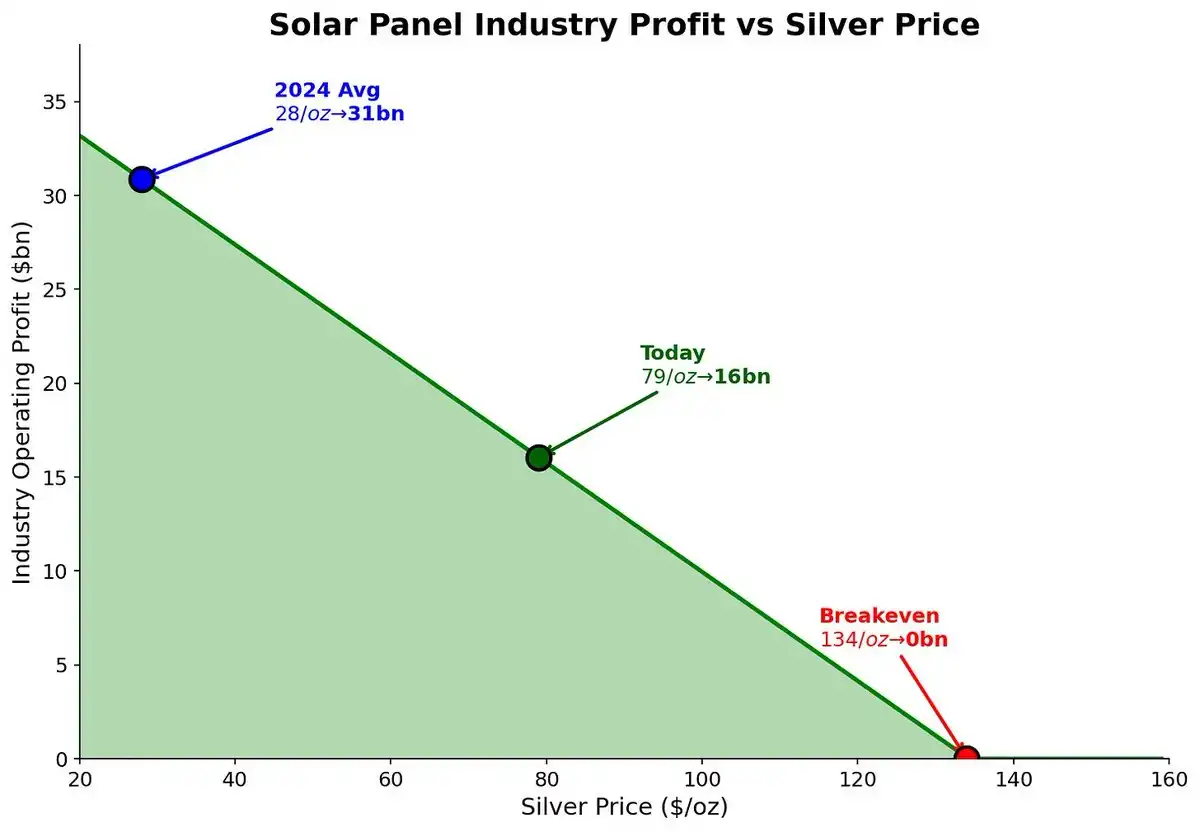
  • Con el precio de la plata a 28 dólares/onza (precio promedio 2024), las ganancias totales de la industria fueron de 31 mil millones de dólares;

  • Con el precio de la plata subiendo a 79 dólares/onza (precio actual), las ganancias de la industria cayeron a 16 mil millones de dólares. Aunque las ganancias se redujeron a la mitad, siguieron comprando.

¿Dónde está el punto de equilibrio?

La destrucción de la demanda comenzaría a manifestarse cuando el precio de la plata alcance los 134 dólares/onza. Este precio está 70% por encima del precio spot actual.

Es importante notar que 134 dólares/onza no es un objetivo de precio, sino el punto de partida de la destrucción de la demanda.

Umbral de urgencia

A medida que el precio de la plata sube aún más, la economía de la sustitución por cobre se vuelve más atractiva:
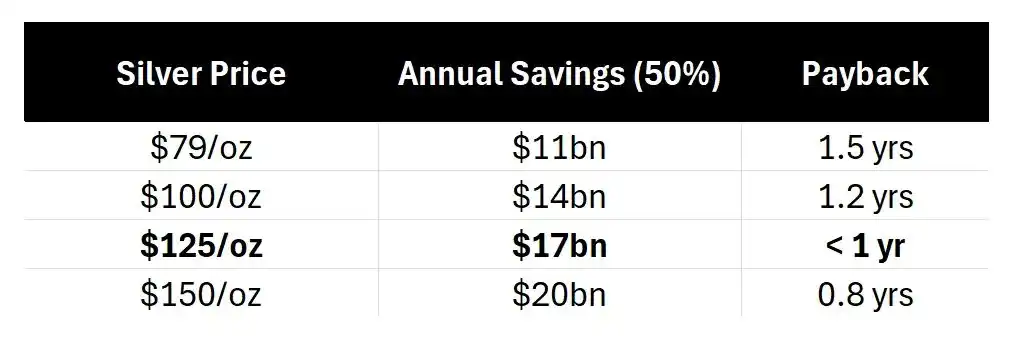
Cuando el precio de la plata alcance los 125 dólares/onza, el período de retorno de la sustitución por cobre se acortará a menos de un año. En ese momento, cada reunión de directorio podría girar en torno a la sustitución por cobre. Sin embargo, incluso si todas las empresas decidieran hacerlo mañana, tomaría 4 años lograr una sustitución del 50%. Mientras tanto, 125 dólares/onza sigue estando 50% por encima del precio spot actual.

El dinero "grita" "actúa rápido", pero la realidad física dice "espera".

Paradoja de la intensidad

Curiosamente, mientras todos hablan de "sustitución por cobre", la industria solar en realidad se está moviendo hacia tecnologías de paneles que usan más plata:
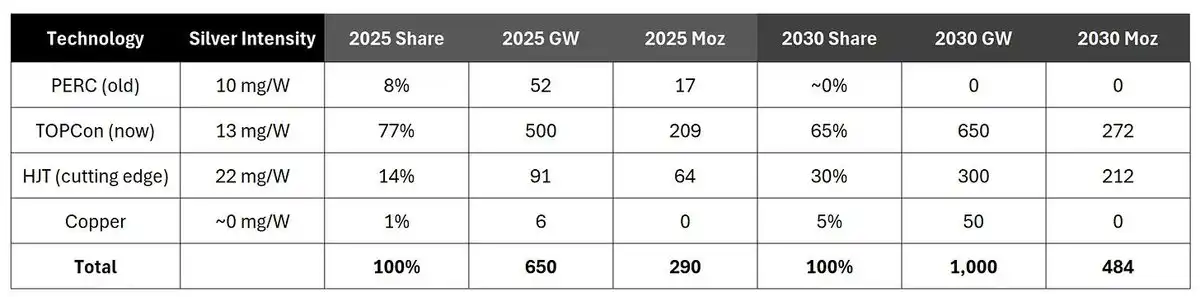
Uso promedio ponderado de plata:

  • 2025: alrededor de 13.5 mg/vatio

  • 2030: alrededor de 15.2 mg/vatio

La transición de PERC a TOPCon y luego a tecnología HJT (heterounión) en realidad aumenta el uso de plata por vatio de panel solar, incluso si el cobre reemplaza gradualmente a la plata en algunos aspectos. Pero es crucial notar que, aunque la eficiencia del uso de plata de cada tecnología mejora con el tiempo, sin planes de inversión masivos en cobre, la industria en general se está moviendo hacia usar más plata por vatio, no menos.

Los bajistas hablan de sustitución por cobre, mientras que la industria en realidad está adoptando tecnología HJT.

Conclusión sobre la sustitución por cobre

El tiempo pasa, pero pasa lentamente.

El precio de la plata está subiendo más rápido de lo que las fábricas pueden reconvertirse. La ventana de 4 años es el paraguas protector de la lógica alcista de la plata: el precio de la plata tiene un 70% de espacio alcista antes de desencadenar la destrucción de la demanda, e incluso si la sustitución por cobre comenzara hoy, no podría alcanzar el ritmo alcista de la plata a corto plazo.

Lógica alcista de la plata (o: por qué este rally podría "desgarrarte, pero de manera placentera")

Bien. Ya hemos tratado lo malo. Ahora hablemos de por qué sigo siendo alcista.

  1. China está "armando" la plata

A partir del 1 de enero, China implementará un sistema de licencias para las exportaciones de plata. Esto es crucial porque China es el principal exportador neto de plata refinada a nivel mundial, exportando alrededor de 121 millones de onzas de plata anualmente, casi en su totalidad a través de Hong Kong hacia el mercado global.

Y ahora, este flujo de exportación requerirá el permiso del gobierno.

El juego de recursos estratégicos está en marcha.

  1. Las primas de la plata física son astronómicamente altas
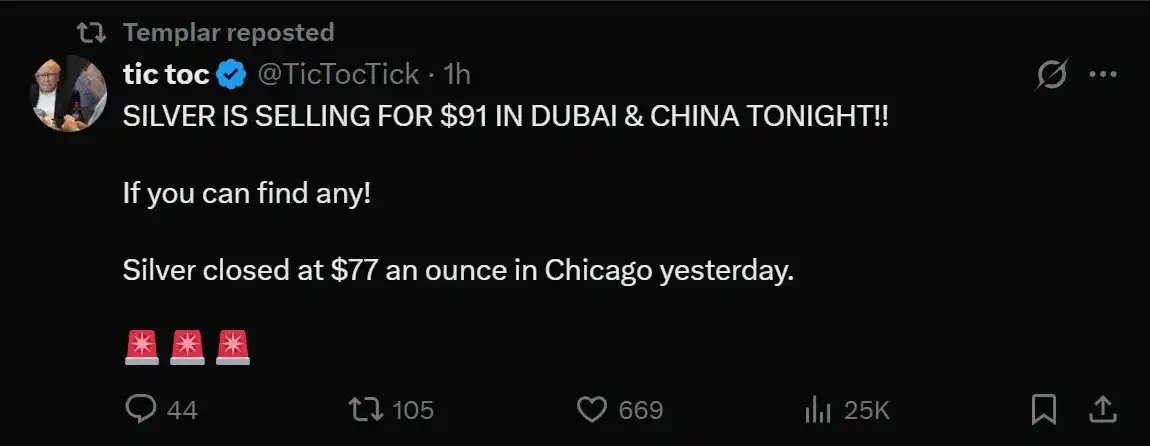
Shanghái: 85 dólares/onza; Dubái: 91 dólares/onza; COMEX: 77 dólares/onza

Tú vives en un mundo denominado en dólares, pero el comprador marginal no. Ellos pagan una prima de 10-14 dólares, y no les importa.

Cuando el precio de la plata física diverge tanto del precio en papel, alguien está equivocado. Y históricamente, quien suele equivocarse no es el mercado físico.

  1. El "grito" del mercado de Londres

El mercado extrabursátil (OTC) de Londres es el núcleo donde se negocia la plata física entre bancos de metales preciosos, refinadores y usuarios industriales, y actualmente se encuentra en su estado de backwardation (mercado invertido) más severo en décadas.

¿Qué es backwardation?

Simple: el mercado está dispuesto a pagar un precio más alto por la entrega física hoy que por la promesa de entrega futura. Es decir, precio spot > precio forward. Este fenómeno no es normal y generalmente indica una gran presión en el mercado.

  • Hace un año: precio spot 29 dólares, la curva de precios subía gradualmente a 42 dólares, un contango normal.

  • Ahora: precio spot 80 dólares, la curva de precios cae a 73 dólares, invertida.

Mientras tanto, el mercado de papel de COMEX todavía muestra un contango perezoso, fingiendo que todo está normal.

Tres mercados, tres narrativas:
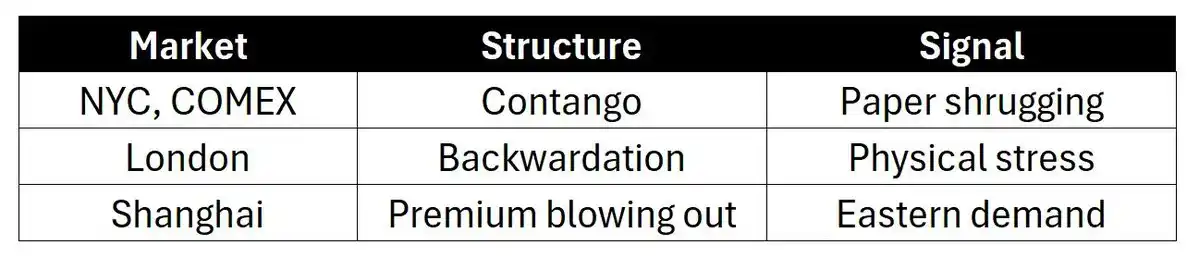
  1. La volatilidad ha sido revalorizada

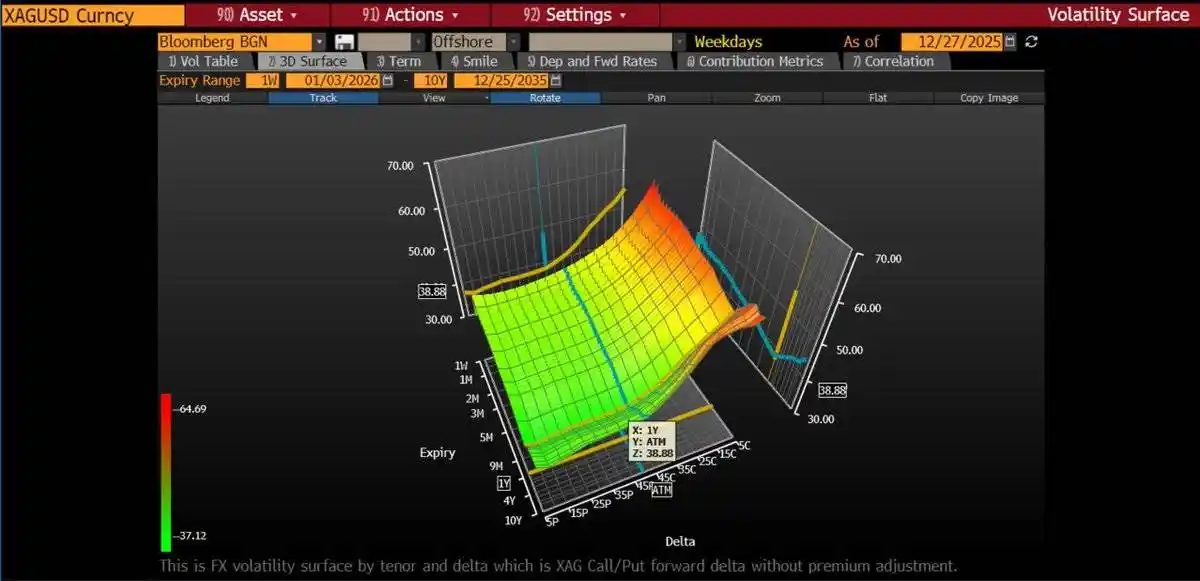
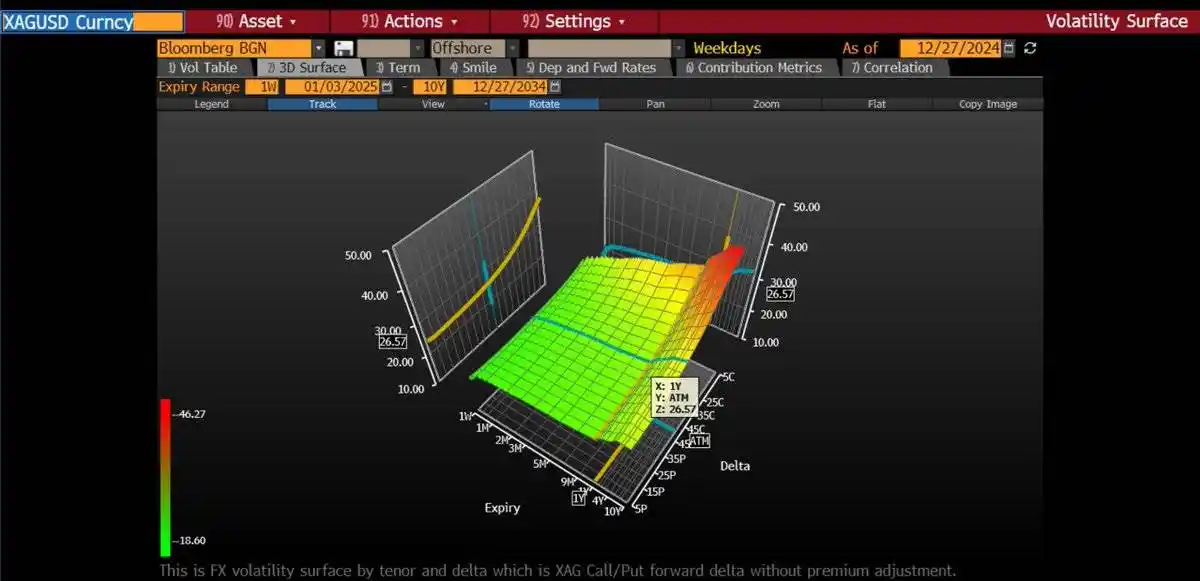
La volatilidad implícita (ATM Volatility) de las opciones at-the-money aumentó interanualmente del 27% al 43%. La volatilidad implícita de las opciones call es más pronunciada: la volatilidad implícita de las opciones out-of-the-money (OTM) alcanza 50-70%. Esto indica que el mercado de opciones está valorando el riesgo de cola de una subida significativa de precios.

Hemos estado posicionándonos gradualmente a lo largo de la curva de volatilidad comprando spreads alcistas (call spreads), específicamente: comprando volatilidad implícita at-the-money y cubriendo costos vendiendo calls con strikes más altos. Recientemente, incluso adoptamos una estrategia de compra de mariposas a 6 meses:

  • Comprar 1 opción call sobre el ETF SLV (iShares Silver Trust) con strike de 70 dólares;

  • Vender 2 opciones call con strike de 90 dólares;

  • Recomprar 1 opción call con strike de 110 dólares.

Esta estrategia refleja nuestra visión a corto plazo de querer reducir nuestra exposición Delta (sensibilidad a los movimientos de precios) en caso de un aumento significativo de precios.

  1. Los especuladores aún no están aglomerados

Actualmente, las posiciones netas largas especulativas en el mercado del oro representan el 31% del interés abierto total (Open Interest), mientras que en el mercado de la plata esta proporción es de solo el 19%. Esto indica que, aunque el precio de la plata ha subido, las posiciones especulativas no han alcanzado niveles extremos, y todavía hay espacio para más subidas.

  1. La demanda de ETF está alcanzando

La demanda de inversión aumenta a medida que sube el precio, validando nuestra predicción anterior: la plata se comportará como un bien Veblen (Veblen Goods), donde a mayor precio, mayor demanda.
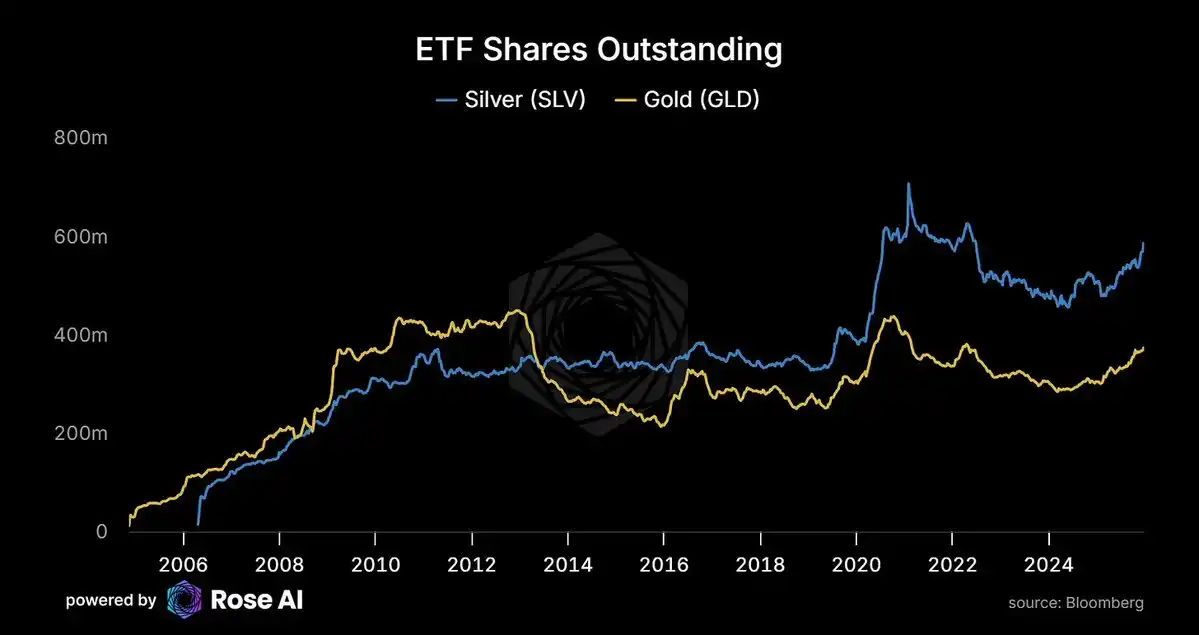
  • El número de acciones en circulación del ETF SLV está aumentando nuevamente después de años de salidas de capital. El precio sube y la demanda aumenta.

  • Este no es el comportamiento típico de un mercado de productos básicos, sino que refleja el crecimiento de la demanda de la plata como un activo monetario.

Mientras tanto, la prima de la plata en el mercado chino persiste:
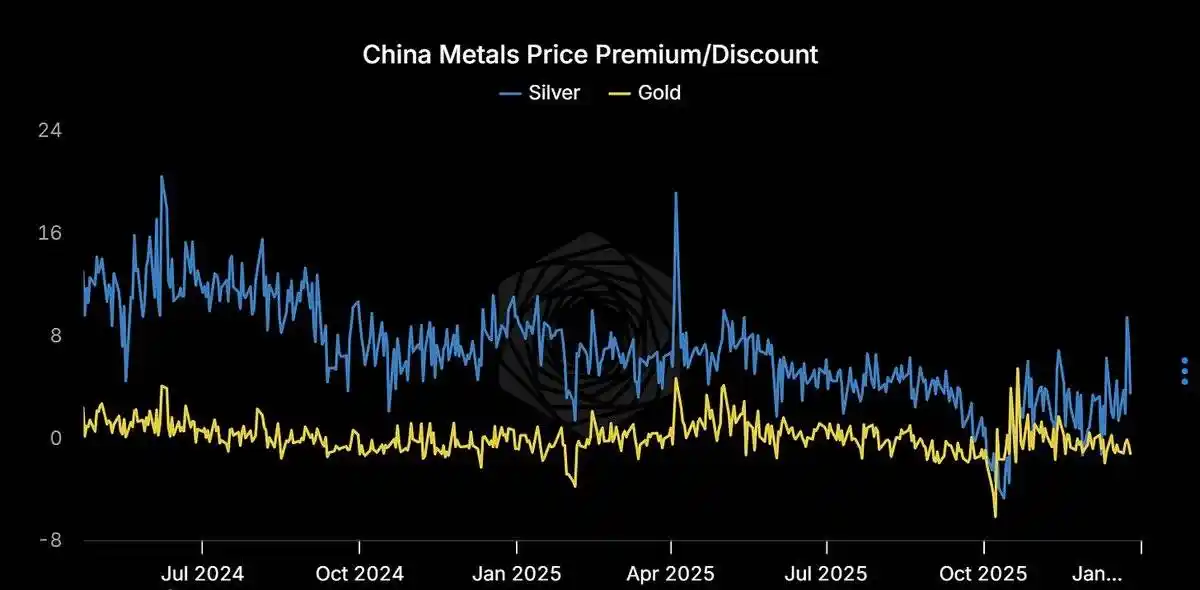
<极速>

  • Los ETF occidentales han comenzado a recomprar plata;

  • Y la demanda física de plata en los mercados orientales nunca se detuvo.

  1. La "devoración" de la plata por la industria solar
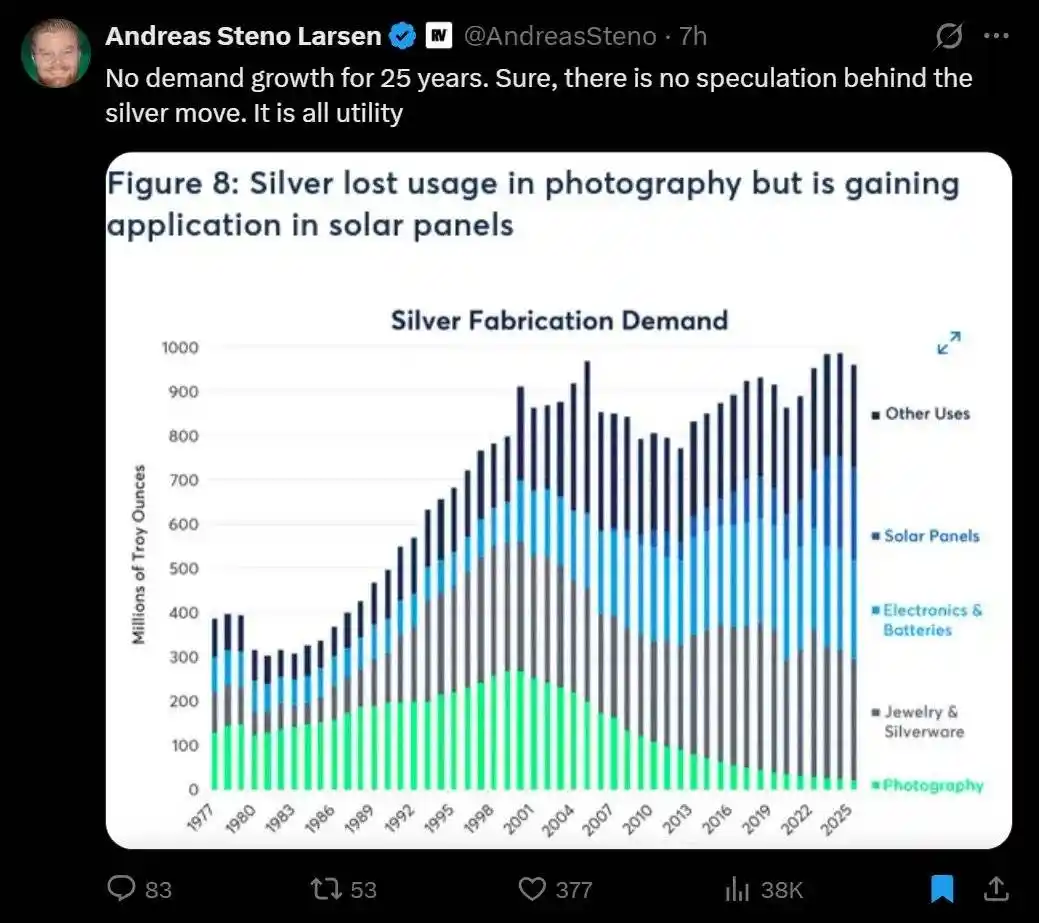
25 años sin crecimiento de la demanda, sin crecimiento de la oferta, y luego llegó la solar

En los últimos 25 años, la demanda del mercado de la plata apenas creció y la oferta no aumentó significativamente. Pero todo cambió con el auge de la industria solar. La demanda de plata para fotografía se desvaneció, y la industria solar no solo llenó este vacío, sino que impulsó further un crecimiento explosivo de la demanda de plata.

  • La demanda actual de plata de la industria solar es de 290 millones de onzas;

  • Para 2030, se espera que esta cifra supere los 450 millones de onzas.

  1. Inteligencia Artificial → Energía → Solar → Plata
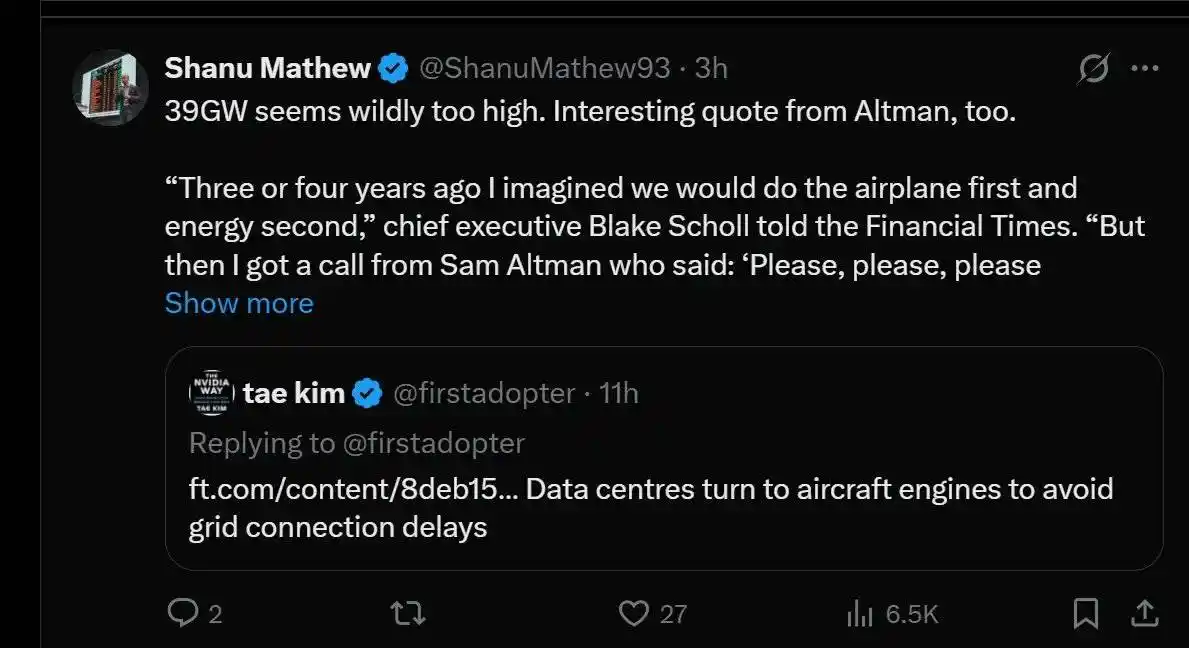
La cadena de demanda desde la inteligencia artificial hasta la plata ya está formada:

  • Sam Altman (CEO de OpenAI) está contactando empresas por todas partes, buscando desesperadamente suministro eléctrico;

  • Los centros de datos están empezando a instalar motores de avión como energía de respaldo para evitar retrasos en la conexión a la red;

  • Cada consulta de IA consume electricidad, y la contribución marginal a la nueva oferta eléctrica proviene de la solar;

  • Y el desarrollo solar necesita plata.

Esta cadena ya está cerrada.

Precios y señales clave a observar
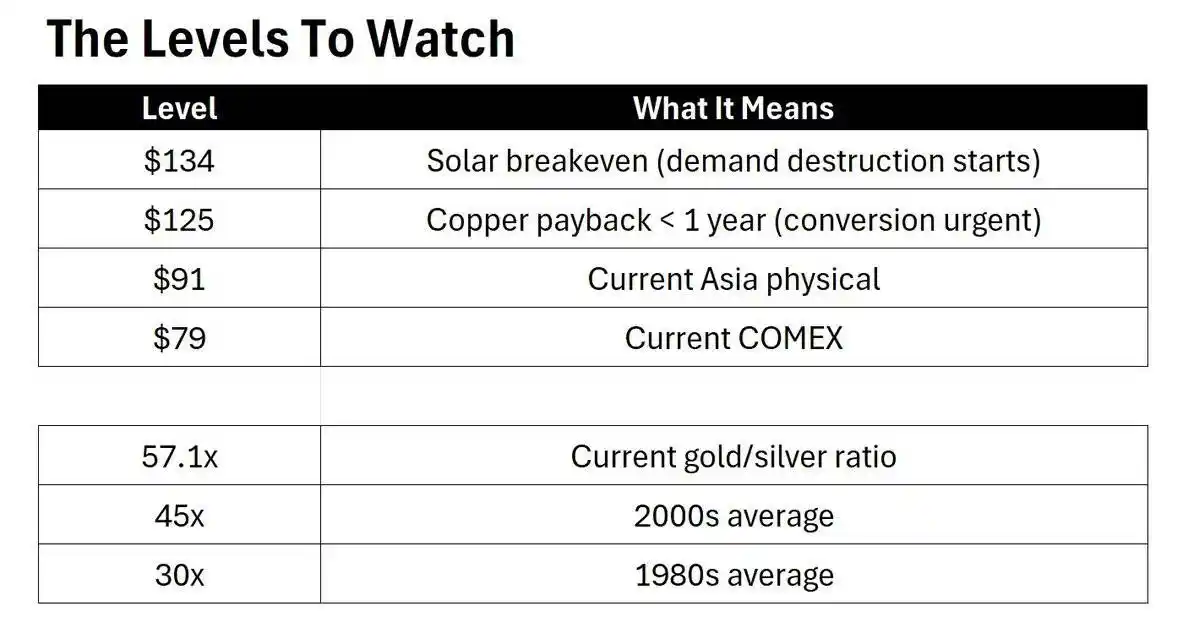
Riesgos a observar

  1. Ventas por impuestos en enero: Los inversores pueden vender por razones fiscales a principios de año, generando volatilidad a corto plazo;

  2. Dólar más fuerte: Un dólar fuerte puede ejercer presión sobre los precios de la plata denominados en dólares;

  3. Aumentos de margen: Aunque el "interruptor de matar" (killer switch) está agotado, aún hay que estar atento a más aumentos de margen.

Señales a observar

  1. El backwardation se profundiza, el precio se consolida: Indica que el mercado se está acumulando;

  2. El backwardation se alivia, el precio cae: Indica que el squeeze se está deshaciendo;

  3. La prima en el mercado de Shanghái persiste: Indica que es un problema estructural, no ruido de mercado.

Marco de observación:

Observa la curva, no el precio.

Si la presión en el mercado físico de Londres persiste, mientras el mercado de papel de COMEX permanece inactivo, el arbitraje continuará ampliándose hasta que el mercado "se rompa":

  1. O la oferta aumenta repentinamente (el precio se dispara para liberar la plata acumulada);

  2. O el precio del mercado de papel se ve forzado a realinearse para reflejar la realidad del mercado físico.

Resumen final

A corto plazo, la lógica bajista existe, y los siguientes factores podrían impactar el mercado:

  • Ventas por impuestos: Las ventas relacionadas con impuestos a principios de año podrían generar volatilidad a corto plazo;

  • Aumentos de margen: Los ajustes de margen potenciales podrían afectar el sentimiento del mercado;

  • Dólar más fuerte: La apreciación del dólar podría ejercer presión sobre los precios de la plata denominados en dólares.

Sin embargo, los factores estructurales a largo plazo que sostienen el precio de la plata siguen siendo sólidos:

  1. El backwardation en Londres está en niveles extremos de décadas;

  2. Las primas en Asia son de 10-14 dólares;

  3. China implementará restricciones a la exportación de plata en 5 días;

  4. La demanda solar es extremadamente inelástica al precio de la plata; incluso a 134 dólares/onza, la destrucción de la demanda apenas comienza;

  5. La sustitución por cobre tomará al menos 4 años para completar una conversión del 50%;

  6. El 72% de la oferta de plata es un subproducto de otros metales, no se puede aumentar simplemente la producción para satisfacer la demanda;

  7. El posicionamiento especulativo no está excesivamente congestionado, los ETF continúan absorbiendo plata física;

  8. La volatilidad ha sido revalorizada, el mercado está valorando el riesgo de cola de subidas significativas de precios.

Este es el lugar más interesante del mercado, y también el más aterrador.

Consejo: Ajusta tu posición según la información anterior, invierte racionalmente. ¡Hasta la próxima!


Related Questions

Q¿Cuáles son los principales factores de riesgo a corto plazo para el precio de la plata según el artículo?

ALos principales riesgos a corto plazo incluyen: ventas por motivos fiscales en enero, un dólar más fuerte que presionaría los metales preciosos denominados en dólares, y el aumento de los requisitos de margen por parte de CME, aunque se considera que este último tiene un impacto menor en comparación con 2011.

Q¿Por qué el artículo argumenta que la sustitución por cobre no es una amenaza inmediata para la demanda de plata?

AEl artículo argumenta que la sustitución por cobre es un proceso lento. Incluso con aprobación inmediata, se necesitarían al menos 4 años para lograr una tasa de sustitución del 50% debido a limitaciones físicas como la reconversión de fábricas y la reconfiguración de la cadena de suministro. Además, el punto de destrucción de la demanda no comenzaría hasta que la plata alcance los 134 dólares por onza, un 70% más que el precio actual.

Q¿Qué indica la fuerte backwardation (mercado en descuento) en el mercado de Londres (OTC) para el precio de la plata?

ALa backwardation extrema en el mercado de Londres OTC indica una enorme presión en el mercado físico. Significa que el mercado está dispuesto a pagar un precio más alto por la plata física disponible inmediatamente que por la plata para entrega futura. Esto no es normal y sugiere una escasez subyacente o una tensión significativa en la oferta física, lo que históricamente ha sido un precursor de ajustes de precios al alza.

Q¿Cómo está afectando la nueva política de exportación de China a partir del 1 de enero al mercado de la plata?

AA partir del 1 de enero, China implementará un sistema de licencias para las exportaciones de plata. Esto es crucial porque China es el principal exportador neto mundial de plata refinada, exportando aproximadamente 121 millones de onzas anuales, casi en su totalidad a través de Hong Kong. Esta medida podría restringir significativamente el flujo de plata hacia los mercados globales, ejerciendo una presión alcista adicional sobre los precios al limitar la oferta disponible fuera de China.

QSegún el artículo, ¿qué papel juega la industria solar en la creciente demanda de plata y cuál es su elasticidad al precio?

ALa industria solar es un motor fundamental de la demanda de plata. Su demanda es notablemente inelástica al precio. Los cálculos del artículo muestran que la industria ha absorbido un aumento de precio de la plata multiplicado por tres, y que el punto de equilibrio donde comenzaría la destrucción de la demanda no se alcanzaría hasta que la plata llegue a los 134 dólares por onza, un 70% más que el precio actual. Se prevé que la demanda de plata para energía solar crezca de 290 millones de onzas actuales a más de 450 millones para 2030.

Related Reads

Warsh's Debut: Will the FED Chair Who Knows Crypto Best Bring Surprises or Shocks to the Market?

Kevin Warsh, the new Federal Reserve Chairman, prepares for his inaugural press conference amidst a challenging macroeconomic landscape: resurgent inflation, a bond market sell-off, and political pressure from President Trump for rate cuts. Uniquely, Warsh holds indirect investments in over 20 crypto and Web3 entities (e.g., Solana, dYdX), making him the first Fed Chair with disclosed crypto exposure. His stance may combine a hawkish, inflation-focused monetary policy with a crypto-friendly regulatory philosophy that shifts from Powell’s “same risk, same rule” approach toward a framework acknowledging blockchain’s productivity value. Warsh’s leadership could impact crypto markets across three dimensions: a paradigm shift in regulation (potentially accelerating pro-innovation legislation and stable币 rules), a re-pricing of risk premiums based on clearer communication and his view of AI as a structural disinflationary force, and a long-term reallocation of global institutional capital driven by increased legitimacy. Two potential scenarios for the press conference are outlined. A “positive surprise” would involve a dovish-leaning tone on rates coupled with signals of regulatory openness, potentially boosting crypto asset valuations. Conversely, a “negative shock” would see a more hawkish-than-expected stance on inflation and rates, triggering a broad risk-asset selloff that crypto markets would not escape. While ethics rules required Warsh to divest his crypto holdings upon confirmation, his deep understanding of the technology may fundamentally lower policy uncertainty and build a more receptive long-term foundation for digital assets’ integration into the mainstream financial system.

marsbit6h ago

Warsh's Debut: Will the FED Chair Who Knows Crypto Best Bring Surprises or Shocks to the Market?

marsbit6h ago

Trading

Spot
Futures

Hot Articles

What is LINON

Linde plc Tokenized Stock (Ondo): Revolutionizing Traditional Equity Access Through Blockchain Innovation The emergence of Linde plc Tokenized Stock (Ondo), represented by the ticker $LINON, signifies a monumental shift in the fusion of traditional financial structures and decentralized finance (DeFi). This innovative financial instrument showcases the tremendous potential of blockchain technology to democratize access to traditional equity markets while ensuring the security and regulatory compliance necessary for institutional-grade financial products. Through Ondo Finance's pioneering tokenization platform, $LINON provides a seamless pathway for global investors to engage with one of the world's leading industrial gas companies, Linde plc, creating a blockchain-native representation of the underlying equity. Introduction to Linde plc Tokenized Stock The landscape of financial markets is witnessing a groundbreaking transformation through the tokenization of real-world assets. Linde plc Tokenized Stock (Ondo) epitomizes this revolutionary approach by bridging the gap between conventional stock ownership and blockchain-enabled financial infrastructure. The $LINON token allows investors to gain exposure to one of the prominent industrial companies worldwide through decentralized technology. Operating within Ondo Finance's comprehensive ecosystem, $LINON symbolizes a practical application of tokenization technology that enhances accessibility, efficiency, and global connectivity in traditional financial markets. By leveraging blockchain infrastructure, this tokenized stock enables international investors to participate in U.S. equity markets, overcoming traditional barriers associated with cross-border investing. The significance of $LINON goes beyond technological innovation; it represents a fundamental shift in asset structuring, distribution, and trading in the digital age. This tokenized stock maintains all the economic benefits associated with traditional Linde plc shares while offering improved liquidity, programmable compliance features, and seamless integration with decentralized finance protocols. The development of $LINON indicates a growing acceptance of blockchain technology as a viable means for traditional finance, exemplifying how even well-established assets like Linde plc can integrate into blockchain systems. This approach preserves the core attributes that appeal to investors while introducing advanced capabilities that enhance the overall investment proposition. Project Overview and Objectives Linde plc Tokenized Stock (Ondo) encapsulates a strategic effort to democratize access to traditional equity markets through advanced blockchain technologies. The primary objective of $LINON is to provide approved global investors seamless access to the economic exposure associated with Linde plc shares, furthering an effort to create a more inclusive financial ecosystem. Beyond the digital representation of traditional assets, $LINON endeavors to eliminate barriers of geography and time zones that limit investor participation. Its design ensures that blockchain technology can elevate traditional investment vehicles without undermining the security or compliance requirements expected by investors. Key goals of the project include enhanced liquidity provision, programmable compliance mechanisms, and interoperability with other blockchain networks. Each $LINON token is fortified by actual Linde plc securities housed at U.S.-registered broker-dealers, allowing holders to reap economic advantages akin to traditional stockholders, such as dividend reinvestment. Furthermore, $LINON aims to establish new industry standards for institutional-grade tokenized securities, paving the way for traditional assets to embrace blockchain technology while remaining compliant with regulatory frameworks. By associating itself with a company as reputable as Linde plc, the project opens avenues for exploring tokenized equities catering to both conservative institutional players and daring retail investors. Project Creator and Development Team The vision for Linde plc Tokenized Stock (Ondo) comes from Nathan Allman, founder and CEO of Ondo Finance. His background in traditional finance coupled with expertise in blockchain technology positions him uniquely to navigate the complexities of asset tokenization. Allman's academic journey began at Brown University, focusing on Economics and Biology, equipping him with valuable analytical skills. His time at Goldman Sachs in the Digital Assets division strengthened his understanding of the interplay between financial institutions and emerging technologies, laying the groundwork for his later endeavors in alternative investment strategies. Under Allman's guidance, Ondo Finance has emerged as a leader in asset tokenization, launching $LINON as a flagship example of the company's larger mission towards revolutionizing traditional financial systems using blockchain technology. His commitment to leveraging blockchain for creating institutional-grade financial products has shaped the landscape of real-world asset tokenization. Investment and Funding Structure The growth of Ondo Finance, the platform powering Linde plc Tokenized Stock (Ondo), is bolstered by robust financial backing from prestigious venture capital firms and strategic investors. This strong investment foundation underpins the development of the key infrastructure essential for compliant tokenized securities like $LINON. In August 2021, Ondo Finance secured $4 million in seed funding led by a major venture capital firm, which enabled the company to commence platform development and establish the necessary regulatory processes for tokenizing real-world assets. This early investment cemented Ondo Finance's credibility within the industry. The Series A funding round followed, garnering $20 million with participation from renowned firms committed to transformative technology companies. This backing demonstrated substantial institutional confidence in Ondo Finance's vision, allowing it to hone its approach to asset tokenization through mechanisms that ensure compliance and accessibility. Noteworthy contributors, including institutional investors and experienced partners, have added significant value to Ondo Finance’s development efforts. Their involvement underscores the confidence across sectors in Ondo Finance's approach to bridging traditional finance with blockchain innovations. Technical Infrastructure and Innovation The technical architecture that underpins Linde plc Tokenized Stock (Ondo) represents a sophisticated melding of traditional finance systems and cutting-edge blockchain technology. The architecture's foundation is built on the Ethereum network, renowned for its security and programmability—both critical for intricate financial instruments. The $LINON tokenization process comprises creating a blockchain-native representation of Linde plc shares that preserves economic benefits while augmenting investor capabilities. Each token corresponds to actual shares held at U.S.-registered broker-dealers, creating a compliant custody structure that legitimizes the asset's existence and value. Automated compliance systems are integrated into the tokenization process, managing critical components such as know-your-customer (KYC) verification and anti-money laundering (AML) protocols. This incorporation of programmable compliance empowers $LINON to uphold regulatory standards essential for institutional proliferation. Cross-chain interoperability characterizes the advanced technical features of $LINON. While initially deployed on Ethereum, the framework is designed for expansion to other networks such as Solana and BNB Chain. This adaptability enhances liquidity and accessibility, allowing investors to select their preferred blockchain ecosystems. Historical Timeline and Development Crafting the history of Linde plc Tokenized Stock (Ondo) unfolds in parallel with the evolution of Ondo Finance's tokenization platform. The timeline's inception dates back to March 2021 when Nathan Allman laid the foundations for creating institutional-grade financial products on blockchain infrastructure. The initial funding round in August 2021 provided crucial resources for developing the platform and establishing partnerships necessary for effective tokenization. By January 2023, Ondo Finance launched its tokenized treasury products, establishing mechanisms that would facilitate future tokenized equities such as $LINON. A pivotal milestone arose in February 2025 when Ondo Chain—a Layer 1 blockchain designed specifically for asset tokenization—was introduced. This infrastructure enhances capabilities vital for institutional markets, demonstrating Ondo Finance's long-term commitment to tokenization. Subsequently, the launch of Ondo Global Markets in September 2025 marked the official debut of $LINON. This milestone showcased the successful transition from development to active trading, enabling investors around the world to access American financial markets seamlessly. Ongoing development plans include a targeted expansion of available tokenized assets to over 1,000 by the end of 2025, pointing to a bright future for Ondo Finance's ecosystem and its mission to broaden tokenized equity accessibility. Regulatory Compliance and Legal Framework The legal architecture governing Linde plc Tokenized Stock (Ondo) emphasizes a sophisticated approach to regulatory compliance, allowing tokenized securities to be implemented within a blockchain-based framework. The legal structure governing $LINON spans multiple jurisdictions while maintaining a robust legal footing. Compliance systems ensure that only eligible investors can access the token, enforced through automated verification that aligns with international regulations. This innovative regulatory technology promises real-time enforcement of complex requirements, considerably enhancing efficiency in operating within the regulatory landscape. The custody framework undergirding $LINON ensures that the underlying shares are securely held at U.S.-registered broker-dealers, complying with necessary regulations while delivering blockchain-driven access to investors. The token maintains its economic equivalency and security through this carefully structured custody arrangement. KYC and AML compliance systems are embedded within the smart contract architecture, ensuring integrity and adherence to regulatory practices while fostering transparency for investors. The jurisdictional restrictions mark a commitment to navigating the evolving landscape of international securities laws. Market Impact and Industry Significance The advent of Linde plc Tokenized Stock (Ondo) holds profound implications for the broader financial landscape, symbolizing a clear shift towards blockchain-enabled markets. $LINON serves as a proof-of-concept for integrating traditional companies into blockchain ecosystems, showcasing the potential benefits such as broader accessibility and improved efficiency. The market's response to $LINON indicates a growing acceptance of tokenization among institutional investors, contributing to the emergence of an expanding sector wherein traditional assets can be interconnected with blockchain innovations. The success of $LINON further solidifies market confidence, indicating an overarching shift towards recognizing asset tokenization as a transformative force in finance. Future Development and Expansion Plans The future trajectory for Linde plc Tokenized Stock (Ondo) centers around the expansion of the tokenization ecosystem and enhanced infrastructure supporting blockchain-enabled financial services. Plans for cross-chain integration usher in new opportunities for liquidity and flexibility within the investment framework, with existing capabilities poised for continuous enhancement. With the introduction of Ondo Chain, Ondo Finance aims to transition $LINON to an optimized blockchain environment specifically designed for asset tokenization. This new infrastructure heralds exciting prospects for the development of institutional-grade financial products, ensuring ongoing compatibility with contemporary investment strategies. Further integration with decentralized finance protocols signifies a commitment to empowering $LINON holders through advanced financial strategies. The anticipated expansion of available tokenized assets promises to broaden investor access, enhancing the utility and appeal of the platform. In alignment with ambitions for regulatory expansion, ongoing efforts to secure approvals for new jurisdictions will enhance investor access, further positioning $LINON at the forefront of the burgeoning tokenization market. Conclusion Linde plc Tokenized Stock (Ondo), as represented by the $LINON token, stands at the intersection of traditional finance and blockchain innovation. It embodies a transformative milestone in how financial assets are structured, distributed, and engaged within modern investment ecosystems. The technical sophistication behind $LINON, combined with its regulatory compliance framework, illustrates that asset tokenization can improve financial infrastructure rather than simply digitizing existing products. This pioneering effort not only enhances investor access to U.S. equity markets but also signifies an evolution of how traditional financial services can integrate blockchain technology. As the asset tokenization market grows exponentially, with prospects suggesting significant valuation increases, $LINON paves the way for a future where tokenized securities become standard fixtures in the financial landscape. The trajectory of $LINON will undoubtedly influence how traditional finance adapts to a transformed, blockchain-powered world.

3.2k Total ViewsPublished 2025.12.05Updated 2025.12.05

What is LINON

What is CRMON

Salesforce Tokenized Stock (Ondo): Revolutionising Traditional Equity Access Through Blockchain Innovation The emergence of Salesforce Tokenized Stock (CRMON) marks a pivotal advancement in integrating traditional financial markets with blockchain technology. This innovative approach offers investors unprecedented access to equity exposure through tokenisation. Developed by Ondo Finance, CRMON provides tokenholders with economic exposure equivalent to holding Salesforce stock (CRM) while automatically reinvesting dividends. This effectively bridges the gap between conventional equity markets and decentralised finance (DeFi). Introduction and Comprehensive Overview of Salesforce Tokenized Stock In recent years, the financial landscape has dramatically transformed due to blockchain technology, fundamentally altering how investors access and interact with traditional assets. The development of Salesforce Tokenized Stock (CRMON) is a prime example of this evolution, representing a sophisticated fusion of conventional equity markets with cutting-edge distributed ledger technology. CRMON is a tokenised version of Salesforce stock, emerging from the innovative work of Ondo Finance, a leading platform in the real-world asset tokenisation sector that positions itself as a bridge between traditional finance and decentralised systems. Designed to provide tokenholders with economic exposure that mirrors the performance of the underlying Salesforce stock, CRMON incorporates automatic dividend reinvestment mechanisms. This eliminates many traditional barriers associated with international equity investment, such as complex brokerage relationships, currency conversion challenges, and restricted trading hours. The tokenisation process reimagines stock ownership as a blockchain-native asset while maintaining its economic equivalence with the underlying security, offering enhanced portability and integration capabilities within decentralised finance ecosystems. CRMON transcends its individual utility as an investment instrument to represent a fundamental shift in how financial markets can operate in an increasingly digital world. By maintaining full backing through U.S.-registered broker-dealers and implementing robust compliance frameworks, CRMON demonstrates that tokenised securities can achieve the regulatory standards necessary for institutional adoption while delivering the technological advantages of blockchain infrastructure. Understanding Tokenized Real-World Assets and CRMON's Strategic Position Tokenised real-world assets signify one of the most significant innovations in modern finance, fundamentally reimagining how traditional securities are represented, traded, and utilised within digital ecosystems. CRMON operates as a tokenised equity instrument correlating directly with Salesforce stock while optimising accessibility and efficiency. This aligns with Ondo Finance's broader mission to democratise access to institutional-grade financial products through innovative tokenisation strategies. The tokenisation process guarantees complete economic equivalence with the underlying Salesforce equity. Each CRMON token represents a proportional claim on Salesforce stock held by qualified custodians, with dividend payments automatically reinvested to maintain continuous exposure to total return performance. This structure simplifies dividend management and ensures that tokenholders receive the full economic benefit of their equity exposure, encompassing both capital appreciation and income generation. Ondo Finance's strategy in tokenising Salesforce stock demonstrates its expertise in creating compliant, institutional-grade products that meet traditional financial markets' stringent requirements. The platform’s focus on merging regulatory compliance with blockchain benefits positions it at the forefront of decentralised finance, captivating both institutional and retail investors seeking blockchain-native solutions. The Technology and Innovation Framework Behind CRMON The technological infrastructure supporting CRMON integrates blockchain technology with traditional financial mechanisms, delivering institutional-grade security and compliance while maintaining the operational advantages of decentralised systems. Built on the Ethereum blockchain, CRMON utilises robust smart contract capabilities to ensure transparent, secure operations. The smart contract architecture incorporates layered security and compliance mechanisms, enabling automated compliance checks and real-time asset backing verification. Integration with oracle services maintains accurate pricing and dividend information, ensuring CRMON reflects the underlying Salesforce stock's accurate performance. This architecture delivers automated dividend reinvestments and other corporate actions, eliminating manual processing requirements and directly enhancing tokenholder benefits. Ondo Finance ensures CRMON's security structure includes daily third-party verification of holdings, independent collateral agents, and a multiple-layer custody system through partnerships with established financial institutions. This framework safeguards tokenholder interests against operational risks while providing robust asset backing. The user interface enhances integration capabilities, allowing seamless interaction between CRMON and various decentralised finance protocols, as well as cryptocurrency exchanges. This interoperability enables users to leverage their tokenised equity across multiple platforms, creating sophisticated investment strategies that marry traditional equity characteristics with blockchain-native innovation. Leadership and Corporate Structure of Ondo Finance The leadership team behind CRMON and Ondo Finance blends expertise from traditional finance and blockchain technology, presenting a robust combination of skills essential for successfully bridging conventional markets with decentralised finance. Nathan Allman, the founder and CEO, emerged from a distinguished financial background before establishing Ondo Finance in 2021. Allman's experience includes notable roles at major financial institutions, including significant contributions to developing cryptocurrency market services. His insights into regulatory compliance were paramount in developing products like CRMON that successfully unify traditional securities with blockchain technology. With a team of professionals boasting substantial experience in both conventional finance and blockchain sectors, Ondo Finance's leadership comprises diverse expertise that covers every aspect of tokenised asset development. Justin Schmidt serves as President and COO, contributing unique operational expertise, while Chris Tyrell brings essential compliance knowledge. Investment Landscape and Funding History The investment landscape surrounding Ondo Finance reflects significant institutional confidence in its mission to tokenise real-world assets. The company has raised substantial funds through various investment rounds, attracting leading venture capital firms and strategic investors that recognise the transformative potential of tokenised securities like CRMON. Notably, Ondo Finance completed a successful Series A funding round in 2022, led by well-known venture capital firms. This funding success validates Ondo Finance's innovative approach to creating compliant, institutional-grade tokenised products. In total, Ondo Finance has successfully secured substantial funding, raising significant capital for product development and market expansion, including a noteworthy token sale that reinforced its governance structure through the establishment of the ONDO token. The diverse composition of investors reflects broad market confidence in Ondo Finance's business model, demonstrating support from both traditional and blockchain-native organisations. Operational Mechanics and Technical Implementation The operational framework supporting CRMON exemplifies sophisticated integration of traditional financial mechanisms with blockchain technology. The technical implementation introduces multiple layers of security, compliance, and operational efficiency to meet institutional standards while enhancing accessibility. The tokenisation process begins by acquiring actual Salesforce stock through U.S.-registered broker-dealers, ensuring each CRMON token maintains direct correlation with the underlying equity performance. Smart contracts automate operational processes, including dividend reinvestment and corporate action processing, facilitating a streamlined user experience. The Minting and redemption processes allow authorised participants to manage CRMON tokens effectively. During U.S. trading hours, institutions can mint new tokens by depositing stablecoins that are used to purchase corresponding Salesforce equity. This structure maintains a tight correlation with underlying assets, enhancing liquidity and price discovery. Additionally, the infrastructure supports twenty-four-hour token transfer capabilities, providing CRMON holders with operations outside traditional market hours. This represents a significant advantage over conventional securities ownership, thus promoting integration with decentralised finance applications. Plans for cross-chain compatibility through partnerships signal further ambitions for CRMON's market reach. By expanding to other blockchain networks, Ondo Finance aims to enhance accessibility and user engagement with tokenised equity products. Timeline and Historical Development of Tokenized Equity Innovation The timeline of CRMON's development and Ondo Finance's broader tokenised capabilities demonstrates a systematic innovation process beginning with the company's founding in 2021. 2021: Ondo Finance is founded by Nathan Allman and co-founders, launching initial products focused on structured vault offerings on the Ethereum blockchain. 2022: The company completes substantial funding rounds—both equity and token sales—totaling significant capital and launching initial tokenised U.S. Treasury products. 2023-2024: Ondo Finance experiences substantial growth, establishing partnerships with major financial institutions while expanding its product offerings beyond fixed-income securities. February 2025: Ondo Global Markets is announced, marking the transition into equity tokenisation with plans for accessing over one hundred U.S. stocks and ETFs. September 2025: The official launch of Ondo Global Markets includes CRMON alongside other tokenised equity offerings, marking a significant evolution in Ondo Finance's product ecosystem. This timeline highlights the organisation's rapid growth and its capability to adapt its technological and compliance frameworks to accommodate different asset classes effectively while maintaining security and regulatory integrity. Regulatory Framework and Compliance Approach Ondo Finance's regulatory framework showcases a sophisticated compliance strategy, essential for achieving institutional adoption in the tokenised securities market. The company's strong partnerships with U.S.-registered broker-dealers promote adherence to Securities and Exchange Commission regulations and apply robust investor protections. Acquisitions, such as Oasis Pro—a registered broker-dealer—significantly enhance Ondo Finance's compliance capabilities, ensuring thorough alignment with existing regulatory structures. The company employs independent verification procedures that foster transparency, aiming for a solid performance standards reputation. Furthermore, Ondo Finance's commitment extends to international regulatory compliance, ensuring token access remains restricted to eligible investors while adhering to pertinent cross-border securities regulations. Comprehensive attention to tax implications and reporting requirements fortifies the security and compliance landscape of CRMON, ensuring that investor obligations remain manageable. Future Prospects and Market Positioning The forward-looking landscape for CRMON and Ondo Finance illustrates substantial growth opportunities driven by institutional adoption of blockchain technology and escalating demand for efficient alternatives to conventional securities ownership. Market projections indicate the tokenised asset sector could value multiple trillion dollars by 2030. With plans to scale CRMON offerings significantly and integrate it with a dedicated blockchain infrastructure—Ondo Chain—Ondo Finance aims to elevate its institutional-grade tokenised asset operations. Additionally, the development of strategic partnerships enhances distribution capabilities while establishing the company's credibility in the financial market. Furthermore, the integration of tokenised equity with decentralised finance protocols offers new potential for innovative financial products and strategies previously impossible with traditional securities. These factors underscore CRMON's positioning to effectively capture increased market share and deliver innovative solutions for international investment exposure. Conclusion Salesforce Tokenized Stock (CRMON) symbolises a transformative development within financial markets, successfully bridging traditional equity ownership with blockchain technology to create unprecedented accessibility for global investors. Through Ondo Finance's sophisticated tokenisation framework, CRMON provides complete economic exposure to Salesforce equity performance while enhancing operational advantages that exceed traditional ownership. The launch of CRMON reflects the broader evolution of financial markets towards blockchain infrastructures that maintain regulatory compliance while delivering increased efficiency. Ondo Finance's extensive approach to regulatory adherence, institutional-grade security, and technological innovation solidifies CRMON as a model for future tokenised securities, delivering access previously unattainable in conventional brokerage structures. As the tokenised asset sector continues to develop, CRMON is well-positioned to address historical inefficiencies in capital markets while providing investors with innovative solutions for accessing traditional securities. The outlook for CRMON looks exceptionally promising, supported by ambitious expansion plans, technological innovations, and strategic partnerships, thereby representing a pioneering model of modern financial infrastructure evolving through blockchain integration.

3.3k Total ViewsPublished 2025.12.05Updated 2025.12.05

What is CRMON

What is SHOPON

Shopify Tokenized Stock (Ondo): A Comprehensive Analysis of Real-World Asset Tokenization in Web3 This article delves into the Shopify Tokenized Stock (Ondo), recognised by its ticker symbol $SHOPON, exploring its implications at the intersection of traditional finance and blockchain technology. As a part of Ondo Finance's tokenized securities platform, Shopify’s tokenized stock exemplifies advancements in democratizing access to global capital markets through innovative digital assets. Introduction and Overview of Shopify Tokenized Stock (Ondo) Shopify Tokenized Stock (Ondo), or $SHOPON, portrays a pivotal innovation in the realm of tokenized securities, allowing investors to gain economic exposure akin to directly owning shares of Shopify Inc. This token, developed under the umbrella of Ondo Finance, not only provides investors with the ability to hold digital representations of the company’s stock but also integrates features such as automatic reinvestment of dividends. This advancement represents a substantial shift in the landscape of decentralized finance (DeFi), linking conventional equity markets with blockchain solutions designed to enhance accessibility, transparency, and liquidity. By eliminating geographical barriers and enabling 24/7 trading capabilities, $SHOPON is positioned as a bridge connecting traditional financial instruments and the emerging Web3 ecosystem. What is Shopify Tokenized Stock (Ondo), $SHOPON? The $SHOPON token serves as a digital manifestation of Shopify Inc.'s shares, engineered to provide a direct correlation to the underlying asset's performance. Through the utilization of blockchain technology, the token gives holders a mechanism to participate in the economic benefits associated with equity ownership, including capital appreciation and dividend distribution. The unique aspect of $SHOPON lies in its automatic dividend reinvestment mechanism, which allows returns to compound without necessitating active management by the investor. This feature inherently enhances its attractiveness as an investment vehicle, particularly for individuals seeking passive income growth alongside exposure to high-performing equities. The tokenization process is facilitated by the custody of actual Shopify shares through regulated intermediaries, ensuring that every $SHOPON token is verifiably backed by real equity. This structure empowers investors with the dual advantages of both traditional financial characteristics and the innovative benefits tied to blockchain technology. Who is the Creator of Shopify Tokenized Stock (Ondo)? The creator of Shopify Tokenized Stock (Ondo), Nathan Allman, is an experienced figure in the finance sector, formerly associated with Goldman Sachs. His rich background includes significant expertise in digital asset development, bridging the gap between traditional finance and cryptocurrencies. Allman’s educational journey, marked by studies at Brown University, provided him with a deep understanding of economics and biology, equipping him with analytical skills that inform his strategic vision. In 2021, he founded Ondo Finance, committing to developing tokenized securities that meet institutional-grade standards while leveraging blockchain's transformative capabilities. Under Allman's leadership, Ondo Finance has focused on creating compliant and innovative financial products that empower a diverse investor base. Who are the Investors of Shopify Tokenized Stock (Ondo)? The investment landscape surrounding Shopify Tokenized Stock (Ondo) is notably robust, underpinned by significant institutional support. Primarily, Pantera Capital stands out as a strategic partner through the Ondo Catalyst initiative, a $250 million commitment aimed at accelerating the development of on-chain capital markets. This partnership not only signifies institutional confidence in the potential of tokenized assets but also reinforces Ondo Finance's operational capabilities and market positioning. The funding pathways have included earlier rounds that amassed millions in seed funding and further structural investments, solidifying relationships with both venture capital firms and private investors. Moreover, the financial framework is complemented by strategic partnerships with established financial institutions and technology companies, enhancing Ondo’s infrastructure and operational expertise. How Does Shopify Tokenized Stock (Ondo), $SHOPON Work? At the core of $SHOPON's operational framework is a sophisticated system integrating traditional finance mechanisms with blockchain technology. The custody of actual Shopify shares ensures that token holders retain authentic economic exposure, safeguarding their investments in line with recognized legal structures. The smart contracts employed in managing $SHOPON handle various functions, including automatic dividend reinvestment and ownership transfer, offering instant settlement and increased liquidity, marking a significant departure from conventional trading systems plagued by multi-day settlement delays. By providing interoperability with other decentralized finance applications, $SHOPON empowers holders with potentially lucrative opportunities for advanced investment strategies, including lending and automated market making. This complex integration presents a unique value proposition, catering to both traditional and crypto-native investors. The innovative structure of $SHOPON also allows for real-time settlements and transactions documented on the blockchain, delivering unparalleled transparency and security—a major advancement over standard equity trading practices. Timeline of Shopify Tokenized Stock (Ondo) March 2021: Nathan Allman establishes Ondo Finance, initially focusing on decentralized finance yield optimization. August 2021: Completion of a $4 million seed funding round led by Pantera Capital. January 2023: Launch of initial tokenized treasury security products, laying the groundwork for future equity tokenization. July 2025: Announcement of the Ondo Catalyst initiative, a strategic investment program valued at $250 million, aimed at propelling the development of tokenization in capital markets. September 3, 2025: Launch of Ondo Global Markets featuring over 100 tokenized U.S. stocks and ETFs, including $SHOPON. Technical Implementation and Blockchain Infrastructure Shopify Tokenized Stock (Ondo) operates on a technical architectural framework that marries blockchain protocols with traditional financial custody arrangements. The ecosystem leverages Ethereum's smart contract capabilities, providing seamless transaction management while ensuring compliance with regulatory standards through established financial custodians. Central to this architecture are security measures and transparent transaction records that affirm the legitimacy of each tokenholder's economic stake. With automated features managed by intricate smart contracts, $SHOPON not only streamlines ownership transfers but also allows for the tactical reinvestment of dividends—a hallmark of modern investment strategies. Moreover, the incorporation of LayerZero technology facilitates cross-chain interoperability, making $SHOPON accessible across multiple blockchain environments while preserving its functional robustness. This forward-thinking technical design positions $SHOPON as an adaptable asset within the larger DeFi milieu. Regulatory Framework and Compliance Architecture $SHOPON's regulatory framework is built upon the meticulous navigation of existing financial regulations that govern securities. The custody arrangements for the underlying Shopify shares are managed by U.S.-regulated broker-dealers, ensuring compliance and protection for investors. By maintaining a separation between the blockchain tokenization process and traditional custody, $SHOPON adheres to legal requirements while offering innovative functionalities that challenge conventional constraints. This dual-layered compliance approach enhances investor confidence and underscores Ondo Finance's commitment to regulatory integrity. Notably, the availability of $SHOPON is tailored to international investors from regions such as Asia-Pacific, Europe, and Africa, as regulatory parameters in the U.S. and U.K. present challenges in accessing tokenized securities. Market Access and Global Distribution Strategy The distribution strategy of $SHOPON is keenly designed to optimize global access while conforming to regulatory standards. The platform aims to establish comprehensive coverage for eligible investors across multiple regions, effectively dismantling traditional barriers through the implementation of blockchain technology. Integration with various cryptocurrency wallets and exchanges also promotes user-friendliness and accessibility, establishing a streamlined experience for investors to manage their holdings. Moreover, the 24/7 trading capabilities afforded by the tokenized model allow participants to react promptly to market shifts, fundamentally transforming how global equities are accessed and traded. Technology Integration and Cross-Chain Functionality The remarkable technological underpinnings of $SHOPON propagate its multi-chain functionality, set to expand its reach beyond Ethereum to networks such as Solana and BNB Chain. Such cross-chain capabilities allow users flexibility when navigating between blockchains, concurrently leveraging distinct network attributes to optimize their trading experience. LayerZero serves as the backbone for ensuring decentralized transfers between networks while providing the requisite security and speed, quintessential for maintaining investor trust. This comprehensive interoperability illustrates $SHOPON's commitment to being a versatile, user-centric asset in the evolving investment landscape. Ecosystem Integration and DeFi Compatibility Incorporating $SHOPON into broader DeFi protocols signifies its potential beyond traditional stock ownership. Token holders can leverage their holdings for various sophisticated strategies and applications, enhancing investment returns and liquidity management. By establishing a presence in lending protocols and automated trading systems, $SHOPON effectively democratizes access to advanced financial strategies previously limited to institutional investors. Such integration contributes to a more competitive and dynamic financial landscape, where individual investors can capitalize on tools typically reserved for larger entities. Risk Management and Security Framework Security remains paramount in the operational infrastructure of $SHOPON. The tokenization framework employs multiple layers of protection—beginning with regulated custody of the underlying Shopify shares. The operational protocols establish rigorous auditing, key management, and transaction monitoring standards, thus safeguarding against potential vulnerabilities. Moreover, meticulous adherence to evolving regulatory requirements provides an extra layer of security, fortifying investor protections and institutional compliance. Market Impact and Industry Implications The introduction of Shopify Tokenized Stock (Ondo) heralds a transformative shift in how financial markets operate, emphasizing the potential of tokenized securities to reshape traditional investment paradigms. The successful integration of $SHOPON encapsulates the efficiencies inherent in blockchain technology and opens avenues for new user demographics previously barred from extensive market participation. The impact extends beyond the immediate benefits to token holders, indicating broader trends that may challenge the status quo of investment services, particularly in addressing geographic restrictions and operational costs typically associated with traditional brokerage platforms. Undeniably, $SHOPON encapsulates the potential for traditional institutions to innovate further, leveraging the increasing demand for seamless blockchain access to complement existing financial infrastructure. Future Development Roadmap and Strategic Vision As Ondo Finance looks forward, the trajectory of $SHOPON rests on ambitious goals aimed at broadening the spectrum of available tokenized assets significantly. Over the next few years, plans are in place to expand to more than 1,000 tokenized securities, further enhancing market participation and investment options for individuals worldwide. Continued integration with traditional financial actors, development of specialized institutional products, and enhancements in automated trading capabilities will ensure that $SHOPON maintains its position at the forefront of financial innovation. Regulatory collaboration will also remain a focal point, establishing a framework that not only supports the compliance requirements but also promotes a healthy environment for tokenized asset proliferation. Conclusion and Market Significance In summary, Shopify Tokenized Stock (Ondo), represented by the ticker $SHOPON, is more than merely a tokenized equity offering; it embodies the innovation possible when traditional finance collides with modern blockchain applications. With a robust technical architecture, a commitment to compliance, and a clear strategic vision, $SHOPON exemplifies the potential for tokenized assets to enhance liquidity, accessibility, and functionality in capital markets. As the global investment landscape evolves, the transformative implications of $SHOPON extend beyond individual investors to revolutionize how financial instruments are perceived, traded, and utilized within both traditional and decentralized frameworks.

3.2k Total ViewsPublished 2025.12.05Updated 2025.12.05

What is SHOPON

Discussions

Welcome to the HTX Community. Here, you can stay informed about the latest platform developments and gain access to professional market insights. Users' opinions on the price of LA (LA) are presented below.

活动图片