Trading Moment: Silver Plunges After Hitting New High, Institutions Warn of Precious Metals Correction Risk, Bitcoin Shows 'Dead Cat Bounce'?

marsbitPublished on 2025-12-29Last updated on 2025-12-29

Abstract

Silver prices hit a record high above $84/oz before sharply retreating to around $78 amid profit-taking, dragging gold and other precious metals lower. While factors like Fed rate cut expectations and central bank buying persist, new supply concerns emerged as China plans export controls on silver from 2026. Institutions are divided: Goldman Sachs sees gold potentially surpassing $4,900, but UBS and Capital Economics warn of a correction, with silver possibly falling to $42 by end-2026. Bitcoin briefly reclaimed $90k but faces cautious sentiment, with analysts debating if it’s a "dead cat bounce" or a setup for a rally toward $112k. ETF outflows and low trading volume signal fragility, though some expect rotation from metals to crypto. Ethereum hovered near $3k, with key support at $2,775; a break could trigger a drop toward $1,800. Key data: BTC at $89,989, ETH at $3,033, fear index at 24. Over $151M liquidated in 24h. ETF flows: Bitcoin ETFs saw $782M outflows last week, Ethereum ETFs $102M. Notable events: Lighter TGE expected Dec 29, Flow hacked for $3.9M, and several tokens facing unlocks worth hundreds of millions.

Daily key data review and trend analysis, produced by PANews.

1. Market Observation

At the start of the new week, the precious metals market took center stage. Spot silver broke through $84/oz to hit a new historical high, but then faced selling pressure from profit-taking, quickly plunging and turning negative intraday, eventually fluctuating around $78. This rollercoaster ride directly impacted related financial products, with spot gold retreating from near its historical high of $4550, and platinum and palladium both falling close to or over 7%. Beyond the traditional logic of Fed rate cut expectations and continued central bank gold buying, the market began pricing in a new narrative of "commodity control," where the importance of geopolitics and supply chain security is increasingly highlighted, especially after China announced export licensing for silver effective January 1, 2026, further exacerbating expectations of tight global physical supply. However, market divergence also intensified. The Chicago Mercantile Exchange (CME) raised margins on silver futures for the second time in two weeks, sparking concerns about a historical replay of the 2011 silver crash triggered by similar measures. Institutions like Goldman Sachs remain bullish on gold continuing its strength into 2026, with a target price potentially exceeding $4900, but UBS and Capital Economics warned that precious metal prices have detached from fundamentals, accumulating correction risks, with Capital Economics even predicting silver could fall back to $42 by the end of next year. For silver, despite its strong industrial demand in sectors like solar energy, analysis suggests that prices reaching $134/oz could lead to demand destruction; while copper, as a potential substitute, poses little short-term threat as factory retrofits take at least 4 years. Institutions like Guojin Securities believe the 2026 investment theme is already visible across commodities, supply chains, and foreign exchange markets—under a structure where investment outweighs consumption,大宗商品 trading ranges are lengthening, China's manufacturing advantages are prominent, and industrial resources resonating with AI investment and global manufacturing recovery are worth watching.

Compared to the剧烈 volatility in the precious metals market, the cryptocurrency market overall was permeated with cautious and sluggish sentiment, even as Bitcoin broke through $90,000 again today. Most analysts are cautious about the outlook. For example, analyst Killa believes that although there might be short-term bounces, the broader trend is still downward seeking support below $70,000, judging that this cycle has ended. Ali Charts expressed similar views, suggesting that against a backdrop of net capital outflows reaching $4.5 billion and Bitcoin ETFs seeing nearly $1 billion in net outflows over the past two weeks, any rebound is likely a "dead cat bounce" lacking support from spot demand. A report from 10x Research also pointed out that current crypto market trading volume is 30% lower than normal, with undercurrents beneath the surface calm making the market particularly fragile. However, there are also bullish voices in the market. Analyst Astronomer, through liquidity analysis, indicated that the market has built sufficient short liquidity in the $94,000 to $95,000 region, creating conditions for a price surge towards the $112,000 target. Michaël van de Poppe expects that as funds rotate from the overheated precious metals market to the crypto market, Bitcoin could move towards $100,000 in the coming week. Analyst Plan B, by recalling the history of the 2021 bull market which experienced a correction of over 50% mid-cycle before hitting new highs, suggested the current pullback might just be a normal correction within the cycle. Samson Mow made the bold assertion that "2025 is the bear market," predicting Bitcoin might embark on a decade-long bull run. On the technical front, analysts are closely watching key levels. Ardi pointed out that whether Bitcoin can effectively break through the resistance zone between $90,000 and $94,600, and hold the support band between $80,000 and $86,300, is core to judging the future direction.

Ethereum broke through $3000 again, but market sentiment remains cautious. On-chain analyst Murphy provided a deeper analysis, suggesting the main矛盾 (contradiction) for Ethereum currently is not the overhead selling pressure from trapped positions, but the overly dispersed structure of profitable筹码 (chips/holdings) below. He noted that $2700 is one of the few levels that can form a consensus strong承接区 (support area); if lost, the price could enter a "vacuum zone" lacking effective support, with the nearest gap area below between $1800 and $2600. Nonetheless, he also observed that the whale group holding over 100,000 ETH has been adding positions near $2700, showing a posture of "long-term optimism, short-term caution." For short-term movements, technical analyst CyrilXBT described Ethereum as a "coiled spring," believing it needs to break through $3345 to release upward momentum. Michaël van de Poppe gave specific key levels: $2775 is an unbreakable support level, otherwise it could trigger a chain reaction decline; while a break above the $3000 resistance could lead to a rapid冲击 (assault) on $3650.

The market is currently most concerned about the TGE of the decentralized perpetual exchange Lighter, widely expected to occur on December 29. According to its airdrop details, the team confirmed the airdrop will account for 25% of the total supply, requiring no claim and will be sent directly to user wallets. The team also clarified that recent large token transfers were for safeguarding investor and team allocations. Meanwhile, the public chain project Flow experienced a security incident over the weekend, where an attacker exploited a vulnerability in its execution layer to transfer approximately $3.9 million, leading validators to temporarily halt operations to deploy a fix; the project team stated that user balances were unaffected and the protocol faces no solvency risk. Additionally, the ZEROBASE token ZBT saw its price briefly突破 (break through) $0.2, with a 78% gain in 24 hours.

2. Key Data (As of 13:00 HKT, December 29)

(Data sources: CoinAnk, Upbit, SoSoValue, CoinMarketCap)

  • Bitcoin: $89,989 (Year-to-date -3.25%), daily spot trading volume $31.45 billion

  • Ethereum: $3,033 (Year-to-date -9.2%), daily spot trading volume $28.28 billion

  • Fear & Greed Index: 24 (Fear)

  • Average GAS: BTC: 1.75 sat/vB, ETH: 0.02 Gwei

  • Market Dominance: BTC 59.1%, ETH 12%

  • Upbit 24-hour trading volume ranking: BTC, ZBT, XRP, ETH, 0G

  • 24-hour BTC Long/Short Ratio: 50.99% / 49.01%

  • Sector Performance: Crypto sectors generally rose, SocialFi sector up over 3%, only Layer2 sector slightly down

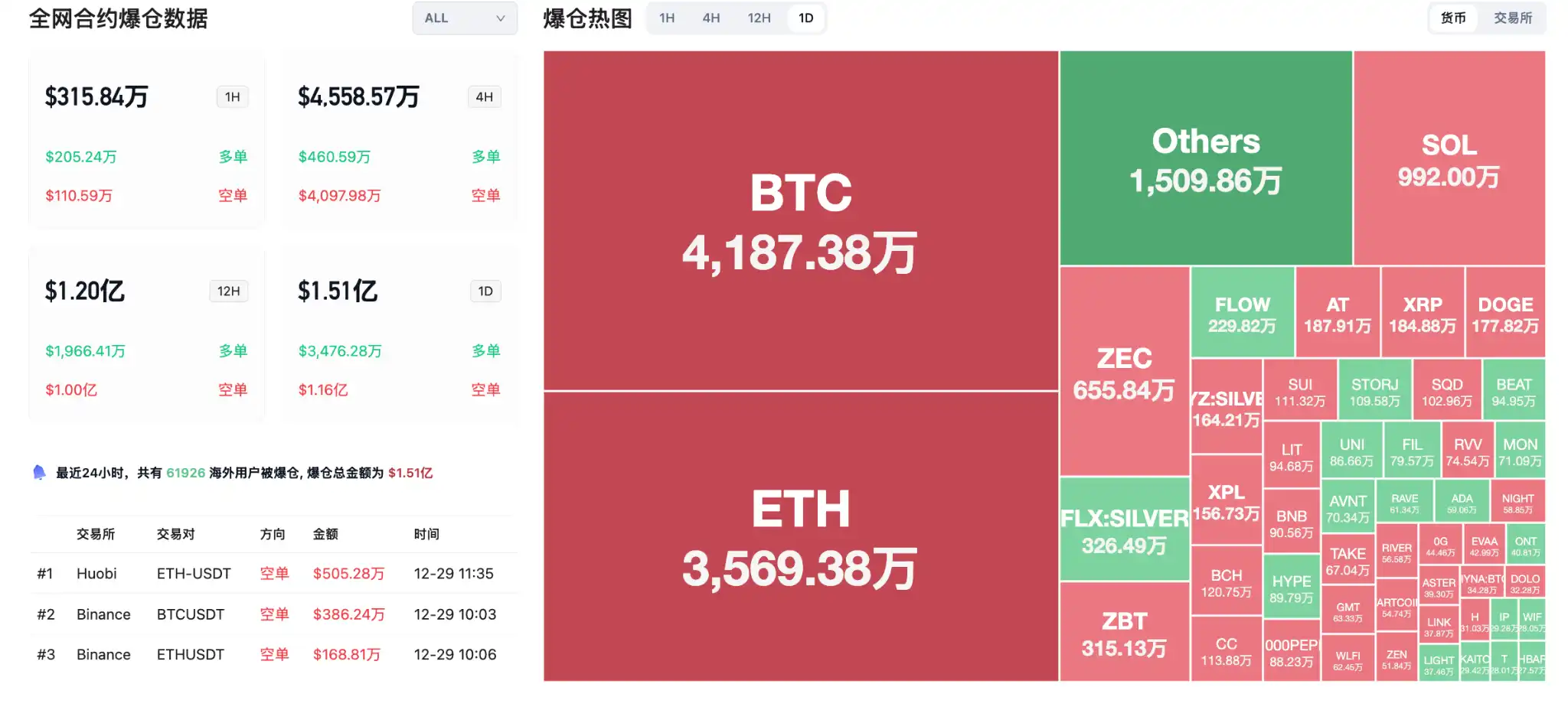
  • 24-hour Liquidation Data: 61,926 people liquidated globally, total liquidation amount $151 million,其中 (including) BTC liquidations $41.87 million, ETH liquidations $35.69 million, ZEC liquidations $6.55 million
3. ETF Flows (As of December 26)

  • Bitcoin ETFs: Net outflow of $782 million last week, BlackRock's IBIT led with net outflow of $435 million

  • Ethereum ETFs: Net outflow of $102 million last week, BlackRock's ETHA led with net outflow of $69.42 million

  • Solana ETF: Net inflow of $13.14 million last week

  • XRP ETF: Net inflow of $64 million last week

4. Today's Preview

  • "Lantian Gerui Case" fund refund registration deadline is December 29, missing it may affect fund return

  • Binance will delist EIGEN/FDUSD, ARB/FDUSD and other FDUSD margin trading pairs on December 30

  • Web3 game studio ChronoForge will shut down on December 30 due to funding shortage

  • Padre: PADRE holders will receive PUMP based on their holdings, need to submit wallet address by December 30

  • SHFE: From close on December 30, price limits for gold and silver futures contracts adjusted to 15%,同时 (simultaneously) adjusting margin ratios

  • SDIC Silver LOF: Class A定投 (fixed investment)上限 (upper limit) reduced back to 100 yuan, Class C shares will begin suspending subscriptions, effective December 29

  • 51VR, Chantecaille (Linshangtang) expected to list on HKEX on December 30

  • Hyperliquid (HYPE) will unlock approximately 9.92 million tokens at 15:30 on December 29, representing about 2.87% of circulating supply, value approx. $256 million;

  • Kamino (KMNO) will unlock approximately 229 million tokens at 20:00 on December 30, representing about 5.35% of circulating supply, value approx. $11.8 million;

  • Slash Vision Labs (SVL) will unlock approximately 234 million tokens at 08:00 on December 30, representing about 2.96% of circulating supply, value approx. $6.8 million;

  • Zora (ZORA) will unlock approximately 166 million tokens at 08:00 on December 30, representing about 4.17% of circulating supply, value approx. $6.7 million.

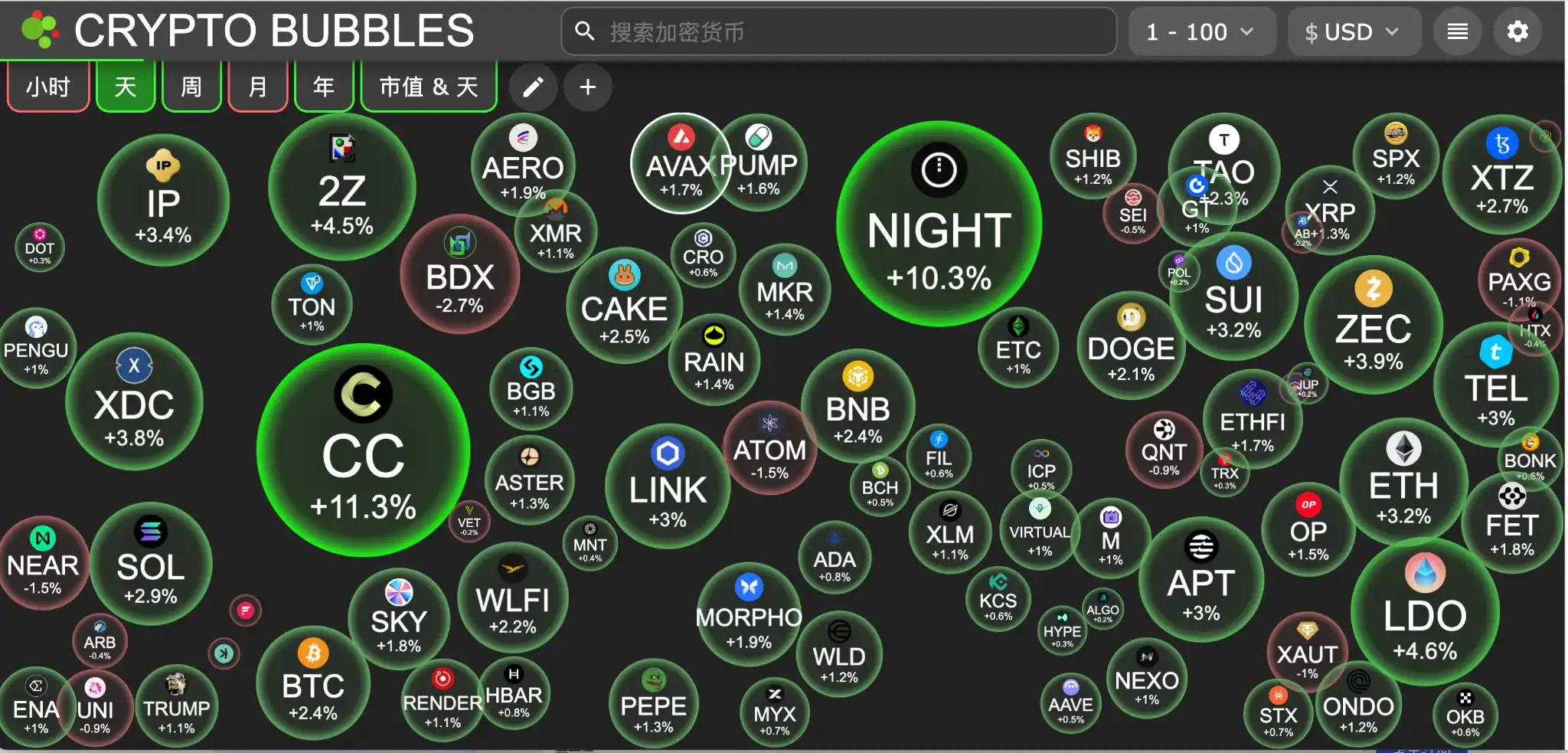
Today's Top 100 Coins by Market Cap - Maximum Gains: Canton Network up 11.3%, Midnight up 10.3%, DoubleZero up 4.7%, Lido DAO up 4.5%, Zcash up 3.9%.
5. Hot News

  • Data: HYPE, SUI, EIGEN and other tokens to see large unlocks next week,其中 (with) HYPE unlock value approx. $256 million

  • Weekly Preview | EU, UK, Hong Kong and other regions implement relevant new regulations for digital assets; Hyperliquid (HYPE) to unlock tokens worth ~$256 million

  • Suspected Trend Research purchased another 11,520 ETH, worth $34.93 million

  • Analysis: Bitcoin spot ETFs累计 (accumulated) net outflows nearly $6 billion over past nine weeks, market funding and sentiment remain under pressure

  • Hyperliquid's weekly revenue仅为 (only) $9.16 million, hitting a new low since early May

  • Solana DEX spot trading volume year-to-date exceeds $1.7 trillion, surpassing Bybit to rank second

  • A whale withdrew 2,218 ETH, 37.1 million SKY, and 4,772 AAVE from Kraken 7 hours ago

  • Spot silver breaks through $80/oz, setting a new record

  • Hyperliquid Co-founder: 1.2 million HYPE tokens will be allocated to team members on January 6 after unlock

  • Bubblemaps: Meme coin project ATLAS疑似 (suspected) insider trading, 68 wallets already hold 47% of token supply

  • Coinbase Bitcoin Premium Index has been in negative premium for two consecutive weeks, currently reported at -0.0784%

  • 100 million UNI burned from Uniswap treasury, worth $596 million

  • Flow hacked for $3.9 million loss, user deposits unaffected

Related Questions

QWhat happened to the price of silver after it hit a new all-time high, and what was a key factor contributing to the subsequent volatility?

AAfter hitting a new all-time high above $84/oz, the price of silver experienced a sharp pullback, falling to around $78/oz. A key factor contributing to this volatility was profit-taking by traders. Additionally, the CME raised margin requirements for silver futures for the second time in two weeks, which historically has triggered sell-offs.

QAccording to analysts cited, what is the prevailing sentiment in the cryptocurrency market despite Bitcoin's price breaking through $90,000?

AThe prevailing sentiment in the cryptocurrency market is one of caution and pessimism. Analysts like Killa and Ali Charts view any price rebounds as potential 'dead cat bounces'—temporary recoveries lacking genuine demand—due to significant capital outflows from Bitcoin ETFs and a general market downturn.

QWhat critical price level for Ethereum did on-chain analyst Murphy identify as a major support zone, and what was the concern if it were broken?

AOn-chain analyst Murphy identified $2,700 as a critical support zone for Ethereum. The concern was that if this level were broken, the price could enter a 'vacuum zone' with little support, potentially falling to a range between $1,800 and $2,600.

QWhat major event is the market anticipating for the decentralized perpetual exchange Lighter, and what is unique about its token airdrop distribution?

AThe market is anticipating the Token Generation Event (TGE) for the decentralized perpetual exchange Lighter, widely expected to occur on December 29th. A unique feature of its airdrop is that it will distribute 25% of the total token supply directly to users' wallets without requiring them to claim it.

QBased on the ETF flow data provided, what was the net flow trend for Bitcoin and Ethereum ETFs for the week ending December 26th?

AFor the week ending December 26th, both Bitcoin and Ethereum ETFs experienced net outflows. Bitcoin ETFs saw a net outflow of $782 million, while Ethereum ETFs had a net outflow of $102 million.

Related Reads

Google TPU Shipments Revised Up by 50%

Recent industry research indicates a significant upward revision in the shipments of Google's TPU (Tensor Processing Unit) chips. Previous expectations for 2027 were set at around 10 million units, but new estimates now point to 15 million units, a 50% increase. This substantial boost directly translates to higher demand across the entire supporting supply chain. Google's TPU clusters utilize a standardized all-optical interconnect architecture. Consequently, key hardware components are deeply integrated and scaled in fixed ratios with the chips. The 15 million TPU target will drive corresponding demand increases for NPO optical engines (roughly a 1:1 match), 1.6T optical modules, OCS optical switches, high-end server power supplies, fiber optics & MPO connectors, and liquid cooling solutions. Among these, liquid cooling is highlighted as the sector experiencing the most significant transformation and offering the most stable potential for excess returns. As next-generation TPU chips reach power levels where traditional air cooling is insufficient, liquid cooling becomes essential. 2026 is forecasted as the first year of substantial adoption for Google's liquid cooling solutions. This shift, coupled with delivery and capacity bottlenecks faced by incumbent overseas manufacturers, is creating a prime window for domestic Chinese suppliers to enter and secure Google's core supply chain. The market size for Google-specific liquid cooling is projected to potentially triple from a baseline of hundreds of billions to around 300 billion units by 2028. The logic for the fiber optic sector is also being rewritten. Once considered a cyclical commodity tied to telecom operator procurement, fiber is now a strategic and scarce resource for AI Data Centers (AIDC). A severe supply-demand imbalance, driven by the long lead time for preform production (18-24 months) and surging demand from cloud giants, is supporting strong performance. Chinese fiber manufacturers are well-positioned to capture a significant share of global AIDC demand, with exports potentially reaching 200-300 million core kilometers in 2026. Overall, the investment focus within the AI computing industry is shifting from pure "chip performance speculation" towards the more certain incremental growth in computing infrastructure and its supporting ecosystem. The upward revision in Google TPU shipments, along with the potential for further doubling by 2028, is seen as solidifying performance visibility for the entire supporting supply chain over the next two years.

marsbit50m ago

Google TPU Shipments Revised Up by 50%

marsbit50m ago

What Wall Street Really Wants After the Crypto Story Recedes

The tide of speculative crypto narratives has receded, revealing Wall Street's true objective: building a controlled, yield-generating, and compliant financial pipeline on distributed ledgers. They are migrating core functions onto blockchains, not for decentralization, but for efficiency and new revenue streams. Key developments include BlackRock's BUIDL fund, a tokenized treasury fund acting as a foundational reserve asset, and the rise of Securitize, which is going public and partnering with the NYSE to build a 24/7 digital securities trading and settlement system. This signals a major shift of securities clearing to blockchain technology. To make volatile assets like Bitcoin palatable for institutional investors, firms like BlackRock and Goldman Sachs are creating "covered call" ETFs (e.g., BITA). These products systematically sell options on Bitcoin holdings, transforming price volatility into stable monthly income, effectively repackaging crypto as a yield-bearing asset. Stablecoins are being positioned not as speculative tools but as efficient payment rails. Companies like Stripe and Mastercard are integrating them for instant, low-cost merchant settlements and cross-border card payments, respectively. Critically, new legislation like the GENIUS Act shapes them as non-interest-bearing, heavily regulated extensions of the US dollar system. In summary, Wall Street is quietly constructing a parallel, blockchain-based financial infrastructure featuring tokenized traditional assets, structured crypto yields, and programmable dollar pipelines—all under its control and fully integrated with existing regulatory and credit frameworks.

marsbit1h ago

What Wall Street Really Wants After the Crypto Story Recedes

marsbit1h ago

Tying Itself to SpaceX: Cursor's $60 Billion Rise

This article recounts the rapid rise of AI-powered coding startup Cursor and its 25-year-old MIT graduate CEO, Michael Truell. Launched in 2023, Cursor achieved explosive growth, reaching over 10 billion USD in revenue by late 2025. However, its journey highlights a central dilemma for AI application companies: dependence on foundational model providers. Cursor initially relied heavily on Anthropic's models but faced an existential threat when Anthropic launched its own competing coding tool, Claude Code. In response, Cursor declared an internal emergency in early 2026 and accelerated development of its own model, Composer. To secure the immense computing power needed, Truell struck a pivotal deal with Elon Musk's SpaceX in April 2026. The collaboration grants Cursor access to SpaceX's supercomputing resources for Composer, while SpaceX's Grok model benefits from Cursor's programming data. The agreement includes a potential 600 billion USD acquisition of Cursor by SpaceX later in the year, though a substantial termination fee is in place if the deal falls through. The story explores Cursor's intense, sometimes controversial hiring practices involving lengthy unpaid "work trials," its complex partnership-turned-rivalry with Anthropic, and its high-stakes gamble to ensure independence through the SpaceX alliance. The core question remains: will Cursor evolve into a defining, independent "generational" software company, or become a key piece in a tech giant's AI arsenal?

marsbit1h ago

Tying Itself to SpaceX: Cursor's $60 Billion Rise

marsbit1h ago

Trading

Spot
Futures

Hot Articles

What is $BITCOIN

DIGITAL GOLD ($BITCOIN): A Comprehensive Analysis Introduction to DIGITAL GOLD ($BITCOIN) DIGITAL GOLD ($BITCOIN) is a blockchain-based project operating on the Solana network, which aims to combine the characteristics of traditional precious metals with the innovation of decentralized technologies. While it shares a name with Bitcoin, often referred to as “digital gold” due to its perception as a store of value, DIGITAL GOLD is a separate token designed to create a unique ecosystem within the Web3 landscape. Its goal is to position itself as a viable alternative digital asset, although specifics regarding its applications and functionalities are still developing. What is DIGITAL GOLD ($BITCOIN)? DIGITAL GOLD ($BITCOIN) is a cryptocurrency token explicitly designed for use on the Solana blockchain. In contrast to Bitcoin, which provides a widely recognized value storage role, this token appears to focus on broader applications and characteristics. Notable aspects include: Blockchain Infrastructure: The token is built on the Solana blockchain, known for its capacity to handle high-speed and low-cost transactions. Supply Dynamics: DIGITAL GOLD has a maximum supply capped at 100 quadrillion tokens (100P $BITCOIN), although details regarding its circulating supply are currently undisclosed. Utility: While precise functionalities are not explicitly outlined, there are indications that the token could be utilized for various applications, potentially involving decentralized applications (dApps) or asset tokenization strategies. Who is the Creator of DIGITAL GOLD ($BITCOIN)? At present, the identity of the creators and development team behind DIGITAL GOLD ($BITCOIN) remains unknown. This situation is typical among many innovative projects within the blockchain space, particularly those aligning with decentralized finance and meme coin phenomena. While such anonymity may foster a community-driven culture, it intensifies concerns about governance and accountability. Who are the Investors of DIGITAL GOLD ($BITCOIN)? The available information indicates that DIGITAL GOLD ($BITCOIN) does not have any known institutional backers or prominent venture capital investments. The project seems to operate on a peer-to-peer model focused on community support and adoption rather than traditional funding routes. Its activity and liquidity are primarily situated on decentralized exchanges (DEXs), such as PumpSwap, rather than established centralized trading platforms, further highlighting its grassroots approach. How DIGITAL GOLD ($BITCOIN) Works The operational mechanics of DIGITAL GOLD ($BITCOIN) can be elaborated on based on its blockchain design and network attributes: Consensus Mechanism: By leveraging Solana’s unique proof-of-history (PoH) combined with a proof-of-stake (PoS) model, the project ensures efficient transaction validation contributing to the network's high performance. Tokenomics: While specific deflationary mechanisms have not been extensively detailed, the vast maximum token supply implies that it may cater to microtransactions or niche use cases that are still to be defined. Interoperability: There exists the potential for integration with Solana’s broader ecosystem, including various decentralized finance (DeFi) platforms. However, the details regarding specific integrations remain unspecified. Timeline of Key Events Here is a timeline that highlights significant milestones concerning DIGITAL GOLD ($BITCOIN): 2023: The initial deployment of the token occurs on the Solana blockchain, marked by its contract address. 2024: DIGITAL GOLD gains visibility as it becomes available for trading on decentralized exchanges like PumpSwap, allowing users to trade it against SOL. 2025: The project witnesses sporadic trading activity and potential interest in community-led engagements, although no noteworthy partnerships or technical advancements have been documented as of yet. Critical Analysis Strengths Scalability: The underlying Solana infrastructure supports high transaction volumes, which could enhance the utility of $BITCOIN in various transaction scenarios. Accessibility: The potential low trading price per token could attract retail investors, facilitating wider participation due to fractional ownership opportunities. Risks Lack of Transparency: The absence of publicly known backers, developers, or an audit process may yield skepticism regarding the project's sustainability and trustworthiness. Market Volatility: The trading activity is heavily reliant on speculative behavior, which can result in significant price volatility and uncertainty for investors. Conclusion DIGITAL GOLD ($BITCOIN) emerges as an intriguing yet ambiguous project within the rapidly evolving Solana ecosystem. While it attempts to leverage the “digital gold” narrative, its departure from Bitcoin's established role as a store of value underscores the need for a clearer differentiation of its intended utility and governance structure. Future acceptance and adoption will likely depend on addressing the current opacity and defining its operational and economic strategies more explicitly. Note: This report encompasses synthesised information available as of October 2023, and developments may have transpired beyond the research period.

376 Total ViewsPublished 2025.05.13Updated 2025.05.13

What is $BITCOIN

Discussions

Welcome to the HTX Community. Here, you can stay informed about the latest platform developments and gain access to professional market insights. Users' opinions on the price of BTC (BTC) are presented below.

活动图片