Analyse du marché du 19 décembre : Pourquoi la baisse aujourd'hui ? Conseils d'opération pour les altcoins BTC, ETH, BNB, SOL, F, RESOLV, GHST, DOLO

金色财经Published on 2025-12-19Last updated on 2025-12-19

Abstract

Au cours des dernières 24 heures, le marché des cryptomonnaies a enregistré une baisse de 1,5 %, portant la perte hebdomadaire à 7 %. La correction actuelle est attribuée à plusieurs facteurs : liquidations de positions à effet de levier, incertitudes macroéconomiques (politique de la Fed, inflation, force du dollar), et craintes liées aux valorisations des actions IA qui ont affecté indirectement les cryptos. Les liquidations ont été sévères : 151 369 traders ont été liquidés pour un total de 556 millions de dollars, avec une dominance de positions longues (369 millions). Parmi les principales cryptos : - Bitcoin (BTC) : environ 87 001 $ (+0,58 %). Niveau clé à 86 600 $ pour un rebond. - Ethereum (ETH) : environ 2 922 $ (+3,36 %). Seuil important à 2 870 $. - BNB : 839 $ (+0,77 %). Résistance à 840 $. - SOL : 123 $ (+0,31 %). Seuil à 122 $. La capitalisation totale du marché est d’environ 3,03 billions de dollars, avec un sentiment de marché à 17 (extrême peur). Les options Bitcoin de 23 milliards de dollars arrivant à échéance pourraient influencer la volatilité. Top gains : F (+30 %), RESOLV (+21 %), HOLO (+16 %). Top pertes : GHST (-14 %), DOLO (-8 %), TNSR (-7 %).

? Au cours des 24 dernières heures, le marché des cryptomonnaies a baissé de 1,5 %, avec une baisse cumulative de 7 % sur la semaine. Le marché est actuellement en phase de correction, sous pression à court terme. Il est conseillé de surveiller les données macroéconomiques et l'évolution des niveaux de levier. Les principaux facteurs à l'origine de cette baisse incluent :

1. La liquidation de positions à effet de levier élevé et l'intensification de la volatilité du marché (il y a eu récemment des liquidations importantes de positions longues et courtes).

2. Les incertitudes macroéconomiques, telles que les anticipations de politique de la Fed, les pressions inflationnistes et le renforcement du dollar qui pèsent sur les actifs risqués.

3. Les inquiétudes concernant les valorisations des actions liées à l'IA qui débordent sur le marché des cryptos (la corrélation entre les cryptos et les actions technologiques s'est renforcée). Des événements techniques comme les expirations d'options amplifient également la volatilité des prix.

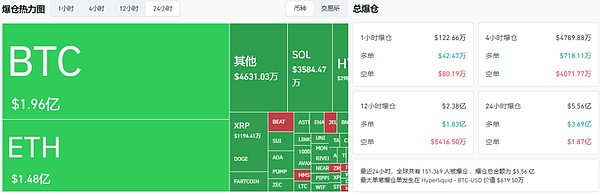
? Alerte aux liquidations :

Sur 24 heures, 151 369 personnes ont été liquidées sur l'ensemble des plateformes, pour un total de 556 millions de dollars, les positions longues ayant été particulièrement touchées (369 millions de dollars), mais les positions courtes n'ont pas non plus été épargnées (187 millions de dollars).
? Performance des principales cryptomonnaies :

1. Bitcoin (BTC) : Prix environ 87 001 $, +0.58 % en 24h

Aujourd'hui, le niveau clé à surveiller pour le Bitcoin se situe autour de 86 600 $. Tant que ce niveau est maintenu sur l'échelle de temps de 4 heures, le rebond pourrait démarrer. Les résistances à surveiller au-dessus se situent près de 88 000 $, 89 450 $ et 90 370 $.

Mais si le niveau de 86 600 $ est cassé, ce rebond sur 4 heures pourrait prendre fin. Portez ensuite une attention particulière aux supports potentiels près de 85 220 $, 83 830 $ et 82 170 $.

2. Ethereum (ETH) : Prix environ 2 922 $, +3.36 % en 24h

Pour l'Ethereum, observez attentivement le niveau de 2 870 $. S'il est maintenu sur l'échelle de temps de 4 heures, un rebond pourrait se développer, avec des résistances à surveiller près de 2 964 $, 3 025 $ et 3 062 $.

Si le niveau de 2 870 $ est perdu, le rebond pourrait marquer une pause. Les supports en dessous se situent près de 2 815 $, 2 773 $ et 2 720 $.

3. BNB : Prix environ 839 $, +0.77 % en 24h

Le BNB a besoin de se maintenir au-dessus de 840 $ aujourd'hui pour que l'échelle de temps de 4 heures puisse ouvrir la voie à un rebond. Au-dessus, surveillez les résistances près de 853 $, 866 $ et 876 $.

S'il ne parvient pas à se maintenir au-dessus de 840 $, la force du rebond pourrait être limitée. Les supports en dessous se situent près de 829 $, 818 $ et 808 $.

4. SOL : Prix environ 123 $, +0.31 % en 24h

Le seuil de force/faiblesse pour le SOL se situe près de 122 $. S'il se maintient au-dessus sur l'échelle de temps de 4 heures, un rebond vers 126 $, 130 $ et 134 $ est possible.

S'il ne parvient pas à dépasser 122 $, la dynamique de rebond à court terme pourrait être insuffisante. Les supports en dessous se situent près de 117 $, 112 $ et 109 $.

?️ Sentiment du marché :

Aujourd'hui, la capitalisation totale du marché des cryptomonnaies est d'environ 3,03 billions de dollars, avec un volume total d'échanges sur 24 heures d'environ 159 milliards de dollars.

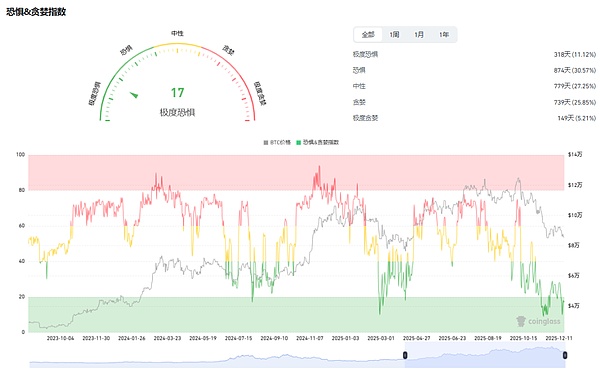
Le sentiment actuel du marché est à 17 (Peur extrême). Le sentiment du marché est devenu particulièrement pessimiste en raison de la faiblesse technique et des ventes de panique, mais la situation de survente signifie également que le marché pourrait se stabiliser. Les cryptomonnaies et les marchés traditionnels restent étroitement liés. Les options Bitcoin de 23 milliards de dollars arrivant à expiration ce vendredi seront un signal clé pour la volatilité du marché. Surveillez attentivement si le cours de clôture dépasse la moyenne mobile sur 7 jours de 2,96 billions de dollars, ce qui déclenchera très probablement un rebond à court terme.
Classement des gains et pertes du jour ?

? Top 3 des gains :

1. F : Prix 0,00753 $, +30 % en 24h

2. RESOLV : Prix 0,0802 $, +21 % en 24h

3. HOLO : Prix 0,0685 $, +16 % en 24h

? Top 3 des pertes :

1. GHST : Prix 0,165 $, -14 % en 24h

2. DOLO : Prix 0,03390 $, -8 % en 24h

3. TNSR : Prix 0,0849 $, -7 % en 24h

Performance d'autres principales cryptomonnaies :

Dogecoin (DOGE) : Prix 0,12570 $, +0.67 % en 24h

Tron (TRX) : Prix 0,2786 $, +0.47 % en 24h

Cardano (ADA) : Prix 0,3607 $, -0.33 % en 24h

Hyperliquid (HYPE) : Prix 23,593 $, -2.95 % en 24h

Avalanche (AVAX) : Prix 11,70 $, -0.43 % en 24h

Stellar (XLM) : Prix 0,2107 $, +1.20 % en 24h

Sui (SUI) : Prix 1,3903 $, -0.54 % en 24h

Chainlink (LINK) : Prix 12,23 $, +0.91 % en 24h

Hedera (HBAR) : Prix 0,10666 $, -1.52 % en 24h

Bitcoin Cash (BCH) : Prix 587,0 $, +10.03 % en 24h

Shiba Inu (SHIB) : Prix 0,00000726 $, -2.42 % en 24h

Litecoin (LTC) : Prix 75,41 $, +0.40 % en 24h

Pepe (PEPE) : Prix 0,00000382 $, -1.04 % en 24h

Toncoin (TON) : Prix 1,441 $, -1.91 % en 24h

Trending Cryptos

Related Questions

QQuels sont les principaux facteurs qui ont contribué à la baisse du marché des cryptomonnaies le 19 décembre ?

ALes principaux facteurs de la baisse incluent : la liquidation de positions à effet de levier élevé et l'augmentation de la volatilité du marché, les incertitudes macroéconomiques (politique de la Fed, pression inflationniste, force du dollar), et les inquiétudes concernant la valorisation des actions liées à l'IA qui se sont propagées au marché crypto. Les expirations d'options ont également amplifié la volatilité des prix.

QQuel était le montant total des liquidations sur le marché des cryptomonnaies au cours des 24 dernières heures mentionnées dans l'article ?

AAu cours des 24 dernières heures, 151 369 traders ont été liquidés pour un montant total de 556 millions de dollars. Les positions longues ont subi l'essentiel des pertes avec 369 millions de dollars liquidés, tandis que les positions courtes ont perdu 187 millions de dollars.

QQuel est le niveau de soutien clé à surveiller pour Bitcoin (BTC) selon l'analyse technique présentée ?

ALe niveau de soutien clé à surveiller pour Bitcoin est à 86 600$. Tant que le prix reste au-dessus de ce niveau sur l'échelle de temps de 4 heures, une reprise pourrait commencer. S'il est rompu, les prochains supports à surveiller se situent autour de 85 220$, 83 830$ et 82 170$.

QQuelle était la pièce performante en tête du classement des gains sur 24 heures, et quel était son pourcentage d'augmentation ?

ALa pièce performante en tête du classement des gains sur 24 heures était F (F), avec une augmentation de 30%, son prix à environ 0,00753$.

QQuel est l'indice de sentiment du marché mentionné dans l'article et que suggère-t-il ?

AL'indice de sentiment du marché est à 17, indiquant une 'peur extrême'. Cela signifie que le sentiment est particulièrement pessimiste en raison de la faiblesse technique et des ventes de panique. Cependant, cet état de survente suggère également que le marché pourrait se stabiliser.

Related Reads

Saylor and Strategy Inc. Officially Endorse the CLARITY Act Bill Concerning Cryptocurrencies in the US

On July 31, Strategy Inc. (MSTR), the world's largest corporate holder of Bitcoin, announced its endorsement of the bipartisan CLARITY Act (Digital Asset Market Clarity Act). The company framed the bill as promoting market growth, institutional investor participation, consumer protection, and individuals' rights to own and control digital assets. Executive Chairman Michael Saylor added his influential voice, stating that while Bitcoin will succeed with or without regulation, America needs clarity for digital assets. The support comes as the Senate considers market structure legislation that would define regulatory roles for the SEC and CFTC and establish registration procedures for exchanges and custodians. The endorsement coincides with Strategy's Q2 report, which showed a significant net loss largely due to Bitcoin's volatility, underscoring the direct relevance of digital asset regulation to its shareholders and capital-raising strategy. Saylor's broader views link Bitcoin's long-term value to regulatory certainty and stable protocol rules. Political pressure is mounting as supporters have initiated nearly 1 million messages urging lawmakers to advance digital asset bills. However, legislative prospects remain uncertain, with one research firm lowering its passage probability estimate to 30%, even as crypto owners indicate the issue could influence their votes in the upcoming midterm elections.

cryptonews.ru6m ago

Saylor and Strategy Inc. Officially Endorse the CLARITY Act Bill Concerning Cryptocurrencies in the US

cryptonews.ru6m ago

Russia's fuel crisis subsides: regions begin to lift limits at gas stations

Russia's fuel crisis is showing signs of abating. Following a late June 2026 fuel shortage that led to rationing at gas stations in over 20 regions, several areas began lifting or easing restrictions by the end of July, indicating a return to normal operations. Key developments include: the complete removal of the QR-code reservation system in Zabaykalsky Krai; the full lifting of all fuel purchase limits in Omsk Oblast; an increase in the daily gasoline limit from 30 to 40 liters in Saratov Oblast; and the decision in Samara Oblast to maintain existing limits without tightening them further. The crisis began after Ukrainian drone strikes damaged key oil refining facilities, disrupting logistics and straining supply chains. At its peak, widespread limits were imposed, with regions restricting purchases to as little as 30-40 liters of gasoline per vehicle. Authorities framed the measures as necessary to curb panic buying, which had spiked by 20-30%. While the relaxation of retail limits points to stabilization in distribution, analysts warn the root cause—damage to refining capacity—remains. Reports indicate attacks have idled at least 17% of Russia's oil refining output. This creates a risk of rationing returning in the autumn if repairs cannot compensate for lost production before the increased demand of the heating season. The sustainability of the current recovery remains uncertain.

cryptonews.ru1h ago

Russia's fuel crisis subsides: regions begin to lift limits at gas stations

cryptonews.ru1h ago

Trading

Spot

Hot Articles

What is $BITCOIN

DIGITAL GOLD ($BITCOIN): A Comprehensive Analysis Introduction to DIGITAL GOLD ($BITCOIN) DIGITAL GOLD ($BITCOIN) is a blockchain-based project operating on the Solana network, which aims to combine the characteristics of traditional precious metals with the innovation of decentralized technologies. While it shares a name with Bitcoin, often referred to as “digital gold” due to its perception as a store of value, DIGITAL GOLD is a separate token designed to create a unique ecosystem within the Web3 landscape. Its goal is to position itself as a viable alternative digital asset, although specifics regarding its applications and functionalities are still developing. What is DIGITAL GOLD ($BITCOIN)? DIGITAL GOLD ($BITCOIN) is a cryptocurrency token explicitly designed for use on the Solana blockchain. In contrast to Bitcoin, which provides a widely recognized value storage role, this token appears to focus on broader applications and characteristics. Notable aspects include: Blockchain Infrastructure: The token is built on the Solana blockchain, known for its capacity to handle high-speed and low-cost transactions. Supply Dynamics: DIGITAL GOLD has a maximum supply capped at 100 quadrillion tokens (100P $BITCOIN), although details regarding its circulating supply are currently undisclosed. Utility: While precise functionalities are not explicitly outlined, there are indications that the token could be utilized for various applications, potentially involving decentralized applications (dApps) or asset tokenization strategies. Who is the Creator of DIGITAL GOLD ($BITCOIN)? At present, the identity of the creators and development team behind DIGITAL GOLD ($BITCOIN) remains unknown. This situation is typical among many innovative projects within the blockchain space, particularly those aligning with decentralized finance and meme coin phenomena. While such anonymity may foster a community-driven culture, it intensifies concerns about governance and accountability. Who are the Investors of DIGITAL GOLD ($BITCOIN)? The available information indicates that DIGITAL GOLD ($BITCOIN) does not have any known institutional backers or prominent venture capital investments. The project seems to operate on a peer-to-peer model focused on community support and adoption rather than traditional funding routes. Its activity and liquidity are primarily situated on decentralized exchanges (DEXs), such as PumpSwap, rather than established centralized trading platforms, further highlighting its grassroots approach. How DIGITAL GOLD ($BITCOIN) Works The operational mechanics of DIGITAL GOLD ($BITCOIN) can be elaborated on based on its blockchain design and network attributes: Consensus Mechanism: By leveraging Solana’s unique proof-of-history (PoH) combined with a proof-of-stake (PoS) model, the project ensures efficient transaction validation contributing to the network's high performance. Tokenomics: While specific deflationary mechanisms have not been extensively detailed, the vast maximum token supply implies that it may cater to microtransactions or niche use cases that are still to be defined. Interoperability: There exists the potential for integration with Solana’s broader ecosystem, including various decentralized finance (DeFi) platforms. However, the details regarding specific integrations remain unspecified. Timeline of Key Events Here is a timeline that highlights significant milestones concerning DIGITAL GOLD ($BITCOIN): 2023: The initial deployment of the token occurs on the Solana blockchain, marked by its contract address. 2024: DIGITAL GOLD gains visibility as it becomes available for trading on decentralized exchanges like PumpSwap, allowing users to trade it against SOL. 2025: The project witnesses sporadic trading activity and potential interest in community-led engagements, although no noteworthy partnerships or technical advancements have been documented as of yet. Critical Analysis Strengths Scalability: The underlying Solana infrastructure supports high transaction volumes, which could enhance the utility of $BITCOIN in various transaction scenarios. Accessibility: The potential low trading price per token could attract retail investors, facilitating wider participation due to fractional ownership opportunities. Risks Lack of Transparency: The absence of publicly known backers, developers, or an audit process may yield skepticism regarding the project's sustainability and trustworthiness. Market Volatility: The trading activity is heavily reliant on speculative behavior, which can result in significant price volatility and uncertainty for investors. Conclusion DIGITAL GOLD ($BITCOIN) emerges as an intriguing yet ambiguous project within the rapidly evolving Solana ecosystem. While it attempts to leverage the “digital gold” narrative, its departure from Bitcoin's established role as a store of value underscores the need for a clearer differentiation of its intended utility and governance structure. Future acceptance and adoption will likely depend on addressing the current opacity and defining its operational and economic strategies more explicitly. Note: This report encompasses synthesised information available as of October 2023, and developments may have transpired beyond the research period.

1.3k Total ViewsPublished 2025.05.13Updated 2025.05.13

What is $BITCOIN

Discussions

Welcome to the HTX Community. Here, you can stay informed about the latest platform developments and gain access to professional market insights. Users' opinions on the price of BTC (BTC) are presented below.

活动图片