El fundador de Curve propone una subvención de 17 millones de CRV para financiar la investigación y el equipo de desarrollo

cointelegraphPublished on 2025-12-15Last updated on 2025-12-15

Abstract

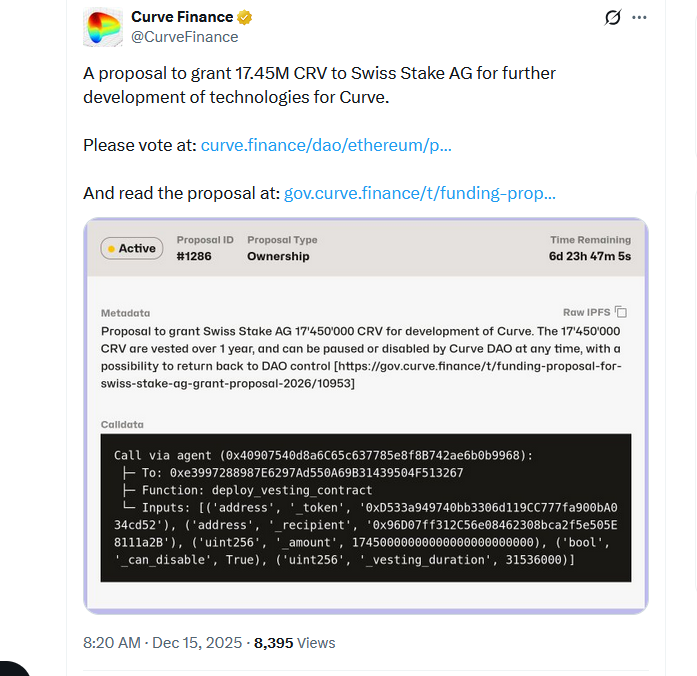
El fundador de Curve Finance, Michael Egorov, ha propuesto una subvención de 17,45 millones de tokens CRV (valorados en unos 6,6 millones de dólares) para financiar a Swiss Stake AG, la empresa detrás del protocolo. Los fondos se destinarán a investigación, desarrollo tecnológico, seguridad, mejoras de interfaz y soporte del ecosistema, con el objetivo de mantener al equipo de 25 miembros y avanzar en proyectos como Llamalend (su sistema de préstamos), swaps de divisas onchain y expansión multired. La empresa se compromete a liberar el código bajo licencia open-source y presentar informes semestrales de gastos. Aunque Swiss Stake AG ha generado algunos ingresos, aún depende del apoyo comunitario para lograr su sostenibilidad.

El fundador de Curve Finance, Michael Egorov, ha propuesto una subvención de 17,45 millones de tokens CRV para apoyar el crecimiento del ecosistema, la investigación y el desarrollo tecnológico del protocolo de préstamos.

La subvención, con un valor aproximado de 6,6 millones de dólares al precio actual, se otorgaría a Swiss Stake AG, la empresa detrás de Curve, y sigue a una subvención anterior otorgada a finales de 2024.

En una propuesta publicada en el foro de gobierno de Curve DAO el domingo, Egorov dijo que los fondos se utilizarían para apoyar una serie de mejoras tecnológicas y de seguridad para el protocolo de préstamos, así como para mantener a su equipo de colaboradores.

"Esta subvención financiará la investigación y el desarrollo de software, la infraestructura, la seguridad y el apoyo al ecosistema, garantizando que el equipo de 25 miembros de Swiss Stake AG pueda continuar sus contribuciones en curso a Curve", dijo Egorov.

El fundador proporcionó una larga lista de objetivos que Swiss Stake AG tiene previstos para Curve en 2026. La lista incluye el lanzamiento y escalado de una nueva versión de su sistema de préstamos, Llamalend, la creación de un swap de divisas extranjeras onchain y la mejora de la interfaz de usuario de Curve.

"Esta propuesta busca continuar financiando el desarrollo y mantenimiento del ecosistema de contratos inteligentes y los repositorios de software de Curve, apoyar más integraciones, funcionalidades crosschain y mejoras en la interfaz de usuario, fortalecer la gobernanza y la infraestructura operativa de Curve DAO", dijo Egorov.
Fuente: Curve Finance

La empresa también liberará cualquier propiedad intelectual creada mediante el uso de la subvención "bajo una licencia de código abierto compatible con los repositorios de software de Curve".

Relacionado: DeFi ya está al 30% del camino hacia la adopción masiva: fundador de Chainlink

Si se aprueba, a Swiss Stake AG se le permitirá stakear parte de los CRV recibidos para generar rendimiento adicional para sus proyectos, pero no podrá utilizar los fondos para ningún propósito no listado en la propuesta. La empresa se compromete a presentar "informes semestrales sobre el gasto del monto de la subvención".

Swiss Stake AG impulsa la autosostenibilidad

En la propuesta, Egorov delineó que, aunque Swiss Stake AG ha generado varias fuentes de ingresos a través de CRV, "sigue dependiendo en gran medida del apoyo de la comunidad para continuar su trabajo".

Como tal, la financiación ayudará a mantener al equipo a flote mientras construye el ecosistema Curve y impulsa la autosostenibilidad.

"Swiss Stake AG ha logrado establecer algunas fuentes de ingresos auxiliares, principalmente a través de implementaciones de Curve Lite en otras redes. Además, hemos obtenido tarifas del sistema al hacer staking de veCRV a través de varios protocolos wrapper (Convex, StakeDAO, Yearn) como participante minoritario", dijo.

"Todos estos ingresos se han utilizado estrictamente de acuerdo con los propósitos outlined en la subvención. Sin embargo, estos ingresos aún no hacen que la empresa sea sostenible en esta etapa", añadió el fundador.

Fundada a principios de 2020, Curve Finance tiene un valor total bloqueado de alrededor de 2.200 millones de dólares, según datos de DefiLlama, lo que la convierte en el protocolo DeFi número 21 más grande del mercado.

Revista: Ten tu stake y gana tarifas también: Tushar Aggarwal sobre el doble dipping en DeFi

Trending Cryptos

Related Questions

Q¿Quién propuso una subvención de 17,45 millones de tokens CRV y con qué objetivo?

AMichael Egorov, fundador de Curve Finance, propuso la subvención para apoyar el crecimiento del ecosistema, la investigación y el desarrollo tecnológico del protocolo de préstamos.

Q¿A qué empresa estaría destinada la subvención y cuál es su valor aproximado en dólares?

ALa subvención estaría destinada a Swiss Stake AG, la firma detrás de Curve, y tiene un valor aproximado de 6,6 millones de dólares al precio actual.

Q¿Qué objetivos específicos menciona Egorov para Curve en 6?

ALos objetivos incluyen lanzar y escalar una nueva versión de su sistema de préstamos Llamalend, crear un swap de divisas extranjeras onchain y mejorar la interfaz de usuario de Curve.

Q¿Cómo planea Swiss Stake AG utilizar los tokens CRV de la subvención además del desarrollo?

ASe le permitirá stakear parte de los tokens CRV recibidos para generar yield adicional, pero no podrá utilizarlos para fines no especificados en la propuesta.

Q¿Por qué Swiss Stake AG aún depende del apoyo de la comunidad según la propuesta?

AAunque ha generado flujos de ingresos secundarios, como implementaciones de Curve Lite en otras redes, estos ingresos aún no hacen que la empresa sea autosostenible en esta etapa.

Related Reads

How to Steadily Earn Money in Blockchain Games? The Project Team Reveals the Dual Profit Logic for Both Players and Projects

**Summary:** This interview features Leo, CBO of Gamebank, discussing the challenges and future of Web3 games through the lens of their project, Pump Snake. He addresses the core questions of playability and profitability. Leo explains that Pump Snake is a multiplayer, competitive take on the classic "Snake" game, designed for mass appeal and accessibility. The primary goal is to create an engaging game first; financial and asset-based features are secondary and depend on a strong player base. The project aims to be a gateway for Web2 users into Web3, allowing them to naturally encounter blockchain concepts through gameplay rather than direct crypto education. Key mechanisms discussed include: * **"Loss-to-Mine":** Players receive redeemable points for losses, which can be used for blind boxes (containing skins, items), improving retention by offering a reward even for losing. * **Commercialization:** Plans include in-game transaction fees, subscription services (SVIP), and sales of skins/blind boxes, all designed not to compromise competitive fairness. * **Future Token:** A token launch is confirmed but will be timed based on market conditions, regulatory clarity, and product maturity to avoid a "death spiral" economy. * **Fairness:** Paid features (SVIP, ads, blind boxes) are designed to offer cosmetic or convenience benefits without granting competitive advantages. Leo acknowledges current Web3 gaming setbacks but is optimistic about the long-term convergence of engaging gameplay, blockchain-based asset ownership/value distribution, and AI integration. Pump Snake is currently in a growth phase, focusing on product iteration and user acquisition in Asia before a broader rollout.

marsbit27m ago

How to Steadily Earn Money in Blockchain Games? The Project Team Reveals the Dual Profit Logic for Both Players and Projects

marsbit27m ago

Trading

Spot

Hot Articles

What is DOGE M

Doge Matrix ($doge m): The New Breed of Community-Driven Cryptocurrency Introduction In the ever-evolving landscape of cryptocurrency, new projects constantly emerge, each aiming to capture the interest of investors and enthusiasts alike. One of the latest entrants to this domain is Doge Matrix, represented by the ticker symbol $doge m. This project has attracted attention thanks to its roots in the popular meme culture surrounding Dogecoin, establishing its place within the web3 space. This article aims to provide a comprehensive analysis of Doge Matrix, covering its overview, creator, investors, functionality, timeline, and notable aspects. What is Doge Matrix ($doge m)? Doge Matrix is a community-driven cryptocurrency project that seemingly builds upon the widespread appeal of Dogecoin, a digital currency known for its Shiba Inu mascot and its meme origins. While the overarching objectives of Doge Matrix are not extensively defined, it is characterised by a commitment to harnessing community involvement and support. Unlike traditional cryptocurrencies that often emphasise utility or intrinsic value through underlying technologies, Doge Matrix positions itself within a space that embraces the cultural phenomenon of cryptocurrencies, particularly appealing to those who resonate with the ethos of meme-based assets. Drawing on the strengths of the Dogecoin community, Doge Matrix operates as part of a broader ecosystem, inviting participation and engagement from users who share an interest in cryptocurrency and the digital landscape. Who is the Creator of Doge Matrix ($doge m)? The identity of the creator of Doge Matrix remains unknown. This lack of transparency is not an uncommon occurrence in the cryptocurrency space, where some projects are launched without revealing the identities of their founders. The absence of information regarding the founding team can raise questions among potential investors about the project’s accountability and direction. Who are the Investors of Doge Matrix ($doge m)? As it stands, there is no publicly available information detailing the investors or investment foundations that back Doge Matrix. The project appears to rely primarily on community support rather than institutional investment. This model aligns with the community-driven nature of the initiative, fostering an environment where the direction of the project is shaped by its participants rather than being dictated by a select few financial backers. How Does Doge Matrix ($doge m) Work? The specifics regarding the operational mechanisms of Doge Matrix are somewhat vague, reflecting a broader trend of projects in the meme coin space where innovative functionalities are not always clearly articulated. Nonetheless, Doge Matrix seems designed to tap into the existing cryptocurrency ecosystem by encouraging user participation while tapping into the familiar cultural references associated with Dogecoin. Its potentially unique characteristics derive from community interactions rather than technological advancements, emphasising shared experiences and collaboration among token holders. While the exact innovations have not been explicitly outlined, the project appears to create a space where community members can engage, share ideas, and propel the project's potential forward. Timeline of Doge Matrix ($doge m) Reflecting on the project’s timeline reveals notable events that have defined its journey thus far: November 25, 2024: Doge Matrix reached its all-time high value, marking a significant milestone in its early history. January 1, 2025: Conversely, Doge Matrix hit its all-time low value, illustrating the volatility often associated with cryptocurrencies, especially in the early stages of a project's lifecycle. Ongoing: The project continues to be actively traded and supported by its community, although specific future milestones or objectives have yet to be disclosed. Key Points About Doge Matrix ($doge m) Community Focus At the heart of Doge Matrix is a commitment to community engagement. The project thrives on the premise of collaboration and shared objectives among its members, emphasising the importance of collective effort. Unlike centralised projects that often have a defined leadership structure, Doge Matrix at present showcases a more fluid approach to governance, where every community member's voice matters. Volatility The cryptocurrency market is notorious for its volatility, and Doge Matrix is no exception. Its price history reflects significant fluctuations between high and low values, which is typical of many new cryptocurrencies but underscores the risks associated with investment in emerging tokens. Lack of Detailed Information One of the most striking features about Doge Matrix is the scarcity of detailed information regarding its technological underpinnings and operational mechanisms. This ambiguity necessitates that potential investors conduct thorough due diligence before engaging with the project. Conclusion In summary, Doge Matrix ($doge m) illustrates a new wave of cryptocurrency projects that lean heavily on community engagement and cultural relevance. While lacking in certain specifics—such as clear leadership, defined objectives, and detailed functionality—the project has managed to generate interest within the crypto community, leveraging the established appeal of meme culture. As with any investment in the cryptocurrency space, understanding the inherent risks and conducting comprehensive research is essential for potential participants. Doge Matrix stands as a reminder of the dynamic, sometimes unpredictable nature of the crypto industry, marked by constant evolution and enthusiasm for community-driven initiatives.

555 Total ViewsPublished 2025.02.03Updated 2025.02.03

What is DOGE M

What is $M

Understanding Mantis ($M): A New Era in Cross-Chain Interoperability In the continually evolving landscape of Web3 and cryptocurrency, new projects strive to offer innovative solutions aimed at enhancing the user experience and expanding functional possibilities within the decentralised financial ecosystem. One such project garnering attention is Mantis ($M), a pioneering protocol founded on the principles of cross-chain interoperability and intent-based settlements. This article delves into the essential aspects of Mantis, including its core functionality, creators, investment backing, innovative features, and critical milestones. What is Mantis ($M)? Mantis is described as a multi-domain intent settlement protocol that simplifies cross-chain interactions, enabling users to execute complex financial transactions across various blockchain platforms seamlessly. The protocol operates through three primary layers: Intent Expression: Users can articulate their transaction goals using natural language facilitated by the DISE LLM, an advanced AI language model. For instance, a user might express a desire to swap Ethereum (ETH) for Solana (SOL) with a specific slippage tolerance of 1%. Execution: This layer employs a network of solvers that compete to fulfil user intents. Transactions are executed using mechanisms such as Coincidence of Wants (CoWs) and Order Flow Auctions (OFAs), which ensure that user demands are met optimally. Settlement: Leveraging the Inter-Blockchain Communication (IBC) protocol, Mantis enables atomic cross-chain transactions, allowing users to operate across various supported chains, including Ethereum, Solana, and Cosmos. Mantis is engineered to introduce native yield generation for idle assets, employing cryptographic proofs to maintain the integrity of transactions throughout the entire process. Creators & Development Team Mantis was conceived by the Composable Foundation, a research-driven organisation notable for its emphasis on blockchain interoperability solutions. This foundation collaborates with esteemed academic institutions, including Harvard University and the University of Lisbon, contributing to extensive research and development efforts that inform Mantis's architecture and functionality. The Composable Foundation’s commitment to fostering innovation in the blockchain space positions Mantis as a robust solution for the growing demand for interoperability among multiple blockchain networks. Investors & Backing While specific details about individual investors have not been publicly disclosed, Mantis enjoys substantial backing from various entities, including: Ecosystem grants from IBC-enabled chains, which support the protocol's growth and integration within decentralised finance ecosystems. Strategic partnerships with infrastructure providers that enhance Mantis's network capabilities and deployment strategies. Funding through the Composable Foundation's treasury, ensuring sustained financial support for ongoing development and operational costs. These collaborative efforts reflect a consensus among stakeholders about the importance of enhancing cross-chain functionality and the potential utility of Mantis's infrastructural innovations. Key Innovations Mantis sets itself apart through several pioneering innovations that enhance its functionality and utility: Chain-Agnostic Intents: Users can initiate transactions from any supported chain while settling on another. This flexibility empowers users, driving increased interaction among different platforms. AI-Powered Interface: The integration of DISE LLM allows users to conduct complex DeFi operations using natural language, thereby simplifying interactions and making blockchain technology accessible to a broader audience. Cross-Domain MEV Capture: Mantis creates an internal market for maximal extractable value (MEV) through competitions among solvers. This innovative approach allows for greater efficiency and value extraction in complex transactions. Modular Settlement Layer: The protocol supports various verification methods, including zero-knowledge proofs and optimistic rollups, providing a versatile framework that can adapt to emerging blockchain technologies. Historical Timeline Mantis's development is marked by several critical milestones that chart its trajectory and growth: | Year | Milestone | |————|————————————————————————-| | 2022 | Initial concept development within the Composable Foundation's research division. | | Q3 2024 | Launch of the testnet with bridging capabilities between Solana and Ethereum. | | Q1 2025 | Anticipated Token Generation Event (TGE) alongside the mainnet launch. | | Q2 2025 | Expected integration of DISE LLM and expansion of cross-chain capabilities. | | 2025 H2 | Planned support for over 15 chains through further IBC upgrades. | This timeline outlines Mantis's evolution, from conceptual discussions to active implementation and future growth phases. Ecosystem Growth Strategy Mantis's strategy for ecosystem growth includes several initiatives designed to encourage user participation and developer engagement: Credits System: Users can earn protocol credits by providing liquidity and engaging in referral programmes. These credits are redeemable for incentives in the future, fostering a robust user community. Modular Software Development Kit (SDK): This toolkit empowers developers to create applications based on intent-driven models utilising Mantis's infrastructure, thus promoting innovation within its ecosystem. Governance Model: As the protocol matures, $M token holders will have a voice in protocol governance, allowing them to vote on proposed upgrades and changes, thereby enhancing community engagement and decentralisation. Mantis represents a significant advancement in the realm of cross-chain architecture. By seamlessly integrating advanced AI algorithms with a robust settlement framework, Mantis seeks to tackle the problems of fragmentation within multi-chain ecosystems. Its innovative approach prioritises improved user experiences while adhering to the foundational principles of decentralisation and security, setting a new standard for the future interoperability of blockchain technologies. As Mantis continues its journey of growth and implementation, it promises to be a project to watch closely in the competitive landscape of Web3 and decentralised finance. With its focus on crossing boundaries and elevating user engagement, Mantis is poised to be an integral part of the future developments in the cryptocurrency space.

78 Total ViewsPublished 2025.03.18Updated 2025.03.18

What is $M

Discussions

Welcome to the HTX Community. Here, you can stay informed about the latest platform developments and gain access to professional market insights. Users' opinions on the price of M (M) are presented below.

活动图片