Resumen Cripto: Strategy se mantiene en el Nasdaq 100, grandes desbloqueos de tokens ZRO, ARB, STRK esta semana

深潮Published on 2025-12-15Last updated on 2025-12-15

Abstract

**Resumen de noticias cripto: Strategy se mantiene en Nasdaq 100; grandes desbloqueos de ZRO, ARB y STRK esta semana** Donald Trump presiona para que la Reserva Federal reduzca las tasas de interés a no más del 1% en un año. La SEC de EE. UU. emitió una guía sobre custodia de criptoactivos, detallando los riesgos y mejores prácticas para billeteras calientes y frías. La OCC aprobó condicionalmente licencias de banco fiduciario para Ripple, BitGo, Fidelity, Paxos y Circle, un paso clave para su integración financiera. Moonbirds anunció el lanzamiento de su token BIRB en Solana para el primer trimestre de 2026. El protocolo de staking líquido de Berachain, Infrared, realizará su TGE el 17 de diciembre con un airdrop para usuarios tempranos. Coinbase planea lanzar un mercado de predicciones interno con apoyo de Kalshi. OKX afirmó tener evidencia de que la manipulación externa causó la anomalía en el precio de OM, con procesos legales en curso. En China, el ex vicegobernador del banco central reafirmó la política prohibitiva contra las criptomonedas y pidió acelerar el desarrollo del yuan digital. Michael Saylor anunció que Strategy (ex-MicroStrategy) se mantendrá en el índice Nasdaq 100 y reiteró su estrategia de acumular Bitcoin. Además, esta semana habrá importantes desbloqueos de tokens: ZRO (6.79% de suministro, 20 dic), ARB (1.90%, 16 dic), STRK (5.07%, 15 dic), SEI (1.08%, 15 dic) y LISTA (6.85%, 20 dic).

Autor: TechFlow Shenchao

Dinámica del mercado de ayer

Trump: Prefiere a Warsh o Hasset para la Fed, las tasas de interés no deberían superar el 1% en un año

El presidente Trump declaró el viernes en una entrevista en la Oficina Oval: "Ambos Kevin (Warsh y Hasset) son excelentes, y otros candidatos también son muy buenos".

Según fuentes informadas, el miércoles Trump se reunió con Warsh en la Casa Blanca durante 45 minutos, donde presionó a Warsh preguntándole si, de ser elegido presidente de la Fed, garantizaría apoyar la reducción de tasas. Trump confirmó esta información en la entrevista: "Él cree que es necesario bajar las tasas, y todas las personas con las que he hablado también lo creen". Trump afirmó que cree que el próximo presidente de la Fed debería consultarle al formular la política de tasas de interés.

Cuando se le preguntó qué nivel de tasas desea dentro de un año, Trump respondió: "1%, quizás incluso más bajo. Deberíamos tener las tasas de interés más bajas del mundo". La reducción de tasas ayudaría al Departamento del Tesoro de EE. UU. a reducir los costos de financiamiento de su deuda gubernamental de 30 billones de dólares.

La SEC de EE. UU. publica una guía sobre custodia de criptomonedas

Según Cointelegraph, la Comisión de Bolsa y Valores de EE. UU. (SEC) publicó el viernes un boletín para inversionistas con una guía sobre billeteras y custodia de criptomonedas, describiendo las mejores prácticas y riesgos comunes de las diferentes formas de almacenamiento de criptoactivos para el público inversionista.

La guía detalla las ventajas y desventajas de los diferentes métodos de custodia de criptomonedas, incluyendo la comparación entre el auto-custodio y permitir que un tercero mantenga los activos digitales. Para los inversionistas que elijan la custodia de terceros, la SEC recomienda comprender las políticas del custodio, incluyendo si "rehipoteca" los activos en custodia o mezcla los activos de los clientes.

La guía también analiza las características de las billeteras calientes y frías. Las billeteras calientes están conectadas a Internet pero enfrentan riesgos de ataques de hackers; las billeteras frías almacenan fuera de línea de manera más segura, pero existe el riesgo de pérdida permanente debido a fallas del dispositivo o filtración de claves privadas.

Ripple, BitGo, Fidelity, Paxos, Circle reciben aprobación condicional para licencias de banco fiduciario

Según crowdfundinsider, la Oficina del Contralor de la Moneda de EE. UU. (OCC) acaba de aprobar condicionalmente las licencias de banco fiduciario para Ripple, BitGo, Fidelity Digital Assets, Paxos y Circle.

La "aprobación condicional" es una forma de reconocimiento preliminar que indica que la OCC ha revisado la solicitud y considera que la empresa cumple básicamente con los requisitos regulatorios (como solvencia, marco de gestión de riesgos y plan de negocio), pero no es una licencia final. La empresa debe cumplir condiciones específicas dentro de un plazo determinado para convertirse en operación plena. Una vez cumplidas todas las condiciones, la OCC emitirá una licencia nacional de banco fiduciario final e incondicional, y la empresa podrá ejercer inmediatamente las facultades de un banco fiduciario, que incluyen principalmente: expansión del negocio principal, gestión de activos de clientes como fiduciario, procesamiento de pagos y liquidaciones, custodia de activos digitales (como reservas de stablecoins) y provisión de servicios financieros relacionados. Sin embargo, una licencia de banco fiduciario es diferente a un banco de servicio completo; no puede aceptar depósitos ni otorgar préstamos. Puede solicitar una cuenta maestra en la Fed, acelerando la liquidación y el acceso al sistema financiero tradicional, fusionando aún más las finanzas cripto y tradicionales.

Moonbirds anuncia el lanzamiento del token BIRB en el primer trimestre del próximo año

Según un mensaje oficial, Moonbirds lanzará el token BIRB en Solana en el primer trimestre de 2026.

El protocolo de staking líquido de Berachain, Infrared, anuncia TGE para el 17 de diciembre

Según un anuncio oficial, el protocolo de staking líquido de Berachain, Infrared, anunció los detalles del airdrop del token IR.

El airdrop está dirigido a miembros tempranos de la comunidad, participantes del evento de pre-depósito de Boyco y usuarios que participaron en actividades comunitarias. Los usuarios pueden reclamar el airdrop por adelantado a través del proceso de pre-depósito en exchanges centralizados (nota: recibirán los tokens el día del TGE). El proceso de pre-depósito será del 13 de diciembre a las 12:00 UTC al 15 de diciembre a las 17:00 UTC. Los usuarios deben iniciar el proceso en el sitio web de Infrared, seleccionar el exchange y enviar su ID de usuario.

El token IR tiene tres funciones principales: staking para obtener sIR y derechos de voto en gobernanza; compartir ganancias a través de un mecanismo de recompra, donde una parte de las tarifas del protocolo fluye al "Fondo Rojo" para recomprar tokens IR; y emisión de tokens para optimizar la eficiencia y los ingresos del protocolo.

El reclamo fuera de exchanges se abrirá el día del TGE. Puntos clave: 17 de diciembre a las 8:00 UTC, listado del token IR; 12 de enero de 2026 a las 00:00 UTC, cierre permanente de todos los reclamos.

Noticia previa: Infrared, el primer protocolo de staking líquido en el ecosistema de Berachain, completó una ronda de financiación Serie A de 14 millones de dólares liderada por Framework Ventures.

Coinbase planea lanzar un mercado de predicciones interno, Kalshi podría ser el único operador inicial

Según CNBC, citando fuentes informadas, la plataforma de intercambio de criptomonedas Coinbase está preparando el lanzamiento de un mercado de predicciones interno, que será apoyado por la plataforma de predicciones Kalshi. Esta medida es parte de la estrategia de Coinbase para ampliar la cobertura de clases de activos en su plataforma de intercambio en un contexto donde algunos inversionistas evitan los activos digitales.

La fuente indicó que Coinbase y Kalshi anunciarán formalmente su colaboración pronto, posiblemente la próxima semana. La colaboración no es un acuerdo exclusivo, pero en las etapas iniciales del lanzamiento del producto, Kalshi será el único operador de mercados de predicciones de Coinbase.

Además, según The Information, Coinbase lanzará este producto en el evento "Actualización del sistema Coinbase" del 17 de diciembre. Bloomberg también mencionó que Coinbase anunciará en el evento el lanzamiento de un producto de tokenización de acciones.

Coinbase se negó a confirmar los informes a CNBC, pero dijo que se preste atención a su evento de la próxima semana.

OKX: Evidencia contundente indica que la anomalía en el precio de OM fue provocada por manipulación externa, se están avanzando múltiples procedimientos judiciales

Según una publicación oficial de OKX en redes sociales, se ha encontrado evidencia contundente de que múltiples grupos de cuentas vinculadas utilizaron conjuntamente grandes cantidades de OM como garantía para pedir prestado USDT y manipular artificialmente el precio al alza. Después de que el equipo de control de riesgos interviniera, la contraparte se negó a cooperar, y OKX luego tomó el control de las cuentas relevantes. Poco después, el precio de OM se desplomó, y OKX solo liquidó una cantidad muy pequeña de OM. Las pérdidas relacionadas fueron cubiertas en su totalidad por el fondo de seguridad de OKX.

Múltiples análisis de terceros muestran que el colapso del precio fue provocado principalmente por operaciones de contratos perpetuos en plataformas distintas a OKX, y cuestionan el origen de los OM anómalos y su altamente concentrado control de tokens. El fondo de seguridad de OKX funcionó completamente según su mecanismo de diseño.

Actualmente, OKX ha presentado evidencia completa a las agencias regulatorias y de aplicación de la ley, y se están avanzando múltiples procedimientos legales.

Wang Yongli: La orientación política de China para contener firmemente las monedas virtuales está completamente definida

Wang Yongli, ex vicepresidente del Banco de China, escribió en su cuenta pública: "El 28 de noviembre, el Banco Popular de China y otras 12 dependencias celebraron conjuntamente la 'Reunión del mecanismo de coordinación para combatir la especulación en transacciones con monedas virtuales', aclarando que las stablecoins son una forma de moneda virtual, enfatizando que se debe continuar con la política prohibitiva hacia las monedas virtuales y persistir en combatir las actividades financieras ilegales relacionadas con las monedas virtuales. Así, la orientación política de China para promover firmemente el desarrollo del yuan digital y contener resueltamente las monedas virtuales está completamente definida.

Es necesario acelerar切实mente la innovación, el desarrollo y la aplicación extensa nacional e internacional del yuan digital, formar lo antes posible sus ventajas únicas en pagos internacionales y recorrer el camino chino del desarrollo exitoso de la moneda digital".

Tom Lee: Bitmine nunca venderá los ETH que posee

Según Decrypt, Tom Lee, presidente de la compañía de tesorería de Ethereum, BitMine, declaró: "Bitmine se acerca a poseer el 4% del suministro total de Ethereum, y cree que la empresa nunca venderá estos ETH. Si apostáramos estos ETH ahora, generarían unos ingresos netos de más de 1 millón de dólares diarios".

Strategy se mantendrá en el índice Nasdaq 100

Según Reuters, a pesar de estar bajo un escrutinio creciente externo por acumular grandes cantidades de bitcoin, Strategy (anteriormente MicroStrategy) continuará como componente del índice Nasdaq 100. Los resultados del ajuste anual del índice confirmaron que Strategy no fue eliminada, y su lugar se mantendrá después de que entre en vigor la nueva ronda de ajustes.

El informe señala que la atención del mercado sobre Strategy se centra principalmente en su modelo de negocio altamente dependiente de la volatilidad del precio de bitcoin, pero esto no afectó su posición actual en el Nasdaq 100.

Michael Saylor compartió la noticia de que Strategy se mantendrá en el Nasdaq 100 y respondió: "Continuaré acumulando bitcoin hasta que el mercado deje de quejarse".

Michael Saylor publica nuevamente información del Rastreador de Bitcoin, posiblemente divulgando nuevamente información sobre la acumulación de BTC

El fundador de Strategy, Michael Saylor, publicó nuevamente información relacionada con el Rastreador de Bitcoin.

Según el patrón anterior, Strategy siempre divulga información sobre la acumulación de bitcoin al día siguiente de la publicación de noticias relacionadas.

Grandes desbloqueos de tokens ZRO, ARB, STRK esta semana

Según datos de Token Unlocks, esta semana habrá grandes desbloqueos de tokens como ZRO, ARB, STRK, entre los cuales:

ZRO desbloqueará 25.71 millones de tokens el 20 de diciembre, valor aproximado de 37.79 millones de dólares, 6.79% de la circulación;

ARB desbloqueará 92.65 millones de tokens el 16 de diciembre, valor aproximado de 19 millones de dólares, 1.90% de la circulación;

STRK desbloqueará 127 millones de tokens el 15 de diciembre, valor aproximado de 13.2 millones de dólares, 5.07% de la circulación;

SEI desbloqueará 55.56 millones de tokens el 15 de diciembre, valor aproximado de 6.93 millones de dólares, 1.08% de la circulación;

LISTA desbloqueará 33.44 millones de tokens el 20 de diciembre, valor aproximado de 5.34 millones de dólares, 6.85% de la circulación.

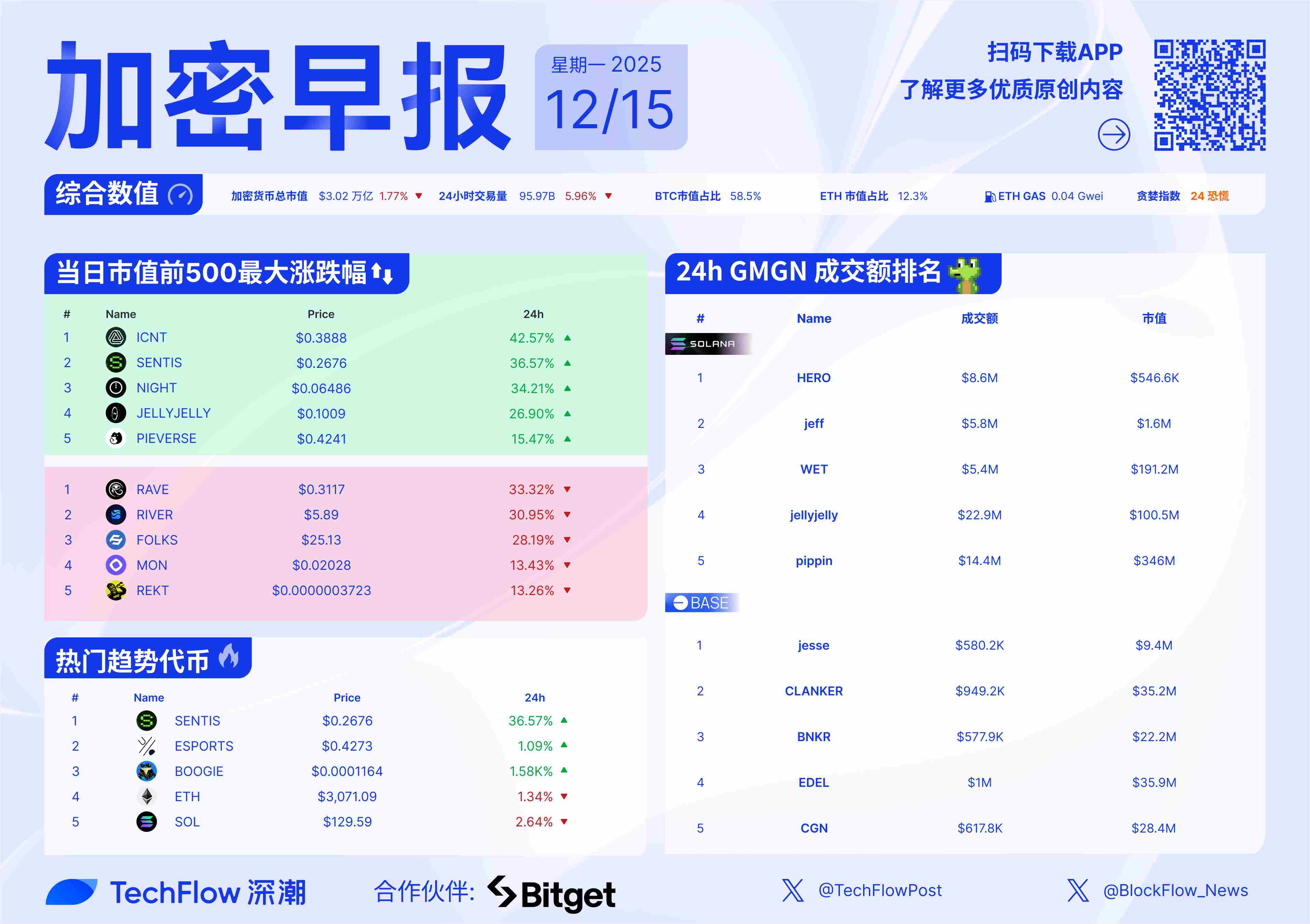
Dinámica del mercado
Lecturas recomendadas

Crisis de la plata, cuando el sistema de papel comienza a fallar

Este artículo analiza la volatilidad extrema del mercado de la plata y las razones subyacentes, revelando la crisis del alza de precios de la plata y los problemas estructurales del mercado. Señala que, debido a la influencia de la financiarización, la confianza en el "sistema de papel" del mercado de la plata se está desmoronando gradualmente, aumentando la demanda física, mientras se discuten en detalle la manipulación del mercado de la plata y el papel clave de JPMorgan.

Lanzamiento de x402 V2: Cuando los Agentes de IA comienzan a tener "tarjetas de crédito", ¿qué proyectos serán reevaluados?

Este artículo explora en detalle el protocolo x402 V2 en el mercado cripto y su profundo impacto en el comportamiento financiero de los Agentes de IA. Las actualizaciones centrales de x402 V2 incluyen pago diferido, compatibilidad full-chain y pistas de pago híbridas, características destinadas a construir una infraestructura financiera adecuada para la sociedad comercial de máquinas. El artículo también analiza narrativas relacionadas y oportunidades de inversión potenciales, explorando las tendencias futuras de desarrollo de las economías de IA.

El cripto 2026 visto por a16z: estas 17 tendencias remodelarán la industria

Este artículo, de varios socios de a16z, resume 17 tendencias clave sobre el desarrollo del campo cripto en el futuro, incluyendo información sobre tecnología de privacidad, mercados de predicción, stablecoins, blockchain, tokenización de activos, combinación de IA y tecnología cripto, etc. Estas tendencias tendrán un impacto profundo en el avance tecnológico de la industria cripto, la innovación financiera y la socioeconomía.

Oracle se desploma un 40%, ¿la sobreinfraestructura de IA arrastrará a los gigantes?

Este artículo relata cómo Oracle y otros gigantes tecnológicos enfrentan enormes desafíos en la construcción de infraestructura de IA. Aunque la IA se considera una dirección importante para el futuro, los gigantes enfrentan presión en la inversión de capital, el incremento de la deuda y la incertidumbre de la demanda del mercado. Si la infraestructura de IA podrá generar los retornos esperados aún requiere tiempo para verificarse, y el mercado también cuestiona la sostenibilidad de las startups y los gigantes.

Advertencia del Gran Corto Burry: La RMP de la Fed pretende ocultar la fragilidad del sistema bancario, esencialmente es reiniciar el QE

Este artículo discute principalmente el último Plan de Compra de Gestión de Reservas (RMP) de la Fed y su impacto en el sistema bancario y los mercados financieros. Michael Burry advierte que esta medida es esencialmente una flexibilización cuantitativa (QE) encubierta, destinada a ocultar la fragilidad del sistema bancario. El artículo analiza la volatilidad del mercado de repos, la preocupación por la restricción de financiamiento y el impacto potencial de la expansión del balance de la Fed en los mercados, al mismo tiempo que explora la dependencia del sistema bancario de la liquidez del banco central.


Trending Cryptos

Related Questions

Q¿Qué anunció Moonbirds sobre su token BIRB y cuándo se lanzará?

AMoonbirds anunció que lanzará su token BIRB en el primer trimestre de 2026 en la blockchain de Solana.

Q¿Qué protocolo de liquid staking en Berachain anunció su TGE para el 17 de diciembre y qué token distribuirá?

AEl protocolo de liquid staking Infrared en Berachain anunció que su TGE (Evento de Generación de Tokens) será el 17 de diciembre, distribuyendo el token IR.

QSegún la SEC, ¿cuáles son los riesgos y mejores prácticas para la custodia de criptomonedas mencionados en su nueva guía?

ALa guía de la SEC destaca los riesgos de las carteras calientes (hot wallets), que están conectadas a internet y son vulnerables a hackers, y las carteras frías (cold wallets), que están fuera de línea pero pueden sufrir fallos de hardware o pérdida de claves privadas. Para la custodia con terceros, recomienda entender sus políticas, incluyendo si realizan 'rehipoteca' de activos o los mezclan con los de otros clientes.

Q¿Qué empresas recibieron la aprobación condicional de la OCC para una licencia de banco fiduciario y qué permisos conlleva?

ARipple, BitGo, Fidelity Digital Assets, Paxos y Circle recibieron la aprobación condicional de la OCC para una licencia de banco fiduciario nacional. Una vez finalizada, les permitirá actuar como fiduciarios, gestionar activos de clientes, procesar pagos, custodiar activos digitales (como reservas de stablecoins) y solicitar una cuenta maestra en la Fed, pero no pueden aceptar depósitos ni otorgar préstamos.

Q¿Qué tokens tendrán desbloqueos masivos de suministro circulante esta semana según Token Unlocks y qué cantidades?

ASegún Token Unlocks, esta semana se producirán grandes desbloqueos de tokens: ZRO (25.71 millones, 6.79% del suministro circulante) el 20 de diciembre, ARB (92.65 millones, 1.90%) el 16 de diciembre, STRK (127 millones, 5.07%) el 15 de diciembre, SEI (55.56 millones, 1.08%) el 15 de diciembre, y LISTA (33.44 millones, 6.85%) el 20 de diciembre.

Related Reads

3B Small Model's Programming Scores Rival Opus 4.5, Mysterious Model Sparks Heated Discussion, Turns Out to be Domestic

A 3B parameter dense reasoning model named VibeThinker-3B has gained significant attention for achieving performance comparable to leading models like Gemini 3 Pro, GPT-5 high, and Claude Opus 4.5 in verifiable reasoning tasks such as programming, mathematics, and STEM problem-solving, despite its significantly smaller size. Developed by Sina Weibo's team, the model is built upon Qwen2.5-Coder-3B. Its training employs an upgraded Spectrum-to-Signal pipeline, featuring a curriculum-based two-stage supervised fine-tuning (SFT), multi-domain reinforcement learning (RL) inspired by MGPO, offline self-distillation, and instruction RL to enhance controllability. A key innovation is the Claim-Level Reliability (CLR) assessment, a test-time scaling strategy that further boosts performance on math benchmarks. The model excels in specific, verifiable domains, scoring highly on tests like AIME26 (94.3/97.1 with CLR) and LiveCodeBench v6 (80.2 Pass@1). However, it performs less impressively in areas requiring broad general knowledge. The authors propose a "parameter compression coverage hypothesis," suggesting that verifiable reasoning abilities—reliant on multi-step logic and feedback—are highly compressible, while open-domain knowledge depends more on large-scale parameters. VibeThinker-3B demonstrates that small models, when specialized for tasks with clear verification signals, can reach frontier performance, offering a complementary research path to scaling model size. The model is publicly available for download and testing.

marsbit46m ago

3B Small Model's Programming Scores Rival Opus 4.5, Mysterious Model Sparks Heated Discussion, Turns Out to be Domestic

marsbit46m ago

Trading

Spot
Futures

Hot Articles

What is LINON

Linde plc Tokenized Stock (Ondo): Revolutionizing Traditional Equity Access Through Blockchain Innovation The emergence of Linde plc Tokenized Stock (Ondo), represented by the ticker $LINON, signifies a monumental shift in the fusion of traditional financial structures and decentralized finance (DeFi). This innovative financial instrument showcases the tremendous potential of blockchain technology to democratize access to traditional equity markets while ensuring the security and regulatory compliance necessary for institutional-grade financial products. Through Ondo Finance's pioneering tokenization platform, $LINON provides a seamless pathway for global investors to engage with one of the world's leading industrial gas companies, Linde plc, creating a blockchain-native representation of the underlying equity. Introduction to Linde plc Tokenized Stock The landscape of financial markets is witnessing a groundbreaking transformation through the tokenization of real-world assets. Linde plc Tokenized Stock (Ondo) epitomizes this revolutionary approach by bridging the gap between conventional stock ownership and blockchain-enabled financial infrastructure. The $LINON token allows investors to gain exposure to one of the prominent industrial companies worldwide through decentralized technology. Operating within Ondo Finance's comprehensive ecosystem, $LINON symbolizes a practical application of tokenization technology that enhances accessibility, efficiency, and global connectivity in traditional financial markets. By leveraging blockchain infrastructure, this tokenized stock enables international investors to participate in U.S. equity markets, overcoming traditional barriers associated with cross-border investing. The significance of $LINON goes beyond technological innovation; it represents a fundamental shift in asset structuring, distribution, and trading in the digital age. This tokenized stock maintains all the economic benefits associated with traditional Linde plc shares while offering improved liquidity, programmable compliance features, and seamless integration with decentralized finance protocols. The development of $LINON indicates a growing acceptance of blockchain technology as a viable means for traditional finance, exemplifying how even well-established assets like Linde plc can integrate into blockchain systems. This approach preserves the core attributes that appeal to investors while introducing advanced capabilities that enhance the overall investment proposition. Project Overview and Objectives Linde plc Tokenized Stock (Ondo) encapsulates a strategic effort to democratize access to traditional equity markets through advanced blockchain technologies. The primary objective of $LINON is to provide approved global investors seamless access to the economic exposure associated with Linde plc shares, furthering an effort to create a more inclusive financial ecosystem. Beyond the digital representation of traditional assets, $LINON endeavors to eliminate barriers of geography and time zones that limit investor participation. Its design ensures that blockchain technology can elevate traditional investment vehicles without undermining the security or compliance requirements expected by investors. Key goals of the project include enhanced liquidity provision, programmable compliance mechanisms, and interoperability with other blockchain networks. Each $LINON token is fortified by actual Linde plc securities housed at U.S.-registered broker-dealers, allowing holders to reap economic advantages akin to traditional stockholders, such as dividend reinvestment. Furthermore, $LINON aims to establish new industry standards for institutional-grade tokenized securities, paving the way for traditional assets to embrace blockchain technology while remaining compliant with regulatory frameworks. By associating itself with a company as reputable as Linde plc, the project opens avenues for exploring tokenized equities catering to both conservative institutional players and daring retail investors. Project Creator and Development Team The vision for Linde plc Tokenized Stock (Ondo) comes from Nathan Allman, founder and CEO of Ondo Finance. His background in traditional finance coupled with expertise in blockchain technology positions him uniquely to navigate the complexities of asset tokenization. Allman's academic journey began at Brown University, focusing on Economics and Biology, equipping him with valuable analytical skills. His time at Goldman Sachs in the Digital Assets division strengthened his understanding of the interplay between financial institutions and emerging technologies, laying the groundwork for his later endeavors in alternative investment strategies. Under Allman's guidance, Ondo Finance has emerged as a leader in asset tokenization, launching $LINON as a flagship example of the company's larger mission towards revolutionizing traditional financial systems using blockchain technology. His commitment to leveraging blockchain for creating institutional-grade financial products has shaped the landscape of real-world asset tokenization. Investment and Funding Structure The growth of Ondo Finance, the platform powering Linde plc Tokenized Stock (Ondo), is bolstered by robust financial backing from prestigious venture capital firms and strategic investors. This strong investment foundation underpins the development of the key infrastructure essential for compliant tokenized securities like $LINON. In August 2021, Ondo Finance secured $4 million in seed funding led by a major venture capital firm, which enabled the company to commence platform development and establish the necessary regulatory processes for tokenizing real-world assets. This early investment cemented Ondo Finance's credibility within the industry. The Series A funding round followed, garnering $20 million with participation from renowned firms committed to transformative technology companies. This backing demonstrated substantial institutional confidence in Ondo Finance's vision, allowing it to hone its approach to asset tokenization through mechanisms that ensure compliance and accessibility. Noteworthy contributors, including institutional investors and experienced partners, have added significant value to Ondo Finance’s development efforts. Their involvement underscores the confidence across sectors in Ondo Finance's approach to bridging traditional finance with blockchain innovations. Technical Infrastructure and Innovation The technical architecture that underpins Linde plc Tokenized Stock (Ondo) represents a sophisticated melding of traditional finance systems and cutting-edge blockchain technology. The architecture's foundation is built on the Ethereum network, renowned for its security and programmability—both critical for intricate financial instruments. The $LINON tokenization process comprises creating a blockchain-native representation of Linde plc shares that preserves economic benefits while augmenting investor capabilities. Each token corresponds to actual shares held at U.S.-registered broker-dealers, creating a compliant custody structure that legitimizes the asset's existence and value. Automated compliance systems are integrated into the tokenization process, managing critical components such as know-your-customer (KYC) verification and anti-money laundering (AML) protocols. This incorporation of programmable compliance empowers $LINON to uphold regulatory standards essential for institutional proliferation. Cross-chain interoperability characterizes the advanced technical features of $LINON. While initially deployed on Ethereum, the framework is designed for expansion to other networks such as Solana and BNB Chain. This adaptability enhances liquidity and accessibility, allowing investors to select their preferred blockchain ecosystems. Historical Timeline and Development Crafting the history of Linde plc Tokenized Stock (Ondo) unfolds in parallel with the evolution of Ondo Finance's tokenization platform. The timeline's inception dates back to March 2021 when Nathan Allman laid the foundations for creating institutional-grade financial products on blockchain infrastructure. The initial funding round in August 2021 provided crucial resources for developing the platform and establishing partnerships necessary for effective tokenization. By January 2023, Ondo Finance launched its tokenized treasury products, establishing mechanisms that would facilitate future tokenized equities such as $LINON. A pivotal milestone arose in February 2025 when Ondo Chain—a Layer 1 blockchain designed specifically for asset tokenization—was introduced. This infrastructure enhances capabilities vital for institutional markets, demonstrating Ondo Finance's long-term commitment to tokenization. Subsequently, the launch of Ondo Global Markets in September 2025 marked the official debut of $LINON. This milestone showcased the successful transition from development to active trading, enabling investors around the world to access American financial markets seamlessly. Ongoing development plans include a targeted expansion of available tokenized assets to over 1,000 by the end of 2025, pointing to a bright future for Ondo Finance's ecosystem and its mission to broaden tokenized equity accessibility. Regulatory Compliance and Legal Framework The legal architecture governing Linde plc Tokenized Stock (Ondo) emphasizes a sophisticated approach to regulatory compliance, allowing tokenized securities to be implemented within a blockchain-based framework. The legal structure governing $LINON spans multiple jurisdictions while maintaining a robust legal footing. Compliance systems ensure that only eligible investors can access the token, enforced through automated verification that aligns with international regulations. This innovative regulatory technology promises real-time enforcement of complex requirements, considerably enhancing efficiency in operating within the regulatory landscape. The custody framework undergirding $LINON ensures that the underlying shares are securely held at U.S.-registered broker-dealers, complying with necessary regulations while delivering blockchain-driven access to investors. The token maintains its economic equivalency and security through this carefully structured custody arrangement. KYC and AML compliance systems are embedded within the smart contract architecture, ensuring integrity and adherence to regulatory practices while fostering transparency for investors. The jurisdictional restrictions mark a commitment to navigating the evolving landscape of international securities laws. Market Impact and Industry Significance The advent of Linde plc Tokenized Stock (Ondo) holds profound implications for the broader financial landscape, symbolizing a clear shift towards blockchain-enabled markets. $LINON serves as a proof-of-concept for integrating traditional companies into blockchain ecosystems, showcasing the potential benefits such as broader accessibility and improved efficiency. The market's response to $LINON indicates a growing acceptance of tokenization among institutional investors, contributing to the emergence of an expanding sector wherein traditional assets can be interconnected with blockchain innovations. The success of $LINON further solidifies market confidence, indicating an overarching shift towards recognizing asset tokenization as a transformative force in finance. Future Development and Expansion Plans The future trajectory for Linde plc Tokenized Stock (Ondo) centers around the expansion of the tokenization ecosystem and enhanced infrastructure supporting blockchain-enabled financial services. Plans for cross-chain integration usher in new opportunities for liquidity and flexibility within the investment framework, with existing capabilities poised for continuous enhancement. With the introduction of Ondo Chain, Ondo Finance aims to transition $LINON to an optimized blockchain environment specifically designed for asset tokenization. This new infrastructure heralds exciting prospects for the development of institutional-grade financial products, ensuring ongoing compatibility with contemporary investment strategies. Further integration with decentralized finance protocols signifies a commitment to empowering $LINON holders through advanced financial strategies. The anticipated expansion of available tokenized assets promises to broaden investor access, enhancing the utility and appeal of the platform. In alignment with ambitions for regulatory expansion, ongoing efforts to secure approvals for new jurisdictions will enhance investor access, further positioning $LINON at the forefront of the burgeoning tokenization market. Conclusion Linde plc Tokenized Stock (Ondo), as represented by the $LINON token, stands at the intersection of traditional finance and blockchain innovation. It embodies a transformative milestone in how financial assets are structured, distributed, and engaged within modern investment ecosystems. The technical sophistication behind $LINON, combined with its regulatory compliance framework, illustrates that asset tokenization can improve financial infrastructure rather than simply digitizing existing products. This pioneering effort not only enhances investor access to U.S. equity markets but also signifies an evolution of how traditional financial services can integrate blockchain technology. As the asset tokenization market grows exponentially, with prospects suggesting significant valuation increases, $LINON paves the way for a future where tokenized securities become standard fixtures in the financial landscape. The trajectory of $LINON will undoubtedly influence how traditional finance adapts to a transformed, blockchain-powered world.

3.2k Total ViewsPublished 2025.12.05Updated 2025.12.05

What is LINON

What is CRMON

Salesforce Tokenized Stock (Ondo): Revolutionising Traditional Equity Access Through Blockchain Innovation The emergence of Salesforce Tokenized Stock (CRMON) marks a pivotal advancement in integrating traditional financial markets with blockchain technology. This innovative approach offers investors unprecedented access to equity exposure through tokenisation. Developed by Ondo Finance, CRMON provides tokenholders with economic exposure equivalent to holding Salesforce stock (CRM) while automatically reinvesting dividends. This effectively bridges the gap between conventional equity markets and decentralised finance (DeFi). Introduction and Comprehensive Overview of Salesforce Tokenized Stock In recent years, the financial landscape has dramatically transformed due to blockchain technology, fundamentally altering how investors access and interact with traditional assets. The development of Salesforce Tokenized Stock (CRMON) is a prime example of this evolution, representing a sophisticated fusion of conventional equity markets with cutting-edge distributed ledger technology. CRMON is a tokenised version of Salesforce stock, emerging from the innovative work of Ondo Finance, a leading platform in the real-world asset tokenisation sector that positions itself as a bridge between traditional finance and decentralised systems. Designed to provide tokenholders with economic exposure that mirrors the performance of the underlying Salesforce stock, CRMON incorporates automatic dividend reinvestment mechanisms. This eliminates many traditional barriers associated with international equity investment, such as complex brokerage relationships, currency conversion challenges, and restricted trading hours. The tokenisation process reimagines stock ownership as a blockchain-native asset while maintaining its economic equivalence with the underlying security, offering enhanced portability and integration capabilities within decentralised finance ecosystems. CRMON transcends its individual utility as an investment instrument to represent a fundamental shift in how financial markets can operate in an increasingly digital world. By maintaining full backing through U.S.-registered broker-dealers and implementing robust compliance frameworks, CRMON demonstrates that tokenised securities can achieve the regulatory standards necessary for institutional adoption while delivering the technological advantages of blockchain infrastructure. Understanding Tokenized Real-World Assets and CRMON's Strategic Position Tokenised real-world assets signify one of the most significant innovations in modern finance, fundamentally reimagining how traditional securities are represented, traded, and utilised within digital ecosystems. CRMON operates as a tokenised equity instrument correlating directly with Salesforce stock while optimising accessibility and efficiency. This aligns with Ondo Finance's broader mission to democratise access to institutional-grade financial products through innovative tokenisation strategies. The tokenisation process guarantees complete economic equivalence with the underlying Salesforce equity. Each CRMON token represents a proportional claim on Salesforce stock held by qualified custodians, with dividend payments automatically reinvested to maintain continuous exposure to total return performance. This structure simplifies dividend management and ensures that tokenholders receive the full economic benefit of their equity exposure, encompassing both capital appreciation and income generation. Ondo Finance's strategy in tokenising Salesforce stock demonstrates its expertise in creating compliant, institutional-grade products that meet traditional financial markets' stringent requirements. The platform’s focus on merging regulatory compliance with blockchain benefits positions it at the forefront of decentralised finance, captivating both institutional and retail investors seeking blockchain-native solutions. The Technology and Innovation Framework Behind CRMON The technological infrastructure supporting CRMON integrates blockchain technology with traditional financial mechanisms, delivering institutional-grade security and compliance while maintaining the operational advantages of decentralised systems. Built on the Ethereum blockchain, CRMON utilises robust smart contract capabilities to ensure transparent, secure operations. The smart contract architecture incorporates layered security and compliance mechanisms, enabling automated compliance checks and real-time asset backing verification. Integration with oracle services maintains accurate pricing and dividend information, ensuring CRMON reflects the underlying Salesforce stock's accurate performance. This architecture delivers automated dividend reinvestments and other corporate actions, eliminating manual processing requirements and directly enhancing tokenholder benefits. Ondo Finance ensures CRMON's security structure includes daily third-party verification of holdings, independent collateral agents, and a multiple-layer custody system through partnerships with established financial institutions. This framework safeguards tokenholder interests against operational risks while providing robust asset backing. The user interface enhances integration capabilities, allowing seamless interaction between CRMON and various decentralised finance protocols, as well as cryptocurrency exchanges. This interoperability enables users to leverage their tokenised equity across multiple platforms, creating sophisticated investment strategies that marry traditional equity characteristics with blockchain-native innovation. Leadership and Corporate Structure of Ondo Finance The leadership team behind CRMON and Ondo Finance blends expertise from traditional finance and blockchain technology, presenting a robust combination of skills essential for successfully bridging conventional markets with decentralised finance. Nathan Allman, the founder and CEO, emerged from a distinguished financial background before establishing Ondo Finance in 2021. Allman's experience includes notable roles at major financial institutions, including significant contributions to developing cryptocurrency market services. His insights into regulatory compliance were paramount in developing products like CRMON that successfully unify traditional securities with blockchain technology. With a team of professionals boasting substantial experience in both conventional finance and blockchain sectors, Ondo Finance's leadership comprises diverse expertise that covers every aspect of tokenised asset development. Justin Schmidt serves as President and COO, contributing unique operational expertise, while Chris Tyrell brings essential compliance knowledge. Investment Landscape and Funding History The investment landscape surrounding Ondo Finance reflects significant institutional confidence in its mission to tokenise real-world assets. The company has raised substantial funds through various investment rounds, attracting leading venture capital firms and strategic investors that recognise the transformative potential of tokenised securities like CRMON. Notably, Ondo Finance completed a successful Series A funding round in 2022, led by well-known venture capital firms. This funding success validates Ondo Finance's innovative approach to creating compliant, institutional-grade tokenised products. In total, Ondo Finance has successfully secured substantial funding, raising significant capital for product development and market expansion, including a noteworthy token sale that reinforced its governance structure through the establishment of the ONDO token. The diverse composition of investors reflects broad market confidence in Ondo Finance's business model, demonstrating support from both traditional and blockchain-native organisations. Operational Mechanics and Technical Implementation The operational framework supporting CRMON exemplifies sophisticated integration of traditional financial mechanisms with blockchain technology. The technical implementation introduces multiple layers of security, compliance, and operational efficiency to meet institutional standards while enhancing accessibility. The tokenisation process begins by acquiring actual Salesforce stock through U.S.-registered broker-dealers, ensuring each CRMON token maintains direct correlation with the underlying equity performance. Smart contracts automate operational processes, including dividend reinvestment and corporate action processing, facilitating a streamlined user experience. The Minting and redemption processes allow authorised participants to manage CRMON tokens effectively. During U.S. trading hours, institutions can mint new tokens by depositing stablecoins that are used to purchase corresponding Salesforce equity. This structure maintains a tight correlation with underlying assets, enhancing liquidity and price discovery. Additionally, the infrastructure supports twenty-four-hour token transfer capabilities, providing CRMON holders with operations outside traditional market hours. This represents a significant advantage over conventional securities ownership, thus promoting integration with decentralised finance applications. Plans for cross-chain compatibility through partnerships signal further ambitions for CRMON's market reach. By expanding to other blockchain networks, Ondo Finance aims to enhance accessibility and user engagement with tokenised equity products. Timeline and Historical Development of Tokenized Equity Innovation The timeline of CRMON's development and Ondo Finance's broader tokenised capabilities demonstrates a systematic innovation process beginning with the company's founding in 2021. 2021: Ondo Finance is founded by Nathan Allman and co-founders, launching initial products focused on structured vault offerings on the Ethereum blockchain. 2022: The company completes substantial funding rounds—both equity and token sales—totaling significant capital and launching initial tokenised U.S. Treasury products. 2023-2024: Ondo Finance experiences substantial growth, establishing partnerships with major financial institutions while expanding its product offerings beyond fixed-income securities. February 2025: Ondo Global Markets is announced, marking the transition into equity tokenisation with plans for accessing over one hundred U.S. stocks and ETFs. September 2025: The official launch of Ondo Global Markets includes CRMON alongside other tokenised equity offerings, marking a significant evolution in Ondo Finance's product ecosystem. This timeline highlights the organisation's rapid growth and its capability to adapt its technological and compliance frameworks to accommodate different asset classes effectively while maintaining security and regulatory integrity. Regulatory Framework and Compliance Approach Ondo Finance's regulatory framework showcases a sophisticated compliance strategy, essential for achieving institutional adoption in the tokenised securities market. The company's strong partnerships with U.S.-registered broker-dealers promote adherence to Securities and Exchange Commission regulations and apply robust investor protections. Acquisitions, such as Oasis Pro—a registered broker-dealer—significantly enhance Ondo Finance's compliance capabilities, ensuring thorough alignment with existing regulatory structures. The company employs independent verification procedures that foster transparency, aiming for a solid performance standards reputation. Furthermore, Ondo Finance's commitment extends to international regulatory compliance, ensuring token access remains restricted to eligible investors while adhering to pertinent cross-border securities regulations. Comprehensive attention to tax implications and reporting requirements fortifies the security and compliance landscape of CRMON, ensuring that investor obligations remain manageable. Future Prospects and Market Positioning The forward-looking landscape for CRMON and Ondo Finance illustrates substantial growth opportunities driven by institutional adoption of blockchain technology and escalating demand for efficient alternatives to conventional securities ownership. Market projections indicate the tokenised asset sector could value multiple trillion dollars by 2030. With plans to scale CRMON offerings significantly and integrate it with a dedicated blockchain infrastructure—Ondo Chain—Ondo Finance aims to elevate its institutional-grade tokenised asset operations. Additionally, the development of strategic partnerships enhances distribution capabilities while establishing the company's credibility in the financial market. Furthermore, the integration of tokenised equity with decentralised finance protocols offers new potential for innovative financial products and strategies previously impossible with traditional securities. These factors underscore CRMON's positioning to effectively capture increased market share and deliver innovative solutions for international investment exposure. Conclusion Salesforce Tokenized Stock (CRMON) symbolises a transformative development within financial markets, successfully bridging traditional equity ownership with blockchain technology to create unprecedented accessibility for global investors. Through Ondo Finance's sophisticated tokenisation framework, CRMON provides complete economic exposure to Salesforce equity performance while enhancing operational advantages that exceed traditional ownership. The launch of CRMON reflects the broader evolution of financial markets towards blockchain infrastructures that maintain regulatory compliance while delivering increased efficiency. Ondo Finance's extensive approach to regulatory adherence, institutional-grade security, and technological innovation solidifies CRMON as a model for future tokenised securities, delivering access previously unattainable in conventional brokerage structures. As the tokenised asset sector continues to develop, CRMON is well-positioned to address historical inefficiencies in capital markets while providing investors with innovative solutions for accessing traditional securities. The outlook for CRMON looks exceptionally promising, supported by ambitious expansion plans, technological innovations, and strategic partnerships, thereby representing a pioneering model of modern financial infrastructure evolving through blockchain integration.

3.3k Total ViewsPublished 2025.12.05Updated 2025.12.05

What is CRMON

What is SHOPON

Shopify Tokenized Stock (Ondo): A Comprehensive Analysis of Real-World Asset Tokenization in Web3 This article delves into the Shopify Tokenized Stock (Ondo), recognised by its ticker symbol $SHOPON, exploring its implications at the intersection of traditional finance and blockchain technology. As a part of Ondo Finance's tokenized securities platform, Shopify’s tokenized stock exemplifies advancements in democratizing access to global capital markets through innovative digital assets. Introduction and Overview of Shopify Tokenized Stock (Ondo) Shopify Tokenized Stock (Ondo), or $SHOPON, portrays a pivotal innovation in the realm of tokenized securities, allowing investors to gain economic exposure akin to directly owning shares of Shopify Inc. This token, developed under the umbrella of Ondo Finance, not only provides investors with the ability to hold digital representations of the company’s stock but also integrates features such as automatic reinvestment of dividends. This advancement represents a substantial shift in the landscape of decentralized finance (DeFi), linking conventional equity markets with blockchain solutions designed to enhance accessibility, transparency, and liquidity. By eliminating geographical barriers and enabling 24/7 trading capabilities, $SHOPON is positioned as a bridge connecting traditional financial instruments and the emerging Web3 ecosystem. What is Shopify Tokenized Stock (Ondo), $SHOPON? The $SHOPON token serves as a digital manifestation of Shopify Inc.'s shares, engineered to provide a direct correlation to the underlying asset's performance. Through the utilization of blockchain technology, the token gives holders a mechanism to participate in the economic benefits associated with equity ownership, including capital appreciation and dividend distribution. The unique aspect of $SHOPON lies in its automatic dividend reinvestment mechanism, which allows returns to compound without necessitating active management by the investor. This feature inherently enhances its attractiveness as an investment vehicle, particularly for individuals seeking passive income growth alongside exposure to high-performing equities. The tokenization process is facilitated by the custody of actual Shopify shares through regulated intermediaries, ensuring that every $SHOPON token is verifiably backed by real equity. This structure empowers investors with the dual advantages of both traditional financial characteristics and the innovative benefits tied to blockchain technology. Who is the Creator of Shopify Tokenized Stock (Ondo)? The creator of Shopify Tokenized Stock (Ondo), Nathan Allman, is an experienced figure in the finance sector, formerly associated with Goldman Sachs. His rich background includes significant expertise in digital asset development, bridging the gap between traditional finance and cryptocurrencies. Allman’s educational journey, marked by studies at Brown University, provided him with a deep understanding of economics and biology, equipping him with analytical skills that inform his strategic vision. In 2021, he founded Ondo Finance, committing to developing tokenized securities that meet institutional-grade standards while leveraging blockchain's transformative capabilities. Under Allman's leadership, Ondo Finance has focused on creating compliant and innovative financial products that empower a diverse investor base. Who are the Investors of Shopify Tokenized Stock (Ondo)? The investment landscape surrounding Shopify Tokenized Stock (Ondo) is notably robust, underpinned by significant institutional support. Primarily, Pantera Capital stands out as a strategic partner through the Ondo Catalyst initiative, a $250 million commitment aimed at accelerating the development of on-chain capital markets. This partnership not only signifies institutional confidence in the potential of tokenized assets but also reinforces Ondo Finance's operational capabilities and market positioning. The funding pathways have included earlier rounds that amassed millions in seed funding and further structural investments, solidifying relationships with both venture capital firms and private investors. Moreover, the financial framework is complemented by strategic partnerships with established financial institutions and technology companies, enhancing Ondo’s infrastructure and operational expertise. How Does Shopify Tokenized Stock (Ondo), $SHOPON Work? At the core of $SHOPON's operational framework is a sophisticated system integrating traditional finance mechanisms with blockchain technology. The custody of actual Shopify shares ensures that token holders retain authentic economic exposure, safeguarding their investments in line with recognized legal structures. The smart contracts employed in managing $SHOPON handle various functions, including automatic dividend reinvestment and ownership transfer, offering instant settlement and increased liquidity, marking a significant departure from conventional trading systems plagued by multi-day settlement delays. By providing interoperability with other decentralized finance applications, $SHOPON empowers holders with potentially lucrative opportunities for advanced investment strategies, including lending and automated market making. This complex integration presents a unique value proposition, catering to both traditional and crypto-native investors. The innovative structure of $SHOPON also allows for real-time settlements and transactions documented on the blockchain, delivering unparalleled transparency and security—a major advancement over standard equity trading practices. Timeline of Shopify Tokenized Stock (Ondo) March 2021: Nathan Allman establishes Ondo Finance, initially focusing on decentralized finance yield optimization. August 2021: Completion of a $4 million seed funding round led by Pantera Capital. January 2023: Launch of initial tokenized treasury security products, laying the groundwork for future equity tokenization. July 2025: Announcement of the Ondo Catalyst initiative, a strategic investment program valued at $250 million, aimed at propelling the development of tokenization in capital markets. September 3, 2025: Launch of Ondo Global Markets featuring over 100 tokenized U.S. stocks and ETFs, including $SHOPON. Technical Implementation and Blockchain Infrastructure Shopify Tokenized Stock (Ondo) operates on a technical architectural framework that marries blockchain protocols with traditional financial custody arrangements. The ecosystem leverages Ethereum's smart contract capabilities, providing seamless transaction management while ensuring compliance with regulatory standards through established financial custodians. Central to this architecture are security measures and transparent transaction records that affirm the legitimacy of each tokenholder's economic stake. With automated features managed by intricate smart contracts, $SHOPON not only streamlines ownership transfers but also allows for the tactical reinvestment of dividends—a hallmark of modern investment strategies. Moreover, the incorporation of LayerZero technology facilitates cross-chain interoperability, making $SHOPON accessible across multiple blockchain environments while preserving its functional robustness. This forward-thinking technical design positions $SHOPON as an adaptable asset within the larger DeFi milieu. Regulatory Framework and Compliance Architecture $SHOPON's regulatory framework is built upon the meticulous navigation of existing financial regulations that govern securities. The custody arrangements for the underlying Shopify shares are managed by U.S.-regulated broker-dealers, ensuring compliance and protection for investors. By maintaining a separation between the blockchain tokenization process and traditional custody, $SHOPON adheres to legal requirements while offering innovative functionalities that challenge conventional constraints. This dual-layered compliance approach enhances investor confidence and underscores Ondo Finance's commitment to regulatory integrity. Notably, the availability of $SHOPON is tailored to international investors from regions such as Asia-Pacific, Europe, and Africa, as regulatory parameters in the U.S. and U.K. present challenges in accessing tokenized securities. Market Access and Global Distribution Strategy The distribution strategy of $SHOPON is keenly designed to optimize global access while conforming to regulatory standards. The platform aims to establish comprehensive coverage for eligible investors across multiple regions, effectively dismantling traditional barriers through the implementation of blockchain technology. Integration with various cryptocurrency wallets and exchanges also promotes user-friendliness and accessibility, establishing a streamlined experience for investors to manage their holdings. Moreover, the 24/7 trading capabilities afforded by the tokenized model allow participants to react promptly to market shifts, fundamentally transforming how global equities are accessed and traded. Technology Integration and Cross-Chain Functionality The remarkable technological underpinnings of $SHOPON propagate its multi-chain functionality, set to expand its reach beyond Ethereum to networks such as Solana and BNB Chain. Such cross-chain capabilities allow users flexibility when navigating between blockchains, concurrently leveraging distinct network attributes to optimize their trading experience. LayerZero serves as the backbone for ensuring decentralized transfers between networks while providing the requisite security and speed, quintessential for maintaining investor trust. This comprehensive interoperability illustrates $SHOPON's commitment to being a versatile, user-centric asset in the evolving investment landscape. Ecosystem Integration and DeFi Compatibility Incorporating $SHOPON into broader DeFi protocols signifies its potential beyond traditional stock ownership. Token holders can leverage their holdings for various sophisticated strategies and applications, enhancing investment returns and liquidity management. By establishing a presence in lending protocols and automated trading systems, $SHOPON effectively democratizes access to advanced financial strategies previously limited to institutional investors. Such integration contributes to a more competitive and dynamic financial landscape, where individual investors can capitalize on tools typically reserved for larger entities. Risk Management and Security Framework Security remains paramount in the operational infrastructure of $SHOPON. The tokenization framework employs multiple layers of protection—beginning with regulated custody of the underlying Shopify shares. The operational protocols establish rigorous auditing, key management, and transaction monitoring standards, thus safeguarding against potential vulnerabilities. Moreover, meticulous adherence to evolving regulatory requirements provides an extra layer of security, fortifying investor protections and institutional compliance. Market Impact and Industry Implications The introduction of Shopify Tokenized Stock (Ondo) heralds a transformative shift in how financial markets operate, emphasizing the potential of tokenized securities to reshape traditional investment paradigms. The successful integration of $SHOPON encapsulates the efficiencies inherent in blockchain technology and opens avenues for new user demographics previously barred from extensive market participation. The impact extends beyond the immediate benefits to token holders, indicating broader trends that may challenge the status quo of investment services, particularly in addressing geographic restrictions and operational costs typically associated with traditional brokerage platforms. Undeniably, $SHOPON encapsulates the potential for traditional institutions to innovate further, leveraging the increasing demand for seamless blockchain access to complement existing financial infrastructure. Future Development Roadmap and Strategic Vision As Ondo Finance looks forward, the trajectory of $SHOPON rests on ambitious goals aimed at broadening the spectrum of available tokenized assets significantly. Over the next few years, plans are in place to expand to more than 1,000 tokenized securities, further enhancing market participation and investment options for individuals worldwide. Continued integration with traditional financial actors, development of specialized institutional products, and enhancements in automated trading capabilities will ensure that $SHOPON maintains its position at the forefront of financial innovation. Regulatory collaboration will also remain a focal point, establishing a framework that not only supports the compliance requirements but also promotes a healthy environment for tokenized asset proliferation. Conclusion and Market Significance In summary, Shopify Tokenized Stock (Ondo), represented by the ticker $SHOPON, is more than merely a tokenized equity offering; it embodies the innovation possible when traditional finance collides with modern blockchain applications. With a robust technical architecture, a commitment to compliance, and a clear strategic vision, $SHOPON exemplifies the potential for tokenized assets to enhance liquidity, accessibility, and functionality in capital markets. As the global investment landscape evolves, the transformative implications of $SHOPON extend beyond individual investors to revolutionize how financial instruments are perceived, traded, and utilized within both traditional and decentralized frameworks.

3.3k Total ViewsPublished 2025.12.05Updated 2025.12.05

What is SHOPON

Discussions

Welcome to the HTX Community. Here, you can stay informed about the latest platform developments and gain access to professional market insights. Users' opinions on the price of ZRO (ZRO) are presented below.

活动图片












