Количество сэндвич-атак на Ethereum резко сократилось

cryptonews.ruPublished on 2025-04-04Last updated on 2025-12-05

Главное:

  • Прибыль от сэндвич-атак на Ethereum резко снизилась, хотя их количество осталось на прежнем уровне.
  • Все больше атак приходится на стейблкоин-пулы, что создает риски для пользователей.
  • Падение доходности может указывать на эффективную работу инструментов MEV-защиты.

В 2025 году активность децентрализованных бирж на Ethereum заметно выросла: ежемесячный объем торгов поднялся с $65 до более чем $100 млрд. Но на фоне этого роста одна из основных угроз сети — «сэндвич-атаки» — стала приносить злоумышленникам намного меньше дохода.

По данным EigenPhi, прибыль от таких атак снизилась с почти $10 млн в конце 2024 года до примерно $2,5 млн к октябрю 2025 года. При этом их число остается прежним — от 60 000 до 90 000 в месяц.
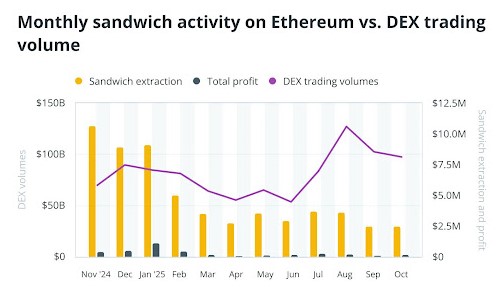
Источник: X.com

Это показывает, что атаки не исчезли, но их эффективность заметно упала: средний доход теперь составляет всего около $3 за попытку. Лишь шесть атакующих заработали более $10 000 долларов за год, что подчеркивает общее падение прибыльности.

Почему увеличилась активность в стейблкоин-пулах

В 2025 году около 38% всех «сэндвич-атак» пришлось на пулы с низкой волатильностью, включая стейблкоины и обернутые активы. Около 12% атак были направлены на стейблкоин-пулы с низким проскальзыванием, где пользователи обычно ожидают наиболее предсказуемый результат сделок. Растущая концентрация ликвидности и стабильное ценообразование делают такие пулы привлекательной мишенью для ботов.

Раньше подобные пулы считались более безопасными, но теперь злоумышленники все чаще выбирают именно их.

Падение общей прибыли может говорить о позитивной тенденции — росте применения инструментов защиты от MEV. Они скрывают данные транзакций или изменяют порядок их обработки, мешая ботам выполнять «сэндвич-стратегии». Решения вроде Flashbots, приватных ретрансляторов и функций приватности в DEX помогают снижать риски для трейдеров.


Trending Cryptos

Related Reads

When Billions Begin to Operate Everything by Voice, How Far is ‘All Assets on Chain’?

In June 2026, WeChat began a limited rollout of "Xiaowei," its native AI assistant. This move is more than an upgrade to a smarter chatbot; it signals a crucial step from "universal internet access" toward the broader vision of "full asset tokenization." Xiaowei, powered primarily by WeChat's in-house WeLM model, demonstrates four key capabilities: 1) direct voice/web chat control of app functions, 2) automated access to mini-programs for services, 3) instant comprehension and summarization of complex documents like PDFs, and 4) generating functional mini-program prototypes from simple natural language requests. This represents a fundamental shift from GUI (Graphical User Interface) to LUI (Language User Interface), eliminating friction in human-digital interaction. The rollout is pivotal because it brings AI Agents to China's massive user base with zero friction—no new app downloads or accounts needed. This "seamless access" mirrors past platform revolutions like the App Store or WeChat Mini-Programs, potentially unlocking a global AI Agent market projected to grow from $7.92 billion in 2025 to nearly $295 billion by 2035. The article argues that China's internet evolution has moved from "connecting everyone" to "putting all services online." The next phase is "tokenizing all assets"—a concept broader than just Real World Assets (RWA) like real estate. It encompasses tokenizing personal assets like social influence, attention, and credit history. RWA tokenization itself is forecast to explode from $35 billion in 2025 to over $500 billion in 2026. The convergence of ubiquitous AI Agents and rapidly tokenizing assets points to a future paradigm for wealth management. Your AI Agent could autonomously manage a globally diversified, tokenized portfolio based on your preferences. Initiatives like EXIO Group's full-stack RWA services aim to lower investment barriers, paralleling WeChat's democratization of AI access. In conclusion, the launch of Xiaowei is not merely a technical upgrade but a historic inflection point. It marks AI Agents' transition from niche tools to essential utilities and accelerates the movement toward a future where voice commands seamlessly interact with tokenized value, redefining humanity's relationship with the digital and financial worlds.

marsbit1h ago

When Billions Begin to Operate Everything by Voice, How Far is ‘All Assets on Chain’?

marsbit1h ago

SoftBank CEO Masayoshi Son's New Trillion-Dollar "Gamble"

SoftBank founder Masayoshi Son is embroiled in a new trillion-dollar "bet" on Physical AI and humanoid robotics, even as his massive wager on OpenAI faces uncertainty ahead of its potential IPO. Recent reports reveal OpenAI's steep losses—$85 billion net loss by Q1 2026 and a $38.5 billion loss in 2025—casting doubt on its path to a trillion-dollar valuation. SoftBank, OpenAI's second-largest external shareholder with a planned 13% stake, stands to gain hugely if OpenAI succeeds. Undeterred, Son is already pushing forward with his next ambitious venture: consolidating SoftBank's AI and robotics assets into a new U.S.-based company named "Roze," targeting a $100 billion IPO as early as late 2026. This move aligns with his belief that Physical AI, merging AI cognition with robotic physical execution, is the next trillion-dollar frontier. Son's confidence stems from recent AI wins; SoftBank's stock surged and he briefly regained the title of Asia's richest person, largely due to OpenAI's soaring valuation. However, his aggressive strategy has raised internal concerns about over-reliance on OpenAI and strained finances. With competitors like Anthropic advancing rapidly and OpenAI's IPO timing uncertain, Son is racing to capitalize on the AI boom. His long-term vision for Physical AI includes a decade of investments in robotics, from Boston Dynamics to recent acquisitions like ABB's robotics unit, and a planned $1 trillion investment in U.S.-based AI robotics industrial parks. Yet, challenges remain: humanoid robotics firms like Figure AI lack the clear revenue paths of AI software companies, and Roze's lofty valuation faces skepticism. For Son, these bets are also driven by an unfulfilled promise of massive returns to key investors like Saudi Arabia's PIF. Despite risks, he continues to double down, betting that the fusion of AI and physical machines will define the next technological era.

marsbit1h ago

SoftBank CEO Masayoshi Son's New Trillion-Dollar "Gamble"

marsbit1h ago

Trading

Spot
Futures

Hot Articles

Discussions

Welcome to the HTX Community. Here, you can stay informed about the latest platform developments and gain access to professional market insights. Users' opinions on the price of ETH (ETH) are presented below.

活动图片