Ethereum Founder Buterin Donates 256 ETH To Two Privacy Messaging Projects

bitcoinistPublished on 2025-11-28Last updated on 2025-11-28

Abstract

Ethereum founder Vitalik Buterin has quietly redirected part of his growing on-chain privacy activity toward the encrypted-messaging space, donating a...

Trusted Editorial content, reviewed by leading industry experts and seasoned editors. Ad Disclosure

Ethereum founder Vitalik Buterin has quietly redirected part of his growing on-chain privacy activity toward the encrypted-messaging space, donating a total of 256 ETH to SimpleX Chat and Session via the Railgun privacy protocol.

Onchain analytics firm Arkham first flagged the move, noting “VITALIK JUST SENT $2.9M $ETH TO RAILGUN. Vitalik holds over $700 MILLION of ETH, and just sent $2.9M into Railgun. What is he cooking?”

Buterin Backs SimpleX And Session

Shortly after, Buterin confirmed the donations from his vitalik.eth account and framed them explicitly as a bet on the next frontier of privacy: permissionless and metadata-hardened messaging. “Encrypted messaging, like @signalapp, is critical for preserving our digital privacy,” he wrote. “Two important next steps for the space are (i) permissionless account creation and (ii) metadata privacy.” He then named Session and SimpleX as “two messaging apps pushing these directions forward.”

Buterin specified that he had “donated 128 ETH to each” project, providing their official websites for anyone wishing to “follow on,” and then pivoted from philanthropy to adoption: “But also, actually download and use them!”

The transactions to SimpleX and Session were executed via Railgun, a zero-knowledge privacy system on Ethereum that obscures the sender, recipient, token type and amount when interacting with smart contracts and DeFi protocols.

While Buterin has used Railgun and other privacy-preserving systems repeatedly over the past two years, he has often explained that such transfers typically represent “some donation to a charitable, non-profit, or other project,” rather than personal cash-outs.The latest pattern fits that narrative: funds routed into Railgun and then out to privacy-focused infrastructure and applications, this time in the messaging domain.

In his post, Buterin positions encrypted messengers as a crucial layer in the broader privacy stack alongside financial anonymity. He explicitly ties the importance of Signal-style end-to-end encryption to new requirements that go beyond content secrecy: “permissionless account creation” and “metadata privacy.” The first is about removing reliance on centralized, real-world identifiers such as phone numbers or email addresses in order to create an account. The second targets the far less visible but equally revealing exhaust of digital communication: who talks to whom, when, and from where.

Why The  Ethereum Founder Supports Both Projects

Both SimpleX and Session are trying to address those problems in ways that diverge sharply from the mainstream model of phone-number-based, cloud-synced messengers. SimpleX’s own documentation emphasizes “complete privacy of your identity, profile, contacts and metadata,” stressing that the platform “has no identifiers assigned to the users – not even random numbers.”

Instead, users establish connections via QR codes or links, and communication routing is designed so that the service itself cannot reconstruct the social graph. Session, originally forked from Signal but rebuilt around onion routing and decentralized service nodes, is pushing a similar line: no phone numbers, Tor-like network-level obfuscation, and attention to metadata minimization.

Buterin is clear that his endorsement is not a claim that these apps are already finished products. “Neither of the two are perfect pieces of software, they have a way to go to get to truly optimal user experience and security,” he cautioned. He then sketched the core engineering problems that still need to be solved if “strong metadata privacy” is to coexist with the kind of convenience users now expect from mainstream messengers.

“Strong metadata privacy requires decentralization, decentralization is hard, users expecting multi-device support makes everything harder,” he wrote. He also flagged Sybil and denial-of-service resistance as a still-open design space: developers must harden “both in the message routing network and on the user side (without forcing phone number dependence).”

The latest donations also underline how Buterin increasingly uses his personal holdings to nudge the ecosystem toward specific priorities: privacy-preserving DeFi, open-source infrastructure, and now, metadata-resistant communication tools. In this case, he explicitly calls for more developer attention: “These problems need more eyes on them. I wish all teams working on these important problems best of luck.”

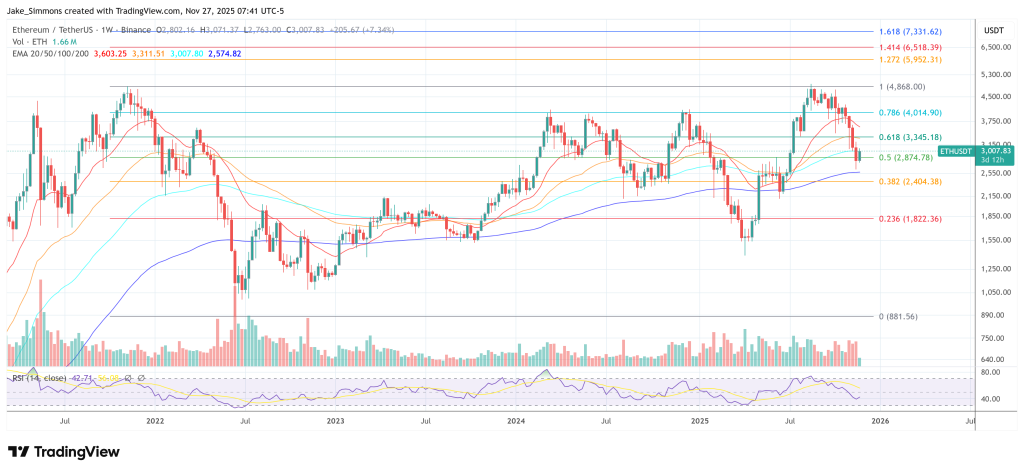
At press time, Ethereum (ETH) traded at $3,007.
Ethereum price
Ethereum rises back above $3,000, 1-week chart | Source: ETHUSDT on TradingView.com
Featured image created with DALL.E, chart from TradingView.com
Editorial Process for bitcoinist is centered on delivering thoroughly researched, accurate, and unbiased content. We uphold strict sourcing standards, and each page undergoes diligent review by our team of top technology experts and seasoned editors. This process ensures the integrity, relevance, and value of our content for our readers.

Jake Simmons has been a Bitcoin enthusiast since 2016. Ever since he heard about Bitcoin, he has been studying the topic every day and trying to share his knowledge with others. His goal is to contribute to Bitcoin's financial revolution, which will replace the fiat money system. Besides BTC and crypto, Jake studied Business Informatics at a university. After graduation in 2017, he has been working in the blockchain and crypto sector. You can follow Jake on Twitter at @realJakeSimmons.

Trending Cryptos

Related Reads

Valuation $1 Billion, Nvidia Doubles Down! Is Prime Intellect Washing Off Its Web3 Label?

Prime Intellect, a decentralized AI infrastructure company founded in 2024, recently announced a $130 million Series A funding round at a $1 billion valuation, with investments from NVIDIA, Intel, and Dell's venture arms. The company claims its annualized recurring revenue (ARR) has exceeded $100 million within a year, serving over 6,000 enterprise clients. Initially rooted in Web3 and decentralized science (DeSci), Prime Intellect has evolved into a full-stack AI training and deployment platform. Its core technology enables distributed training of large language models across globally dispersed, heterogeneous GPU clusters. Key milestones include releasing open-source models like INTELLECT-1 and INTELLECT-3, and launching Prime Intellect Lab, a platform allowing users to train and optimize agentic models without managing their own GPU infrastructure. The company's deep collaboration with hardware giants, particularly NVIDIA, extends beyond investment to joint optimization of software (e.g., integrating NVIDIA Dynamo) and hardware systems. A notable commercial case involves fintech company Ramp using Prime Lab to train a specialized agent, demonstrating the platform's applied value. While achieving rapid commercial growth, Prime Intellect has systematically downplayed its earlier Web3 and token-based incentives from its official documentation, repositioning itself as a mainstream AI infrastructure provider focused on enterprise adoption and potential IPO.

Foresight News10m ago

Valuation $1 Billion, Nvidia Doubles Down! Is Prime Intellect Washing Off Its Web3 Label?

Foresight News10m ago

After 13% Daily Distribution, Why Did SATA Still Fall?

Strive Asset Management's BTC-linked preferred stock SATA transitioned from monthly to daily dividend distributions on June 16, with a current annualized yield of 13%. Despite this change, SATA's price fell approximately 9.9% from June 22 to June 26. The analysis highlights that this decline reflects fundamental credit and structural risks, not simply dividend frequency. SATA represents a perpetual, cumulative preferred equity interest in Strive, not a direct Bitcoin-backed bond. Its dividends depend on Strive's corporate credit and access to capital markets. While Strive's Bitcoin holdings grew from 15,009 to 19,864 BTC between May 12 and June 18, SATA's outstanding shares grew faster (from ~4.96 million to ~7.83 million). Coupled with a drop in BTC price, the pure Bitcoin coverage ratio for SATA's stated amount fell from ~2.44x to ~1.52x. A further ~34.3% decline in BTC to ~$39,416 would bring this coverage to 1.0x. Daily dividends smooth cash flow for investors and reduce dividend-capture trading, but do not eliminate price volatility or credit risk. SATA now trades at a ~12.25% discount to its $100 stated amount, implying a market yield of ~14.81% and a credit spread of ~1,117 bps over SOFR. Key risks include a negative feedback loop if SATA trades below par, making new issuance dilutive; reliance on capital markets for dividend funding despite a ~17-month cash buffer; and the perpetual nature of the security, where dividends can be deferred. In summary, SATA innovates by providing daily income from a Bitcoin-focused corporate balance sheet, but its recent price action underscores its exposure to Bitcoin valuation, company-specific financing risks, and perpetual duration. The market is repricing it from a near-par yield product to a deeply discounted high-risk credit instrument.

marsbit38m ago

After 13% Daily Distribution, Why Did SATA Still Fall?

marsbit38m ago

Unlocking 20%, $125 Million in Pressure, Can PUMP Hold Up?

"Pump.fun Faces Crucial Test with $125M Token Unlock Despite a cooldown in the meme coin market, Pump.fun remains one of Web3's top revenue-generating protocols, earning $28.4 million in the past 30 days. The platform has accumulated approximately $1.05 billion in total revenue from over 12 million tokens created. The protocol now faces its biggest challenge: the first unlock of team and investor tokens. A total of 82.5 billion PUMP tokens (8.25% of total supply, 20.23% of previous circulating supply), valued at around $125 million, have been unlocked. This potential selling pressure is significant compared to the token's 24-hour trading volume of only $28 million. While Pump.fun uses a portion of its revenue to buy back and burn PUMP tokens, creating buy-side pressure, this support has weakened. The buyback rate was reduced from 100% to 50% of net fees in April 2024. In June 2024, monthly buybacks totaled just $9.2 million, an over 80% drop from its peak. At this rate, selling just 7% of the newly unlocked tokens would offset a full month of buybacks. Furthermore, this unlock is only the first batch; team and investors still hold another 247.5 billion locked PUMP tokens, with 240 billion community tokens awaiting a release schedule. Despite these headwinds, PUMP is argued to be a relatively scarce asset in the current market. With a $610 million market cap against $28.4 million in monthly revenue, its valuation is lower than competitors like Hyperliquid. The investment thesis for PUMP is not betting on a single meme coin but on the persistent activity of the meme market and Pump.fun's ability to maintain its position as a key platform. The conclusion suggests that while the unlock tests short-term price resilience, the protocol's underlying revenue strength will determine PUMP's long-term trajectory, potentially making the current dip a viable entry point for long-term accumulation."

Odaily星球日报51m ago

Unlocking 20%, $125 Million in Pressure, Can PUMP Hold Up?

Odaily星球日报51m ago

Aave Withdrawal, TVL Plunges: Where is MegaETH's Valuation Anchor?

MegaETH, once a highly anticipated new blockchain, has seen a dramatic decline in its Total Value Locked (TVL) and token price. According to DefiLlama data, its TVL plummeted nearly 60% in 24 hours, falling to just over $30 million from a May peak, with the Aave V3 protocol withdrawing 80% of its liquidity. The MEGA token price dropped to around $0.048, with a market cap of ~$54 million and a fully diluted valuation (FDV) of ~$480 million. The analysis identifies three key mismatches between MegaETH's valuation and its fundamentals. First, its high FDV contrasts with minimal real usage: low protocol revenue (~$90k/30 days) and few daily active addresses. Second, its DeFi narrative is contradicted by its revenue structure, where a collectible card game (Monster) generates most income, not major DeFi protocols like Aave. Third, initial hype from VC backing and airdrop farming has faded without sustained user adoption or clear applications. The TVL was heavily concentrated in Aave and largely driven by cyclical arbitrage strategies involving stablecoins like USDm and USDe. As the yield for these strategies diminished, funds rapidly exited. The departure of this speculative capital has exposed a lack of substantial, organic ecosystem activity. While the sharp drop could be seen as a correction from inflated expectations, the article suggests MegaETH's valuation lacks a solid foundation. Future price movements may rely on short-term market sentiment rather than genuine improvement in network fundamentals, such as increased real usage, a diversified application ecosystem, and consistent user growth. The situation reflects a broader market trend of demanding clearer value propositions beyond just high TVL figures.

marsbit1h ago

Aave Withdrawal, TVL Plunges: Where is MegaETH's Valuation Anchor?

marsbit1h ago

Trading

Spot

Hot Articles

Discussions

Welcome to the HTX Community. Here, you can stay informed about the latest platform developments and gain access to professional market insights. Users' opinions on the price of ETH (ETH) are presented below.

活动图片