Author: Zhou, ChainCatcher
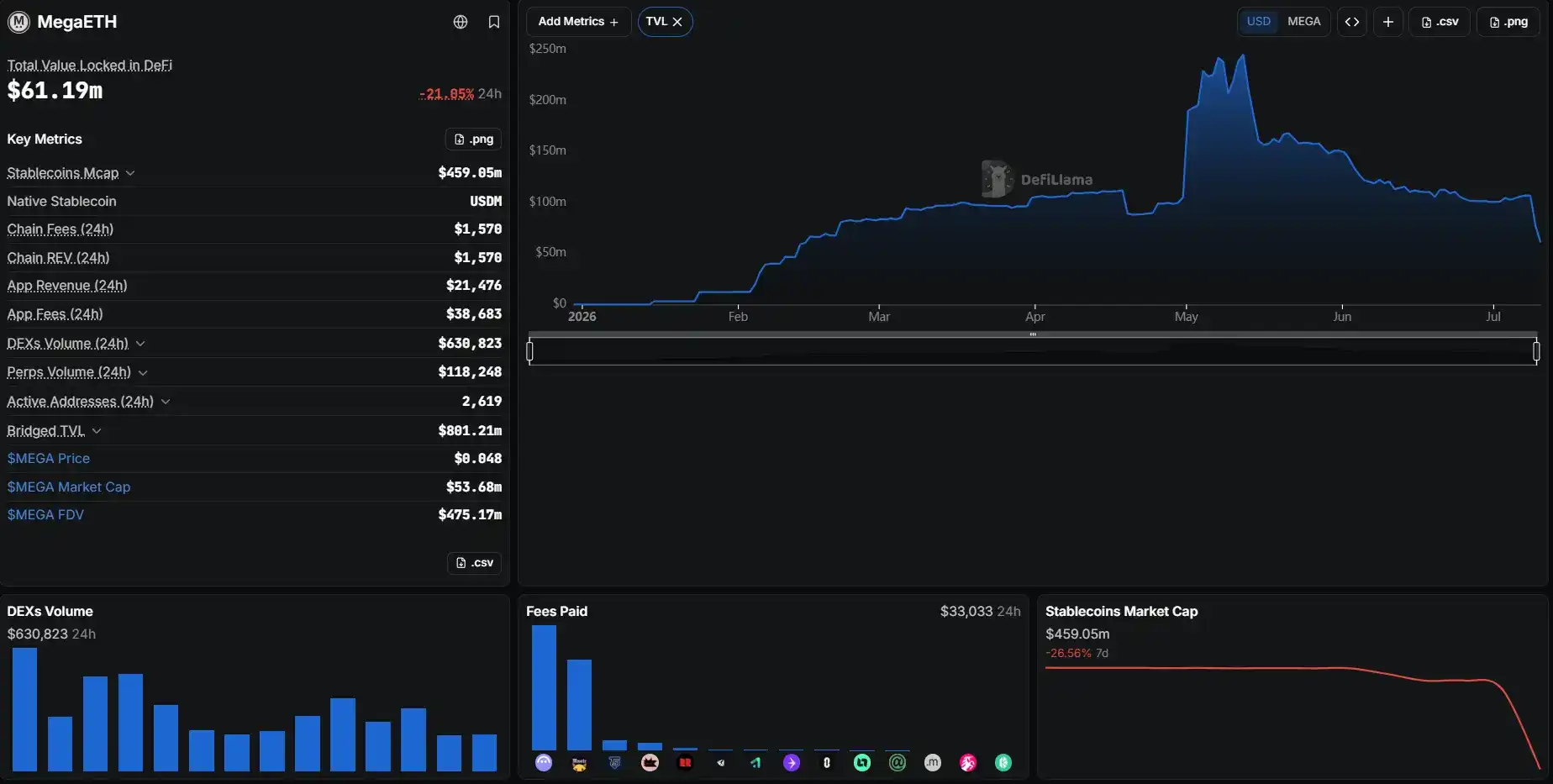
According to the latest data fromDefiLlama, MegaETH's full-chain TVL experienced violent fluctuations from July 9 to 10, once falling to just over $30 million, a 24-hour drop of nearly 60%, and evaporating about 70% compared to its peak in May. The on-chain top protocol Aave V3withdrew 80% of its liquiditywithin a day.
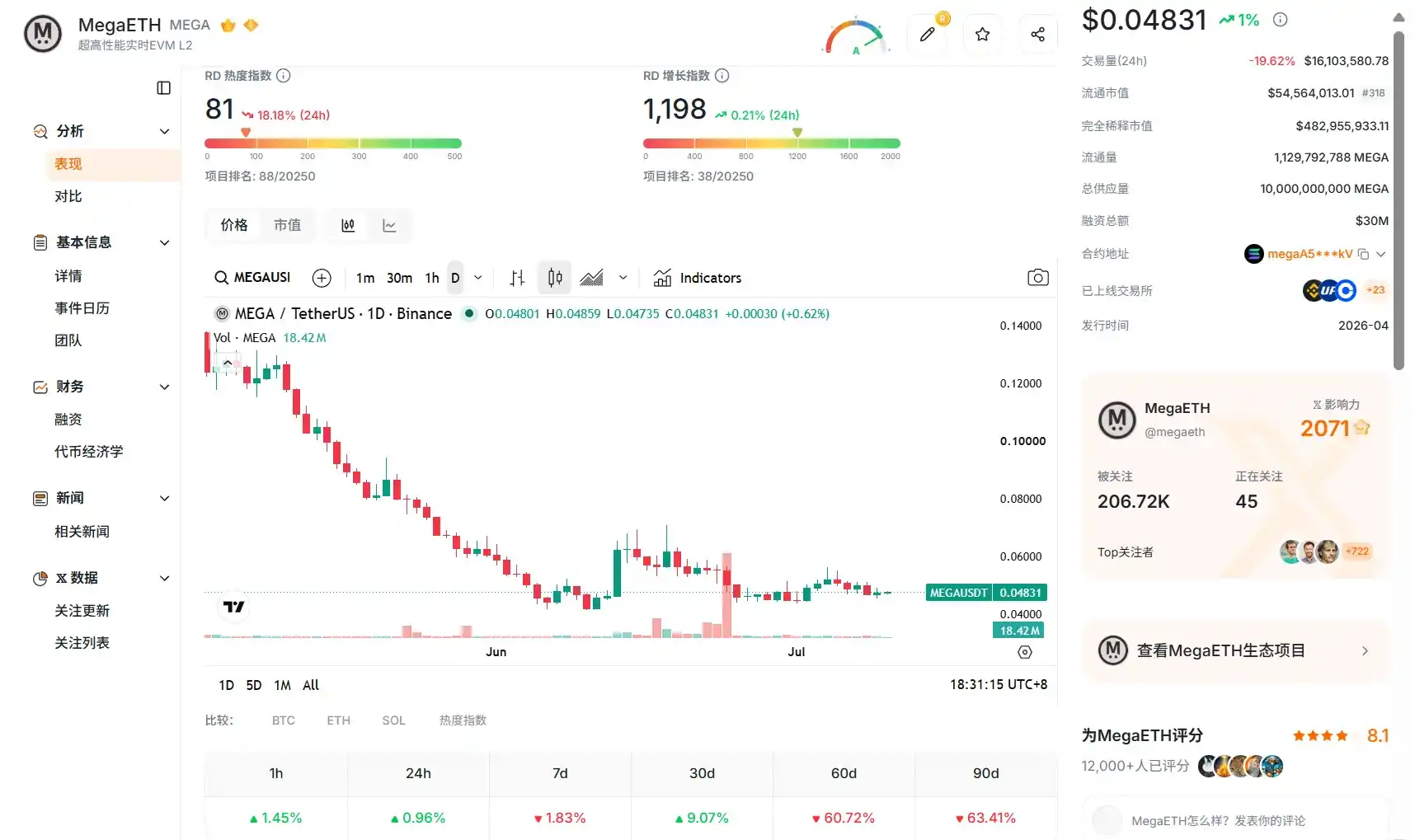
In terms of market performance,the price of MEGA fell to around $0.048, with a market capitalization of only about $54 million and an FDV of approximately $4.8 billion.
MegaETH was once one of the most anticipated new public chains in this cycle. It launched right into a market hotspot, backed by a luxurious VC lineup and KOL enthusiasm for new listings, with its token FDV once soaring to about $20 billion. In May of this year, its DeFi TVL reached $245 million, once squeezing into the top 11 public chains by TVL ranking.
From a widely viewed star public chain to experiencing sharp TVL retraction in a short time, MegaETH took only a few months. With the capital base supporting its valuation loosening, has its price already bottomed out? Or, after the paper prosperity fades, does its valuation still lack support.
TVL Highly Dependent on a Single Protocol and Circular Strategies
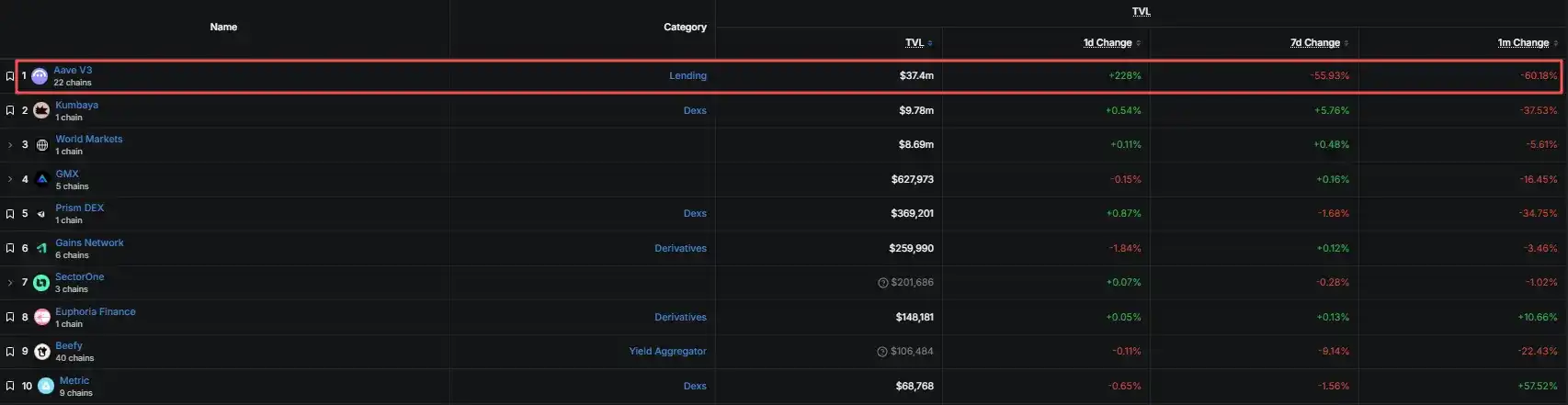
In MegaETH's ecosystem, at its peak, Aave once contributed about ninety percent of the chain's TVL.Currently, the total TVL fluctuates around $60 million, of which Aave still accounts for about 65%.
In fact,just over two months ago, the biggest source of TVL on MegaETH was someone else. On the day of the token's listing, the native DEX protocol Kumbaya accounted for $59.03 million out of the $98.43 million total TVL, about sixty percent.
At the same time, projects like Aave V3, GMX, and Chainlink Scale integrated and launched on the chain. After that, the dominant TVL contributor gradually became Aave.
Risk assessment firm LlamaRisk previously pointed out that MegaETH's TVL is highly dependent on Aave, while its stablecoin structure is highly concentrated in USDm and USDe. In its view, after excluding native assets, the proportion of external assets entering MegaETH through third-party and specific asset channels is relatively high, with highly concentrated funding sources, asset types, and protocol methods, raising stability concerns.
Specifically regarding the gameplay, the market generally questions that a large part of this volume comes from Ethena-related stablecoin circular strategies, which involve repeatedly collateralizing, borrowing, and re-collateralizing stablecoins, artificially inflating the books through leveraged stacking.
This means that when the yield of USDe falls below Aave's borrowing cost, this arbitragemechanismloses its interest rate spread space, the circular positions start unwinding, and funds withdraw accordingly.
Whether it's points incentives during the launch period or the interest rate spread profits in circular strategies, this type of capital essentially comes for returns. Once the expected returns disappear, they will leave. This is common commercial behavior in DeFi and is not surprising in itself.
What truly alerted the market is what remains on the MegaETH chain after this disproportionately large capital is withdrawn, and whether what remains can support its current valuation.
Valuation and Fundamentals, Separated by Three Layers of Mismatch
The first layer of mismatch occurs between valuation and real usage
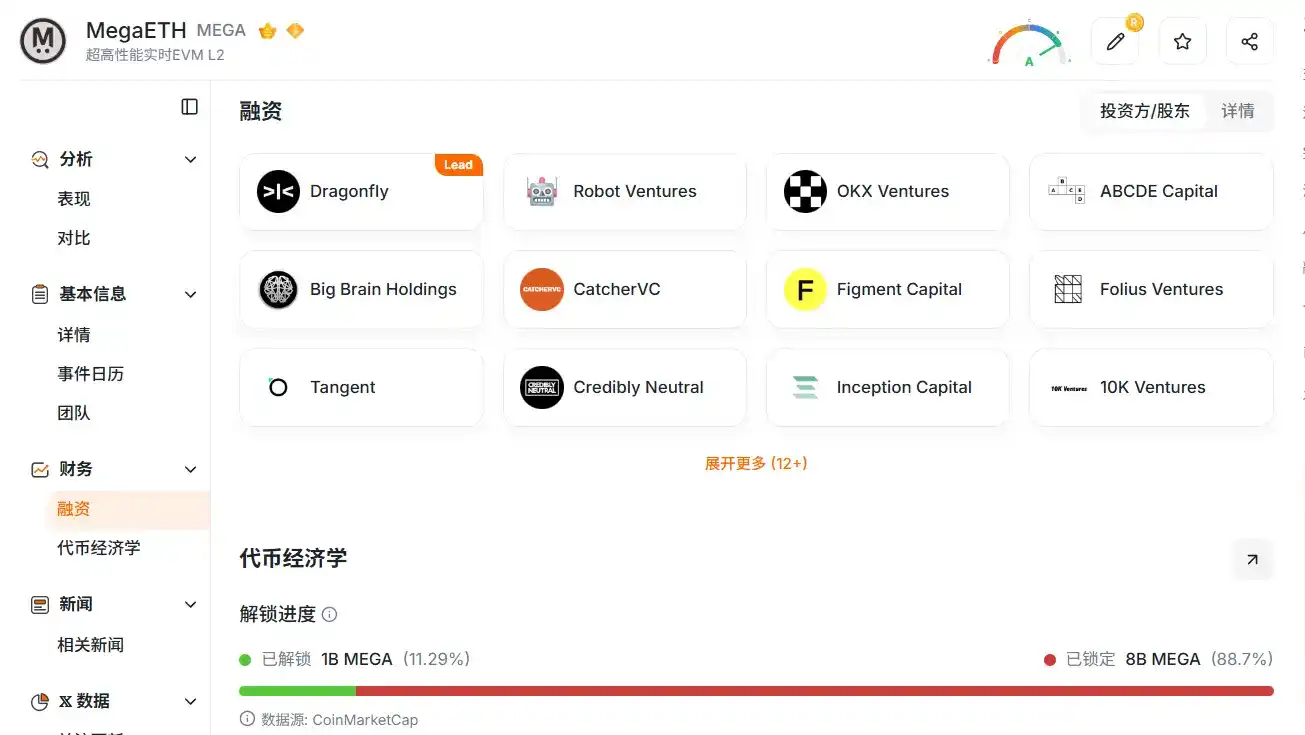
As of writing, MEGA's market capitalization is about $54 million, and its FDV is about $470 million. According to RootData, currently 88.7% of MEGA tokens are not in circulation, and a large number of holders cannot exit due to a one-year lockup arrangement, meaning there is still a batch of potential sell pressure in the future.
Now, look at how much real usage the current valuation corresponds to. Data shows that the 30-day real revenue of all protocols on MegaETH is less than $900,000, annualized at about $10 million, with only 2,619 daily active addresses.
Averaged per daily active address, MegaETH carries an FDV of about $180,000, while the real protocol revenue contributed by each address in a month is less than $350.
Clearly, its price is not anchored to the current scale of real economic activity, but to the market's imagination of its future. And this expectation is crumbling step by step.
The second layer of mismatch is between token narrative and ecosystem quality
The market buys MEGA, buying the story of a high-performance DeFi public chain. However, looking at the revenue structure, there is a certain degree of contrast.
DefiLlama data shows that the highest-earning protocol on MegaETH is Monster, which is a physical collectible card game, with a 30-day revenue of about $670,000, accounting for nearly eighty percent of the chain's protocol revenue.
Aave, which carries the DeFi narrative and accounted for about ninety percent of the chain's TVL at its peak, had a revenue of only about $90,000 during the same period.
The same misalignment is also reflected in stablecoins. The supply of the native stablecoin USDM on the MegaETH chain is about $460 million, while DEX daily volume is only about $630,000, and perpetual contracts volume per day is only about $120,000. Moreover, this supply is also draining, with USDM's market cap dropping over 26% in the past 7 days, indicating real capital is leaving, even more so than the TVL decline.
A long-term participant@OlricOnlyfornftpointed out that MegaETH once had a very strong community early on, but the team has long been more focused on technology and applications, with insufficient communication with the community. Many promising projects ultimately migrated to other chains. Nowadays, there are not many applications that can be clearly identified as success cases, and only a few are still persisting in building.
This kind of view may not be enough to form a conclusion alone, but it indicates that after the market hype fades, MegaETH still needs clearer application examples to prove the quality of its ecosystem.
The third layer of mismatch lies between short-term expectations and long-term delivery
MegaETH carried excessively high expectations at launch: TGE, blue-chip integration, KOL participation in new listings, TVL surge, all together formed the early valuation anchor. Looking back a few months later, the chain's delivery capability has consistently failed to catch up.
In February of this year, Uniswap deployed v2, v3, and v4 on MegaETH. As of writing, Uniswap's TVL on MegaETH is less than $20,000, evaporating about 97% in the past 7 days. In the last day, Aave V3's TVL once rebounded over 240% in a single day, but over a 7-day period, it still declined over 50%.

The dramatic inflows and outflows of capital precisely indicate that this portion of TVL is driven by arbitrage capital, not stable, settled real demand.
It's worth noting that MEGA's situation is not an isolated case. Another star new public chain highly valued in this cycle, Monad's token MON, has also been declining. MON is currently around $0.022, down more than 50% from its high in November 2025, with a current market cap of about $2.69 billion.
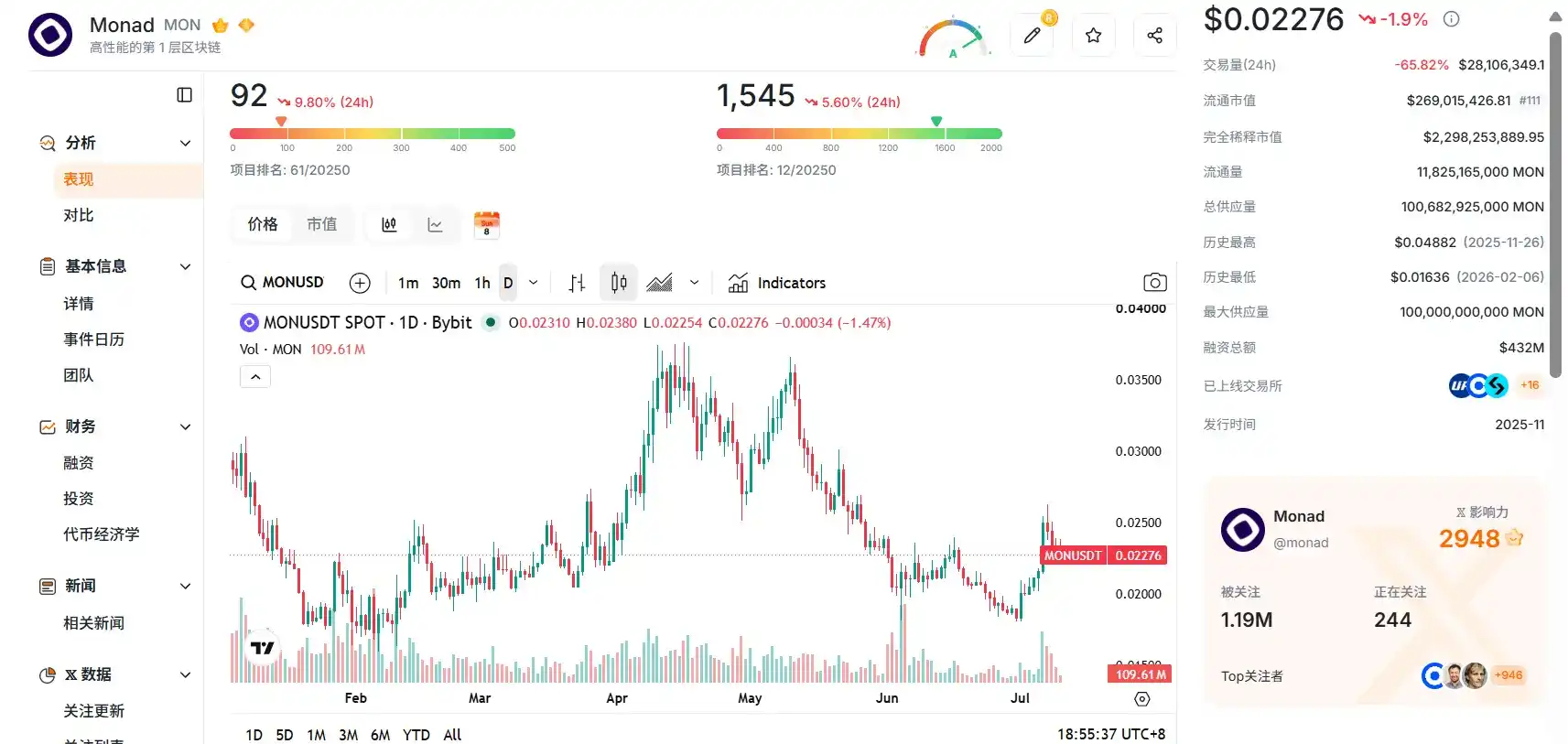
Although Monad's recent TVL has rebounded due to fund inflows into lending protocols, the market reaction has been tepid. This points to the same judgment as MegaETH's situation: when pricing this type of public chain, the market increasingly does not recognize paper TVL but looks at real value support.
In other words, this round of adjustment may not just be MegaETH's single-point slowdown, but more like the market starting to reduce the premium for paper TVL and star narratives,转而 demanding clearer transactions, revenue, and ecosystem capacity as support.
Moreover, competition in the public chain track is still intensifying, with new players including Robinhood continuously entering, continuously diverting market attention and capital.
For MEGA, although the decline has been huge, if a rebound occurs, it is more likely to come from short-term market sentiment repair rather than a genuine improvement in fundamentals.
Paper Prosperity Fades, MEGA is Still Waiting for a Value Anchor Point
Looking at these mismatches together, the conclusion becomes gradually clear.
When the paper prosperity propped up by incentive and arbitrage capital recedes, what is missing between MEGA's current market capitalization and its real on-chain fundamentals is precisely a solid value anchor point.
Market sentiment has also clearly shifted towards caution. One view holds that this is a normal valuation regression after incentive capital recedes. Points incentives stop, the interest rate spread for circular arbitrage disappears, capital leaving is an inevitable result. MegaETH simply leveraged this play higher, hence the exceptionally severe retraction.
At the community level, many users have persistently questioned the team's communication and transparency, pointing out that Discord has closed community discussions, Telegram is only open to users holding large amounts of tokens, and the team's public appearances are far fewer than before the launch.
However, these claims are mostly one-sided user statements and have not been officially confirmed. As of writing, the MegaETH team has not publicly responded to the relevant criticisms.
For MEGA, whether it is viewed as still in the process of returning to fundamentals or having already fallen into a significant mismatch between valuation and fundamentals, the follow-up focus falls on the same thing: whether the team can convert short-term liquidity into real usage and turn the massive funds previously raised into tangible ecosystem results.
Before these deliveries appear, aside from short-term rebounds driven by market sentiment, it seems there isno other solid reason yet seen for the valuation to firmly stabilize again.