Бутерин назвал две угрозы для Ethereum из-за роста влияния BlackRock

cryptonews.ruPublished on 2025-04-19Last updated on 2025-11-20

Беспрецедентные темпы накопления второй по капитализации криптовалюты институциональными инвесторами несут фундаментальные угрозы для Ethereum. Об этом заявил Виталик Бутерин во время конференции Devconnect, пишет DL News.

Риски

Первый вызов — отток разработчиков. По словам соучредителя Ethereum, основное сообщество, которое годами развивало децентрализованную инфраструктуру, вряд ли захочет работать с Уолл-стрит.

Главная цель проекта — создание прозрачных и открытых систем, а не инструментов для традиционных финансов. Если платформа сосредоточится на последнем, часть разработчиков может покинуть экосистему. Без них Ethereum рискует утратить техническую экспертизу и идейную основу сообщества.

Сейчас девять гигантов с Уолл-стрит, включая BlackRock, управляют активами на $19 млрд через биржевые фонды. Еще столько же удерживают на своих балансах несколько десятков DAT-компаний.
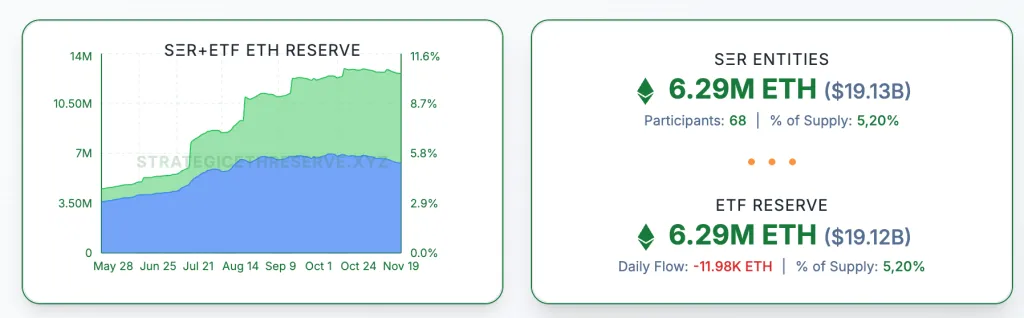
Источник: Strategic ETH Reserve.

Эти участники рынка аккумулировали 10,4% от общего предложения ведущего альткоина.

Второй риск заключается в давлении на техническое развитие. Инвесторы могут лоббировать изменения в базовом протоколе, которые выгодны им, но вредны для рядовых пользователей.

Бутерин привел гипотетический пример с уменьшением времени создания блока до 150 миллисекунд. Это сделало бы невозможной работу ноды для обычных пользователей за пределами финансовых хабов.

Тем временем BlackRock зарегистрировала в штате Делавэр новый Ethereum-ETF с функцией стейкинга, обратил внимание аналитик Bloomberg Эрик Балчунас.

BlackRock is planning to file for a Staked Ethereum ETF, as per the Delaware name registration. '33 Act. Filing coming soon. pic.twitter.com/NmAsQhcq5D

— Eric Balchunas (@EricBalchunas) November 19, 2025

Процедура — один из первых шагов, которые необходимо сделать эмитенту для запуска биржевого фонда. BlackRock еще предстоит подать другие соответствующие документы, чтобы предложенный продукт получил одобрение регуляторов.

Новый инструмент станет дополнением к ETHA, который с момента запуска в 2024 году привлек $13,1 млрд.

Решение

В качестве решения программист предложил сосредоточиться на уникальных преимуществах Ethereum:

«Нам нужно сфокусироваться на вещах, которых иначе будет не хватать: глобальном, беспристрастном и устойчивом к цензуре протоколе».

По словам Бутерина, Уолл-стрит не нуждается в «высокоскоростном сверхэффективном Ethereum для обработки транзакций» — для этого у компаний есть собственные системы.

Истинная ценность платформы — создание по-настоящему глобальной системы, доступной каждому без необходимости получения разрешений и механизмов доверия. Это недостижимо для традиционных финансовых институтов, считает соучредитель проекта.

Виталик Бутерин подчеркнул, что сохранение названных им качеств «сильного ядра сообщества, сфокусированного именно на этих принципах» — не на адаптации под институциональные требования, а на верности изначальным ценностям.

Напомним, на Devconnect программист также высказал обеспокоенность развитием квантовых компьютеров. По его словам, они смогут взломать текущую модель безопасности уже к следующим президентским выборам в США в 2028 году.

В октябре разработчик клиента Geth Петер Силадьи указал на централизацию власти вокруг Бутерина. Тогда же глава Polygon заявил о кризисе лояльности к Ethereum.

Бутерин предложил новые способы защиты децентрализации Ethereum

Trending Cryptos

Related Reads

Rented Faith: How Much of the Bitcoin ETF Inflows Is Real Money?

"Rented Conviction: How Much of Bitcoin ETF Flows Is Real Money" The weekly inflows into Bitcoin ETFs are often interpreted as a gauge of institutional belief. However, a significant portion of this activity is driven by a hidden arbitrage trade, not directional conviction. The core mechanism is a cash-and-carry arbitrage: traders buy spot Bitcoin (often via ETFs) while simultaneously shorting CME futures to lock in the price difference, or "basis." This delta-neutral trade is essentially an interest rate play. In weekly data, about half the fluctuation in ETF flows can be explained by new short positions added by leveraged funds (hedge funds), with a correlation of 0.70. Bitcoin's price movement in a given week shows no statistical power in predicting these flows. While this arbitrage trade drives weekly *volatility*, it is not the main component of the cumulative *stock*. Of the total ~$55 billion in net ETF inflows, the current net arbitrage position is only about $1 billion. The remainder is steady, directional buying averaging ~$400 million per week, which constitutes the vast majority of the accumulated "mountain" over two years. Thus, ETF flow data overstates the *volatility* of conviction, not its *level*. This arbitrage trade has been unwinding for nearly two years. Leveraged fund short positions peaked at ~$14 billion in late 2024 and have since declined to ~$4.5 billion. When the basis compresses to unprofitable levels, ETF inflows and short positions retreat together. Recent outflows should not be mistaken for a loss of faith but rather the routine unwinding of this rate trade. For Ethereum ETFs, the pattern is weaker. Accounting for staking yield makes the basis often negative, so neither strong conviction buying nor robust arbitrage supports its flows. To interpret ETF flows correctly, monitor the CME basis versus T-bill rates and leveraged fund net shorts. They reveal how much of the next "demand" headline is real. The real, patient buy-and-hold demand is what constitutes the enduring bulk of ETF assets.

marsbit45m ago

Rented Faith: How Much of the Bitcoin ETF Inflows Is Real Money?

marsbit45m ago

Soaring Over Tenfold Within the Year: The Frenzy Over SK Hynix Leveraged Products

South China Morning Post The leveraged ETF tracking SK Hynix has surged over tenfold year-to-date, fueled by intense market speculation on the memory chip sector. By June 22, the value of the 'South Korea 2x Long SK Hynix ETF' listed in Hong Kong had skyrocketed by more than 1,061% since the start of the year, while its asset size exploded over twenty times from the end of last year. The rally is driven by AI-driven demand for high-bandwidth memory (HBM), with SK Hynix recently sampling its next-generation HBM4E product. However, industry professionals warn of significant risks. Leveraged ETFs magnify both gains and losses. During a recent market correction, while the underlying SK Hynix stock fell 19.1%, its double-leveraged ETF dropped nearly 38%. Korean regulators noted that such products could theoretically lose 60% in a single day. Additionally, these ETFs face risks like time decay in volatile markets, liquidity spirals during mass redemptions, and extreme price dislocations from market-making failures, as seen in early June when an ETF moved opposite to its underlying stock. The trading is predominantly driven by retail investors, with institutional capital largely absent due to the products' high volatility. Analysts caution that with the semiconductor sector at elevated valuations and facing geopolitical and supply chain uncertainties, leveraged ETFs pose a substantial threat of amplified losses for uninformed investors.

marsbit1h ago

Soaring Over Tenfold Within the Year: The Frenzy Over SK Hynix Leveraged Products

marsbit1h ago

18 Months, Over 50x Surge: KIOXIA's Epic Comeback

KIOXIA, a NAND flash memory giant, staged a dramatic comeback driven by AI demand. After a period of significant losses, a failed merger, and missed HBM opportunities, its 2024 IPO began modestly. However, fueled by explosive demand for AI data storage, its stock price skyrocketed over 50 times within 18 months, making it Japan's most valuable company, surpassing Toyota. Its Q1 FY2026 profit guidance soared 30-fold year-over-year, with 2026 NAND capacity already sold out. Key to its success is its 3D NAND technology, BiCS FLASH. As the inventor of NAND, KIOXIA advanced its technology through generations, reaching over 200 layers by 2023. Key innovations include CBA (CMOS directly Bonded to Array), which separately manufactures control circuits and memory arrays for better performance, and OPS (On Pitch Select Gate) to increase density. The company is now developing high-capacity packages like an 8TB solution stacking 32 dies. Looking beyond NAND, KIOXIA is exploring 3D DRAM with its OCTRAM technology, using oxide semiconductor transistors for ultra-low leakage to reduce power consumption. This fundamental research differs from HBM and represents a long-term bet to extend its 3D expertise from NAND into future DRAM architectures. KIOXIA's story highlights how technological assets and shifting market cycles can rapidly transform a company's fortunes. While questions remain about sustaining growth beyond the current AI boom, its resurgence demonstrates that in semiconductors, being down does not necessarily mean being out.

marsbit1h ago

18 Months, Over 50x Surge: KIOXIA's Epic Comeback

marsbit1h ago

Trading

Spot
Futures

Hot Articles

Discussions

Welcome to the HTX Community. Here, you can stay informed about the latest platform developments and gain access to professional market insights. Users' opinions on the price of ETH (ETH) are presented below.

活动图片