Ethereum повторяет паттерн июня перед ралли на 116%

cryptonews.ruPublished on 2025-11-15Last updated on 2025-11-18

Курс Ethereum снизился примерно на 7% за последние 24 часа. Месячное падение котировок составило почти 24%. Трейдеры расходятся во мнениях относительно вероятности отскока. Однако ключевой ончейн-индикатор демонстрирует структуру, почти идентичную июньской. Тогда похожий сценарий спровоцировал рост на 116%. Тем не менее сначала рынок пережил глубокую просадку.

Аналитики оценивают, повторяется ли та же ситуация в настоящее время.


Сценарий «сброса» слабых рук

Для понимания этой структуры необходимо рассмотреть метрику NUPL (Чистая нереализованная прибыль/убыток). NUPL измеряет прибыль или убыток, который держатели фиксируют при продаже. Резкое падение показателя свидетельствует о «сбросе» слабых рук. Это обычно предшествует крупному изменению рыночного тренда.

Данный паттерн четко проявился в июне. 5 июня NUPL находился вблизи 0.24. Многие инвесторы посчитали это локальным дном. Затем Ethereum отскочил до $2,814 к 10 июня.

После этого NUPL снизился до 0.17 к 22 июня, а цена упала до $2,230. Это снижение на 20.7% стало истинным дном коррекции. С этой отметки ETH вырос на 116% ($4,829) за два месяца.
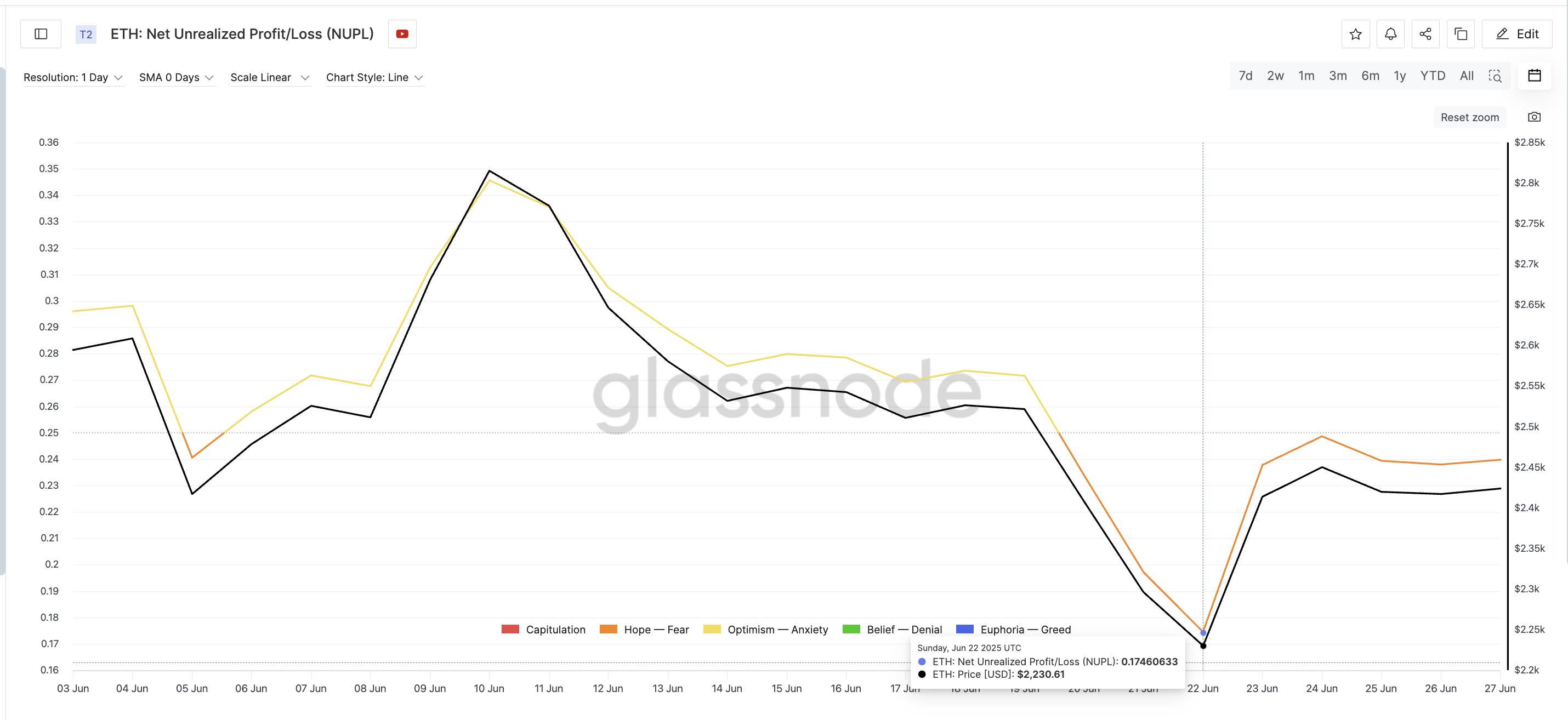
Июньский сброс NUPL и цена Ethereum
Июньский сброс NUPL и цена Ethereum: Glassnode

Текущая структура полностью повторяет этот сценарий. 14 ноября NUPL снова находился в районе 0.24. Последовал слабый отскок до $3,115. После этого продажи возобновились, и курс ETH начал снижаться.
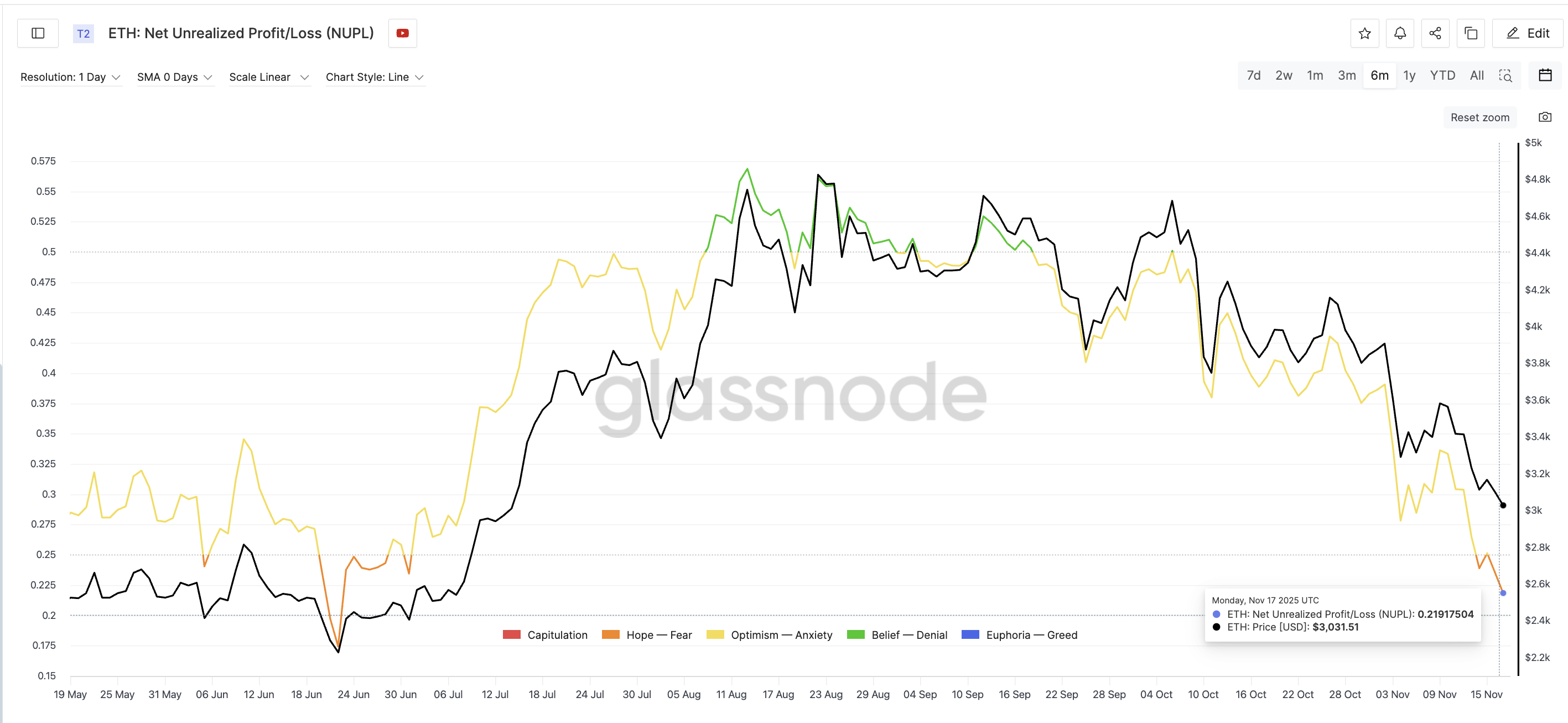
Стимул к фиксации прибыли должен быть ниже для следующего ралли Ethereum
Стимул к фиксации прибыли должен быть ниже для следующего ралли Ethereum: Glassnode

Если NUPL достигнет зоны 0.17, прогнозируемая цена составит $2,470. Это соответствует падению на 20.7% от уровня отскока. К 16 ноября NUPL уже опустился до 0.21, что подтверждает агрессивное движение вниз.

Активность бирж указывает на слабость

Поведение инвесторов на торговых платформах поддерживает идею о необходимости «сброса» слабых позиций. Метрика чистого изменения позиций на биржах показывает приток и отток ETH. 6 ноября отток составлял 1.14 млн ETH. К 17 ноября этот показатель сократился на 50% – до 574 000 ETH.
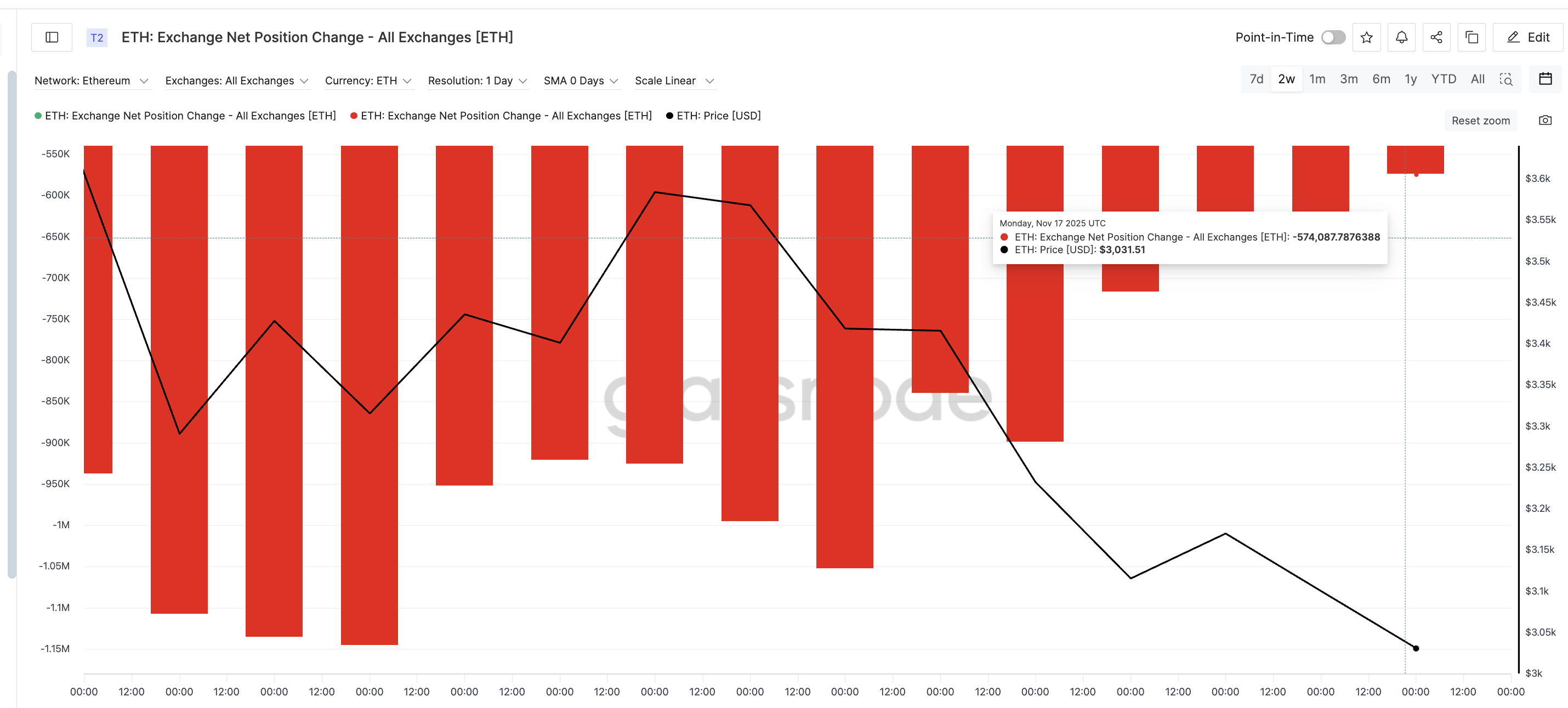
Отток средств с бирж замедляется
Отток на бирже замедляется: Glassnode

Быстрое сокращение оттока обычно означает, что держатели фиксируют прибыль или продают активы. Совместно NUPL и биржевая активность указывают на необходимость более глубокой «чистки» перед началом устойчивого ралли.


Технический анализ подтверждает цель

Ethereum продолжает движение в нисходящем канале, начавшемся в начале октября. Общая структура рынка остается медвежьей. Курс находится вблизи критически важного уровня поддержки.

Первым важным уровнем является $2,920. Пробой этой отметки на дневном закрытии подтвердит преобладание продавцов. Если поддержка будет пробита, следующая ключевая зона находится на уровне $2,466. Падение до этой цены составит существенные 17% от текущих уровней.

Этот момент заслуживает особого внимания:

  • Июньская модель «сброса» указывает на уровень $2,470.
  • Текущая графическая структура указывает на уровень $2,466.
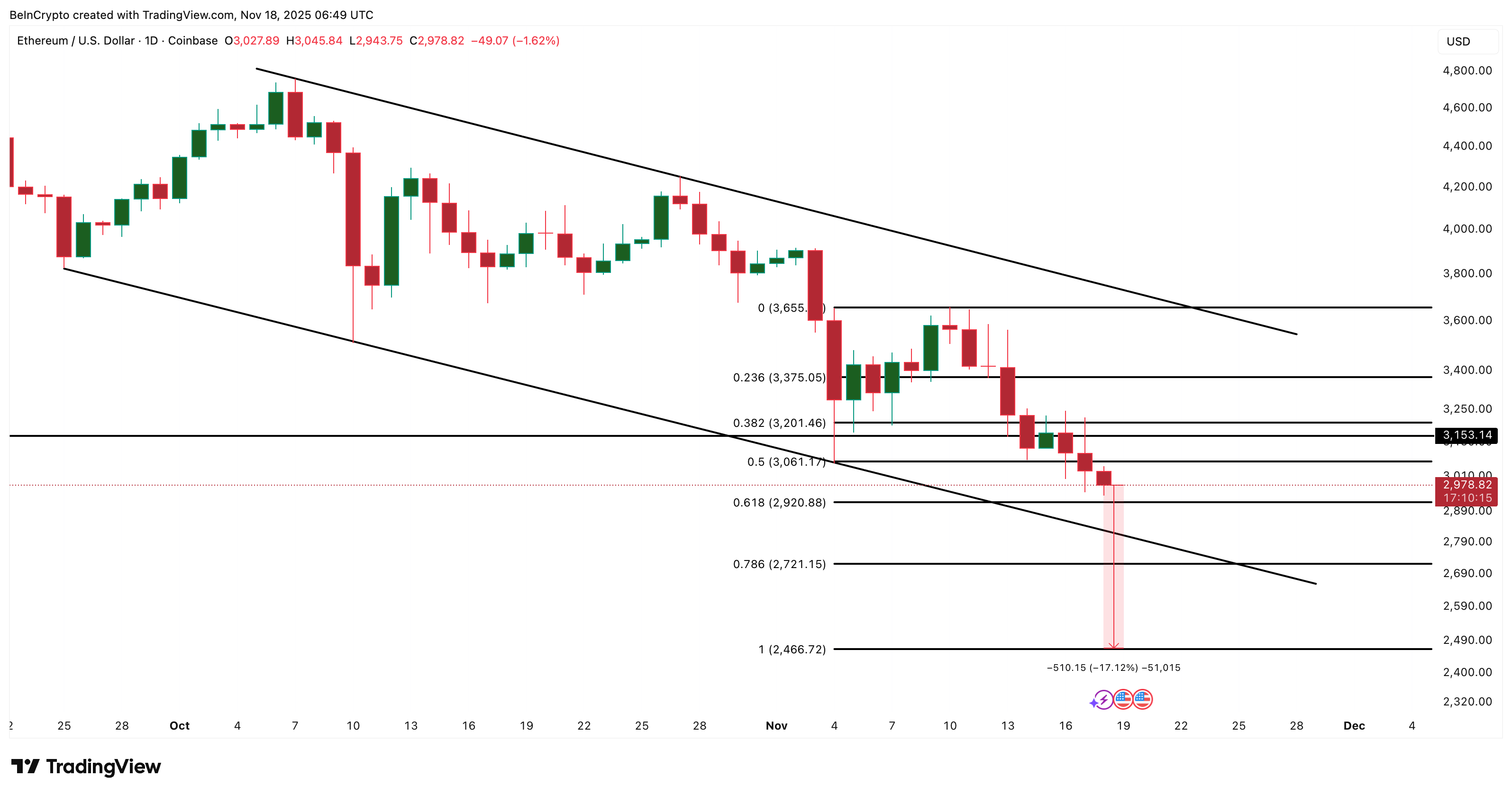
Анализ цены Ethereum
Анализ цены Ethereum: TradingView

Подобное совпадение сигналов от двух независимых систем требует повышенного внимания трейдеров.

Если ETH удержит $2,920 и отскочит, картина может улучшиться. Однако текущая структура склоняется к финальной просадке перед значимым разворотом. Восстановление $3,655 в краткосрочной перспективе временно отменит эту теорию, но может стать лишь временным отскоком, аналогичным тому, что наблюдался 5 июня.

The post Ethereum повторяет паттерн июня перед ралли на 116% appeared first on BeInCrypto.

Trending Cryptos

Related Reads

In the AI Era, What's Left for Bitcoin?

As Bitcoin falls below $60,000, the author reflects on the relationship between AI and Bitcoin, seeing them as two sides of the same coin. In the AI era, the cost of generating content has plummeted, making fake text, images, and videos increasingly easy and cheap to produce. This has led to a fundamental shift: while AI dramatically lowers the cost of information production, it also undermines trust and authenticity online. What becomes truly valuable is not more content, but the ability to verify what is real—"verifiability." This perspective offers a new lens for Bitcoin. Its massive energy consumption, often criticized as wasteful, is reinterpreted. While AI burns energy to enhance "capability" and efficiency, Bitcoin burns energy to produce "verifiability." Its purpose is not to be trusted but to enable a system where no trust in intermediaries—banks, platforms, or developers—is needed. Every transaction and the entire ledger's history is secured by cryptography and a decentralized network of nodes, making it independently verifiable. AI cannot forge a transaction on the Bitcoin network because the system is designed for proof, not generation. The author draws a historical parallel to the Renaissance: the printing press drastically reduced the cost of copying knowledge, while double-entry bookkeeping reduced the cost of trust in commerce. Today, AI is the new printing press, reducing content creation costs to near zero. Blockchain, and Bitcoin as its pioneer, may be the modern equivalent of double-entry bookkeeping—a foundational technology for verifying digital asset ownership and historical records without centralized authorities. Thus, AI and blockchain are not competitors. AI lowers the cost of creation; blockchain lowers the cost of verification. In an age where AI can generate anything, true scarcity may lie not in more content, but in independently verifiable facts. Whether the market will reprice Bitcoin accordingly remains uncertain, but its core value proposition as a "machine for producing verifiability" becomes strikingly relevant.

marsbit48m ago

In the AI Era, What's Left for Bitcoin?

marsbit48m ago

In the Age of AI, What's Left for Bitcoin?

Author: Sevclub, Seven Research Amid Bitcoin's recent drop below $60k, the author reflects on a growing sense that AI and Bitcoin are two sides of the same coin. Today, encountering any content triggers a new default question: "Was this made by AI?" The cost of generating convincing text, images, and video is now negligible. While the internet lowered information *distribution* costs, AI is crashing information *production* costs to near zero. The consequence is a flood of content where truth and falsehood are increasingly indistinguishable. In this environment, what becomes truly valuable is not more information, but the ability to verify what is real—"verifiability." This reframes the common criticism that Bitcoin "wastes electricity." AI consumes power to produce "capability" (e.g., more powerful models). Bitcoin consumes power to produce something else: "verifiability." Bitcoin's core purpose isn't about belief or trust in any institution, developer, or even its creator. It's about enabling independent verification. Every bitcoin's origin, every transaction, and the integrity of the entire ledger are secured by mathematics, cryptography, and a global network of nodes. AI can fabricate convincing media, but it cannot falsify a transaction on the Bitcoin network. The expended energy makes篡改历史 (tampering with history) prohibitively expensive, purchasing a globally verifiable ledger. The author draws a historical parallel to the Renaissance. The printing press drastically reduced the cost of copying knowledge, while double-entry bookkeeping reduced the cost of trust in commerce—one enabled creation, the other verification. Today, AI is the new printing press, driving content production costs toward zero. The question becomes: what is this era's "double-entry bookkeeping"? Blockchain appears to be the leading candidate. It doesn't verify which news is true or which image is real, but it provides a foundational layer for independently verifying asset ownership and historical records in the digital realm without centralized authorities. Therefore, AI and blockchain are not in competition. AI lowers the cost of *generation*. Blockchain (and Bitcoin as a prime example) lowers the cost of *verification*. One creates, the other proves. Whether Bitcoin ultimately succeeds remains uncertain, facing potential challenges from quantum computing, regulation, and technical evolution. However, the author now sees it less as a "machine for making bitcoin" and more as a "machine for making verifiability." In an age where AI can generate anything, true scarcity may no longer be "more content," but "more independently verifiable facts." Whether the market will price this accordingly is a separate question.

链捕手56m ago

In the Age of AI, What's Left for Bitcoin?

链捕手56m ago

Trading

Spot

Hot Articles

Discussions

Welcome to the HTX Community. Here, you can stay informed about the latest platform developments and gain access to professional market insights. Users' opinions on the price of ETH (ETH) are presented below.

活动图片