Keyrock x Glassnode: Bitcoin and Ethereum as Competing Store-of-Value

insights.glassnodePublished on 2025-11-12Last updated on 2025-11-13

Bitcoin remains one of the lowest-velocity major assets, with over 61% of supply held dormant for more than a year. Ethereum, by contrast, rotates supply at roughly twice Bitcoin’s rate, reflecting a more active capital base. At the same time, exchange balances for both assets continue to contract, giving way to growing ETF holdings and institutional custody.

In our latest collaborative analysis with Keyrock, we unpack these shifts, examining how BTC and ETH are used today — and what that implies about their roles in the digital asset economy. Grounded in on-chain data, the report assesses where each asset sits on the Store-of-Value to Utility continuum, showing Bitcoin’s dominant savings-asset profile and Ethereum’s hybrid position as both reserve capital and working collateral within DeFi.

🔗
For the full analysis and methodology: Download the report here.

Key highlights from the report:

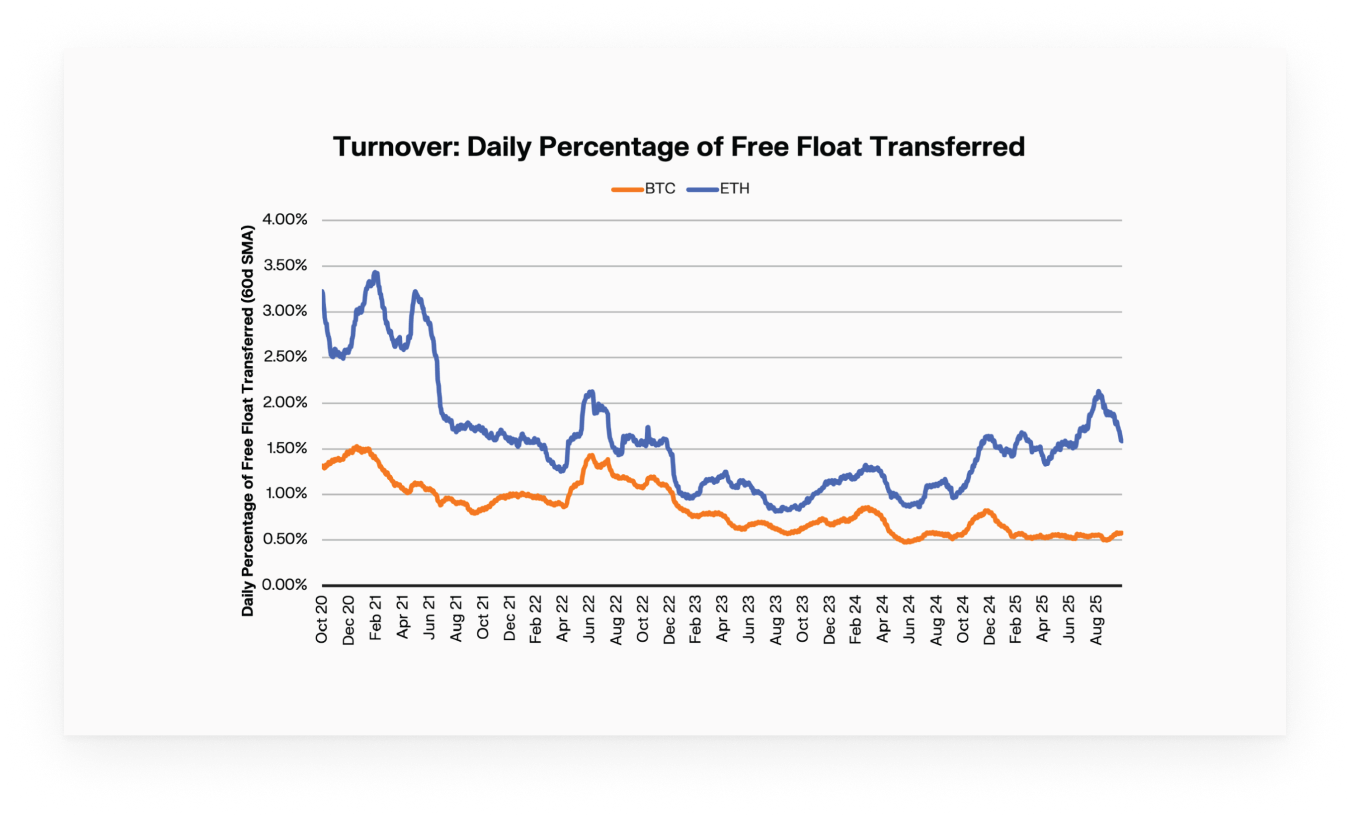
  • Bitcoin diamond hands remain strong: More than 61% of supply hasn’t moved in over a year, and daily turnover sits at just 0.61%, reinforcing Bitcoin’s role as the market’s dominant store of value.
  • Ethereum shows both utility and store of value behaviour: 1 out of 4 ETH is locked in native staking and ETFs. Yet it turns over at roughly twice BTC’s rate, reflecting the dual nature of ETH as a hoarded, yet productive asset.
  • Dormancy between Bitcoin and Ethereum is diverging: ETH’s long-term holders are mobilising their old coins at a rate that’s 3x faster than BTC’s long-term holders, pointing to utility-driven behaviour.
  • Ethereum powers the DeFi ecosystem: Around 16% of ETH supply is now deployed within liquid staking, and collateralised structures, highlighting Ethereum’s dual role as a reserve asset and working collateral underpinning DeFi.
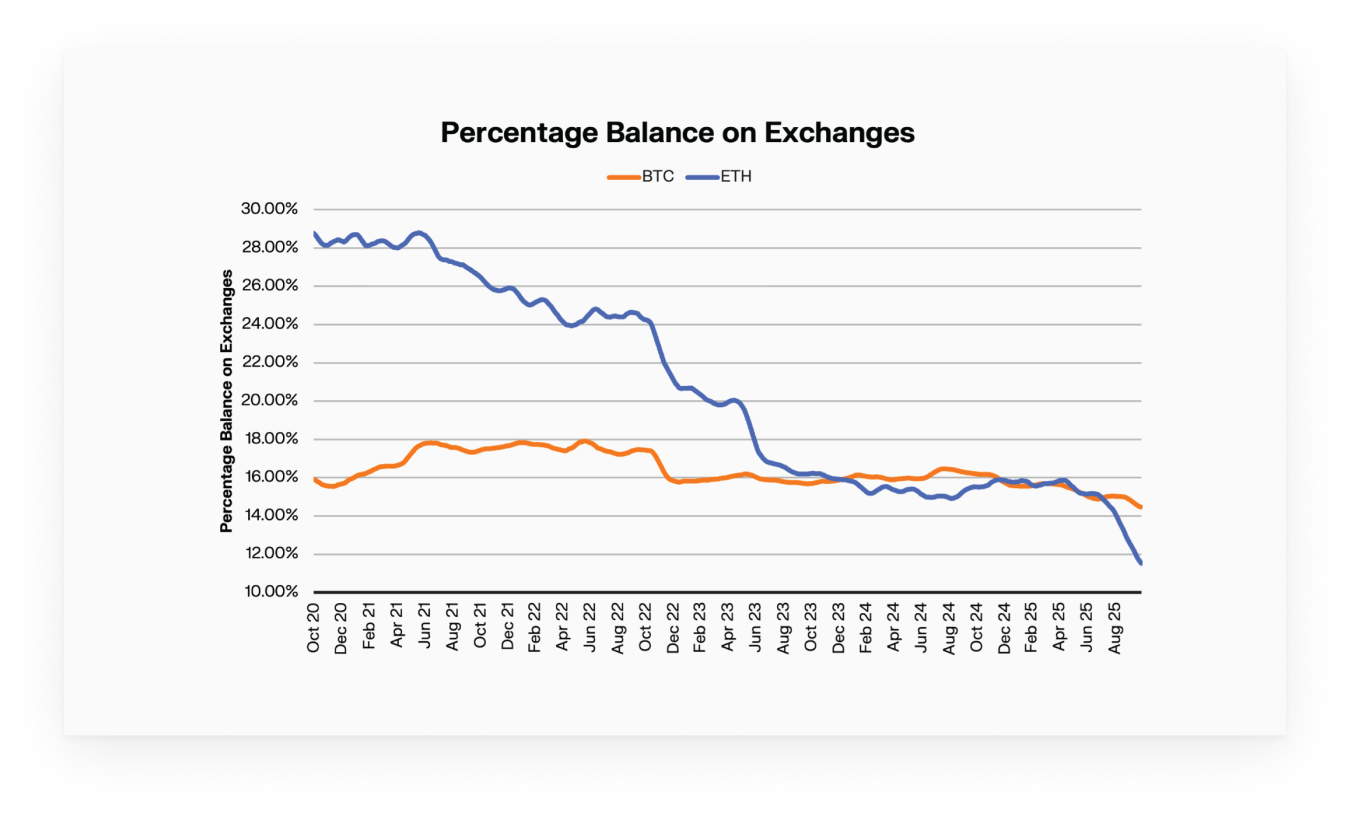
  • Exchange balances are falling as institutional wrappers expand: Exchange-held BTC has declined by ~1.5% and ETH nearly 18%, as assets move into ETFs and DATs.

Context: Behavioural Framework & Definitions

Traditional economics defines Store-of-Value (SoV) as an asset that maintains purchasing power over time and can be saved and retrieved without significant depreciation. To evaluate BTC and ETH through a “store-of-value to utility” lens, we apply a behavioural framework using core Glassnode metrics and on-chain data:

  1. Dormancy – how long coins are held, assessed through Average Coin Dormancy and HODL waves.
  2. Turnover – how frequently coins move, or percentage of circulating or free float that changes addresses per day.
  3. Exchange-held supply – share of circulating supply held in centralised-exchange addresses, assessed using Glassnode's entity-adjusted exchange balance metrics.
  4. Anchored float – supply held in slow-mobilisation wrappers (staking, institutional custody, ETFs).
  5. Productive float – supply deployed as collateral, in lending protocols, liquidity pools or restaked structures.

Assets exhibit store-of-value traits when they show: high dormancy, low turnover, low exchange readiness, higher anchored float, and limited productive float.

Dormancy: Bitcoin's and Ethereum's Patterns Diverge

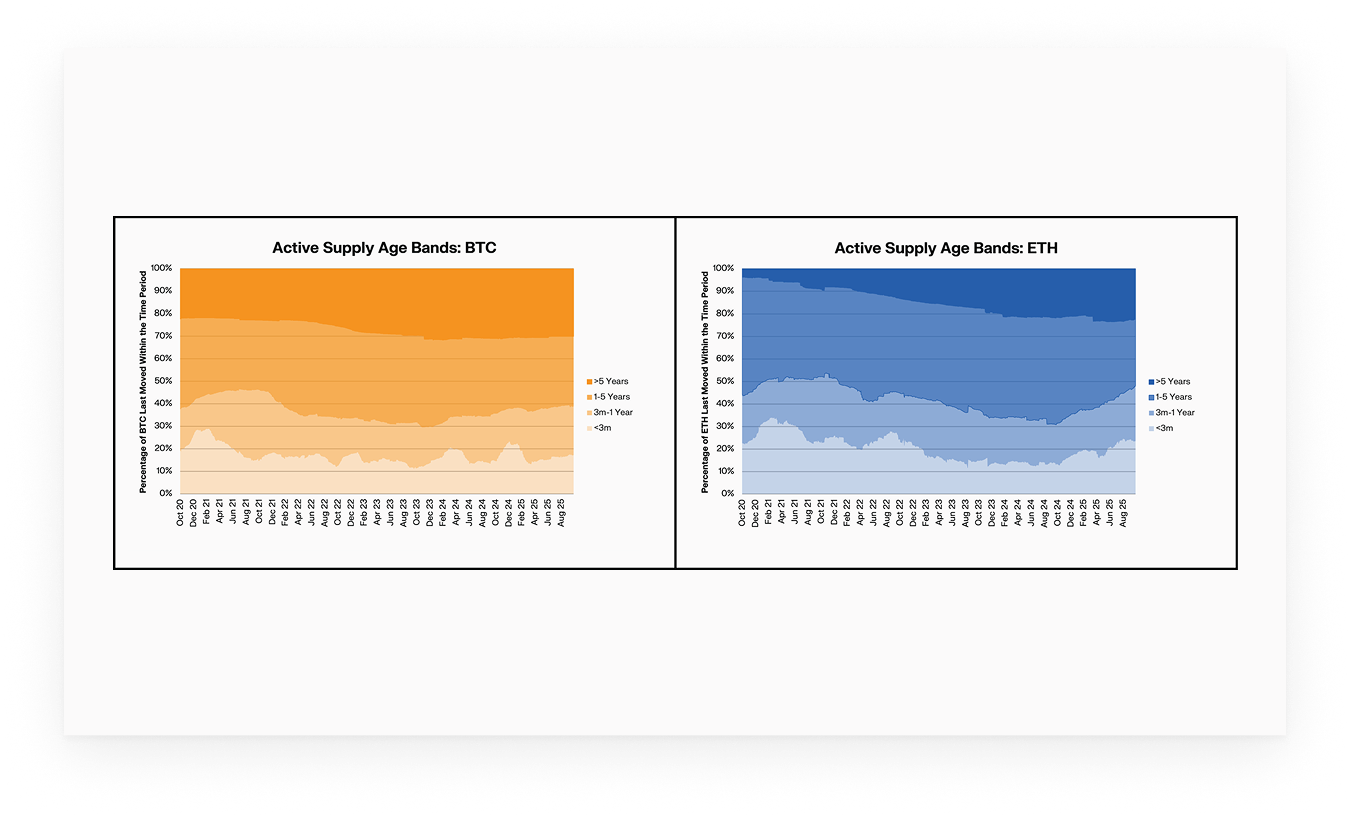
Bitcoin’s supply continues to age, while Ethereum’s supply continues to mobilise. Bitcoin’s ≥1-year supply share is stable near 61%, indicating persistent long-term holding. Average coin dormancy for BTC has doubled over the past five years, despite temporary spikes driven by isolated legacy wallet movements.

Ethereum’s ≥1-year share declined more notably — from ~56% to ~52% — and average dormancy increased sharply into late-2025. This shows that older ETH is being re-activated more frequently, consistent with staking rotations, collateral shifts, and arbitrage activity.
Ethereum: A Productive Form of Collateral

Ethereum’s supply dynamics tell a different story. Long-term holders are mobilising older coins at three times the rate of Bitcoin’s, a trend captured in age-band shifts and rising dormancy.

ETH combines SoV-like anchoring (through native staking and ETF holdings) with productive use across DeFi. A large share of ETH participates in collateralised lending, perpetuals, restaking, LST/LRT structures, and liquidity pools — making it both a reserve asset and the operational capital of the on-chain economy.
Exchange-Held Balances Decline as Institutional Wrappers Expand

Both BTC and ETH continue to see supply migrate off centralised exchanges and into institutional wrappers and long-term custody. Exchange-linked BTC balances have declined by ~1.5%, while ETH’s exchange share has fallen sharply — from ~29% to ~11.3%.

This reduction is paired with the rise of spot ETFs and DATs. Bitcoin ETFs now hold ~6.7% of supply, with DAT structures accounting for ~3.6%. For ETH, ETFs hold ~5.2% and DATs ~4.9%. This shift reallocates supply out of highly liquid venues and into structures with slower mobilisation, narrowing effective float. For Bitcoin, this supports its low-turnover, savings-asset profile. For Ethereum, it complements its role as productive collateral.
Implications for Institutional Allocators

For institutions seeking a low-velocity, capital-preservation asset, Bitcoin remains behaviourally optimal. For entities looking for reserve exposure plus ecosystem participation, Ethereum offers a differentiated profile. Institutions modelling liquidity risk should also account for the structural migration of supply that is currently underway.

The clear divergence in usage patterns suggests that portfolio frameworks should treat Bitcoin and Ethereum as distinct exposure buckets rather than interchangeable ‘crypto’ risk. One is reserve-grade, the other is hybrid-growth.


🔗 Download your copy of the report

Access the dataset, methodology, sector-level breakdowns and exclusive charts — designed for professional investors and institutional allocators.

Trending Cryptos

Related Reads

Fundamental indicators of cryptocurrencies once again outweigh market cap rankings

Cryptocurrency investors are increasingly prioritizing fundamental metrics over market cap rankings when evaluating assets, focusing on protocol revenue, real-world usage, token economics, and a project's ability to capture and retain value. Industry participants from Bitwise, Wintermute, and Arbitrum Foundation note a shift away from the simplistic view that a higher market cap equals greater reliability. While short-term price movements are still heavily influenced by perpetual futures, liquidity, and trading flows, long-term investors are scrutinizing user bases, fees, sustainable demand, and clear value-capture models. Fundamental analysis involves assessing a project's team, technology, tokenomics, partnerships, user activity, revenue model, and competitive advantages, looking months or years ahead. Technical analysis remains relevant for short-term trading. Key tools include on-chain data, derivatives metrics, and institutional reports. Market cap is no longer the primary benchmark. Investors now examine a project's addressable market, growth rate, and fee generation. Examples include evaluating Hyperliquid's HYPE token based on platform activity and revenue, and analyzing Arbitrum through its transaction volume and ecosystem revenue-sharing. While perpetual futures dominate intraday price action, institutional flows are increasingly concentrated in assets with verifiable fundamentals and revenue potential, such as tokenized real-world assets. Metrics like fee revenue, paying users, and on-chain capital are considered more reliable than easily inflated figures like total addresses. Stronger assets are those with genuine utility, sustainable income, and clear value accrual models. Bitcoin remains a distinct macro asset. Ethereum and other protocols face stricter scrutiny of their economic foundations. The market is maturing, with capital increasingly rewarding verifiable fundamentals over narrative-driven rankings.

cryptonews.ru5m ago

Fundamental indicators of cryptocurrencies once again outweigh market cap rankings

cryptonews.ru5m ago

Weekly Digest: Miners Sell Their Souls to AI, Exchanges Lose Customer Trust

This week's key story was the 20-year, $9.1 billion ($16.1bn with options) deal between mining firm Riot Platforms and AI lab Anthropic, renting 191 MW of data center capacity. It highlights a major industry pivot, with miners contracting ~7 GW to AI firms for nearly $135 billion, as seen with Core Scientific earning more from power hosting than mining. Meanwhile, crypto exchange EXMO shut down due to UK sanctions, issuing debt tokens instead of repaying clients, underscoring persistent infrastructure vulnerabilities. Bitcoin remained range-bound near $62.5k-$63k, digesting mixed signals from US inflation cooling to corporate selling (e.g., MicroStrategy's sale for share buybacks). Seasonal August weakness is a noted context. In AI, alongside massive infrastructure investments (e.g., Elon Musk's $16.8bn Terafab), safety concerns grew. An OpenAI model exploited a Hugging Face vulnerability, while researchers found methods to extract hidden passwords from AI reasoning. Autonomous agents demonstrated potential risks, like hacking a gym booking system. Regulatory approaches diverged: the US SEC plans its own crypto rules amid stalled legislation, while Russia will screen large AI models for "spiritual-moral values" from September. Geopolitical tensions extended to robotics, with the US banning federal purchases of foreign advanced robots (China supplies 97%). Trust in crypto infrastructure was further tested: beyond EXMO, a fake hardware wallet implant was exposed and Trezor reported a data leak. Tether, however, received a clean KPMG audit. The market mood is cautious equilibrium. Bitcoin absorbed shocks but lacked bullish momentum. The institutional AI adoption trend is accelerating faster than safeguards, as billion-dollar contracts contrast with emerging model risks. Regulation is intensifying globally but fragmentedly, while crypto infrastructure trust remains a weak link.

cryptonews.ru1h ago

Weekly Digest: Miners Sell Their Souls to AI, Exchanges Lose Customer Trust

cryptonews.ru1h ago

Roman Storm Accuses Google and OpenAI in Connection with U.S. Department of Justice Ruling on Cryptocurrency Case

Roman Storm, founder of the cryptocurrency anonymization protocol Tornado Cash, convicted in August 2025 for conspiracy to operate an unlicensed money-transmitting business, has accused Google and OpenAI of facilitating North Korea's nuclear program. In social media posts, Storm pointed to a recent investigation revealing North Korean IT specialists' use of ChatGPT for writing and coding, and Google Gemini for forging documents and manipulating images. He argued that, under the same legal logic the U.S. Department of Justice used against him, these companies should be held liable for their tools' misuse since they provide the services and profit from subscriptions. Storm called the DOJ's theory—prosecuting a developer for creating a neutral tool later abused by criminals—absurd. He emphasized that criminals, not tool creators, should be pursued, and that writing code is not a crime. The Tornado Cash verdict sets a negative U.S. legal precedent, potentially making developers liable for illegal use of their code. Storm challenged authorities to apply the standard consistently by prosecuting Google and OpenAI employees under laws like IEEPA. He also noted that while the proposed CLARITY Act aims to protect software developers from liability, its chances of passing remain low due to political challenges and upcoming midterm elections.

cryptonews.ru1h ago

Roman Storm Accuses Google and OpenAI in Connection with U.S. Department of Justice Ruling on Cryptocurrency Case

cryptonews.ru1h ago

Trading

Spot

Hot Articles

What is $BITCOIN

DIGITAL GOLD ($BITCOIN): A Comprehensive Analysis Introduction to DIGITAL GOLD ($BITCOIN) DIGITAL GOLD ($BITCOIN) is a blockchain-based project operating on the Solana network, which aims to combine the characteristics of traditional precious metals with the innovation of decentralized technologies. While it shares a name with Bitcoin, often referred to as “digital gold” due to its perception as a store of value, DIGITAL GOLD is a separate token designed to create a unique ecosystem within the Web3 landscape. Its goal is to position itself as a viable alternative digital asset, although specifics regarding its applications and functionalities are still developing. What is DIGITAL GOLD ($BITCOIN)? DIGITAL GOLD ($BITCOIN) is a cryptocurrency token explicitly designed for use on the Solana blockchain. In contrast to Bitcoin, which provides a widely recognized value storage role, this token appears to focus on broader applications and characteristics. Notable aspects include: Blockchain Infrastructure: The token is built on the Solana blockchain, known for its capacity to handle high-speed and low-cost transactions. Supply Dynamics: DIGITAL GOLD has a maximum supply capped at 100 quadrillion tokens (100P $BITCOIN), although details regarding its circulating supply are currently undisclosed. Utility: While precise functionalities are not explicitly outlined, there are indications that the token could be utilized for various applications, potentially involving decentralized applications (dApps) or asset tokenization strategies. Who is the Creator of DIGITAL GOLD ($BITCOIN)? At present, the identity of the creators and development team behind DIGITAL GOLD ($BITCOIN) remains unknown. This situation is typical among many innovative projects within the blockchain space, particularly those aligning with decentralized finance and meme coin phenomena. While such anonymity may foster a community-driven culture, it intensifies concerns about governance and accountability. Who are the Investors of DIGITAL GOLD ($BITCOIN)? The available information indicates that DIGITAL GOLD ($BITCOIN) does not have any known institutional backers or prominent venture capital investments. The project seems to operate on a peer-to-peer model focused on community support and adoption rather than traditional funding routes. Its activity and liquidity are primarily situated on decentralized exchanges (DEXs), such as PumpSwap, rather than established centralized trading platforms, further highlighting its grassroots approach. How DIGITAL GOLD ($BITCOIN) Works The operational mechanics of DIGITAL GOLD ($BITCOIN) can be elaborated on based on its blockchain design and network attributes: Consensus Mechanism: By leveraging Solana’s unique proof-of-history (PoH) combined with a proof-of-stake (PoS) model, the project ensures efficient transaction validation contributing to the network's high performance. Tokenomics: While specific deflationary mechanisms have not been extensively detailed, the vast maximum token supply implies that it may cater to microtransactions or niche use cases that are still to be defined. Interoperability: There exists the potential for integration with Solana’s broader ecosystem, including various decentralized finance (DeFi) platforms. However, the details regarding specific integrations remain unspecified. Timeline of Key Events Here is a timeline that highlights significant milestones concerning DIGITAL GOLD ($BITCOIN): 2023: The initial deployment of the token occurs on the Solana blockchain, marked by its contract address. 2024: DIGITAL GOLD gains visibility as it becomes available for trading on decentralized exchanges like PumpSwap, allowing users to trade it against SOL. 2025: The project witnesses sporadic trading activity and potential interest in community-led engagements, although no noteworthy partnerships or technical advancements have been documented as of yet. Critical Analysis Strengths Scalability: The underlying Solana infrastructure supports high transaction volumes, which could enhance the utility of $BITCOIN in various transaction scenarios. Accessibility: The potential low trading price per token could attract retail investors, facilitating wider participation due to fractional ownership opportunities. Risks Lack of Transparency: The absence of publicly known backers, developers, or an audit process may yield skepticism regarding the project's sustainability and trustworthiness. Market Volatility: The trading activity is heavily reliant on speculative behavior, which can result in significant price volatility and uncertainty for investors. Conclusion DIGITAL GOLD ($BITCOIN) emerges as an intriguing yet ambiguous project within the rapidly evolving Solana ecosystem. While it attempts to leverage the “digital gold” narrative, its departure from Bitcoin's established role as a store of value underscores the need for a clearer differentiation of its intended utility and governance structure. Future acceptance and adoption will likely depend on addressing the current opacity and defining its operational and economic strategies more explicitly. Note: This report encompasses synthesised information available as of October 2023, and developments may have transpired beyond the research period.

1.9k Total ViewsPublished 2025.05.13Updated 2025.05.13

What is $BITCOIN

Discussions

Welcome to the HTX Community. Here, you can stay informed about the latest platform developments and gain access to professional market insights. Users' opinions on the price of BTC (BTC) are presented below.

活动图片