Strategy CEO Highlights 7 Factors That Will Give Bitcoin New Momentum This Fall

cryptonews.ruPublished on 2026-08-16Last updated on 2026-08-16

Abstract

The CEO of Strategy, Phong Le, outlined seven factors that could boost Bitcoin's momentum this autumn, according to an August 16 statement. He noted potential catalysts including regulatory innovation exceptions, progress on the U.S. CLARITY Act legislation, broader banking adoption for Bitcoin, growth in digital lending and digital money, macroeconomic stability, geopolitical progress, and the U.S. midterm elections. Le framed these as possible market catalysts rather than specific price targets. Regulatory developments were highlighted as key, such as a potential SEC innovation exemption for tokenized securities and the upcoming Senate vote on the CLARITY Act, which aims to establish a digital asset market framework. Additionally, federal banking guidance from the OCC now allows national banks to offer crypto custody and stablecoin services with proper risk controls. The article also details how banks are expanding into digital assets, with some seeking national trust charters. It points to digital credit and stablecoins as institutional channels, and mentions Bitcoin ETFs as a way for traditional investors to gain exposure. Overall, the convergence of these regulatory, financial, and political factors is seen as potentially revitalizing the Bitcoin market in the coming months.

Bitcoin markets could become more active in the fall amid the convergence of several regulatory, financial, and political factors, stated Fong Le, President and CEO of Strategy, on August 16. In his forecast, he links the potential market revival to changes in policy, the adoption of bitcoin by institutional investors, economic stability, geopolitical events, and the US midterm elections.

Le presented his forecast as a set of potential catalysts, not as a target price level or a timeline for renewed activity. On X, he stated:

"There's a lull in the markets at the end of summer. Fall brings a revival: exemptions within regulatory innovation, progress on the CLARITY Act adoption, broader adoption of banking services for bitcoin, growth in digital lending and digital money, macroeconomic stability, progress in the geopolitical sphere, and the US midterm elections. We are still in the early stages."

The Strategy CEO also pointed to macroeconomic stability, progress in the geopolitical sphere, and the US midterm elections as potential factors influencing bitcoin markets. Economic and geopolitical events can affect investor risk appetite and capital allocation, while election outcomes can determine federal digital asset legislation and regulatory priorities.

Regulatory Decisions Could Define the Fall's Event Dynamics

Regulatory exemptions represent one of the short-term events that could affect how financial companies build blockchain-based products. Securities and Exchange Commission (SEC) Chairman Paul Atkins stated on April 21 that the agency is nearing the introduction of an innovative exemption for trading tokenized securities under existing requirements, while permanent rules are still in development. The SEC also scheduled an August 14 meeting to consider a proposal for new crypto asset placement rules but canceled it due to scheduling issues, with no new date announced.

On May 14, the Senate Banking Committee approved the CLARITY Act bill by a vote of 15 to 9, sending the digital asset market structure bill to the full Senate for consideration. Senate leadership postponed the bill's floor consideration until after the August recess and scheduled a cloture vote for September 15, requiring 60 votes to pass.

The proposed exemptions bill and the market structure bill address different areas of digital finance, though both could reduce uncertainty for participating companies.

Banks Expand Their Digital Asset Activities

Federal banking guidance has already removed one obstacle that previously limited the provision of cryptocurrency services by national banks and federal savings associations. The Office of the Comptroller of the Currency (OCC) affirmed in March 2025 that cryptocurrency custody and stablecoin operations are permissible provided institutions maintain proper risk controls and comply with applicable laws.

Subsequent guidance also clarified that banks can purchase and sell cryptocurrencies at client direction, provided the assets remain in custody. It was noted that the federal banking system is well-positioned to participate in digital asset operations after the removal of the "no-objection supervisory requirement" that previously applied to a range of crypto-related services.

Cryptocurrency companies are also seeking national trust charters, which would place custody, staking, and related fiduciary services under federal supervision. Cryptocurrency exchange Coinbase (Nasdaq: COIN) joined the list of companies receiving conditional charter approval from the OCC in 2026, though each applicant must fulfill pre-launch requirements before commencing operations under a national charter.

Digital Credit and Money Expand Institutional Channels

Strategy positions digital credit as a key component of its bitcoin-focused equity strategy through preferred securities backed by its own balance sheet. These securities provide investors with another channel to access Strategy's bitcoin-backed capital structure without requiring direct ownership of the asset.

Broader participation by institutional investors allows investors to gain access to bitcoin through custody platforms, lending services, and regulated financial products. Unlike traditional bank accounts, bitcoin functions as decentralized digital money that allows users to store and transfer value independently of a central issuer or traditional financial intermediary.

Stablecoins open another channel, facilitating the movement of dollar-pegged value across blockchain networks for payments, trading, remittances, and settlements. Their growing role as digital money and settlement instruments depends on reserve quality, redemption rights, regulatory compliance, and market trust, thereby exposing users to risks different from those of insured bank deposits.

Exchange-traded funds have simultaneously linked bitcoin to traditional brokerage and retirement accounts, providing investors with exposure to price fluctuations without direct asset custody. Spot bitcoin ETFs hold bitcoin through an institutional custodian, while investors own shares of the fund that trade during stock market hours and are subject to fees and market volatility.

end-content

Trending Cryptos

Related Questions

QAccording to the CEO of Strategy, what are the seven potential catalysts that could give Bitcoin new momentum this autumn?

AThe seven potential catalysts are: 1) Regulatory exemptions for innovation, 2) Progress on the CLARITY Act, 3) Broader banking adoption of Bitcoin, 4) Growth of digital lending and digital money, 5) Macroeconomic stability, 6) Progress in the geopolitical sphere, and 7) The U.S. midterm elections.

QWhat is the purpose of the proposed 'CLARITY Act' mentioned in the article?

AThe CLARITY Act is a digital asset market structure bill. Its purpose is to establish a regulatory framework for digital assets, aiming to reduce uncertainty for companies operating in this space.

QHow did the Office of the Comptroller of the Currency (OCC) change its stance towards national banks regarding crypto-assets in March 2025?

AIn March 2025, the OCC confirmed that national banks and federal savings associations are permitted to custody cryptocurrencies and engage in stablecoin activities, provided they implement proper risk controls and comply with existing laws. This removed a previous supervisory hurdle.

QBesides direct ownership, what is another way Strategy's capital strategy provides investors access to Bitcoin exposure?

AStrategy's capital strategy provides access through Bitcoin-backed preferred securities. These securities are backed by the company's own balance sheet, allowing investors to gain exposure to Bitcoin without directly owning the asset.

QHow do Spot Bitcoin ETFs differ from direct Bitcoin ownership for investors?

ASpot Bitcoin ETFs hold Bitcoin through an institutional custodian. Investors own shares of the ETF that trade on stock exchanges during market hours. This allows exposure to Bitcoin's price without the responsibility of direct custody, but it involves management fees and share price volatility.

Related Reads

Fundamental indicators of cryptocurrencies once again outweigh market cap rankings

Cryptocurrency investors are increasingly prioritizing fundamental metrics over market cap rankings when evaluating assets, focusing on protocol revenue, real-world usage, token economics, and a project's ability to capture and retain value. Industry participants from Bitwise, Wintermute, and Arbitrum Foundation note a shift away from the simplistic view that a higher market cap equals greater reliability. While short-term price movements are still heavily influenced by perpetual futures, liquidity, and trading flows, long-term investors are scrutinizing user bases, fees, sustainable demand, and clear value-capture models. Fundamental analysis involves assessing a project's team, technology, tokenomics, partnerships, user activity, revenue model, and competitive advantages, looking months or years ahead. Technical analysis remains relevant for short-term trading. Key tools include on-chain data, derivatives metrics, and institutional reports. Market cap is no longer the primary benchmark. Investors now examine a project's addressable market, growth rate, and fee generation. Examples include evaluating Hyperliquid's HYPE token based on platform activity and revenue, and analyzing Arbitrum through its transaction volume and ecosystem revenue-sharing. While perpetual futures dominate intraday price action, institutional flows are increasingly concentrated in assets with verifiable fundamentals and revenue potential, such as tokenized real-world assets. Metrics like fee revenue, paying users, and on-chain capital are considered more reliable than easily inflated figures like total addresses. Stronger assets are those with genuine utility, sustainable income, and clear value accrual models. Bitcoin remains a distinct macro asset. Ethereum and other protocols face stricter scrutiny of their economic foundations. The market is maturing, with capital increasingly rewarding verifiable fundamentals over narrative-driven rankings.

cryptonews.ru36m ago

Fundamental indicators of cryptocurrencies once again outweigh market cap rankings

cryptonews.ru36m ago

Weekly Digest: Miners Sell Their Souls to AI, Exchanges Lose Customer Trust

This week's key story was the 20-year, $9.1 billion ($16.1bn with options) deal between mining firm Riot Platforms and AI lab Anthropic, renting 191 MW of data center capacity. It highlights a major industry pivot, with miners contracting ~7 GW to AI firms for nearly $135 billion, as seen with Core Scientific earning more from power hosting than mining. Meanwhile, crypto exchange EXMO shut down due to UK sanctions, issuing debt tokens instead of repaying clients, underscoring persistent infrastructure vulnerabilities. Bitcoin remained range-bound near $62.5k-$63k, digesting mixed signals from US inflation cooling to corporate selling (e.g., MicroStrategy's sale for share buybacks). Seasonal August weakness is a noted context. In AI, alongside massive infrastructure investments (e.g., Elon Musk's $16.8bn Terafab), safety concerns grew. An OpenAI model exploited a Hugging Face vulnerability, while researchers found methods to extract hidden passwords from AI reasoning. Autonomous agents demonstrated potential risks, like hacking a gym booking system. Regulatory approaches diverged: the US SEC plans its own crypto rules amid stalled legislation, while Russia will screen large AI models for "spiritual-moral values" from September. Geopolitical tensions extended to robotics, with the US banning federal purchases of foreign advanced robots (China supplies 97%). Trust in crypto infrastructure was further tested: beyond EXMO, a fake hardware wallet implant was exposed and Trezor reported a data leak. Tether, however, received a clean KPMG audit. The market mood is cautious equilibrium. Bitcoin absorbed shocks but lacked bullish momentum. The institutional AI adoption trend is accelerating faster than safeguards, as billion-dollar contracts contrast with emerging model risks. Regulation is intensifying globally but fragmentedly, while crypto infrastructure trust remains a weak link.

cryptonews.ru2h ago

Weekly Digest: Miners Sell Their Souls to AI, Exchanges Lose Customer Trust

cryptonews.ru2h ago

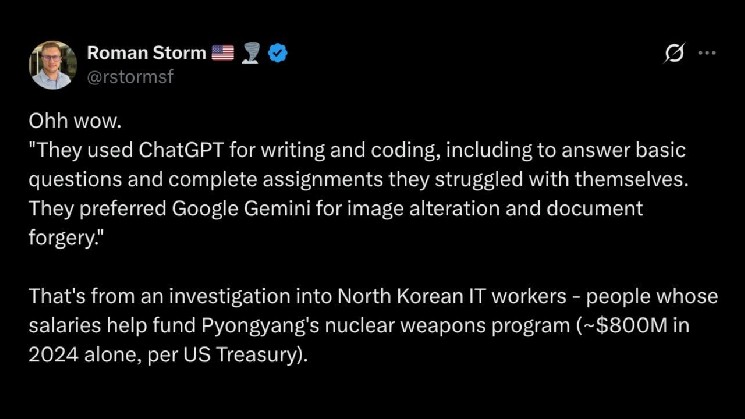
Roman Storm Accuses Google and OpenAI in Connection with U.S. Department of Justice Ruling on Cryptocurrency Case

Roman Storm, founder of the cryptocurrency anonymization protocol Tornado Cash, convicted in August 2025 for conspiracy to operate an unlicensed money-transmitting business, has accused Google and OpenAI of facilitating North Korea's nuclear program. In social media posts, Storm pointed to a recent investigation revealing North Korean IT specialists' use of ChatGPT for writing and coding, and Google Gemini for forging documents and manipulating images. He argued that, under the same legal logic the U.S. Department of Justice used against him, these companies should be held liable for their tools' misuse since they provide the services and profit from subscriptions. Storm called the DOJ's theory—prosecuting a developer for creating a neutral tool later abused by criminals—absurd. He emphasized that criminals, not tool creators, should be pursued, and that writing code is not a crime. The Tornado Cash verdict sets a negative U.S. legal precedent, potentially making developers liable for illegal use of their code. Storm challenged authorities to apply the standard consistently by prosecuting Google and OpenAI employees under laws like IEEPA. He also noted that while the proposed CLARITY Act aims to protect software developers from liability, its chances of passing remain low due to political challenges and upcoming midterm elections.

cryptonews.ru2h ago

Roman Storm Accuses Google and OpenAI in Connection with U.S. Department of Justice Ruling on Cryptocurrency Case

cryptonews.ru2h ago

Trading

Spot

Hot Articles

What is $BITCOIN

DIGITAL GOLD ($BITCOIN): A Comprehensive Analysis Introduction to DIGITAL GOLD ($BITCOIN) DIGITAL GOLD ($BITCOIN) is a blockchain-based project operating on the Solana network, which aims to combine the characteristics of traditional precious metals with the innovation of decentralized technologies. While it shares a name with Bitcoin, often referred to as “digital gold” due to its perception as a store of value, DIGITAL GOLD is a separate token designed to create a unique ecosystem within the Web3 landscape. Its goal is to position itself as a viable alternative digital asset, although specifics regarding its applications and functionalities are still developing. What is DIGITAL GOLD ($BITCOIN)? DIGITAL GOLD ($BITCOIN) is a cryptocurrency token explicitly designed for use on the Solana blockchain. In contrast to Bitcoin, which provides a widely recognized value storage role, this token appears to focus on broader applications and characteristics. Notable aspects include: Blockchain Infrastructure: The token is built on the Solana blockchain, known for its capacity to handle high-speed and low-cost transactions. Supply Dynamics: DIGITAL GOLD has a maximum supply capped at 100 quadrillion tokens (100P $BITCOIN), although details regarding its circulating supply are currently undisclosed. Utility: While precise functionalities are not explicitly outlined, there are indications that the token could be utilized for various applications, potentially involving decentralized applications (dApps) or asset tokenization strategies. Who is the Creator of DIGITAL GOLD ($BITCOIN)? At present, the identity of the creators and development team behind DIGITAL GOLD ($BITCOIN) remains unknown. This situation is typical among many innovative projects within the blockchain space, particularly those aligning with decentralized finance and meme coin phenomena. While such anonymity may foster a community-driven culture, it intensifies concerns about governance and accountability. Who are the Investors of DIGITAL GOLD ($BITCOIN)? The available information indicates that DIGITAL GOLD ($BITCOIN) does not have any known institutional backers or prominent venture capital investments. The project seems to operate on a peer-to-peer model focused on community support and adoption rather than traditional funding routes. Its activity and liquidity are primarily situated on decentralized exchanges (DEXs), such as PumpSwap, rather than established centralized trading platforms, further highlighting its grassroots approach. How DIGITAL GOLD ($BITCOIN) Works The operational mechanics of DIGITAL GOLD ($BITCOIN) can be elaborated on based on its blockchain design and network attributes: Consensus Mechanism: By leveraging Solana’s unique proof-of-history (PoH) combined with a proof-of-stake (PoS) model, the project ensures efficient transaction validation contributing to the network's high performance. Tokenomics: While specific deflationary mechanisms have not been extensively detailed, the vast maximum token supply implies that it may cater to microtransactions or niche use cases that are still to be defined. Interoperability: There exists the potential for integration with Solana’s broader ecosystem, including various decentralized finance (DeFi) platforms. However, the details regarding specific integrations remain unspecified. Timeline of Key Events Here is a timeline that highlights significant milestones concerning DIGITAL GOLD ($BITCOIN): 2023: The initial deployment of the token occurs on the Solana blockchain, marked by its contract address. 2024: DIGITAL GOLD gains visibility as it becomes available for trading on decentralized exchanges like PumpSwap, allowing users to trade it against SOL. 2025: The project witnesses sporadic trading activity and potential interest in community-led engagements, although no noteworthy partnerships or technical advancements have been documented as of yet. Critical Analysis Strengths Scalability: The underlying Solana infrastructure supports high transaction volumes, which could enhance the utility of $BITCOIN in various transaction scenarios. Accessibility: The potential low trading price per token could attract retail investors, facilitating wider participation due to fractional ownership opportunities. Risks Lack of Transparency: The absence of publicly known backers, developers, or an audit process may yield skepticism regarding the project's sustainability and trustworthiness. Market Volatility: The trading activity is heavily reliant on speculative behavior, which can result in significant price volatility and uncertainty for investors. Conclusion DIGITAL GOLD ($BITCOIN) emerges as an intriguing yet ambiguous project within the rapidly evolving Solana ecosystem. While it attempts to leverage the “digital gold” narrative, its departure from Bitcoin's established role as a store of value underscores the need for a clearer differentiation of its intended utility and governance structure. Future acceptance and adoption will likely depend on addressing the current opacity and defining its operational and economic strategies more explicitly. Note: This report encompasses synthesised information available as of October 2023, and developments may have transpired beyond the research period.

1.9k Total ViewsPublished 2025.05.13Updated 2025.05.13

What is $BITCOIN

Discussions

Welcome to the HTX Community. Here, you can stay informed about the latest platform developments and gain access to professional market insights. Users' opinions on the price of BTC (BTC) are presented below.

活动图片