The Bitcoin Future Now Runs On Wall Street Inflows, BlackRock Exec Says

bitcoinistPublished on 2025-11-12Last updated on 2025-11-12

Abstract

BlackRock’s head of crypto, Robbie Mitchnick, says the gravitational center of Bitcoin’s market structure has shifted decisively from miner issuance...

Trusted Editorial content, reviewed by leading industry experts and seasoned editors. Ad Disclosure

BlackRock’s head of crypto, Robbie Mitchnick, says the gravitational center of Bitcoin’s market structure has shifted decisively from miner issuance to exchange-traded fund demand—and that’s why classic four-year “halving cycles” should command far less attention than they used to. In a Bankless interview released November 10, Mitchnick argued that the ETF era is now the dominant flow regime for BTC, even as leverage and short-term derivatives noise continue to whipsaw prices.

ETF Inflows Now Dwarf The Bitcoin Halving

“It’s not over,” Mitchnick said when asked whether the latest sell-off marked the end of Bitcoin’s current cycle. “This is the fifth cycle we’ve seen […] through each successive cycle, the level that Bitcoin reached was massively higher than the prior cycle.” He added a pointed caveat for anyone still treating halvings as the metronome of BTC: “A lot of people believe the cycle is tied to [the] Bitcoin halving. The Bitcoin halving at this point is almost totally irrelevant […] when ETFs are accumulating inflows, the magnitude of those inflows is many, many multiples larger than any change in supply created by a Bitcoin halving event.”

Mitchnick’s framing puts Wall Street, not the protocol schedule, at the center of the next phase. BlackRock’s spot Bitcoin ETF, IBIT, “has been the fastest-growing ETF post-launch in history,” he said, reaching milestones at roughly four times the pace of the previous record. More telling than raw AUM, in his view, is the changing composition of holders. In the first quarter after launch, “IBIT was over 80% direct retail investors. Every quarter thereafter that number has come down […] today it’s close to 50%,” reflecting the steady rise of wealth advisory and institutional channels.

That institutional cohort is still early, but broadening. “If you think about the big categories of institutional investors, you’ve got family offices, asset managers, sovereign wealth funds, university endowments, foundations, corporate treasurers, insurers, pension funds. You have some adopters in every one of those archetypes, but not the majority, not even close,” he said.

For those allocating, typical position sizes land in the “1% to 3% range.” The gating factor, again, is less about custody or access—and more about how Bitcoin behaves inside a portfolio. “It’s all about correlation,” Mitchnick noted, recounting a conversation with a pension CIO who is “literally” watching that metric. If Bitcoin persistently tracks “digital gold” rather than “levered NASDAQ,” he argued, “it’s a slam dunk to put a couple percentage of portfolio allocation in it.”

The tension is that short-term market action still looks like crypto. Mitchnick called the October 10 washout—roughly “$21 billion in liquidations”—a leverage event rather than a shift in fundamentals, and contrasted it with the steadiness of fund buyers: “What was the impact on ETF outflows? Tiny […] a couple hundred million.” That discrepancy, he said, is precisely why cycles should attenuate over time: a larger, slower-moving base of ETF and advisory capital can absorb derivatives-driven shocks without mechanically exiting.

He also pushed back on narratives that Bitcoin’s 2025 underperformance versus gold invalidates the “uncorrelated hedge” thesis. The digital asset, he argued, already banked its “debasement trade” in late 2024, rallying from the “high $60s to over $100K,” and even notched a new all-time high around $126,000 before the October crash “derailed the momentum.” In other words, the year-to-date scoreboard reflects sequencing and leverage, not a structural repudiation of Bitcoin’s store-of-value pitch.

On supply dynamics, Mitchnick acknowledged that legacy cohorts have taken profits at psychological levels, but he dismissed the idea that Bitcoin is in an “IPO moment” where early adopters permanently hand the float to institutions. What’s more plausible, he said, is simple risk management by ultra-early holders whose basis sits at “$100 or $500,” many of whom had $100,000 as a round-number trim target. “At some point you do have to take some chips off the table,” he said, adding that long-term performance has favored patience over short-term, levered trading.

Mitchnick was careful not to oversell universal adoption among big pools of capital. Central banks, he suggested, remain a tail-risk buyer rather than a base case. The near-term path instead runs through the institutions already tiptoeing in—pensions, insurers, sovereign wealth funds—whose conviction will hinge on medium-term behavior and policy clarity.

The message for allocators facing their first full drawdown with ETFs live was direct: don’t mistake derivatives noise for broken fundamentals, and be selective. “There’s a reason Bitcoin is still roughly 65% of the market cap of the space,” he said. “One has to be very wary going far down the table […] the vast majority of [tokens] are or will be totally worthless.”

For Bitcoin, the test is whether it keeps behaving like what institutions think they’re buying. “People have to look beyond these short-term moves […] and more about, you know, medium and longer term how does it track,” Mitchnick said.

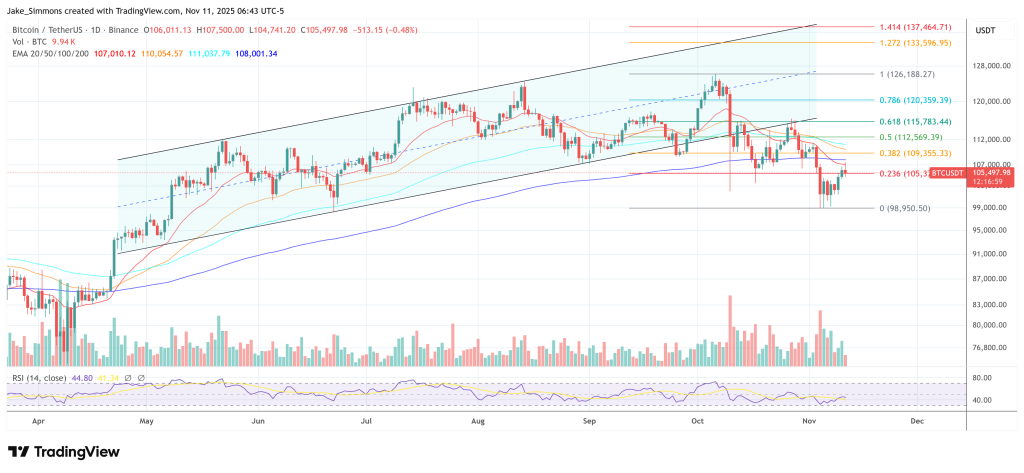
At press time, BTC traded at $105,497.
Bitcoin price
Bitcoin price, 1-day chart | Source: BTCUSDT on TradingView.com
Featured image created with DALL.E, chart from TradingView.com
Editorial Process for bitcoinist is centered on delivering thoroughly researched, accurate, and unbiased content. We uphold strict sourcing standards, and each page undergoes diligent review by our team of top technology experts and seasoned editors. This process ensures the integrity, relevance, and value of our content for our readers.

Jake Simmons has been a Bitcoin enthusiast since 2016. Ever since he heard about Bitcoin, he has been studying the topic every day and trying to share his knowledge with others. His goal is to contribute to Bitcoin's financial revolution, which will replace the fiat money system. Besides BTC and crypto, Jake studied Business Informatics at a university. After graduation in 2017, he has been working in the blockchain and crypto sector. You can follow Jake on Twitter at @realJakeSimmons.

Related Reads

Learn Codex with the "Morning Briefing": Six Replicable Levels of Use

This article introduces a "Morning Briefing" as a simple, progressive framework for learning to effectively use Codex (an AI assistant), moving from basic information gathering to a more sophisticated, autonomous work partner. It outlines six actionable levels: **Level 1: Basic Information Query.** Start by simply asking Codex to check your Slack, Gmail, and Calendar to summarize what needs your attention today. **Level 2: Personalization with an Agents File.** Create a persistent file containing your default preferences for the briefing's format and content, so it's consistently useful. **Level 3: Automation.** Set the briefing to run automatically every weekday morning, creating a reliable starting point for your day. **Level 4: Project-Specific Briefings.** Instead of one overwhelming summary, create separate, dedicated threads for different projects (e.g., a launch, recruitment), each with its own focused briefing. **Level 5: Drafting Follow-Up Actions.** Elevate the briefing from a summary to an action starter by having it draft replies, prepare meeting notes, or highlight stalled decisions—ready for your review. **Level 6: Building a Memory System (Vault).** Integrate a knowledge vault (a structured file system) where important recurring information (project statuses, key people, decisions) is stored and updated. The briefing consults this vault to provide richer context and learns over time. The approach's strength is its incremental nature. Each level teaches a core Codex capability (connectors, personalization, automation, project context, assisted work, persistent memory) within a familiar, practical workflow, avoiding overwhelming theoretical concepts. It transforms a simple daily check-in into a personalized, evolving work operating system.

marsbit37m ago

Learn Codex with the "Morning Briefing": Six Replicable Levels of Use

marsbit37m ago

Can Alibaba Cloud Rewrite Itself?

Over the past five months, Alibaba Cloud's MaaS (Model as a Service) revenue has surged 15x, marking a strategic overhaul where the company is shifting its 17-year-old system designed for "humans using cloud" to a new paradigm centered on "Agents consuming Tokens." At its recent summit, Alibaba Cloud announced a full-stack upgrade encompassing "chip-cloud-model-inference," all optimized for AI Agents. Key launches include the new AI product portal "QianWen Cloud," hyper-node servers powered by the in-house AI chip Zhenwu M890, and the latest flagship model, Qwen3.7-Max. Senior VP Liu Weiguang described this as building "China's largest AI factory," where chips are raw materials, the cloud is the workshop, models are machines, and the inference platform is the assembly line, with Tokens as the final product. The company is now emphasizing its chip strategy, unveiling the Zhenwu M890 and a two-year roadmap for future chips. With over 560,000 chips deployed across 400+ clients, Alibaba Cloud aims to control the marginal cost per Token, mirroring Google's integration of TPU and Gemini for optimal cost-performance. The cloud infrastructure itself is being rewritten. Traditional cloud interfaces are being transformed into standardized, Agent-callable Skills. A new scheduling logic focuses on "task scheduling" over "resource scheduling" to handle the unpredictable, elastic workloads of Agents. Liu noted that AI applications now automatically provision cloud resources, with one customer's daily automated provisioning equaling two weeks of manual work. For models, the focus has shifted from conversational prowess to execution capability. Qwen3.7-Max demonstrated this by autonomously writing and optimizing a production-grade AI compute kernel for the new Zhenwu M890 chip over 35 hours, achieving a 10x performance improvement. The underlying Bailian platform was upgraded for efficiency, and it maintains an open ecosystem, hosting third-party models. This restructuring extends beyond technology to sales, organization, and metrics. Alibaba Cloud has established dedicated MaaS sales teams, separated from traditional IaaS, with new KPIs focusing on high-quality Tokens that solve real problems, the number of core business systems integrated with models, and the efficiency of Agent task completion. The underlying bet is clear: AI represents an opportunity orders of magnitude larger than before. Despite the uncertainty, Alibaba Cloud is aggressively rebuilding its entire system, betting on an AI-driven future where Tokens could become its largest product line.

marsbit1h ago

Can Alibaba Cloud Rewrite Itself?

marsbit1h ago

Trading

Spot
Futures

Hot Articles

What is $BITCOIN

DIGITAL GOLD ($BITCOIN): A Comprehensive Analysis Introduction to DIGITAL GOLD ($BITCOIN) DIGITAL GOLD ($BITCOIN) is a blockchain-based project operating on the Solana network, which aims to combine the characteristics of traditional precious metals with the innovation of decentralized technologies. While it shares a name with Bitcoin, often referred to as “digital gold” due to its perception as a store of value, DIGITAL GOLD is a separate token designed to create a unique ecosystem within the Web3 landscape. Its goal is to position itself as a viable alternative digital asset, although specifics regarding its applications and functionalities are still developing. What is DIGITAL GOLD ($BITCOIN)? DIGITAL GOLD ($BITCOIN) is a cryptocurrency token explicitly designed for use on the Solana blockchain. In contrast to Bitcoin, which provides a widely recognized value storage role, this token appears to focus on broader applications and characteristics. Notable aspects include: Blockchain Infrastructure: The token is built on the Solana blockchain, known for its capacity to handle high-speed and low-cost transactions. Supply Dynamics: DIGITAL GOLD has a maximum supply capped at 100 quadrillion tokens (100P $BITCOIN), although details regarding its circulating supply are currently undisclosed. Utility: While precise functionalities are not explicitly outlined, there are indications that the token could be utilized for various applications, potentially involving decentralized applications (dApps) or asset tokenization strategies. Who is the Creator of DIGITAL GOLD ($BITCOIN)? At present, the identity of the creators and development team behind DIGITAL GOLD ($BITCOIN) remains unknown. This situation is typical among many innovative projects within the blockchain space, particularly those aligning with decentralized finance and meme coin phenomena. While such anonymity may foster a community-driven culture, it intensifies concerns about governance and accountability. Who are the Investors of DIGITAL GOLD ($BITCOIN)? The available information indicates that DIGITAL GOLD ($BITCOIN) does not have any known institutional backers or prominent venture capital investments. The project seems to operate on a peer-to-peer model focused on community support and adoption rather than traditional funding routes. Its activity and liquidity are primarily situated on decentralized exchanges (DEXs), such as PumpSwap, rather than established centralized trading platforms, further highlighting its grassroots approach. How DIGITAL GOLD ($BITCOIN) Works The operational mechanics of DIGITAL GOLD ($BITCOIN) can be elaborated on based on its blockchain design and network attributes: Consensus Mechanism: By leveraging Solana’s unique proof-of-history (PoH) combined with a proof-of-stake (PoS) model, the project ensures efficient transaction validation contributing to the network's high performance. Tokenomics: While specific deflationary mechanisms have not been extensively detailed, the vast maximum token supply implies that it may cater to microtransactions or niche use cases that are still to be defined. Interoperability: There exists the potential for integration with Solana’s broader ecosystem, including various decentralized finance (DeFi) platforms. However, the details regarding specific integrations remain unspecified. Timeline of Key Events Here is a timeline that highlights significant milestones concerning DIGITAL GOLD ($BITCOIN): 2023: The initial deployment of the token occurs on the Solana blockchain, marked by its contract address. 2024: DIGITAL GOLD gains visibility as it becomes available for trading on decentralized exchanges like PumpSwap, allowing users to trade it against SOL. 2025: The project witnesses sporadic trading activity and potential interest in community-led engagements, although no noteworthy partnerships or technical advancements have been documented as of yet. Critical Analysis Strengths Scalability: The underlying Solana infrastructure supports high transaction volumes, which could enhance the utility of $BITCOIN in various transaction scenarios. Accessibility: The potential low trading price per token could attract retail investors, facilitating wider participation due to fractional ownership opportunities. Risks Lack of Transparency: The absence of publicly known backers, developers, or an audit process may yield skepticism regarding the project's sustainability and trustworthiness. Market Volatility: The trading activity is heavily reliant on speculative behavior, which can result in significant price volatility and uncertainty for investors. Conclusion DIGITAL GOLD ($BITCOIN) emerges as an intriguing yet ambiguous project within the rapidly evolving Solana ecosystem. While it attempts to leverage the “digital gold” narrative, its departure from Bitcoin's established role as a store of value underscores the need for a clearer differentiation of its intended utility and governance structure. Future acceptance and adoption will likely depend on addressing the current opacity and defining its operational and economic strategies more explicitly. Note: This report encompasses synthesised information available as of October 2023, and developments may have transpired beyond the research period.

363 Total ViewsPublished 2025.05.13Updated 2025.05.13

What is $BITCOIN

Discussions

Welcome to the HTX Community. Here, you can stay informed about the latest platform developments and gain access to professional market insights. Users' opinions on the price of BTC (BTC) are presented below.

活动图片