Криптофонды потеряли $1.2 млрд. Почему инвесторы перешли в Solana и XRP

cryptonews.ruPublished on 2025-11-22Last updated on 2025-11-22

За прошедшую неделю инвестиционные продукты на основе цифровых активов потеряли $1.17 млрд. Это второй подряд эпизод значительного оттока. Причиной стала экономическая неопределённость в США и сохраняющаяся октябрьская волатильность.

Биткоин и Ethereum приняли на себя основной удар. Объем оттока составил $932 млн и $438 млн соответственно.

Отток капитала: Рынок США лидирует

Согласно отчету CoinShares, рынок США зафиксировал отток в размере $1.22 млрд. Следовательно, это указывает на крайне негативный сантимент. Инвесторы опасались возможного снижения процентной ставки в декабре и угрозы приостановки работы правительства.

Кроме того, недавние жёсткие комментарии главы ФРС Джерома Пауэлла усилили опасения на рынке. Он высказал сопротивление снижению ставки. В результате, это спровоцировало широкий отказ от рисковых активов. Фокус рынка сместился от надежд на монетарное смягчение к беспокойству об инфляции.

Однако, европейские инвесторы проявили больший оптимизм. Германия и Швейцария зафиксировали приток капитала на общую сумму около $91 млн. Вклад Германии составил $41.3 млн, Швейцарии — $49.7 млн.
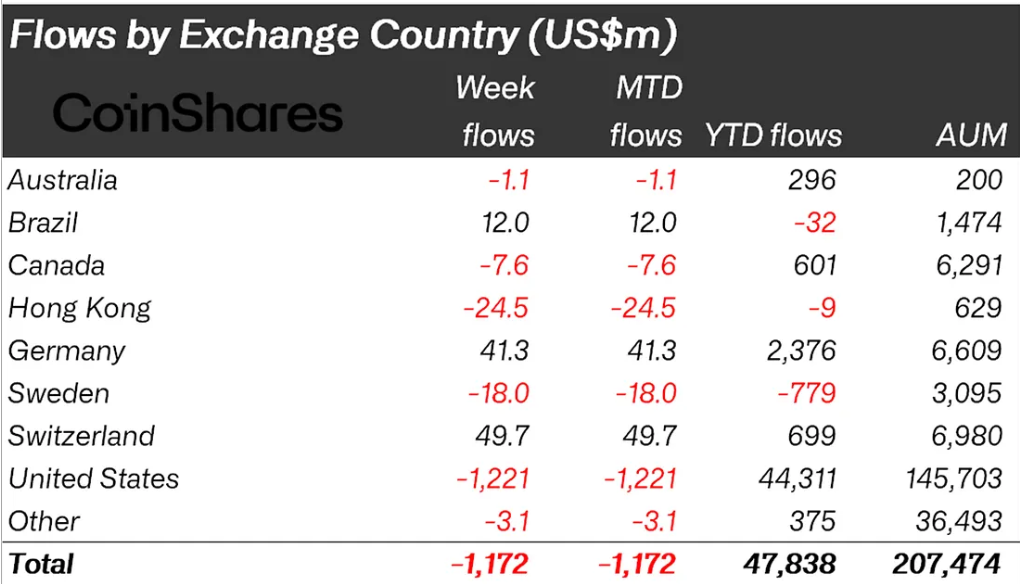
Оттоки криптовалют по странам
Оттоки криптовалют по странам. Источник: Отчет CoinShares

Подобное расхождение подчёркивает разницу в аппетитах к риску. Европейские рынки демонстрировали конструктивный настрой, невзирая на глобальную турбулентность.

Объем торгов ETP оставался высоким, достигнув $43 млрд за неделю. Активность возросла в середине недели. Так как появились надежды, что Конгресс предотвратит остановку работы правительства. Тем не менее, текущая политическая нестабильность восстановила пессимизм инвесторов. Это привело к росту объемов вывода средств в конце недели.

Биткоин и Ethereum под давлением

Продукты на основе биткоина понесли наибольшие потери: $932 млн было выведено. Стала очевидна чувствительность ведущей криптовалюты к изменениям политики США. Инвесторы скорректировали позиции в ответ на позицию Пауэлла.

Ethereum также продемонстрировал значительное снижение. Был зафиксирован $438 млн оттока. Несмотря на приток $57.6 млн неделей ранее, сохраняющаяся волатильность указывает на смешанные краткосрочные ожидания.
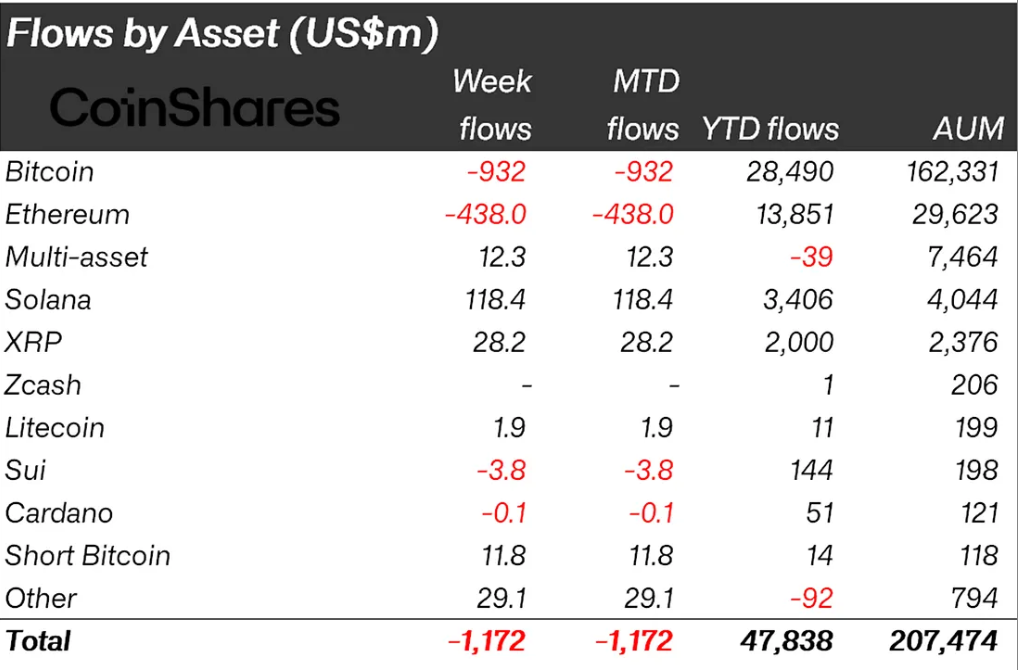
Отток криптовалют по активам.
Отток криптовалют по активам. Источник: отчет CoinShares

Короткие ETP на Bitcoin привлекли $11.8 млн нового капитала. Это самый высокий приток с мая 2025 года. Безусловно, этот рост отражает убеждённость инвесторов в том, что ралли Bitcoin может столкнуться с трудностями. Различия в потоках подчеркивают текущую рыночную неопределенность.

Solana и XRP: Институциональный спрос вопреки тренду

На фоне общего сильного оттока Solana выделилась притоком в размере $118 млн. Это довело девятинедельный итог до $2.1 млрд. За 2025 год продукты на основе Solana привлекли $3.3 млрд. Таким образом, это сигнализирует о росте институционального спроса.

Запуски американских ETF на Solana усилили этот импульс. Bitwise (BSOL) и Grayscale (GSOL) показали высокий спрос. Они зафиксировали четыре последовательных дня чистого притока на $200 млн.

Другие альткоины также сопротивлялись общему спаду. HBAR получил $26.8 млн, Hyperliquid — $4.2 млн. Кроме того, XRP наряду с Solana привлек притоки. Следовательно, это демонстрирует возможность избирательной силы альткоинов.

Разделение потоков капитала подчёркивает противоречивость тенденций на рынке. Неопределенность в политике США давит на Bitcoin и Ethereum. Тем не менее, Solana и ряд альткоинов демонстрируют: инвесторы концентрируются на фундаментальных показателях и новых продуктах.

Политический тупик в Вашингтоне и позиция ФРС по ставкам продолжают формировать отношение к риску. Если экономическая ситуация ухудшится, отток капитала может усилиться. И наоборот, разрешение политического кризиса или смягчение риторики могут возродить аппетит инвесторов.

The post Криптофонды потеряли $1.2 млрд. Почему инвесторы перешли в Solana и XRP appeared first on BeInCrypto.


Trending Cryptos

Related Reads

AMD acquires Taalas: hardware AI manages without scarce HBM memory

AMD has agreed to acquire Toronto-based startup Taalas, which tackles a key bottleneck in AI inference: the constant need to transfer model weights from memory to the processor for each generated token. Taalas's chips eliminate this operation by permanently embedding the model weights into the transistors themselves. This data transfer is what currently limits inference speed and has made high-bandwidth memory (HBM) a scarce commodity. Taalas's first test chip, fabricated on TSMC's 6nm process, reportedly generated tokens for Meta's Llama 3.1 8B model at speeds 48 times faster than comparable Nvidia GPUs. Its architecture features a mask ROM section for fixed weights and SRAM for adaptable components. However, this design comes with a significant trade-off: each chip is permanently dedicated to a single model. Switching models requires a partial redesign and fabrication, a process taking about two months. While the acquisition is seen as part of AMD's rivalry with Nvidia in inference, its broader implication lies in challenging the assumption of a permanent HBM memory shortage. The AI memory market is currently booming, with HBM supply sold out through 2026. Yet, Taalas's technology demonstrates that the memory bottleneck is an engineering challenge, not an absolute physical constraint. This aligns with industry-wide efforts from companies like Nvidia (through model compression) and memory makers like Samsung and SK hynix (developing new packaging and storage technologies) to reduce dependency on scarce HBM. AMD's move suggests that the current high prices for memory, driven by AI demand, may not be sustainable. It highlights a growing engineering push against the premise of perpetual memory scarcity, reminding investors that memory has historically been a cyclical business.

cryptonews.ru1h ago

AMD acquires Taalas: hardware AI manages without scarce HBM memory

cryptonews.ru1h ago

Vance says US-Iran conflict remains in 'midgame', US military 'seeks exit', Iran sets 'six conditions for reopening the strait'

U.S. Vice President Vance described the U.S.-Iran conflict as being in the "mid-game," stating the U.S. is utilizing diplomatic, economic, and military tools, with a focus on increasing oil and gas shipments through the Strait of Hormuz. Meanwhile, U.S. Chairman of the Joint Chiefs of Staff Gen. Dan Caine is reportedly seeking an "exit" privately, expressing concerns that airstrikes alone are insufficient to achieve objectives and that further escalation carries significant risks. He highlighted critical ammunition shortages for key missile defense systems. In response, Iran’s Supreme National Security Council Secretary, Zolgadr, presented six conditions for reopening the Strait of Hormuz: a U.S. pledge never to threaten Iran, an end to aggression against Iran and its allies, withdrawal of forces from the region, war reparations, lifting of all sanctions, and the unconditional unfreezing of Iranian assets. These demands, seen as a high bar set by hardliners, contrast with more pragmatic requests made in backchannel talks, which focus on lifting the blockade, restoring oil sanctions waivers, and accessing frozen funds. While Iran and Oman are close to a technical agreement on a temporary shipping lane, Iran clarified this does not equate to a full reopening of the strait, which remains contingent on U.S. meeting its conditions. Attacks on commercial vessels in the area continue, with recent incidents attributed to Iran. Despite pauses in military action and expressions of openness to talks from both sides, negotiations are currently stalled over Iran's economic demands and U.S. insistence on freedom of navigation.

marsbit1h ago

Vance says US-Iran conflict remains in 'midgame', US military 'seeks exit', Iran sets 'six conditions for reopening the strait'

marsbit1h ago

Trading

Spot

Hot Articles

What is XRP 2.0

XRP 2.0: A New Frontier in the Cryptocurrency Landscape Introduction to XRP 2.0 In the ever-evolving realm of cryptocurrency, new projects continuously emerge, vying for attention and adoption. One such promising initiative is XRP 2.0, a novel cryptocurrency project designed to leverage advanced blockchain technology and robust encryption methodologies. While the name draws parallels with Ripple’s XRP, it’s crucial to note that XRP 2.0 operates independently, focusing on enhancing transaction security, privacy, and scalability. As the digital financial landscape increasingly embraces decentralized solutions, XRP 2.0 aims to contribute meaningfully to web3 and the overall expansion of crypto projects. What is XRP 2.0? At its core, XRP 2.0 is a cryptocurrency project that aims to create a secure and decentralized digital currency ecosystem. Its foundational technology integrates sophisticated blockchain principles with cutting-edge encryption techniques. The overarching goal of XRP 2.0 is to establish itself as a reliable and efficient platform enabling swift transaction execution while prioritizing enhanced privacy protections for its users. The project is promoted as a solution to many limitations faced by existing cryptocurrencies, proposing a system that can handle a higher volume of transactions with improved speed and privacy. This versatility positions XRP 2.0 as a significant contender in a marketplace riddled with various digital currencies. Who is the Creator of XRP 2.0? The identity of the creator behind XRP 2.0 has been flagged as ‘Wilbur.’ However, comprehensive details regarding Wilbur or their associated entity remain elusive. The anonymity of many cryptocurrency creators is not an uncommon phenomenon in the industry, often designed to maintain a degree of privacy and security. Who are the Investors of XRP 2.0? As of now, specific information related to the investment foundations or organizations supporting XRP 2.0 is not publicly available. In the cryptocurrency sector, the backing by reputed investors can significantly influence a project's credibility and success, yet the transparency regarding the financial supporters of XRP 2.0 has not been established. How Does XRP 2.0 Work? XRP 2.0 stands out by employing a combination of blockchain technology and advanced encryption algorithms that ensures secure and decentralized transactions. Its innovative structure includes unique features designed to foster user engagement and broaden functionalities beyond conventional cryptocurrency transactions. Among these features, XRP 2.0 incorporates AI-powered capabilities, such as text-to-image and text-to-speech functionalities. These additions are designed to enhance the interactive experience for users, promoting broader applicability across various sectors. By bridging technological advancements with user-centered design, XRP 2.0 aims to capture the attention of a diverse range of individuals and enterprises looking to integrate cryptocurrency solutions into their operational frameworks. Timeline of XRP 2.0 Understanding XRP 2.0 requires examining the milestones that have defined its journey thus far: July 23, 2023: XRP 2.0 is introduced as a novel cryptocurrency project, aiming to revolutionize secure and decentralized transaction capabilities in the blockchain domain. September 8, 2023: The launching of another project, XRP20, occurs, marking the emergence of an ERC-20 token on the Ethereum blockchain that remains unrelated to XRP 2.0. November 13, 2023: The XRP Ledger undergoes a significant update with the release of rippled server software version 2.0.0. It is essential to note that this development is disconnected from the XRP 2.0 cryptocurrency project. Key Points About XRP 2.0 To distill the essence of XRP 2.0, several critical factors emerge: Unique Features: The inclusion of features like AI-powered text-to-image and text-to-speech further diversifies the potential applications of XRP 2.0. Blockchain Technology: The framework utilizes advanced blockchain mechanisms and encryption protocols, ensuring a secure and decentralized environment for transactions. Scalability and Privacy: XRP 2.0 prioritizes enhanced privacy protections in transaction processes and the scalability necessary to accommodate a growing user base. No Affiliation with Ripple: Importantly, despite its name, XRP 2.0 does not have any allegiance or collaboration with Ripple’s XRP, distinguishing its operational framework and objectives within the cryptocurrency ecosystem. Conclusion XRP 2.0 represents an ambitious venture into the cryptocurrency sphere, aiming to offer a combination of security, privacy, and efficiency in digital transactions. By integrating sophisticated technologies and user-friendly features, the project sets out to broaden the horizons of what cryptocurrency can achieve in today's digital economy. While the anonymity of its creator and lack of disclosed investors might raise questions for some, XRP 2.0's focus on advanced functionalities and decentralisation enhances its appeal amidst an increasingly crowded crypto market. As the cryptocurrency landscape continues to evolve, XRP 2.0 may yet emerge as a pivotal player in the expansion of secure and scalable blockchain solutions.

1.4k Total ViewsPublished 2024.04.01Updated 2024.12.03

What is XRP 2.0

Discussions

Welcome to the HTX Community. Here, you can stay informed about the latest platform developments and gain access to professional market insights. Users' opinions on the price of XRP (XRP) are presented below.

活动图片